
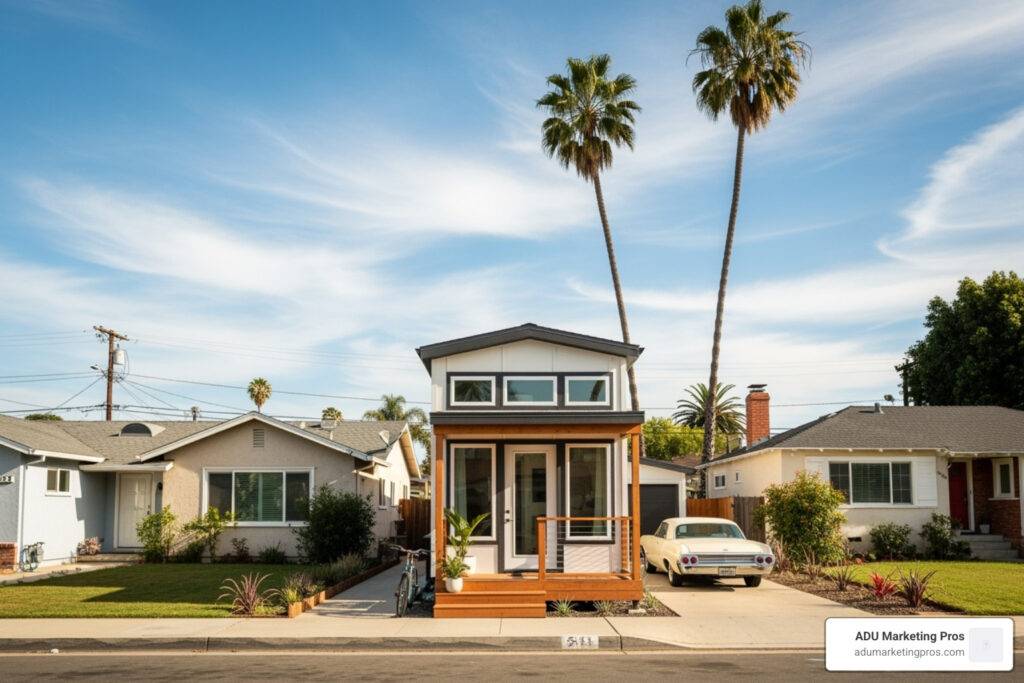
Why Los Angeles Tiny Homes Are at the Center of California’s Housing Crisis
Los Angeles tiny homes serve two very different roles in one of America’s most expensive housing markets: they’re both an aspirational lifestyle choice for those seeking affordable, minimalist living and an emergency response to a homelessness crisis affecting over 66,000 people daily.
Quick Overview of Los Angeles Tiny Homes:
- For Purchase: Range from $7,000 shells to $108,000 modular units (88-300 sq. ft.)
- To Build: Average cost around $72,000 for custom builds; permits take 7 months
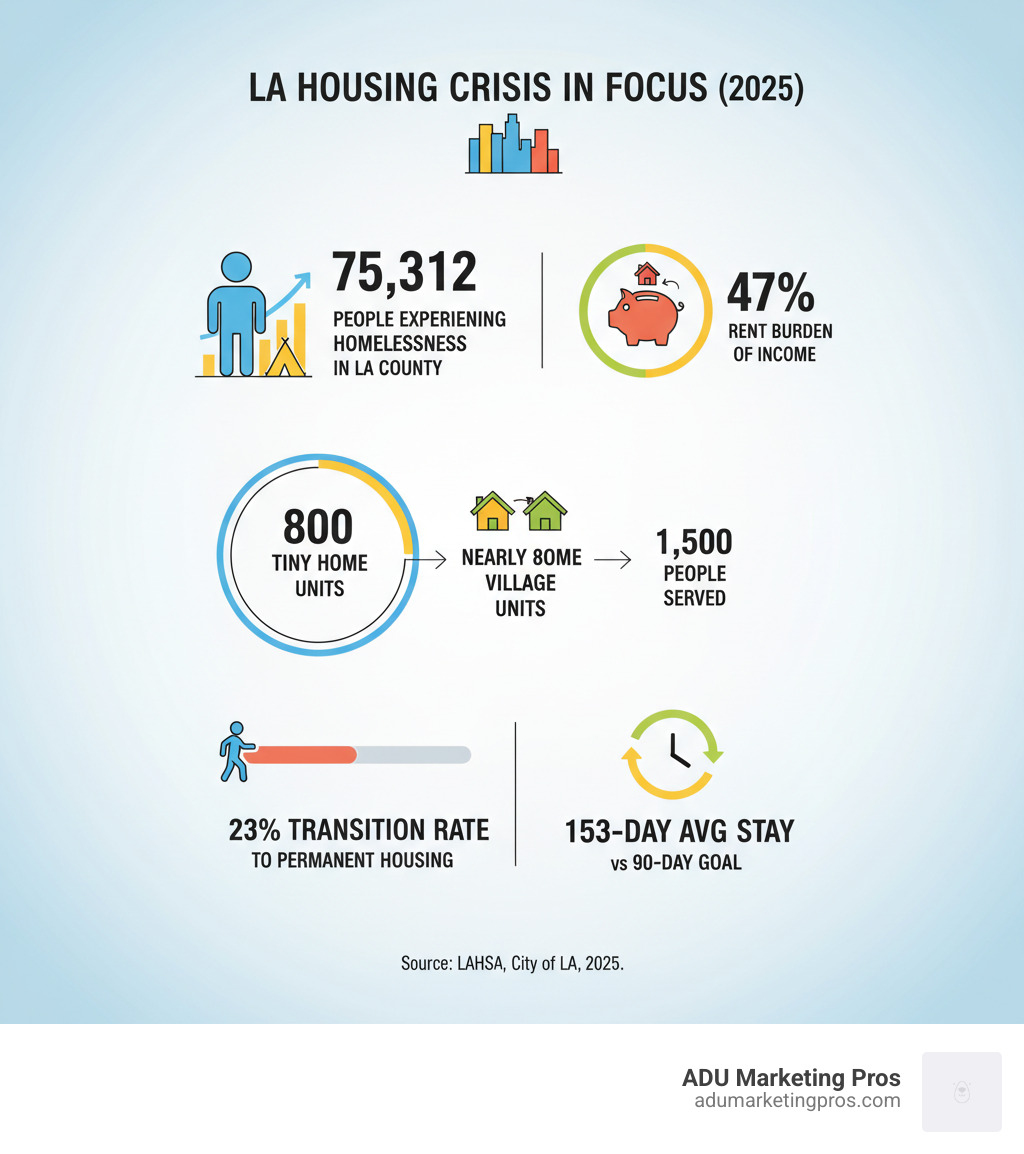
- As Crisis Housing: Nearly 800 units in 12 villages provide interim shelter for 1,500 people
- Success Rate: Only 23% of village residents transition to permanent housing
- Key Challenge: 53% of residents return to homelessness after leaving villages
The reality is stark. Angelenos spend 47% of their income on rent—the highest percentage in the nation. Meanwhile, roughly 66,500 people experience homelessness here each day. While 207 people exit homelessness daily, 227 become newly homeless, creating an overwhelming tide that traditional solutions haven’t stemmed.
In response, the city has turned to tiny homes in two distinct ways. For homeowners and investors, they’re exploring Accessory Dwelling Units (ADUs) on private property as rental income or multigenerational housing. For the unhoused population, the city and nonprofits have rapidly constructed villages of 64-square-foot units designed as interim shelter with wrap-around services.
This guide explores both paths—the personal journey of buying or building a tiny home in LA, and the controversial public policy experiment of tiny home villages for people experiencing homelessness. Whether you’re an ADU builder serving the private market or evaluating the effectiveness of publicly funded shelters, understanding this dual landscape is essential.
The Personal Path: Buying or Building a Tiny Home in LA
For many Angelenos, Los Angeles tiny homes aren’t about surviving a crisis—they’re about making a choice. Maybe you’re drawn to minimalist living, eager to shrink your carbon footprint, or simply searching for a way to afford life in one of America’s priciest cities without sacrificing your dreams. Whatever brings you here, the path to tiny home ownership in LA offers real possibilities, from mobile dwellings that let you chase the sunset to compact backyard retreats that turn unused space into income or family housing.
Types of Los Angeles Tiny Homes for Sale
The Los Angeles tiny homes market is more diverse than most people expect. You’ll find everything from turnkey mobile units to bare-bones shells waiting for your personal touch.
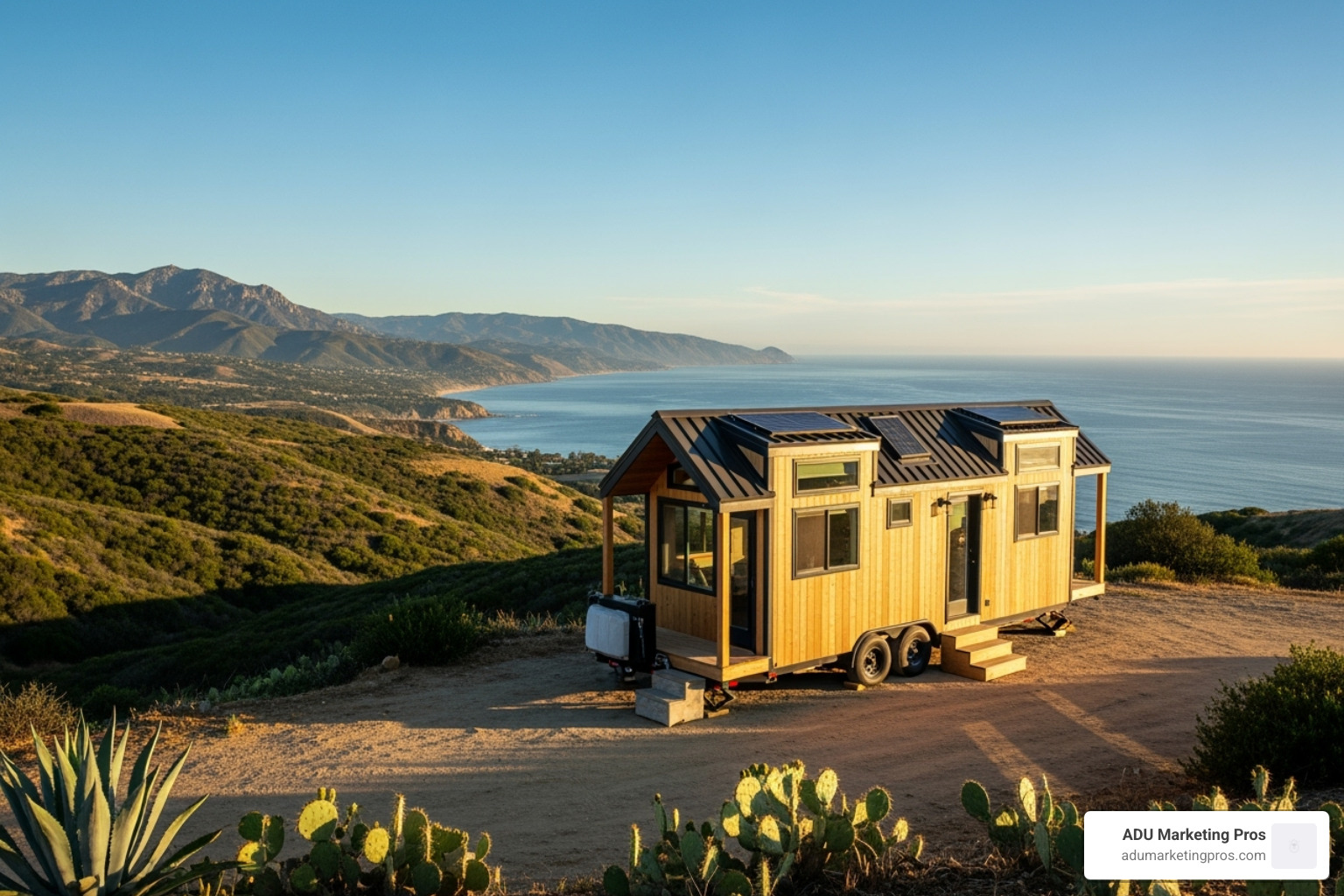
Tiny Houses on Wheels (THOWs) are probably what you picture when someone says “tiny home.” Built on trailers, these mobile units give you flexibility to relocate and can be parked on private land with proper permits or in designated communities. The Catalina 150, a 150 sq. ft. model, typically runs around $44,500 and represents a sweet spot between affordability and livability.
Modular micro houses offer a more permanent feel. These prefabricated units arrive ready to install on a foundation, making them feel less like camping and more like actual housing. The Metro 300, spanning 300 sq. ft. with one bedroom and bath, was recently listed at $108,000—a significant investment, but still a fraction of traditional LA home prices.
For the truly adventurous, box truck conversions and Sprinter van homes blend mobility with unique character. A 20-foot box truck conversion offering 224 sq. ft. recently sold for $90,000, while a compact 100 sq. ft. Sprinter tiny house listed at $64,999. These aren’t for everyone, but they offer ultimate freedom and a conversation-starting aesthetic.
At the budget-friendly end, gable roof tiny houses and insulated buildings can serve as shells you finish yourself or simple completed structures. A 160 sq. ft. Duramax unit with one bed and bath started at just $6,999, proving that entry into tiny living doesn’t always require a massive financial leap.
The price spectrum stretches from under $7,000 for basic shells to over $100,000 for fully equipped modular units. Sizes typically range from a cozy 88 sq. ft. up to a more spacious 300 sq. ft. If you’re a homeowner considering adding a tiny home to your property as an Accessory Dwelling Unit, you’ll want experienced professionals who understand LA’s unique regulations. Check out more info about ADU builders in Los Angeles to explore your options.
The Cost of Building Your Own Tiny House
Building a custom tiny home in Los Angeles sounds romantic until you start adding up the numbers. One builder’s story perfectly captures the reality: what started as a $40,000 estimate ballooned to $72,000 by the time they turned the key. That’s not a cautionary tale about poor planning—it’s just the honest truth about construction in Los Angeles.
Materials form the foundation of your budget, literally and figuratively. Quality lumber, insulation, windows, and fixtures add up faster than you’d think, especially in a market where everything costs more. You can save money with creative sourcing and reclaimed materials, but compromising on structural elements or weatherproofing in Southern California’s climate rarely pays off.
Labor costs are where many budgets meet reality. Plumbing, electrical work, and structural framing require licensed professionals in LA, and their expertise doesn’t come cheap. The builder who spent $72,000 chose to complete the final 20% themselves—not just to save money, but to truly understand their home from the inside out. That DIY approach saved thousands but added months to the timeline.
The permitting process deserves its own line item in your budget and calendar. Count on roughly seven months to steer LA’s approval maze. This isn’t bureaucratic inefficiency—it’s the city ensuring your tiny home meets safety standards and zoning requirements. Rushing this process or trying to skip it entirely can lead to expensive do-overs or even forced removal.
After permits are approved, expect about six months for construction. That’s the timeline for the $72,000 build mentioned earlier, and it’s actually pretty reasonable for custom work in Los Angeles. Weather delays, material shortages, and inspector schedules can all push that timeline further.
If you’re considering building a tiny home as an ADU on your property, understanding local regulations isn’t optional—it’s essential. Your Guide to Los Angeles ADU Regulations walks you through what you need to know before breaking ground. And if you’re still in the dreaming phase, browsing ADU floor plans for Los Angeles can help you visualize what’s possible in 300 square feet or less.
A City’s Response: Los Angeles Tiny Homes Villages for the Unhoused
While individual tiny homes represent personal choices for some Angelenos, the city itself has acceptd the concept on an entirely different scale. With nearly 66,500 people experiencing homelessness each day and a net increase of 20 newly unhoused individuals daily, Los Angeles has turned to tiny home villages as a rapid response to an overwhelming crisis.
The Rise of Tiny Home Villages
The city’s approach is built on a “housing-first” philosophy—the idea that stable shelter isn’t just helpful, it’s fundamental to addressing every other challenge someone experiencing homelessness faces. When voters approved Proposition HHH in 2016, authorizing $1.2 billion in bonds to create 10,000 units of affordable housing, there was real hope for change. But traditional construction moved slowly, and people needed help now.
In April 2018, Mayor Eric Garcetti and the City Council declared an emergency shelter crisis. This wasn’t just symbolic—it cut through red tape and allowed for faster construction of what they called “bridge housing.” Suddenly, the City of Los Angeles, the Los Angeles Homeless Services Authority (LAHSA), and nonprofits like Hope the Mission could move quickly to build villages of tiny homes across the city.
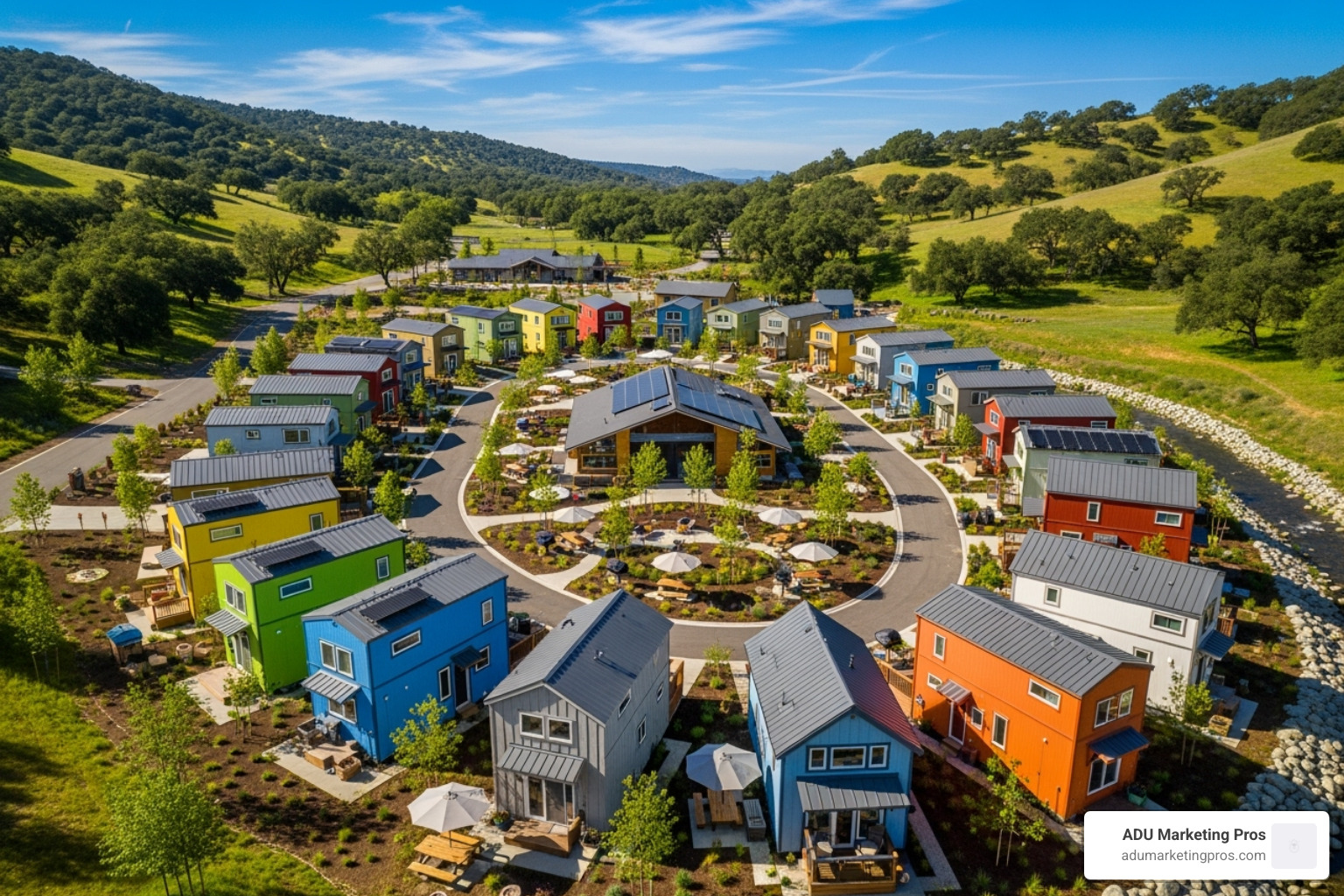
The results came fast. Chandler Blvd. Village opened in February 2021 with 39 homes serving 85 people. Three months later, Alexandria Park launched with 103 homes and 200 beds. By November 2021, the Arroyo Seco Tiny Home Village opened its doors as the largest facility of its kind in California—and the entire United States—with 117 units housing 224 residents. Reseda followed in June 2021 with 52 homes and 101 beds, while Tarzana opened that July with 78 homes serving 148 people.
These villages fit into a broader statewide effort. Governor Newsom’s plan included $80 million specifically for tiny homes, aiming to create 1,200 beds across California, with 500 of those right here in Los Angeles. The message was clear: the streets cannot be a waiting room while permanent housing gets built. For more context on California’s plan for tiny homes, the state’s approach reflects an urgent need for immediate solutions.
Services, Amenities, and Daily Life
Life inside a Los Angeles tiny homes village looks dramatically different from life on the streets. The units themselves are compact—just 64 square feet—but they offer something precious: dignity and privacy. Each home comes with heat and air conditioning, windows that let in natural light, a small desk for personal use, and most importantly, a locking front door. There’s space for two beds and a small shelving unit for belongings.
Because the units are intentionally small, communal facilities become the heart of daily life. Villages provide shared restrooms and showers, maintaining a minimum ratio of one toilet, one sink, and one shower for every fifteen residents. There are laundry facilities so people can wash their clothes in private, and even dog runs because many residents have pets they refuse to leave behind.
But the real power of these villages lies in what’s called wrap-around services. This is where housing-first becomes more than just a roof. On-site case managers work with each resident to create personalized plans for finding permanent housing. Mental health support helps people address trauma and challenges that may have contributed to their homelessness. Job training and placement programs open doors to employment and financial stability. Three nutritious meals are served daily, with accommodations for dietary restrictions and preferences.
There’s even attention paid to community and beauty. At Arroyo Seco, Los Angeles-based muralists transformed the exteriors of tiny homes into works of art, creating a cheerful atmosphere that helps combat the isolation and depression so common among people experiencing homelessness. It’s about building connectedness—recognizing that recovery happens in community, not just in square footage.
Innovative Approaches and Technologies
The construction and operation of these villages has pushed innovation in affordable housing. Prefabricated units from companies like Pallet Shelter allow for rapid deployment—villages can go from empty lot to fully operational in a fraction of the time traditional buildings require. These modular units are designed to withstand the elements while remaining easy to assemble and relocate if needed.
Some organizations are pushing even further into sustainability. Our Backyard Homes is developing tiny homes that are completely off-grid, generating their own power from solar panels and even extracting water from the air itself. While their current focus is housing-insecure college students, the technology shows what’s possible. Their “Porta-Home” project—a modified porta-potty turned tiny dwelling—serves as both a functional prototype and an awareness campaign about creative solutions to the housing crisis.
The factory-built construction approach reduces waste, saves time, and cuts costs dramatically. This efficiency mirrors what’s happening in the private sector with Accessory Dwelling Units. Homeowners exploring similar compact living solutions might consider options like Garage Conversion in Los Angeles, where existing structures can be transformed into livable spaces through smart design and efficient construction methods.
The Reality Check: Challenges and Successes of the Village Model
While Los Angeles tiny homes villages offer a crucial first step off the streets, we need to be honest about what’s actually happening inside these communities. The promise of rapid shelter is real, but the path from a 64-square-foot unit to permanent housing is proving far more difficult than anyone hoped.
Measuring Success: Transition to Permanent Housing
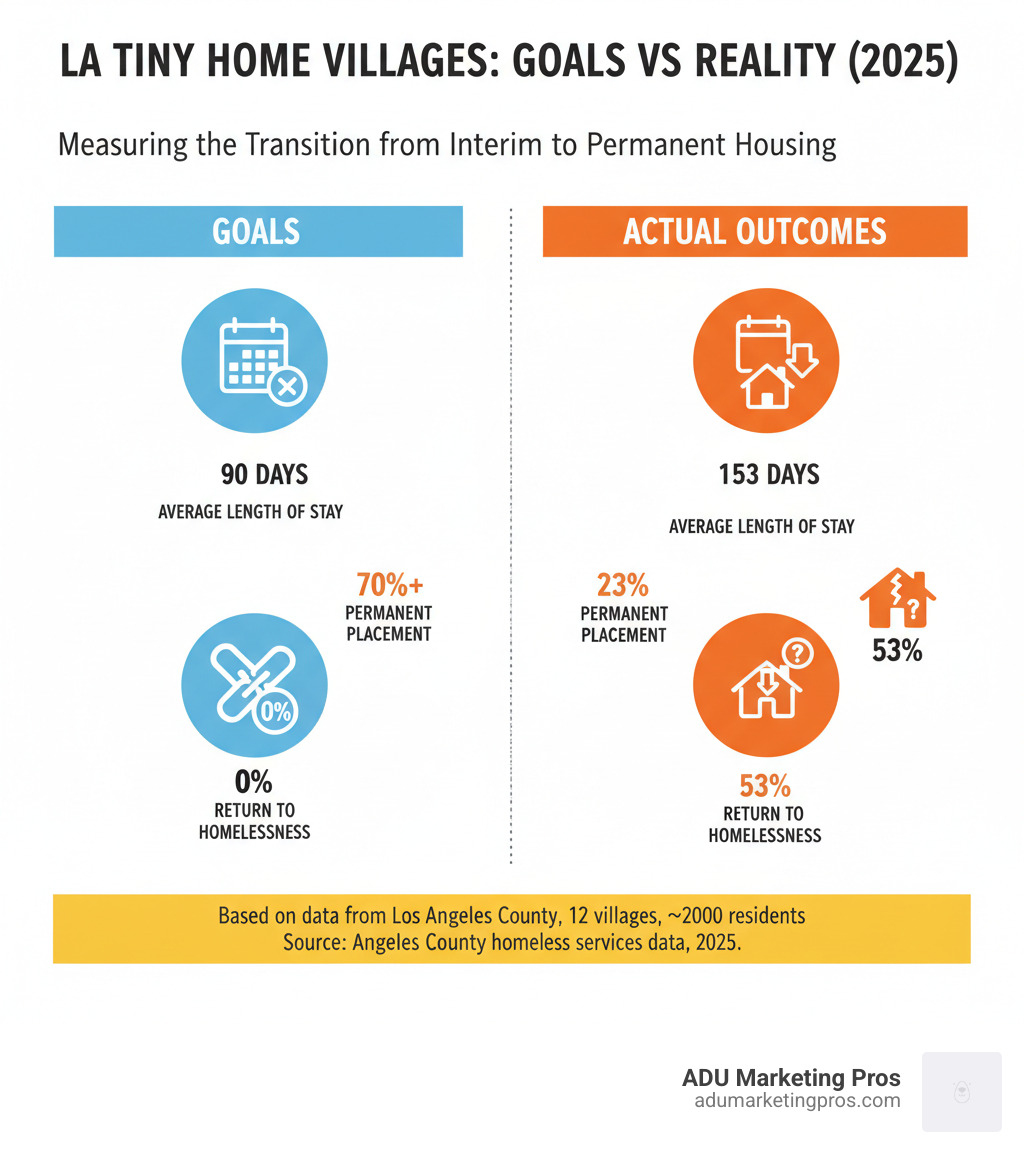
When you look at the numbers, the story becomes sobering. These villages were designed as temporary bridges—90 days of support before moving residents into permanent homes. But the reality looks very different.
Out of nearly 2,000 people who’ve lived in these villages, only 23% made it to permanent housing. That’s 462 individuals who successfully transitioned out. Meanwhile, more than half—a staggering 53%—ended up homeless again after leaving. We’re talking about 1,047 people who cycled back to the streets. Another 87 people ended up in jail, prison, or juvenile detention.
The timeline tells another part of the story. That 90-day goal? The actual average stay across 12 villages was 153 days—more than five months. Some villages saw residents staying for 208 to 235 days on average. This isn’t necessarily because people don’t want to leave. Often, it’s because there’s simply nowhere for them to go.
These numbers force us to ask hard questions. Are we providing genuine pathways to stability, or are we creating well-intentioned holding patterns?
Common Complaints from Los Angeles Tiny Homes Residents
Beyond the statistics, residents have shared experiences that reveal significant gaps between the vision and the reality. We’ve listened to their stories, and they paint a troubling picture.
The physical conditions inside some villages have been described as barely livable. During storms, water leaked into units, sometimes reaching residents’ knees and destroying their few possessions. Heaters broke down regularly, leaving people wearing jackets to bed in the middle of winter. One resident described their heater constantly turning off, making sleep nearly impossible. The insufficient number of restrooms meant long waits, adding indignity to an already difficult situation.
Management issues emerged as a recurring theme. Residents reported staff who didn’t respond to maintenance requests or complaints about harassment and theft. The revolving door of case managers made it impossible to build trust—one resident had four different case managers in just 1.5 years. How can anyone make progress toward stable housing when the person guiding them changes every few months?
Some residents received expired food that made them sick. Others reported harassment from neighbors dealing with mental health crises, with seemingly little intervention from staff. Despite 24/7 security, theft remained common—sometimes allegedly involving staff members themselves. Drugs, alcohol, and weapons found their way inside facilities that were supposed to be safe havens.
The tragedy is measured not just in frustration but in lives lost. Thirty-three residents died in 10 tiny home villages over a 13-month period ending March 1, 2024. Each death represents a person the system failed to reach in time.
The strict visitor policies, while intended to maintain safety, often left residents feeling isolated and lonely—the opposite of the community connection that helps people heal and rebuild.
The Long-Term Sustainability Debate
The financial reality of these villages raises important questions about whether we’re spending our limited resources wisely. Nonprofits spent $38 million in the 2022-23 fiscal year just to operate these villages using public funds. Hope the Mission, one of the major operators, saw its net assets and revenue explode from $2.8 million in 2020 to $78.7 million in 2023, with contracts totaling $32.5 million over two years.
We’re not suggesting these organizations are acting in bad faith. Running these villages is expensive and complex work. But when only 23% of residents transition to permanent housing, we have to ask: is this the best use of taxpayer dollars?
Housing experts point to alternative approaches that might deliver better results. Creating more public, low-income, and market-rate housing addresses the root problem—not enough places for people to live. Expanding housing vouchers and subsidy programs gives people choices and dignity. Emergency grants to prevent evictions stop people from becoming homeless in the first place. Streamlining zoning for ADUs, duplexes, and triplexes increases housing supply without massive public investment.
The recent Supreme Court ruling on public camping has made this conversation even more urgent. Cities now have the legal authority to arrest people for camping outdoors, which puts enormous pressure on Los Angeles to provide alternatives—even imperfect ones. Tiny homes villages become not just a policy choice but a legal necessity.
The answer isn’t choosing between temporary shelters and permanent housing—it’s doing both better. The immediate crisis demands rapid response, but that response must genuinely lead somewhere. For businesses working in housing development, understanding these policy dynamics is essential. The market for solutions is growing, but so is scrutiny of what actually works. For firms to effectively position themselves as part of the solution, developing strong ADU marketing digital strategies is key to reaching clients who want to make a real difference in California’s housing crisis.
Frequently Asked Questions about Los Angeles Tiny Homes
We hear a lot of questions about Los Angeles tiny homes—and they’re all over the map. Some people want to know about building their dream backyard retreat, while others are curious about the villages that have become part of the city’s homelessness strategy. Let’s tackle the most common questions we encounter.
What is the average cost to build a tiny house in Los Angeles?
Here’s the honest truth: costs vary wildly based on size, materials, and whether you hire professionals or roll up your sleeves and do it yourself. We’ve seen a real-world example where someone started with a $40,000 estimate and ended up spending $72,000. That’s nearly double the initial budget, and it’s not uncommon.
Several factors drive these costs up. Materials can range from basic to high-end, and that choice alone can swing your budget by thousands. Labor is another big one—hiring skilled contractors for plumbing, electrical work, and structural elements adds significant expense, though many builders choose to tackle some of the work themselves to save money. The permitting process in Los Angeles is particularly lengthy, often taking around 7 months, and can add unexpected costs if you hit any snags. Once you get the green light, the actual construction typically takes about 6 months.
If you’re building a tiny home as a legal ADU, you’ll need to factor in additional costs for permits, foundation work, and utility hookups. These aren’t optional extras—they’re required to make your tiny home a legal, permanent structure on your property. For a deeper dive into what’s involved, check out Your Guide to Los Angeles ADU Regulations and explore various ADU Floor Plans for Los Angeles to visualize your options.
Are tiny home villages a successful solution for homelessness in LA?
This is where things get complicated, and the answer is honestly “it depends on how you measure success.” On the immediate, human level, Los Angeles tiny home villages are absolutely a success. They provide private, lockable shelter with heat, air conditioning, and dignity—a massive improvement over sleeping on the streets. Residents get three meals a day, access to showers and laundry, and comprehensive support services including case management, mental health counseling, and job training. For someone who’s been living in a tent, this is life-changing.
But when we look at the long-term data, the picture becomes murkier. Only about 23% of residents successfully transition to permanent housing. More troubling, 53% return to homelessness after leaving the villages. The average stay is 153 days, far exceeding the 90-day goal that planners envisioned. These numbers suggest that while tiny home villages excel at getting people off the streets quickly, they struggle as a pathway to permanent stability.
So are they successful? Yes, as an immediate crisis response and a significant step up from street encampments. But as a definitive solution to homelessness? The jury’s still out, and the data suggests we need to pair them with more robust long-term housing strategies.
What are the rules for living in a tiny home village?
Living in a Los Angeles tiny home village isn’t quite like living in your own apartment, but it’s not a traditional shelter either. The rules strike a balance between providing freedom and maintaining a safe, supportive environment for everyone.
Residents are expected to work actively with case managers to develop a personalized plan for moving into permanent housing. This isn’t just paperwork—it’s the core purpose of these villages. Most villages have curfews, though they’re generally reasonable and designed to maintain security. Guest policies tend to be restrictive, which some residents find isolating but which operators say is necessary for safety. There’s a strict prohibition on drugs, alcohol, and weapons on-site, which makes sense but can be challenging to enforce.
In exchange for following these rules, residents receive their own 64-square-foot private unit with a locking door, heat, and air conditioning. They get three nutritional meals daily, access to communal bathrooms, showers, and laundry facilities, and comprehensive support services ranging from mental health counseling to job training. For many residents, the tradeoff is worth it—the structure and support help them work toward stability, even if some of the rules feel restrictive. It’s not perfect, but for people who’ve been living without shelter, it’s a chance to rebuild their lives with dignity and support.
Conclusion
The story of Los Angeles tiny homes reveals a city struggling with two very different housing realities. On one side, you have homeowners and developers embracing ADUs as a smart solution—whether for rental income, multigenerational living, or simply making better use of existing property. On the other, you have a city desperately trying to shelter tens of thousands of people with nowhere else to go.
For those pursuing the personal path, tiny homes and ADUs represent possibility. They’re a chance to create affordable housing in one of America’s most expensive markets, to live more sustainably, or to generate income from underused space. The regulations are getting clearer, the builders more experienced, and the market more receptive.
For the city’s unhoused population, tiny home villages offer something more immediate and urgent: a door that locks, a bed that’s yours, and a shot at stability. Are they perfect? Far from it. The data on permanent housing placements tells a sobering story, and resident complaints reveal real gaps between the promise and the reality. But for someone coming in from a street encampment, these 64-square-foot units represent dignity, safety, and access to services that simply didn’t exist before.
The truth is, Los Angeles needs both approaches—and probably a dozen others—to make a meaningful dent in its housing crisis. Tiny homes alone won’t solve homelessness, just as ADUs alone won’t create enough affordable housing. But they’re part of the solution, imperfect tools in a toolkit that needs to keep growing.
For builders, architects, and developers working in this space, the opportunity is clear. Whether you’re constructing private ADUs or partnering on public projects, you’re helping address one of California’s most pressing challenges. Getting your message to the right clients, however, requires expertise in a rapidly evolving market. Strategic marketing is essential for professionals, from ADU builders in the Bay Area to those throughout California, to connect with homeowners and contribute to solving the housing shortage through targeted and effective outreach.
The housing crisis won’t be solved overnight. But every ADU built, every tiny home village opened, and every person housed is a step in the right direction. Los Angeles tiny homes, in all their forms, are part of that journey forward.