Why Affordable ADU Plans Are Your Key to Backyard Success
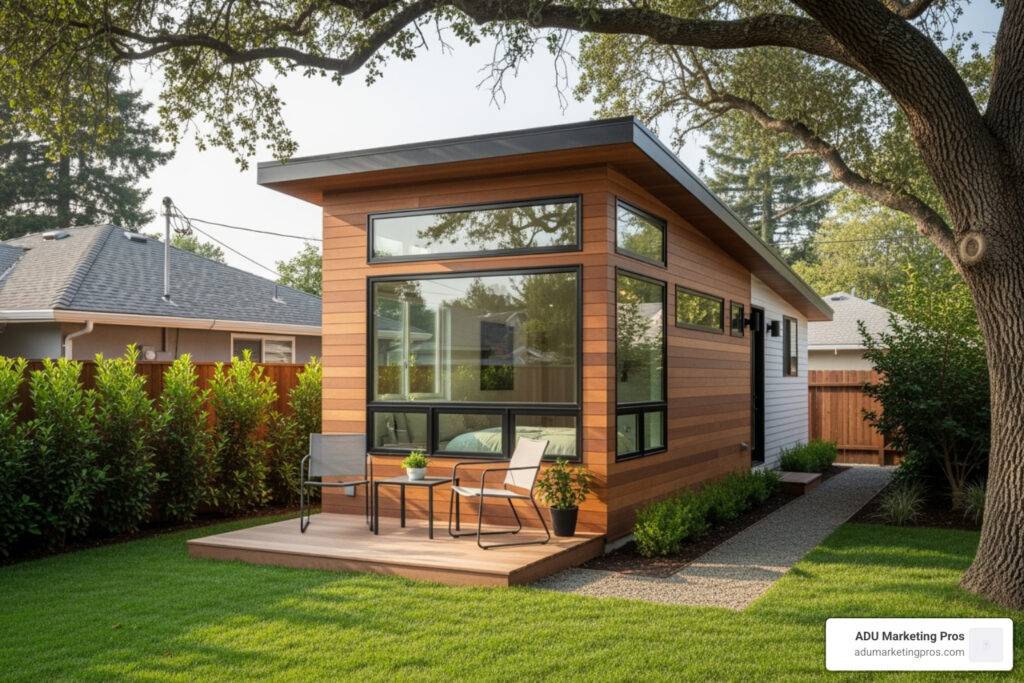
In an era defined by a nationwide housing crisis and evolving family needs, affordable ADU plans are fundamentally changing how homeowners unlock the hidden potential of their properties. An Accessory Dwelling Unit (ADU) is more than just a small backyard house; it’s a powerful tool for financial growth and personal flexibility. By opting for pre-designed plans, homeowners can save tens of thousands of dollars—often 10% or more of the total project budget—compared to commissioning a custom architectural design. These intelligently standardized designs, typically ranging from 400 to 1,200 square feet, are packed with desirable features like one to two bedrooms, highly efficient kitchens, and smart, open-concept layouts that make every inch of space feel purposeful and expansive.
Quick Guide to Affordable ADU Plan Options:
- Free Plans: Offered by some city pre-approved programs and available as basic online downloads, these plans cost $0 but often require local engineering and adjustments.
- Pre-designed Plans: Found on architectural marketplaces, these comprehensive plan sets range from $788 to $1,499 and offer a wide variety of styles and sizes.
- Modular/Prefab: Turn-key factory-built solutions that offer cost and timeline certainty, with all-in packages starting around $180,000 for a complete unit.
- Typical Savings: Homeowners can expect to save $20,000 to $40,000 on architectural fees alone when choosing a pre-designed plan over a custom one.
- Time Savings: The design and revision process for custom plans can take many months. Selecting a pre-designed plan can cut this phase down to just a few weeks, accelerating the entire project timeline.
ADUs, also known as “granny flats” or “in-law suites,” have surged in popularity as a pragmatic solution to the housing crunch. For homeowners, they represent a clear path to generating substantial rental income, achieving a significant increase in property value, and gaining flexible living space for family members. The beauty of pre-designed ADU plans lies in their simplicity and economy; they are engineered for straightforward construction, feature compact footprints that fit most residential lots, and can save critical months in the often-lengthy design and permitting phase.
Whether your goal is to provide a comfortable home for aging parents, create a secluded home office, or build a source of passive income that can transform your financial future, the right affordable plan is the essential first step that makes your ADU dreams achievable without breaking the bank.
What Defines an “Affordable” ADU Plan?
When you begin dreaming of a backyard cottage, the word “affordable” should mean much more than just a low price tag on a set of blueprints. True affordable ADU plans embody a smart, holistic philosophy aimed at keeping costs reasonable across the entire project lifecycle—from design and permitting to construction and long-term maintenance. An affordable plan is strategically designed to use common, readily available materials and straightforward construction methods. This approach minimizes the need for specialized labor or complex techniques that can quickly inflate budgets. The result is a beautiful, highly functional, and durable ADU that won’t drain your savings or lead to costly surprises down the road.
The Financial Advantage of Pre-Designed Plans
Choosing a pre-designed plan over a custom architectural project is one of the most impactful financial decisions you can make. This single choice can save you a significant sum—often representing 10% of your total project budget. To put that in perspective, a fully custom architectural design for an ADU typically runs between $20,000 and $40,000, and sometimes even more for complex designs. In stark contrast, high-quality, builder-ready affordable ADU plans from online marketplaces usually cost between $0 to $1,500. This immediate savings of tens of thousands of dollars can be reallocated to high-value areas of your project, such as premium appliances, upgraded insulation for better energy efficiency, or higher-end finishes.
The time savings are equally impressive and translate directly into financial benefits. A custom design process can stretch for months, involving numerous meetings, drafts, and revisions. By selecting a pre-designed plan, you can compress this timeline into a matter of days or weeks. This accelerated start often leads to quicker permitting, especially in cities that offer pre-approved plan programs. Getting your project off the ground faster means you can start construction sooner, finish earlier, and begin generating rental income or enjoying your new space months ahead of schedule.
Key Characteristics of Cost-Effective Designs
What truly makes an ADU plan affordable to build? It comes down to a series of smart design choices that prioritize efficiency, simplicity, and functionality without sacrificing style or comfort.
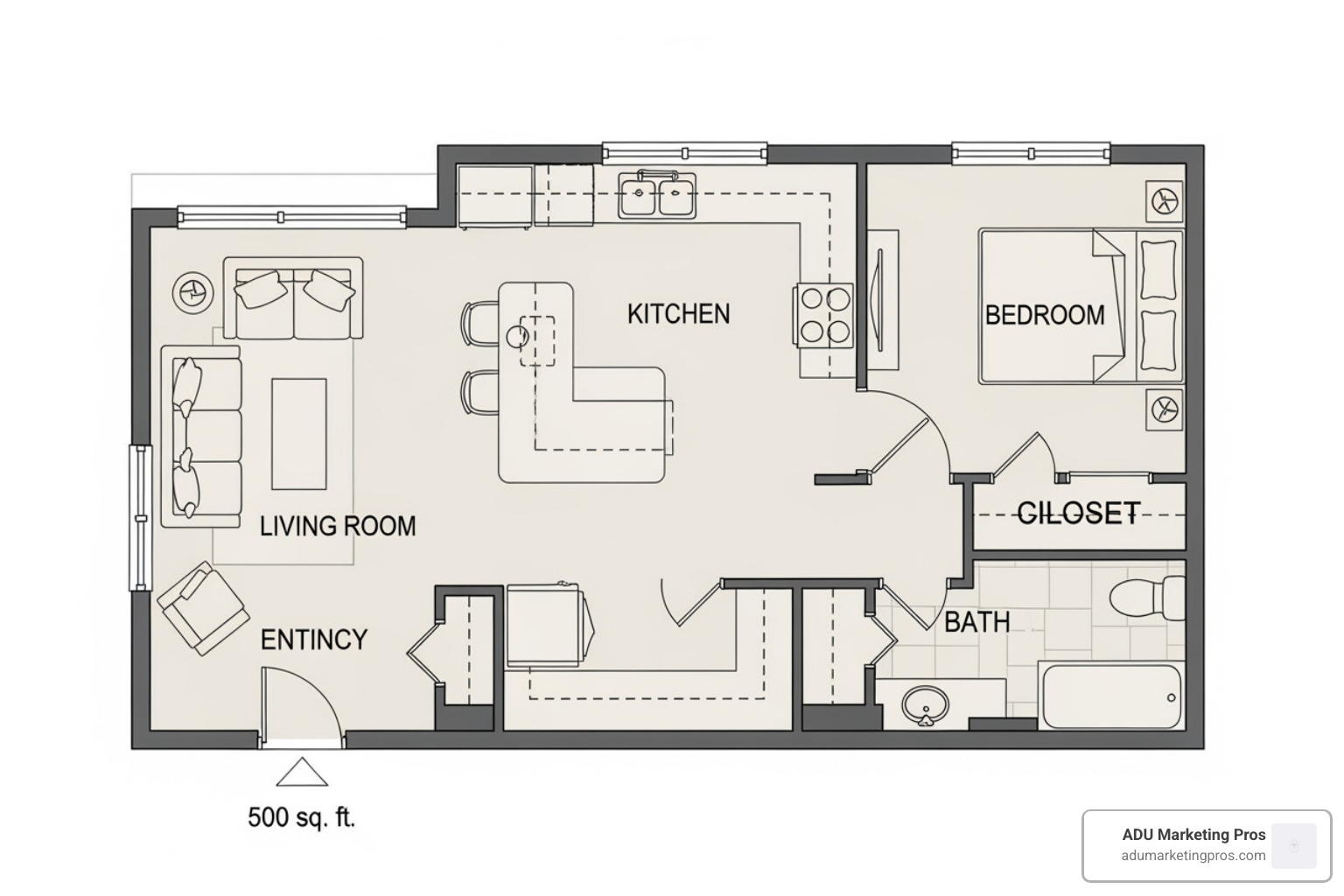
- Efficient Space Utilization: The best affordable plans are masters of spatial economy, squeezing maximum function from every square foot. Open-concept floor plans are a hallmark, seamlessly combining living, dining, and kitchen areas to create a spacious, airy feel even in compact units under 600 square feet.
- Simple Rooflines and Massing: Complex rooflines with multiple gables, dormers, and valleys look impressive but add significant costs in framing, labor, and materials. They also create more potential points for future leaks. Affordable plans stick with clean, straightforward roof designs like simple gables or shed roofs that are easier, faster, and cheaper to build and maintain.
- Standard Window and Door Sizes: Custom-sized windows and doors are a major budget-killer. Affordable plans are designed around standard, off-the-shelf sizes that are readily available from any supplier. This not only keeps material costs down but also reduces labor costs, as builders can source and install them quickly without custom framing.
- Multi-functional Areas and Built-ins: Cost-effective designs often feature clever spaces that serve multiple purposes. A built-in window seat can provide seating and hidden storage, a kitchen island can double as a dining table, and a loft space might function as both a home office and a guest sleeping area. These elements add immense utility without increasing the footprint.
- Consolidated Plumbing and Mechanicals: Smart plans group plumbing-intensive areas like kitchens and bathrooms close together, often sharing a common “wet wall.” This simplifies the plumbing runs, reducing material and labor costs for one of the most expensive trades involved in construction.
These strategies are not about cutting corners on quality or livability. Instead, they focus on eliminating unnecessary complexity and cost, ensuring your ADU is comfortable, attractive, and significantly more affordable to bring to life.
Your Guide to Finding Affordable ADU Plans
The search for affordable ADU plans doesn’t have to be an overwhelming quest. A wealth of options exists to fit various timelines, budgets, and design preferences. Whether you prefer browsing extensive online catalogs, leveraging streamlined city programs, or opting for an all-in-one prefab solution, there is a clear path forward for every prospective ADU builder.
Free & Low-Cost Online Plan Catalogs
Online architectural marketplaces have become a go-to resource, offering vast and diverse catalogs of ADU designs. These platforms allow you to filter plans by essential criteria like bedrooms, bathrooms, square footage, and architectural style—from sleek modern designs to charming craftsman bungalows. Some platforms even provide free downloadable blueprints as a promotional starting point, though these almost always require local engineering and modifications to meet specific code requirements. For a modest investment, you can purchase comprehensive, builder-ready pre-designed plan sets, which typically range from $788 to $1,500. This small upfront cost is negligible compared to the tens of thousands saved on custom architectural fees.
The variety is truly impressive, catering to nearly every need and aesthetic. You can find everything from compact 400-square-foot studios perfect for a single renter to spacious 1,200-square-foot, two- or three-bedroom units suitable for a small family. Furthermore, government initiatives are increasingly supporting this model. For example, the catalog of pre-approved ADU plans from the County of San Diego is a fantastic resource that combines the convenience of an online catalog with the assurance of pre-vetted compliance.
City Pre-Approved ADU Programs: A Permit Fast-Track
To combat the housing shortage and encourage new construction, many cities, particularly in California, have launched pre-approved ADU programs. These programs function as an express lane for the often-daunting permitting process. The city’s planning department pre-vets a selection of ADU designs from various architects and companies to ensure they comply with local zoning, building, and safety codes. The benefits for homeowners are immense: dramatically expedited permitting timelines, significantly reduced architectural and engineering fees, and far less bureaucratic red tape. Cities at the forefront of this movement include Los Angeles, San Jose, Encinitas, and Mountain View, all of which use these programs to incentivize ADU development.
The Los Angeles Department of Building and Safety’s ADU Standard Plan Program is a prime example, offering a gallery of plans designed specifically to meet the city’s complex regulations. Before starting your project, it is always wise to check your local government’s planning or building department website. They often have dedicated ADU sections with lists of pre-approved plans, checklists, and specific guidelines for your jurisdiction.
The Rise of Modular and Prefabricated Options
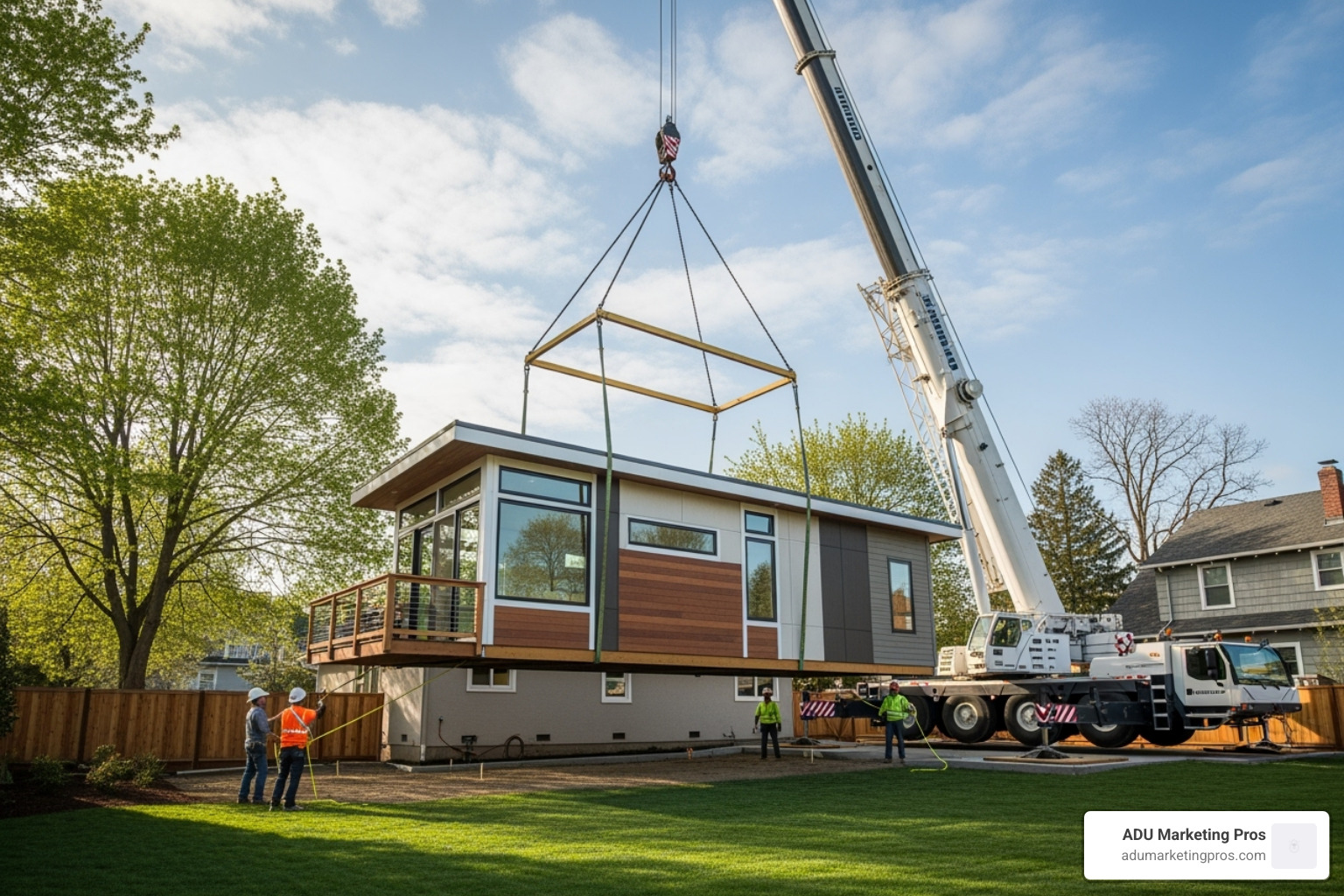
For those who prioritize predictability and speed, modular and prefabricated ADUs are an increasingly popular choice. These units are constructed in a climate-controlled factory environment, which offers several key advantages over traditional on-site construction. Building indoors eliminates weather delays, ensures a higher level of quality control through standardized processes, and reduces material waste. The timeline is a major selling point: while a traditional ADU build can take 9-12 months, modular ADUs can often be permitted in about 3 months while the site preparation (foundation and utilities) occurs simultaneously. The factory-built unit can then be delivered and installed, often in a single day, with utility hookups and final finishing taking just a few more weeks.
Cost certainty is another significant draw. While site work—including foundations, utility trenching, and landscaping—can add $70,000 or more to the total cost, the price of the unit itself is typically fixed. Many companies offer turn-key solutions that bundle design, permitting, manufacturing, and installation into a single contract. For instance, you might find packages starting around $180,000 for a 580-square-foot, two-bedroom unit. These all-inclusive services can greatly reduce homeowner stress and guarantee project timelines and costs from the outset.
Understanding Your ADU Plan Package and Project Scope
Once you’ve selected an affordable ADU plan that fits your vision and budget, it’s crucial to understand exactly what you’re getting and what additional steps and services will be required to take your project from paper to reality. Think of your plan set as a detailed recipe from a master chef: you have the complete instructions for a fantastic result, but you are still responsible for sourcing the specific ingredients (local engineering, site plans) and doing the cooking (construction).
Typical Features and Sizes of Affordable ADU Plans
Affordable ADU plans are masterfully designed for maximum function within a compact footprint. They typically range from efficient 400-square-foot studios to more spacious 800-square-foot layouts, though many options are available up to California’s 1,200-square-foot maximum. These plans are not just shrunken-down houses; they are thoughtfully optimized for small-space living.
Common configurations include:
- Studio Layouts: Ranging from 350-450 square feet, these are ideal for a single occupant, a dedicated home office, or a high-demand rental unit in an urban area.
- 1-Bedroom, 1-Bathroom: Often around 500-600 square feet, this is the most popular configuration, perfect for generating rental income or housing a family member or couple.
- 2-Bedroom Layouts: Typically ranging from 750 to 1,000 square feet, these offer greater flexibility for small families, roommates, or a live-in caregiver arrangement.
These plans incorporate thoughtful details that make a big difference in livability. You’ll find compact kitchens that cleverly fit full-size appliances, dedicated alcoves for stacked in-unit laundry, and smart use of vertical space with lofts or high ceilings to create an open, airy feel. They are designed to accommodate space-saving furniture like Murphy beds, drop-leaf tables, and extensive built-in storage. Furthermore, features like dual-pane windows, proper insulation callouts, and options for solar-ready roofs help keep long-term utility bills low.
What’s Included in a Standard ADU Plan Set?
A professional, affordable ADU plan set is a comprehensive architectural roadmap that provides your builder with the essential information needed to construct the unit. A typical package, also known as a set of construction documents, includes:
- Cover Sheet & General Notes: An overview of the project, including square footage, building codes referenced, and a legend for symbols used throughout the plans.
- Floor Plans: Detailed, to-scale drawings of each level, showing room layouts, dimensions, window and door locations, and wall thicknesses.
- Building Elevations: Exterior views of all four sides of the ADU, specifying materials, finishes, roof pitches, and final heights.
- Building Sections & Details: Critical cutaway views through the structure that show how it is assembled, from the foundation to the roof. This includes wall construction, insulation, and key structural connections.
- Electrical Layout: A schematic showing the proposed locations for all outlets, switches, light fixtures, and the electrical panel.
- Roof Plan: A top-down view of the roof, indicating slopes, ridges, valleys, and locations for vents or skylights.
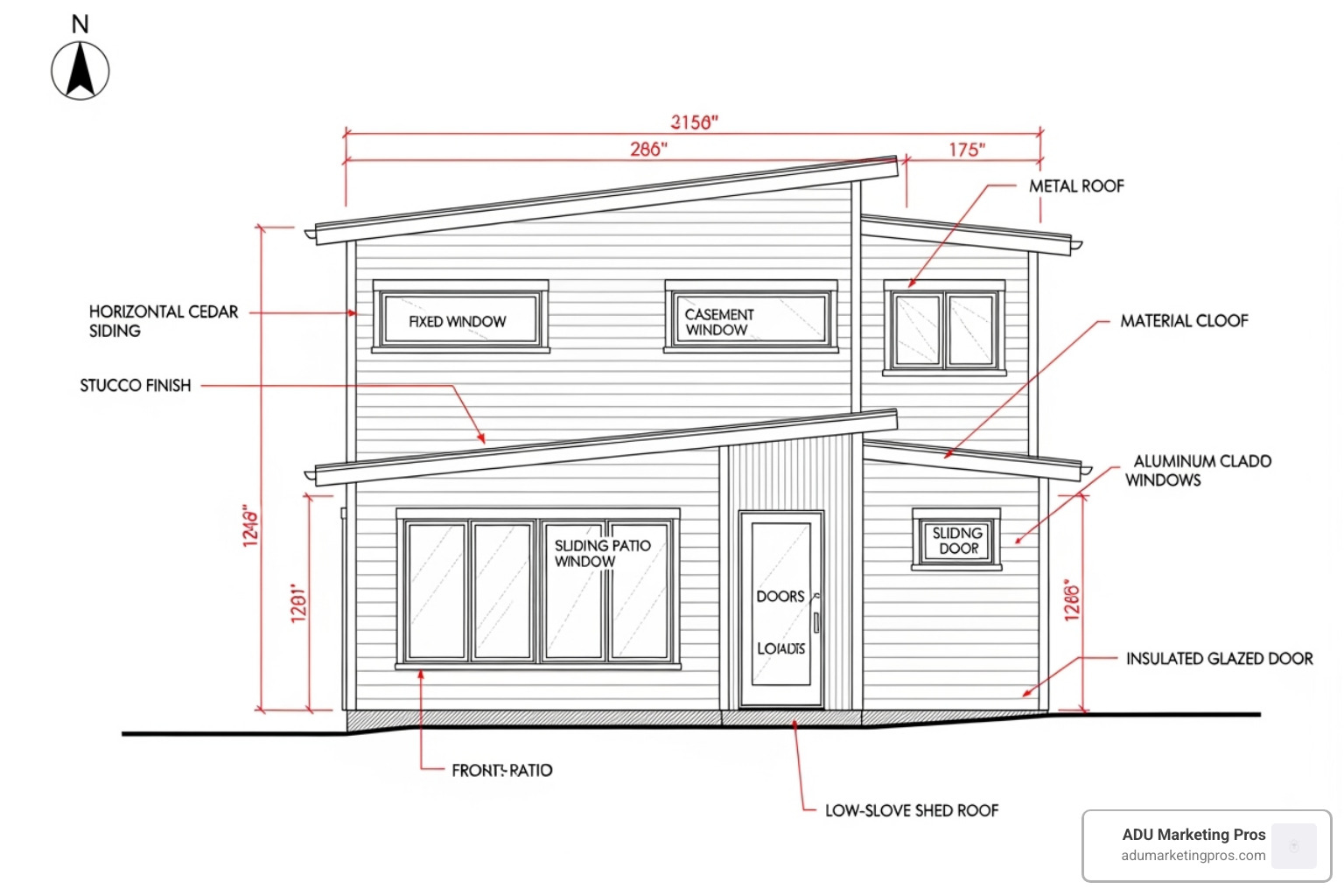
However, it’s equally crucial to understand what is not included, as these items are site-specific and must be completed by local professionals. You will almost always need to hire experts for:
- Structural Engineering: A local structural engineer must review, modify, and stamp the plans to ensure they meet local requirements for seismic activity, wind loads, and your property’s specific soil conditions.
- Title 24 Energy Report (California): This mandatory report proves the design complies with California’s strict energy efficiency standards. An energy consultant will perform calculations and provide the necessary documentation.
- Site-Specific Plans: This includes a site plan showing the ADU’s placement on your property, a foundation design tailored to your soil type, and utility connection plans for water, sewer, and power.
- Soils Report: Most jurisdictions require a geotechnical (soils) report to determine the appropriate foundation design.
- Plumbing, HVAC & Mechanical Details: While the plan may show fixture locations, detailed schematics for plumbing, heating, ventilation, and air conditioning are typically designed by the respective subcontractors based on local codes.
- Permit Application & Fees: The plan set is the main component of your permit application, but you or your contractor are responsible for completing the paperwork and paying the municipal fees.
Even with these additional steps, you are still saving thousands of dollars and months of time compared to a fully custom design, all while starting with a professional, builder-vetted plan.
From Blueprint to Build: Navigating the ADU Journey
Having an affordable ADU plan in hand is a major milestone, but it’s the beginning of the journey, not the end. Your blueprint is the map, but successfully navigating the local terrain of regulations, site work, and financing is what will ultimately turn those drawings into a beautiful, livable space. This phase requires careful planning, attention to detail, and collaboration with local experts.
Key Considerations: Zoning, Permits, and Site Prep
Every city and county has its own unique set of rules governing ADU construction. What is standard practice in Los Angeles might be different in San Jose or a smaller municipality. Understanding these local requirements is non-negotiable.
- Zoning Regulations: These are the fundamental rules that determine if, where, and how large you can build. Key factors include setback requirements (the minimum distance your ADU must be from property lines, other structures, and easements), maximum lot coverage (the percentage of your lot that can be covered by buildings), and height restrictions (often capped at 16 feet for a single-story ADU, but this can vary). State laws in places like California have standardized many rules to encourage ADU construction, but local ordinances still play a major role.
- Permitting Process: This can feel like a bureaucratic maze, but it’s a critical step to ensure your ADU is safe and legal. The process generally involves submitting your plan set, structural engineering calculations, Title 24 report, and site-specific plans to your local building department. Choosing a pre-approved plan can save you months of back-and-forth with plan checkers and reduce the risk of costly revision requests. Be prepared for multiple reviews and inspections at key stages of construction.
- Site Preparation: This is where your project moves from paper to dirt. It’s a critical and often costly phase that must be done correctly. Key steps include conducting a site survey, grading and drainage work to ensure water flows away from the foundation, trenching for utility connections (water, sewer/septic, electricity, and gas), and pouring the foundation. The foundation work is especially critical and must be based on the recommendations of a soils report and your structural engineer’s design.
We strongly recommend involving local professionals early in this process. A good general contractor or ADU consultant who is experienced in your specific area will be invaluable in navigating these complexities and avoiding common pitfalls.
How to Finance Your ADU Project
Even with the savings from an affordable plan, an ADU is a significant financial investment, with total project costs often ranging from $150,000 to $400,000 or more depending on size, location, and finishes. Fortunately, there are several smart financing strategies available to homeowners.
- Home Equity Loans and HELOCs: If you have built up equity in your primary residence, these are often the most popular and accessible options. A home equity loan provides a lump sum with a fixed interest rate, which is great for budget certainty. A Home Equity Line of Credit (HELOC) functions more like a credit card, allowing you to draw funds as needed, which can be ideal for managing construction payments.
- Construction Loans: These short-term loans are specifically designed for building projects. The lender releases funds in stages (or “draws”) as construction milestones are met and verified by an inspector. Once the ADU is complete, the construction loan is typically refinanced into a conventional mortgage.
- Cash-Out Refinance: This strategy involves refinancing your existing mortgage for a larger amount than you currently owe and taking the difference in cash to fund the ADU project. This can be a good option if current interest rates are favorable, as it consolidates your debt into a single monthly payment.
- Government Grants and Programs: To spur ADU construction, some states and local governments offer financial assistance. For example, California’s Housing Finance Agency has an ADU Grant Program that can provide up to $40,000 for pre-construction costs (like planning and permit fees) to qualifying low- and moderate-income homeowners. You can find Information on the California Housing Finance Agency’s ADU Grant Program to see if you qualify.
- Cash: Using your savings is the most straightforward option, as it avoids interest payments and loan fees. However, it’s crucial to ensure you don’t deplete your emergency fund.
Start these financial conversations early. Talk to your bank, a credit union, or a mortgage broker to understand your options, get pre-qualified, and have your financing secured before you break ground.
The Big Picture: ADUs, Property Value, and Community
Building an ADU with an affordable ADU plan is more than just a construction project; it’s a strategic investment that pays substantial dividends, both for you as a homeowner and for the broader community. These versatile, small-scale homes are a powerful tool for improving your personal financial situation while simultaneously contributing to the creation of more sustainable, equitable, and resilient neighborhoods.
Opening up the Benefits for Homeowners
For a homeowner, an ADU is a financial Swiss Army knife, offering a multitude of benefits that can adapt to your changing needs over a lifetime. The primary advantages are clear and compelling:
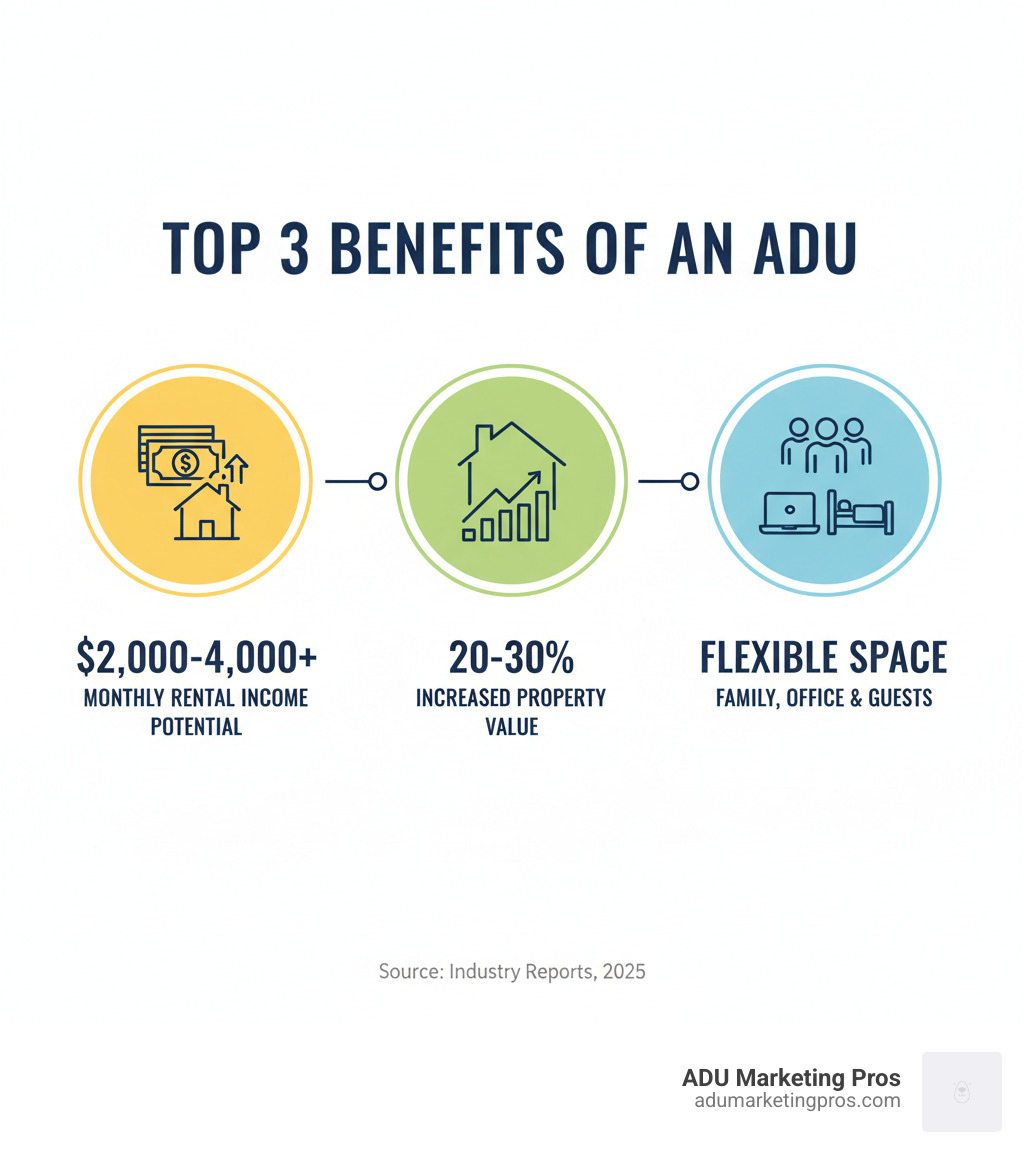
- Significant Rental Income: In many housing markets, an ADU can generate a powerful passive income stream. Depending on your location, size, and amenities, this can range from $2,000 to over $4,000 per month. This income can offset or even cover your primary mortgage, accelerate your retirement savings, or fund other life goals.
- Increased Property Value: Adding permitted, functional living space is one of the most reliable ways to boost your property’s market value. Studies and real estate experts consistently find that an ADU can increase a property’s value by 20-30%, often yielding a return on investment that far exceeds the initial construction cost.
- Flexible Housing for Family: ADUs are the perfect solution for multi-generational living. They provide a safe, independent home for aging-in-place parents, allowing them to live with dignity and privacy while remaining close to family support. They also serve as an affordable stepping stone for adult children saving for their own home, giving them a head start in a tough housing market.
- Dedicated Workspace and Personal Space: With the normalization of remote work, a detached ADU can serve as the ultimate home office, creating a crucial physical and mental boundary between work and home life. It can also be a creative studio, a gym, or a private guest house for visiting friends and family, enhancing your quality of life.
This inherent flexibility is perhaps the ADU’s greatest strength. A unit that starts as a rental can later become a home for a family member, and then an office, adapting to your needs as life evolves.
How ADUs Contribute to Healthier Neighborhoods
Beyond your own property line, the positive impact of ADUs ripples throughout the community, helping to address some of our most pressing housing and environmental challenges.
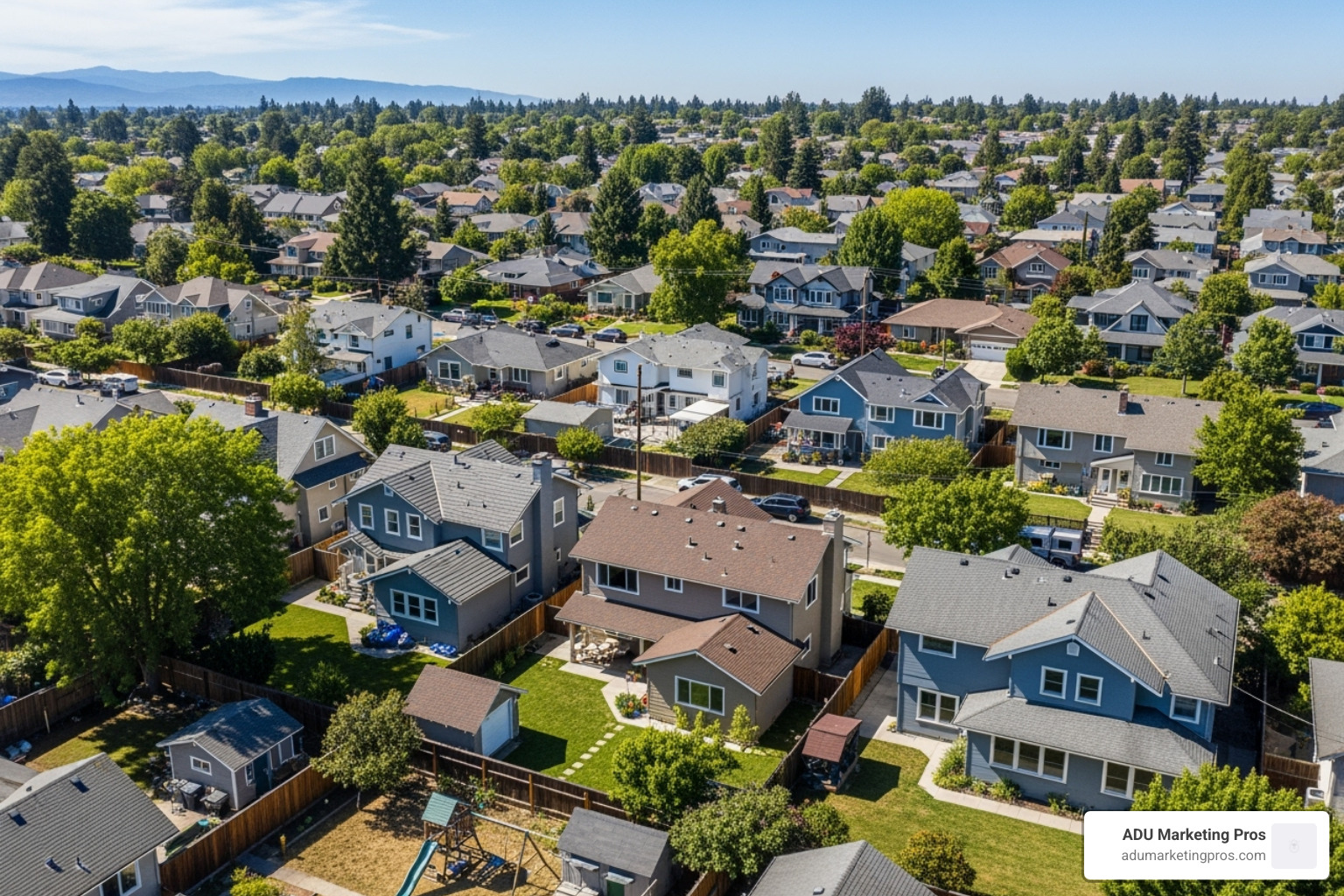
ADUs are a key component of gentle density, a planning concept that focuses on increasing housing options within existing neighborhoods without resorting to large, character-altering apartment complexes. This form of infill development makes efficient use of existing urban infrastructure—like roads, schools, and utilities—and is a powerful form of sustainable land use, reducing the pressure to build sprawling new subdivisions on undeveloped land.
They also foster stronger communities by supporting multi-generational living, which creates robust family support networks and allows seniors to age within their familiar neighborhoods. Perhaps most importantly, ADUs directly create more affordable housing options in high-cost communities. By increasing the overall housing supply at a lower price point than new single-family homes, they help essential workers like teachers, firefighters, and service providers live in the communities they serve. This diversity strengthens the social and economic fabric of our neighborhoods, making them more vibrant and inclusive for everyone.
Each new ADU built from an affordable plan is a small but meaningful step toward solving our collective housing challenges, one backyard at a time.
Conclusion: Your Path to an Affordable ADU Starts Now
The journey to building a new home in your backyard does not have to be overwhelmingly complex or financially prohibitive. As we’ve explored, affordable ADU plans are your single most effective tool for launching this transformative project, serving as the smartest first step toward creating valuable, flexible space. By leveraging pre-designed blueprints, city pre-approved programs, or efficient modular construction, you can save tens of thousands of dollars in fees and shave critical months off your project timeline, putting you on an accelerated path to success.
Remember, these are not just construction projects; they are profound investments in your financial future and your family’s well-being. Whether you are dreaming of a consistent rental income that builds wealth, a private and comfortable space for aging parents, or a dedicated home office that enhances your work-life balance, an affordable plan is the key that makes it all achievable. By choosing to build an ADU, you also become part of a larger solution, contributing to the fight against the housing crisis by adding gentle density and creating more diverse, affordable housing options in your community.
The path forward is clear and actionable. Begin by researching your local zoning regulations to understand what’s possible on your property. Dive into online plan catalogs to find a design that inspires you. Explore whether a pre-approved city plan or a turn-key modular solution is the right fit for your goals and timeline. Most importantly, connect with local professionals who can help you adapt your chosen plan to your site and guide you through the permitting and construction process.
Your ADU project can transform from a distant dream into a tangible reality much faster than you might imagine. Don’t let analysis paralysis delay your progress. Every month you wait is a month of missed rental income, lost property value appreciation, and deferred family flexibility. The time to act is now.
Ready to turn your vision into a valuable asset? We’re here to connect you with the expertise, resources, and plans that make ADU success not just possible, but straightforward.
Explore professionally designed ADU floor plans and connect with trusted builders in your area.