
Why Small Living Solutions Matter More Than Ever
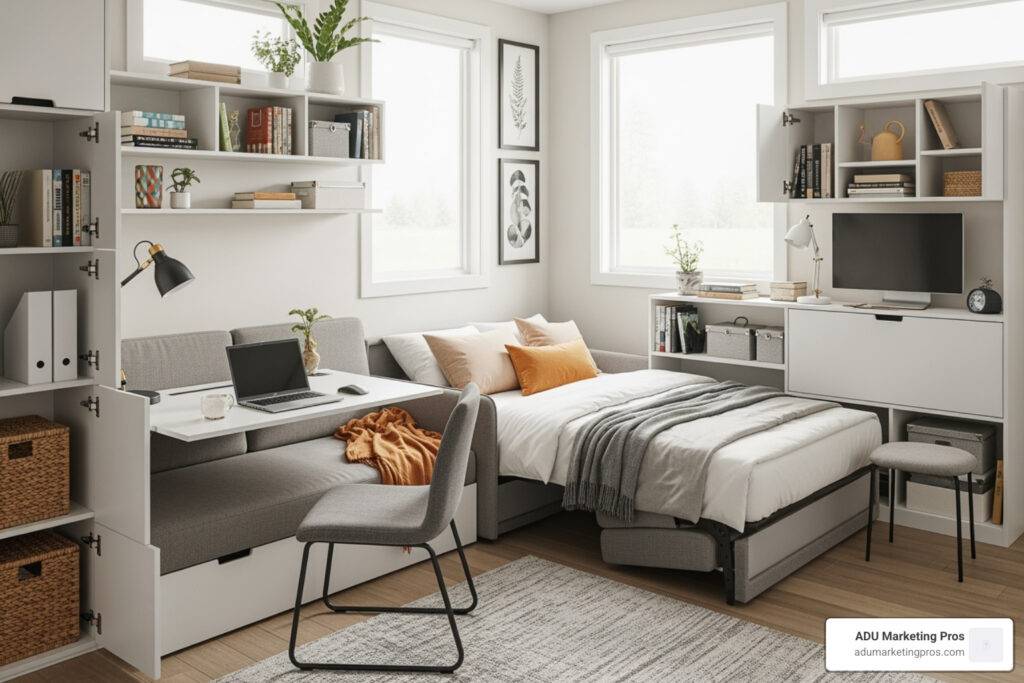
Small living solutions are a collection of smart strategies and design principles aimed at maximizing comfort, functionality, and style within compact living spaces like studio apartments, tiny homes, and accessory dwelling units (ADUs). As urban populations continue to swell and housing costs in major metropolitan areas reach unprecedented highs, a growing number of people are discovering that limited square footage doesn’t have to mean limited possibilities. This isn’t about compromise; it’s about creativity.
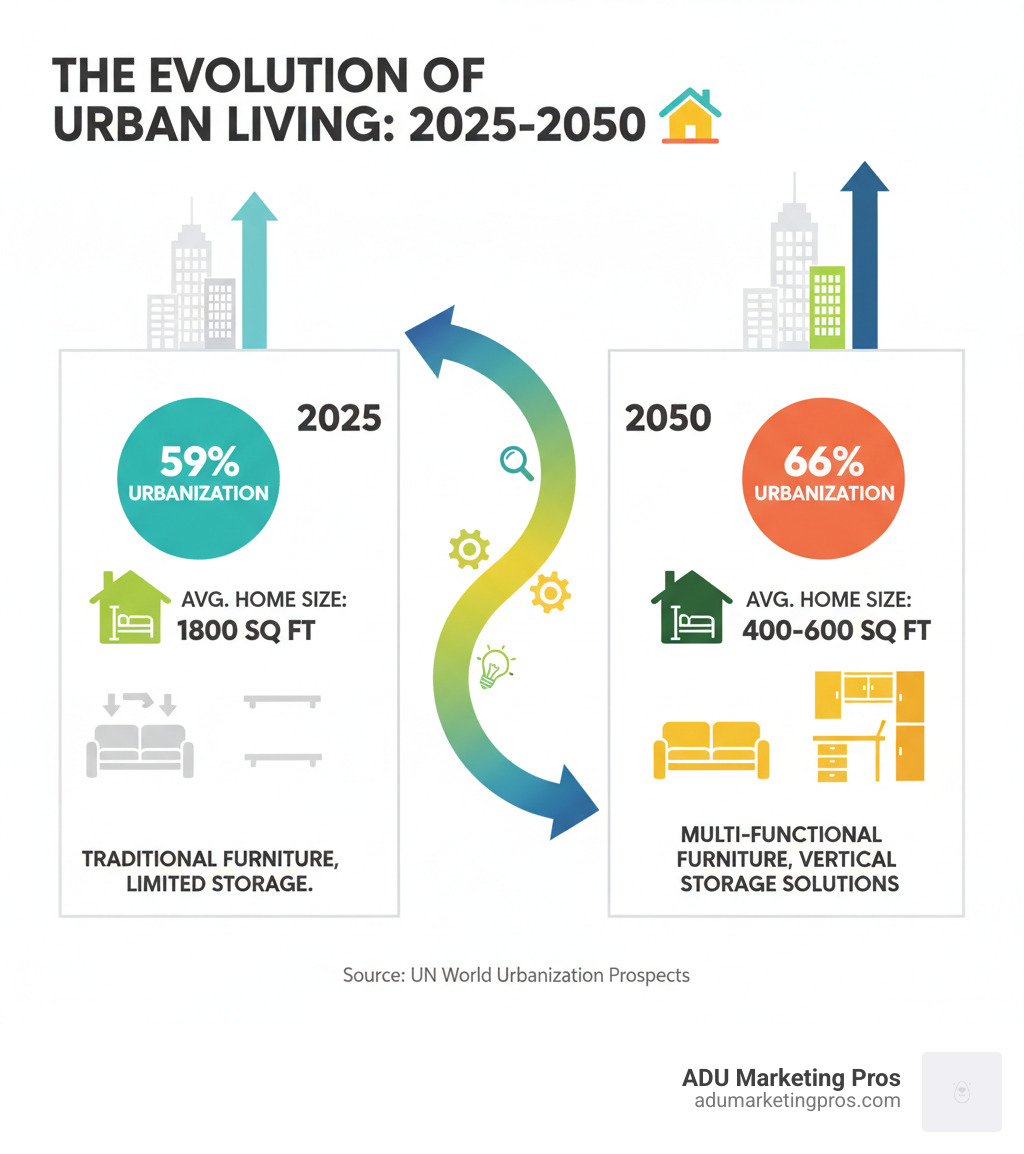
This global shift is driven by powerful economic and demographic trends. With as much as 66% of the world’s population projected to live in urban areas by 2050, the demand for housing is intensifying, causing average home sizes to shrink. In response, a design revolution has been sparked, one that champions efficiency and ingenuity. The good news is that scaling down your living space can lead to scaling up your quality of life. It encourages a more intentional lifestyle, reduces environmental impact, and frees up financial resources. In a well-designed small home, every inch counts, and this guide will show you how to make your space work harder, feel larger, and look better.
Quick Answer: Top Small Living Solutions
- Multi-functional furniture – Invest in pieces that do double or triple duty, like Murphy beds with integrated desks, storage ottomans, and drop-leaf tables.
- Vertical storage – Draw the eye upward and free up the floor by using wall-mounted shelves, tall bookcases, pegboards, and high cabinets.
- Smart zoning – Use tools like area rugs, open-backed bookshelves, and strategic furniture placement to create distinct, functional living areas without walls.
- Light and color tricks – Employ mirrors, light paint colors, sheer curtains, and layered lighting to make spaces feel brighter, more open, and significantly larger.
- Hidden storage – Conceal clutter and maintain a serene environment with under-bed drawers, benches with hidden compartments, and toe-kick drawers in the kitchen.
Smart Furnishing & Layout Strategies
When working with limited square footage, every furniture choice carries extra weight. The goal isn’t just to fit everything in—it’s to create a cohesive, thoughtfully arranged space that feels open, inviting, and eminently livable. The right furniture and layout can transform a cramped room into a functional and beautiful home.

Choosing Multi-Functional Furniture
The secret weapon in any effective small living solution is furniture that serves multiple purposes. This approach minimizes the number of items you need, freeing up valuable floor space and reducing clutter.
- Storage ottomans are a classic for a reason. They offer seating, a footrest (with a tray on top, it’s a coffee table), and a hidden compartment for blankets, remote controls, or magazines.
- Nesting tables provide flexible surface area that can be expanded for guests or tucked away to save space. They are far more versatile than a single, static coffee table.
- Drop-leaf and expandable dining tables are transformative. They can sit discreetly against a wall as a slim console but expand to accommodate a dinner party, adapting to your needs on the fly.
- Convertible sofas and Murphy beds are essential for single-room living. Modern designs are stylish and comfortable, allowing you to convert a living room into a guest room or a bedroom into a home office in seconds. Some advanced Murphy beds even integrate desks, sofas, or shelving that remain level as the bed is lowered.
- A vintage trunk can serve as a coffee table with built-in storage, adding character and function simultaneously. For more creative ideas on furnishing compact spaces, check out our ADU design ideas.
- C-tables are designed to slide under a sofa or chair, providing a convenient surface for a laptop or drink without taking up floor space like a traditional end table.
Arranging Furniture to Create Flow and Openness
Counterintuitively, pushing all your furniture against the walls can make a room feel smaller and less inviting. This creates an awkward, unused “dead zone” in the center. Instead, pull key pieces slightly away from the walls to create breathing room and establish clear, intuitive pathways for movement.
- Low-profile furniture with slender, visible legs (often called \”leggy\” furniture) is a game-changer. It allows the eye to travel under the furniture and across the room, making the floor plan feel more expansive.
- Armless chairs and sofas save physical and visual space. Their streamlined silhouette feels lighter and more open than their bulky, armed counterparts.
- Sometimes a few larger, well-proportioned pieces work better than a clutter of small ones. A single large L-shaped sofa can define a corner and make a space feel more intentional and less chaotic than a collection of mismatched chairs and loveseats.
- Curved furniture, like a sofa with soft lines, a circular coffee table, or a round dining table, can soften the hard angles of a small, boxy room. The lack of sharp corners improves flow and makes the space feel more welcoming and dynamic, a technique often used by high-end designers like Ali Budd.
- Transparent furniture made of acrylic or glass can almost disappear, providing function without adding visual weight. A clear coffee table or console table keeps the sightlines open.
Defining Zones in a Single Space
In studios, ADUs, and open-plan homes, you need to create distinct zones for sleeping, living, and dining without building walls. This creates a sense of order and purpose.
- Bookshelves as room dividers are a brilliant solution. Open-backed shelves, in particular, provide storage and visual separation while still allowing light and air to pass through, preventing the space from feeling closed off. You can find many examples of bookshelves that work as room dividers online.
- Area rugs are essential for anchoring a living area and making it feel separate from a dining or sleeping space. Ensure the rug is large enough that at least the front legs of all furniture pieces in the zone can sit on it.
- Strategic lighting signals how different areas function. Use bright, focused overhead light in the kitchen, a stylish floor lamp for a reading nook, and a dedicated desk lamp for a workspace.
- A functional home office nook can be created with a wall-mounted folding desk that disappears when not in use, or a slim desk tucked behind a sofa.
- Banquette seating built into a corner maximizes seating for a dining area while taking up minimal floor space. It also clearly defines the dining zone and can be built with hidden storage underneath.
Maximizing Every Inch: Creative Small Living Solutions for Storage
When it comes to small living solutions, effective storage is paramount. The secret isn’t about magically finding more space, but rather using the space you already have more creatively and efficiently. In a compact home, every nook, vertical surface, and piece of furniture becomes a valuable storage opportunity waiting to be unlocked.
Going Vertical: Utilizing Wall and Ceiling Space
To truly maximize storage in compact homes, you have to look up. Walls and ceilings offer an incredible amount of often-untapped real estate. Drawing the eye upward not only provides storage but also creates the illusion of higher ceilings.
- Floating shelves provide storage for books, plants, and decor without the visual bulk of traditional bookcases, keeping the floor clear and the space feeling open.
- Wall-mounted cabinets that stretch all the way to the ceiling offer serious, out-of-sight storage without consuming any floor space. They are perfect for kitchens and home offices.
- High shelving above doorways and windows is a clever spot for items you don’t need to access daily, like seasonal decor, extra linens, or archived documents.
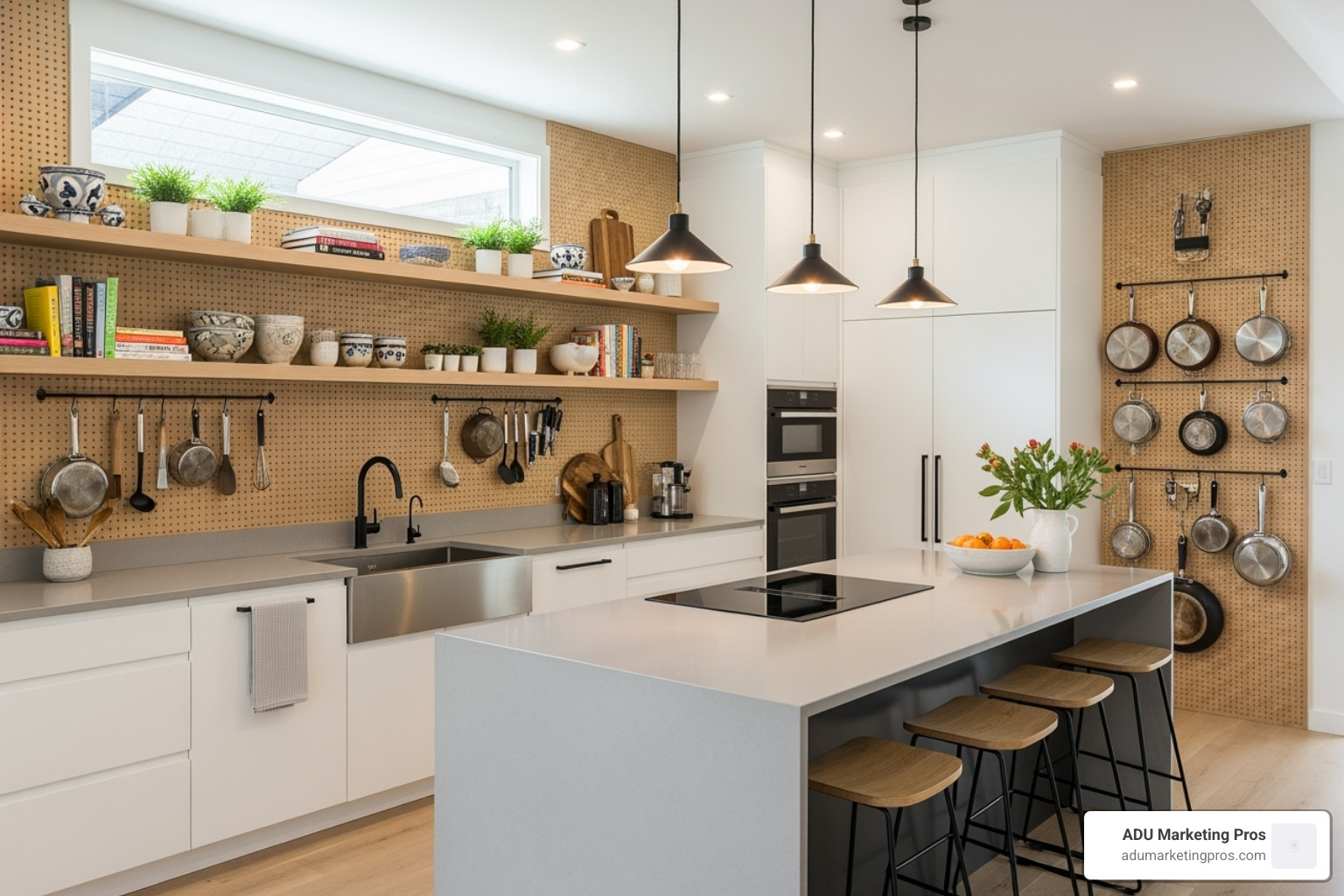
- A pegboard wall is a versatile, game-changing solution for kitchens, craft rooms, or entryways. It offers customizable storage for everything from pots and pans to keys and coats. The work of Position Collective’s cheerful peachy pegboard wall shows just how stylish this functional solution can be.
- Hanging pot racks or ceiling-mounted racks in the kitchen free up entire cabinets and can add a touch of rustic or industrial charm.
- Wall-mounted bike storage turns your bicycle from a floor-hogging obstacle into a piece of functional art.
- Ladder shelves offer a stylish, minimal-footprint alternative to a bulky bookcase, providing vertical storage that leans elegantly against a wall.
Sneaky and Stylish Small Living Solutions for Storage
The most satisfying storage solutions are those that are incorporated so seamlessly they look like an intentional part of your decor. The goal is to maintain a beautiful home, not a storage warehouse.
- Under-bed storage is non-negotiable in a small bedroom. Use rolling bins, zippered bags, or beds with built-in drawers to store off-season clothes, extra bedding, and shoes.
- A bench with hidden storage in an entryway, at the foot of a bed, or in a living room provides seating and a discreet spot for shoes, bags, or toys.
- Decorative baskets and bins are the ultimate organizational chameleons. Use them on open shelves, in corners, or under console tables to hide clutter in plain sight while adding texture and color.
- Vintage suitcases stacked as a side table add a touch of worldly character while providing hidden storage for items you rarely use.
- Hiding clutter behind curtains on a simple tension rod can conceal open shelving in a laundry area or closet, creating a neat, cohesive appearance instantly.
- Toe-kick drawers installed in the dead space under your kitchen or bathroom cabinets are perfect for storing flat items like baking sheets, serving platters, or even a spare dustpan.
Budget-Friendly and DIY Small Living Solutions for Storage
You don’t need a massive budget to implement stylish, effective storage. Creativity and a little bit of elbow grease can go a long way in transforming your space.
- Repurpose a dresser as a media console or buffet. It will offer far more drawer storage than a traditional TV stand and can be found affordably at thrift stores.
- DIY crate shelving is a budget-friendly and customizable way to create unique storage units. Simply sand, paint or stain inexpensive wooden crates and then stack or mount them on the wall in a configuration that fits your space.
- Tension rods are organizational powerhouses. Use them to create instant hanging space in closets, under sinks to hang cleaning supplies, or even vertically in cabinets to organize cutting boards and baking sheets.
- Upcycling old furniture with a fresh coat of paint, new hardware, or stylish contact paper can transform a castoff into a custom treasure that perfectly fits your style and storage needs.
As designer Megan Hopp proved with her own home, smart choices and DIY determination can yield stunning, high-end results on a shoestring budget. See how designer Megan Hopp transformed her rental on a budget for incredible inspiration. For more ideas on sustainable design, see our guide to Eco-Friendly Small Homes.
The Illusion of Space: Design Tricks with Color, Light, and Decor
Beyond furniture and storage, you can manipulate perception to create the illusion of a larger, more expansive home. These powerful small living solutions are all about tricking the eye. Best of all, many of these high-impact strategies cost little to nothing to implement but can fundamentally change the feel of your space.
The Power of Color and Paint
Color is arguably the most transformative and cost-effective tool in your design arsenal. The right paint choices can make walls recede, ceilings lift, and boundaries blur.
- Light and neutral palettes are the go-to for a reason. Shades of white, cream, pale gray, and soft pastels are excellent at reflecting light, which naturally makes a room feel brighter, airier, and larger.
- A monochromatic color scheme, where walls, trim, and even large furniture pieces are in similar shades, creates a seamless, cohesive look. This blurring of boundaries prevents the eye from stopping at the corners of the room, making it feel more expansive.
- Surprisingly, dark, moody colors like navy, charcoal, or deep green can also work wonders. When used on all walls (and sometimes even the ceiling) in a small room, they create an illusion of depth and intimacy. The corners and edges of the room disappear, making the space feel boundless, like the night sky.
- Painting the ceiling a shade or two lighter than the walls is a classic trick that draws the eye upward, creating the perception of more height.
- Match storage units to your wall color to make them visually recede. Painting a tall bookcase the same color as the wall behind it allows you to add a massive amount of storage without it feeling bulky or intrusive.
Leveraging Natural and Artificial Light
Light is the second key ingredient to making a space feel bigger. A well-lit room feels more open, clean, and inviting, while a poorly lit room feels cramped and gloomy.
- Maximize natural light at all costs. Use sheer or translucent curtains instead of heavy, opaque drapes. If you need privacy, opt for bottom-up shades. A pro tip is to hang curtain rods higher and wider than the actual window frame—this tricks the eye into thinking the window is much larger than it is.
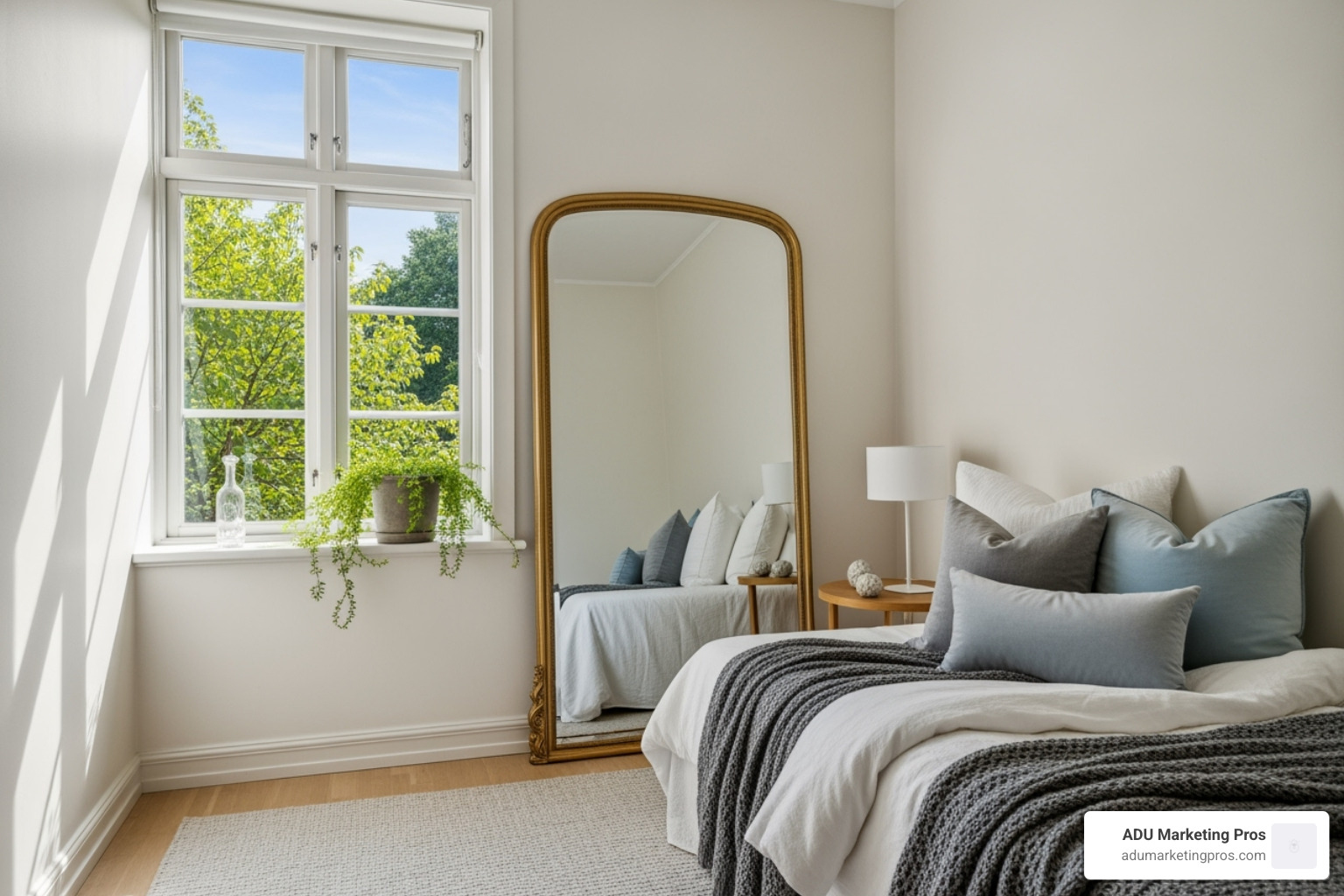
- Mirrors are a small space’s best friend. A large mirror placed strategically opposite a window can effectively double the amount of light in the room and create a profound sense of depth, making the space feel twice as big.
- Create layered lighting by using a mix of ambient (general overhead light), task (focused light for reading or cooking), and accent (light that highlights art or architectural features) sources. This adds dimension and eliminates dark corners, which can make a room feel smaller.
- Wall-mounted sconces and plug-in pendants provide excellent light without taking up any precious floor or table space. They add a sophisticated, custom touch.
- Don’t forget other reflective surfaces. High-gloss paint finishes, metallic decor, glass tabletops, and lacquered furniture all help bounce light around the room.
Decorating to Improve, Not Clutter
When decorating a small space, every single object must earn its place. The goal is to inject personality and style without creating visual chaos. Restraint is key.
- Choose one large piece of artwork as a focal point rather than a gallery wall of many small items. A large, bold piece commands attention and makes a space feel more curated and grand, whereas a multitude of small frames can feel busy and cluttered.
- Adopt a minimalist-adjacent approach. This doesn’t mean your home has to be sterile, but it does mean you should carefully curate the items you display. Choose objects that are either beautiful, functional, or deeply meaningful—preferably all three.
- Layer textures to add richness and warmth without adding visual clutter. A chunky knit throw, velvet pillows, a plush rug, and linen curtains can make a neutral room feel incredibly cozy and sophisticated.
- Use a larger area rug. It may seem counterintuitive, but a small rug that floats in the middle of the room can make the space feel choppy and smaller. A larger rug that allows most of your furniture to sit on it unifies the space and makes it feel more cohesive and expansive.
Understanding different compact living options can also help you tailor your design approach. Learn the difference between an ADU vs Tiny House to choose the right strategies for your specific structure.
Common Pitfalls: Mistakes to Avoid in Small Space Design
Knowing what not to do is just as important as knowing what works. Many people make the same common mistakes that sabotage their efforts to create a functional, spacious-feeling home. Avoiding these missteps is a critical part of implementing effective small living solutions.
Furniture and Layout Faux Pas
-
The Mistake: Choosing Oversized Furniture. A massive sectional or a bulky four-poster bed might look great in a showroom, but it will overwhelm a small room, dominate the visual landscape, and hinder movement.
- What to Do Instead: Opt for \”apartment-sized\” furniture, which is scaled down for smaller footprints. Always measure your space and use painter’s tape on the floor to map out furniture dimensions before you buy.
-
The Mistake: Blocking Pathways. Forcing people to squeeze past furniture or turn sideways to get through a room makes a space feel cramped and dysfunctional, no matter how stylish it is.
- What to Do Instead: Ensure there are clear, comfortable pathways (aim for at least 30-36 inches) for major traffic routes. Arrange furniture to guide movement naturally through the space.
-
The Mistake: Pushing All Furniture Against the Walls. This is an instinctual but flawed strategy that creates an awkward, empty \”dead zone\” in the middle of the room and makes the space feel static.
- What to Do Instead: Pull furniture out from the walls, even just a few inches. This creates breathing room and a more dynamic, layered layout. Float a sofa in the middle of the room to create a walkway behind it.
-
The Mistake: Ignoring Scale and Proportion. Every element in a room relates to the others. A giant chandelier in a tiny nook or a tiny lamp on a large end table will look out of place and throw off the room’s balance.
- What to Do Instead: Choose pieces that are proportional to the room and to each other. A large piece of art can work, but a collection of oversized furniture will not.
Storage and Clutter Catastrophes
-
The Mistake: Relying Only on Open Storage. While a few open shelves are great for display, using them for all your storage needs creates instant visual chaos and a constant pressure to be perfectly tidy.
- What to Do Instead: Strive for a balance of open and closed storage. Use beautiful baskets and bins on open shelves to corral items, and prioritize cabinets and drawers for hiding everyday necessities.
-
The Mistake: Not Decluttering First. You can’t organize clutter. Buying more storage containers before you’ve purged is a recipe for a messier, more crowded home.
- What to Do Instead: Be ruthless. Before you even think about storage solutions, get rid of anything you don’t need, use, or love. Adopt a \”one in, one out\” policy to maintain order.
-
The Mistake: Overlooking \”Sneaky\” Storage Spots. Forgetting to use the space under stairs, inside window seats, above cabinets, or beneath beds is a massive missed opportunity.
- What to Do Instead: Conduct a \”storage audit\” of your home. Look high and low for underutilized spaces and find creative ways to activate them with drawers, bins, or custom built-ins.
Decor and Design Don’ts
-
The Mistake: Using Rugs That Are Too Small. A tiny rug floating in the middle of the floor makes a room feel disconnected and visually shrinks the space.
- What to Do Instead: Choose a larger rug that unifies the furniture grouping. At a minimum, the front legs of your sofa and all chairs should sit comfortably on the rug.
-
The Mistake: Too Many Small Decor Items. A collection of tiny knick-knacks scattered around a room creates visual noise and makes a space feel cluttered, even if it’s clean.
- What to Do Instead: Opt for fewer, larger, and more impactful decorative pieces. Group smaller items together on a tray or in a bowl to give them collective presence.
-
The Mistake: Inadequate or Harsh Lighting. A single, harsh overhead light (the dreaded \”boob light\”) casts unflattering shadows and makes a space feel flat and uninviting.
- What to Do Instead: Layer your lighting with a mix of ambient (general), task (reading, cooking), and accent (highlighting art) sources at different heights to create warmth and dimension.
-
The Mistake: Ignoring the Fifth Wall. Forgetting to use walls for storage and decor is a cardinal sin in a compact home. Blank walls are wasted potential.
- What to Do Instead: Go vertical! Use walls for shelving, mounting your TV, hanging plants, and installing sconce lighting to free up valuable floor space.
Frequently Asked Questions about Small Living Solutions
Here are answers to some of the most common questions people have when they’re diving into the world of compact living for the first time. These practical tips can help you navigate the unique challenges and opportunities of a smaller footprint.
What is the best way to add storage to a small living room without it looking cluttered?
The key is to integrate storage so seamlessly that it either disappears or doubles as a stylish feature. Avoid bulky, standalone pieces that just scream \”storage unit.\”
- Go Vertical: Use floating shelves or tall, narrow bookcases (like ladder shelves) to draw the eye upward. This utilizes wall space efficiently and can actually make the room feel taller. Painting them the same color as the wall enhances this effect.
- Use Multi-functional Furniture: This is the most important strategy. Choose a coffee table with drawers or a lift-top, an ottoman with a hidden storage compartment, and end tables with shelving or cabinets.
- Match Storage to Walls: As mentioned, painting storage units the same color as your walls is a powerful trick. This camouflage effect makes them visually recede, allowing you to add significant storage without adding visual weight.
- Use Cohesive Baskets and Bins: Corral smaller items like remote controls, chargers, and magazines in a set of matching decorative baskets. This reduces visual clutter and makes open shelving look intentional and organized rather than messy.
- Think Built-Ins: If your budget allows, custom or semi-custom built-ins that flank a fireplace or run along a wall provide a massive amount of storage with a polished, high-end look that feels like part of the architecture.
How can I make my small apartment feel bigger on a budget?
Making a space feel larger doesn’t have to be expensive. Some of the most effective small living solutions are surprisingly affordable and rely more on cleverness than cash.
- Declutter Mercilessly: This is the most effective and completely free way to create immediate breathing room. A tidy, organized space always feels larger than a cluttered one.
- Harness the Power of Mirrors: A large, inexpensive mirror can be a game-changer. Place it opposite a window to double the light and create a powerful illusion of depth. Check thrift stores, flea markets, and big-box stores for budget-friendly options.
- Paint with Light Colors: A gallon of light-colored paint is a low-cost, high-impact investment. A fresh coat of white, light gray, or pale blue can instantly make a room feel brighter, cleaner, and more open.
- Shop Second-Hand: Scour Facebook Marketplace, Craigslist, and local thrift stores for multi-functional furniture. You can often find drop-leaf tables, storage ottomans, or nesting tables for a fraction of their retail price.
- Embrace DIY Projects: You don’t need to be a master carpenter. Build simple shelves using brackets and lumber from a hardware store, use tension rods inside closets for custom storage, or give a tired piece of furniture a makeover with paint. For inspiration, see how designer Megan Hopp transformed her rental on a budget.
What are the most essential multi-functional furniture pieces for small houses?
Certain pieces are true workhorses in compact living, earning their keep by serving multiple needs and adapting to different situations. If you’re going to invest in a few key items, start here.
- Sofa Bed or Murphy Bed: This is essential for studio apartments or any home where the living room must also function as a guest room. Modern sofa beds are surprisingly comfortable, and a Murphy bed allows a room to transform completely from bedroom to office in seconds.
- Storage Ottoman or Coffee Table: This piece is a non-negotiable. It provides a surface for drinks, a footrest for relaxing, extra seating for guests, and hidden storage for blankets, games, or electronics.
- Expandable Dining Table: A drop-leaf or butterfly-leaf table is a marvel of flexibility. It can live as a slim console table against a wall for daily use and then expand to seat six or eight for a dinner party.
- Nesting Tables: A set of two or three tables that tuck into one another offers incredible versatility. You can use them together as a tiered coffee table, or pull them apart to serve as end tables or individual snack tables when guests are over.
- A Console Table with Stools: A slim console table can function as a desk, a dining spot for two, a bar, or an entryway drop zone. Choose one with two small stools that can be tucked completely underneath when not in use.
These pieces exemplify the flexibility and functionality that are at the heart of smart small-space living. For more ideas, explore our comprehensive guide to Small Houses.
Conclusion
Living in a compact space is not about limitation; it’s about liberation. It’s an exercise in creativity, intentionality, and smart design that empowers you to make every square foot work for you. As we’ve explored, a thoughtful combination of small living solutions can transform any tiny home, ADU, or apartment into a sanctuary that feels functional, stylish, and surprisingly spacious.
The key takeaways are a powerful blueprint for success. First, choose smart, multi-purpose furnishings that adapt to your changing needs. Second, maximize every inch with creative storage that goes vertical, tucks into hidden nooks, and conceals clutter. Finally, master the art of illusion with strategic use of color, light, and decor to visually expand the feel of your space. By embracing these principles and avoiding common pitfalls, you can craft a home that is perfectly tailored to your life.
At ADU Marketing Pros, we specialize in helping ADU construction and architecture firms thrive throughout Southern California—from the bustling neighborhoods of Los Angeles and San Diego to the innovative hubs of the San Francisco Bay Area, including San Jose, Sunnyvale, Palo Alto, and Menlo Park. We have seen firsthand how thoughtfully designed compact homes can offer everything a homeowner needs without the burden of excess square footage. These are not spaces for \”making do\”—they are highly efficient, personalized spaces where you can truly thrive.
Ultimately, smaller living encourages a more intentional lifestyle, leading to homes that feel more personal, are easier to maintain, and have a lighter environmental footprint. It’s a shift from valuing quantity of space to valuing quality of life. Ready to explore the possibilities of compact living? Find out more in our guide to places in Southern California that allow tiny houses. Your perfectly designed small space is waiting.