
Why Finding the Right ADU Builder Makes All the Difference
The ADU boom is fundamentally reshaping backyards across California, as homeowners from San Diego to the Bay Area add granny flats and rental units to increase property values, generate passive income, and house family members. But here’s the critical catch that can make or break your project: not all builders are created equal.
An Accessory Dwelling Unit is not a simple shed or a minor renovation. It’s a new home, subject to a complex web of state and local building codes, zoning ordinances, and permitting requirements. An inexperienced contractor can quickly turn your dream project into a nightmare of budget overruns, failed inspections, and costly delays. You need a team that not only delivers exceptional quality craftsmanship on time and on budget but also serves as your expert guide. Experienced ADU builders are licensed, insured professionals who expertly navigate homeowners through every phase, from initial design concepts to the final inspection.
When searching for the right team, your vetting process should be thorough. Look for these essential pillars of a trustworthy builder:
Credentials: The Non-Negotiable Foundation
A true professional will proudly display their credentials. This starts with a valid California State Licensing Board (CSLB) license. Beyond that, they must carry comprehensive general liability and workers’ compensation insurance. This protects you from any liability in case of accidents on your property. A bonded status provides an additional layer of financial protection for you as the homeowner.
Experience: A Portfolio of Proven Success
Talk is cheap; a portfolio is proof. An experienced builder will have a strong, verifiable portfolio of completed ADU projects. Ask to see examples of different types of ADUs they’ve built—detached, attached, and garage conversions—to gauge their versatility and the quality of their finished work.
Capability: The Power of an In-House Team
Look for a builder with in-house architects, designers, and construction teams. This integrated design-build model ensures seamless communication, a unified vision, and greater accountability. It eliminates the common friction points between separate design and construction firms, leading to a smoother process.
Transparency: Clarity in Costs and Communication
A reputable builder provides detailed, line-item estimates with no hidden costs. Be wary of vague proposals or lump-sum quotes that don’t break down labor, materials, and fees. Transparency should extend to communication throughout the project, with regular updates and a clear process for handling any changes.
Local Expertise: Navigating Your City’s Rules
Every city and county in California has its own unique set of zoning and permit requirements. Deep knowledge of your specific municipality’s regulations is invaluable. An experienced local builder knows the city planners, understands the nuances of the code, and can anticipate potential hurdles, saving you months of delays.
Reputation: Verified Client Satisfaction
Check online reviews on Google, Yelp, and Houzz, but don’t stop there. Ask for a list of recent client referrals and take the time to call them. Ask about their experience with the builder’s communication, professionalism, and ability to stay on budget and on schedule.
This guide will walk you through identifying and hiring these top-tier ADU builders, understanding your options, navigating the complex permitting process, and avoiding costly mistakes. Choosing the right builder is the single most important decision you’ll make for your ADU project.
Why an ADU is Your Property’s Smartest Upgrade
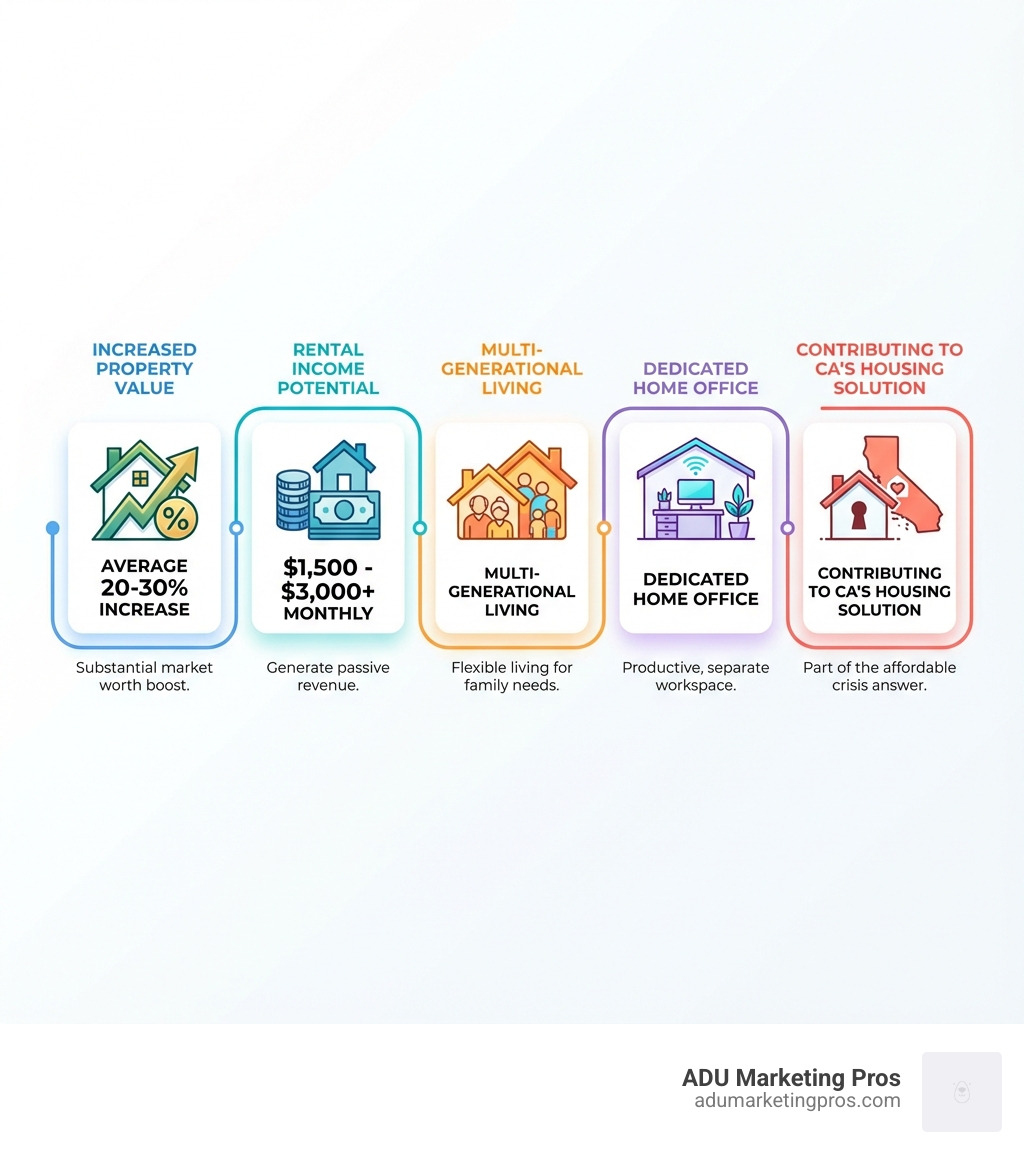
Adding an Accessory Dwelling Unit (ADU) is more than a construction project; it’s a strategic investment in your financial future and quality of life. These versatile structures, when planned and executed by experienced ADU builders, can significantly improve a homeowner’s portfolio and daily living. Here are the primary benefits of building an ADU in California.
A Tangible Boost to Your Property Value
First and foremost, an ADU is a proven way to increase your property value. In California’s competitive housing market, a functional, well-built, and permitted unit is a highly desirable asset. Appraisers recognize ADUs as a significant value-add, often increasing a property’s worth by a substantial margin. This isn’t just about adding square footage; it’s about adding a legal, independent dwelling that enhances the property’s utility and appeal, providing a strong return on investment.
Creating a Powerful Passive Income Stream
ADUs are fantastic for generating passive rental income. With the high cost of living across the state, there’s a constant and growing demand for affordable rental options. An ADU provides a steady income stream that can help offset your mortgage, cover property taxes, fund retirement, or simply provide a financial cushion. In high-demand areas like Los Angeles, San Diego, and the Bay Area, a one-bedroom ADU can generate thousands of dollars in monthly rent.
Fostering Multi-Generational Living Solutions
They also offer invaluable multi-generational living solutions. ADUs provide a perfect, private space for aging parents who desire independence but need to be close to family for support. They are also an ideal solution for adult children saving for their own home or seeking affordable housing in their community. This arrangement fosters family closeness and mutual support while maintaining privacy and autonomy for everyone.
The Ultimate Home Office or Creative Studio
For the growing number of remote workers, an ADU can become a dedicated home office. Separating your workspace from your living space is crucial for productivity and a healthy work-life balance. A quiet, professional environment just steps from your main residence can significantly boost focus and eliminate the distractions of working from the kitchen table. This space can also serve as a creative studio, gym, or guest suite.
A Flexible and Dignified Downsizing Option
An ADU can also be a practical downsizing option. Empty-nesters can build a smaller, more manageable, and accessible living space on their property and rent out the main house. This strategy provides significant financial flexibility, allowing them to age in place, generate retirement income, and remain in a cherished neighborhood without the burden of maintaining a large home.
Contributing to California’s Housing Needs
Finally, by building an ADU, you’re actively contributing to California’s affordable housing solutions. ADUs add much-needed housing units to existing neighborhoods without requiring new land development. This form of gentle density helps communities grow responsibly, providing more housing options and supporting local businesses without drastically changing the character of the neighborhood.

Understanding Your ADU Options: Types and Styles
One of the first and most exciting steps in an ADU project is understanding the different types available. Each has unique benefits, costs, and construction processes, and experienced ADU builders can provide an expert site evaluation to help you choose the right fit for your property, budget, and goals.
Here are the main types of ADUs you can build in California:
Detached ADUs: The Ultimate in Privacy
Often called a granny flat or backyard cottage, a detached ADU is a standalone structure, separate from the main home. Because they are built from the ground up, they offer the most design flexibility and provide maximum privacy for both the main home occupants and the ADU residents. This makes them an ideal choice for rental units or for family members who desire a high degree of independence.
Attached ADUs: A Seamless Extension of Your Home
These units are built as an addition to your primary residence, sharing at least one wall. However, they are required to have their own separate entrance, kitchen, and bathroom facilities. Attached ADUs can be a cost-effective option that leverages the existing structure and can simplify utility connections. They are a great solution for creating an in-law suite or a guest wing that feels connected to, yet separate from, the main house.
Garage Conversions: The Cost-Effective Choice
Transforming an existing garage into a living space is one of the most popular and economical ADU options. Because you are using a pre-existing structure, you can save significantly on foundation and framing costs. This is an excellent way to add a functional living unit without sacrificing yard space. An experienced builder can expertly handle the structural and insulation upgrades needed to turn a garage into a comfortable, fully compliant home.
Junior ADUs (JADUs): Maximizing Existing Space
JADUs are smaller units, limited to no more than 500 square feet, created entirely within the existing footprint of a single-family home (such as a spare bedroom). They must have their own exterior entrance and an efficiency kitchen, which includes a small sink, cooking appliance, and food preparation area. JADUs are the ultimate space-maximization tool and can be combined with a standard ADU on the same property in many jurisdictions.
Prefabricated vs. Site-built: A Key Decision
Beyond the type, you’ll also choose a construction method. Experienced ADU builders may specialize in one or both.
- Prefabricated (Modular) ADUs: These are built in sections (modules) off-site in a factory-controlled environment. The completed modules are then transported to your property, set on a foundation, and assembled. This method can offer faster timelines and more predictable costs.
- Site-built (Custom) ADUs: These are constructed entirely on your property using traditional building methods, from the foundation up. This approach allows for maximum customization in design, layout, and materials, ensuring the ADU can seamlessly integrate with your existing home’s aesthetic.
When choosing, consider your budget, timeline, and desired level of customization.
| Feature | Prefabricated (Modular) ADU | Site-built (Custom) ADU |
|---|---|---|
| Cost | Often more predictable, potentially lower upfront | Can vary more, higher customization often means higher cost |
| Timeline | Generally faster, as much work is done off-site | Typically longer, subject to on-site weather and scheduling |
| Customization | Limited to available models and finishes, some flexibility | High degree of customization, unique designs possible |
| Site Impact | Minimal disruption on-site during construction | More extensive on-site work and disruption |
Regarding size, California regulations provide a flexible framework. JADUs are capped at 500 square feet. State law allows for a detached ADU of at least 850 square feet for one bedroom or 1,000 square feet for two or more bedrooms, regardless of local zoning rules. Attached ADUs can often be up to 1,000 square feet or 50% of the primary dwelling’s area. A knowledgeable builder will know how to leverage these state mandates to maximize your project’s potential.
The Ultimate Checklist for Vetting Experienced ADU Builders
Finding and hiring the right experienced ADU builders is the most critical step in your entire project. A top-tier builder is more than just a contractor; they are your project manager, problem-solver, and trusted partner. They manage the entire complex process, from navigating labyrinthine permit offices to handling unforeseen on-site challenges. This checklist will help you identify, vet, and hire the best professionals in California.
Key Qualities of Experienced ADU Builders
Look for these hallmarks of excellence that distinguish true ADU specialists from general contractors:
- Deep ADU-Specific Experience: A long track record (e.g., 25+ years in construction with a dedicated focus on ADUs in recent years) indicates a deep understanding of best practices. They should have completed dozens, if not hundreds, of ADU projects.
- Extensive and Diverse Project Portfolio: A builder’s portfolio should showcase a wide variety of completed ADUs—custom, prefab, garage conversions, large and small. This demonstrates their design capabilities, quality of work, and ability to adapt to different properties and client needs.
- Verifiable CSLB License and Full Insurance: This is non-negotiable. Use the CSLB’s online portal to verify the builder holds a current, valid contractor’s license in good standing. Confirm they carry comprehensive general liability and workers’ compensation insurance to protect you, your property, and the workers on site.
- Integrated In-house Team Expertise: A full-service design-build firm with an in-house team of architects, designers, and project managers ensures seamless communication and accountability. This model saves time and money by preventing the miscommunications and delays common when working with separate firms.
- Unwavering Commitment to Quality Craftsmanship: A reputable builder prides themselves on superior workmanship, from the structural integrity of the foundation and framing to the fine details of the tile work and trim. Their reputation is built on the quality of their finished product.
- Use of High-Quality, Durable Materials: The best builders use durable, energy-efficient, and sustainable materials that meet modern building standards. They should be knowledgeable about Title 24 energy requirements and recommend materials that provide long-term value and low maintenance.
How to Find and Hire Experienced ADU Builders
Follow these steps for a systematic and effective hiring process:
- Compile a Shortlist Through Research: Start by researching builders with a strong local presence and a wealth of positive online reviews on platforms like Google, Houzz, and Yelp. Ask for recommendations from friends, family, or local real estate agents.
- Verify Credentials and Check for Red Flags: Before you even make a call, vet your shortlist. Use the CSLB website to verify license, insurance, and bond status. Check for any disciplinary actions or complaints.
- Conduct In-Depth Interviews: Interview at least three builders. Prepare a list of detailed questions. Ask about their specific process for ADUs, their communication style, how they handle change orders, and their typical project timeline. Ask them to walk you through a recent, similar project.
- Request and Compare Detailed Quotes: A professional will provide a comprehensive, line-item estimate that clearly breaks down all anticipated costs (permits, materials, labor, etc.). Be wary of vague quotes, unusually low prices (which may indicate cut corners), or high-pressure tactics.
- Speak with Past Clients: Ask for and contact at least three recent references. Ask them about the builder’s communication, cleanliness of the job site, ability to stick to the budget and timeline, and how they handled any problems that arose.
- Review the Contract Meticulously: Before signing, ensure the contract is thorough. It should clearly outline the full scope of work, a detailed payment schedule, a projected timeline with key milestones, a clear change order process, warranty information, and a dispute resolution clause.
The Design-Build Advantage
Working with a single firm that handles both design and construction—a design-build team—streamlines the entire process. This integrated model offers a single point of contact and accountability, which simplifies communication and ensures a cohesive vision from start to finish. Integrated project management often results in a more efficient project flow, faster timelines, and better budget control by identifying cost-saving opportunities early in the design phase.
Navigating the ADU Building Journey: From Blueprint to Move-In
An ADU project involves several distinct phases, each with its own set of tasks and potential challenges. Experienced ADU builders are your indispensable partners, providing clarity and expert management to guide you smoothly through each step of the journey.
Phase 1: Planning, Design, and Financing
This foundational phase is where your vision takes shape and the groundwork for a successful project is laid. Rushing this stage is a common mistake; thorough planning is key.
- Initial Consultation & Feasibility Study: Your journey begins with a detailed discussion of your goals, needs, and budget with your builder. They will then perform a comprehensive site assessment, evaluating your property’s size, topography, utility access points, and local zoning constraints to determine the most feasible ADU type, size, and placement.
- Architectural Design and Material Selection: Here, you’ll decide between a fully custom design tailored to your exact specifications or potentially modifying pre-approved or pre-designed plans, which can sometimes expedite the process. You’ll work with the design team to finalize floor plans, elevations, and select materials and finishes, from roofing and siding to flooring and fixtures.
- Detailed Budgeting and Cost Analysis: Your builder will translate the design into a detailed, line-item cost estimate. A typical ADU cost in California can start around $170,000, but the final price is highly dependent on size, materials, finishes, and site-specific conditions. This transparent budget should account for both “hard costs” (labor and materials) and “soft costs” (design fees, permits, and engineering).
- Securing Financing: Most homeowners need financing for their ADU. Common options include a Home Equity Loan (HEL), a Home Equity Line of Credit (HELOC), a cash-out refinance of your existing mortgage, or a dedicated construction loan. It’s wise to get pre-approved for financing early in the process. Be sure to explore any available state or local grants; the Accessory Dwelling Units website offers great information on the benefits that make ADUs a sound investment.
Phase 2: California’s Zoning and Permitting Maze
This is often the most daunting and time-consuming phase for homeowners, but an experienced builder will manage the entire process on your behalf.
- The Builder’s Critical Role: A seasoned builder and their design team will create a full set of permit-ready architectural and structural plans. They will manage the entire submittal process with your local building department, responding to comments and requests from plan checkers to ensure all necessary permits are obtained as efficiently as possible.
- Understanding Key California Regulations: While rules vary by city, statewide regulations provide a powerful framework that often supersedes restrictive local ordinances. For the most current information, consult the California HCD website. Key state rules include:
- Setbacks: Minimum side and rear yard setbacks are often just 4 feet.
- Height Limits: Detached ADUs typically have a 16-foot height limit, though some jurisdictions allow for more.
- Parking: Parking is not required for ADUs located within a half-mile of public transit or in a historic district, among other exemptions.
- Owner-Occupancy: California has waived owner-occupancy requirements for new ADUs permitted between January 1, 2020, and January 1, 2025, making it easier to build rental units.
- Typical Timeline: The entire ADU journey, from the first consultation to final completion, typically takes 6 to 12 months. The permitting phase alone can take 2-4 months, depending on the jurisdiction’s efficiency.
Phase 3: Construction and Mitigating Challenges
With permits secured, construction can finally begin.
- Site Prep, Foundation, and Utilities: The site is cleared, graded, and prepared for construction. The foundation is then formed and poured. Simultaneously, trenches are dug to connect essential utilities like water, sewer, gas, and electricity to the main lines.
- Framing, Roofing, and Structure: The ADU’s skeleton is framed, and the structure begins to take shape. This is followed by roofing, window and door installation, and exterior sheathing to create a weather-tight shell.
- Interior and Exterior Finishing: This is the longest phase, where the house becomes a home. It includes all rough-in work for plumbing, electrical, and HVAC, followed by insulation, drywall, painting, and the installation of all finishes: flooring, cabinetry, countertops, tile, and light fixtures.
- Handling Inevitable Challenges: Even with the best builders, challenges like material delays, subcontractor scheduling conflicts, or unexpected site conditions (like poor soil) can arise. A great builder communicates proactively and transparently, keeping you informed of progress, potential delays, and any necessary budget adjustments, and presenting solutions rather than just problems.
Frequently Asked Questions
Here are answers to some of the most common inquiries we hear from California homeowners who are considering building an Accessory Dwelling Unit.
How long does it typically take to build an ADU in California?
The entire process, from the initial design consultation to the final move-in day, generally takes 6 to 12 months. This timeline can be broken down into three main stages:
- Planning & Design: 1-2 months. This involves site analysis, developing architectural plans, and selecting materials.
- Permitting & Approvals: 2-4 months. This is often the most variable phase and depends heavily on the workload and efficiency of your local building department.
- Construction: 3-6 months. This includes everything from laying the foundation to the final coat of paint.
Factors like the complexity of your custom design, local permit processing times, supply chain availability for materials, and homeowner-requested changes can influence the final timeline. Experienced ADU builders can provide a more accurate projection based on your specific project and location.
What are the key differences between an ADU and a Junior ADU (JADU)?
While both are accessory units, they have distinct legal definitions and characteristics:
- Size: A JADU is strictly limited to 500 square feet. A standard ADU can be much larger, often up to 1,000-1,200 square feet, depending on local rules and state allowances.
- Location: A JADU must be created within the existing, conditioned footprint of a single-family home (e.g., converting a bedroom). An ADU can be attached to the home, detached in the backyard, or a conversion of a garage or other accessory structure.
- Kitchen: A JADU only requires an “efficiency kitchen,” which has a smaller sink and appliances. A full ADU requires a complete, standard kitchen.
- Entrance: A JADU may share a bathroom or an entrance with the main home, but it must have its own separate exterior entrance. A standard ADU must have its own separate exterior entrance.
- Owner Occupancy: In many cases, the property owner must reside in either the main house or the JADU. This requirement is often waived for standard ADUs.
How much does an ADU cost to build?
The cost of an ADU in California varies widely, making a single “average cost” misleading. While starting prices for a complete project often begin around $170,000, the final cost is influenced by many factors:
- Type and Size: Garage conversions are often the most cost-effective, while larger, custom-designed detached ADUs are the most expensive.
- Location: Labor rates, permit fees, and material costs differ significantly across regions like Los Angeles, San Diego, and the Bay Area.
- Materials and Finishes: The level of customization and the quality of finishes (e.g., flooring, countertops, appliances) are major cost drivers.
- Site Conditions: Properties with steep slopes, difficult access for machinery, or long utility runs will incur higher site preparation costs.
Because of this variability, it is crucial to get detailed, line-item quotes from several experienced ADU builders to ensure transparency and avoid unexpected costs.
Do I have to pay separate property taxes on my ADU?
No, you will not receive a separate tax bill for the ADU. However, your property taxes will increase. When the ADU construction is complete, the county assessor will perform a “blended assessment.” This means your property’s existing assessed value remains the same, but the value of the new construction (the ADU) is added to it. Your tax bill will be recalculated based on this new, higher total assessed value. It is not a reassessment of your entire property.
Can I build an ADU on my property?
Most residential properties in California are eligible for at least one ADU, and often a JADU as well, thanks to state laws designed to encourage their construction. Generally, if you have a single-family or multi-family property, you can likely build an ADU. There are no longer minimum lot size requirements in most cases, and parking requirements are often waived. The best way to confirm eligibility is to consult with an experienced ADU builder who can perform a detailed feasibility analysis based on your specific property and local jurisdiction.
Conclusion: Building Your Future with the Right Partner
The journey to building an Accessory Dwelling Unit is an exciting and powerful investment in your property’s value, your financial independence, and your family’s future. As we’ve explored, the benefits are undeniable—from generating a significant passive income stream that can transform your finances to offering flexible, multi-generational living solutions that keep family close.
However, the ultimate success of your project, and your peace of mind throughout the process, hinges on one critical decision: selecting truly experienced ADU builders. The path to a successful ADU is paved with due diligence. You must look for a builder with decades of construction experience and a specific, proven track record in ADUs. Prioritize those with a robust portfolio, impeccable credentials, and a full-service, integrated design-build approach. A top-tier builder acts as your dedicated partner, expertly managing the immense complexities of design, permitting, and construction while delivering the highest standards of quality craftsmanship.
Choosing the right builder isn’t just about hiring a contractor to put up walls; it’s about entrusting your vision, your property, and your investment to a professional who can navigate the challenges and deliver a result that exceeds your expectations.
At ADU Marketing Pros, we understand the immense value that experienced ADU builders bring to homeowners across California. We specialize in helping these elite firms stand out in a crowded and competitive market, connecting them with discerning homeowners like you who demand expertise, transparency, and quality.
Ready to envision the possibilities for your own backyard? Take the next step by exploring these stylish studio ADU floor plans to inspire your project and begin the conversation about building your future.