
Why Modular Construction Is Reshaping Los Angeles Housing
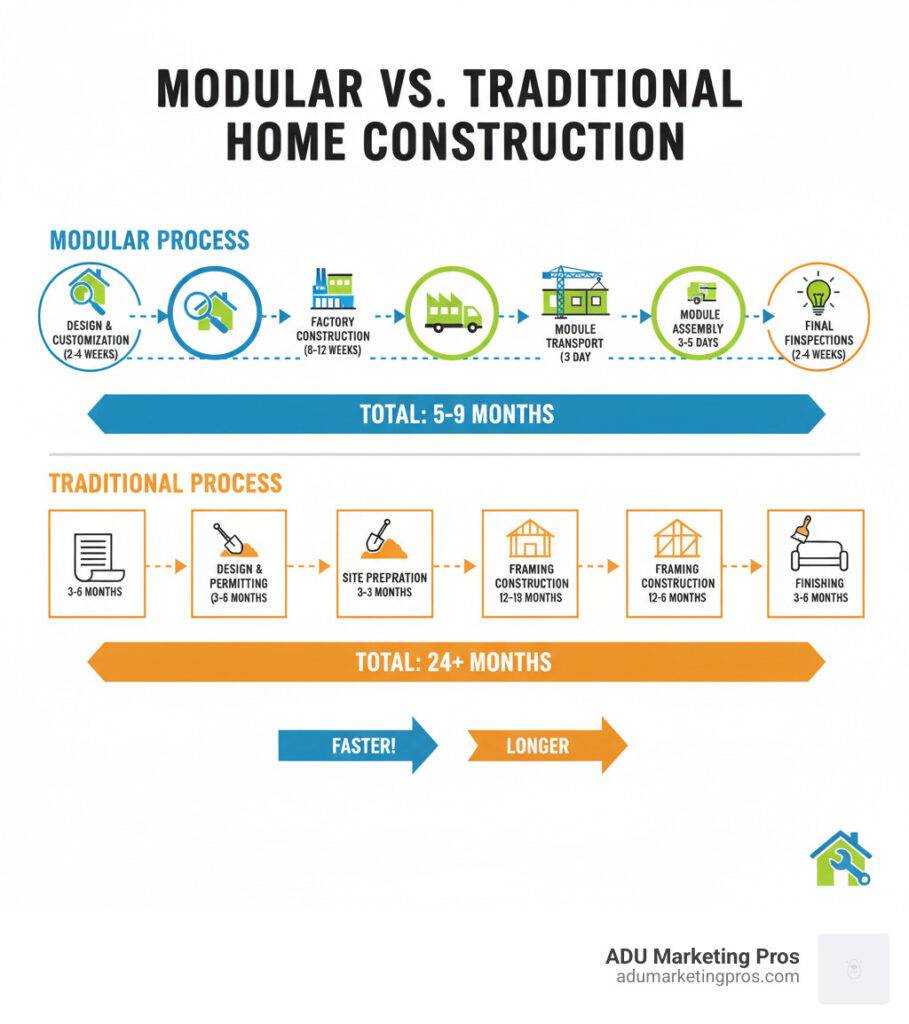
Modular homes los angeles are emerging as a key solution for homeowners, developers, and fire victims who need high-quality housing built efficiently. This factory-based approach offers a smarter, more predictable alternative to traditional construction, delivering permanent, architecturally significant homes in just 5-9 monthsa fraction of the typical 24+ month timeline that has become the norm in Southern California.
Quick Answer: Top Benefits of Modular Homes in LA
- Unmatched Speed: Complete your home and move in within 5-9 months, compared to the 2+ years common for site-built projects. This means less time renting and faster returns on investment.
- Cost Predictability: Base costs range from $100-$250 per square foot, with comprehensive ADU projects typically landing between $300,000-$450,000. Fixed pricing minimizes the risk of budget overruns.
- Superior Quality & Resilience: Factory precision ensures robust steel frames, non-combustible materials for fire resistance, and engineering that exceeds seismic compliance standards.
- Advanced Sustainability: Achieve net-zero energy with integrated solar systems, benefit from superior insulation, and reduce construction waste by up to 60%.
- Streamlined Permitting: Many modular plans are pre-approved by the state and recognized by LADBS, significantly accelerating project start times.
Los Angeles is caught in a perfect storm of a severe housing shortage, with a deficit of hundreds of thousands of units, soaring home prices that push the median well over $900,000, and painfully long construction timelines. Traditional building methods are struggling to keep pace, hampered by a shrinking skilled labor pool, persistent supply chain disruptions, unpredictable costs, and weather delays. Furthermore, the increasing frequency and intensity of wildfires have created an urgent need for rapid, resilient reconstruction in many vulnerable communities.
Modular construction directly confronts these challenges. By building up to 95% of a home in a climate-controlled factory, manufacturers eliminate weather-related setbacks, optimize material usage to reduce waste by up to 60%, and implement a rigorous quality control process that is nearly impossible to replicate on an open-air construction site. The completed modules arrive at the property virtually finished, allowing for on-site assembly in a matter of days, not months.
Modern modular technology is synonymous with luxury, high-end customization, and unparalleled speed. California’s stringent building and fire safety codes are actually an advantage in factory production, where these high standards can be implemented with precision and consistency. However, it’s crucial to understand that not all prefab companies offer a complete, turnkey service. Many act only as manufacturers, leaving homeowners to navigate the labyrinthine permitting process and complex site work on their own.
This guide will help you identify the best full-service modular home builders in the Los Angeles market, ensuring your project is managed seamlessly from concept to completion, whether you’re building a primary residence, an accessory dwelling unit (ADU), or a multi-family development.
Why More Angelenos Are Choosing Modular Over Traditional Construction
In a city where time and money are paramount, more Los Angeles residents are finding that modular construction offers advantages that traditional building methods cannot match. Modular homes los angeles builders provide a streamlined, concierge-like experience, combining factory precision with sophisticated modern design. Instead of a two-year construction ordeal filled with noise, dust, delays, and neighborhood disruptions, homeowners see their projects completed in a matter of months. The on-site phase is dramatically shortened, preserving peace and privacy for both the homeowner and their neighbors.
The core advantage is the controlled factory environment. Homes are built indoors as a series of modules, protected from weather and theft, with rigorous quality inspections at every stage of production. This predictable, assembly-line process eliminates the constant surprises and compromises that are all too common in traditional on-site construction.
The Speed Advantage: From Factory to Foundation in Record Time
The most significant and life-changing benefit of modular construction is speed. A traditional LA build can easily stretch to 24 months or more, a period filled with uncertainty. In stark contrast, a modular home is typically designed, fabricated, and installed for move-in within 5 to 9 months. This accelerated timeline has profound financial and personal benefits: it means less time paying rent while also covering a mortgage, faster access to rental income from a new ADU, and a much quicker, less traumatic recovery for families rebuilding after a disaster like a wildfire.
The efficiency stems from a parallel workflow. While your contractor is performing site work—grading, excavation, and pouring the foundation—your home’s modules are being simultaneously built to completion in the factory. By the time the foundation is cured, the nearly-finished modules arrive on trucks for installation. Weather delays, a major bottleneck for site-built homes, are rendered irrelevant. The crane installation itself is a remarkable process, often completed in just one or two days, followed by a few weeks of final finishing work and inspections. This highly predictable schedule allows you to plan your finances and your move with confidence.
A Smarter Investment: Comparing the Costs of Modular Homes in Los Angeles
While not always cheaper on a per-square-foot basis, modular homes represent a smarter, more secure financial decision. The base cost for high-quality modular homes los angeles typically ranges from $100 to $250 per square foot for the structure itself. A complete, all-in ADU project generally costs between $300,000 and $450,000, a figure that should include permits, site work, foundation, installation, and utility hookups. The key benefit is cost certainty.
This fixed or guaranteed pricing protects you from the rampant cost overruns common in traditional construction, which are often driven by unforeseen change orders, labor shortages, weather delays, and volatile material prices. The financial benefits extend long-term, too. Modern modular homes are exceptionally energy-efficient, with many achieving net-zero energy consumption when paired with solar panels, which drastically reduces or eliminates utility bills. The shorter construction timeline also means lower carrying costs on construction loans. Financing is readily available through HELOCs, cash-out refinancing, or specialized construction loans. Reputable full-service builders have established relationships with lenders who understand the modular process and can help streamline the financing and appraisal stages.
Best Quality and Durability for the LA Climate
Modern modular construction consistently surpasses the quality of traditional builds. The factory setting allows for a level of precision, engineering, and quality control that is simply impossible on an outdoor job site. Materials are stored in a protected environment, and every stage of construction—from frame welding to drywall finishing—is inspected by a dedicated quality assurance team.
Many leading modular homes los angeles builders use high-strength, light-gauge steel frames, which offer significant advantages over wood. Steel is dimensionally stable, meaning it won’t warp, twist, or shrink. It is impervious to rot and termites and is inherently non-combustible. When combined with non-combustible exterior materials like fiber cement siding and metal roofing, these homes offer superior fire resistance—a critical feature for safety and peace of mind in California. All homes must comply with the strict California Building Code, with a dual inspection process at both the state-approved factory and the final site, ensuring the highest level of accountability and safety.
Structurally, the additional reinforcements required to transport modules by truck and lift them by crane make them incredibly robust. This inherent strength makes them exceptionally resilient during seismic events, often outperforming their site-built counterparts. This combination of precision engineering, durable materials, and robust design provides homeowners with genuine peace of mind in the face of LA’s unique climate challenges.
Designing for the LA Lifestyle: Customization, Styles, and Sustainability

The Los Angeles lifestyle is defined by its deep connection to the outdoors, and modern modular homes los angeles are specifically designed to embrace and enhance it. Far from the outdated image of cookie-cutter boxes, today’s modular homes champion the principles of California modernism, offering extensive customization options and prioritizing the forward-thinking sustainability that Angelenos value.
Popular Modular Home Designs in Los Angeles
The dominant aesthetic for modular homes in LA is a clean, warm modernism. This style is characterized by strong horizontal lines, flat or low-slung roofs, open-concept floor plans, and large expanses of high-performance glass. These designs focus on creating a seamless indoor-outdoor flow, often featuring floor-to-ceiling sliding or retractable glass walls that merge living rooms with patios, decks, and gardens. This architectural philosophy makes the most of Southern California’s enviable year-round weather, effectively extending the living space into the landscape.
Whether you’re building a spacious primary residence on a hillside or a compact luxury ADU in a backyard, the emphasis is on light, air, and functionality. Clerestory windows are often used to bring in natural light while maintaining privacy. The minimalist approach creates calm, uncluttered spaces that feel larger and more connected to their natural surroundings, proving that beautiful, high-design living doesn’t require massive square footage.
The Customization Process: Tailoring Your Dream Home
Choosing a modular home doesn’t mean sacrificing personality or settling for a one-size-fits-all solution. The design journey is a collaborative process. It typically begins with selecting a base floor plan that suits your lifestyle, whether you need a great room for entertaining, a flexible room for a home office or gym, or a multi-generational living arrangement. From there, you personalize your home through a detailed finish selection process.
Reputable builders offer a wide range of high-end options for flooring, custom cabinetry, countertops, tile, and plumbing fixtures. Many provide curated design packages developed by interior designers, which group complementary finishes to simplify decision-making and ensure a cohesive, professional aesthetic. For those wanting more control, working with an in-house design team or an outside architect can allow for significant modifications to floor plans, window placements, and exterior massing. A key advantage of the modular process is that all these design decisions are finalized upfront, before construction begins. This avoids the stress, budget uncertainty, and costly delays of making changes on-site.
Building Green: Sustainability and Energy Efficiency
Modular homes los angeles are at the forefront of sustainable building practices. Many builders now offer net-zero energy designs as a standard or readily available option. These homes are engineered to produce as much energy as they consume over a year, thanks to features like a highly insulated building envelope, energy-efficient appliances, and standard integration of solar panels. Some systems even include battery storage, creating “Self-Powered” homes that can provide backup power during grid outages.
Sustainability is built-in, not bolted on. The precision construction in a factory setting results in a much tighter building envelope, reducing air leakage and improving thermal performance. This, combined with superior insulation, means your HVAC system works less, lowering utility costs and increasing indoor comfort. The factory process itself is inherently greener, cutting material waste by up to 60% compared to site-built projects and lowering the home’s overall embodied carbon. All new homes in California must meet the state’s rigorous Title 24 Building Energy Efficiency Standards, and modular construction often exceeds these requirements with ease. Many homeowners complete their sustainable vision with drought-tolerant landscaping and permeable hardscaping, further reducing their environmental impact. For code context on efficiency, see California’s Title 24 Building Energy Efficiency Standards from the California Energy Commission: https://www.energy.ca.gov/programs-and-topics/topics/building-energy-efficiency/title-24-building-energy-efficiency-standards.
Navigating the Unique Challenges of Building in Los Angeles
Building in Los Angeles presents a unique trifecta of challenges: complex regulations, significant seismic and wildfire risks, and difficult or constrained building sites. Fortunately, the very nature of modular homes los angeles means they are engineered from the ground up to overcome these problems more efficiently and effectively than traditional construction.
Built to Last: Addressing Seismic Activity and Wildfire Risks
Earthquakes and wildfires are not abstract risks but a tangible reality in Southern California. Modular construction offers superior resilience by design. Each module is engineered and built to withstand the stresses of transportation over hundreds of miles and being lifted by a crane. This process subjects the structure to forces that often exceed those experienced during a major earthquake, resulting in an exceptionally robust building. Many premier modular homes los angeles builders use durable steel frame structures, which provide exceptional strength and ductility to resist seismic forces, as well as being non-combustible.
To combat wildfire threats, these homes are built to meet or exceed the stringent requirements of Wildfire Urban Interface (WUI) codes. This includes using non-combustible materials like fiber cement or metal siding, metal roofing, multi-pane tempered glass windows, and ember-resistant vents. The architectural impact of LA fires underscores the critical importance of this resilient design approach. Factory production guarantees that these life-saving features are implemented with precision and consistency, eliminating the variables and potential oversights of on-site construction.
The Permitting and Approval Process for Modular Homes in Los Angeles
The Los Angeles Department of Building and Safety (LADBS) is known for its notoriously complex and lengthy permitting process. Modular construction offers a significant advantage by streamlining this bureaucratic hurdle. The process operates under a dual jurisdiction: the home’s modules are inspected and pre-approved by state inspectors at the factory under California’s Factory-Built Housing Program, which is administered by the Department of Housing and Community Development (HCD). This state-level approval, represented by an HCD insignia, supersedes local structural plan checks for the modules themselves. See HCD: https://www.hcd.ca.gov/building-standards/factory-built-housing and LADBS for local permitting: https://www.ladbs.org/.
This means the local LADBS review is focused primarily on site-specific issues: the foundation plan, utility connections, site drainage, and compliance with local zoning ordinances. This division of labor dramatically simplifies and accelerates the local permitting timeline. Top-tier builders offering modular homes los angeles provide full-service permitting support, acting as the homeowner’s agent to manage all LADBS paperwork and coordination. Many work with pre-approved plans that are already familiar to city plan checkers, further reducing approval times and minimizing hassle for the homeowner.
Site Selection and Preparation Essentials
Proper site selection and preparation are the foundation of a successful modular project. A thorough lot suitability check, or feasibility study, is the critical first step. This analysis examines local zoning laws, setbacks, soil conditions via a geotechnical report, and topography. Hillside lots, which are common throughout Los Angeles, require specialized foundation engineering (like caissons or piles) and careful logistical planning for both access and construction.
Crane access is another non-negotiable factor. The large, heavy modules must be lifted from the delivery truck and precisely set onto the foundation. This requires a clear, unobstructed path and stable, level ground for the crane to set up. An experienced builder will conduct a detailed crane study early in the process. While your home is being fabricated in the factory, your contractor will be concurrently preparing the site—grading the land, excavating for utilities, pouring the foundation, and running sewer, water, and power lines. This parallel work is the key to achieving the rapid 5-9 month construction timeline.
Modular Homes Los Angeles: A Solution for the Housing Crisis and ADUs
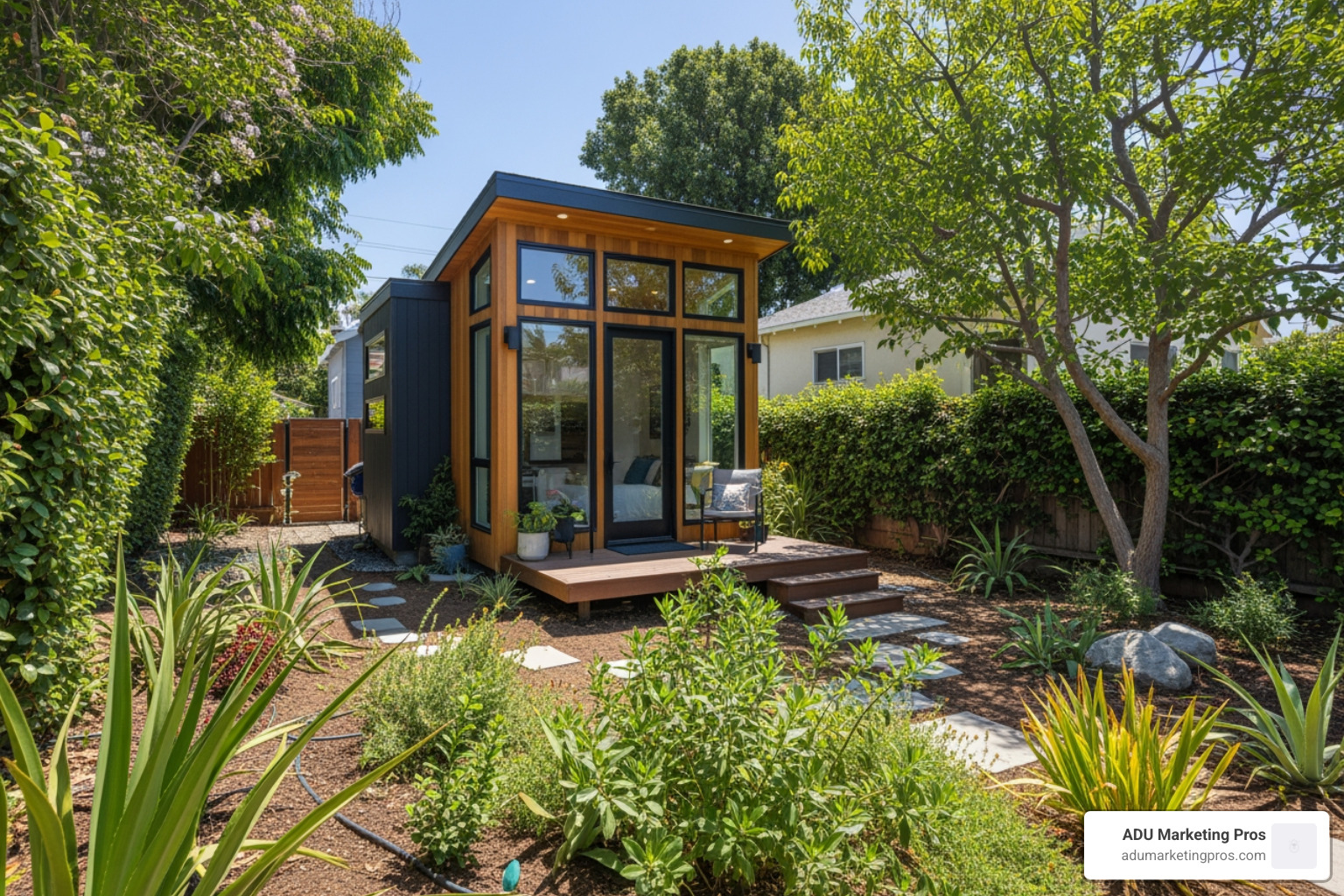
Los Angeles faces a chronic and deepening housing crisis, defined by a severe shortage of homes and a crisis of affordability for its residents. Traditional construction methods, with their slow pace and high costs, cannot build us out of this problem alone. Modular homes los angeles offer a powerful, scalable, and practical solution, both for large-scale development and through the explosive growth of individual Accessory Dwelling Units (ADUs).
Tackling the Housing Shortage and Affordability
To make a meaningful impact on the housing shortage, Los Angeles needs more homes of all types built faster and more affordably. Modular construction directly enables this by delivering high-quality housing in 5 to 9 months, a revolutionary timeline that can fundamentally change the pace of housing development. This speed, combined with the cost efficiencies and predictability of factory production, makes it possible to increase the housing supply at a scale and pace that traditional methods cannot match.
For multi-family developments and community housing projects, the benefits are magnified. Modular construction can cut project timelines by 30-50%, which dramatically reduces carrying costs and allows developers to house residents sooner and recycle capital into new projects faster. This efficiency is a critical component in creating more affordable housing and the “missing middle” housing—like duplexes, triplexes, and small apartment buildings—that can gently increase density across Los Angeles.
The Rise of the Modular ADU in Los Angeles
Accessory Dwelling Units (ADUs), or “granny flats,” have become one of the most popular and effective tools for homeowners to add value and flexibility to their properties, and modular construction is the ideal method for building them. The powerful combination of factory precision, rapid installation, minimal neighborhood disruption, and predictable all-in pricing makes modular ADUs an incredibly attractive option for adding valuable living space.
Homeowners use ADUs for a variety of reasons: to generate significant rental income to offset their mortgage, to provide a private and accessible home for aging parents or adult children, or to create a dedicated home office, art studio, or guest suite. The building process is significantly streamlined with a modular approach. Many builders offer a catalog of pre-designed ADU plans that are pre-approved by the state and familiar to LADBS, which can drastically shorten approval times. For official resources, see the City of Los Angeles ADU information: https://planning.lacity.org/plans-policies/initiatives-and-content/adu.
Because the vast majority of construction happens off-site, the on-site disruption to your home, family, and neighborhood is reduced from over a year to just a few weeks. Companies specializing in prefab ADUs often provide transparent, all-in pricing, typically between $300,000 and $450,000, which covers everything from permits to final installation. Recent state legislation like Senate Bill 9 (SB-9) has further encouraged ADU development by allowing for lot splits and the creation of additional units on single-family parcels. For a state law overview, see California HCD’s SB 9 page: https://www.hcd.ca.gov/planning-and-community-development/housing-laws/sb-9. For an LA homeowner, a modular ADU represents the fastest, most predictable, and least stressful path to expanding their living space, generating income, and significantly increasing their property’s value.
How to Find the Best Modular Home Builder for Your LA Project
Choosing the right builder is the single most critical decision you will make for your modular homes los angeles project. A great partner acts as your trusted guide, managing every complexity from start to finish. The wrong one can lead to frustrating delays, budget-busting costs, and a finished product that doesn’t meet your expectations. Here’s a comprehensive guide to evaluating potential builders and finding a team you can trust.
Key Criteria for Evaluating Builders
When vetting builders, your due diligence should focus on these essential qualifications:
- Deep Local LA Experience: Building in Los Angeles is not like building anywhere else. Your builder must have a deep, proven knowledge of local zoning, LADBS permitting intricacies, specific soil conditions, and the logistical challenges of building on hillside lots or in dense neighborhoods. A builder with a strong LA track record is invaluable.
- A Tangible Portfolio of Completed Projects: Don’t just look at renderings. Ask to see a portfolio of completed projects that are similar to yours in style and scope. Case studies, photos, and ideally, video testimonials from past LA clients demonstrate real-world capability and a history of success.
- Proven Expertise in Resilient Design: Your builder must be an expert in California’s demanding seismic and fire safety codes. Prioritize builders who use high-strength steel frames and non-combustible materials as their standard, not as a costly upgrade. Ask them to explain their specific engineering and material choices for resilience.
- Transparent, All-Inclusive Pricing: A reputable builder will offer clear, comprehensive, and preferably fixed pricing that covers the entire scope of the project. This should include design, engineering, permits, site work, fabrication, delivery, installation, and all interior and exterior finishing. This protects you from the surprise costs that plague traditional construction.
- True Full-Service Offerings: The best builders provide a turnkey solution, managing the entire process under one contract. This single point of accountability is crucial. They should handle everything from the initial feasibility study and design to handing you the keys. This saves you the immense headache of trying to coordinate architects, engineers, contractors, and permit expediters.
Questions to Ask a Potential Builder
Come to your initial consultations prepared with a list of detailed questions. Their answers will reveal their experience and transparency.
- Can you provide a detailed, line-item breakdown of what is included in your all-in price? What is explicitly not included?
- How do you handle unforeseen site conditions (like rock or groundwater), and how are those potential costs managed in the contract?
- What is your change order process, and how are costs for client-requested changes calculated?
- What is your guaranteed project timeline from contract signing to move-in for a home like mine?
- Can I tour a completed home, a home under construction, or a showroom in the Los Angeles area?
- How do you manage the LADBS permitting process? Who on your team is the point person for the city?
- What specific customization options are available for floor plans, window placements, and finishes?
- How, specifically, do your homes address California’s seismic and WUI (wildfire) codes? Please explain the materials and structural systems you use.
- What warranties do you offer on the structure, craftsmanship, and installed components?
- Can you provide at least three references from recent clients in Los Angeles whose projects are similar to mine?
- Do you assist with financing? Can you connect me with lenders who are experienced with your construction loan draw schedule?
Red Flags to Watch Out For
Be cautious and prepared to walk away if you encounter any of these warning signs:
- Vague or Incomplete Pricing: If a builder is hesitant to provide a comprehensive, fixed-price quote, it’s a sign that hidden costs are likely to appear later.
- Lack of a Local Portfolio or References: A builder with no demonstrable experience in the LA market will likely struggle with local regulations, inspections, and logistics.
- Service Ending at Factory Delivery: Avoid companies that are just “box-droppers.” A builder who leaves you to manage permitting, site prep, and installation is not a full-service partner.
- High-Pressure Sales Tactics: A good partner provides information and empowers you to make a confident decision. Be wary of anyone pushing for a quick deposit or creating a false sense of urgency.
- Missing Credentials: Ensure the builder holds a valid California General Contractor’s license and that their factory partner has a current certification from the California HCD.
Conclusion
Modular construction is fundamentally changing the housing landscape in Los Angeles. For homeowners, it offers a compelling combination of speed, cost-effectiveness, and superior quality. You can move into a custom, resilient home in 5 to 9 months, not years, often for a more predictable price than a traditional build.
These homes are engineered for California living, with steel frames and fire-resistant materials to withstand earthquakes and wildfires. Beyond individual projects, modular homes los angeles are a vital tool in addressing the city’s housing crisis, enabling the rapid development of everything from backyard ADUs to multi-family affordable housing.
The future of LA housing is about building smarter, more sustainably, and more accessibly. Modular construction delivers on all fronts, putting quality housing within reach for more Angelenos.
Ready to explore how a prefab ADU can transform your property? Learn more about developing your property with a Prefab ADU in Los Angeles. Your dream home might be closer and faster to build than you ever imagined.