
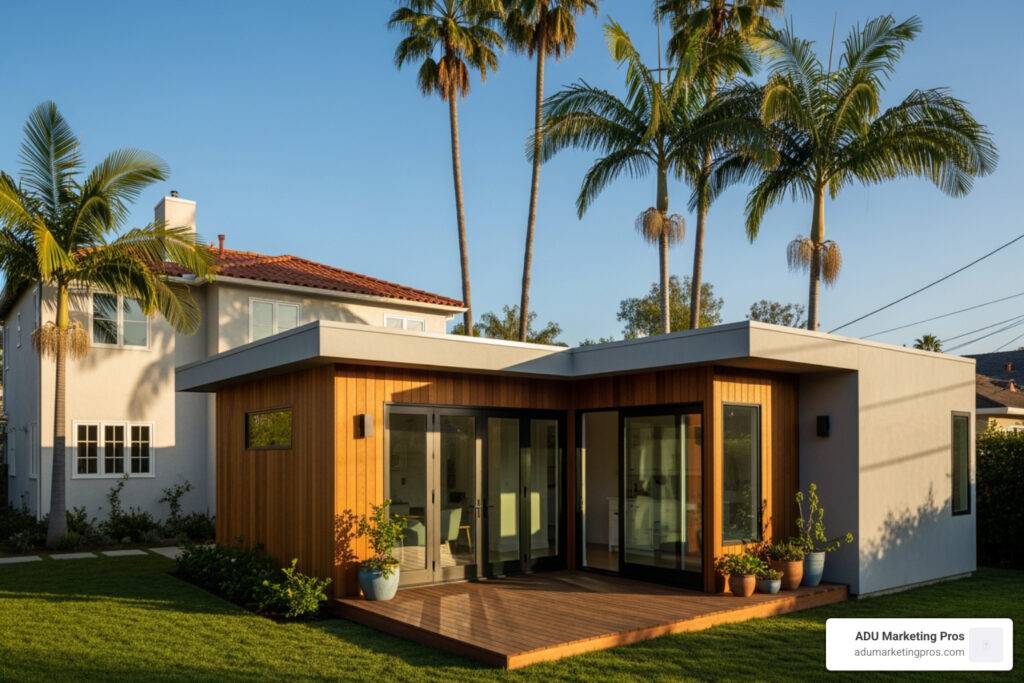
Why Understanding ADU Rules California Is Critical Before You Build
Understanding ADU rules California is the single most critical step in your building journey. Navigating the complex web of state mandates and local ordinances can be daunting, but getting it right from the start can save you tens of thousands of dollars, prevent months of frustrating delays, and ensure your project is a success.
Quick Answer: Key California ADU Rules You Need to Know
- Minimum Size: 150 square feet required statewide for an ‘efficiency unit’.
- Maximum Size: Up to 1,200 sq ft for detached ADUs; local agencies must allow at least 850 sq ft for a one-bedroom and 1,000 sq ft for a two-bedroom ADU.
- Height Limits: 16-25 feet, depending on the ADU type and proximity to transit or multifamily dwellings.
- Setbacks: A minimum of 4 feet from side and rear property lines is the statewide standard. No setbacks are required for conversions of existing structures.
- Parking: One space is the general rule, but numerous exemptions exist, making most projects exempt (e.g., near transit, garage conversions, historic districts).
- Impact Fees: Completely waived for any ADU under 750 square feet.
- Owner-Occupancy: No longer required for ADUs permitted after 2020, with the ban becoming permanent in 2025.
- Permits: Always required. Local agencies must approve or deny a permit within a 60-day ministerial review timeline.
- Local Variations: Cities cannot enact rules more restrictive than state law but can offer more generous allowances or bonus programs.
As a direct response to California’s severe housing crisis, Accessory Dwelling Units (ADUs) have exploded in popularity. Once a niche concept, they are now a cornerstone of the state’s housing strategy. Since 2016, a wave of pro-ADU legislation has led to over 80,000 permitted ADUs, and by 2023, these units accounted for an astonishing 21% of all new homes permitted statewide.
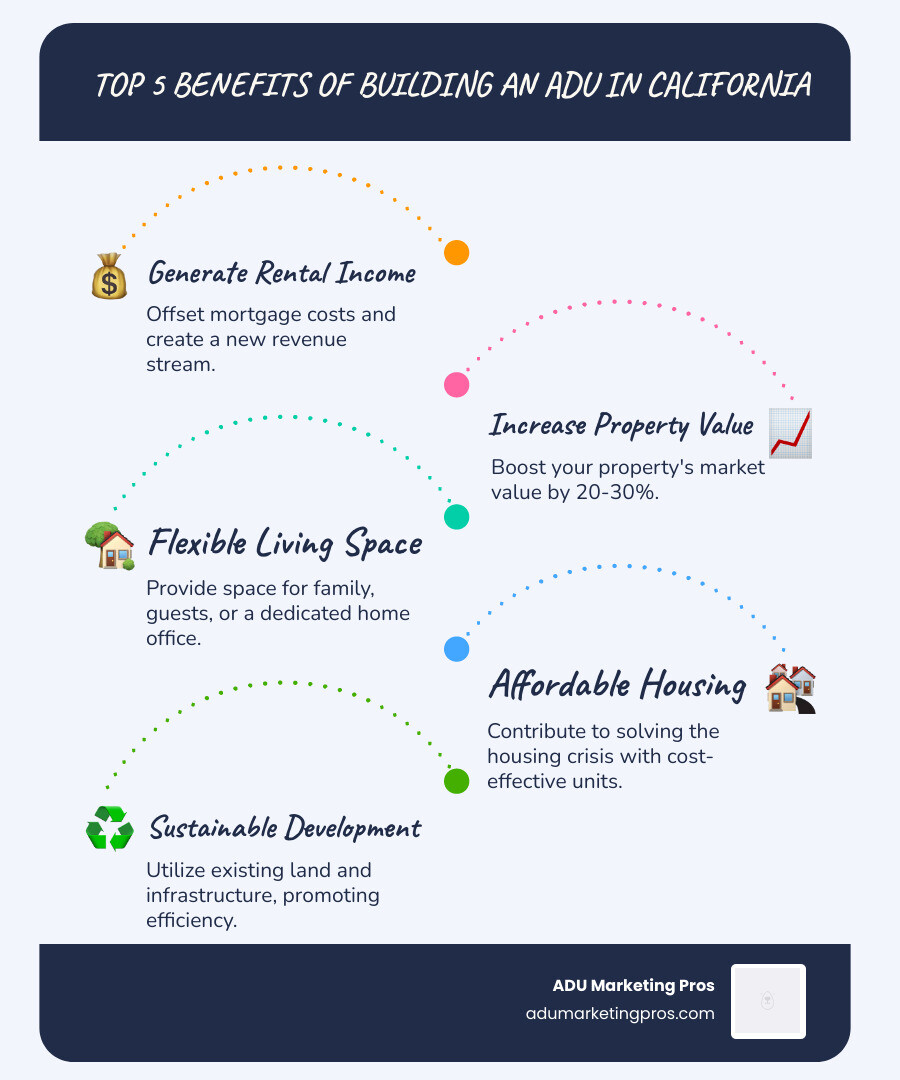
The appeal is undeniable. ADUs can significantly increase property value, generate substantial rental income to offset mortgage payments, and provide flexible, independent living space for aging parents, adult children, or caregivers. They represent an affordable housing solution that leverages existing residential land and infrastructure, with total project costs typically ranging from $70,000 for a simple conversion to over $200,000 for a custom new build.
The primary challenge for homeowners is the fluid nature of California’s ADU laws. The state legislature continues to pass new bills each year to streamline approvals and curb restrictive local practices, with major new rules taking effect in 2025. This guide is your comprehensive resource to confidently navigate the latest state mandates, understand local variations, and successfully complete your ADU project.
Understanding ADU and JADU Fundamentals
To master the ADU rules California has established, you must first distinguish between an Accessory Dwelling Unit (ADU) and a Junior Accessory Dwelling Unit (JADU). While both add living space, they are governed by different regulations.
An Accessory Dwelling Unit (ADU) is a fully independent home on the same lot as a primary residence. It can be attached or detached and must provide complete living facilities, including permanent provisions for living, sleeping, eating, cooking, and sanitation (a kitchen and a bathroom).
A Junior Accessory Dwelling Unit (JADU) is a smaller, more integrated unit. It must be no larger than 500 square feet and created within the existing walls of a single-family home, often by converting a spare bedroom. A JADU must have its own separate entrance and an efficiency kitchen (sink, cooking appliance, counter space, and storage). It can share sanitation facilities (a bathroom) with the primary residence, which significantly reduces construction costs. A key distinction is that owner-occupancy is required for properties with a JADU; the owner must live in either the main house or the JADU.
Understanding these core differences—size, location, kitchen/bath requirements, and occupancy rules—is the foundational first step to successfully navigating ADU rules California.

What are the different types of ADUs?
The flexibility of ADU construction is a major advantage. Homeowners can choose the type that best suits their property, budget, and needs.
- Detached ADU: A new, standalone structure built in the backyard. It offers the most privacy for both the main home residents and the ADU occupants, making it ideal for renters. These are typically the most expensive to build due to the need for a new foundation, structure, and utility connections.
- Attached ADU: A new unit that is built onto and shares at least one wall with the primary home. It has its own separate entrance and functions as an independent unit. This can be more cost-effective than a detached ADU as it may leverage the existing structure.
- Garage Conversion: An extremely popular and cost-effective option. It transforms an existing attached or detached garage into a legal, habitable ADU. This approach leverages the existing foundation, walls, and roof, significantly reducing costs. State law also prohibits cities from requiring replacement parking when a garage is converted.
- Interior Conversion (basement/attic): This method converts existing, underutilized space within the primary home’s footprint, such as a basement, attic, or a large primary suite, into an independent ADU. This is often the cheapest and fastest option but requires careful planning to ensure proper egress, ceiling height, and light.
- Prefab vs Modular ADUs: These terms describe construction methods, not ADU types, but are crucial to understand. Prefab ADUs (often called ‘panelized’ or ‘kit’ homes) have their components built in a factory and are assembled on-site. Modular ADUs are built as three-dimensional ‘boxes’ in a factory, transported to the site, and craned onto a permanent foundation. Both methods can significantly reduce construction timelines and potentially lower costs compared to traditional ‘stick-built’ construction.
Statewide ADU Rules California Homeowners Must Follow
California state law establishes the foundational ADU rules California homeowners can rely on. A critical principle is that state law preempts local ordinances; if a city’s rule is more restrictive than the state’s, it is legally void. This statewide framework is designed to dismantle local barriers and standardize the process, accelerating housing production in high-demand areas like Los Angeles, San Diego, the San Francisco Bay Area, and San Jose.
One of the most important concepts in state law is the requirement for objective standards. Local agencies must review ADU applications based on fixed, quantifiable, and written criteria. They cannot use subjective measures like neighborhood character or design preferences to deny a compliant project. This ensures a predictable and streamlined ministerial approval process.
State law also explicitly prohibits common historical barriers. For instance, cities cannot impose a minimum lot size requirement for ADUs, nor can they apply restrictive lot coverage or Floor Area Ratio (FAR) standards that would prevent the construction of an 800 sq ft ADU. Furthermore, Homeowners Associations (HOAs) are legally barred from unreasonably prohibiting or restricting ADUs, rendering many prohibitive CC&Rs unenforceable.
General Size, Height, and Setback ADU Rules in California
Understanding the physical constraints is crucial for designing your ADU:
- Minimum Size (150 sq ft): All ADUs must be at least 150 square feet, the minimum size for an ‘efficiency unit’ under the California Health and Safety Code.
- Maximum Size (850-1,200 sq ft): State law allows detached ADUs to be up to 1,200 sq ft. Importantly, local ordinances cannot set a maximum size smaller than 850 sq ft for a studio or one-bedroom ADU, or 1,000 sq ft for an ADU with two or more bedrooms. If a city has no specific ADU ordinance, the 1,200 sq ft state maximum applies.
- Can an ADU be larger than the house?: Generally, no. For attached ADUs, the unit cannot exceed 50% of the primary dwelling’s floor area.
- Height Limits (16-25 ft):
- Detached ADUs: A one-story detached ADU has a height limit of 16 feet. This can be increased to 18 feet if the ADU is within a half-mile walking distance of major public transit or on a lot with an existing multifamily dwelling. Some local ordinances may allow for two-story, 25-foot ADUs.
- Attached ADUs: The height limit is generally 25 feet or the height limit of the underlying zone, whichever is lower. It cannot be taller than the primary home.
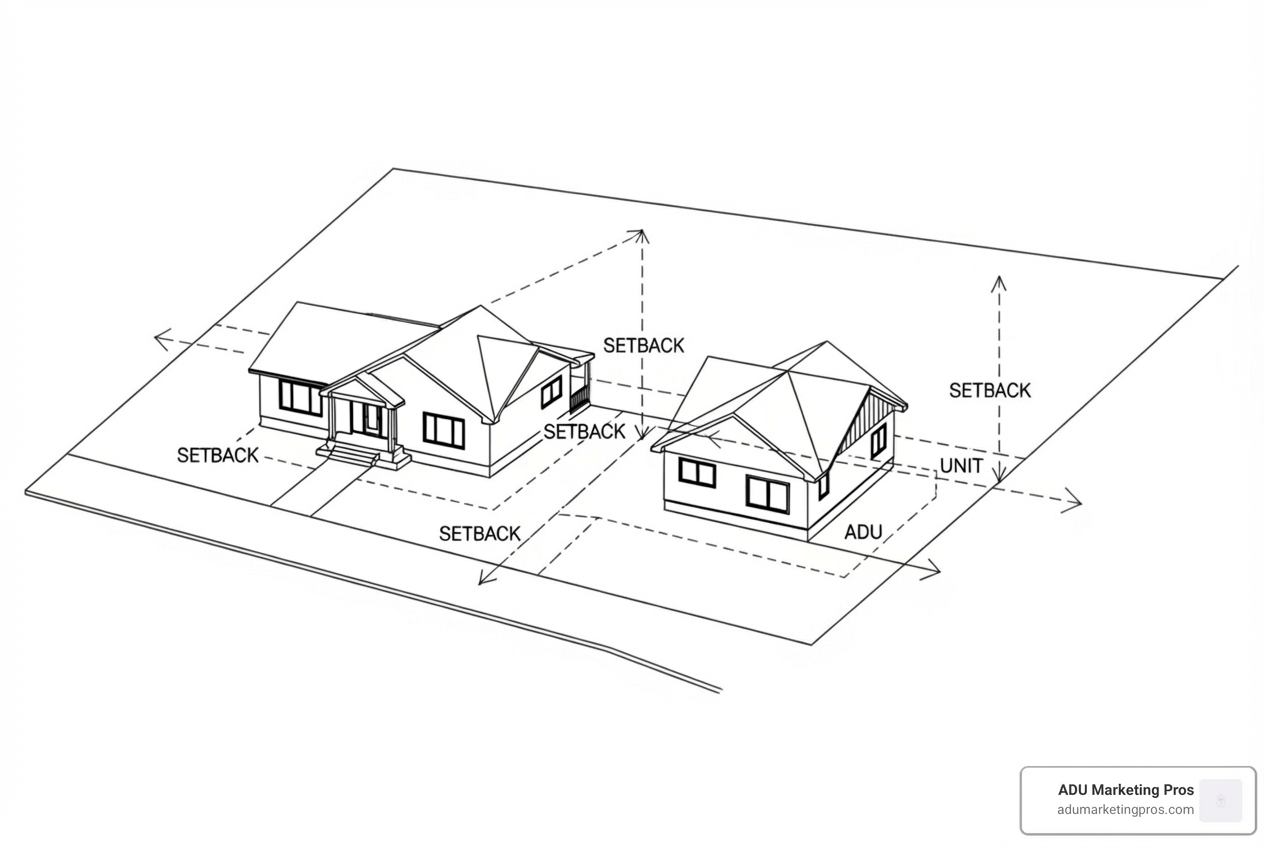
- Setback Requirements (4-foot minimum): The statewide minimum setback is 4 feet from the side and rear property lines. No setbacks are required for an ADU converted from an existing legal structure (like a garage) or for a new ADU built in the same location as a former structure.
- Statewide Exemption ADU (800 sq ft): This is a powerful provision. State law guarantees that every homeowner can build an ADU of at least 800 sq ft, up to 16 feet high, with 4-foot side and rear setbacks. A city cannot use its local development standards (like FAR, lot coverage, or open space requirements) to deny an ADU of this size.
- Multiple Bedrooms and Bathrooms: State law prohibits cities from establishing a maximum number of bedrooms, so ADUs with multiple bedrooms and bathrooms are permitted, subject to meeting building codes.
Parking, Utilities, and Fees
These practical considerations are a major part of any ADU project budget and plan.
- Parking Requirements: One parking space is required per ADU (or per bedroom, whichever is less). However, this requirement is waived in many common scenarios. No parking is needed if the ADU is:
- Within a half-mile walking distance of public transit (a bus stop or rail station).
- Created within an existing primary residence or an accessory structure (i.e., a garage conversion).
- Located in a designated historic district.
- On a property where on-street parking permits are required but not offered to the ADU occupant.
- Within one block of a dedicated car-share vehicle pickup/drop-off location.
- Furthermore, SB 1211 (2025) clarifies that cities cannot require replacement parking for demolished uncovered parking spaces that are in the way of an ADU.
- Impact Fee Waiver: All ADUs under 750 sq ft are completely exempt from local impact fees, which can save homeowners $10,000-$30,000 or more.
- Proportional Fees for Larger ADUs: For ADUs 750 sq ft or larger, impact fees must be proportional to the ADU’s size relative to the primary home. For example, if a 1,000 sq ft ADU is built on a lot with a 2,000 sq ft home, the fees can be no more than 50% of what would be charged for a new primary home. School impact fees are also waived for ADUs under 500 sq ft.
- Utility Connection Rules: For conversions of existing structures, a new or separate utility connection is generally not required. For new detached ADUs, a separate connection may be required by the local utility, but the connection fees must be reasonable and cannot be ‘disproportionate’ to the burden of the unit.
- Solar Panel Requirements: Per the California Energy Code, all newly constructed detached ADUs must have their own solar photovoltaic (PV) system. The size of the system depends on the ADU’s floor area and climate zone. Conversions and attached ADUs are typically exempt.
- Fire Sprinkler Rules: If the primary home does not have fire sprinklers, an ADU built on the same property is not required to have them. SB 897 clarified that adding an ADU does not trigger a requirement to retrofit the main house with sprinklers.
Ownership, Occupancy, and Sale Regulations
Recent laws have dramatically changed the rules around who can live in and own an ADU.
- Owner-Occupancy Requirements (Abolished by AB 976): As of January 1, 2025, AB 976 permanently prohibits cities from requiring the property owner to live in either the primary home or the ADU. This applies to all ADUs permitted since 2020 and gives homeowners complete flexibility to rent out both units.
- JADU Owner-Occupancy Rules: This abolition does not apply to Junior Accessory Dwelling Units (JADUs). For any property with a JADU, the owner must occupy one of the remaining units on the lot (either the primary residence or the ADU, if one exists).
- Separate Sale of ADUs (AB 1033): This groundbreaking 2023 law gives local agencies the option to adopt an ordinance that allows ADUs to be sold separately from the primary home, similar to a condominium. This requires creating a condo map and forming a homeowners association to manage shared elements like driveways and yards.
- HOA Restrictions (Cannot Prohibit or Unreasonably Restrict): State law now voids any covenants, conditions, or restrictions (CC&Rs) in an HOA agreement that prohibit or ‘unreasonably restrict’ the construction or use of ADUs or JADUs. An ‘unreasonable restriction’ would be a rule that makes it infeasible or cost-prohibitive to build an ADU that is otherwise allowed by local ordinance.
The Latest California ADU Legislation: What’s New for 2024-2025?
California’s legislature continues to aggressively refine ADU rules California to combat the housing shortage. The overarching goal is to remove local barriers, standardize the approval process, and make it faster, cheaper, and easier for homeowners to build.
Two foundational reforms are the ministerial approval process and the 60-day permit review timeline. Ministerial approval means that if an ADU application complies with all objective, written standards, the local planning department must approve it. No public hearings, discretionary reviews, or neighbor consent is required. Furthermore, if an agency fails to act on a complete application within 60 days, the permit is automatically “deemed approved” by law.
Key ADU Rule Changes Effective January 1, 2025
The start of 2025 ushers in another set of impactful laws that further expand homeowner rights under ADU rules California:
- AB 2533 (Legalizing Unpermitted Units): This bill creates a new statewide ADU amnesty program. It requires cities to establish a process for legalizing unpermitted ADUs that were built before January 1, 2020. To be eligible, the unit must not be a ‘health and safety’ risk (as defined by specific code sections) and the owner must bring it into compliance. The law limits penalties and fees, making it more feasible for owners to bring these units onto the books.
- SB 1211 (Multifamily Properties, Parking Rules): This law clarifies and expands ADU potential on lots with existing multifamily buildings (e.g., duplexes, apartment buildings). It allows property owners to build up to eight detached ADUs, subject to height and setback limits. It also prohibits cities from requiring replacement parking for uncovered parking spaces that are demolished to make way for an ADU and refines the definition of ‘livable space’ for multifamily conversions.
- SB 1077 (Guidance for Coastal Zones): Building in the California Coastal Zone has always been complex. This law directs the California Coastal Commission and the Department of Housing and Community Development (HCD) to collaborate and develop clear, streamlined guidance for ADU and JADU permitting within the Coastal Zone. This guidance is due by July 1, 2026, and aims to align coastal development rules with state housing goals.
- Impact on Local Control: These laws continue the trend of reducing local government discretion. Any local ordinance that conflicts with these new state mandates will become void and unenforceable on January 1, 2025.
Other Recent Game-Changing ADU Laws
Beyond the 2025 updates, several other recent bills have fundamentally reshaped the ADU rules California landscape:
- AB 1033 (Separate Sale as Condos): Effective in 2024, this law permits cities to pass their own ordinances allowing ADUs to be sold separately from the primary residence. This creates a new path to affordable homeownership but requires the property to be treated like a condominium project, with separate legal descriptions and a homeowners association.
- AB 976 (Permanent Owner-Occupancy Ban): This bill made the temporary ban on owner-occupancy requirements permanent for ADUs permitted after January 1, 2024. This is a huge win for property owners seeking maximum rental income and investment flexibility. This does not apply to JADUs.
- AB 434 (Pre-Approved Plans): To accelerate the permitting process, this law requires all California cities and counties to create a program offering pre-approved, ‘off-the-shelf’ ADU plans by January 1, 2025. Homeowners can use these plans to significantly reduce design costs and permit review times.
- SB 897 (Non-Conforming Conditions, Fire Sprinklers): This important law prevents cities from denying an ADU permit because of a pre-existing, non-conforming condition on the property (e.g., a shed that is too close to the property line), unless that condition poses a direct health and safety risk. It also clarified that adding an ADU does not trigger a requirement to add fire sprinklers to the main house.
- SB 9 (Lot Splits, Duplexes): While technically separate from ADU law, SB 9 is a related housing production bill. It allows for ministerial approval of lot splits and the construction of up to two primary units on each new lot in most single-family zones, creating another avenue for adding density.
- The official California ADU Handbook: This comprehensive guide from the California Department of Housing and Community Development (HCD) is the ultimate source of truth. It is continually updated to reflect new legislation and is an invaluable resource for homeowners, builders, and designers.
The ADU Building Journey: A Step-by-Step Guide
Building an ADU is a major project, but it can be broken down into three manageable phases: planning, permitting, and construction. Following a structured approach is the best way to steer the complex ADU rules California has in place.
Step 1: Planning, Design, and Financing
This initial discovery and preparation stage sets the foundation for your entire project. Rushing this phase is a common and costly mistake.
- Site Assessment and Feasibility: Before you do anything else, evaluate your property. Where is the best location for an ADU? Consider access for construction, privacy for both dwellings, sun exposure, and proximity to utility lines (sewer, water, electric). A professional can help you perform a feasibility study to identify potential challenges early.
- Budgeting: Develop a comprehensive and realistic budget. Total project costs in California typically range from $70,000 for a simple garage conversion to over $200,000 for a high-end custom build. Your budget must account for ‘soft costs’ (design fees, engineering, permit fees) and ‘hard costs’ (labor and materials), plus a 10-15% contingency fund for unexpected issues.
- Assembling Your Team: You’ll need a team of professionals. You can hire an architect or designer to create custom plans, or you can work with a ‘design-build’ firm that handles the entire process from design through construction. The right team will be experienced in local ADU rules California and have a network of trusted engineers and contractors.
- Design (Custom, Pre-Approved, Prefab): Choose your design path. A custom design offers maximum flexibility. Using your city’s pre-approved plans (mandated by AB 434) can save time and money on design and permitting. A prefab or modular ADU can dramatically shorten the on-site construction timeline.
- Financing Options (Loans, Refinance): Most homeowners finance their ADUs. Common options include a Home Equity Line of Credit (HELOC), a home equity loan, a cash-out refinance of your existing mortgage, or a construction loan. Some lenders now offer specific ‘ADU loans.’
- ADU Grant Program: Investigate the CalHFA ADU Grant Program. This state-funded program provides up to $40,000 to reimburse pre-development and non-recurring closing costs for low- to moderate-income homeowners. These are grants, not loans, and can be a game-changer for eligibility.
- State and Local Incentives: Always check for local incentive programs. Cities like Los Angeles, San Diego, and San Jose may offer waived fees, technical assistance, or access to their own pre-approved plans to encourage ADU construction.
Step 2: Navigating Permits and Local Rules
This is often the most intimidating part of the process, but state laws have made it more straightforward than ever.
- Research Local Ordinances: While state law sets the minimums, your local city or county planning department is where you’ll submit your application. Start by thoroughly reading the ADU ordinance on their website.
- Develop a Compliant Plan Set: Work with your designer or architect to create a complete set of construction documents. A full submittal package typically includes a site plan, floor plans, elevations, structural plans and calculations, a soils report, and a Title 24 energy compliance report.
- Submit Application: Submit the complete application package to your local planning and building department. An incomplete submission is the most common cause of delays. Thanks to the 60-day shot clock, the agency must review your application and provide comments or an approval within that timeframe.
- Plan Check and Revisions: The city’s plan checkers will review your documents for compliance with all building, fire, and zoning codes. They will likely return a list of corrections. Your designer will address these comments and resubmit the plans.
- Obtain Building Permit: Once all corrections are made and all fees are paid, the city will issue your building permit. You cannot begin construction until the permit is posted at the job site.
- Finding Your Local City/County Ordinances: Always start with your specific jurisdiction. For example:
- Los Angeles County: The Los Angeles County Planning Department provides resources for unincorporated areas.
- San Diego County: The San Diego County Planning & Development website has a dedicated ADU section.
- San Francisco: The San Francisco Planning Department has unique rules due to the city’s density.
- San Jose: The San Jose Planning, Building, & Code Enforcement Office offers extensive online ADU resources.
- For other cities like Sunnyvale, Palo Alto, Mountain View, and Menlo Park, their individual city planning department websites are the best source of information.
- Special Rules for Historic Districts and Coastal Zones: Properties in historic districts may face additional design review to ensure compatibility. For coastal zones, new guidance (SB 1077) is expected by mid-2026 to simplify the rules, but for now, a Coastal Development Permit is often required.
Step 3: Construction and Final Approval
With permits in hand, you can finally break ground.
- Hiring Licensed Contractors: It is essential to hire a licensed and insured general contractor with specific ADU experience. Get at least three competitive bids, check references thoroughly, and review their past projects. Sign a detailed contract that specifies the scope of work, payment schedule, and timeline.
- Key Construction Phases: The typical construction sequence includes site preparation and grading, pouring the foundation, framing the walls and roof, rough-in of plumbing, electrical, and HVAC systems, insulation, drywall, and finally, the installation of exterior and interior finishes.
- Required Inspections: Throughout construction, a city building inspector will visit the site to conduct multiple inspections at key milestones (e.g., foundation, framing, rough electrical/plumbing, insulation). The contractor is responsible for scheduling these inspections. Each one must be passed before work can continue.
- Certificate of Occupancy: After the project passes the final inspection, the city will issue a Certificate of Occupancy (C of O). This official document certifies that the ADU is legal, safe, and ready to be lived in. You cannot legally rent out or occupy the unit until you have the C of O.
Frequently Asked Questions about ADU Rules in California
We understand that the nuances of ADU rules California can be confusing. Here are clear, direct answers to some of the most common questions homeowners ask.
Do you need a permit for an ADU in California?
Yes, a building permit is always required for any ADU in California. There are no exceptions. Building a new unit, converting a garage, or creating an interior ADU all require a permit from your local city or county building department. A permit ensures the unit is safe, habitable, and meets all state and local building, fire, and energy codes. For homeowners with unpermitted units built before 2020, the new AB 2533 amnesty program provides a path to legalization, but this still involves a permitting process to ensure the unit meets health and safety standards.
How many ADUs can I build on my property?
This depends entirely on whether your property is a single-family or multifamily lot:
- Single-Family Lots: You can build up to two units: one ADU (either attached or detached) and one Junior Accessory Dwelling Unit (JADU). This allows a single-family property to be converted into a triplex (main house + ADU + JADU), with three separate living quarters.
- Multi-Family Properties: The rules allow for multiple ADUs. You can convert existing non-livable space (like storage rooms, boiler rooms, or carports) into at least one ADU, and potentially more, depending on the building’s size. Additionally, you can build up to two new detached ADUs on the property, with some jurisdictions allowing up to eight under SB 1211.
Are ADUs a good investment in California?
Yes, for the vast majority of homeowners, ADUs are an excellent investment in California. In a state with a severe housing shortage and high rents, an ADU can generate significant and reliable monthly rental income. This income can often cover the entire cost of the ADU’s financing and even contribute to the primary mortgage. Furthermore, an ADU adds substantial value to your property, with many studies showing a 20-30% increase in resale value. While initial costs can range from $70,000 to over $200,000, the long-term financial returns, combined with state incentives like waived impact fees and grants, make it one of the most favorable home improvement investments available.
How will an ADU affect my property taxes?
Building an ADU will increase your property taxes, but not on the entire value of your property. California’s Proposition 13 limits tax increases. When you build an ADU, your property will be reassessed, but only the value of the new construction (the ADU itself) will be added to your existing tax basis. Your primary home’s assessed value will not be affected. The tax increase is typically modest and is often far outweighed by the rental income the ADU generates.
Can I build an ADU on a property with a septic system?
Yes, you can build an ADU on a property with a septic system, but it requires an extra step. You must have your septic system evaluated by a qualified professional to ensure it has adequate capacity to handle the additional wastewater load from the ADU. If the existing system is not large enough, you may need to upgrade it or install a new, separate septic system for the ADU. This requirement is determined by your local health or environmental quality department, not the planning department.
Conclusion: Build Your Future with an ADU
Building an ADU in California is a uniquely rewarding journey that offers immense financial and personal benefits. Thanks to a series of progressive state laws, the path to building is clearer and more accessible than ever before. The state’s commitment to streamlining ADU rules California has transformed a once-complicated process into a powerful tool for homeowners to build wealth, house family, and contribute to solving the state’s housing crisis.
By understanding the core rules for size, setbacks, parking, and fees, and by staying informed on recent legislation, you can approach your project with confidence and clarity. State-level incentives like impact fee waivers and grants, combined with local programs in cities like Los Angeles, San Diego, the San Francisco Bay Area, and San Jose, make the financial case for ADUs compelling.
An ADU is far more than just extra square footage; it’s an investment in your financial future, your family’s well-being, and the sustainability of your community. It’s a chance to unlock the hidden potential of your property. Our team at ADU Marketing Pros specializes in connecting homeowners with the industry’s top ADU construction and architecture firms. We empower our clients to showcase their expertise, ensuring you can find the perfect, most qualified partner for your project.
With diligent planning, a solid understanding of the rules, and the right professional guidance, your ADU dream is well within reach.
Learn how to connect with top ADU architects and builders in California.