
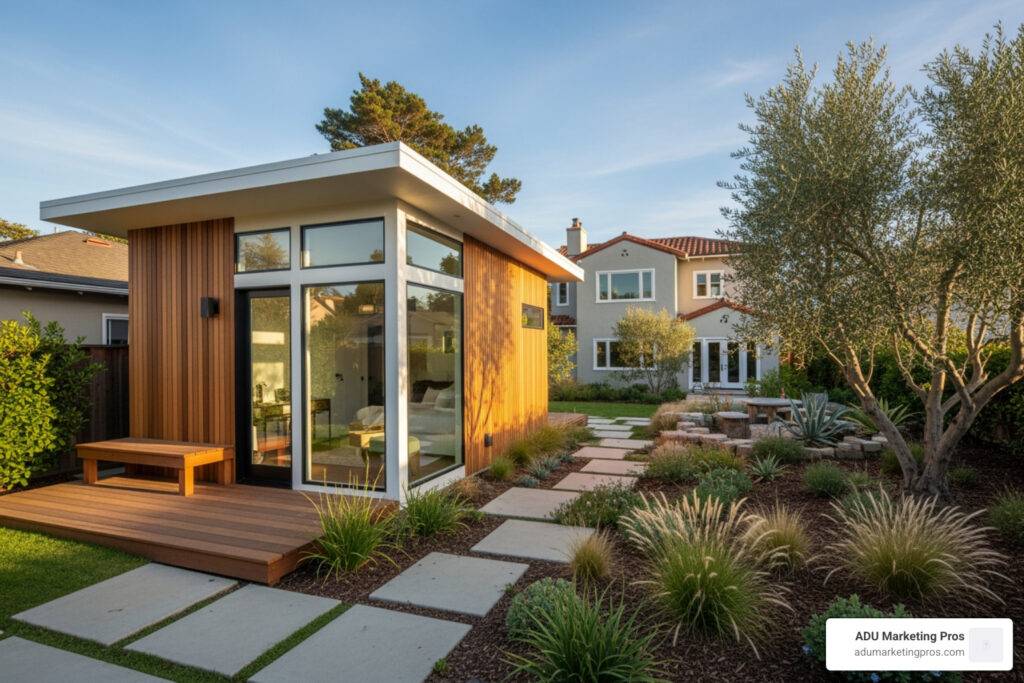
Why Understanding Santa Cruz ADU Rules Matters Before You Build
Santa Cruz ADU rules are your roadmap to adding a valuable, legal dwelling unit to your property—whether you’re looking to house family, generate rental income, or increase your home’s value. With Santa Cruz facing a critical housing shortage driven by university growth and its proximity to Silicon Valley, and with average property values exceeding $629,000, ADUs represent one of the most practical solutions for homeowners to create additional housing while building personal wealth.
This isn’t just about adding a spare room; it’s about creating a tangible financial asset. The income from an ADU can offset your mortgage, fund your retirement, or provide the financial freedom you’ve been seeking. In a competitive market, it’s a powerful tool for leveraging the property you already own.
Quick Answer: Key Santa Cruz ADU Rules at a Glance
- Single-family lots: You can add 1 detached or attached ADU plus 1 JADU.
- Multi-family lots: You can add up to 2-8 detached ADUs, depending on lot size and state law exemptions.
- Size limits: Minimum of 150 sq ft; maximums range from 500 sq ft (JADU) to 1,200 sq ft (detached ADU), varying by type and location.
- Height limits: Generally 16-22 feet in the City or 16-28 feet in the County, depending on the design and setbacks.
- Setbacks: A minimum of 4 feet from side and rear property lines is standard for new construction. No setbacks for converting existing structures.
- Parking: Typically not required for conversions, JADUs, or units near public transit.
- Timeline: The permitting process is now streamlined, often taking just 3-4 months for ministerial approval.
- Fees: Many impact fees are waived for ADUs under 750 sq ft, saving you thousands.
- Short-term rentals: Prohibited on properties with ADUs to ensure units serve long-term housing needs.
The good news? Recent state legislation has dramatically simplified the ADU approval process. What once required months of discretionary review, neighbor notifications, and stressful public hearings now typically needs only a building permit. This is a ministerial process, meaning if your plans meet the objective, black-and-white standards laid out in the code, the city must approve your application within 60 days of submission. This shift provides homeowners with unprecedented certainty and speed.
However, navigating the specific rules can still be complex. The City of Santa Cruz and unincorporated Santa Cruz County have different regulations, particularly around size limits, height restrictions, and coastal zone requirements. Understanding these distinctions is crucial before you invest time and money into planning your ADU. A mistake at this stage can lead to costly redesigns and delays.
This guide breaks down everything you need to know about Santa Cruz ADU rules—from basic eligibility and size limitations to permitting processes and cost considerations. Whether you’re a homeowner exploring your options or an ADU professional helping clients steer the regulations, you’ll find the specific, actionable information you need to move forward with confidence.
Understanding ADUs and JADUs in Santa Cruz
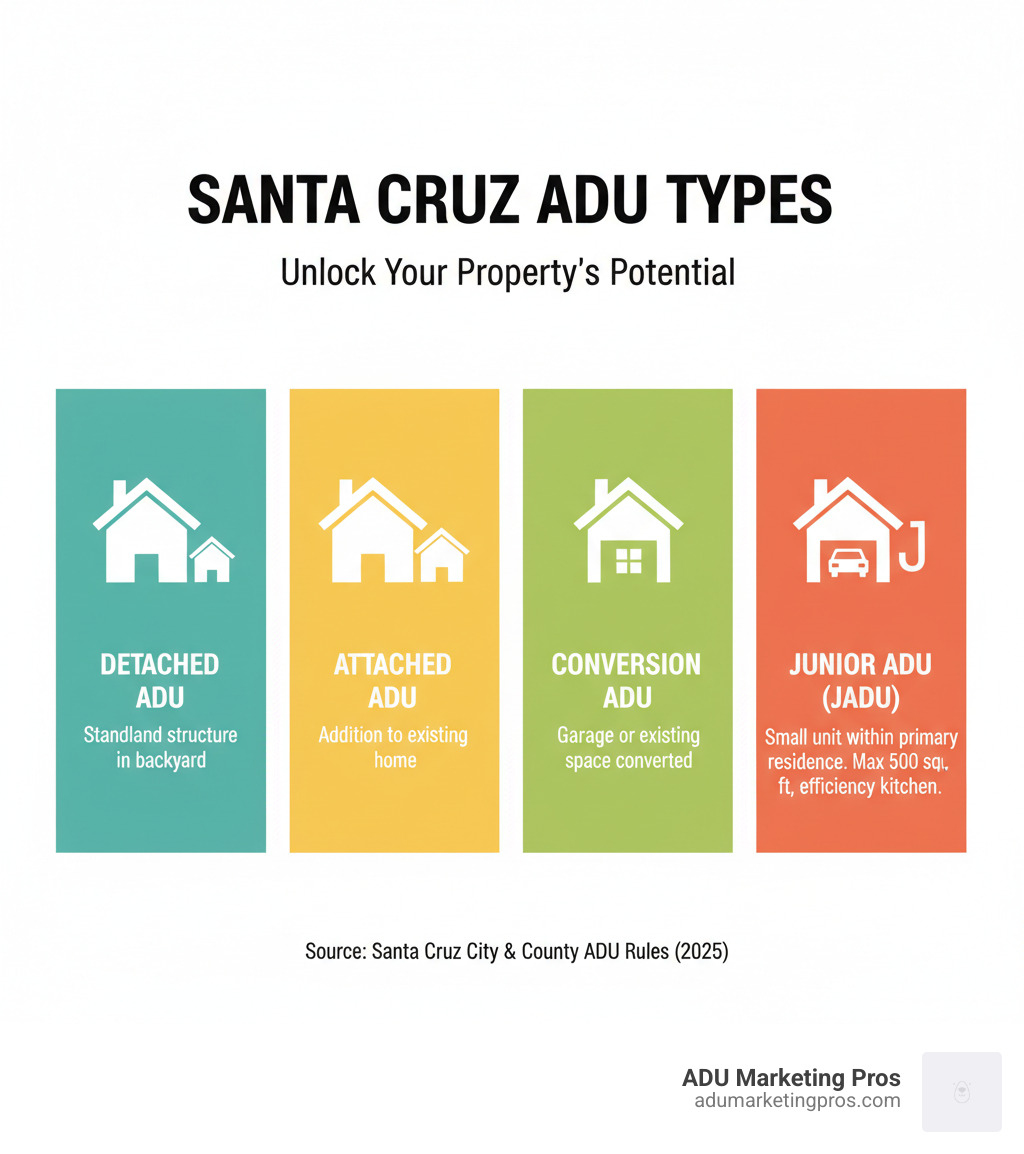
If you’re considering building an ADU in Santa Cruz, the first step is understanding exactly what you’re allowed to build. Santa Cruz ADU rules distinguish between two main types of accessory units: Accessory Dwelling Units (ADUs) and Junior Accessory Dwelling Units (JADUs). While they share similar purposes—adding housing, generating income, and increasing property value—they have important differences that will shape your project’s scope, cost, and timeline.
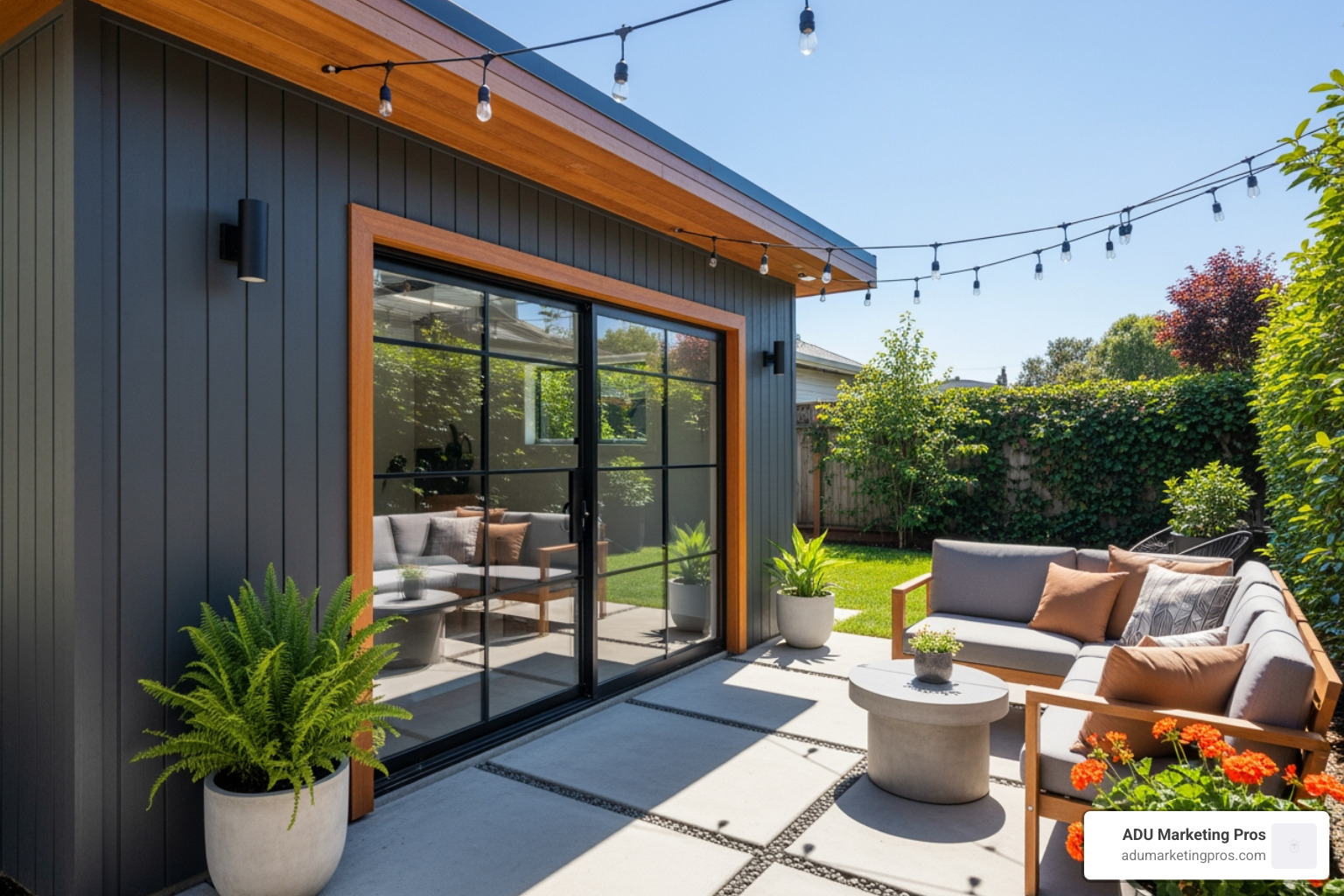
At its most basic, an ADU is a complete, self-contained home on the same property as your primary residence. It has everything you’d find in any apartment or house: a full kitchen with a countertop, cooking appliance, refrigerator space, and sink; a full bathroom with a toilet, sink, and shower or bath; and its own independent exterior access. Think of it as a mini-home that could function entirely on its own, offering total privacy for its occupant.
The financial benefits are compelling. According to Santa Cruz rental market data, studio apartments average around $2,000 per month in rent, while one-bedroom units command approximately $2,900 monthly. A one-bedroom ADU could generate $34,800 in annual gross income. This significant ADU rental income can transform your financial picture—many homeowners see property value increases of 100 times the monthly rental value or more, adding hundreds of thousands of dollars in equity.
Beyond the money, ADUs solve real housing needs. They provide private, dignified space for aging parents who need to be close but want their independence. They give adult children a place to land while saving for their own homes in an expensive market. They can house a live-in caregiver, a local teacher, or a graduate student. They also create dedicated home office space that truly separates work from home life. In a region facing a housing crisis, ADUs are practical, ground-up solutions that benefit everyone.
What is an Accessory Dwelling Unit (ADU)?
ADUs come in three main flavors, and understanding the differences will help you choose the right approach for your property and budget.
A detached ADU is a completely separate structure from your main house—the classic “granny flat” or “casita” in the backyard. It offers maximum privacy and often commands the highest rent and appraisal value. While typically the most expensive to build due to new foundation and utility connections, it provides a truly independent living experience. If you have adequate yard space, a detached ADU can be custom-designed to complement your existing architecture.
An attached ADU shares at least one wall with your primary residence, functioning like an addition or “in-law suite.” This configuration can be more cost-effective than building detached since you’re leveraging existing foundation, walls, and utilities. However, it’s crucial to consider soundproofing and fire separation between the units. Attached ADUs work particularly well when you want easy access between the units—ideal for family members who benefit from being close by.
The conversion ADU transforms existing, permitted space into a legal dwelling unit. This might mean a garage conversion to ADU, turning an unfinished basement into an apartment, or adding a second-story unit above an existing garage. Conversions typically cost less and are completed faster than new construction because you’re working with an existing structure. They are often the quickest route to creating rental income, but may require significant structural or utility upgrades to meet modern building codes.
No matter which type you choose, every ADU must meet the same basic requirements: that full kitchen, complete bathroom, and independent exterior access we mentioned earlier. These aren’t just suggestions—they’re what make an ADU legally distinct from a simple bedroom or guest space.
What is a Junior Accessory Dwelling Unit (JADU)?
If an ADU seems like too much space, investment, or construction, a JADU offers a more compact alternative. Think of it as ADU’s smaller cousin—still a legal dwelling unit, but with some important differences that make it more accessible for many homeowners.
The defining feature of a JADU is its 500 square foot maximum size. That’s considerably smaller than most ADUs, but it’s enough space for a comfortable studio apartment. The entire unit must be contained within the existing walls of your single-family home—no new structures, no additions that expand the building footprint. You’re essentially carving out a legal dwelling from space you already have, like a spare bedroom or part of a large living room.
Instead of a full kitchen, a JADU requires only an “efficiency kitchen.” This must include a sink with hot and cold water, cooking facilities (like a hot plate or microwave), food preparation counters, and storage cabinets. This isn’t a full range with an oven, but it’s enough for someone to prepare meals independently. Even more flexible, a JADU can share a bathroom with the primary dwelling rather than requiring its own separate facilities, further reducing construction costs.
Here’s the big catch: JADUs come with an owner-occupancy requirement. Under Santa Cruz ADU rules, the property owner must live in either the primary dwelling or the JADU itself. You can’t own the property, build a JADU, and rent out both units while living elsewhere. This rule is in place to ensure JADUs are used by homeowners to support their own housing needs, not for purely speculative investment. This requirement does not apply to standard ADUs, making it a key distinction when planning your project.
The JADU option shines for homeowners with larger homes who want to create housing with minimal construction, lower costs, and less disruption. It’s perfect for situations where you want to stay close to family members—perhaps you live in the JADU while an aging parent occupies the main house, or vice versa.
Navigating the Core Santa Cruz ADU Rules: City vs. County
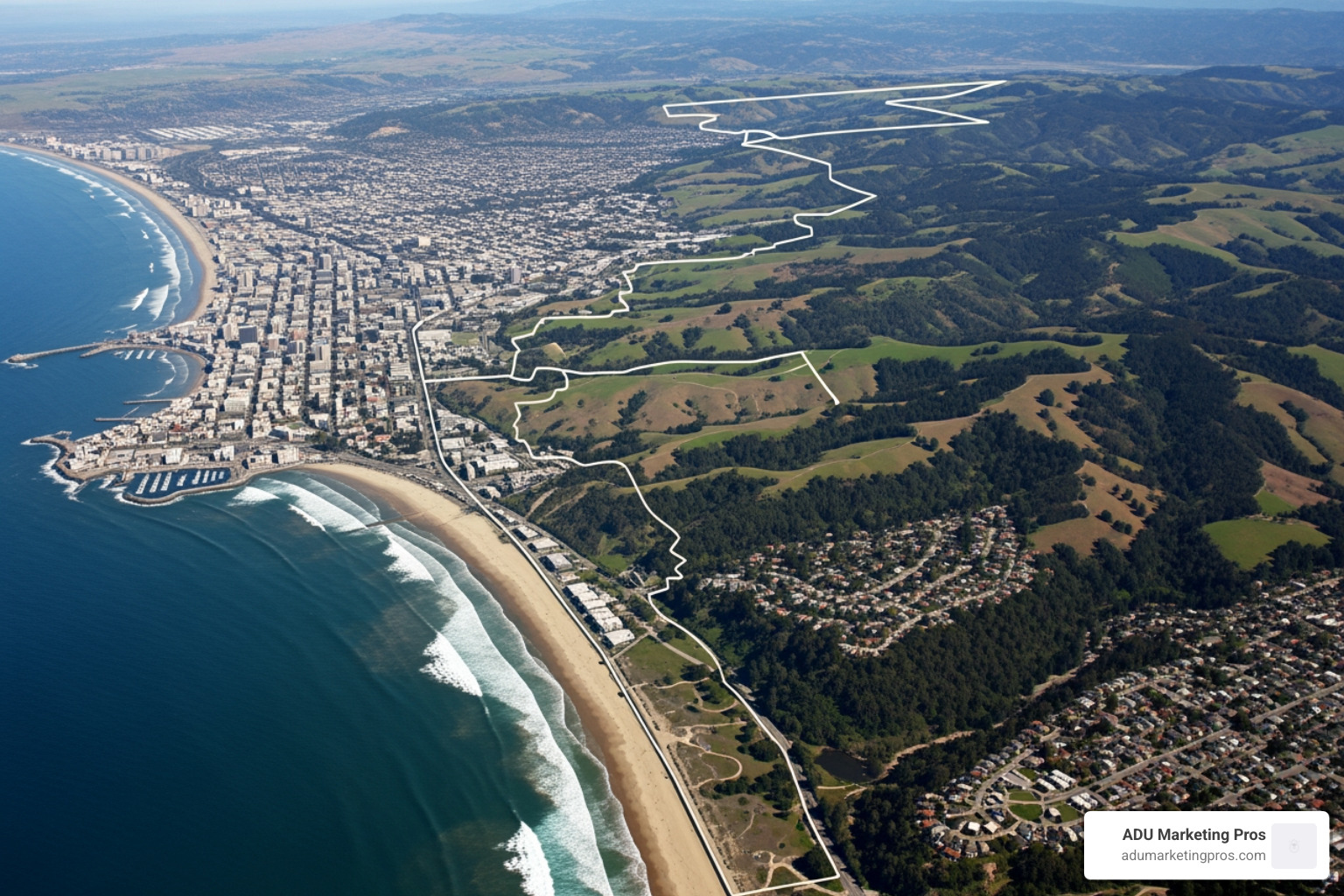
Alright, let’s get down to the nitty-gritty! Planning an ADU in Santa Cruz is exciting, but here’s a super important first step: knowing if your property is inside the City of Santa Cruz or out in the beautiful, unincorporated County. Why does this matter? Well, while California has laid down some great statewide rules, both the City and the County have their own special flavors of Santa Cruz ADU rules that can make a big difference for your project. This section is all about highlighting those crucial differences so you can plan smart.
General Eligibility and Zoning
The good news is, most folks in Santa Cruz have a green light to build an ADU! Under current Santa Cruz ADU rules, if your property is zoned for homes – think residential or even mixed-use areas – and you’ve got a main house already there (or you’re planning one), you’re likely good to go. And guess what? There’s no minimum lot size here. So, whether your backyard is sprawling or snug, you can probably fit an ADU. This is a major departure from old laws that often required huge lots, effectively excluding most urban homeowners. For a broader understanding of how these rules work, check out our guide on ADU Zoning Laws.
Now, a little heads-up for our coastal dwellers. If your property is hugging the coastline, you might be in what’s called a Coastal Zone. This means you might need an extra permit, called a Coastal Permit, which ensures your project doesn’t negatively impact coastal access, views, or habitats. This could involve additional design review or slightly stricter rules. Not sure if this applies to you? The City has a handy GIS Planning Layers List where you can check your property’s status. And while we’re talking about special zones, if your home happens to be in an area with a higher fire risk (a ‘Fire Hazard Severity Zone’), don’t fret! It just means there might be a few extra rules about using fire-resistant materials or maintaining defensible space around your ADU. Safety first, right?
How Many Units Can You Build?
So, how many extra units can you squeeze onto your property? This is where the type of lot you own really matters.
If you have a single-family home, you’re generally allowed to build one ADU and one JADU on your property. This means you can have your main house, a full ADU (like a backyard cottage), and a smaller JADU (like a converted bedroom) all on one lot. For multi-family properties, it gets even more interesting. You can typically add up to two detached ADUs. Plus, you can convert existing non-livable spaces, like old storage rooms or even garages, into ADUs. This allows for the creation of new ADUs equal to up to 25% of the existing units on your property, with a minimum of one conversion ADU always allowed. For example, on an 8-unit apartment property, you could convert two garage bays into two ADUs. Thanks to some state magic, multi-family lots can potentially have up to eight detached ADUs, depending on the number of existing units and specific exemptions. These allowances offer significant opportunities for increasing housing density and options on existing parcels.
Key Restrictions: Short-Term Rentals, Septic Systems, and Separate Sales
Okay, now for a few important boundaries. While Santa Cruz ADU rules are super supportive, there are a couple of things you absolutely need to know before you get too far into your planning.
First up: short-term rentals. We’re talking about those vacation rentals, like renting out your ADU for just a few days or weeks. Nope, sorry! Both the City and the County explicitly prohibit short-term rentals (meaning rentals less than 30 days) for properties with ADUs. The goal is to ensure these new units contribute to the long-term housing supply for local residents, not for tourists. This means properties with ADUs are not eligible to participate in the City’s Short-Term Vacation Rental Program or the County’s Vacation Rental or Hosted Rental programs.
Next, if your home isn’t hooked up to the city sewer and you rely on a septic system, you’ll need to get the system evaluated. Adding an ADU means more wastewater, so you must prove your current system can handle the increased load. This often requires a site evaluation by a qualified professional. If it can’t, you might need to upgrade your current system or even design a new one. You’ll need to contact the Environmental Health Department Septic Requirements early in your process. It’s all about keeping things flowing smoothly and safely!
And here’s a really exciting new change coming in 2025! Thanks to new state laws like AB 1033, you might be able to sell your ADU separately from your main home. Think of it like creating a mini-condo on your property. This process, sometimes called “condo-ization,” requires you to work with a surveyor to create a parcel map, get approval from your city or county, and form a homeowners association (HOA) to manage shared elements like a driveway or yard. It also requires getting your current mortgage lender’s consent. While it involves extra steps, it offers new ownership models and could really change the game for building wealth and creating more affordable homeownership opportunities.
Key Development Standards: Size, Height, Setbacks, and Parking
Now, let’s dive into the specifics that will shape the physical design and placement of your ADU. These are the details that determine how big, how tall, and where on your property your ADU can be built. While state law provides a baseline, the City of Santa Cruz and Santa Cruz County each have their own nuances. Understanding these differences is key to a smooth project and a design that maximizes your property’s potential.
| Standard | City of Santa Cruz (General) | Santa Cruz County (Unincorporated) |
|---|---|---|
| Max Size (Detached) | 1,200 sq ft | 1,200 sq ft |
| Max Size (Attached) | 1,000 sq ft or 50% of main home, whichever is less | 1,200 sq ft or 50% of main home, whichever is less |
| Max Height | 16 ft (single-story); 22 ft (two-story) | 16 ft (within setbacks); up to 28 ft (with larger setbacks) |
| Setbacks (Side/Rear) | 4 ft minimum | 4 ft minimum |
| Parking | 1 space per ADU, but many exemptions apply | 1 space per ADU, but many exemptions apply |
ADU Size Limitations: How Big Can You Build?
Both the City and County allow for generously sized ADUs, but the specifics vary slightly. In both jurisdictions, the minimum size for any ADU is 150 square feet (the size of a small studio), and state law guarantees you can build at least an 800 sq ft ADU regardless of other local limits, as long as it meets height and setback requirements.
- In the City of Santa Cruz, a new detached ADU can be up to 1,200 sq ft. An attached ADU is limited to the smaller of two options: 1,000 sq ft or 50% of the primary home’s living area. For example, if you have a 1,800 sq ft home, your attached ADU could be up to 900 sq ft (50% of the main home). If your home is 2,200 sq ft, your attached ADU is capped at 1,000 sq ft.
- In unincorporated Santa Cruz County, the rules are slightly more expansive. Both detached and attached ADUs can be up to 1,200 sq ft. The attached unit is also limited to 50% of the main home’s size, but the absolute cap is higher. So, on that same 2,200 sq ft home, you could build an attached ADU up to 1,100 sq ft in the County.
Height Restrictions: Building Up, Not Out
Height is another area with key differences between the City and County, offering different strategies for maximizing space.
- City of Santa Cruz: The standard height limit is 16 feet for a single-story ADU. If you’re building a two-story ADU (often above a garage to preserve yard space), the maximum height is 22 feet.
- Santa Cruz County: The rules offer a trade-off. The base height limit is 16 feet if you are building within the minimum 4-foot setbacks. However, you can build taller—up to 28 feet—if you increase your setbacks from the property line. This tiered approach is designed to protect the privacy and sunlight of neighboring properties while still allowing for more substantial two-story designs.
Setback Requirements: Your ADU’s Personal Space
Setbacks define the required distance between your ADU and your property lines. The good news is that state law has made these requirements much more builder-friendly, unlocking potential on thousands of properties.
For most new construction ADUs in both the City and County, you only need to maintain a 4-foot setback from the side and rear property lines. This is a dramatic reduction from older rules that often required 10, 15, or even 20 feet, making it possible to build on lots that were previously considered too small. Front setbacks are typically determined by the existing primary home’s setback, meaning the ADU cannot be closer to the street than the main house.
The biggest game-changer is for conversion ADUs. If you are converting an existing, legally permitted structure like a garage or shed into an ADU, no setbacks are required. You can build within the existing footprint, even if that structure is right on the property line. This is a massive benefit for homeowners with detached garages located at the rear of their properties.
Parking Rules and Exemptions
Worried about adding another parking spot? You probably don’t have to. While the default rule is one new parking space per ADU, the exemptions are so broad that most projects in Santa Cruz qualify for a waiver.
No additional parking is required for your ADU if any of the following apply:
- The ADU is located within a half-mile walking distance of public transit (a bus stop, for example). You can easily document this with a simple map printout in your application.
- The ADU is located within an architecturally and historically significant historic district.
- The ADU is part of the proposed or existing primary residence (i.e., a conversion ADU or a JADU).
- A car-share vehicle is located within one block of the property.
Given Santa Cruz’s extensive public transit network and the popularity of garage conversions, the vast majority of ADU projects do not require adding a new parking space. This not only saves on construction costs but also preserves valuable yard space.