
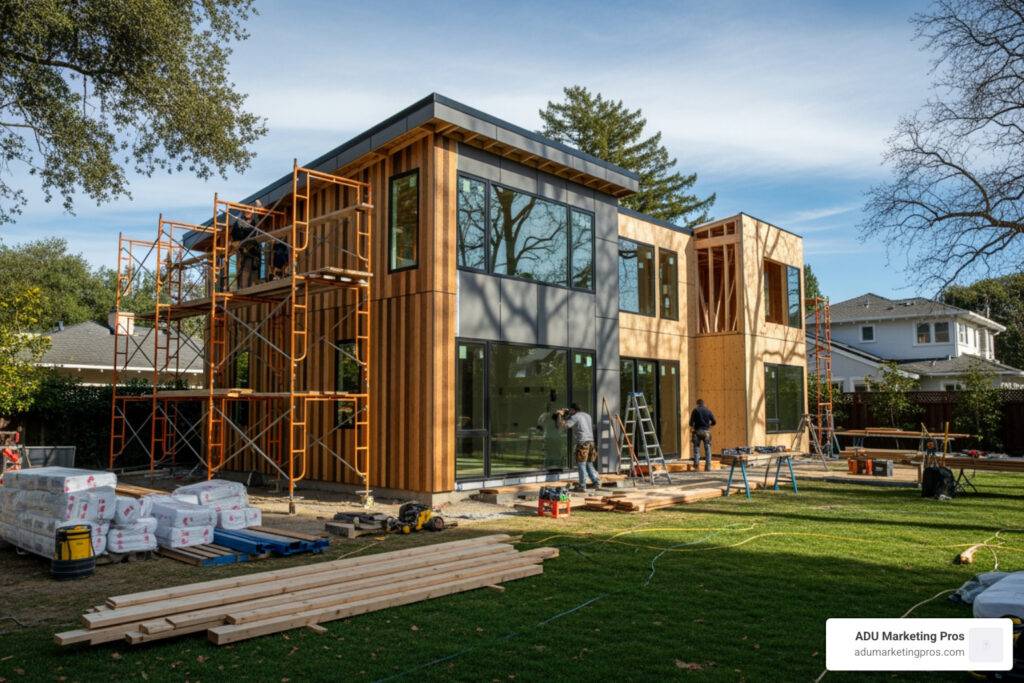
Why Menlo Park ADU Construction is Changing Bay Area Housing
Menlo Park ADU construction is booming as homeowners find the financial and practical benefits of adding a secondary unit. Whether for rental income, family housing, or a home office, understanding local regulations is the first step.
Situated at the heart of Silicon Valley, Menlo Park faces intense housing pressure, driven by its proximity to global tech giants and a consistently high demand for quality living spaces. This has made traditional homeownership and even renting prohibitively expensive for many. In response, Menlo Park ADU construction has emerged not just as a trend, but as a critical piece of the housing solution. These secondary units, often called granny flats or in-law suites, gently increase housing density in established single-family neighborhoods without drastically altering community character. They represent a flexible, sustainable, and financially savvy approach to addressing the local housing shortage one backyard at a time.
Quick Answer: Building an ADU in Menlo Park requires:
- Property eligibility – Single-family properties can build up to two ADUs (one detached, one attached/interior/junior)
- Size compliance – Maximum 1,200 sq ft for standard ADUs, 500 sq ft for JADUs
- Setback requirements – Minimum 4 feet from side and rear property lines
- Height restrictions – 16 feet for single-story, up to 24 feet for two-story units
- Permit approval – Standard 60-day city review process
- Design matching – Exterior must match your primary dwelling’s materials and color
While the rules can seem complex, Menlo Park has streamlined its approval process. Most single-family properties are eligible, and ADUs under 750 square feet are exempt from city impact fees, making projects more accessible.
Driven by high housing demand in the Bay Area, ADUs offer a smart solution. These units can increase property value by 25-35% and provide housing flexibility that traditional additions can’t. This guide covers every step, from zoning and permits to construction and costs, helping you steer your Menlo Park ADU project.
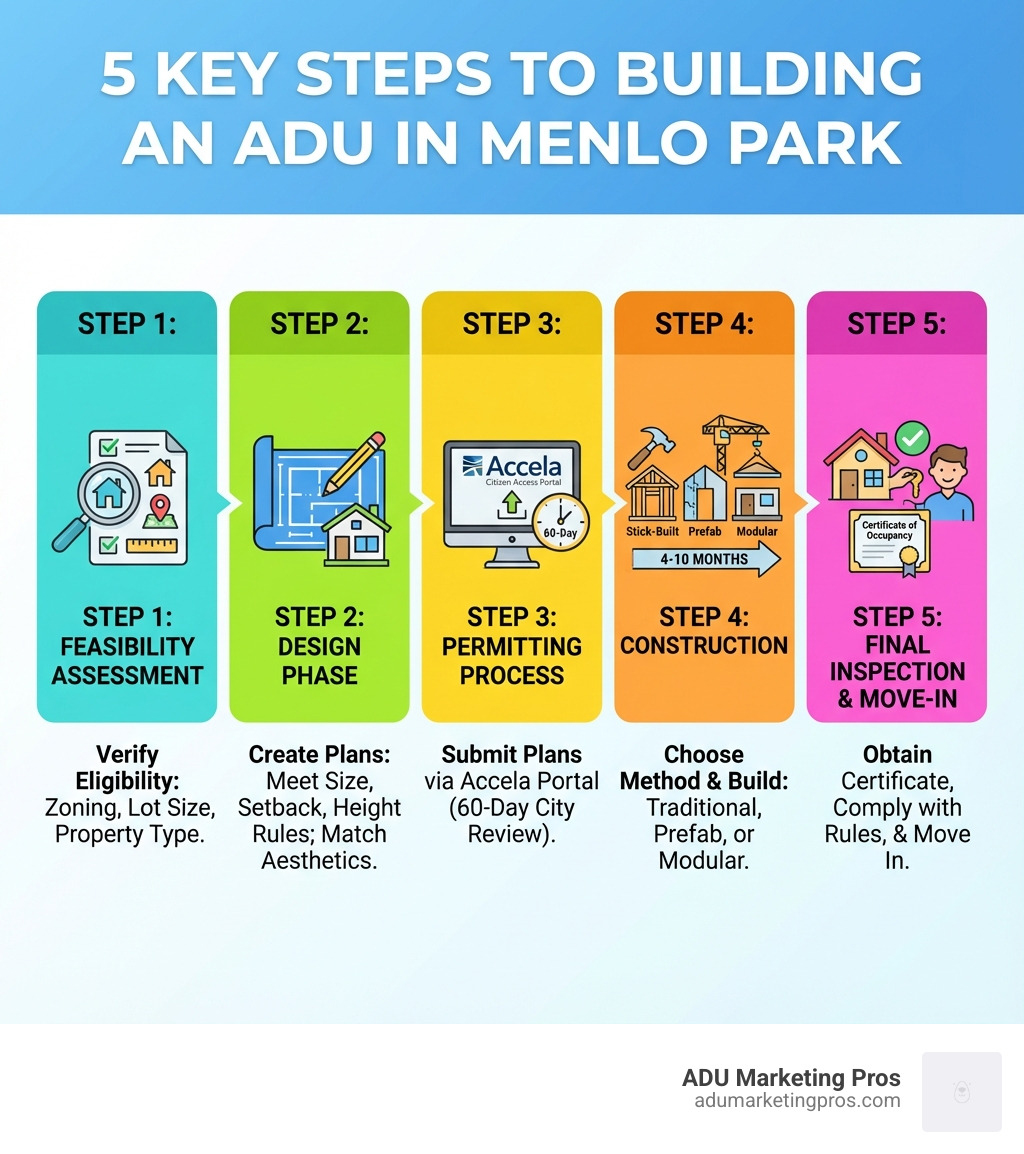
Key terms for Menlo Park ADU construction:
Why Build an ADU in Menlo Park? Understanding Your Options
Building an Accessory Dwelling Unit (ADU) in Menlo Park offers compelling benefits for your property and lifestyle.
A primary advantage is significant rental income. High demand in the Bay Area means an ADU can generate thousands monthly, offsetting mortgage costs or providing financial security. ADUs are also an excellent solution for multigenerational living, offering private, proximate housing for aging parents or adult children.
Beyond housing, an ADU can be a dedicated home office, gym, or guest house, expanding your home’s functionality. A well-built ADU also brings a substantial increase in property value, often 25-35% in urban areas like Menlo Park, making it a wise long-term investment.
As the AARP notes, ADUs are “good for people and places,” creating diverse housing options. Overall, ADUs provide unparalleled housing flexibility to adapt to your changing needs. For more on state-wide rules, see our guide on California ADU Guidelines.
Types of ADUs Allowed
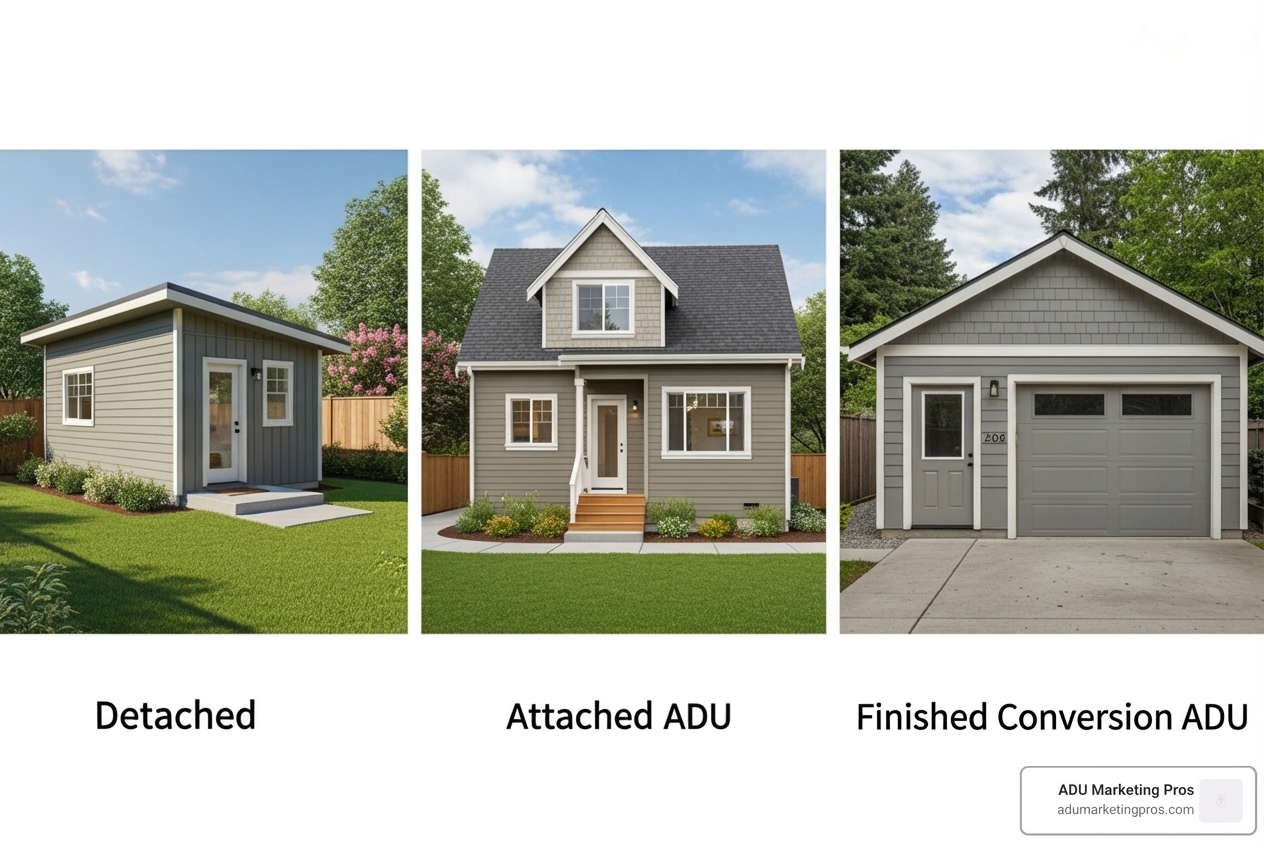
Menlo Park allows several ADU types, giving homeowners flexibility in their Menlo Park ADU construction project.
-
Detached ADUs: Standalone structures, either new or converted from a garage or shed. Single-family properties can build one detached ADU. Height and size rules vary; for example, units up to 800 sq ft have a 16 ft height limit. See 16.79.060(b) for details.
-
Attached ADUs: Units connected to the main house, providing separate living with convenient access.
-
Interior/Conversion ADUs: Created from existing space like a basement or attic. A key benefit is they may maintain existing setbacks, simplifying planning per Section 16.79.050(b)(2)(A).
-
Garage Conversions: A popular, cost-effective option that repurposes an existing garage. Replacement parking is recommended but not always required.
On a single-family lot, you can build up to two ADUs: one detached and one attached, interior, or junior unit, offering incredible flexibility.
ADU vs. Junior ADU (JADU): Key Differences
While both add living space, ADUs and Junior ADUs (JADUs) have distinct regulations in Menlo Park. A JADU is a smaller unit (max 500 sq ft) created entirely within an existing or proposed single-family home.
Here are the key distinctions:
| Feature | Accessory Dwelling Unit (ADU) | Junior Accessory Dwelling Unit (JADU) |
|---|---|---|
| Maximum Size | Up to 1,200 sq ft (1,000 sq ft for attached/detached) | No more than 500 sq ft |
| Location | Attached, detached, or interior to primary dwelling | Contained entirely within existing or proposed single-family dwelling |
| Kitchen Req. | Full kitchen (permanent range, counters, refrigerator, sink) | Efficiency kitchen (cooking facility, food prep, storage) |
| Bathroom Req. | Full, independent bathroom | May share sanitation facilities with primary dwelling |
| Separate Entrance | Required | Required (exterior access) |
| Owner Occupancy | No owner-occupancy requirement for ADUs constructed before Jan 1, 2025 (unless specific conditions apply) | Owner-occupancy required for JADUs constructed after Jan 1, 2020 |
| Parking Req. | One off-street space typically required (with exemptions) | No parking required |
The owner-occupancy rule for JADUs requires the property owner to live in either the main house or the JADU. JADUs also have no minimum lease term, though short-term rentals are prohibited. For full JADU requirements, see Section 16.79.070 of the Municipal Code.
ADUs on Single-Family vs. Multi-Family Properties
Menlo Park’s ADU regulations cover both single-family and multi-family properties, with different allowances.
Single-family properties have generous rules, allowing up to two ADUs: one detached unit and one attached, interior, or junior ADU (JADU). This provides a significant opportunity to maximize your property’s potential. See Section 16.79.050 for details.
Multi-family properties (e.g., apartments, townhouses) can also develop attached and detached ADUs, following specific zoning and architectural guidelines. Details are on the city’s Multifamily residential and mixed-use ADUs page and in Section 16.79.090.
Understanding these distinctions is crucial for any Menlo Park ADU construction project.
The Complete Guide to Menlo Park ADU Construction Regulations
Navigating the rules for Menlo Park ADU construction is key to a successful project. The city follows state ADU laws but has its own zoning ordinances to ensure new units fit the community. ADUs are permitted in most residential zones, including R-1, R-2, and R-3. All projects must comply with the California Building Standards Code and Menlo Park’s Municipal Code, which includes “Reach Codes” for energy efficiency. For a state-level overview, see our guide on California ADU Regulations.
Size, Height, and Setback Requirements
The physical dimensions and placement of your ADU are strictly regulated in Menlo Park ADU construction to ensure they fit into existing neighborhoods.
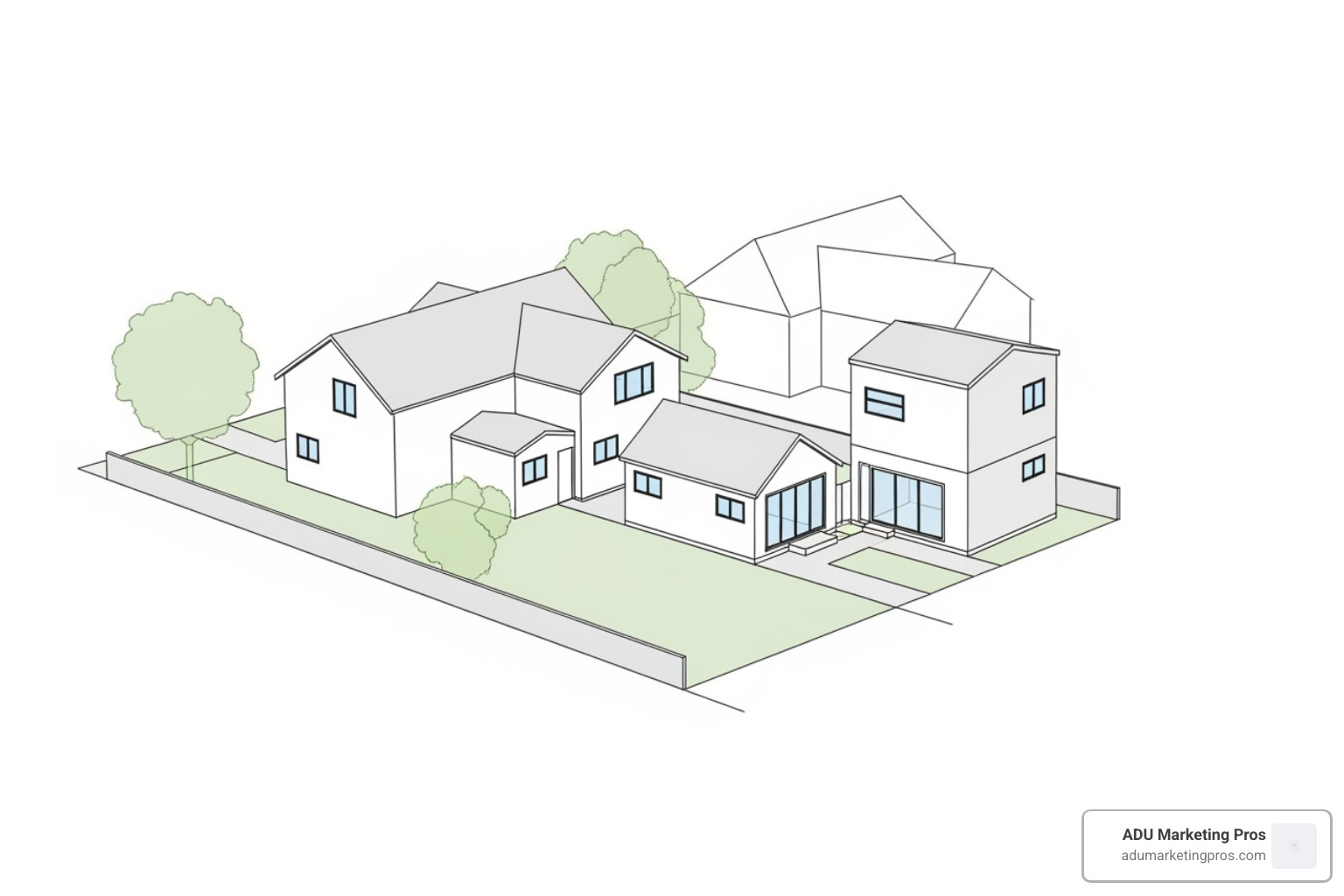
Size Limitations:
- Maximum Size: Standard ADUs can be up to 1,000 sq ft, or 1,200 sq ft under certain state provisions. Attached ADUs cannot exceed 50% of the main home’s floor area unless under 800 sq ft.
- Minimum Size: 150 sq ft.
- JADUs: Limited to 500 sq ft.
Height Restrictions:
- Single-Story: Up to 16 ft.
- Two-Story: Up to 24 ft (with additional requirements).
- Detached ADUs: Height varies by size (e.g., 16 ft for units up to 800 sq ft, 17 ft for 801-1,000 sq ft).
Setback Requirements:
- Side and Rear: Minimum 4 feet.
- Front: 20 feet, matching the primary dwelling.
- Separation: At least 10 feet from the main dwelling.
- Daylight Plane: For detached ADUs over 800 sq ft, a specific “daylight plane” requirement applies. This is an angled plane that begins at a specified height at the property line and slopes up and over the lot. The ADU cannot penetrate this plane. The purpose is to preserve light, air, and privacy for adjacent properties, ensuring that larger ADUs don’t create an overbearing presence.
Generally, ADUs count toward Floor Area Ratio (FAR) and building coverage. However, a new ADU of 800 sq ft or less may exceed these limits, offering greater design flexibility. For full details, see the city’s guide on New Detached Accessory Dwelling Unit (ADU) Requirements.
Parking and Design Mandates
Menlo Park has clear rules for parking and aesthetic integration to ensure ADUs complement the neighborhood.
Parking Requirements:
One additional off-street parking space is typically required per ADU. However, this is waived if the property is:
- Within a half-mile walking distance of public transit.
- Within one block of a car-share vehicle.
- An interior ADU.
Since on-street overnight parking is prohibited in single-family zones, planning for parking is important. For details, see Section 16.79.080.
Exterior Design Matching:
To maintain neighborhood harmony, ADUs must generally match the main dwelling’s exterior design, including:
- Materials and Color: Use similar palettes and materials.
- Roof Pitch: Match the roof style of the main house.
- Siding and Windows: Styles should be complementary.
In addition to aesthetics, all new construction, including ADUs, must comply with Menlo Park’s energy efficiency “Reach Codes.” These local amendments to the state energy code are designed to promote greener building practices. Key requirements often include all-electric new construction (no gas lines), mandating high-efficiency electric appliances for heating, cooling, and cooking. They may also include stricter standards for insulation and solar panel installation. Complying with these codes is not optional and is a critical part of the design and permitting phase.
The goal is a seamless blend with your property’s existing architecture. For firms, showcasing expertise in these local design nuances is a key marketing advantage, an area where specialized Bay Area SEO can help.
Utility Connections and Fire Safety
Proper utility connections and fire safety measures are non-negotiable for any Menlo Park ADU construction project.
Utility Connections:
ADUs must connect to existing water, sewer, and electricity. While connecting to the primary home’s utilities is common, separate meters are often recommended for rental units to simplify billing. All connections must meet local and state codes.
Fire Safety Regulations:
All ADUs must comply with fire safety codes, including:
- Smoke and carbon monoxide detectors.
- Use of fire-resistant materials as required by code.
- Emergency egress from all sleeping areas.
- Fire sprinklers may be required if the main home has them or based on ADU size/location.
The Menlo Park Fire Protection District (MPFPD) may require a separate review and approval before a building permit is issued. This coordination is emphasized in the city’s New Detached Accessory Dwelling Unit (ADU) Requirements.
The A-to-Z Permitting and Building Process
Obtaining a permit is the official gateway to your Menlo Park ADU construction project. The process moves from design to final inspection, and the city has a clear system to ensure all new structures are safe and compliant.
- Prepare Plans: The first step is to hire a qualified architect, designer, or design-build firm. They will create a full set of construction documents, including a detailed site plan, floor plans, elevations, and structural calculations. These plans must meticulously adhere to all Menlo Park zoning ordinances, building codes, and energy “Reach Codes.” A professional familiar with local requirements can prevent significant delays during the review process.
- Gather Documents: Collect supporting documents, which may include a geotechnical soils report, an arborist report if protected trees are nearby, and Title 24 energy calculations, depending on your site and project specifics.
- Submit Application: Submit all plans and documents electronically through the City’s Accela Citizen Access Portal. A complete and accurate submission is crucial to ensure your application is accepted for review without delay.
- City Review: State law requires the city to review and respond to ADU applications within 60 days. During this time, city staff from Planning, Building, and Public Works departments will check your plans for compliance with all relevant codes and regulations.
- Address Comments: It is common for the city to return plans with comments or requests for revisions (known as plan check corrections). Respond promptly and thoroughly with your design professional to keep your project on schedule.
- Permit Issuance: Once all departments have approved the plans, your building permit is issued, and you can officially begin construction.
For detailed questions, the City of Menlo Park provides a comprehensive Frequently asked questions page. For firms, mastering this process is a key selling point, and effective Construction SEO Services can highlight this expertise.
Understanding the Process for Menlo Park ADU Construction
Once permits are secured, the building phase begins. Homeowners have several construction methods to choose from for their Menlo Park ADU construction.
- Traditional Stick-Built: This is the classic construction method where your ADU is built from the ground up, piece by piece, entirely on your property. Pros: It offers unparalleled design flexibility, allowing for complete customization to perfectly match your primary home’s architecture or achieve a unique vision. It also supports local labor and material suppliers. Cons: It typically has the longest construction timeline (6-10+ months) and is more susceptible to weather delays, on-site noise, and disruption. Costs can also be less predictable than with factory-built options.
- Prefabricated (Prefab) / Modular ADUs: These units are constructed in a climate-controlled factory and then transported to your property as complete units or modules for final assembly. Pros: This method offers significantly shorter on-site construction timelines, less disruption to your property, and more predictable costs. Cons: Customization may be more limited compared to stick-built, and transportation logistics to the site can sometimes be challenging.
- Panelized Construction: A hybrid approach where pre-built wall, floor, and roof panels are manufactured in a factory and then assembled on-site. This method combines the speed of prefab with some of the on-site customization flexibility of a traditional build.
Choosing a qualified builder or design-build firm familiar with Menlo Park’s rules is crucial. To find experienced professionals in the region, you can explore options with ADU Builders Bay Area.
Typical Timelines from Design to Completion
Understanding the timeline for your Menlo Park ADU construction project helps manage expectations. While every project varies, here’s a typical breakdown:
- Design Phase: Creating and refining architectural plans typically takes 4-8 weeks.
- Permitting Phase: The city’s 60-day review period means this phase usually takes 2-4 months, including time for any necessary revisions.
- Build Phase: Actual construction can range from 4-10 months, depending on the method (prefab is often faster), complexity, and site conditions.
The total project timeline from design to move-in generally ranges from 10 to 19 months. Factors like project complexity, permit revisions, and material availability can influence this schedule.
It’s wise to build a buffer into your timeline. Common delays in Menlo Park ADU construction can stem from several sources. The city’s plan review might require multiple rounds of corrections, adding weeks or months to the permitting phase. Site-specific challenges, such as poor soil conditions or the discovery of an unexpected utility line, can halt foundation work. Supply chain issues for specific materials (windows, custom cabinetry) or a shortage of skilled labor can also push back completion dates. Proactive communication with your builder and having a financial contingency are the best ways to navigate these potential hurdles.
Key Financial and Site-Specific Considerations
Building an ADU is a significant investment, and understanding the financial implications alongside any unique site conditions is crucial for a successful project in Menlo Park.
Rental Rules: Owner-Occupancy and Short-Term Rentals (Airbnb)
Menlo Park has specific rules for renting your ADU to ensure they provide long-term housing.
- Minimum Lease Term: A 30-day minimum lease is required for ADUs built after January 1, 2020. JADUs have no minimum lease term.
- No Short-Term Rentals: Rentals on platforms like Airbnb or VRBO are not allowed.
- Owner-Occupancy: For JADUs constructed after January 1, 2020, the owner must live in either the main house or the JADU. This requirement will also apply to ADUs built after January 1, 2025.
These rules, detailed in Section 16.79.100 of the municipal code, are vital to understand for compliance.
How ADUs Affect Property Taxes and Fees
Building an ADU will affect your property taxes and involve various fees.
Property Tax Implications:
Your property will not be fully reassessed. Instead, the San Mateo County Assessor’s Office will perform a “blended assessment,” where only the value of the newly constructed ADU is added to your tax bill. Your primary home’s assessed value remains under its original Proposition 13 limit.
Impact Fees:
- City Impact Fee Exemption: ADUs 750 square feet or smaller are exempt from city impact fees, a significant cost saving.
- School Impact Fees: School impact fees may still apply regardless of ADU size. Contact the Sequoia Union School District for specific fee information.
You can get a detailed fee estimate by creating a Building Pre-Application (BPA) through the city’s online portal.
Typical Costs for Menlo Park ADU Construction
The cost of Menlo Park ADU construction varies based on size, materials, and construction method.
Cost per Square Foot:
In the Bay Area, ADU construction can range from $300 to over $700 per square foot. For a quality stick-built unit in Menlo Park, expect costs to be $500+ per square foot.
Key Cost Components:
- Soft Costs: Design and engineering fees can range from $10,000 to $30,000+. This includes architectural plans, structural engineering, Title 24 energy reports, and any required site surveys or reports (geotechnical, arborist).
- Permit & Impact Fees: Budget several thousand dollars for city permits and potentially school impact fees. ADUs under 750 sq ft are exempt from city impact fees.
- Construction Costs: This is the largest expense, covering labor, materials, foundation, finishes, and site work. This is often referred to as the “hard cost.”
- Utility Connections: Costs for trenching and connecting to water, sewer, and power lines can vary widely, from a few thousand to over $20,000, depending on the distance and complexity.
Prefab vs. Traditional Cost:
- Prefab/Modular ADUs can be more cost-effective, with some models starting around $228,000. The factory-built process reduces on-site labor and offers a more predictable budget.
- Traditional Stick-Built ADUs offer more customization but are often more expensive, potentially exceeding $500,000 for high-end units.
Always get detailed quotes and include a 10-20% contingency for unexpected costs.
Special Site Conditions: Flood Zones, Geohazards, and Historic Areas
Certain site conditions in Menlo Park require special attention during Menlo Park ADU construction.
- Flood Zones: If your property is in a flood zone, your ADU must meet specific requirements, such as elevation and use of flood-resistant materials. A FEMA worksheet is typically required.
- Geohazard Zones: A Geologist or Geotechnical Soils Report is mandatory for all new detached ADUs in Menlo Park. This isn’t just a formality; it’s a critical safety measure in a seismically active region. The report analyzes soil stability, liquefaction risk, and proximity to fault lines. Its findings directly inform the structural engineer’s foundation design, ensuring your ADU is built to withstand seismic events. If significant hazards are identified, it could lead to more complex and costly foundation requirements.
- Protected Trees: Menlo Park has a strong heritage tree ordinance to protect its urban forest. If your proposed ADU construction is near a “heritage tree” (typically a large, old, or significant species), you will need an arborist report and a tree protection plan. Construction activities, including excavation for the foundation and utility trenching, must not damage the tree’s root system. Failure to comply can result in significant fines and project stoppages. It’s essential to factor tree locations into your initial site planning.
- Historically Designated Areas: ADU projects on or near historic properties face extra design review to ensure the new structure preserves the site’s architectural integrity.
Thorough due diligence is essential to avoid delays and added costs related to these conditions.
Conclusion
Building an ADU in Menlo Park is a journey with significant rewards. It’s a strategic financial investment that can generate substantial rental income, a practical solution for housing family members, and a way to significantly boost your property’s value in one of the nation’s most competitive real estate markets.
As we’ve detailed, the path from concept to completion involves careful navigation of local regulations—from size and setback rules to design mandates and energy codes. Understanding the permitting process, choosing the right construction method, and anticipating costs and site-specific challenges are all critical steps to success. While the process requires diligence, Menlo Park’s streamlined rules and fee waivers for smaller units make it more accessible than ever.
An ADU is more than just an extra building; it’s an investment in your property’s future, your financial flexibility, and the fabric of the Menlo Park community. Given the complexities of zoning, building codes, and site-specific requirements like geohazards and tree protection, partnering with experienced professionals is not just a recommendation—it’s essential. A skilled team can save you time, prevent costly mistakes, and ensure your project is a resounding success.
For builders and architects, demonstrating a deep understanding of these local nuances is the key to earning a homeowner’s trust. ADU Marketing Pros specializes in helping these top-tier firms connect with clients who are ready to build.
If you’re ready to take the next step and explore the possibilities for your property, we can help you find the right team for the job.