
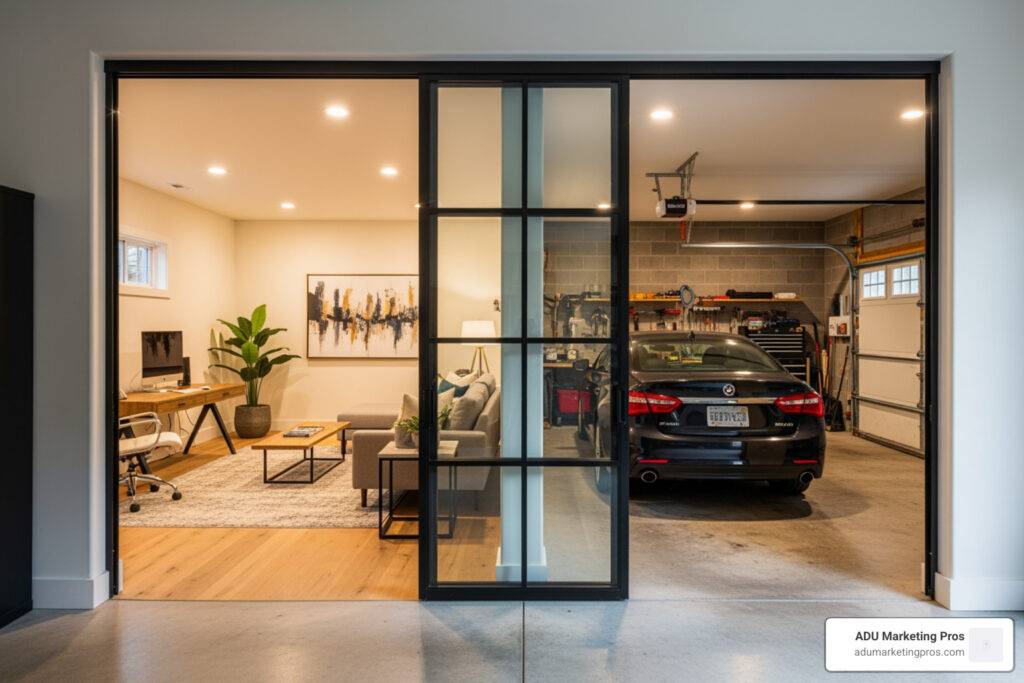
Why Convert Half a Garage Into a Room? The Flexibility Advantage
Convert half garage into room projects are rapidly becoming one of the most requested home improvements because they offer a practical middle ground: you gain valuable living space without sacrificing all your storage or parking.
Quick Answer: Converting half your garage into a room involves:
- Dividing the space with a partition wall (typically front-to-back or side-by-side)
- Adding insulation, drywall, and flooring to create a finished living area
- Installing windows or replacing part of the garage door for natural light
- Upgrading electrical and HVAC to meet building codes for habitable space
- Obtaining permits to ensure legal compliance
- Retaining the other half for parking, storage, or workshop use
Average cost: $6,000–$27,500 (typically $16,500)
Timeline: 3–6 weeks with professionals
Common uses: Home office, guest bedroom, gym, utility room
Many homeowners worry about losing their garage entirely. Some need the extra square footage but still want space for a car, bikes, or tools. A partial conversion solves both problems.
The beauty of this approach is flexibility. You can create a functional home office or guest room while keeping enough garage space for essential storage. We avoid the expense and complexity of a full addition, and we work within your existing footprint.
According to industry data, partial garage conversions are among the most popular remodeling projects. Homeowners especially favor utility rooms, home offices, and downstairs bathrooms because these spaces free up room elsewhere in the house. And unlike a full garage conversion, you preserve at least some of the original function—which can be critical for resale value in neighborhoods where parking is tight.
The cost per square foot runs about $30, making it significantly cheaper than building a new addition. Plus, you’re working with a structure that’s already built, so you skip major foundation and framing work.
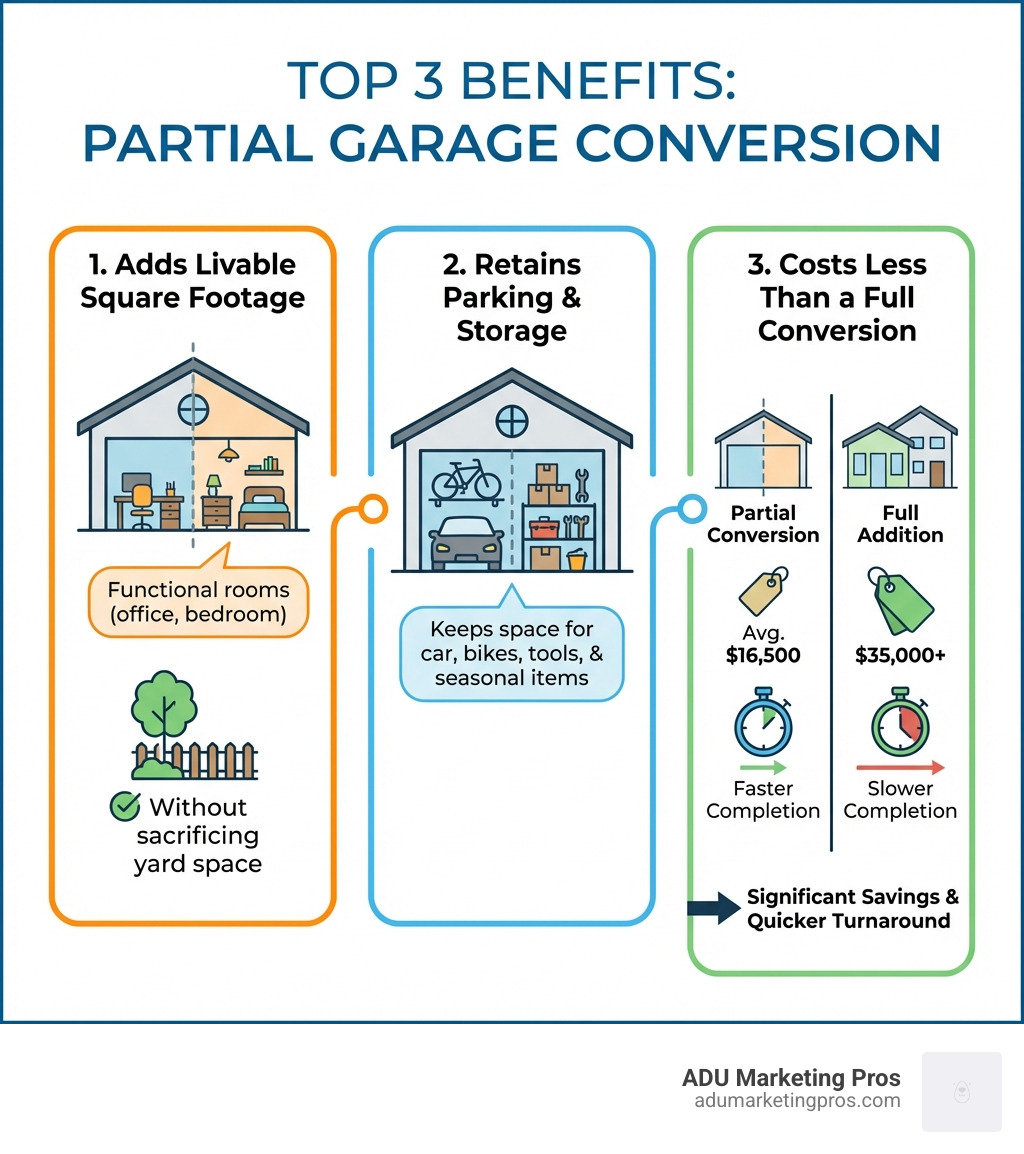
The “Best of Both Worlds”: Why Convert Only Half a Garage?
When we talk about adding living space to our homes, a full home addition can be costly and time-consuming. That’s where the ingenious idea to convert half garage into room comes in. It’s a strategic move that allows us to expand our functional living area without the hefty price tag or the complete loss of valuable garage space. This approach offers a unique blend of benefits, making it one of the most requested conversions in places like Los Angeles, San Diego, and the San Francisco Bay Area.
The primary benefit is obvious: we gain usable square footage within our existing home footprint. This means less disruption to our yard and often a faster, more streamlined construction process. Perhaps we need a dedicated home office, a quiet guest bedroom, or even a compact home gym. By converting just half the garage, we achieve these goals while still retaining a portion of the garage for its original purpose. This could mean keeping space for a car, bikes, tools, or other storage needs that are essential for many California homeowners.
Retaining some garage space is a significant advantage. Many homeowners are “slicing their garage in half,” ensuring they still have room for at least one car. This can be crucial in areas where street parking is limited or where local regulations require a certain number of off-street parking spaces. Keeping a visible garage door, even if the remaining space is shallower, can also help maintain the home’s original curb appeal, which some homeowners find important.
However, like any renovation, there are potential drawbacks. The new room created will be smaller than if we converted the entire garage. This means clever design and multi-functional furniture are key to making the most of the space. Soundproofing can also be a challenge; if one half becomes a bedroom and the other remains a workshop, we’ll need to invest in sound-dampening insulation and potentially double-layered drywall to minimize sound transfer. Furthermore, we must address significant HVAC and insulation challenges. Garages are unconditioned “buffer zones,” not built to the same thermal standards as the main house. This means the walls, ceiling, and concrete slab floor will require substantial insulation and a dedicated heating and cooling solution.
Pros and Cons of a Partial Garage Conversion
To help us weigh the decision, let’s look at a clear comparison:
| Pros | Cons |
|---|---|
| Retains storage/parking | Smaller added room |
| Lower cost | Potential for noise transfer (requires soundproofing) |
| Faster completion | May result in awkward layouts if poorly planned |
| Less permit complexity (potentially) | HVAC & insulation challenges |
| Preserves curb appeal (if done well) | May still impact curb appeal (if not done well) |
| Less disruption to yard | Limits future full conversion options |
Impact on Property Value and Rental Income
A convert half garage into room project can significantly impact our property’s value and potential for rental income, especially in high-demand California markets. Adding functional living space generally boosts a home’s appraisal value. A well-executed conversion can increase a home’s value by as much as six percent, although this is often contingent on the availability of ample street parking in the area. In dense urban environments like Los Angeles or San Francisco, taking away all off-street parking could potentially decrease value, making a partial conversion a smarter choice. The quality of the conversion is paramount; a shoddy, unpermitted job can actually detract from value. However, a professionally finished space that feels like a natural extension of the home is a strong selling point.
Furthermore, converting part of a garage into a habitable room can open up opportunities for Accessory Dwelling Units (ADUs), which are particularly popular and often encouraged by zoning laws in California. If the converted space meets specific criteria—such as having a private entrance, sleeping area, bathroom, temperature control, and a full kitchen—it can qualify as an ADU. This allows us to generate rental income, which can be a substantial financial benefit, potentially offsetting the renovation costs. We’ve seen homeowners in places like San Jose and Palo Alto successfully use these conversions to create income-generating units.
Even if not a full ADU, a quality conversion adds value to our home. The average cost to convert a garage to living space is around $16,500, significantly less than a full home addition. A well-thought-out, quality conversion is considered a good-value strategy, with some high-end projects seeing an 80 percent return on investment when the home is sold. This makes the decision to convert half garage into room not just about gaining space, but also about making a wise financial investment in our property. For more insights on how these improvements can boost your home’s worth, we recommend checking out this guide on increasing home value.
Designing Your Space: Popular Ideas and Layouts for a Partial Conversion
The true magic of a partial garage conversion lies in thoughtful design. The goal is to seamlessly integrate the new living space with the existing home while ensuring the remaining garage portion remains functional.

When we decide to convert half garage into room, the placement of the new partition wall is the first critical design choice. A side-by-side split is the most common approach, dividing the garage down the middle. This typically leaves one full-depth bay for a car or workshop and creates a new room of equivalent depth, making it ideal for maintaining a functional parking space. A front-to-back split, also known as a tandem split, partitions the garage horizontally. This often creates a new room at the back of the garage, offering more privacy and a potential connection to the backyard. The front portion is then left as a shallower storage area for bikes and tools, though it’s usually too short for a car. This allows for dedicated access and entry points for both the new room and the retained garage area. For instance, we might create an 180 sq ft guest bedroom in the back, leaving a 9×19 ft space for a workshop in the front, as some homeowners have successfully done.
Popular Uses for Your Converted Half-Garage
The flexibility of a partial conversion means we can tailor the new room to our specific needs. Here are some of the most popular and practical uses we’ve seen:
- Home Office: With the rise of remote work, a dedicated, quiet workspace is invaluable. This allows for better separation of work and home life.
- Guest Bedroom: A cozy bedroom with a walk-in closet for visitors, especially useful if our main house lacks a spare room. Multi-functional furniture like a sofa bed can maximize comfort and versatility.
- Home Gym or Yoga Studio: No more gym memberships! A personal workout space with rubber flooring and mirrored walls can be a fantastic addition.
- Utility and Laundry Room: Free up space in the kitchen by moving the washer and dryer to a dedicated utility area. Adding a downstairs toilet (WC) here can also transform how our home functions.
- Kids’ Playroom or Teen Hangout: Give younger children a designated play zone or older kids a cool, private spot for gaming and socializing.
- Hobby or Craft Room: A space for creative pursuits, complete with ample storage for supplies and a large workbench.
- Mudroom and Transitional Space: Create a highly functional entry point from the garage with built-in benches, cubbies for shoes and coats, and durable flooring. This helps keep the rest of the house clean and organized.
Maximizing the Remaining Garage Space
Just because we’re converting half of it doesn’t mean the remaining garage space should become a forgotten junk drawer. We can optimize it for maximum utility:
- Smart Storage Solutions: Incorporate built-in cabinetry, vertical shelving, and wall-mounted organization systems. This uses vertical space efficiently and keeps clutter off the floor.
- Overhead Racks: Use the ceiling space for storing seasonal items, luggage, or sporting equipment.
- Workshop Setup: If a workshop is our goal, plan for workbenches, tool storage, and adequate lighting.
- Bike and Gear Storage: Wall mounts or ceiling hoists are excellent for keeping bikes and other recreational gear organized and accessible.
- Maintaining Functionality: Remember to retain enough depth for essential items like lawnmowers or, if applicable, a smaller car, ensuring the space serves its intended purpose without feeling cramped.
How to Convert Half a Garage Into a Room: The Practical Guide
Starting on a convert half garage into room project requires more than just a vision; it demands careful planning, adherence to regulations, and a clear understanding of the construction process. We need to ensure that our exciting new living space is not only beautiful but also safe, legal, and adds lasting value to our home.
Navigating Legal Requirements and Building Codes
Before we even pick up a hammer, navigating the legal landscape is crucial, especially in California’s diverse municipalities like San Jose, Los Angeles, and San Diego. Permits are almost always required when converting a non-habitable space into a living area. This ensures our project meets local building codes for safety, ventilation, and egress.
Here’s what we typically need to consider:
- Permits for Conversion: Our local zoning department is the best resource. Permits can range from a few hundred dollars to over a thousand, depending on the scope and whether it includes plumbing, electrical, or HVAC. In many California cities, garage conversions often fall under Accessory Dwelling Unit (ADU) regulations, even for partial conversions, which have specific requirements. We specialize in helping firms steer these complex regulations for ADU projects.
- Habitable Space Requirements: The new room must meet standards for living spaces, not just storage. This includes:
- Ceiling Height: A minimum of 7-1/2 feet is generally required.
- Egress Windows: For bedrooms, a window large enough for emergency exit is mandatory.
- Insulation R-values: Walls, ceilings, and floors must be properly insulated to meet energy efficiency codes.
- Electrical Codes: Adequate outlets and lighting are needed. “No cord should have to reach farther than 6 feet to reach an outlet.” We may need to upgrade our electrical panel to support the increased load, especially if adding a kitchen or bathroom.
- Plumbing Regulations: If we’re adding a bathroom or kitchenette, plumbing must meet specific codes.
- Certificate of Lawful Development: Obtaining this document can be invaluable, proving our conversion was done legally and to code, which is helpful when selling the home.
For more detailed information on permits, especially for ADU projects in California, we recommend exploring our resources on ADU permit application and ADU electrical requirements.
Budgeting Your Project: How to convert half a garage into a room without breaking the bank
The cost to convert half garage into room can vary widely, but it’s generally a more budget-friendly option than a full home addition. We’ve seen costs range from $6,000 to $27,500, with an average around $16,500. To provide a clearer picture, here’s a potential breakdown of costs for a mid-range partial conversion (approximately 200 sq ft):
| Item | Estimated Cost Range | Notes |
|---|---|---|
| Permits & Plans | $500 – $2,000+ | Varies significantly by city and project scope. |
| Framing & Partition Wall | $1,000 – $3,000 | Includes lumber, fasteners, and labor. |
| Insulation | $500 – $2,500 | Depends on type (batt, spray foam) and required R-value. |
| Electrical | $1,500 – $4,000 | For a new subpanel, wiring, outlets, and lighting fixtures. |
| Plumbing | $2,000 – $8,000+ | Only if adding a bathroom or kitchenette; can be a major cost driver. |
| HVAC (Mini-Split) | $2,500 – $5,500 | For a single-zone ductless system providing heating and cooling. |
| Drywall & Finishing | $1,500 – $3,500 | Includes hanging, taping, mudding, and texturing. |
| Flooring | $800 – $4,000 | Includes subfloor preparation and materials like LVP or tile. |
| Windows & Doors | $1,000 – $5,000 | Cost depends on size, style (e.g., egress window), and quantity. |
| Exterior Finishes | $500 – $2,000 | Siding, paint, and trim to seamlessly match the existing house. |
Note: These are estimates. Labor costs, which can account for 40-60% of the total budget, vary by location.
Several factors influence the final price:
- Scope of Work: A basic conversion with just insulation and drywall will be cheaper than one that includes new plumbing for a bathroom or a kitchenette.
- Plumbing and Electrical Work: Adding these utilities significantly increases costs, as it often involves running new lines and potentially upgrading the main electrical panel.
- HVAC Installation: Extending existing HVAC or installing a new mini-split system adds to the budget.
- Quality of Finishes: High-end flooring, custom cabinetry, or premium windows will naturally raise the price.
- DIY vs. Professional Contractor: A DIY approach can lower labor costs, potentially bringing a basic conversion down to $6,000, but it will take much longer (several months versus 3-6 weeks with professionals) and requires significant skill. For complex projects, hiring a professional contractor is often the wisest investment. About half the cost of a professional conversion is typically labor.
The Step-by-Step Construction Process
Once permits are secured and the budget is set, we can dive into the construction. Here’s a typical step-by-step process:
- Planning and Design: This is where we finalize the floor plan, ensuring it aligns with our vision, budget, and local codes. We recommend having a professional drafter create a detailed floor plan.
- Demolition and Clearing: The first physical step is clearing out the garage and removing any existing features that won’t be part of the new space.
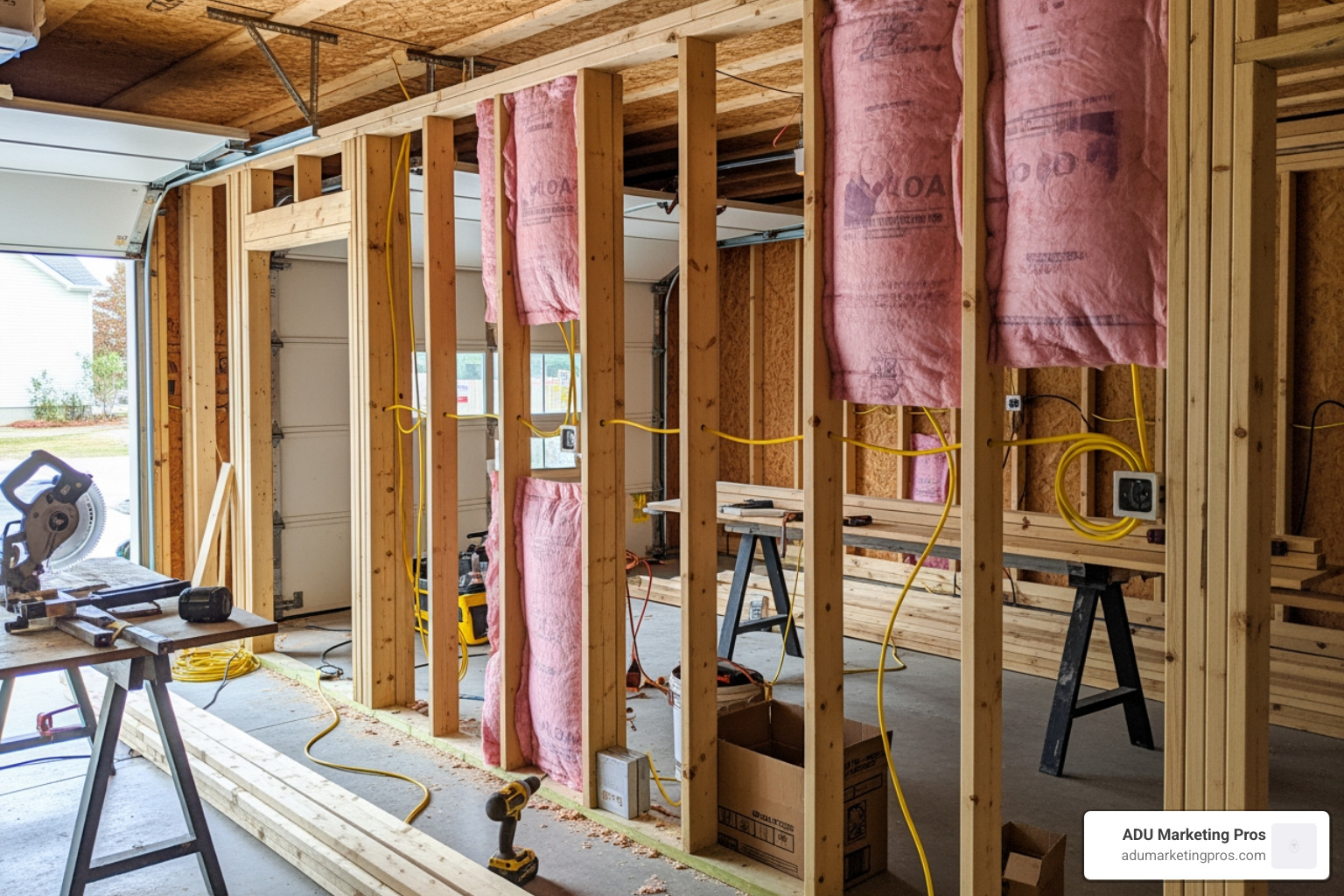
- Framing the Partition Wall: This is the core of a partial conversion. We’ll build a new stud-framed wall to separate the converted room from the remaining garage space.
- Electrical and Plumbing Rough-in: Before closing up walls, all new electrical wiring, outlets, switches, and plumbing lines (if applicable) are installed. This is a critical stage for inspections.
- Insulation Installation: Garages are rarely insulated to habitable standards. We’ll install appropriate insulation (fiberglass, rockwool, or spray foam) in the new partition wall, existing exterior walls, and ceiling.
- Drywall and Finishing: Once insulation and rough-ins are complete and inspected, drywall is installed on walls and ceilings, taped, mudded, and sanded smooth.
- Flooring Installation: Garage floors present a unique challenge as they are typically sloped concrete slabs. We must first address this. The concrete should be sealed to prevent moisture wicking up from the ground. Then, we can either pour a self-leveling compound to create a flat surface or build a raised subfloor with a wood frame and plywood sheathing. A subfloor is often preferred as it creates a warmer, more comfortable floor and provides a cavity for insulation and running wires. Once the subfloor is prepared, we can install the final flooring, such as laminate, engineered wood, tile, or luxury vinyl plank (LVP).
- Painting and Trim: The final aesthetic touches, including painting walls and ceilings, and installing baseboards and door/window trim.
Essential Finishes for a Comfortable and Appealing Space
Converting half a garage into a room isn’t just about adding square footage; it’s about creating a comfortable, functional, and aesthetically pleasing extension of our home. The right finishes make all the difference, transforming the space from a basic box into an integral part of the house.
Creating a Weather-Tight, Comfortable Envelope
Garages are not built for human comfort. To make the new room habitable year-round, we must create a tightly sealed and conditioned envelope.
- Insulation is Non-Negotiable: Garages generally lack insulation. We need to prioritize high-quality insulation in all converted walls (both exterior and the new partition wall), the ceiling, and even the floor. Spray foam insulation is an excellent choice for its superior sealing and thermal resistance, but high-density fiberglass batts or rigid foam boards are also effective options. Proper insulation is key to meeting energy codes and keeping utility bills down.
- HVAC is a Must: The new room will need its own heating and cooling source. While extending existing ductwork from the main house is sometimes possible, it can be inefficient and costly. A ductless mini-split system is often the most practical and efficient solution. These systems provide both heating and cooling, are highly energy-efficient, and allow for precise temperature control of the new zone without major construction. For specialized advice, we often refer to experts like those mentioned at Rapid Heating and Cooling.
- Thorough Weatherization: “Garages weren’t built for insulation, so any openings must be thoroughly weatherized.” This means sealing every crack and gap. We must use high-quality, insulated exterior doors and windows, apply weatherstripping, and use caulk or spray foam to seal around all penetrations for wiring or plumbing.
Letting in Light: Windows, Doors, and Curb Appeal
To banish the dark, gloomy feel of a typical garage, we need to strategically introduce natural light and ensure the exterior looks intentional and attractive.
- Windows and Skylights: Installing new windows is essential for natural light, ventilation, and meeting egress requirements for bedrooms. If exterior wall space is limited, skylights or solar tubes can be a fantastic way to flood the room with daylight.
- Rethinking the Garage Door: This is a critical decision. We can replace the portion of the garage door in front of the new room with an insulated wall and a standard window. For a more dramatic transformation, installing French doors or sliding glass doors can create a beautiful focal point and a seamless connection to the outdoors.
- Maintaining Curb Appeal: The exterior of the conversion must blend with the rest of the home. This means carefully matching siding, brick or stone veneer, trim details, and paint colors. A well-executed exterior makes the conversion look like it was always part of the original home design, protecting and even enhancing property value.
Interior Finishes: Flooring, Lighting, and Soundproofing
The interior finishes are what make the space feel like a true room.
- Flooring Solutions: After leveling the concrete slab or building a subfloor, we can choose from various flooring options. Luxury Vinyl Plank (LVP) is a popular choice for its durability, water resistance, and wide range of styles. Engineered hardwood offers the look of real wood but with better stability in environments with potential moisture. Tile is extremely durable and great for bathrooms or mudrooms, while carpet tiles can add warmth and are easy to replace if stained.
- Layered Lighting Design: Good lighting is crucial. We should plan for a layered approach. Ambient lighting (e.g., recessed cans or a central fixture) provides overall illumination. Task lighting (e.g., a desk lamp in an office or under-cabinet lights in a kitchenette) focuses on specific work areas. Accent lighting (e.g., track lighting on a feature wall) adds style and visual interest.
- Soundproofing the Partition Wall: If the other half of the garage will be used for parking, a workshop, or storage, soundproofing the new partition wall is vital for peace and quiet. We can achieve this by using dense insulation like mineral wool, installing resilient channels to decouple the drywall, or using a double layer of sound-dampening drywall.
Final Checks: Pest Control and Security
Finally, we must address the practical realities of converting a space that was once open to the elements.
- Pest Control Measures: Garages are common entry points for pests. During construction, we must diligently seal all gaps, cracks, and openings. Using rodent-proof mesh over any exterior vents is a smart preventative measure.
- Securing the Remaining Garage: The unconverted portion of the garage still needs to be secure. Ensure any remaining entry doors are solid and have sturdy locks. Upgrading the remaining garage door to an insulated model can also improve the energy efficiency of the entire structure, benefiting both the new room and the garage itself.
Frequently Asked Questions about Partial Garage Conversions
We understand you likely have many questions about starting on a convert half garage into room project. Here are some of the most common ones we encounter:
How much does it cost to convert half a garage?
The cost to convert half garage into room typically ranges from $6,000 to $27,500, with an average around $16,500. However, this can vary significantly based on several factors. A basic conversion might be on the lower end, while adding plumbing for a bathroom or kitchenette, extensive electrical work, high-end finishes, or a new HVAC system can push the budget higher. For example, a project involving adding a kitchen and bathroom could substantially increase the overall cost. Your location within California (e.g., San Francisco Bay Area vs. San Diego) can also influence labor and material prices.
Do you need a permit to convert part of a garage?
Yes, in most cases, you will absolutely need a permit to convert half garage into room. Since you are changing a non-habitable space into a living area, you must meet stringent local building codes for safety, ventilation, minimum ceiling height, and egress (emergency exit routes). This process involves submitting plans and undergoing inspections by your local municipality, whether it’s in Los Angeles, San Jose, or Palo Alto. Ignoring permit requirements can lead to fines, difficulties with insurance, and problems when selling your home. It’s always best to check with your city’s planning department at the outset of your project.
Does a partial garage conversion add value to a home?
Yes, a well-executed partial garage conversion that adds functional living space while retaining at least one parking spot often adds significant value to a home. Especially in competitive California markets, extra square footage is highly valued. Reports suggest a home’s value could increase by as much as six percent, particularly if ample street parking is available. A high-end conversion can even see an 80 percent return on investment when the home is sold. By preserving some garage functionality, we avoid potential negative impacts on property value that can arise from completely removing off-street parking in dense areas. The key is a quality conversion that integrates seamlessly with the rest of the home.
How do I deal with the sloped garage floor?
A common challenge with any garage conversion is the concrete floor, which is intentionally sloped for drainage. To create a level surface suitable for a living space, we have two primary options. The first is to use a self-leveling compound over the existing slab after it has been thoroughly cleaned and sealed. The second, and often superior, method is to build a raised subfloor using a wood frame (often called a “floating floor”). This not only creates a perfectly level surface but also provides a thermal break from the cold concrete, makes the floor feel less hard underfoot, and creates a convenient space to run electrical wiring or plumbing pipes.
Will I need to upgrade my main electrical panel?
It’s a strong possibility. A standard garage may only have one or two circuits for an opener and a few outlets. A new living space requires multiple outlets, dedicated lighting circuits, and potentially power for an HVAC unit, bathroom fan, or kitchenette appliances. A licensed electrician must perform a load calculation to determine if your existing electrical panel can handle this increased demand. If you have an older 100-amp panel, or if your panel is already near capacity, an upgrade to a 200-amp panel will likely be required to meet building codes and ensure the safety of your home.
Conclusion: Is a Partial Garage Conversion Right for You?
The decision to convert half garage into room is a smart and increasingly popular way to expand our living space without the significant investment and disruption of a full home addition. We’ve explored the myriad benefits, from gaining essential functional rooms like home offices or guest bedrooms to retaining valuable storage and parking. This flexibility, coupled with the cost-effectiveness compared to other renovation options, makes it an attractive proposition for many homeowners in California and beyond.
By carefully considering design, navigating permits and building codes, budgeting wisely, and executing the construction process with attention to detail, we can transform an underused space into a cherished part of our home. Whether it’s for a growing family, a work-from-home setup, or simply to improve our lifestyle, a partial garage conversion offers a tangible return on investment, both in terms of property value and daily comfort.
For contractors and architects specializing in these types of projects, standing out in the competitive ADU and conversion market is key. Here at ADU Marketing Pros, we help construction firms attract high-quality leads for projects just like this, ensuring their expertise is matched with homeowners eager to make these valuable home improvements.
To learn more about ADU garage conversions and how to market them, visit our dedicated page: Learn more about ADU garage conversions and how to market them.