
Navigating Santa Cruz Building Permits: Your Essential Guide
Embarking on a construction project in the beautiful coastal region of Santa Cruz is an exciting venture. However, turning your vision into a tangible, safe, and legal structure requires navigating the world of Santa Cruz building permits. This process is not just bureaucratic red tape; it’s a critical framework designed to protect you, your investment, and the community by ensuring all construction adheres to proven safety, structural, and environmental standards. Attempting to bypass this system can lead to severe consequences, including hefty fines, stop-work orders that derail your timeline, and the potential need to demolish unpermitted work. More importantly, it can create significant safety hazards.
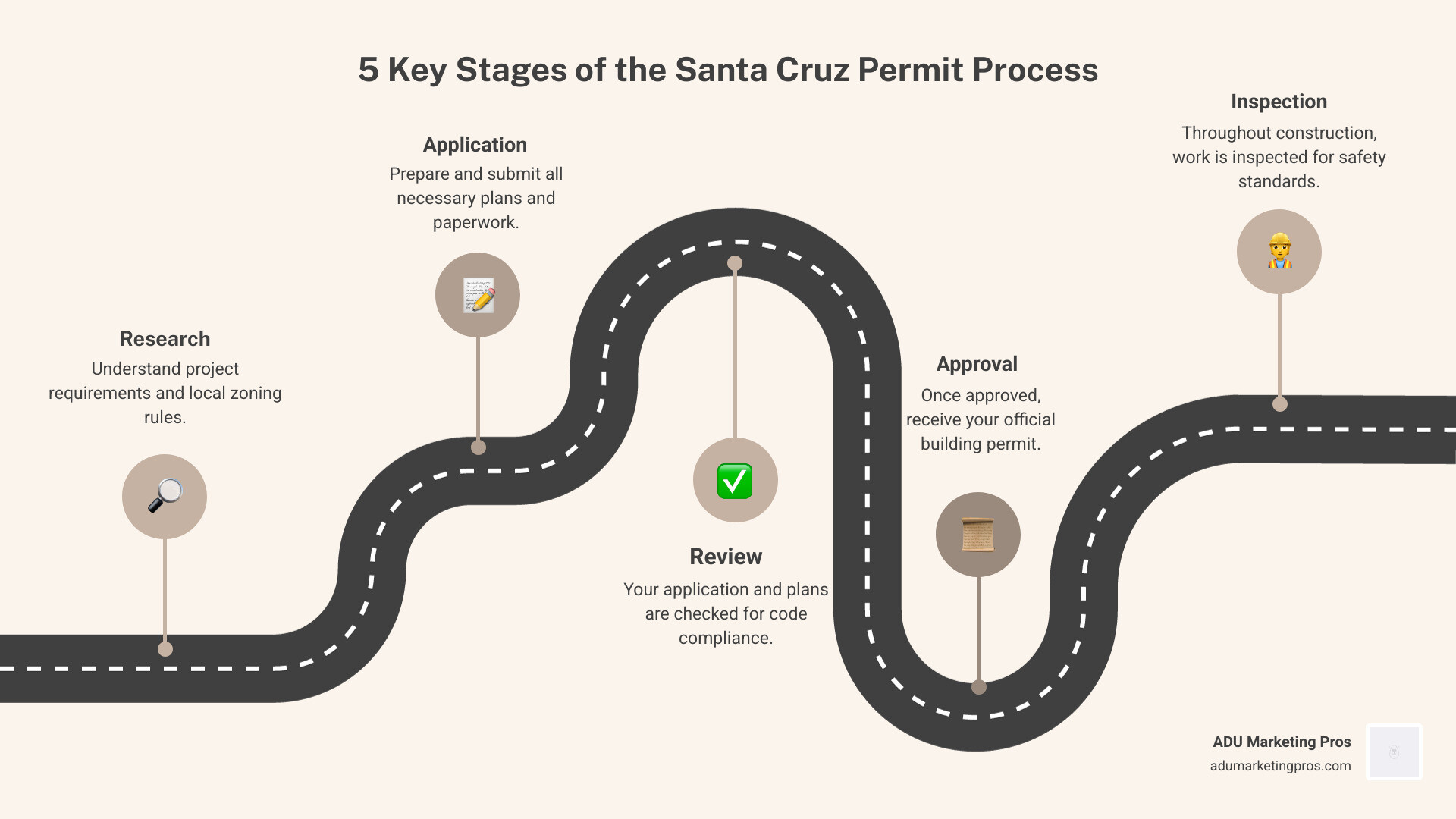
Whether you’re planning to build a new custom home, add a value-boosting Accessory Dwelling Unit (ADU), or undertake a major renovation, understanding the local permit process is the first and most important step. The journey generally involves these core stages:
- Research: Deeply investigate your property’s specific zoning rules, potential constraints, and permit history.
- Application: Meticulously prepare and compile all required plans, engineering documents, and forms for submission.
- Review: Your application undergoes a thorough review by various county or city departments to verify compliance with building codes, zoning ordinances, and environmental regulations.
- Approval: Once all requirements are met and fees are paid, you receive your official building permit, granting you the legal authority to begin construction.
- Inspection: A series of mandatory inspections are conducted throughout the construction process to ensure the work on-site matches the approved plans and meets all safety standards.
This comprehensive guide is designed to be your trusted resource, demystifying each step of the Santa Cruz permit process. We’ll help you identify which jurisdiction governs your project, avoid common pitfalls that cause costly delays, and leverage the powerful online tools available to streamline your application. By the end, you’ll have the knowledge and confidence to ensure your project proceeds smoothly, safely, and in full compliance with all local regulations.
Understanding the Santa Cruz Permit Landscape
Starting a construction project in Santa Cruz requires a clear understanding of its unique regulatory environment. The area is divided into two primary jurisdictions—the City of Santa Cruz and the unincorporated areas of Santa Cruz County—each with its own distinct permitting authority, rules, and procedures. Identifying which jurisdiction your property falls under is the foundational first step of your entire project.
For projects located within the unincorporated county, the Unified Permit Center (UPC) serves as a centralized hub. It was created to streamline the often-complex process of obtaining permits by bringing together staff from the Planning Department, Public Works, and Environmental Health Services. This integrated approach is particularly beneficial for complex projects like new homes, remodels, and Accessory Dwelling Units (ADUs).
Permits are broadly categorized into Building Permits for structural work, Discretionary Permits for projects that require subjective review and public input (like subdivisions or projects with zoning variances), and Environmental Permits to ensure compliance with regulations protecting sensitive habitats. This guide focuses primarily on Santa Cruz building permits. For a deeper dive into ADU-specific regulations, our detailed guide on the ADU Permit Process is an essential resource.
Types of Permits Available
Nearly any project that involves construction, alteration, or demolition requires a Santa Cruz building permit. Understanding the specific type of permit your project needs will clarify the application requirements. Here are the most common categories:
- Residential Permits: This is the most common category for homeowners. It covers new single-family homes, additions, major remodels (especially those involving structural changes or moving plumbing/electrical), and Accessory Dwelling Units (ADUs).
- Commercial Permits: Required for new commercial structures, tenant improvements (e.g., converting a retail space into a restaurant), changes of occupancy, and exterior modifications like new signs.
- EZ Permits: A simplified, expedited process for small, single-trade jobs that don’t require plan review. This is ideal for straightforward replacements and minor alterations. We will explore this in detail later.
- Demolition Permits: Necessary for the partial or complete removal of a structure. This permit ensures that the process is done safely and that utility lines are properly disconnected.
- Grading Permits: Any project involving significant earthmoving (typically over 50 cubic yards) requires a grading permit to prevent erosion, ensure slope stability, and manage drainage.
- Solar & Battery Permits: Specific permits for installing photovoltaic solar panel systems and associated battery energy storage systems, often streamlined through programs like SolarApp+.
- Swimming Pool Permits: Required for the construction of new in-ground or above-ground pools and spas, or for significant alterations to existing ones. These permits address safety features like fencing and electrical bonding.
- Retaining Wall Permits: Necessary for walls holding back soil, typically when they exceed a certain height (often 4 feet measured from the bottom of the footing). This ensures they are properly engineered to withstand soil pressure.
City of Santa Cruz vs. Santa Cruz County
A critical, and often confusing, distinction is whether your property lies within the incorporated City of Santa Cruz or the unincorporated Santa Cruz County. They are entirely separate government entities with different planning departments, building codes, and fee structures. Submitting your application to the wrong jurisdiction is a common mistake that can cause significant delays.
- City of Santa Cruz: Governs all properties within the official city limits. These projects are managed by the City’s Planning and Community Development Department. Their rules are often tailored to a denser, more urban environment.
- Santa Cruz County: Governs all properties in the unincorporated areas, which includes communities like Aptos, Soquel, Live Oak, and the San Lorenzo Valley. These projects are processed through the County’s Unified Permit Center.
Before you begin any research or planning, you must verify your property’s jurisdiction. The most reliable methods are to check your annual property tax statement, which lists the taxing authority, or to use the online parcel lookup tools provided by both the city and the county. Making this verification your first step will save you time and frustration.
For direct assistance and to access jurisdiction-specific information:
Your Digital Toolkit: Online Permit Services
To make the permitting process more accessible and efficient, both the City and County of Santa Cruz have invested in robust digital solutions. These online portals are your primary toolkit for applying for, managing, and tracking your Santa Cruz building permits from the convenience of your home or office. You can use them to submit applications, upload detailed plans, pay fees, schedule inspections, and monitor your project’s progress in real-time.

This section will focus on the County’s online tools, which provide two distinct pathways—EZ Permits and ePlan Review—tailored to the complexity of your project.
EZ Permits for Simple Projects
For small-scale, single-trade projects that do not require complex architectural or engineering plans, the EZ Permit system offers a fast-track, convenient solution. In many cases, you can apply for, pay for, and receive your permit online on the same day. This makes it the ideal choice for straightforward repairs and replacements.
Common projects that qualify for EZ Permits include:
- Reroofing: Replacing the roof covering on an existing structure.
- Water Heater Replacements: Swapping out an old water heater for a new one in the same location.
- Minor Electrical and Plumbing: Simple alterations like adding a circuit or replacing a fixture.
- HVAC Replacements: Replacing a furnace or air conditioning unit with a similar model.
- Like-for-Like Window Replacements: Replacing existing windows with new ones of the same size and in the same opening.
- Siding or Stucco Replacement: Re-siding a home without structural changes.
- Fireplace Inserts: Installing a certified insert into an existing masonry fireplace.
Property owners can use the ePermit service without creating an account, providing a quick path for DIY projects. However, licensed contractors are required to register for an account to pull permits. To begin a simple project, use the Login to the EZ Permit portal to process, pay, and print your permit.
ePlan Review for Complex Projects
For the majority of construction projects, including those requiring detailed architectural and engineering plans, you will use the ePlan Review system. This comprehensive online portal is designed for building and discretionary permits that necessitate a thorough, multi-departmental review to ensure full compliance with all applicable codes and regulations.
Projects that require ePlan Review include:
- New Construction: Building a new home, commercial building, or ADU from the ground up.
- Major Remodels or Additions: Any project that alters the building’s footprint, changes structural elements, or involves extensive interior reconfiguration.
- Most Accessory Dwelling Units (ADUs): Due to their nature as new residential units, nearly all ADUs require full plan review.
- Significant Grading Projects: Earthmoving projects that require engineering and environmental review.
- Commercial Tenant Improvements: Modifications to commercial spaces, especially those involving structural changes or a change in use.
The ePlan portal is a powerful tool that allows you to submit all application materials electronically, check your application status in real-time (including the assigned reviewer’s name and their review due date), and view and respond to required corrections directly within the system. This digital workflow significantly speeds up review cycles compared to traditional paper-based submissions and creates a transparent, centralized record of all communications and revisions.
For these more involved projects, Login to the ePlan Review portal to create an account and begin your application.
SolarApp+ for Solar Projects
To further streamline renewable energy adoption, Santa Cruz County has adopted SolarApp+, an automated online platform for approving residential solar and battery storage projects. Developed by the National Renewable Energy Laboratory, this tool provides a standardized, code-compliant review process that can issue permits in a matter of minutes.
To be eligible for SolarApp+, the project must be for a residential, roof-mounted photovoltaic system and/or a battery storage system that meets specific criteria. The application must be submitted by a licensed B-General, C-10 Electrical, or C-46 Solar contractor who is registered with SolarApp+. This automated system dramatically reduces the wait time for solar permits, making it easier and faster for homeowners to switch to clean energy.
The Application Process for Santa Cruz Building Permits
With your jurisdictional research complete and your digital tools identified, you’re ready to tackle the application for your Santa Cruz building permits. A methodical and thorough approach during this phase is the single most important factor in ensuring a smooth and timely review. The roadmap is straightforward: conduct deep pre-application research, meticulously gather your documents, and submit a complete application package. Let’s break down each critical step.
Step 1: Pre-Application Research
Investing time in pre-application research is your secret weapon to prevent costly redesigns and unexpected delays. This phase is about uncovering every relevant detail about your property before you spend a dollar on design.
First, locate your Assessor’s Parcel Number (APN), the unique identifier for your property found on your tax bill or deed. With your APN, you can obtain the County’s free Parcel Information Report. This document is a treasure trove of vital information, including:
- Zoning and General Plan Designation: Defines the allowable uses and development density for your property.
- Known Constraints: Identifies potential issues such as location within a flood zone, sensitive habitat, high fire hazard area, or geologic hazard zone (e.g., fault lines, landslide risk).
- Coastal Zone Status: Determines if your project is subject to additional review by the California Coastal Commission.
Next, dive deep into your property’s specific Zoning Regulations. These rules govern everything from what you can build to where you can build it, including maximum building height, lot coverage, and setbacks (the required distances from your construction to property lines, roads, and other structures). This is especially critical for ADUs, which are subject to a unique set of ADU Zoning Laws that can significantly influence your design and placement options.
Finally, perform a Permit History Search. For Santa Cruz County, records from 1985 to the present are available online. This search reveals all previously issued permits for your property, which can uncover unpermitted additions or provide valuable context about past construction. If you find discrepancies or need records from before 1985, contact the Zoning Information Line at 831-454-2130 for assistance.
To begin your deep dive, Get a Free Parcel Report.
Step 2: Gathering Your Documents for Santa Cruz Building Permits
With your research complete, the next step is to assemble a comprehensive and accurate set of documents. The specific requirements will vary based on your project’s complexity, but for most Santa Cruz building permits requiring ePlan Review, you will need the following:
- Application Forms: The official, fully completed, and signed application forms from the correct jurisdiction (City or County).
- Site Plans: A detailed, to-scale drawing of your entire property. It must show property boundaries, dimensions, all existing and proposed structures, setbacks from all property lines, easements, driveways, and the location of utility connections (water, sewer/septic, gas, electric).
- Architectural Drawings: A complete set of professional blueprints that includes floor plans, roof plans, exterior elevations, building sections, and construction details. All drawings must be fully dimensioned and compliant with the latest California Building Standards Code.
- Engineering Calculations: For any non-conventional construction, you will need structural calculations and plans stamped by a licensed California engineer. This includes foundations, retaining walls, and framing elements like beams and headers.
- Title 24 Energy Calculations: A report demonstrating that your project complies with California’s energy efficiency standards.
- Contractor Information: The license number and insurance information for your general contractor. If you are acting as your own contractor, you will need to complete owner-builder declaration forms, acknowledging your legal responsibilities and liabilities.
- Project Description: A clear, concise narrative summarizing the scope of your project and explaining how it complies with local zoning and development standards.
For ADU projects, ensure your plans adhere to all specific ADU Building Requirements. All documents must be legible, correctly scaled, and formatted as PDFs for digital submission to the ePlan Review system.
Step 3: Submitting Your Application
Once your document package is complete and double-checked for accuracy, it’s time to submit your application for Santa Cruz building permits. The submission method is determined by your project type:
- Online via EZ Permit Portal: For simple, single-trade jobs like a water heater replacement or reroof. This portal allows for immediate processing, payment, and printing of your permit.
- Online via ePlan Review Portal: For all complex projects, including new homes, major remodels, and ADUs. You will upload your complete set of digital plans and documents here to initiate the formal review process.
- In-Person Appointments: While most submissions are now digital, the Permit Center offers in-person or virtual appointments for those who need personalized assistance or have unique project circumstances. This can be a valuable opportunity to ask clarifying questions before you submit. You can Schedule an Appointment with the Permit Center staff.
Before hitting ‘submit,’ perform one final review of your entire application. Incomplete applications are the number one cause of delays in the permit process. Ensuring every form is filled out and every required document is included will set your project up for success.
After You Apply: Review, Fees, and Inspections
Submitting your application for Santa Cruz building permits marks the beginning of the official review and approval phase. This period involves careful scrutiny by various departments, fee payments, and eventually, on-site inspections. Santa Cruz County provides excellent online tools to track your progress and offers special programs, particularly for ADUs, that can provide significant support.
How to Check Your Santa Cruz Building Permits Status
Once your application is submitted via the ePlan Review portal, you can monitor its journey in real-time. Santa Cruz County’s online tracking system offers a high degree of transparency. By entering your Parcel Number or assigned Permit Number, you can access a detailed status page.
This page shows which departments are currently reviewing your plans, the name of the specific reviewer, and the review due date. This information is invaluable for project planning and for knowing who to contact with questions. If your application status changes to “on hold” or “corrections required,” it means a reviewer has identified issues that need to be addressed. The portal will provide detailed comments explaining the required revisions. Responding to these comments promptly and thoroughly is crucial to keep your project moving forward.
Access the tracking system here: Check your Building Permit Application Status and Permit History.
The Plan Review and Inspection Cycle
The post-submission process follows a structured cycle:
- Plan Review: After a pre-screening to ensure the application is complete, your plans are routed to all relevant departments. This typically includes Planning (for zoning compliance), Building (for structural and life safety), Public Works (for grading, drainage, and road access), and Environmental Health (for water and septic systems).
- Corrections Loop: Each department reviews the plans concurrently. If revisions are needed, they will issue comments. You (or your architect/designer) will then need to revise the plans and resubmit them. This loop may repeat until all departments are satisfied that the plans meet all codes and regulations.
- Permit Issuance: Once all departments have approved the plans, you will be notified that your permit is ready to be issued. You will need to pay the final permit fees, and your licensed contractor (or you as an owner-builder) can pull the official permit.
- Inspections: Construction can now begin. However, you must schedule a series of mandatory inspections at critical stages of the project. An inspector will visit the site to verify that the work being done matches the approved plans and complies with building codes. Common inspections include foundation, framing, plumbing/electrical/mechanical rough-in, insulation, and a final inspection upon completion.
Passing all required inspections is necessary to “finalize” your permit and receive a Certificate of Occupancy, which officially certifies the space as safe and legal to use.
Understanding Permit Fees and Payments
Permit fees for Santa Cruz building permits are a significant project cost and should be budgeted for early. These fees cover the county’s cost for plan review, administration, and the multiple inspections required during construction. Fees are calculated based on the project’s valuation, size, and complexity.
To help with budgeting, Santa Cruz County provides a Residential Fee Estimator that can give you a ballpark figure for common projects like additions and ADUs. Be aware that this is only an estimate, and the final cost may vary. In addition to the primary building permit fees, your project may also be subject to other impact fees, such as those for schools, parks, or traffic mitigation.
The County offers convenient online payment options for all fees. Note that online payments made with a credit card are subject to a 2.29% convenience fee charged by the third-party payment processor.
For fee estimates and online payments, visit: Pay Permit Fees Online. For a comprehensive look at ADU-related costs, see our guide on ADU Permit Cost California.
ADU Programs and Incentives
Recognizing the need for more housing, both the City and County of Santa Cruz have established programs to make ADU development more accessible and affordable.
The County ADU Incentives Program, run in partnership with the nonprofit Hello Housing, is a remarkable resource. It provides free, dedicated project management support to eligible homeowners. This expert guidance covers the entire ADU lifecycle, from navigating design and permitting to selecting a contractor and overseeing construction. Apply for the County’s ADU Incentives Program to see if you qualify for this invaluable assistance.
The City of Santa Cruz Pre-Approved ADU Program is being developed to comply with state law AB 1332 and is set to launch by January 1, 2025. This program will feature a gallery of pre-approved ADU building plans from various architects and designers. By choosing one of these designs, homeowners can benefit from a dramatically streamlined 30-day review process and significantly lower permit costs. This initiative removes major barriers to entry, aligning with statewide efforts detailed in the California ADU Regulations.
Frequently Asked Questions about Santa Cruz Building Permits
Navigating the permit process can bring up many questions. We’ve compiled answers to some of the most common inquiries about Santa Cruz building permits to help you proceed with clarity and confidence.
How long does it take to get a building permit in Santa Cruz?
The timeline for obtaining Santa Cruz building permits varies dramatically based on the project’s scope and the quality of the application.
- EZ Permits: For simple, single-trade jobs, you can often receive your permit online the same day you apply.
- ePlan Review: For complex projects like new homes, additions, or ADUs, the plan review process can take anywhere from several weeks to several months. A standard review cycle for a well-prepared application might take 8-12 weeks, but this can be extended if multiple rounds of corrections are needed.
Key factors that influence the timeline include:
- Project Complexity: A simple interior remodel will be reviewed much faster than a new two-story home in a geologically sensitive area.
- Application Completeness: This is the most common cause of delays. An incomplete application with missing documents or poorly drawn plans will immediately be put on hold.
- Responsiveness: How quickly you or your designer can respond to correction requests from reviewers will directly impact the overall timeline.
- Department Workload: Processing times can fluctuate and tend to be longer during peak construction seasons (spring and summer).
Do I need a permit to build a deck or a fence?
Yes, in most cases, you do. The specific requirements depend on the size and location of the structure.
- Decks: A building permit is generally required if the deck’s walking surface is more than 30 inches above the ground at any point. A permit is also typically needed if the deck is attached to the house or will have a roof over it. This ensures the deck is structurally sound, has safe railings, and proper footings.
- Fences: A permit is often not required for fences up to 6 feet high in rear and side yards. However, in front yards, the height limit is usually lower (around 3-4 feet). A permit is almost always required for any fence exceeding these heights. Zoning regulations also dictate placement (e.g., not on the property line without neighbor agreement) and sometimes materials.
Because these rules can be nuanced, it is always best to contact the appropriate City or County Planning Department to confirm the requirements for your specific project before you start building.
What happens if I start work without a permit?
Performing construction work without a required permit is a serious violation with significant consequences. If caught, the county or city will issue a Stop Work Order, immediately halting all activity on your site. You will then likely face:
- Penalties and Fines: These can be substantial, often double or triple the original permit fee.
- Retroactive Permitting: You will be required to apply for a permit after the fact. This may involve opening up walls, floors, or ceilings so an inspector can see the hidden work (plumbing, electrical, framing). There is no guarantee the work will be approved.
- Demolition: If the unpermitted work cannot be proven to meet code or is in violation of zoning rules, you may be ordered to tear it down at your own expense.
- Insurance and Liability Issues: Your homeowner’s insurance may not cover damages or injuries related to unpermitted construction.
- Problems Selling Your Home: Unpermitted work creates a cloud on your property’s title and can derail a future sale.
Can I do the work myself or do I need a contractor?
California law allows property owners to obtain an “Owner-Builder” permit, effectively acting as their own general contractor. However, this path carries immense responsibility and risk.
As an Owner-Builder, you are legally and financially responsible for the entire project. This includes hiring, scheduling, and paying subcontractors; ensuring all work complies with building codes; maintaining a safe job site; and assuming all liability for construction defects, property damage, or worker injuries. It is a full-time job that requires significant construction knowledge.
Hiring a licensed contractor is the recommended and safer choice for most homeowners. A qualified contractor brings expertise, manages the project, carries the necessary liability and workers’ compensation insurance, and is ultimately responsible for delivering a safe, code-compliant project.
Even as an owner-builder, you are often required to hire licensed subcontractors for specialized trades like electrical, plumbing, and HVAC. Furthermore, streamlined applications like SolarApp+ must be submitted by a licensed B-General, C-10 Electrical, or C-46 Solar contractor.
Conclusion
Navigating Santa Cruz building permits is an essential and non-negotiable part of any construction project, serving as your roadmap to a safe, legal, and successful outcome. While the process can seem complex, it is a system designed to uphold quality and safety standards that protect homeowners, their neighbors, and the entire community. By approaching it with diligence and preparation, you can transform a potentially daunting task into a manageable one.
The key to a smooth experience lies in thorough preparation. Understanding the critical difference between City and County jurisdictions, leveraging the powerful online tools like the ePlan Review portal, and submitting a complete, accurate application are the most effective ways to prevent costly delays. Whether you are using EZ Permits for a simple repair or embarking on a major build, meticulous research and documentation are your best allies.
For those looking to enhance their property’s value and utility, Santa Cruz’s progressive ADU programs present an unparalleled opportunity. With incentives like free project management support from the County and streamlined pre-approved plans from the City, building an Accessory Dwelling Unit for family, rental income, or flexible living space has never been more accessible.
At ADU Marketing Pros, we live and breathe the ADU market. We understand the nuances of the permitting process and are dedicated to helping homeowners and builders succeed in this exciting space. Your vision for a better property is achievable, and we are here to provide the resources and expertise to help you get there.
Ready to take the next step in your ADU journey? Explore Pre-Approved ADU Plans for Santa Cruz and let us help you turn your vision into a reality.