
Introduction: The Tiny Dream and the Legal Maze
The appeal of the tiny house movement is undeniable, rooted in a powerful desire for a life lived more intentionally. It promises financial freedom from crushing mortgages, a simplified existence free from the burden of excessive possessions, and a significantly reduced environmental footprint. But while the dream is simple, the path to making a tiny house legal is a complex maze of building codes, zoning restrictions, and classification systems that were never designed for homes under 400 square feet.
This guide provides a comprehensive overview of the legal pathways and potential roadblocks you may encounter. Here’s a quick look at the primary routes:
Quick Legal Pathways for Tiny Houses:
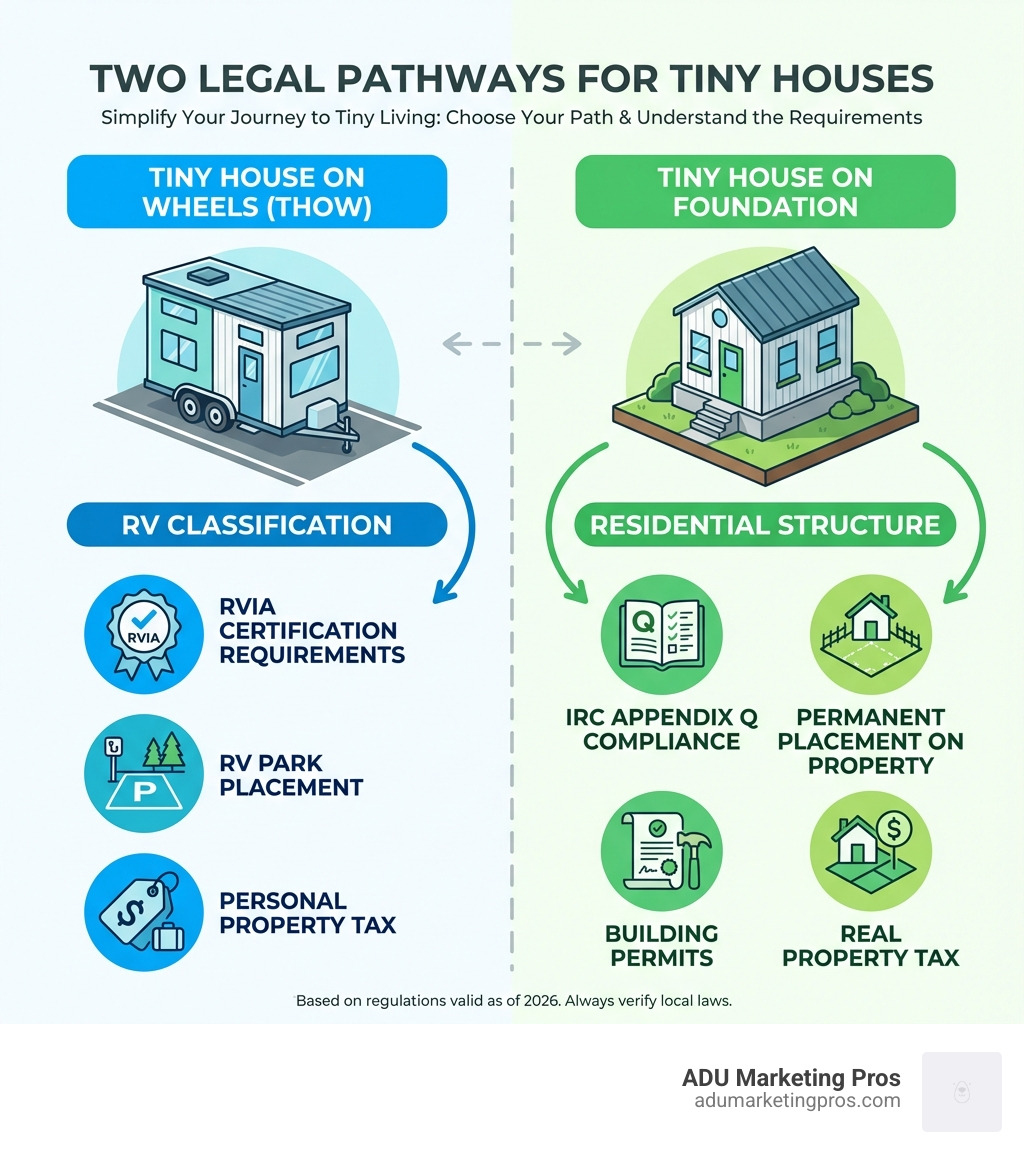
- Tiny Houses on Wheels (THOWs): In most jurisdictions, these are legally classified as recreational vehicles (RVs). To be legal, they must be built to specific safety standards, such as those from the Recreational Vehicle Industry Association (RVIA) or the American National Standards Institute (ANSI). Placement is the biggest challenge, as they are typically restricted to RV parks and are not permitted as permanent, full-time residences on private land in most areas.
- Tiny Houses on Foundations: This is the most direct route to creating a permanent, legal dwelling. These homes are regulated as residential structures under the International Residential Code (IRC), specifically the optional Appendix Q, which provides standards for homes 400 square feet or less. They must be built on a permanent foundation and meet all local building codes, zoning requirements, and pass inspections.
- Accessory Dwelling Units (ADUs): This has become the most viable legal path for tiny homes on foundations in states like California. State laws have created flexible rules for these secondary structures, allowing homeowners to build small homes in their backyards, provided they comply with local ordinances regarding size, setbacks, and utility connections.
- Key Requirement: The single most important takeaway is that all real estate is local. State-level rules provide a framework, but your specific city and county planning departments have the final say. Never assume a state law guarantees local approval without verification.
The fundamental question isn’t a simple “Are tiny houses legal?” but rather, “Where and how can I make my specific tiny house legal in my chosen location?” The answer hinges entirely on whether your home is on wheels or a foundation and what your local government has decided to allow. This guide will walk you through the intricate legal landscape, with a special focus on California—a state at the forefront of the ADU revolution—and its key regions like Los Angeles, San Diego, and the San Francisco Bay Area, including San Jose, Sunnyvale, Palo Alto, and Menlo Park.
Tiny house legal terms to learn:
What is a “Tiny House” Legally? Decoding the Definitions
There is no single, universal legal definition of a “tiny house.” Instead, its legal identity is determined by how it’s constructed, whether it has wheels or a foundation, and the specific codes and ordinances of its location. Understanding these classifications is the first step toward a successful and legal tiny living journey.
The Official IRC Definition: Appendix Q
The most significant step toward legitimizing tiny homes on foundations came with the 2021 International Residential Code (IRC). First introduced in 2018, Appendix Q (now Appendix AQ in the 2021 IRC) provides a standardized definition: a dwelling unit of 400 square feet or less, excluding lofts. This appendix is a game-changer because it modifies traditional building standards that are impractical for small spaces, offering a clear legal path for permanent small homes.
Key requirements under IRC Appendix Q include:
- Size: The habitable floor space must be 400 square feet or less. Lofts are not counted toward this total, providing crucial extra space.
- Ceiling Height: The minimum ceiling height for habitable spaces is 6 feet 8 inches. However, bathrooms can have a minimum height of 6 feet 4 inches. This is a relaxation from the standard 7-foot requirement in larger homes.
- Loft Requirements: Lofts must have a floor area of at least 35 square feet, a minimum dimension of 5 feet, and a ceiling height of at least 3 feet. They must also have a guardrail and access via a ladder, ship’s ladder, or alternating tread device, which saves significant space compared to a conventional staircase.
- Emergency Escape: Every sleeping area, including lofts, must have a designated emergency escape and rescue opening (egress window or door) to ensure occupant safety.
- Safety Standards: A tiny house must still adhere to all standard plumbing, electrical, mechanical, and structural codes to ensure it is as safe as a traditional home.
Crucially, Appendix Q is optional. A local city or county must formally adopt it into their building code for it to be applicable. Without its adoption, builders must try to meet the standard residential code, which is often impossible for a tiny footprint.
Tiny House vs. RV vs. Manufactured Home
Understanding these legal distinctions is critical. Misclassifying your home can lead to significant legal and financial problems. Your tiny house legal status depends on fitting into one of these established categories.
-
Tiny Houses on Wheels (THOWs): Built on a trailer chassis, these are almost always legally classified as Recreational Vehicles (RVs). To be compliant, they should be built to RV standards like NFPA 1192 or ANSI A119.5, which govern health and safety aspects for mobile structures. Certification from the RVIA or a similar third-party certifier like the National Organization of Alternative Housing (NOAH) is often required for insurance, financing, and placement in RV parks. This classification is designed for temporary, recreational use, which is why permanent living on private land is typically prohibited.
-
Manufactured Homes (MHs): Often confused with tiny or modular homes, manufactured homes (formerly mobile homes) are built in a factory to a single, preemptive federal standard: the HUD Code. The U.S. Department of Housing and Urban Development oversees this code, which supersedes all local building codes. These homes are built on a permanent steel chassis, transported to the site, and installed on a permanent foundation. They are typically 320 square feet or larger and are legally considered real property once installed.
-
Modular Homes: Like manufactured homes, modular homes are built off-site in a factory. However, they are built in sections (modules) and are designed from the outset to meet all state and local building codes for the specific destination where they will be installed. Once transported to the site and assembled on a permanent foundation, they are legally indistinguishable from a traditional site-built home.
-
Accessory Dwelling Units (ADUs): This is a zoning classification, not a type of building. An ADU is a secondary, self-contained home located on the same lot as a primary single-family residence. In California, this is the primary legal pathway for tiny homes on foundations. Thanks to pro-ADU state laws, a tiny house built to IRC standards (ideally with Appendix Q) can be permitted as an ADU. Understanding the difference between an ADU vs. Tiny House is vital for any California homeowner considering this option.
Navigating the Tiny House Legal Landscape: A Case Study in California
California presents a fascinating paradox for tiny home enthusiasts. It is simultaneously one of the most regulated states and one of the most progressive, thanks to its aggressive push for Accessory Dwelling Units (ADUs). Navigating California’s tiny house legal complexities requires a deep understanding of the interplay between state mandates and local control. While the state’s Department of Housing and Community Development (HCD) provides guidance and enforces housing laws, the real, on-the-ground rules are set at the city and county level.
Zoning Laws: The “Where” of Tiny Living
Zoning laws dictate how land can be used (e.g., residential, commercial, agricultural) and are often the biggest initial hurdle for tiny homes.
- Minimum Square Footage: Historically, many zoning codes included minimum dwelling sizes (e.g., 800-1,200 sq. ft.) specifically to prevent the construction of very small homes. These were seen as a way to protect property values but are now recognized as a barrier to affordable housing.
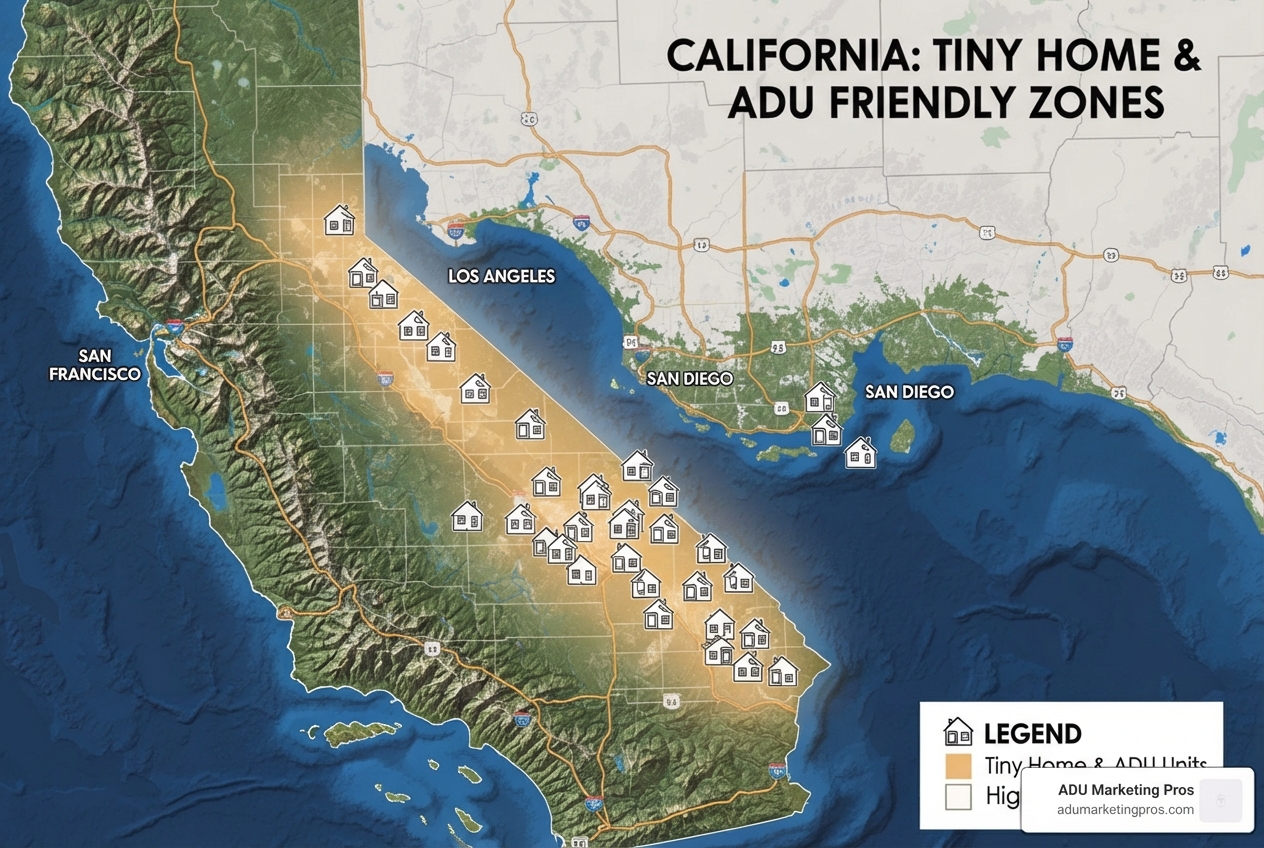
- Accessory Dwelling Units (ADUs): This is the game-changer in California. A series of state laws (including AB 68, AB 881, and SB 9) have effectively forced cities to allow ADUs. These laws standardize and streamline the approval process, requiring cities to permit ADUs that meet certain criteria. Cities like San Jose, Sunnyvale, and Palo Alto have adopted these policies, providing a clear legal path for smaller, secondary homes on foundations. These ADUs have specific size limits (typically up to 800-1,200 sq. ft.) and setback requirements (as little as 4 feet from property lines), but they make tiny living a reality in dense residential neighborhoods.
- Unincorporated County Land: Many people assume that moving to unincorporated county land means freedom from rules. This is a dangerous misconception. While some rural areas may have less restrictive zoning (e.g., no minimum lot size for agriculture), they are not a free-for-all. Building permits, inspections, and stringent utility regulations still apply. You will likely face requirements for approved septic systems (which can require expensive soil percolation tests), proven water sources (like a permitted well), and road access that meets fire department standards.
Tiny Homes on Wheels (THOWs): The RV Classification
As discussed, THOWs are almost universally considered recreational vehicles in the eyes of the law. This classification has major legal implications in California.
- Legal Classification: In California, THOWs are regulated as RVs or park trailers. This means they are legally intended for temporary, not permanent, occupancy.
- Placement: Legal placement is typically restricted to licensed RV parks or mobile home parks. These parks have their own rules regarding the age and condition of the vehicle and often have limits on the length of stay (e.g., 30, 90, or 180 days).
- Restrictions: It is generally illegal to live in a THOW full-time on private residential land outside of a designated park. Some cities, like Fresno and San Jose, have created specific ordinances or pilot programs allowing THOWs as backyard cottages, but these are exceptions, not the rule, and come with their own strict requirements.
- Registration: As vehicles, THOWs must be registered with the DMV and are subject to annual registration fees, not property taxes.
Tiny Homes on Foundations: Building a Permanent Residence
For those seeking stability and a permanent home, building on a foundation is the most straightforward legal path in California.
- Building Codes: These homes must comply with the California Building Standards Code (CBSC), which is based on the IRC. If the local jurisdiction has adopted Appendix Q, it provides specific, more flexible standards for homes 400 sq ft or less. If not, the home must meet the standard code, which can be challenging.
- Permits and Inspections: A tiny house on a foundation requires a full set of permits and inspections, just like a traditional home. This process includes submitting architectural plans, structural engineering calculations, and a Title 24 energy compliance report. Inspections occur at multiple stages: foundation, framing, rough electrical and plumbing, and a final inspection before a Certificate of Occupancy is issued.
- Foundation: A proper, permanent foundation engineered to meet local soil and seismic safety standards is non-negotiable.
Here’s a quick comparison of the key legal aspects:
| Feature | Tiny Home on Wheels (THOW) | Tiny Home on Foundation |
|---|---|---|
| Governing Code | RVIA/ANSI (NFPA 1192) | IRC (Appendix Q where adopted) / California Building Standards Code |
| Placement | RV parks, designated communities, temporary locations | Residential lots (often as ADUs), tiny home communities |
| Legality | Temporary/Recreational use; Permanent residential use often restricted | Permanent residential use (requires permits/zoning) |
| Taxation | Personal property (vehicle registration fees) | Real property (property taxes) |
| Financing | RV loans, personal loans, cash | Traditional mortgages (if qualified), personal loans, cash |
| Utilities | RV-style hookups (shore power, water hose, dump tank) | Standard utility connections (water, sewer, electric) |
| Resale Value | Depreciates like a vehicle | Appreciates with the real estate market |
Finding Your Place: Tiny-House-Friendly Locations
Finding the right location is more than half the battle. In California, a “tiny-friendly” jurisdiction is almost always one with progressive ADU policies or, more rarely, a designated tiny home community. What makes a location friendly for tiny house legal placement is a proactive approach from the local government to embrace alternative housing solutions, often driven by the need for more affordable housing stock.
Spotlight on Accommodating California Communities
California is the national leader in promoting Accessory Dwelling Units (ADUs), which serve as the primary legal pathway for tiny homes on foundations. The cities we serve—including Los Angeles, San Diego, San Jose, Sunnyvale, Palo Alto, and Mountain View—have all implemented robust ADU ordinances in response to state mandates.
- ADU-Friendly Zones: These cities offer tangible benefits that make building a tiny ADU feasible. For example, Los Angeles has pre-approved ADU plans (Standard Plans) to expedite permitting. San Diego provides a comprehensive technical manual and has waived many development and impact fees for ADUs under 750 square feet. San Jose was a pioneer, creating an ordinance that allows for movable tiny homes (THOWs) to be used as ADUs under very specific conditions, including being connected to utilities and having a certified manufacturer.
- Designated Tiny Home Communities: While less common, some areas are developing communities specifically zoned for tiny homes. These can be on foundations or wheels and handle the complex infrastructure and legal framework for you. Examples include communities in the Fresno area and the Delta Bay community in Northern California. Living in these areas provides legal clarity, shared amenities, and a sense of community with like-minded individuals.
How to Research Your Local Tiny House Legal Requirements
Because laws are hyper-local, you cannot rely on blogs or general advice. Direct, diligent research is non-negotiable. Here’s a step-by-step guide to getting definitive answers:
-
Contact Local Planning and Zoning Departments: This is your first and most important call. Go to your city or county’s website and find the number for the Planning Department. Be specific and polite with your questions:
- “Has your jurisdiction officially adopted Appendix Q of the International Residential Code for tiny houses?”
- “What are the minimum and maximum square footage requirements for a detached Accessory Dwelling Unit (ADU)?”
- “What are the setback requirements (front, side, and rear) for a detached ADU on my property?”
- “Are Tiny Homes on Wheels (THOWs) permitted for permanent occupancy on private land, or only in licensed RV parks? If they are allowed as ADUs, what are the specific requirements?”
- “What are the current permit fees, impact fees, and estimated processing times for an ADU application?”
- “Are there any pre-approved ADU plans available that I can use or purchase?”
-
Review Municipal Codes Online: Most California cities and counties publish their municipal codes online. Before you call, do some preliminary research. Search for your city’s name + “municipal code.” Look for chapters on “Zoning,” “Accessory Dwelling Units,” or search for terms like “minimum dwelling size.” This will help you understand the terminology and ask more intelligent questions when you speak with an official.
-
Consult a Title 24 Energy Consultant: In California, all new residential construction, including tiny ADUs, must comply with the state’s strict Title 24 energy code. This involves calculations for insulation, window efficiency, heating/cooling systems, and more. A Title 24 report is a required part of your permit application, so engaging with a consultant early in the design process is essential.
-
Speak with Local Experts: Firms specializing in ADUs or tiny homes in your specific area (like us) have invaluable hands-on experience. They have navigated the local bureaucracy, understand the common pitfalls, and can offer practical advice that you won’t find in the municipal code.
-
Verify for Your Specific Parcel: Even in a tiny-friendly city, the zoning for your specific property might have unique restrictions (e.g., overlays, environmental constraints, HOA rules). Always confirm the rules for your exact address with the planning department before investing any money.
The Practical Problems: Permits, Financing, and Taxes
Once you’ve navigated the zoning maze, the practicalities of permits, financing, and taxes present the next set of challenges in your tiny house legal journey. These logistical hurdles are where the dream meets the reality of spreadsheets, applications, and regulations.
The Paper Trail: Permits and Certifications for Your Tiny House
The required paperwork depends entirely on your tiny home’s legal classification. There is no shortcut around this process.
- Building Permits for Foundation Homes: A tiny home on a permanent foundation (including all ADUs) requires a building permit from your local building department. This is a comprehensive process that involves submitting detailed architectural and structural plans stamped by a licensed engineer or architect. These plans must demonstrate full compliance with the California Building Standards Code, including structural, electrical, plumbing, mechanical, and energy codes (Title 24).
- Certificate of Occupancy (CO): This is the final document issued by the building department after your home has passed all required inspections (foundation, framing, insulation, rough-in, final). The CO legally certifies that the home is safe to live in. Without it, you cannot legally occupy the house, get insurance, or sell it as a legitimate dwelling.
- RVIA/ANSI/NOAH Certification for THOWs: A THOW classified as an RV should be certified by a recognized third party. The RVIA (Recreational Vehicle Industry Association) certification is the industry standard for RVs. Alternatively, certification from the National Organization of Alternative Housing (NOAH) is popular, as it’s specifically tailored to tiny houses and is based on American National Standards Institute (ANSI) standards for safety and construction. This certification is often crucial for securing RV loans, getting insurance, and gaining entry into quality RV parks.
Attempting to build without permits can result in stop-work orders, hefty fines, a mandate to demolish the structure, and an inability to ever insure or legally sell the property.
Financing and Insuring Your Tiny Home
Financing a tiny home is more complex than a traditional house, as it falls outside standard lending categories. While many tiny homeowners pay with cash, other options are becoming more available.
- Challenges with Mortgages: Traditional mortgages are difficult to obtain for tiny homes. Lenders often have minimum loan amounts and square footage requirements (e.g., 400–600 sq ft) that many tiny homes don’t meet. However, a legally permitted ADU on a foundation can sometimes be financed through a renovation loan or by refinancing the primary mortgage on the property.
- Home Equity Line of Credit (HELOC): If you have equity in an existing primary residence, a HELOC can be an excellent way to finance the construction of a tiny house ADU.
- RV Loans: An RVIA-certified THOW may qualify for an RV loan. These are secured loans, but they typically have shorter terms (5-15 years) and higher interest rates than a mortgage because the asset (the THOW) depreciates over time.
- Personal Loans: Many buyers use unsecured personal loans. These offer flexibility as the funds can be used for any purpose, but they often come with the highest interest rates.
- Insurance: Standard homeowner’s insurance does not cover tiny homes. For THOWs, you’ll need RV insurance; be sure to get a policy that specifically allows for full-time residency if that’s your plan. For tiny homes on a foundation permitted as an ADU, you can typically add it as an extension of your existing homeowner’s policy.
Understanding Tiny Home Property Taxes
How your tiny home is taxed in California is directly tied to its legal classification.
- Permanent Structures (Real Property): A tiny home on a foundation, such as an ADU, is assessed as real property. This means the county assessor will determine its value, and that value will be added to your property tax bill. For example, if your current home is valued at $700,000 and you add an ADU assessed at $150,000, your property tax will be based on the new total assessed value. However, thanks to Prop 13, only the new construction ($150,000) is assessed at the current 1% rate, not the entire property.
- THOWs Classified as RVs (Personal Property): A THOW is typically treated as personal property. Instead of property taxes, you will pay annual vehicle registration fees to the DMV. However, be aware that if a tax assessor determines that a THOW has been permanently affixed to the land (e.g., wheels removed, built onto a deck, connected to a permanent septic system), they have the authority to reclassify it as real property, triggering a potentially large and unexpected property tax bill.
Frequently Asked Questions about Tiny House Legality
We often hear similar questions from prospective tiny homeowners navigating this complex world. Here are some of the most common inquiries, with answers tailored to the California context.
Can I put a tiny house in my backyard in California?
This is the most common question, and the answer is a nuanced “yes, but…” For a tiny home on a foundation, the answer is often a strong “yes” if it is built to code and qualifies as an Accessory Dwelling Unit (ADU). California’s progressive ADU laws have made this a viable option in most cities, including Los Angeles, San Diego, and San Jose. However, it must meet all local ADU requirements for size, height, setbacks, and utility connections, and it must pass all building inspections. For a tiny home on wheels (THOW), the answer is generally “no” for permanent, full-time residence. Most cities prohibit living in an RV in a backyard outside of designated RV parks. A few cities like Fresno and San Jose have specific pilot programs that allow them under strict conditions, but this is the exception, not the rule.
What is the smallest legal house size in California?
There is no single statewide minimum square footage for a primary dwelling. Local zoning codes have historically imposed minimums (e.g., 800–1,200 sq ft), but these are being challenged. For tiny homes on foundations, the key is the adoption of IRC Appendix Q, which provides a legal framework for homes under 400 sq ft. For ADUs, state law has effectively eliminated high minimums. While state law allows for ADUs as small as 150 square feet (the size of an “Efficiency Unit”), local discretion still plays a role. It’s crucial to check your specific city or county’s ADU ordinance for their exact minimum and maximum allowable sizes.
Are there California counties with no building codes or zoning?
This is a persistent myth. While some very remote, unincorporated areas in vast counties like San Bernardino or Inyo might have very minimal zoning regulations, there is no county in California that has no building codes. The California Building Standards Code applies statewide as a minimum for health and safety. Even in the most rural areas, you will need permits for structural work, electrical, plumbing, and especially for septic and well systems. The idea of an unregulated patch of land where you can build whatever you want is not a reality in California. Always assume rules apply and verify with the county’s planning and development office.
Do I need an architect or engineer for my tiny house plans?
For a tiny home on a foundation, the answer is almost certainly yes. To obtain a building permit, you must submit detailed plans that are compliant with all local and state codes. In California, these plans typically require a stamp from a licensed architect or structural engineer to verify their safety and compliance, especially regarding seismic and structural requirements. For a THOW, you don’t need a stamped architect’s plan for DMV registration, but working with a reputable builder who understands engineering principles and safety standards (like NFPA 1192) is critical for safety and insurability.
What are the biggest hidden costs of building a legal tiny house?
Many people budget for the structure itself but are surprised by the soft costs and site work. The biggest hidden costs for a foundation-based tiny home (ADU) are often:
- Utility Connections: Trenching and connecting to water, sewer, and electrical lines can cost anywhere from $10,000 to $30,000+, depending on the distance and complexity.
- Permit and Impact Fees: While California has waived some impact fees for ADUs under 750 sq ft, you will still pay for building permits, plan check fees, and potentially school or park fees, which can total several thousand dollars.
- Site Preparation: This includes grading the land, soil testing, and pouring the foundation, all of which can be costly.
- Professional Fees: Don’t forget to budget for your architect, engineer, and Title 24 energy consultant.
Conclusion: Building Your Tiny Dream the Right Way
The journey to making your tiny house legal in California, or anywhere else, is a marathon, not a sprint. It requires patience, diligence, and a willingness to engage with the very systems the movement often seeks to simplify. As we’ve explored, the path to legality is not a single road but a branching one, with clear distinctions between temporary, mobile living in a THOW and permanent, residential living in a foundation-based home.
The key to success lies in three core principles: understanding the legal classifications, conducting meticulous hyper-local research, and preparing for the practical realities of the building process. The tiny home movement, born from a powerful desire for affordability, sustainability, and minimalism, continues to push boundaries and inspire change. In California, this has led to the groundbreaking acceptance of ADUs, creating thousands of new, legal small homes in backyards across the state. This is the landscape where companies like ADU Marketing Pros operate, helping construction and architecture firms navigate these evolving regulations to deliver compliant, safe, and beautiful housing solutions.
For anyone dreaming of a small-footprint life, the message is clear: your dream is achievable, but it must be built on a foundation of knowledge. A legal tiny house is more than just a home; it’s an insurable, financeable, and stable asset that provides peace of mind. The path to legality begins not with a hammer and nails, but with a phone call to your local planning department. By doing your homework, consulting with experts, and embracing the process, you can transform your tiny dream into a fully realized, and fully legal, reality.
Discover the best Places in Southern California That Allow Tiny Houses.