
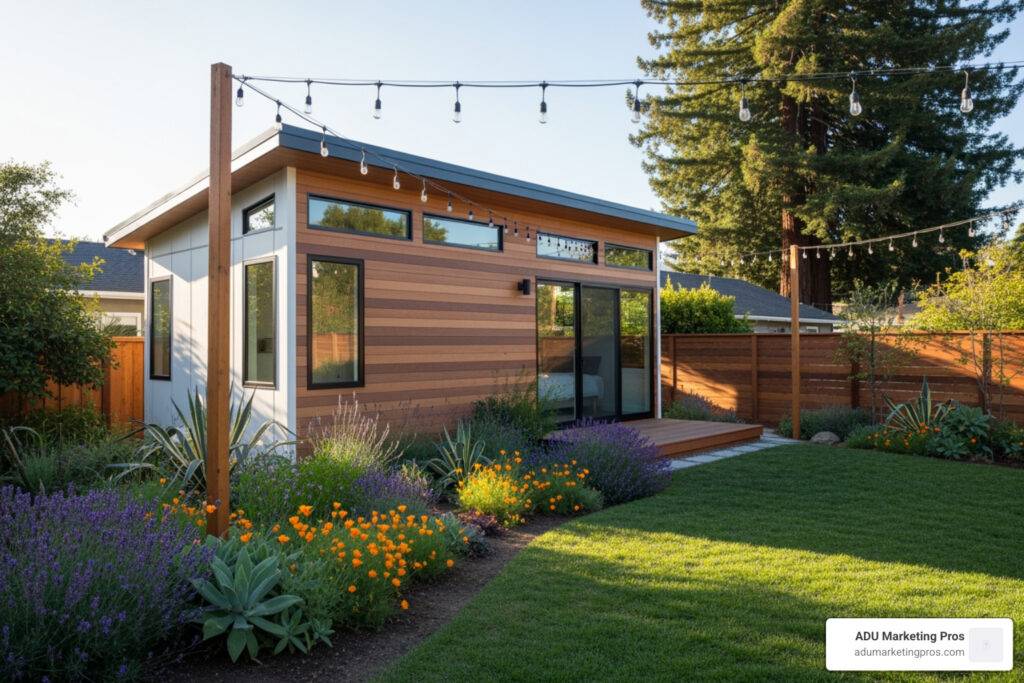
Why Santa Cruz County Planning for ADUs Matters More Than Ever
In 2026, the conversation around Santa Cruz County planning ADU regulations is not just relevant; it’s critical. These rules represent the most potent tool the region has to combat a decades-in-the-making housing crisis. Santa Cruz’s magnetic pull—a unique blend of world-class surf, redwood forests, a vibrant counter-culture, the intellectual hub of UC Santa Cruz, and its strategic proximity to the Silicon Valley job engine—has created a perfect storm. Housing demand consistently outstrips supply, cementing its status as one of America’s most expensive places to live. In this high-stakes environment, Accessory Dwelling Units (ADUs) have emerged as a vital, scalable solution, championed by both the State of California and forward-thinking local planners.
For Santa Cruz homeowners, an ADU is a multifaceted asset. It can be a powerful financial engine, generating consistent rental income to offset a mortgage, a private haven for aging parents or adult children struggling with housing costs, or a strategic enhancement that significantly boosts property value. For the region’s builders, architects, and designers, the sustained ADU boom presents a generational opportunity. However, the market is saturated with firms vying for attention. True success in this competitive landscape is no longer just about construction quality; it’s about demonstrating unimpeachable expertise in the complex, ever-shifting regulatory maze. Mastery of Santa Cruz County planning ADU rules—from zoning intricacies and setback nuances to the specific challenges of the Coastal Zone and evolving state mandates—is what separates the leaders from the pack.
This is precisely the edge that firms partnering with ADU Marketing Pros gain. By transforming your deep regulatory knowledge into clear, authoritative marketing content, you attract a different caliber of client: one who is educated, has a realistic budget, and is actively seeking a trusted guide, not just the lowest bidder. Your expertise becomes your most powerful sales tool.
If you are a homeowner contemplating an ADU, or a builder aiming to dominate the local market, understanding the current regulatory framework is non-negotiable. Regulations are dynamic, so always cross-reference information with official sources like the County of Santa Cruz Planning Department and the California Department of Housing and Community Development (HCD). What follows is a comprehensive, high-level overview of the key rules shaping ADU projects in 2026.
Navigating Santa Cruz County’s ADU Regulations: A 2026 Deep Dive
California’s state laws provide a foundational framework for ADUs, but local jurisdictions like Santa Cruz County have the authority to adopt and refine these rules. The county has generally embraced a pro-housing stance, aiming to reduce barriers and encourage development. Understanding these specific local provisions is the first step toward a successful project.
Unit Allowances: Maximizing Density on a Single Lot
One of the most revolutionary aspects of modern ADU law is the ability to significantly increase housing density on a single-family residential lot. In Santa Cruz County, property owners can leverage a powerful combination of units. On a typical single-family parcel, you are generally permitted to build:
- One Detached New-Construction ADU: A brand-new, standalone unit in your backyard.
- One Conversion ADU: An ADU created from existing, permitted space within the primary home or an accessory structure (like a garage, basement, or studio).
- One Junior ADU (JADU): A smaller unit created within the existing walls of the primary residence.
This means a single property could potentially add two new rental units (a detached ADU and a JADU, as the conversion ADU and JADU are often mutually exclusive options within the main home’s footprint). This “by-right” allowance, meaning it doesn’t require discretionary review if all standards are met, is a game-changer for homeowners looking to maximize their property’s financial return and contribute to the local housing supply.
Size, Height, and Setback Requirements
The physical envelope of your ADU is governed by specific dimensional standards. These rules ensure that new units fit within the context of existing neighborhoods.
- Size Limits: Standard ADUs offer considerable flexibility. A studio or one-bedroom ADU can be up to 850 sq ft, while an ADU with two or more bedrooms can be as large as 1,200 sq ft. The state also mandates that a jurisdiction must allow at least an 800 sq ft ADU regardless of other local development standards like Floor Area Ratio (FAR) or lot coverage. JADUs, intended as more compact spaces, are capped at 500 sq ft.
- Height Limits: For a detached, single-story ADU, the height limit is typically 16 feet. If the ADU is located above a garage, or if the primary home is two stories, a height of up to 18-20 feet may be possible, often requiring administrative review. Attached ADUs must conform to the height limits of the primary residence.
- Setbacks: State law has drastically reduced setback requirements. A new detached ADU generally only needs to be 4 feet from the side and rear property lines. This allows for ADUs on smaller or irregularly shaped lots that were previously undevelopable. For conversion ADUs created from existing structures like a garage, no new setbacks are required, even if the structure is located on the property line.
Owner-Occupancy Rules: The Evolving 2026 Landscape
Owner-occupancy requirements have been a focal point of state legislation. A crucial state law temporarily suspended these requirements for new ADUs permitted between January 1, 2020, and January 1, 2025. This waiver turned ADUs into a powerful tool for real estate investors. With that window now closed, Santa Cruz County must adhere to the current version of California’s ADU statutes. This means that new ADU permit applications in 2026 may be subject to revised owner-occupancy rules, depending on ongoing legislative updates. It is critical to verify the current rule at the time of your application. In contrast, JADUs have a standing owner-occupancy requirement: the property owner must reside in either the primary home or the JADU. This is enforced via a recorded deed restriction, cementing the JADU’s role as a solution for homeowners rather than off-site investors.
Parking Mandates: A Major Hurdle Removed
Historically, parking requirements were a primary obstacle to building accessory units. State law has largely eliminated this barrier. In Santa Cruz County, only one off-street parking space is required per new-construction ADU. Furthermore, this requirement is completely waived if the property meets any of the following conditions:
- It is located within a half-mile walking distance of a public transit stop (e.g., a Santa Cruz METRO bus stop).
- It is within an architecturally and historically significant historic district.
- It is part of an ADU conversion or a JADU project.
- A car-share vehicle is located within one block of the property.
Given Santa Cruz’s extensive transit network and numerous historic areas, a vast number of properties qualify for this waiver. This not only simplifies projects but also reduces construction costs significantly.
Impact Fee Waivers and Financial Incentives
To further incentivize the creation of smaller, more affordable housing, the county and state provide significant financial relief. Per state law, any ADU under 750 sq ft is exempt from all impact fees. These fees, which can run into tens of thousands of dollars, are typically charged by local agencies to fund public infrastructure like parks, schools, and roads. Waiving them dramatically improves the financial feasibility of smaller ADU projects. For ADUs larger than 750 sq ft, impact fees are charged, but they must be proportional to the size of the ADU relative to the primary home. For the most current information on local grants, fee schedules, and technical assistance, the County of Santa Cruz’s ADU resource page is an essential bookmark.
Long-Term Rental Focus: Housing for Locals, Not Tourists
To ensure that new ADUs directly address the local housing shortage, Santa Cruz County explicitly prohibits their use as short-term vacation rentals. All rental agreements for ADUs must be for a term of 30 consecutive days or more. This policy directs the new housing stock toward residents—students, young professionals, small families, and service workers—rather than the tourist market, aligning with the core mission of ADU legislation.
The 60-Day Shot Clock: Streamlined Permitting Explained
Predictability in the permitting timeline is crucial for any construction project. State law mandates that ADU applications be processed ministerially, without discretionary review or public hearings, as long as they meet all objective standards. This is handled through a standard building permit application, submitted via the county’s online ePlan Review system. Once a planning department deems an application complete, they have just 60 days to approve or deny it. This “shot clock” provides homeowners and builders with much-needed certainty and prevents projects from languishing in bureaucratic limbo.
For ADU construction and architecture firms, demonstrating a granular understanding of these rules is what builds trust and wins contracts. ADU Marketing Pros specializes in translating this complex expertise into compelling, search-optimized content that attracts qualified leads throughout Santa Cruz County and the greater San Francisco Bay Area.
Choosing Your Path: ADU vs. JADU in Santa Cruz
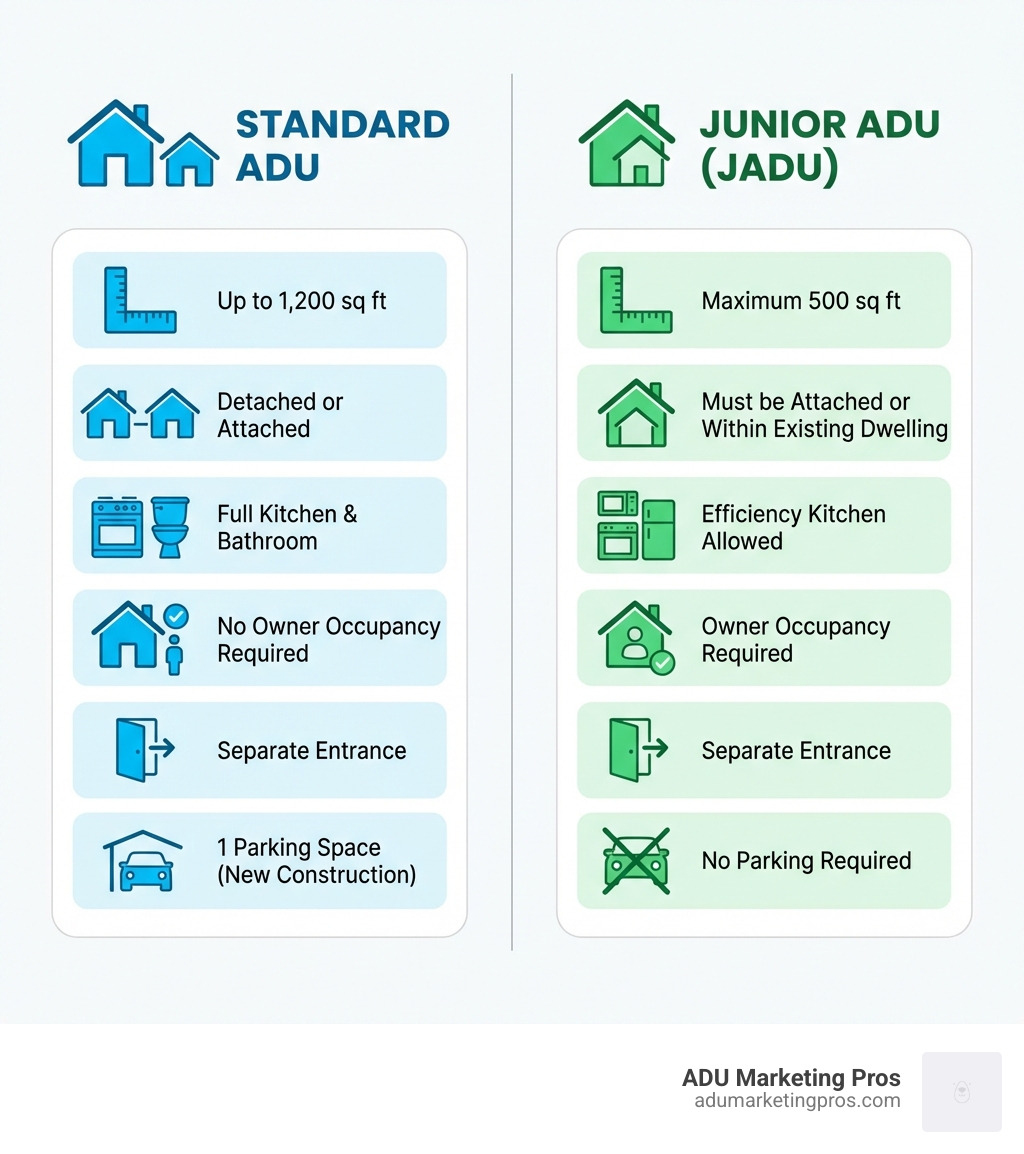
While the regulations provide the blueprint, the first major decision for a homeowner is choosing the right type of unit for their goals, property, and budget. The distinction between a full Accessory Dwelling Unit (ADU) and a Junior Accessory Dwelling Unit (JADU) is fundamental. Making the right choice requires a clear understanding of their respective features and limitations.
What are ADUs and JADUs?
At its core, an Accessory Dwelling Unit (ADU) is an independent, self-contained home located on the same lot as a primary residence. As defined by Santa Cruz County and the state, it must provide permanent facilities for living, sleeping, eating, cooking, and sanitation. Often called granny flats, in-law units, or backyard cottages, ADUs function as complete, smaller homes, offering total independence for the occupant. They can be detached structures, attached to the main house, or converted from an existing building like a garage.
A Junior Accessory Dwelling Unit (JADU) is a more integrated and compact housing solution. A JADU is always created within the existing, permitted walls of a single-family home, often by repurposing a spare bedroom, den, or attached garage. Limited in size and subject to a strict owner-occupancy requirement, JADUs are an ideal, lower-cost option for housing a family member, a student, or a caregiver. A key feature for both unit types is the requirement for a separate exterior entrance, which preserves privacy for everyone on the property. For a definitive guide to statewide rules, the California Department of Housing and Community Development’s ADU Handbook is an invaluable resource.
The primary functional difference lies in the amenities. A standard ADU must have a full kitchen, complete with a sink, a conventional stove or cooktop/oven, a refrigerator, and sufficient counter space. A JADU, however, only requires an “efficiency kitchen.” This typically includes a sink, a small cooking appliance (like a hot plate or microwave), a small refrigerator, and limited counter space. This distinction has significant implications for cost, complexity, and the intended use of the unit.
Key Differences: A Head-to-Head Comparison
The choice between an ADU and a JADU is the first strategic fork in the road for any homeowner. This table breaks down the critical distinctions:
| Feature | Accessory Dwelling Unit (ADU) | Junior Accessory Dwelling Unit (JADU) |
|---|---|---|
| Location | Can be a detached new structure, attached to the main house, or a conversion of an existing structure (e.g., garage, barn). | Must be created within the existing walls of a single-family residence. An attached garage conversion can qualify. |
| Maximum Size | Up to 850 sq ft for a studio/1-bedroom; up to 1,200 sq ft for 2+ bedrooms. Minimum size is 150 sq ft. | 500 sq ft maximum. |
| Kitchen | A full, independent kitchen is required with a sink, cooktop, oven, refrigerator, and adequate counter space. | An “efficiency kitchen” is sufficient. This includes a sink, a cooking facility (e.g., hot plate), refrigeration, and food prep counter. |
| Bathroom | A full, separate bathroom is required within the unit. | May have its own separate bathroom or can be designed to share a bathroom with the primary residence. |
| Entrance | Must have its own separate exterior entrance. | Must have its own separate exterior entrance. An interior connection to the main house is optional. |
| Owner Occupancy | Owner-occupancy requirements depend on the date of permit issuance and current state law. Many ADUs permitted from 2020–2024 were exempt; new permits must be reviewed against the latest rules. | The property owner must reside in either the primary dwelling or the JADU. A deed restriction is recorded. |
| Parking | One space per new construction ADU, unless an exemption applies (e.g., near transit). No parking is required for conversion ADUs. | No additional parking is required. |
| Quantity Allowed | A property can have one detached ADU and one conversion ADU (which can be a JADU). | One JADU is permitted per single-family residential lot. |
| Utility Meters | New detached ADUs may require a separate utility connection, depending on the provider. Attached/conversion ADUs can often share meters. | Generally shares all utility meters with the primary residence. |
Strategic Implications for Homeowners and Investors
These differences create distinct strategic pathways for property owners in Santa Cruz.
The Investor vs. The Homeowner: The owner-occupancy rule is the great divider. The potential return of owner-occupancy requirements for new ADUs makes it critical for investors to verify the rules at the time of application. A JADU, with its non-negotiable owner-occupancy mandate, is purely a tool for homeowners looking to add space for personal use (family, caregiver) or to generate rental income while living on-site. This fundamentally shapes the financial model and target audience for the unit.
Cost, Complexity, and Speed: A JADU is, by far, the faster and more affordable option. By utilizing existing structures and requiring only an efficiency kitchen, it minimizes the need for extensive plumbing, electrical, and foundation work. A standard ADU, especially a detached new-build, is a more complex and costly undertaking, but it also yields a fully independent unit that typically commands higher rent.
Privacy and Rental Value: A detached ADU offers maximum privacy for both the owner and the tenant, functioning as a small, separate house. This separation is highly desirable in the rental market and often justifies a premium rent. An attached ADU or a JADU requires more thoughtful design to manage shared walls, potential noise transfer, and access paths to ensure a comfortable living situation for all parties.
For design-build firms, clearly articulating these trade-offs is a hallmark of a true expert. ADU Marketing Pros helps firms across Santa Cruz, San Jose, and the Bay Area develop content that educates homeowners, builds trust, and converts qualified prospects into high-value projects.
The ADU Planning and Design Process in Santa Cruz County
A successful ADU project is a journey with several distinct phases. A methodical approach, guided by professional expertise, is the surest way to navigate from initial idea to a completed, income-producing unit.
Step 1: Initial Feasibility and Financial Analysis
Before a single line is drawn, a thorough feasibility study is essential. This involves confirming your property’s zoning, identifying any specific overlays (like Coastal Zone, geologic hazard areas, or riparian corridors), and getting a preliminary understanding of what can be built. This is also the time for a financial analysis. What is your total budget? How will you finance the project? What is the expected rental income, and what is your target return on investment? Answering these questions upfront prevents costly surprises later.
Step 2: Assembling Your Expert Team
An ADU project is a team sport. You will need an architect or designer who specializes in Santa Cruz County planning ADU projects and understands the local submittal process. They will translate your vision into a compliant set of plans. You will also need a licensed general contractor with a proven track record of building ADUs in the area. Many homeowners opt for a design-build firm that integrates both services, streamlining communication and accountability. This is where builders who have invested in marketing their specific expertise can stand out and attract clients looking for a seamless experience.
Step 3: Site-Specific Design and Coastal Zone Considerations
With your team in place, the design phase begins. This is where you’ll make key decisions about the ADU’s layout, style, and placement on your property to maximize usability, privacy, and views. If your property is in the Coastal Zone, an additional layer of review—a Coastal Development Permit (CDP)—may be required. This process scrutinizes the project’s potential impact on public access and coastal resources. An experienced designer will anticipate these requirements and incorporate them into the initial design, saving time and effort.
Step 4: Permit Submittal and The Review Process
Once the construction drawings are complete, your designer or contractor will compile the permit application package. This includes architectural plans, structural engineering calculations, and California Title 24 energy compliance reports. The entire package is submitted digitally through the county’s ePlan Review portal. A planner will review the submittal for completeness. Once it’s accepted, the 60-day “shot clock” begins, and various departments (Planning, Building, Public Works, Environmental Health) will review the plans to ensure they comply with all codes before issuing a building permit.
Overcoming Common ADU Hurdles in Santa Cruz
While the process is more streamlined than ever, challenges can still arise. Proactive planning with an experienced team is the key to overcoming them.
Site Constraints: Slopes, Septic Systems, and Coastal Bluffs
Many properties in Santa Cruz County are not flat, empty lots. Steep slopes can trigger the need for a geotechnical report and more complex foundation designs. Properties in rural areas may be on septic systems, which require a capacity review from the Environmental Health department to ensure the system can handle an additional dwelling. Proximity to coastal bluffs or sensitive habitats will trigger additional review and potential restrictions on development. Identifying these constraints early is critical.
Utility Connections: The Hidden Costs
Connecting the new ADU to water, sewer/septic, and electricity is a significant part of the project budget that is often underestimated. A detached ADU may require trenching across your yard to lay new lines. In some cases, a new, separate electrical panel or even a transformer upgrade from PG&E might be necessary. Getting a clear estimate for utility work from your contractor early in the process is essential for accurate budgeting.
Financing Your Santa Cruz ADU Project
Funding an ADU, which can cost anywhere from $150,000 to $400,000+, requires a solid financial plan. Common financing options include a cash-out refinance of your primary mortgage, a home equity line of credit (HELOC), or a construction loan. Each option has different qualification requirements, interest rates, and disbursement schedules. Speaking with a mortgage broker who has experience with ADU financing can help you find the best product for your situation.
Your Partner in Building the Future of Santa Cruz Housing
The path to a completed ADU in Santa Cruz County is paved with regulations, but it leads to a powerful destination: a more flexible, valuable property and a tangible solution to our community’s housing needs. The complexity of Santa Cruz County planning ADU rules creates a clear demand for true experts—builders, designers, and architects who don’t just build structures, but guide clients through the entire process with confidence and clarity.
This expertise is a valuable asset, but it only wins clients if it’s communicated effectively. ADU Marketing Pros is dedicated to helping ADU professionals translate their deep knowledge into a powerful marketing engine. We build websites, create search-optimized content, and run targeted campaigns that put you in front of serious homeowners actively searching for the best. If you’re ready to stop competing on price and start winning with expertise, let’s talk.
Santa cruz county planning adu vocabulary: