
Why Choose Local ADU Builders for Your Project
Finding the right Local ADU builders in Redlands, CA, is a crucial step toward enhancing your property. Redlands, often referred to as the “Jewel of the Inland Empire,” presents a unique landscape for residential development. The city’s commitment to preserving its historic charm while embracing modern housing solutions makes the role of local experts even more critical. To ensure a successful project, homeowners should seek:
- Verified Licenses and Insurance: Confirm the builder holds a current state license and comprehensive insurance. This isn’t just a formality; it protects you from liability and ensures the work meets California’s rigorous safety standards.
- Proven Experience: Look for a track record of successfully completed ADU projects, especially in your local area. An ADU is not just a “small house”; it involves specific engineering challenges regarding utility tie-ins and space optimization.
- Strong Local References: Check client reviews and testimonials, particularly from other Redlands homeowners. A builder who understands the local soil conditions and neighborhood aesthetics is invaluable.
- Expertise in Local Regulations: The builder should be well-versed in Redlands zoning laws and permitting requirements. Redlands has specific architectural guidelines, especially in historic districts, that a local builder will navigate more effectively than an outsider.
- Clear Communication: A reliable contractor will provide transparent pricing and keep you informed throughout the process. In 2026, top-tier builders use project management software to give you real-time updates.
Accessory Dwelling Units (ADUs) are independent living spaces built on the same property as a main home. By April 2026, these units have become increasingly popular in Redlands and the broader Inland Empire. This trend is driven by their ability to provide flexible housing solutions, generate passive income, and significantly increase property value. With hundreds of ADU professionals serving the Redlands area, understanding what to look for in a local expert is key.
Building an ADU offers many advantages for Redlands homeowners. They can create comfortable spaces for multigenerational living, allowing families to stay close while maintaining privacy. They also present an excellent opportunity to earn rental income, helping homeowners navigate rising costs. Furthermore, adding an ADU can boost your property’s overall market value, often by hundreds of thousands of dollars in the current competitive market.
Explore more about Local ADU builders:
Why Redlands Homeowners are Choosing Local ADU Builders
The Inland Empire is experiencing a historic transformation. As we move through 2026, Redlands has emerged as a hub for homeowners looking to maximize their land. With the median home sale price in comparable thriving communities hovering around $725,000, many residents find themselves “house rich” but space poor. This is where Local ADU builders step in to unlock the hidden goldmine in your backyard.
The housing shortage across California hasn’t spared our beautiful orange-grove-dotted city. By working with ADU Builders Near Me, homeowners are bypassing the stress of buying a new, larger home and instead creating customized living spaces on their existing lots. Whether it’s to house a college student, provide a sanctuary for aging parents, or create a high-yield rental, the flexibility of these units is unmatched.
When you build an ADU in Menlo Park, CA or right here in Redlands, you aren’t just adding a room; you are leveraging your home equity to create a future-proof asset. The “Silver Tsunami” of aging baby boomers has also contributed to this trend, as families seek ways to keep their elders close without the high costs of assisted living facilities.
The Financial Benefits: Passive Income and Property Value
Let’s talk numbers—because that’s where the ADU story gets really exciting. In the current 2026 market, a well-designed ADU in the Inland Empire can command an average monthly rent of $2,500. For many, this passive income covers a significant portion of their primary mortgage or funds a comfortable retirement. In some cases, the rental income from an ADU can even exceed the monthly mortgage payment of the entire property, effectively allowing the homeowner to live for free.
Beyond the monthly checks, the Return on Investment (ROI) is substantial. Real estate data suggests that adding a high-quality ADU can boost your property’s total value by 25% to 35%. When you hire a professional ADU Building Contractor, you ensure that the craftsmanship matches the primary residence, which is essential for maximizing equity growth. In a market where the average home price sits at $725,000, that value bump is a game-changer for your family’s net worth. Furthermore, the appraisal value of ADUs has become more standardized in 2026, making it easier for homeowners to realize this gain during a sale or refinance.
Navigating Redlands Zoning and California ADU Laws
Understanding the legal landscape is the first hurdle. Thankfully, California law has become increasingly “ADU-friendly.” Under current mandates, local jurisdictions like Redlands must approve or deny ADU applications within 60 days. This streamlined process is designed to get your project out of the filing cabinet and onto the construction site faster than ever before.
Key regulations to keep in mind include:
- SB 9 and SB 10: These laws have revolutionized density, allowing for lot splits and additional units in areas previously restricted to single-family homes. This has opened up massive opportunities for homeowners with larger lots in South Redlands.
- Setback Requirements: Most ADUs only require 4-foot side and rear setbacks, allowing you to maximize your yard space. This is a significant reduction from the 15-20 foot setbacks often required for primary residences.
- JADUs (Junior ADUs): These units, often converted from bedrooms or attached garages, are limited to 500 square feet but offer a lower-cost entry point into the market. They must be contained within the existing walls of the primary residence.
- Title 24 Compliance: Your ADU Builders California must ensure the unit meets strict energy efficiency standards, which saves you money on utilities in the long run. This includes requirements for solar panels on all new detached ADUs.
Top-Rated Local ADU Builders Serving Redlands and the Inland Empire
With over 700 ADU professionals registered on platforms like Houzz serving the Redlands area, the choice can feel overwhelming. However, the “best” builder isn’t just the one with the lowest quote—it’s the one with the right credentials and a local footprint. Local builders understand the specific soil types in the Inland Empire, which can range from sandy loam to heavy clay, requiring different foundation approaches.
When searching for Custom ADU Builders, you’ll find names like Full Circle Builders, OC Builders Group, and Concierge Home Remodeling frequently topping the charts. These firms have established themselves by focusing on the specific architectural styles of the Inland Empire, from historic Victorian-inspired cottages to sleek, modern minimalist units. Companies like Golden State ADUs also bring over a decade of experience and hundreds of successful projects to the table, offering a 100% on-time completion rate that is rare in the construction industry.
What to Look for in Local ADU Builders
The “secret sauce” to a stress-free build lies in the vetting process. Don’t just take a contractor’s word for it; look for these non-negotiables:
- Verified CSLB License: Always check the California Contractors State License Board to ensure their license is active and free of major complaints. A “B” General Building Contractor license is typically required for ADU construction.
- Project Tracking Portals: Top-tier ADU Builders in Los Angeles and Redlands now use digital portals. This allows you to see daily progress photos, schedule updates, and permit status from your smartphone, ensuring total transparency.
- Liability and Workers’ Comp: Never hire a team that isn’t fully insured. This protects you from being liable for on-site accidents. Ask for a “Certificate of Insurance” that names you as an additionally insured party for the duration of the project.
- Local References: Ask for the addresses of three projects they’ve completed within 50 miles of Redlands. A quick drive-by can tell you a lot about their finish quality and how well the unit integrates with the neighborhood.
Comparing the Best Local ADU Builders in Southern California
Choosing between a “one-stop-shop” design-build firm and a traditional general contractor is a major decision. Design-build firms handle everything from the first sketch to the final paint stroke, which often prevents “accountability blurring” between architects and builders. This model is increasingly popular in 2026 because it provides a single point of contact for the homeowner.
Many of these top-rated firms now offer fixed-price contracts. This is a massive benefit for homeowners, as it protects you from the dreaded “budget creep” that used to plague backyard projects. By locking in the price of materials and labor upfront, you can plan your financing with total confidence. Additionally, look for builders who offer a warranty on their work—typically one year for finishes and up to ten years for structural components.
Understanding the Cost and Types of ADU Construction
Every backyard is different, and the type of ADU you choose will dictate your budget and timeline. In Redlands, we see three primary categories:
- Detached ADUs: Standalone cottages that offer the most privacy. These are ideal for long-term rentals or guest houses where complete separation from the main house is desired.
- Attached Suites: Additions that share a wall with the main house, perfect for keeping family close. These often have lower utility connection costs because they can tap into the main house’s existing lines more easily.
- Garage Conversions: Often the most cost-effective way to add square footage by utilizing the existing structure. In Redlands, many older homes have detached garages that are perfect candidates for this transformation.
Whether you are looking for ADU Contractors in San Diego or right here in the Inland Empire, you must decide between “stick-built” (built on-site from scratch) and “prefab” (built in a factory and delivered). If you want to build a prefab ADU in the Bay Area or Redlands, you might find that the speed of delivery is worth the slight reduction in customization. Prefab units can often be installed in a matter of weeks once the foundation is ready.
Estimating Your Investment: From Prefab to Custom Builds
How much does it really cost? In 2026, Local ADU builders generally start their rates around $299 per square foot for standard “rental grade” finishes. However, total project costs include more than just the building. You must account for:
- Site Preparation: Grading, clearing trees, and leveling the ground. In Redlands, removing old citrus trees or navigating rocky soil can add to this cost.
- Utility Connections: Running sewer, water, and electrical lines from the main house to the new unit. If your main electrical panel needs an upgrade to handle the additional load, expect to add $3,000 to $5,000.
- Permit and Impact Fees: While California has waived many of these for units under 750 square feet, larger units may still incur school impact fees or park fees.
For those on a tighter budget, many high-quality prefab ADUs can be installed for under $100,000, while a luxury, custom-designed 1,200-square-foot detached home might reach $350,000 or more. When researching ADU Builders in the Bay Area, we’ve seen that transparency in these “hidden” costs is what separates the pros from the amateurs.
Financing Options for Your ADU Project
You don’t need a mountain of cash to start building. Most homeowners in 2026 utilize one of several smart financing paths:
- HELOC (Home Equity Line of Credit): A flexible way to borrow against your home’s value, often with lower interest rates than personal loans.
- Cash-Out Refinance: Replacing your current mortgage with a larger one and taking the difference in cash. This is popular when interest rates are stable.
- RenoFi Loans: These are revolutionary because they allow you to borrow based on the after-renovation value of your home, rather than just the current value. This unlocks much more capital for the project.
- CalHFA Grants: Keep an eye out for state-sponsored grants that can provide up to $40,000 for pre-development costs like soil tests and architectural plans. These grants are designed to encourage middle-income housing production.
If you are working with ADU Builders in the San Francisco Bay Area, ask if they have in-house financing partners. Many firms now act as a bridge to specialized lenders who understand the ADU market and can offer “construction-to-permanent” loans that simplify the payment process.
The Step-by-Step Process to Designing and Building Your ADU
Building a second home in your backyard isn’t a weekend DIY project. It’s a complex dance of engineering and logistics. Whether you are using Palo Alto ADU Builders or local Redlands experts, the process generally follows two distinct phases. Understanding these phases helps manage expectations and prevents the “construction fatigue” that can set in during long projects.
Phase 1: Design and Permitting with Local ADU Builders
This is the “brain work” phase. It begins with a feasibility study to ensure your backyard can actually support a unit. This involves checking for easements (areas where utility companies have access rights), utility locations, and soil stability.
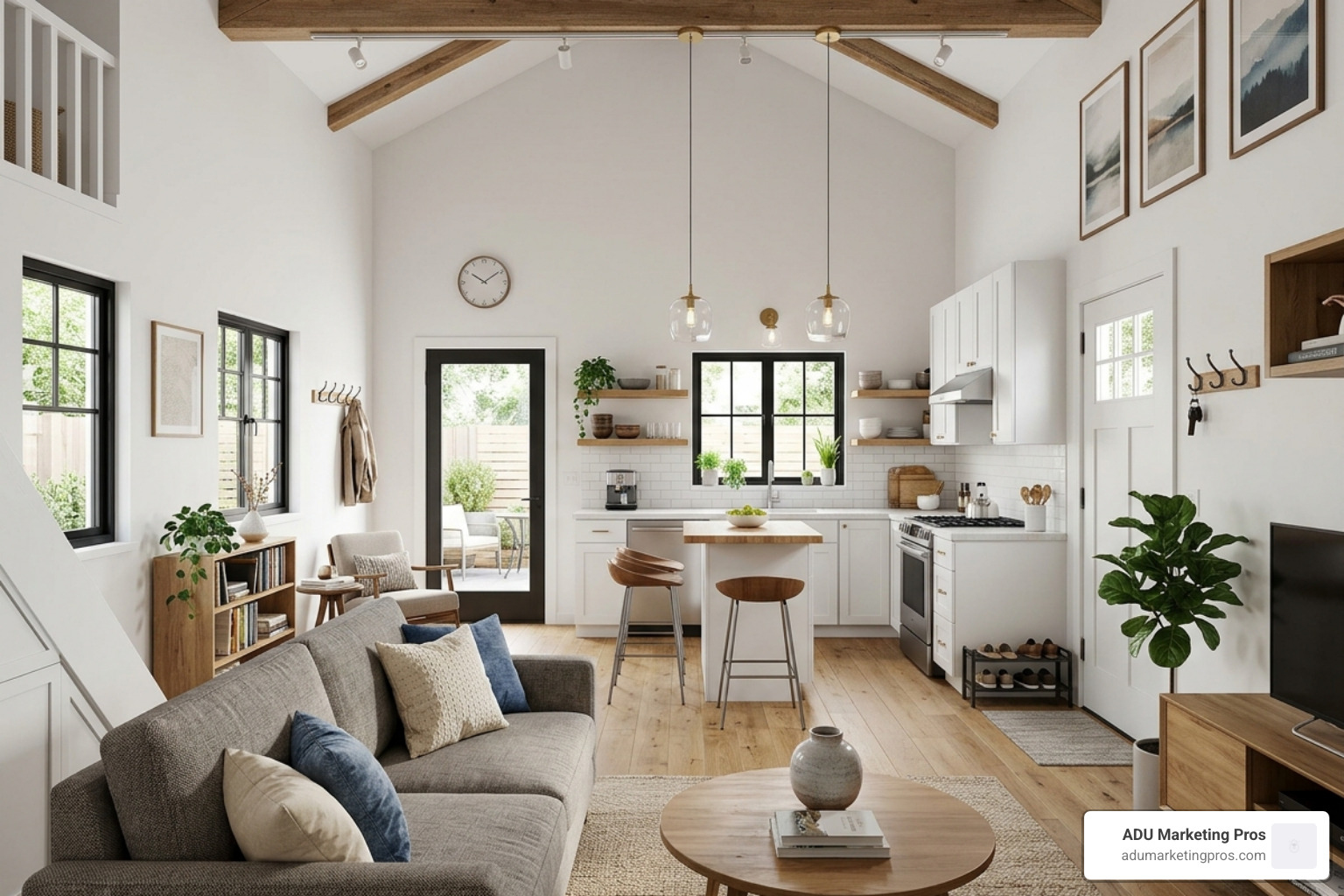
- Design (4–8 Weeks): You’ll work with an architect to create plans that maximize space. Think vaulted ceilings, pocket doors, and “great room” concepts that make 600 square feet feel like 1,000. In 2026, 3D renderings are standard, allowing you to “walk through” your ADU before a single nail is driven.
- Permitting (Approx. 60 Days): Your contractor submits the plans to the City of Redlands. Thanks to current state laws, this process is much faster than it was five years ago. However, if your property is in a historic district like the Smiley Heights area, additional architectural reviews may be required.
Leading firms like Acton ADU emphasize that “building it right the first time” starts here. Skipping a proper site inspection can lead to five-figure surprises once the shovels hit the dirt. For example, discovering an old, unmapped sewer line mid-construction can derail both your timeline and your budget.
Phase 2: Construction and Final Inspection
Once the “Golden Ticket” (your permit) is in hand, the physical work begins. This phase is often noisy and dusty, but it’s where your vision comes to life.
- Foundation and Underground Utilities: The “dirty” phase where pipes and concrete are laid. This is the most critical stage for long-term structural integrity.
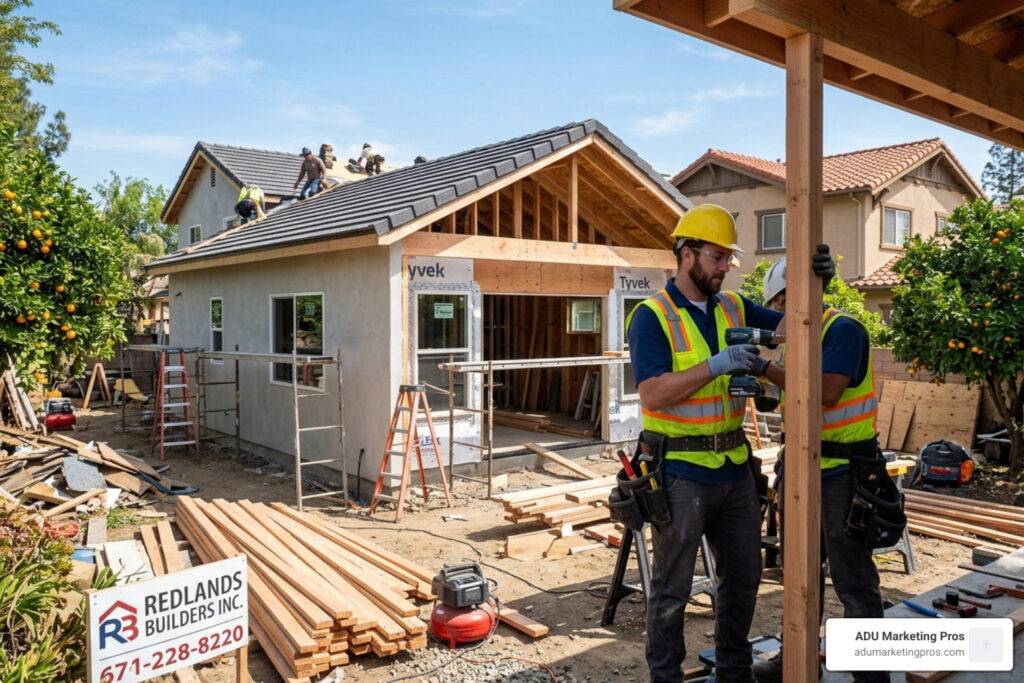
- Framing and Roofing: When the structure finally takes shape. You’ll finally see the scale of the building in your yard.
- MEP (Mechanical, Electrical, Plumbing): Installing the guts of the home. This includes HVAC systems, which in 2026 are almost exclusively high-efficiency mini-split systems.
- Finishes: Drywall, paint, flooring, and those beautiful quartz countertops you picked out. This is the most rewarding part of the process for most homeowners.
Many Local ADU builders now offer a “100-day build promise” from the day they break ground. This efficiency is achieved through tight project management and pre-ordering materials to avoid supply chain hiccups. The final step is the city walkthrough and the issuance of your Certificate of Occupancy—the moment your ADU officially becomes a home. Once you have this document, you can legally move in tenants or family members.
Frequently Asked Questions about Local ADU Builders
How much does it cost to build an ADU in Redlands in 2026?
While prices vary based on customization, most homeowners should budget between $150,000 and $300,000 for a fully permitted, detached unit. Garage conversions are typically more affordable, starting around $90,000 to $120,000. Factors like high-end finishes, solar upgrades, and complex landscaping will push these numbers higher.
Can I build an ADU on my property if I have an HOA?
Yes! California state law largely prohibits Homeowners Associations from banning ADUs. While they can have reasonable “aesthetic” requirements (like matching the roof tile or paint color of the main house), they cannot stop you from building one or make the process so expensive that it’s “unfeasible.” It is always best to share your plans with the HOA board early to avoid friction.
How long does the entire ADU process take from start to finish?
On average, expect the journey to take 8 to 12 months. This includes 2 months for design, 2-3 months for permitting, and 4-6 months for active construction. Prefabricated units can often shave 2-3 months off the construction timeline because the building is manufactured simultaneously with the site preparation.
Does an ADU require its own solar panels?
Under California’s Title 24 building standards, all newly constructed detached ADUs are required to have solar panels. However, garage conversions and attached ADUs are often exempt from this requirement unless the addition increases the home’s total floor area by a certain percentage. Your builder will help you determine the most cost-effective solar solution.
Will building an ADU increase my property taxes?
Yes, but only for the value of the new construction. Your primary home will not be reassessed at current market value. This is known as a “blended assessment.” For example, if you add a $200,000 ADU, your property tax will only increase by roughly 1% of that $200,000 (about $2,000 per year), while your primary home’s tax basis remains the same.
Can I sell my ADU separately from my main house?
In most cases, no. ADUs are intended to be accessory to the primary residence. However, under SB 9, some properties may be eligible for a lot split, which would allow the two units to be sold independently. This is a complex legal process that requires specific lot sizes and zoning conditions.
Conclusion
Investing in an ADU is one of the smartest moves a Redlands homeowner can make in 2026. It addresses the urgent need for housing in the Inland Empire, provides a reliable safety net of passive income, and ensures your family has the space it needs to grow together. Whether you are looking to house a returning college graduate, provide a dignified space for an aging parent, or simply diversify your investment portfolio, the ADU is a versatile and powerful tool.
At ADU Marketing Pros, we specialize in helping the best construction and architecture firms in the business connect with homeowners like you. We believe that by focusing on expertise, quality, and local knowledge, we can help transform California’s backyards into vibrant, functional living spaces that benefit the entire community. The journey from a vacant patch of grass to a beautiful, income-generating home is complex, but with the right local partner, it is incredibly rewarding.
Ready to take the next step? Learn more about the most popular ADU project in the Inland Empire: ADU Garage Conversions.