
The Strategic Value of Lead Nurturing for ADU Businesses
ADU lead nurturing is the systematic process of building relationships with potential accessory dwelling unit clients through personalized, timely communications from first contact to signed contract.
For quick reference, here’s what effective ADU lead nurturing includes:
| Element | Purpose | Impact |
|---|---|---|
| Personalized follow-up | Address specific property and zoning questions | 21x higher conversion when done within 5 minutes |
| Educational content | Build trust and demonstrate expertise | Positions your firm as the obvious choice |
| Segmentation | Tailor messaging for homeowners vs. investors | Can triple qualified lead rates |
| Automation | Ensure consistent, timely communication | Reduces no-shows and prevents lost leads |
| Multi-channel approach | Meet prospects where they are | Forms (70%), phone (20%), email/other (10%) |
California’s ADU boom has created massive opportunity, but simply generating leads isn’t enough. The research shows that ADU projects have longer sales cycles, with prospects often needing 50+ days to make decisions. During this consideration period, your nurturing strategy makes all the difference.
As one San Diego contractor finded, simplifying their contact form from 12 fields to just 3 increased completion rates from 12% to 37% overnight. Another client in San Jose tripled their qualified investor lead rate by shifting their landing page messaging to focus on ROI for ADU investments.
Whether you’re working with homeowners seeking additional living space or investors looking for rental income, a structured nurturing approach transforms cold leads into warm prospects and ultimately into signed contracts and referrals.
What Is ADU Lead Nurturing and Why It Matters
Have you ever wondered why some potential clients slip away while others eagerly sign contracts? The difference often comes down to one thing: ADU lead nurturing.
At its heart, ADU lead nurturing is the thoughtful process of building meaningful relationships with potential clients who aren’t quite ready to commit to an ADU project yet. While lead generation is about capturing initial interest (like getting someone’s contact information), nurturing is the art of guiding these prospects through their decision journey with helpful, timely information that speaks directly to their unique situation.
Think of it this way: if lead generation is like meeting someone at a party, lead nurturing is the series of coffee dates that build trust and eventually lead to a committed relationship. For ADU professionals working in competitive markets like San Jose or Los Angeles, this distinction isn’t just academic—your business success.
“B2B research consistently shows that 30-50% of leads are not ready to buy when they first inquire, but about 75% of these leads will become sales-ready within 12 to 18 months,” explains marketing automation expert Peter Sharkey. This pattern holds remarkably true for ADU prospects, who typically need extensive education and reassurance before committing $150,000+ to their backyard project.
The numbers tell a compelling story about nurturing’s impact:
- Companies with solid nurturing strategies generate 50% more sales-ready leads at 33% lower cost
- ADU prospects who receive a personalized response within 5 minutes are an astounding 21 times more likely to convert than those contacted after half an hour
- One of our San Diego clients boosted their consultation booking rate by 62% after adding an interactive ADU value calculator to their nurturing sequence
Understanding the psychological differences between homeowners and investors is crucial for effective nurturing. Homeowners tend to make decisions based on emotional factors—creating space for aging parents or boomerang kids, improving their lifestyle, or enhancing their property. Investors, meanwhile, focus primarily on hard numbers: ROI calculations, rental potential, and property value increases.
Key Differences Between Lead Generation & Nurturing
While lead generation and nurturing work hand-in-hand, they serve distinct purposes in your marketing strategy:
Lead Generation captures initial interest through activities like Google Ads, SEO, and social media. Success here is measured by volume and cost per lead—like running a campaign for “ADU Design Services in San Francisco” and tracking how many contact forms get filled out.
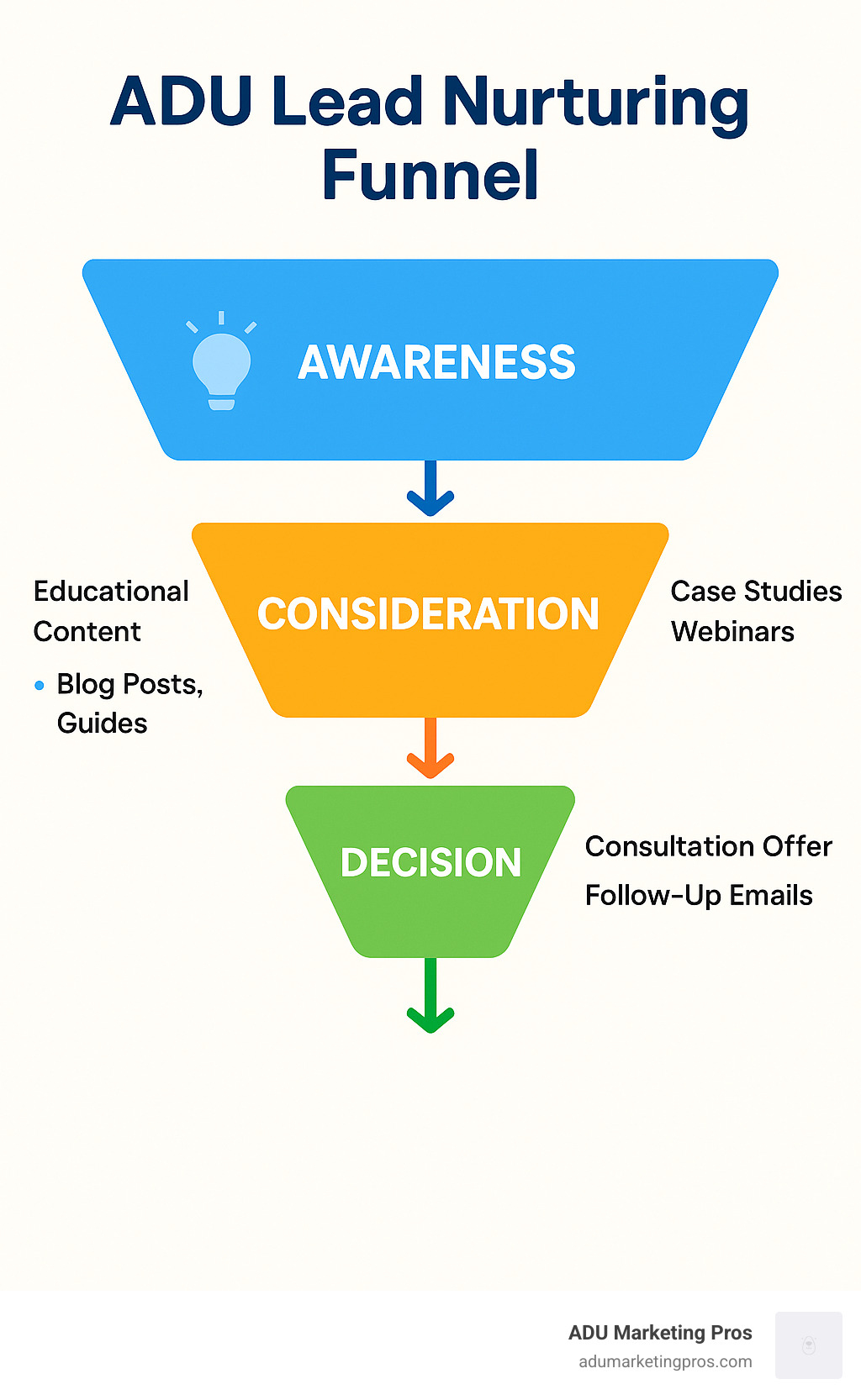
Lead Nurturing builds relationships through mid-funnel activities like personalized email sequences, educational content, and targeted retargeting. Success is measured by engagement, conversion rates, and sales velocity—like sending a 5-part email series explaining ADU permitting processes for different Bay Area cities and tracking how many recipients book consultations.
As Clay Stevens, who grew an ADU company from zero to $100M in sales volume as CMO, puts it: “The true value isn’t in how many leads you generate, but in how effectively you nurture them through the consideration process. ADU projects have complex decision cycles involving zoning, financing, and design considerations—each requiring custom education and reassurance.”
Our experience at ADU Marketing Pros confirms this wisdom. Firms who excel at lead nurturing typically close at rates 2-3 times higher than those focused solely on lead generation. They also enjoy shorter sales cycles and higher average contract values.
The science is clear: converting an ADU prospect into a client isn’t just about making that first connection—it’s about nurturing the relationship with the right information at the right time. Check out our comprehensive guide to ADU Lead Generation for more insights, or explore scientific research on ADU basics to deepen your understanding of what motivates potential clients.
Mapping the ADU Buyer’s Journey
Understanding the ADU buyer’s journey is essential for effective lead nurturing. This journey typically includes four key stages, each requiring different nurturing approaches:
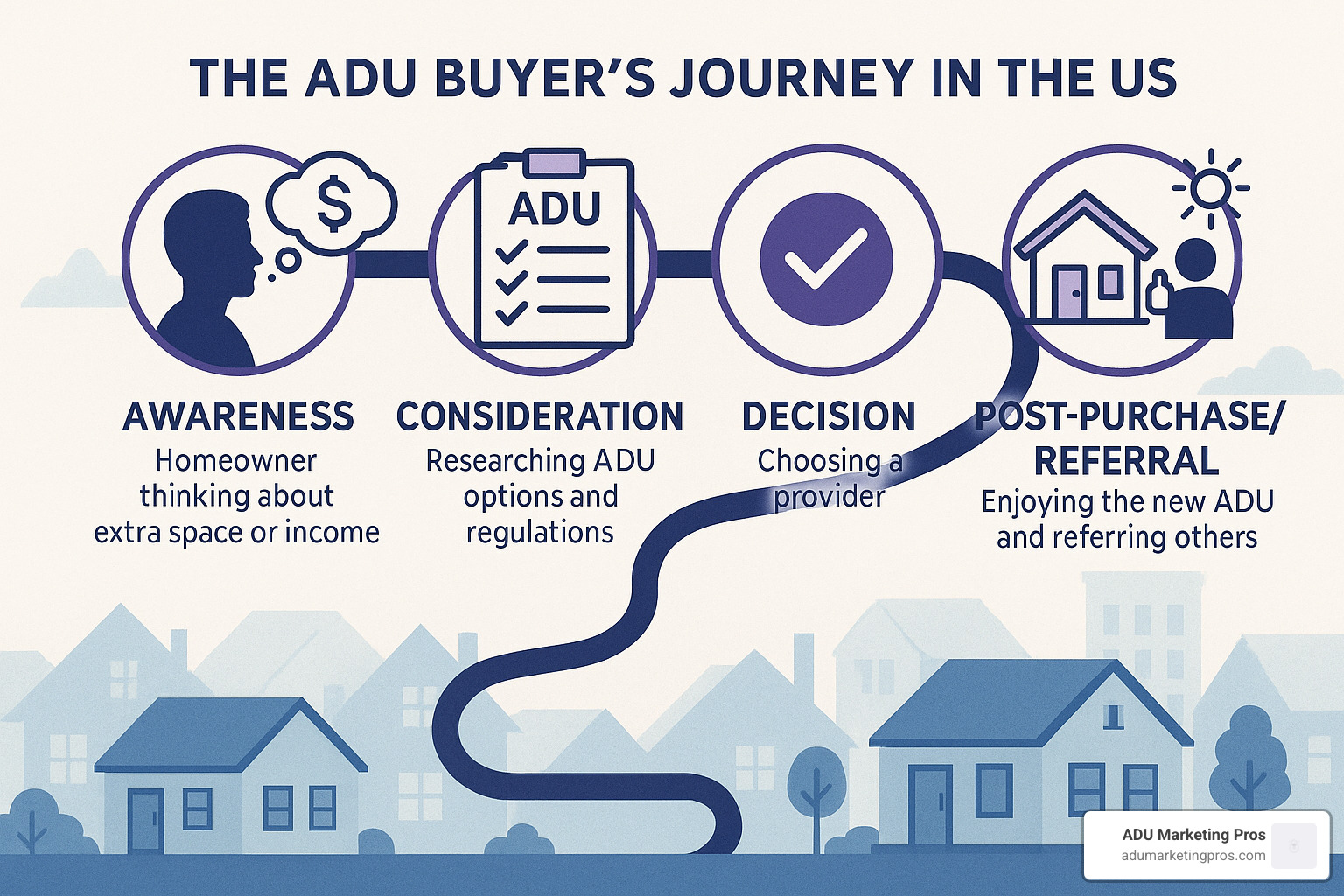
When a homeowner first considers adding an ADU to their property, they enter what we call the awareness stage. This is when they’re just realizing they need additional space or finding the income potential hiding in their backyard. From there, they move into the consideration stage, researching options, costs, and local regulations while evaluating potential providers.
As they gather information and narrow their choices, they reach the decision stage – that critical moment when they’re evaluating specific proposals and preparing to select their ADU partner. But the journey doesn’t end with a signed contract. The post-purchase/referral stage encompasses their experience throughout construction and, hopefully, their excitement to refer friends and family to your services.
What makes ADU projects unique is the maze of concerns prospects must steer at each stage. A recent study of California ADU projects revealed that permit approval worries and financing uncertainties were the top two reasons why interested homeowners abandoned their plans altogether. Understanding these roadblocks is crucial to guiding prospects through their journey.
The path looks quite different depending on who’s walking it. Here’s how homeowner and investor journeys typically diverge:
| Stage | Homeowner Pain Points | Investor Pain Points |
|---|---|---|
| Awareness | Need for family living space; aging parents | ROI potential; passive income opportunity |
| Consideration | Design aesthetics; family functionality | Rental market analysis; tenant preferences |
| Decision | Personal budget constraints; disruption concerns | Financing options; timeline to revenue |
| Post-Purchase | Construction experience; family satisfaction | Tenant acquisition; property management |
“Understanding these distinct journeys allows us to create targeted nurturing content that addresses the specific concerns of each audience,” explains our team at ADU Marketing Pros. “A homeowner in Palo Alto considering housing an aging parent has completely different information needs than an investor in San Diego looking at rental income potential.”
Adaptive Tactics at Each Stage
The magic of effective lead nurturing happens when you match your approach to where your prospect stands in their journey.
During the awareness stage, your focus should be on education and inspiration. Blog posts explaining ADU benefits, introductory webinars, and social media showcasing beautiful completed projects work wonders here. One of our clients found that offering downloadable local zoning guides for specific cities became their most powerful lead magnet, addressing the #1 concern of prospects just starting their research.
As prospects enter the consideration stage, they crave more detailed information. This is where detailed cost guides, financing option breakdowns, and case studies of similar projects make all the difference. Interactive ROI calculators prove especially effective for investors, while design lookbooks and 3D visualization tools help homeowners envision possibilities. Permit process checklists custom to different municipalities also provide immense value at this stage.
The decision stage calls for more concrete, personalized materials. Detailed proposals with clear timelines, client testimonials from similar projects, and virtual tours of completed ADUs help prospects feel confident in their choice. Offering permit approval assistance guarantees can also remove a major barrier to signing.
Even after the contract is signed, nurturing continues. During the post-purchase/referral stage, regular construction updates, referral incentive programs, and post-completion celebration events strengthen the relationship. For investor clients, offering rental listing assistance provides added value that can lead to repeat business.
A Mountain View client finded the power of emotional connection when they doubled their click-through rates by shifting their messaging. Rather than focusing on construction features in the awareness stage, they highlighted emotional benefits for homeowners while maintaining technical ROI information for prospects further along in their journey.
By mapping your content and communications to these journey stages, you create a seamless path that guides prospects from curious researcher to satisfied client – and ultimately to enthusiastic referral source. Learn more about developing comprehensive ADU Marketing Strategies that address each stage of the buyer’s journey.
Channels, Tools, and Automation for Effective ADU Lead Nurturing
Successful ADU lead nurturing isn’t just about what you say—it’s about where and how you say it. After working with dozens of ADU builders across California, we’ve finded that combining the right channels with smart automation creates a nurturing system that feels personal but runs like clockwork.
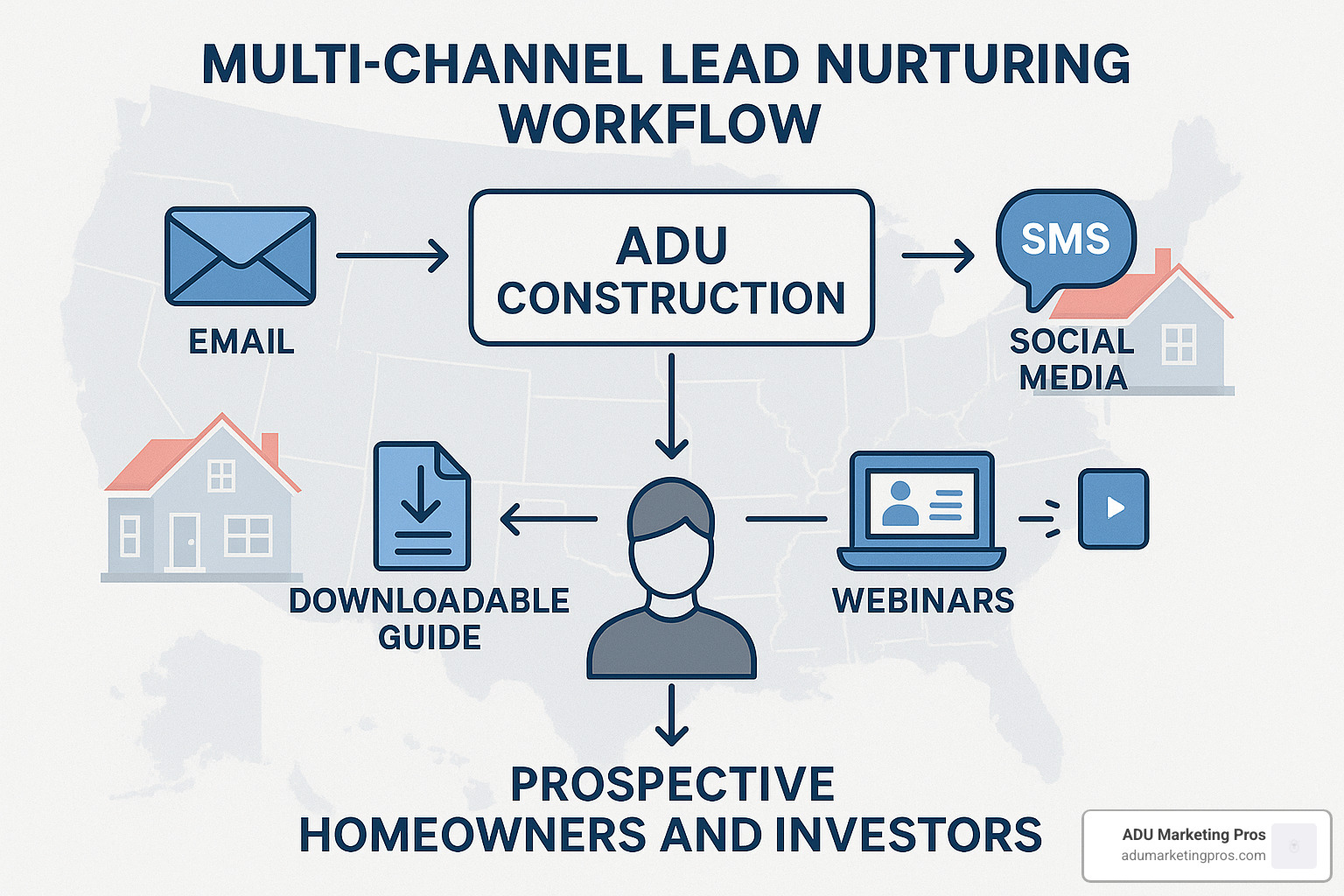
Remember when a San Jose builder told us they were “drowning in leads but starving for clients”? Their problem wasn’t attracting interest—it was nurturing that interest into real relationships. Once they implemented a proper multi-channel approach, their conversion rates tripled within 60 days.
Email marketing remains the workhorse of ADU lead nurturing. One of our clients in San Jose created a simple “ADU 101” email series that achieved a remarkable 47% open rate. Why? They took the time to separate homeowner and investor lists, knowing these groups have completely different questions and concerns.
When you need immediate attention, nothing beats SMS messaging. With near-perfect open rates, text messages create urgency without feeling pushy. I’ll never forget how an LA builder slashed their consultation no-shows by 68% with a simple automated text reminder system. “It was the easiest fix we ever made,” their marketing director told me.
Have you noticed how that ADU design you viewed follows you around the internet? That’s retargeting at work, and it’s incredibly effective for complex purchases like ADUs. A Sunnyvale firm we work with saw website return visits jump 34% after implementing ads that specifically addressed financing concerns—the number one sticking point for their prospects.
Despite all our digital tools, phone calls remain irreplaceable for high-value projects. The research is crystal clear: responding to an inquiry within 5 minutes makes you 21 times more likely to qualify that lead than waiting 30 minutes. One builder told me, “Every minute that passes feels like watching money float away.”
Don’t overlook the power of direct mail in our digital age. When a San Francisco design-build firm started sending beautiful, personalized lookbooks to qualified prospects, their consultation bookings jumped to 23%. In a world of digital noise, something tangible can make a profound impression.
For visual inspiration, social media platforms shine. Instagram and Pinterest have become essential for showcasing ADU designs and progress updates. A San Diego builder uses Instagram Stories for weekly construction updates, giving prospects confidence while they’re still deciding. “People tell us they feel like they already know us before the first meeting,” their founder shared.
Core Tech Stack for ADU Lead Nurturing
You don’t need enterprise-level budgets to build an effective nurturing system, but you do need thoughtful integration. Think of your tech stack as an ecosystem where each part supports the others.
At the heart of everything sits your Customer Relationship Management (CRM) system. This isn’t just a fancy contact list—it’s the central nervous system of your nurturing efforts. The best ADU firms customize their CRMs with fields that matter for their business: property dimensions, zoning classifications, and budget ranges that help prioritize follow-up.
Your email marketing platform should feel like a natural extension of your CRM. When a prospect downloads your “ADU Financing Guide,” does that automatically trigger a relevant email sequence? For most of our clients, this integration is where the magic happens.
Smart ADU companies use lead scoring to focus their energy where it matters most. When someone visits your pricing page three times, that’s different from someone who only looked at your blog once. A simple point system helps your team prioritize follow-up and personalize conversations. “Before scoring, we treated every lead the same,” admitted one builder. “Now we know exactly who needs attention first.”
Don’t underestimate the value of call tracking and recording. One of our Orange County clients finded their highest-converting sales rep was emphasizing rental income potential, while others focused on construction quality. This insight reshaped their entire messaging approach.
For immediate engagement, many firms find chatbots and live chat invaluable. A Menlo Park specialist saw after-hours lead capture increase by 37% after adding a simple chatbot that gathered basic property information and scheduled follow-ups.
Bringing everything together in an analytics dashboard helps you see what’s working. Focus on meaningful metrics like lead-to-consultation ratio and nurturing sequence completion rates rather than vanity metrics that don’t predict revenue.
The good news? Tools like Zapier make connecting these systems surprisingly simple. As one client put it: “Setting up our Typeform surveys to automatically feed into our CRM and trigger the right email sequence was a game-changer. We’re capturing richer data while making the process simpler for prospects.”
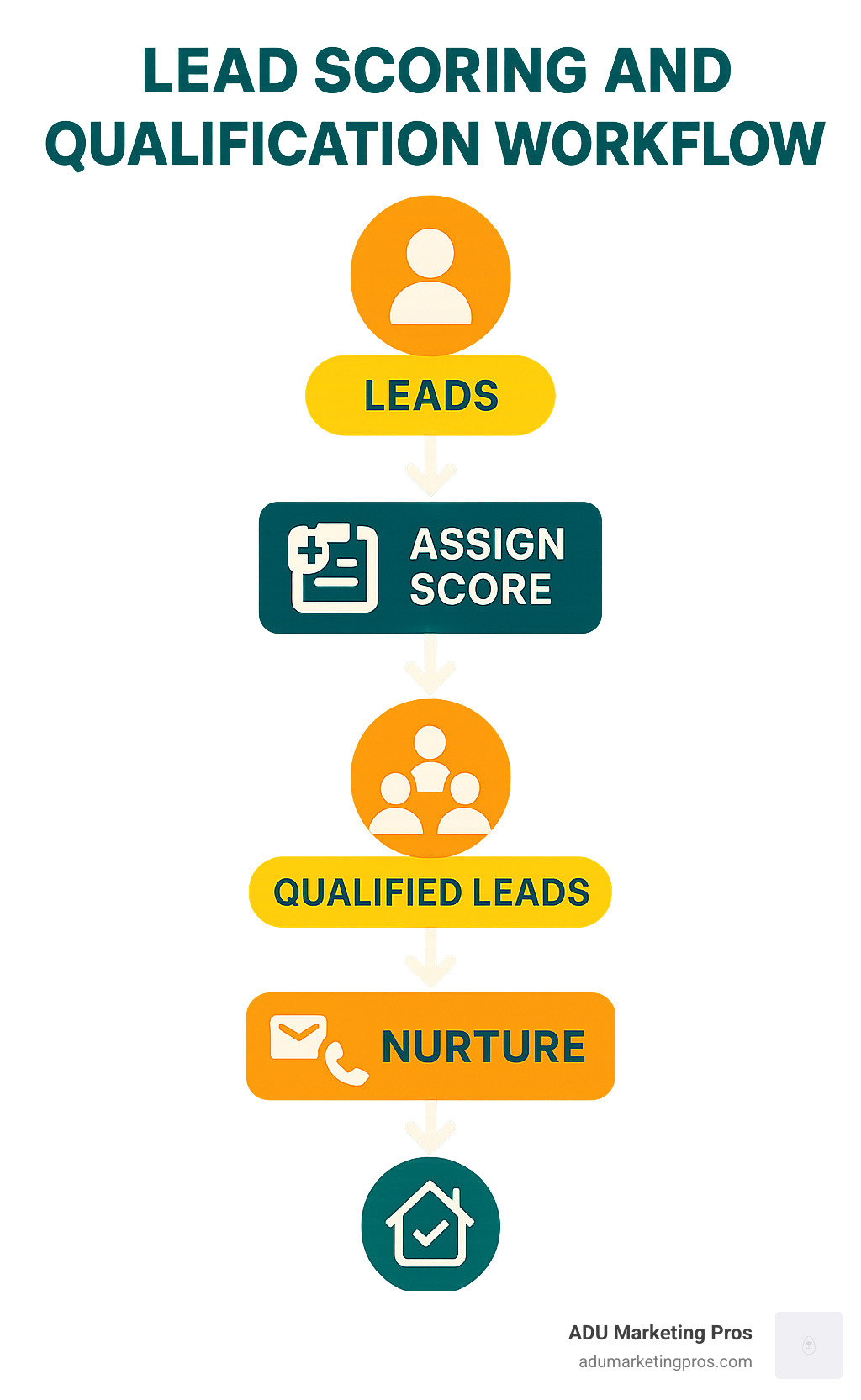
The tools you choose matter less than how they work together. The most successful firms create systems where information flows naturally between touchpoints, creating a seamless experience for prospects while giving their teams clear visibility into the nurturing process. Check out our guide on Email Marketing for Architects for deeper insights on crafting effective communications, or review Marketo’s comprehensive report on nurturing for broader industry benchmarks.
Content, Personalization, and Segmentation Tactics to Move Homeowners & Investors to “Yes”
Creating content that truly resonates with ADU prospects isn’t about quantity—it’s about speaking directly to their unique situation and needs. This personalized approach sits at the heart of effective ADU lead nurturing, and the results speak for themselves.
I recently spoke with a San Jose ADU builder who shared something remarkable: “When we started segmenting our content for homeowners versus investors, our qualified lead rate tripled within weeks.” This isn’t surprising when you consider how different these audiences are.
Content That Converts for Different Segments
Homeowners and investors are looking for completely different things in your communications. For homeowners, emotional storytelling that showcases family benefits like multigenerational living or aging in place creates powerful connections. They want to see beautiful design galleries, step-by-step guides that explain the ADU process, and relatable testimonials from people just like them.
Investors, on the other hand, speak the language of numbers. They’re looking for detailed ROI calculators, market rental analyses for specific neighborhoods, and case studies with concrete financial returns. They want to understand tax benefits and property value appreciation data—anything that helps them evaluate the ADU as a business decision.
A client in Mountain View implemented this insight brilliantly. They created two distinct nurturing paths based on a simple form question: “Primary purpose for your ADU?” The results? Consultation booking rates jumped by 42% when content aligned with the prospect’s stated purpose.
Personalized Workflows for ADU Lead Nurturing
True personalization goes far beyond just dropping someone’s name into an email. The most effective ADU companies create nurturing workflows that adapt to each prospect’s behavior and needs.
Behavior-based triggers allow you to respond intelligently to prospect actions. When someone views your financing page three times, that’s not random browsing—it’s a signal they need help with funding options. Smart automation can deliver the right resources at exactly the right moment.
Location-specific content is particularly crucial in the ADU world, where regulations vary dramatically between municipalities. One Bay Area client created city-specific permit guides for 12 local municipalities, positioning themselves as the go-to experts in navigating complex local requirements.
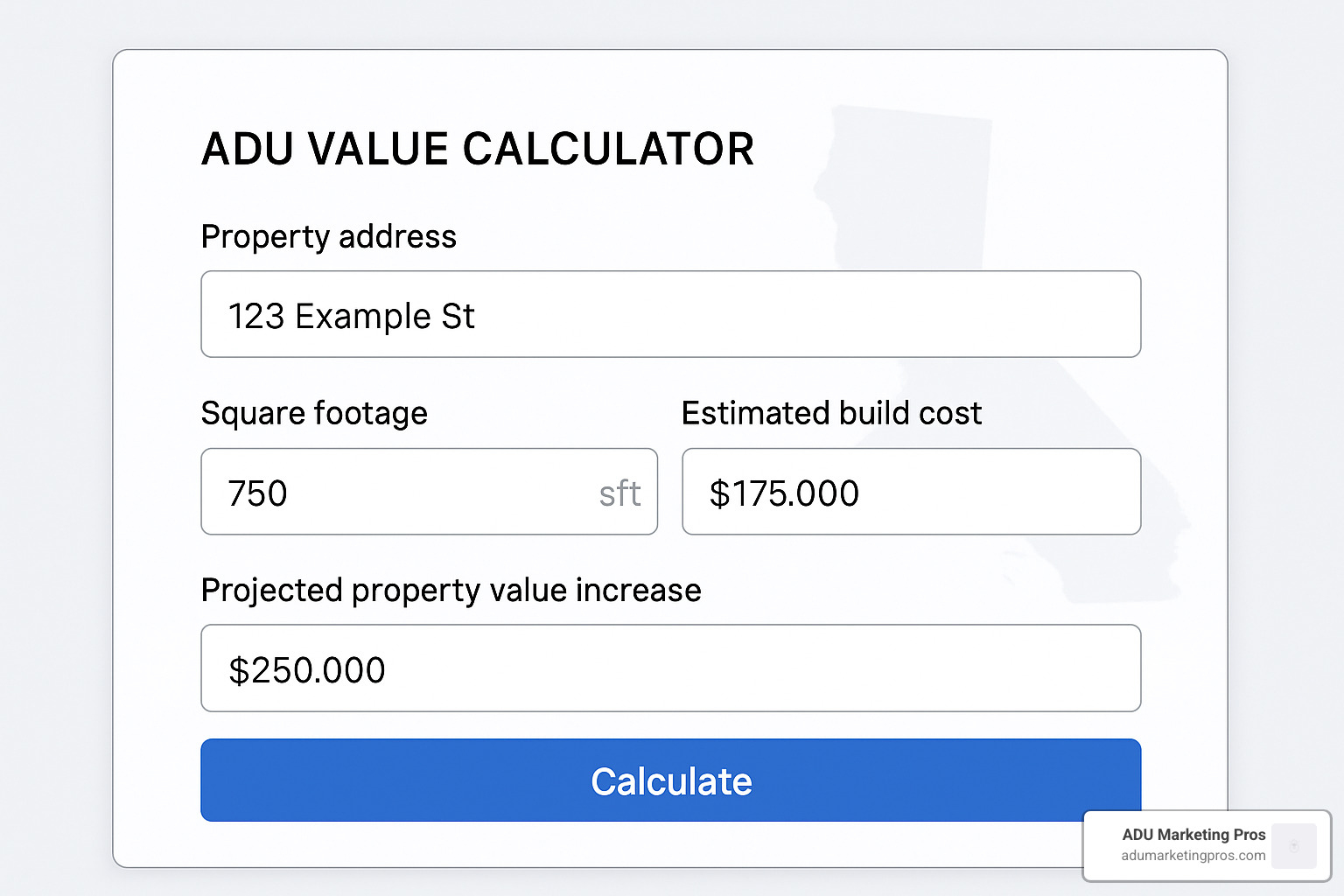
Interactive tools create engagement while gathering valuable information. A San Diego contractor saw consultation bookings jump by 62% after implementing an interactive ADU value calculator like the one shown above. These tools not only provide value to prospects but also help you understand their specific needs better.
The progressive profiling approach has proven particularly effective. Rather than scaring prospects away with lengthy forms, gather information gradually throughout the nurturing process. A Los Angeles ADU firm saw form completion rates triple (from 12% to 37%) by reducing their initial form to just three fields, then collecting additional details through subsequent interactions.
Sometimes the simplest approaches work wonders. Our team at ADU Marketing Pros has found that sending a brief 9-word email to stagnant leads can be remarkably effective. A simple “Are you still interested in building an ADU?” sent to cold leads generated a 58% response rate for one client, rekindling conversations that had gone silent.
Personalization must continue through the sales handoff. Your sales team should have access to each prospect’s complete interaction history, content consumption patterns, and specific interests before making contact. This creates a seamless experience that builds trust and demonstrates your attention to detail—qualities that matter tremendously when someone is considering a six-figure investment in their property.
For more insights on reaching your ideal ADU clients, check out our guide to ADU Digital Marketing Strategies.
Lead Scoring, Qualification, and Metrics: Proving Your Nurture Program Works
Implementing a robust lead scoring and qualification system is essential for effective ADU lead nurturing. Without it, your team may waste valuable time on prospects who aren’t ready to buy or miss opportunities with highly qualified leads.
“When we implemented lead scoring, we finded we were spending 70% of our sales time on prospects with only a 10% close probability,” reports a San Francisco ADU builder. “Reallocating our efforts based on lead scores increased our overall close rate by 34%.”
Building a Scoring Matrix
An effective ADU lead scoring system typically includes both demographic and behavioral factors:
Demographic Scoring Factors:
– Property location (zoning-friendly areas score higher)
– Property size (adequate for ADU requirements)
– Homeownership status (owners vs. renters)
– Budget range alignment
– Timeline expectations
Behavioral Scoring Factors:
– Website engagement (pages viewed, time on site)
– Content downloads (higher scores for decision-stage content)
– Email engagement (opens, clicks, replies)
– Form submissions and information provided
– Consultation attendance and participation
Here’s a simplified example of how points might be assigned:
| Action or Attribute | Score |
|---|---|
| Property in ADU-friendly zone | +15 |
| Budget over $200K indicated | +10 |
| Downloaded financing guide | +5 |
| Viewed pricing page | +8 |
| Opened 3+ emails | +3 |
| Clicked on case studies | +5 |
| Attended webinar | +12 |
| Requested consultation | +20 |
Leads can then be categorized as cold (0-20 points), warm (21-50 points), or hot (51+ points), with corresponding nurturing strategies for each category.
A client in Palo Alto refined their scoring system after analyzing their closed deals, finding that prospects who viewed their “ADU Financing Options” page more than twice closed at 3x the rate of other leads. They adjusted their scoring to prioritize these high-intent signals.
Key Metrics to Track
To prove your nurturing program’s effectiveness, focus on these critical metrics:
- Lead-to-SQL Conversion Rate: Percentage of leads that become Sales Qualified Leads through nurturing
- Nurture Sequence Completion Rate: Percentage of leads who complete your email sequences
- Engagement Rate: Open, click, and response rates across nurturing content
- Consultation-to-Proposal Ratio: Percentage of consultations that result in formal proposals
- Proposal-to-Contract Ratio: Percentage of proposals that convert to signed contracts
- Sales Velocity: Time from initial inquiry to signed contract
- Customer Acquisition Cost (CAC): Total marketing and sales costs divided by number of new customers
- Customer Lifetime Value (CLV): Including referrals and additional services
“Tracking CLV is particularly important for ADU businesses,” explains our team at ADU Marketing Pros. “If an average ADU project brings in $150,000 and 20% of your business comes from referrals, your CLV is significantly higher than the initial project revenue alone.”
Regular dashboard reviews are essential. A San Diego ADU firm conducts weekly metrics reviews, allowing them to quickly identify and address nurturing bottlenecks. After noticing a drop in consultation bookings, they finded their appointment scheduling page was loading slowly on mobile devices—fixing this issue increased bookings by 28% in just one week.
Metrics should drive action. As one successful ADU builder noted, “The numbers tell us where to focus our efforts. When we saw that leads who received our permit guide converted at double the rate of others, we made sure every lead received that content within the first week.”
Common Pitfalls & Pro Tips for ADU Lead Nurturing
Even the most carefully designed ADU lead nurturing programs can stumble without attention to certain common pitfalls. After working with dozens of ADU construction and architecture firms throughout California, we’ve spotted recurring issues that can derail your nurturing efforts—and developed practical solutions to overcome them.
Top 7 ADU Lead Nurturing Mistakes
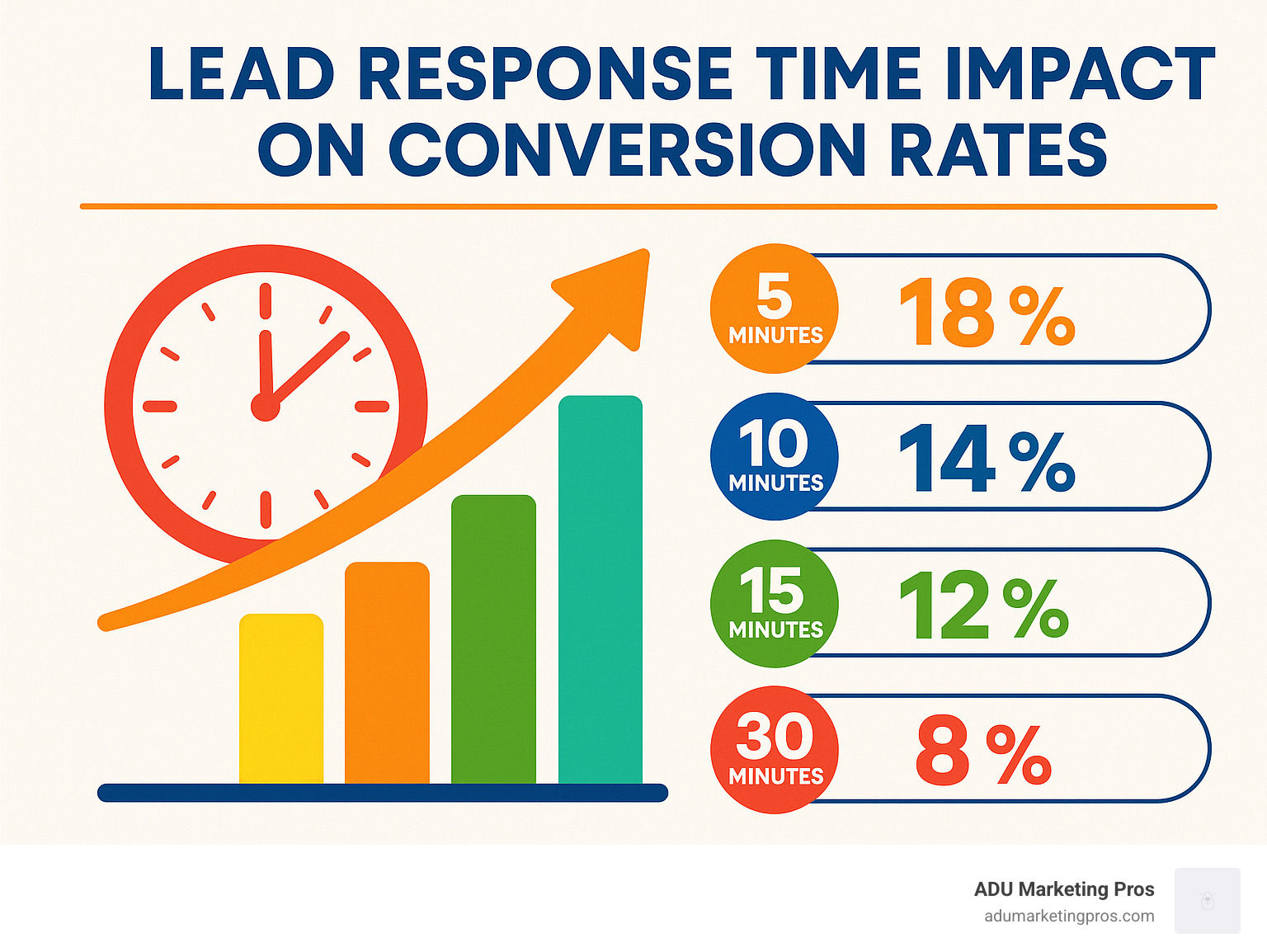
The response clock starts ticking the moment a prospect reaches out. When a San Diego contractor implemented a 5-minute response guarantee, their conversion rates jumped by 32% in just one month.
Slow Follow-Up is perhaps the most costly mistake we see. The research is crystal clear: responding to leads within 5 minutes makes you 21 times more likely to convert them compared to waiting just 30 minutes. Yet surprisingly, many ADU firms still take hours or even days to make contact.
“We were losing golden opportunities without even realizing it,” confessed one of our Los Angeles clients. “Once we set up an immediate auto-response system followed by a personal touch within minutes, our qualification rate nearly doubled.”
Generic, one-size-fits-all communication is another conversion killer. Sending identical messages to all prospects completely misses the vastly different motivations between homeowners looking for family space and investors seeking rental income.
A warm, personalized approach makes all the difference. One Bay Area firm saw consultation bookings increase 47% after creating separate nurturing tracks for different prospect types, addressing their specific concerns and questions.
Overreliance on email limits your ability to connect. While email remains the backbone of most nurturing programs, relying solely on one channel leaves opportunities on the table. Your prospects are everywhere—your nurturing should be too.
Ignoring local regulations undermines your expertise. California’s patchwork of ADU ordinances means that advice relevant in San Jose might be completely wrong for Santa Monica. Generic content that glosses over these crucial differences makes prospects question your knowledge.
“Creating city-specific content addressing local ADU ordinances was a game-changer for us,” shared a contractor from Palo Alto. “It immediately positioned us as the local expert compared to competitors using generic information.”
Overwhelming prospects with technical information too early is like proposing marriage on the first date—it scares people away. We’ve seen countless firms dump complex construction specifications and zoning codes on early-stage prospects, causing confusion and abandonment.
Neglecting lead scoring means treating all prospects equally—a recipe for wasted time and missed opportunities. Without a system to identify your hottest leads, you’ll inevitably focus on the wrong prospects while neglecting those most likely to convert.
Finally, inconsistent sales handoff forces relationships to start from scratch. When your sales team lacks visibility into a prospect’s previous interactions, all the trust built through nurturing evaporates in an instant.
Quick-Fix Optimizations
Need to improve your ADU lead nurturing right away? Here are five high-impact changes you can implement this week:
Simplify your initial contact form to capture just the essentials. When a Bay Area client reduced their form from 12 fields to just 3, their completion rates soared from 12% to 37% overnight. You can always gather more information later.
Implement a 5-minute response guarantee during business hours. Create internal processes ensuring every lead receives acknowledgment within moments of reaching out, and make this guarantee visible on your website.
Add one simple segmentation question to your forms: “What’s your primary interest in an ADU?” with options like “Additional family living space,” “Rental income,” or “Increasing property value.” This single data point allows for meaningful personalization.
Develop a basic three-email sequence that works while you sleep: a warm introduction, valuable educational content, and an invitation to consult. Even this simple automation creates consistency many competitors lack.
Set up proper analytics tracking to establish your baseline metrics. You can’t improve what you don’t measure, so configure your systems to track key conversion actions from the start.
“The simplest changes often have the biggest impact,” notes our team at ADU Marketing Pros. “One client in Los Angeles implemented a chatbot that asked three qualification questions and scheduled consultations automatically. Their after-hours lead capture increased by 42% in the first month.”
Don’t forget compliance considerations in your nurturing communications. Include necessary disclaimers about construction timelines, permit approvals, and financing options. A simple compliance checklist should be part of your content creation process to protect both you and your prospects.
By avoiding these common pitfalls and implementing these straightforward fixes, you’ll create a nurturing system that converts more prospects into projects—and does so more efficiently than your competition. For more specialized guidance on optimizing your ADU lead nurturing, visit our ADU Marketing Solutions page.
Frequently Asked Questions about ADU Lead Nurturing
How fast should I follow up with a new ADU inquiry?
Let’s cut right to the chase – speed isn’t just important, it’s everything when it comes to ADU inquiries. The research paints a crystal-clear picture: leads contacted within 5 minutes are a whopping 21 times more likely to enter your sales process than those contacted after half an hour. With ADU projects representing significant investments, that first impression really counts.
Here’s what works best for our most successful clients:
First, send an immediate automated acknowledgment that feels personal and sets clear expectations. Then follow up with an actual human response within 5 minutes during business hours. One of our San Francisco clients who implemented a “5-minute guarantee” saw their lead-to-consultation rate jump by 34% in just the first month!
For those after-hours inquiries (because let’s face it, homeowners often research ADUs in the evening), make sure your automated response clearly explains when they’ll hear from your team. Then make sure someone follows up within the first hour of the next business day. That small window makes a huge difference in conversion rates.
What’s the best way to segment homeowners vs. investors?
The simplest approach is often the most effective – just ask directly on your contact form! A straightforward question like “What’s your primary interest in building an ADU?” with options for family space, rental income, property value increase, or “other” can inform your entire nurturing strategy.
This single data point can completely transform how you communicate with prospects. Beyond this initial segmentation, pay attention to how they interact with your content:
Homeowners typically linger on design galleries and family-focused content, while investors gravitate toward ROI calculators and rental market information. Their digital body language tells you a lot about their motivations.
One of our clients in San Jose created separate landing pages and nurturing sequences for these segments and tripled their qualified investor lead rate in just weeks. That’s the power of relevant communication!
Of course, many prospects have multiple motivations – someone might want both family space now and rental income later. Allow for this complexity by including some crossover content that addresses both perspectives. The key is making each prospect feel like you understand their specific situation.
Which metrics matter most for calculating nurture ROI?
When it comes to measuring the effectiveness of your ADU lead nurturing, not all metrics are created equal. For ADU businesses specifically, here are the numbers that truly matter:
Cost Per Acquisition (CPA) tells you exactly what you’re spending to land each new client. This bottom-line metric helps you understand if your nurturing efforts are financially sustainable.
Lead-to-Contract Ratio shows the percentage of leads that eventually sign on the dotted line. This conversion rate is the ultimate measure of nurturing effectiveness.
Sales Velocity measures how quickly leads move through your pipeline. Good nurturing should accelerate this timeline, turning what might be a 90-day sales cycle into 50 days or less.
Average Contract Value helps you understand if your nurturing is attracting higher-value projects. Are your educational materials encouraging clients to invest in premium features?
Customer Lifetime Value (CLV) captures the full picture, including referrals and additional services. One successful ADU can lead to multiple projects through word-of-mouth.
Return on Marketing Investment (ROMI) gives you the big picture: (Revenue from nurturing – Cost of nurturing) ÷ Cost of nurturing.
One fascinating insight we uncovered with an ADU Marketing Pros client: tracking close rates by lead source revealed that website contact forms generated prospects 2.5 times more likely to sign contracts than social media leads. This allowed them to shift budget toward higher-converting channels.
For ongoing optimization, keep an eye on engagement metrics like email opens, content downloads, and website return visits. These leading indicators help you refine your nurturing approach before seeing the impact on sales metrics.
ADU projects typically have longer sales cycles than many other industries – sometimes 50+ days according to our research. Your metrics tracking should account for this longer timeline to accurately measure success.
Conclusion
Effective ADU lead nurturing is not just another marketing tactic—it’s a business-changing approach that changes how ADU construction and architecture firms turn curious prospects into committed clients. Throughout this guide, we’ve seen that nurturing extends far beyond sending a few follow-up emails; it’s about building genuine relationships, providing real value, and walking alongside prospects as they steer their decision journey.
The numbers tell a compelling story:
– Reaching out personally within 5 minutes makes prospects 21 times more likely to convert
– Simplifying your forms can boost completion rates from a measly 12% to an impressive 37%
– When you segment your nurturing efforts thoughtfully, you can triple your qualified lead rates
– Interactive tools like value calculators can increase consultation bookings by a whopping 62%
If you’re running an ADU business in competitive markets like San Jose, Los Angeles, or anywhere in the Bay Area, a structured nurturing program isn’t something nice to have—it’s absolutely essential for growth that lasts.
Your Next Steps: A Roadmap to Nurturing Excellence
Start by taking a good look at your current process. Map out exactly how leads flow from that first contact to final contract signing. Where are the gaps? Where are you losing people? How quickly are you responding to inquiries, and what percentage actually convert?
Then, implement some basic segmentation. Add a simple question to your forms that helps you understand intent. Create separate content paths for homeowners (who care about family needs and lifestyle) versus investors (who focus on ROI and rental potential). Develop location-specific information for the cities you serve most—remember, ADU regulations vary dramatically across California.
Building your tech stack doesn’t need to be complicated. Select a CRM system that includes lead scoring capabilities, set up some automated email sequences, and make sure you’re tracking calls and form submissions. The right tools make nurturing manageable, even for smaller firms.
Your content library is your nurturing foundation. Create materials appropriate for each stage of the journey and each prospect segment. Build interactive tools that engage prospects and showcase your expertise. Develop case studies that tell the stories of successful projects similar to what your prospects are considering.
Finally, establish systems to measure what’s working. Define your key metrics, create simple dashboards for monitoring, and schedule regular meetings to review and optimize your approach.
The most successful ADU firms we work with at ADU Marketing Pros see nurturing as an ongoing journey of improvement. They’re constantly testing new approaches, refining their messages, and optimizing their systems based on real performance data.
As one of our clients beautifully put it: “Our nurturing program doesn’t just help us close more business; it pre-educates clients so projects run more smoothly and everyone’s happier with the outcome.”
In California’s competitive ADU landscape, the firms that master the art of nurturing will be the ones that thrive in the years ahead. By implementing the strategies we’ve discussed, you’re taking important steps toward becoming one of them.
Ready to take your ADU lead nurturing to the next level? At ADU Marketing Pros, we specialize in helping construction and architecture firms develop high-converting nurturing systems custom to their specific markets and business goals. Contact us today to learn how we can help you convert more leads into satisfied clients who will sing your praises for years to come.