
Why ADU Construction Services Are Changing California Housing
In the face of California’s persistent housing crisis, ADU construction services have emerged as a transformative solution for homeowners. Spurred by state-level legislation designed to cut red tape, Accessory Dwelling Units (ADUs) are no longer a niche concept but a mainstream strategy for creating much-needed housing. For property owners, they represent a unique opportunity to maximize their land’s potential. Whether you envision a private backyard cottage for aging parents, a modern rental unit to generate passive income, or a flexible space for a home office, finding the right contractor is the critical first step in turning that vision into a tangible, valuable asset.
Quick Guide to ADU Construction Services:
- Types Available: Detached units, garage conversions, attached ADUs, and Junior ADUs (JADUs)
- Timeline: 10-16 months from design to completion
- Cost Range: $130,000 – $430,000 in California (averaging $250-$300 per square foot)
- Key Requirements: Valid CSLB license, proper insurance, local permit expertise
- Best Approach: Get 3+ detailed bids from specialized ADU contractors
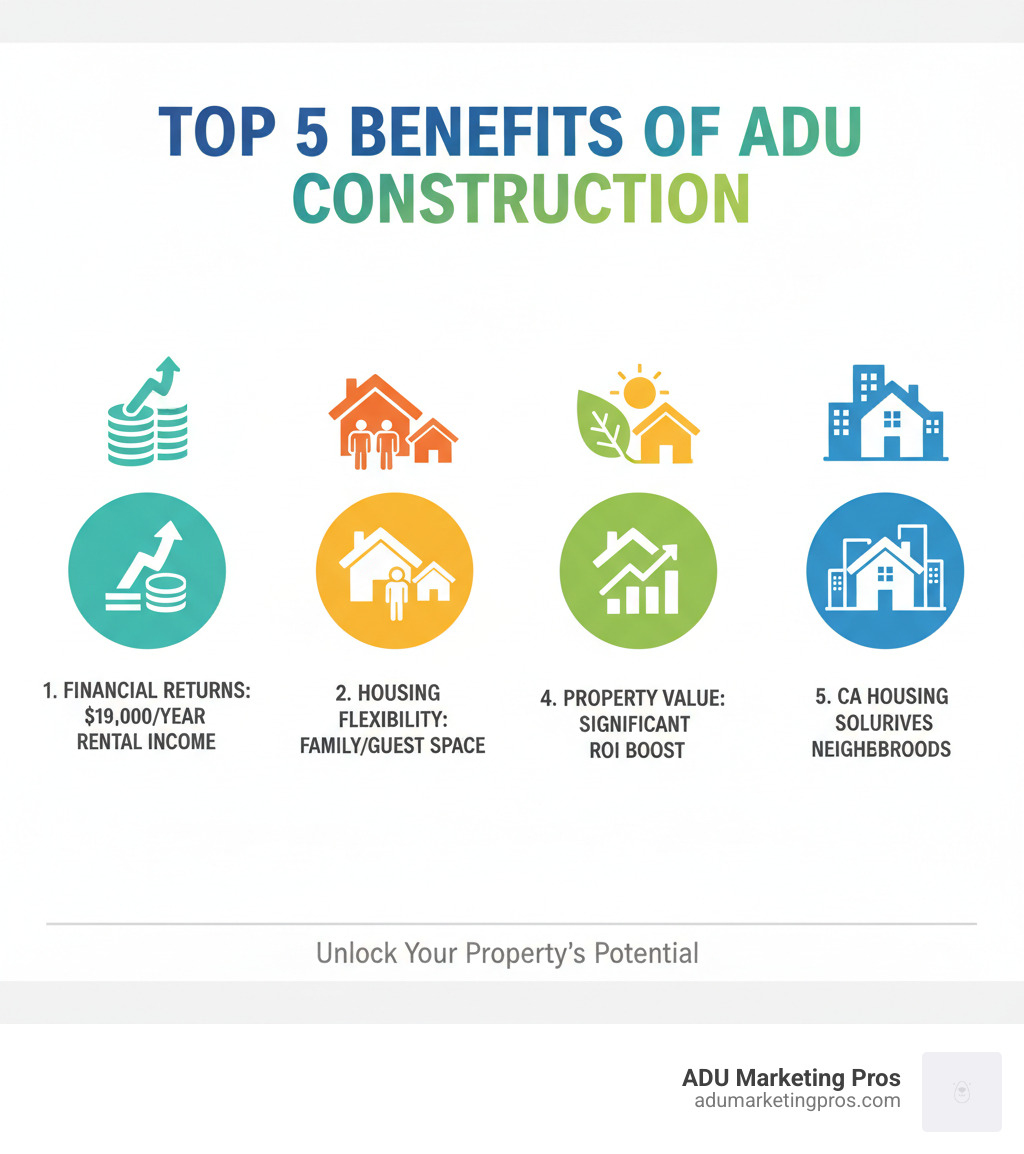
ADUs can generate around $19,000 annually in rental income and significantly boost your property’s market value. However, the process involves navigating complex regulations, detailed design choices, and lengthy timelines. That’s where choosing the right ADU construction service becomes the most important decision you’ll make. As one satisfied homeowner shared: “I hired the contractor for an ADU build in their backyard and was pleased with the outcome… they guided me through the entire ADU building process smoothly.”
The stakes are incredibly high. An ADU is a significant financial and personal investment. Building without the proper permits isn’t just risky—it can lead to crippling fines, stop-work orders, insurance claim denials, and, in the worst-case scenario, a demolition order from the city. Furthermore, partnering with an inexperienced or unreliable contractor can derail your project with endless delays, unexpected cost overruns, and shoddy craftsmanship that undermines your property’s value.
This guide is designed to equip you with the knowledge to navigate this complex process successfully. We’ll cover everything from understanding the different types of ADUs to meticulously vetting contractors and avoiding the costly mistakes that can jeopardize your investment.
Understanding the ADU Landscape: Types, Costs, and Timelines
Before diving into finding the perfect ADU construction services partner, it’s essential to understand the landscape. This foundational knowledge will empower you to have meaningful conversations with contractors, set realistic expectations, and make informed decisions throughout the project.
The Different Types of ADUs
An Accessory Dwelling Unit is a self-contained living space on your property with its own entrance, kitchen, bathroom, and sleeping area. These units typically range from 150 to 1,200 square feet. Each type has unique benefits and challenges.
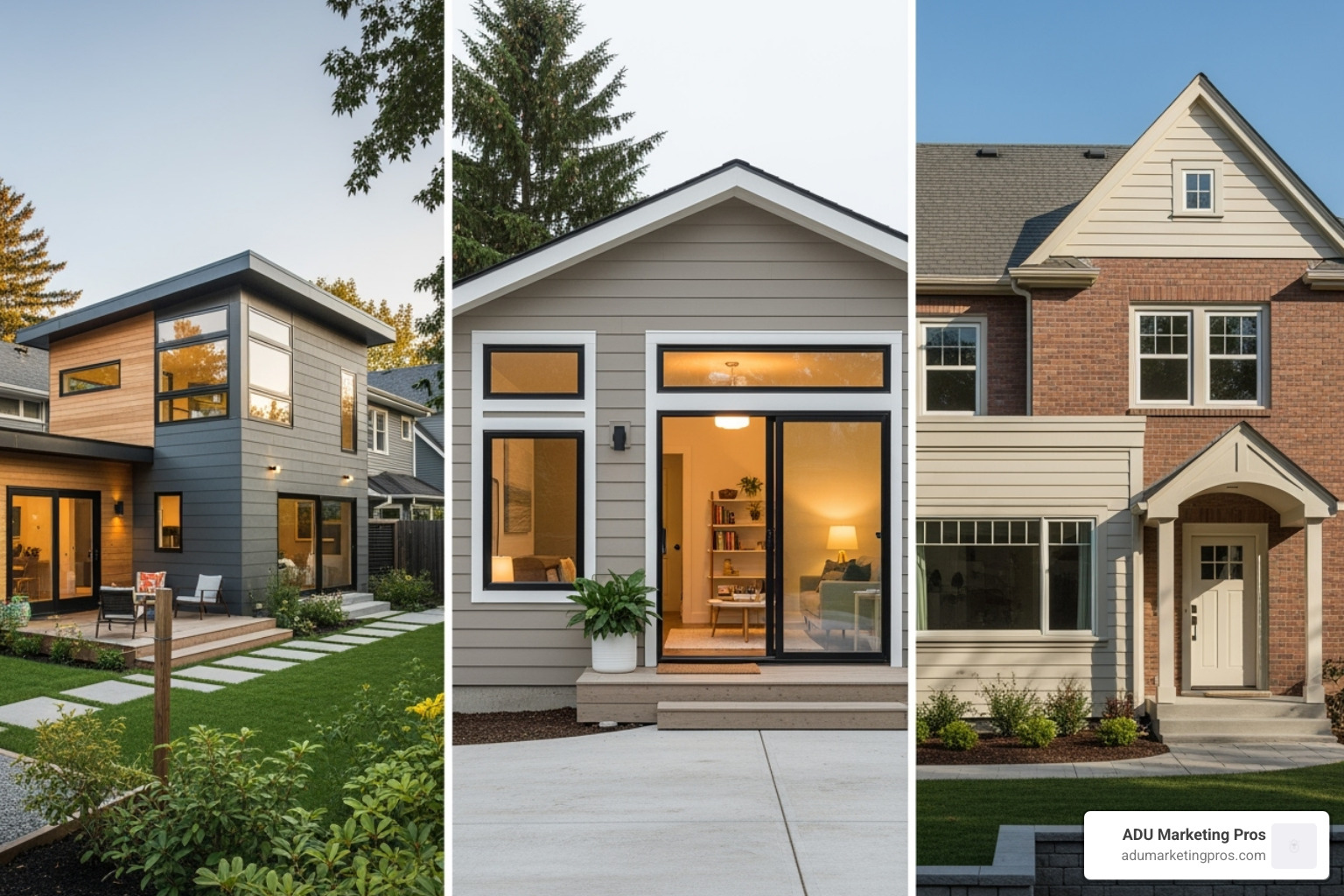
- Detached ADU: A standalone structure, often called a backyard cottage or granny flat. It offers the most privacy for both the main home residents and the ADU occupants. This type provides the greatest design freedom but is often the most expensive due to the need for a new foundation, framing, and utility connections.
- Attached ADU: An addition built onto your existing home. It shares at least one wall with the primary residence but has its own separate entrance. This can be a good compromise between cost and privacy, often simplifying utility hookups compared to a detached unit.
- Garage Conversion: A popular and cost-effective option that transforms an existing garage into a livable space. It saves significant money on foundation and structural framing. However, challenges can include dealing with a sloped concrete slab, insulating the space properly, and replacing the garage door with a new wall and entrance.
- Basement or Over-Garage Conversion: Transforms underutilized space into valuable living quarters. A basement ADU is ideal for lots with limited backyard space, while an over-garage unit can offer great views and privacy. Both require careful planning for access, ceiling height, and emergency egress.
- Junior ADU (JADU): A compact unit (up to 500 sq. ft.) created within the existing, conditioned footprint of your home, such as a spare bedroom. JADUs must have a separate exterior entrance and an efficiency kitchen. They may share a bathroom with the main house, which helps reduce costs. Owner-occupancy is typically required for properties with a JADU.
The ADU Construction Timeline
The journey from concept to a move-in-ready ADU typically takes 10 to 16 months. It’s wise to plan for the longer end of this spectrum to account for unforeseen delays. The process is generally broken into three major stages:
- Phase 1: Design and Planning (3-5 months): This is where your vision takes shape. It involves a site analysis, schematic design to create the floor plan, design development to select materials and finishes, and the creation of detailed construction documents (blueprints) for permitting.
- Phase 2: Permitting (3-4 months): Your contractor or architect submits the construction documents to your local city or county planning department for review. This is often the most unpredictable phase, as it depends on the jurisdiction’s workload and review process. Some cities offer pre-approved plans that can shorten this stage, but they offer limited customization.
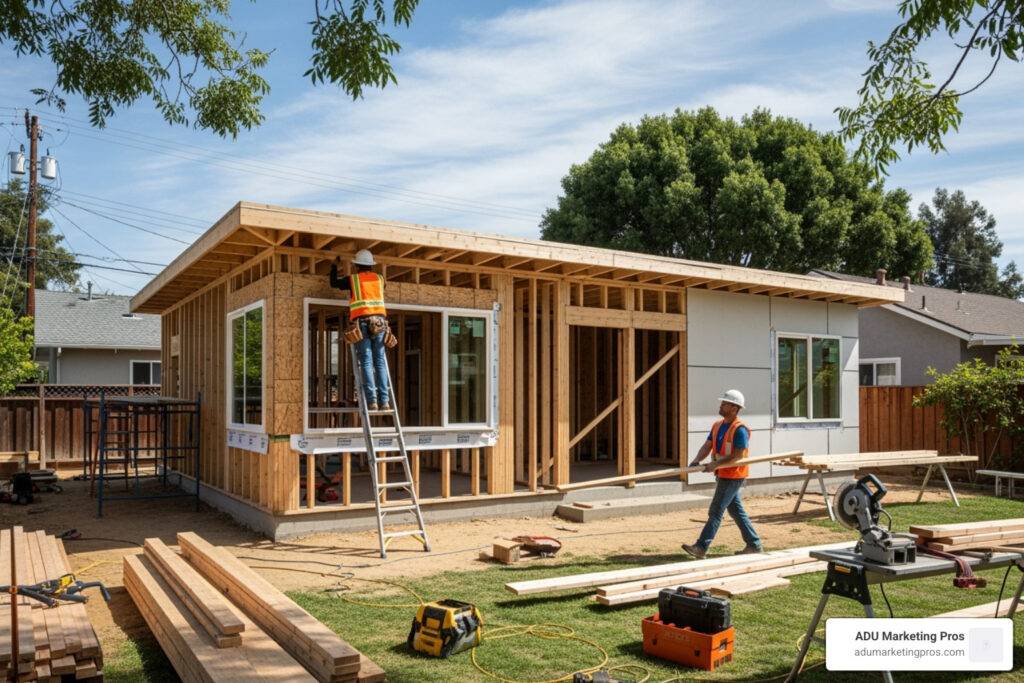
- Phase 3: Construction (4-8 months): Once the permit is issued, construction begins. This phase includes site preparation and grading, pouring the foundation, framing, roofing, rough-in of electrical, plumbing, and HVAC, insulation, drywall, interior and exterior finishes, and a series of final inspections.
Budgeting for Your ADU Project
Building an ADU in California typically costs between $130,000 and $430,000, with the average falling between $250 to $300 per square foot. While this is a significant investment, it’s often the most affordable way to add a new living space in the state, as you already own the land.
Your total budget will consist of hard costs and soft costs:
- Hard Costs: These are the tangible construction expenses, including labor, materials, foundation, framing, roofing, plumbing, electrical, and finishes.
- Soft Costs: These are the fees associated with planning and permitting, such as architectural design fees, structural engineering costs, permit fees, and potentially school or park impact fees depending on your location and ADU size.
Key cost factors include:
- Site Conditions: A flat, easily accessible lot is less expensive to build on. Sloped lots may require costly retaining walls, and long distances from the main utility lines will increase trenching costs.
- Size and Type: A simple garage conversion is generally the least expensive option, while a large, two-story detached ADU will be the most expensive.
- Materials and Finishes: High-end, custom finishes (e.g., marble countertops, premium flooring) will increase the cost compared to quality, builder-grade standard options.
- Prefab vs. Custom: Prefabricated units can have a lower initial structure cost (starting around $30,000), but you must still budget for delivery, crane rental, site preparation, foundation, installation, and utility connections, which can bring the total cost close to that of a custom build. Custom builds offer complete design flexibility to match your needs and property.
Navigating the Legal Maze: Permits and Regulations
Building an ADU in California requires navigating a complex world of state and local regulations. While the state has passed laws to streamline the process, each city and county adds its own layers of complexity. An experienced ADU construction services partner is invaluable in managing this legal maze, ensuring your project is compliant, safe, and protected from costly mistakes.

Why You Can’t Skip the Permit Process
Attempting to build an ADU without the required permits is a gamble that can have devastating financial and legal consequences. The risks far outweigh any perceived savings:
- Hefty Fines: Local authorities can levy thousands, or even tens of thousands, of dollars in penalties and may require you to pay for retroactive permits at an inflated cost.
- Legal and Safety Issues: You could face stop-work orders that halt your project indefinitely or lawsuits from neighbors. More importantly, unpermitted work is not inspected, creating potential fire and safety hazards.
- Demolition Orders: In the worst-case scenario, you may be forced to tear down the entire structure at your own expense, resulting in a total loss of your investment.
- Insurance Invalidation: Standard homeowner’s insurance policies will not cover damages or liability claims related to an unpermitted structure, leaving you personally exposed.
- Resale and Financing Complications: An unpermitted ADU is a major red flag for lenders and buyers. It can make your property difficult or impossible to sell or refinance, and you may be forced to legalize or demolish it before a sale can proceed.
A reputable contractor will insist on pulling all necessary permits and will manage the entire process as a standard part of their service.
Key California ADU Regulations to Know
While state laws provide a general framework, you must always verify the specific rules with your local jurisdiction. An experienced ADU builder will be an expert in these local nuances. Here are some key areas:
- Setback Requirements: These rules dictate the minimum distance between your ADU and property lines. State law mandates that jurisdictions must allow at least a 4-foot side and rear setback. Many garage conversions are exempt from setbacks if they remain within the existing footprint.
- Height Limits: Most jurisdictions limit ADU height to preserve neighborhood character. A common limit is 16 feet for a single-story detached ADU, but some cities allow for two-story units up to 25 feet, especially if attached to a two-story primary home.
- Owner-Occupancy: As of 2020, California has eliminated owner-occupancy requirements for standard ADUs permitted through 2025, a major benefit for rental property investors. However, this rule does not apply to Junior ADUs (JADUs), which still require the property owner to live in either the main house or the JADU.
- Parking: State law prohibits jurisdictions from requiring additional off-street parking for an ADU if the property is located within a half-mile of public transit, in a historic district, or if it’s part of the existing primary residence (like a JADU or garage conversion).
- Fire Safety: Sprinkler requirements vary. Detached ADUs under 1,200 sq. ft. are often exempt, but requirements are stricter if the property is in a high fire hazard severity zone. Your contractor must be knowledgeable about local fire department regulations.
- Solar Panels: In California, newly constructed buildings, including detached new-construction ADUs, are generally required to have a solar photovoltaic (PV) system.
For the most current information, consult your local city or county’s planning department website, such as the official Sacramento ADU guidelines. Regulations are constantly evolving.
Financial Assistance and Grant Opportunities
Several programs can help homeowners finance their ADU projects. The California Housing Finance Agency (CalHFA) ADU Grant Program provides up to $40,000 to reimburse homeowners for pre-construction costs like design, engineering, and permit fees. This grant is specifically for lower-to-moderate-income homeowners. After its initial funds were exhausted, the program was revived with an additional $25 million, as recent reports show how these new grants can help low-income Californians build. Beyond grants, homeowners often use financing options like a Home Equity Line of Credit (HELOC), a cash-out refinance on their existing mortgage, or a construction loan to fund their ADU build.
The Ultimate Guide to Vetting ADU Construction Services
Finding the right contractor is the single most critical decision in your ADU journey. You are not just hiring a builder; you are choosing a long-term partner who will manage a complex, high-stakes project and protect your investment. This requires careful, methodical due diligence.

Where to Find Potential Contractors
- Referrals: Word-of-mouth from friends, family, or neighbors who have recently completed ADU projects is the gold standard. They can provide honest, firsthand accounts of their experience.
- Online Directories: Platforms like Houzz, Yelp, and BuildZoom are valuable resources. They feature contractor profiles, project portfolios, and a wide range of client reviews. Look for contractors with consistently high ratings and detailed, positive feedback.
- Local Builder Associations: Organizations like the National Association of the Remodeling Industry (NARI) or local chapters of the National Association of Home Builders (NAHB) can provide lists of reputable, vetted members in your area.
- Specialized ADU Companies: Many firms now focus exclusively on ADU construction services. These specialists offer deep expertise in the unique regulations, design challenges, and construction nuances of ADUs, which can be a significant advantage.
Essential Qualities of a Top ADU Builder
- ADU Specialization: General contractors may be capable, but an ADU specialist lives and breathes these projects. They understand the specific zoning codes, permit processes, and space-saving design strategies that are unique to ADUs.
- Extensive Experience: Look for a company with a long and proven track record in residential construction, like A+ Construction & Remodeling’s 30+ years of experience. This indicates stability and a deep well of knowledge.
- Local Knowledge: A contractor with extensive experience in your specific city or county will have established relationships with the local planning department, which can help streamline the permitting process.
- Design-Build Services: A firm that offers integrated design and construction services provides a single point of responsibility. This streamlines communication, reduces the risk of errors, and often results in a more cohesive and cost-effective project.
- Turnkey Solutions: The best services offer a comprehensive, turnkey approach, managing every phase of the project from the initial design concepts and permit applications to the final inspection and handover of the keys. This minimizes stress and workload for the homeowner.
- Transparency and Communication: A great contractor communicates clearly, provides detailed cost breakdowns, sets realistic timelines, and is responsive to your questions and concerns.
Your Vetting Checklist for ADU Construction Services
- Verify CSLB License: Any contractor performing work over $500 in California must have an active license from the Contractors State License Board (CSLB). You can and should verify their license status online. Ensure it’s active and in good standing.
- Check Insurance: Ask for certificates of general liability insurance and workers’ compensation insurance. This protects you from financial liability in case of accidents or property damage during construction.
- Read Online Reviews: Look for patterns in client feedback. Are they praised for their communication, quality of work, and ability to stay on budget and on schedule?
- Review Their Portfolio: A picture is worth a thousand words. Ask to see a portfolio of completed ADU projects, paying close attention to those that are similar in style and scope to your vision.
- Contact Client References: Speak with at least three recent clients. Ask detailed questions: “How did the contractor handle unexpected problems?” “Was the final cost close to the initial bid?” “Were you happy with the communication from the project manager?” “Would you hire them again?”
- Get 3+ Detailed Bids: Do not rely on verbal estimates. Request comprehensive written bids that itemize all costs, including materials, labor, permit fees, and allowances for finishes. Compare the bids on a line-by-line basis, not just the final number.
- Understand Their Contract and Change Order Process: A professional contract should clearly define the scope of work, payment schedule tied to milestones, material specifications, and warranty details. Ask how they handle change orders—unexpected changes or homeowner requests—to ensure the process is fair and transparent.
Red Flags to Watch Out For
- Abnormally Low Bids: A price that seems too good to be true often is. It may indicate the use of subpar materials, uninsured labor, or a plan to make up the difference with expensive change orders later.
- High-Pressure Sales Tactics: A trustworthy professional will provide a detailed bid and give you ample time to make an informed decision. Be wary of anyone demanding an immediate commitment.
- Vague Contracts: A contract that lacks detail is a recipe for disaster. If the scope of work, materials, or payment terms are unclear, walk away.
- Large Upfront Payments: In California, a down payment for a home improvement contract is legally limited to 10% of the total contract price or $1,000, whichever is less. Any contractor demanding more is violating the law.
- Poor Communication: If a contractor is unresponsive, unclear, or unprofessional during the vetting process, their communication is unlikely to improve once they have your money.
- Unwillingness to Provide Documentation: Any hesitation to provide a license number, insurance certificates, or a list of references is a major deal-breaker.
From Blueprint to Reality: Design and Long-Term Value
Once you’ve selected your ADU construction services partner, the exciting design phase begins. This is where your vision starts to become a reality. Smart, forward-thinking design choices are crucial for creating a space that is not only highly livable and functional but also maximizes your long-term return on investment.
Key ADU Design Considerations
Creating a great ADU within a compact footprint requires clever and efficient design. Work with your designer to focus on these key areas:
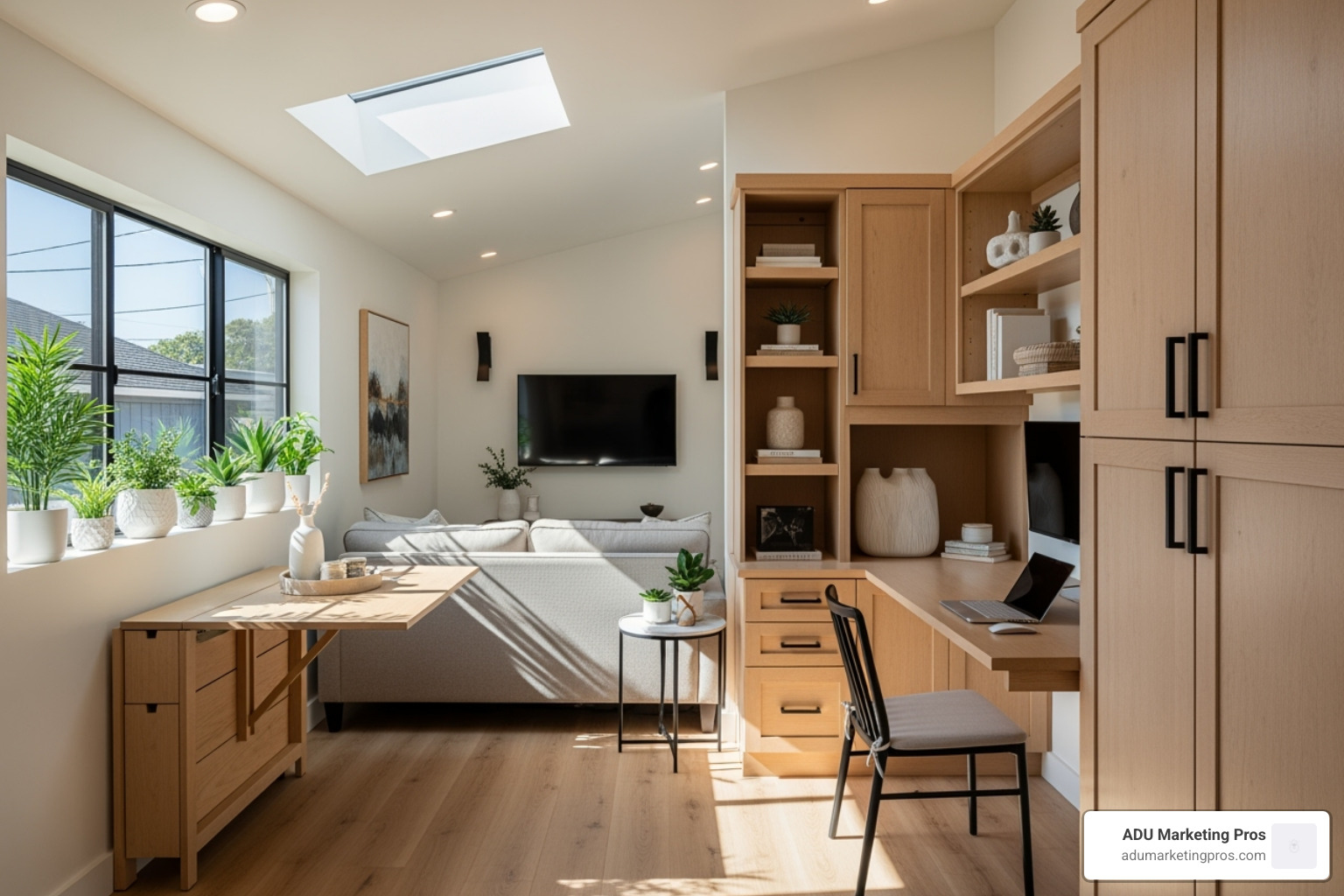
- Space Optimization: Every square inch counts. Incorporate multi-functional furniture, like a dining table that doubles as a workspace or a murphy bed that folds away. Use space-saving features like pocket doors, built-in storage, and vaulted ceilings to make the unit feel larger than its actual square footage.
- Natural Light: Maximize windows, especially south-facing ones, to flood the space with natural light. Consider adding skylights or solar tubes to bring light into interior spaces like bathrooms and hallways, making the ADU feel brighter and more inviting.
- Energy Efficiency: A well-designed ADU should have low utility costs. This means complying with California’s Title 24 energy code by incorporating high-quality insulation, energy-efficient windows, and modern, high-efficiency HVAC systems like ductless mini-splits. Consider features like cool roofs and tankless water heaters.
- Sustainable and Durable Materials: Choose materials that are both eco-friendly and built to last. Options like bamboo flooring, recycled-content countertops, and low-VOC paints appeal to environmentally conscious renters and reduce long-term maintenance needs.
- Architectural Style: The ADU’s exterior should complement the primary home and the surrounding neighborhood. This creates a cohesive look that enhances overall property value. A good designer can create a plan that respects the existing architecture while giving the ADU its own character.
- Accessibility and Universal Design: Consider incorporating elements of universal design, such as a no-step entrance, wider doorways (36 inches), and a walk-in shower with grab bars. These features make the unit versatile and future-ready for aging family members or tenants with mobility needs.
The Financial Payoff: Property Value and Rental Income
Building an ADU is one of the smartest financial moves a California homeowner can make. Adding a legal, permitted, self-contained living unit significantly boosts your property’s market value. When it comes time to sell, a home with a turnkey rental unit or in-law suite is highly attractive to a wide range of buyers. Appraisers are increasingly recognizing the value of ADUs, but they will only assign full value to a legally permitted unit, reinforcing the importance of following the proper process.
The most immediate financial benefit of an ADU is its rental income potential. The average unit in California can generate around $19,000 annually, providing a steady cash flow that can help cover your mortgage, pay off the ADU construction loan, or build long-term financial security. In high-demand rental markets, this income can be even greater, offering a powerful return on your investment.
The Versatility of an ADU
Beyond the financial returns, an ADU is a uniquely dynamic asset that adapts to your family’s changing needs over time. Its uses are nearly limitless:
- Housing for Aging Parents: An ADU allows for multi-generational living, providing a way for elderly family members to live close by while maintaining their independence and privacy.
- Space for Adult Children: In a state with high housing costs, an ADU offers an affordable stepping stone for young adults saving for their own home.
- Guest House: It provides a private and comfortable space for visiting friends and family, allowing you to host without disrupting your normal routine.
- Home Office or Studio: In the age of remote work, a detached ADU creates the perfect dedicated workspace, free from the distractions of the main house.
- Rental Unit: Whether for long-term tenants or, where permitted, short-term rentals, the ADU can generate consistent income. This income stream can be turned on or off as your personal needs for the space change over the years.
Frequently Asked Questions about ADU Construction Services
Embarking on an ADU project naturally brings up many questions. Here, we answer some of the most common inquiries we receive about ADU construction services to provide you with the clarity and confidence needed to begin your journey.
How long does it really take to build an ADU?
The typical timeline to build an ADU, from the first design meeting to the final inspection, is 10 to 16 months. It is always prudent to plan for the longer end of this range, as unforeseen delays can occur, particularly during the permitting phase.
The process breaks down into three main stages:
- Design & Planning: 2-4 months
- Permitting: 3-4 months (This is the most variable stage and can be longer in busy jurisdictions)
- Construction: 5-8 months
Potential delays can arise from various sources, including supply chain issues for specific materials, inclement weather, or backlogs with city inspectors. A seasoned contractor will anticipate these potential hurdles and build buffer time into the schedule. If your city offers pre-approved ADU plans, you may be able to reduce the permitting time to just 1 to 1.5 months, but this comes at the cost of customization.
How much does an ADU cost in California?
ADU costs vary widely across California, but a realistic budget will range from $130,000 to $430,000. The average cost per square foot is typically $250-$300. It is impossible to give a precise estimate without a detailed site evaluation and project scope.
Several key factors influence the final price:
- Location: Labor and material costs are significantly higher in the San Francisco Bay Area and Los Angeles compared to areas like Sacramento or the Central Valley.
- Type and Size: A simple 400 sq. ft. garage conversion will cost far less than a new, 1,200 sq. ft. two-story detached ADU.
- Finishes: The level of finishes has a major impact. Luxury choices for flooring, cabinetry, countertops, and fixtures will increase the budget compared to standard-quality options.
- Site Complexity: A sloped lot requiring extensive grading and retaining walls, difficult site access for machinery, or the need for long utility trenches to connect to the main house will all add to the cost.
A new, ground-up custom ADU often starts around $128,000 for a very basic unit in a lower-cost area. While prefab units may have a lower initial structure cost (around $30,000), you must factor in significant additional costs for site prep, foundation, delivery, crane rental, installation, and utility connections. The only way to get an accurate number is to obtain detailed bids from at least three qualified contractors.
Can I customize the design of my ADU?
Yes, absolutely. While pre-approved plans offer a faster path through permitting, their main drawback is the lack of flexibility. Working with a design-build firm or an architect provides the opportunity for complete customization, allowing you to tailor the ADU to your specific needs, aesthetic preferences, and property constraints.
Customization options are vast:
- Layout and Floor Plan: You can create the ideal layout, whether it’s an open-concept studio for a rental or a traditional one-bedroom layout with a separate living area for a family member.
- Material Selection: You have full control over choosing your flooring, cabinetry, countertops, fixtures, lighting, and paint colors to match your style and budget.
- Exterior Aesthetics: The exterior can be designed to perfectly complement your main house’s architectural style or to have its own unique modern or traditional look.
An experienced ADU construction service is essential for this process. Their expertise helps you balance your custom design vision with the practical requirements of local building codes, zoning regulations, and your budget. They can guide you on where to spend for maximum impact and where to save, ensuring the final design is both beautiful and buildable.
Conclusion: Building Your Future with the Right Partner
Building an Accessory Dwelling Unit is a powerful investment in your family’s future, your property’s value, and your financial security. From understanding the nuances of different ADU types and budgeting for both hard and soft costs to navigating the complex web of permits and regulations, the journey is multifaceted and requires careful planning. With the potential for significant rental income—averaging $19,000 annually in California—and a substantial boost to your property value, a well-executed ADU is one of the smartest and most versatile investments a homeowner can make.
However, the ultimate success of your project hinges on one critical factor: your choice of ADU construction services. A specialized, experienced, and transparent partner transforms a daunting process into an exciting and rewarding one. They manage the complexities, anticipate challenges, and ensure your vision is realized on time and on budget. The wrong partner, on the other hand, can lead to costly delays, budget overruns, and profound disappointment.
Thoroughly vetting your builder is not just a preliminary step; it is the foundation of your entire project. Always prioritize a contractor with specialized ADU experience in your local area. Diligently verify their CSLB license and insurance, get multiple detailed bids to compare, and speak with past clients about their real-world experiences. An expert partner turns the complex 10-16 month timeline into a structured, manageable, and predictable process.
At ADU Marketing Pros, our mission is to connect homeowners with quality builders who prioritize expertise, transparency, and craftsmanship. We believe that when reputable, highly-qualified firms are easy to find, everyone wins—builders grow their businesses with deserving projects, and families get the dream ADUs they deserve.
Your ADU is a major undertaking and a lasting asset. Take the time to do your research, ask the right questions, and choose a team that will treat your project with the care and professionalism it deserves.
Ready to connect with experienced professionals? Find top-rated ADU builders in the San Francisco Bay Area who have the track record to deliver exceptional results.