

Why ADU Floor Plans Matter More Than Ever
ADU Floor Plans are the architectural blueprints that transform an underused space into a fully functional, independent living unit. In an era of housing shortages and evolving family structures, understanding your floor plan options is the critical first step in your ADU journey. Whether you’re planning a compact studio for rental income or a spacious two-bedroom layout for family, the right plan is the foundation of a successful project.
Quick Answer: Most Popular ADU Floor Plans
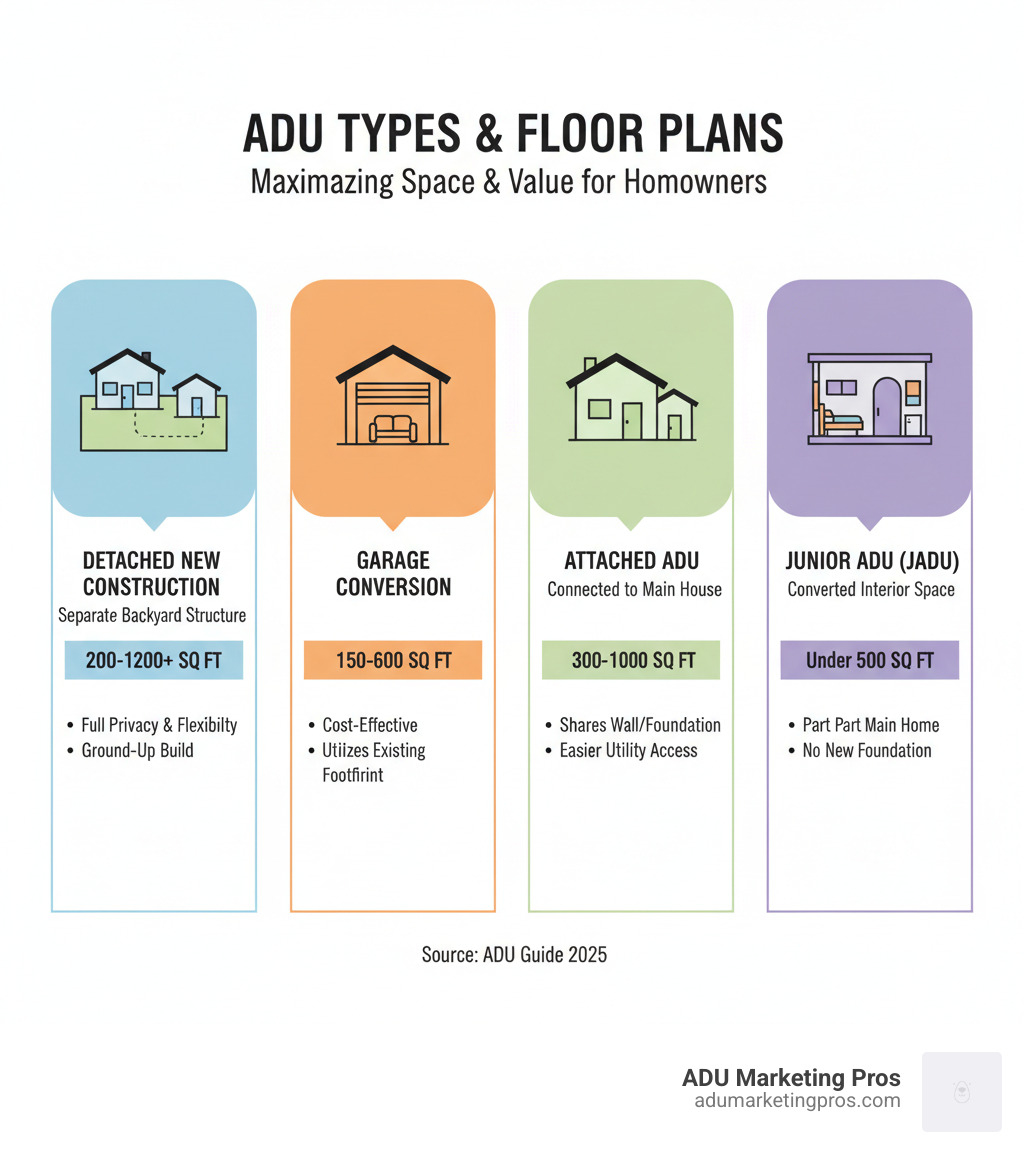
- Studio & Junior ADUs (150-500 sq ft): Ideal for single-person rentals, home offices, or guest quarters. JADUs are created within the primary home’s existing footprint.
- One-Bedroom ADUs (400-850 sq ft): The most versatile option, perfect for long-term rentals, couples, or multi-generational living.
- Two-Bedroom ADUs (700-1,200 sq ft): Best for small families, co-living arrangements, or maximizing rental income in high-demand areas.
- Garage Conversion ADUs: A cost-effective way to transform an existing, underutilized structure into valuable, livable space.
- Attached vs. Detached: The choice depends on lot size, desired privacy, budget, and local regulations. Detached units offer more privacy, while attached units can be more cost-effective.
Accessory Dwelling Units (ADUs)—also known as granny flats, in-law suites, casitas, or backyard cottages—have surged in popularity, especially as states like California pass sweeping legislation to streamline their approval and address critical housing shortages. These secondary homes offer a powerful combination of flexible living space, significant rental income potential, and a substantial increase in property value. But it’s the thoughtful design of ADU Floor Plans that elevates a simple structure into a comfortable, desirable home.
Modern ADU floor plans are masters of efficiency. They leverage open-concept layouts, high ceilings, and large windows to create a sense of spaciousness that defies their modest footprint. Architects and designers employ clever strategies like built-in storage, multi-functional furniture, and seamless indoor-outdoor transitions to maximize every square inch. For builders and architects, the ability to match the right design to a homeowner’s property, budget, and long-term goals is the key to unlocking the full potential of any ADU project.
Exploring Popular ADU Floor Plan Layouts
When planning your ADU, the first question is often about size and layout. The answer depends entirely on your intended use, lot constraints, and budget. Modern ADU Floor Plans offer a wide and exciting variety of configurations, from cozy, efficient studios to surprisingly spacious multi-bedroom units. Let’s explore the most popular layouts and what makes them work.
Studio ADU Floor Plans: Smart and Compact
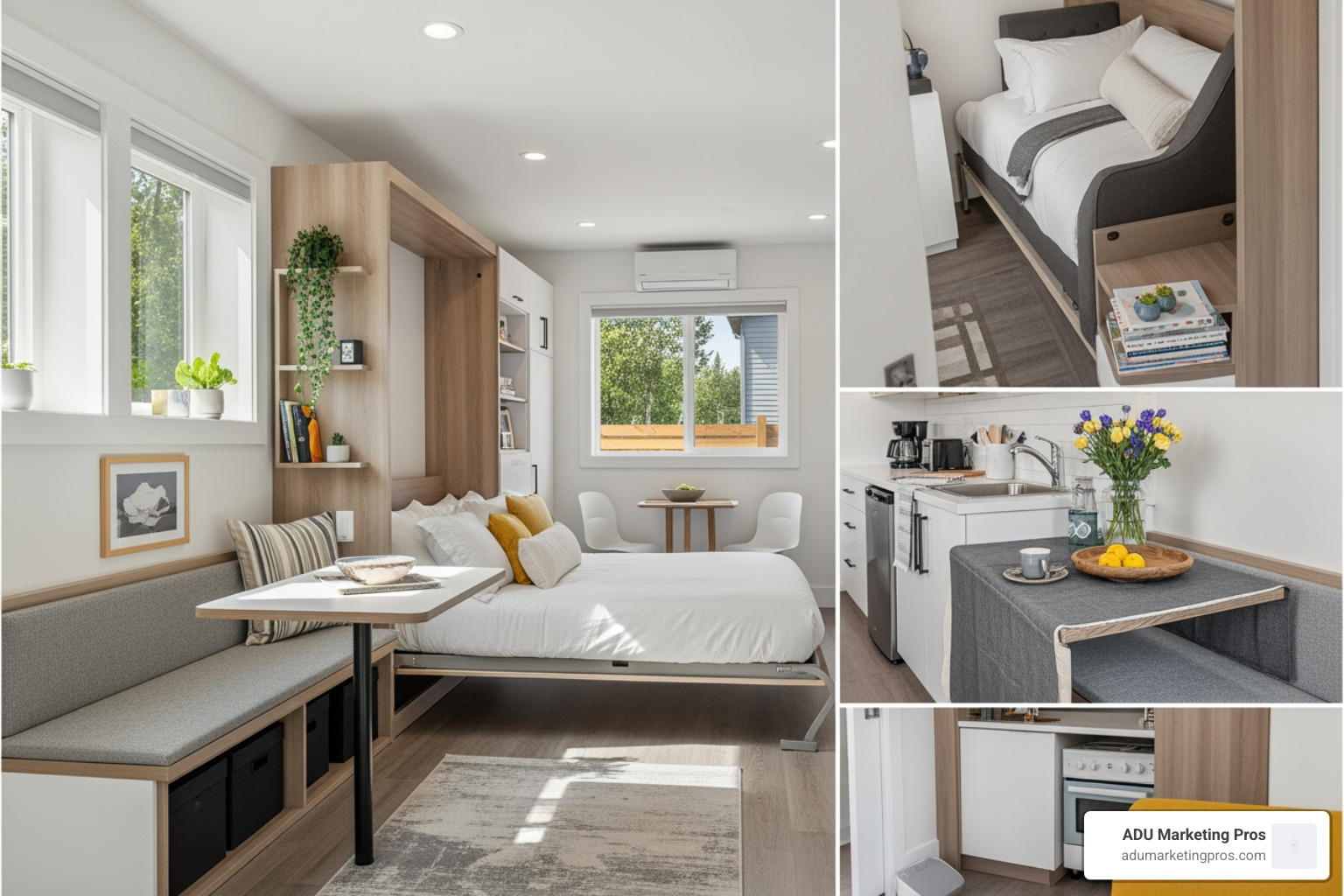
Studio ADU Floor Plans prove that great design doesn’t require a large footprint. Ranging from 150 to 400 square feet for a standard studio, these compact units are incredibly versatile. They are perfect as high-demand vacation rentals, quiet home offices, creative studios, or private guest quarters. Think of them as a sophisticated tiny home, engineered for maximum efficiency and comfort.
The key to a successful studio is an open-concept design that eliminates interior walls to make the unit feel larger and more fluid. Smart designers incorporate an arsenal of space-saving features to ensure full functionality. This includes custom built-in storage, lofted beds to free up floor space, and transformable furniture like Murphy beds that disappear into the wall or collapsible dining tables. High ceilings and large, strategically placed windows are also essential, flooding the space with natural light to create an airy, expansive feel. A well-designed kitchenette and a functional 3/4 bathroom complete the package, making the unit fully self-contained. A subset of this category is the Junior ADU (JADU), which is created within the existing walls of the main house and is capped at 500 square feet. For more ideas, see our resources on Studio ADU Floor Plans and 400 Square Foot ADU Plans.
Key space-saving features that make studio ADUs work: built-in storage and custom cabinetry, lofted beds or sleeping nooks, transformable furniture like Murphy beds and collapsible tables, open-concept layouts with minimal walls, high ceilings and oversized windows for natural light, and compact multi-functional kitchenettes.
One-Bedroom ADU Floor Plans: The Versatile Choice
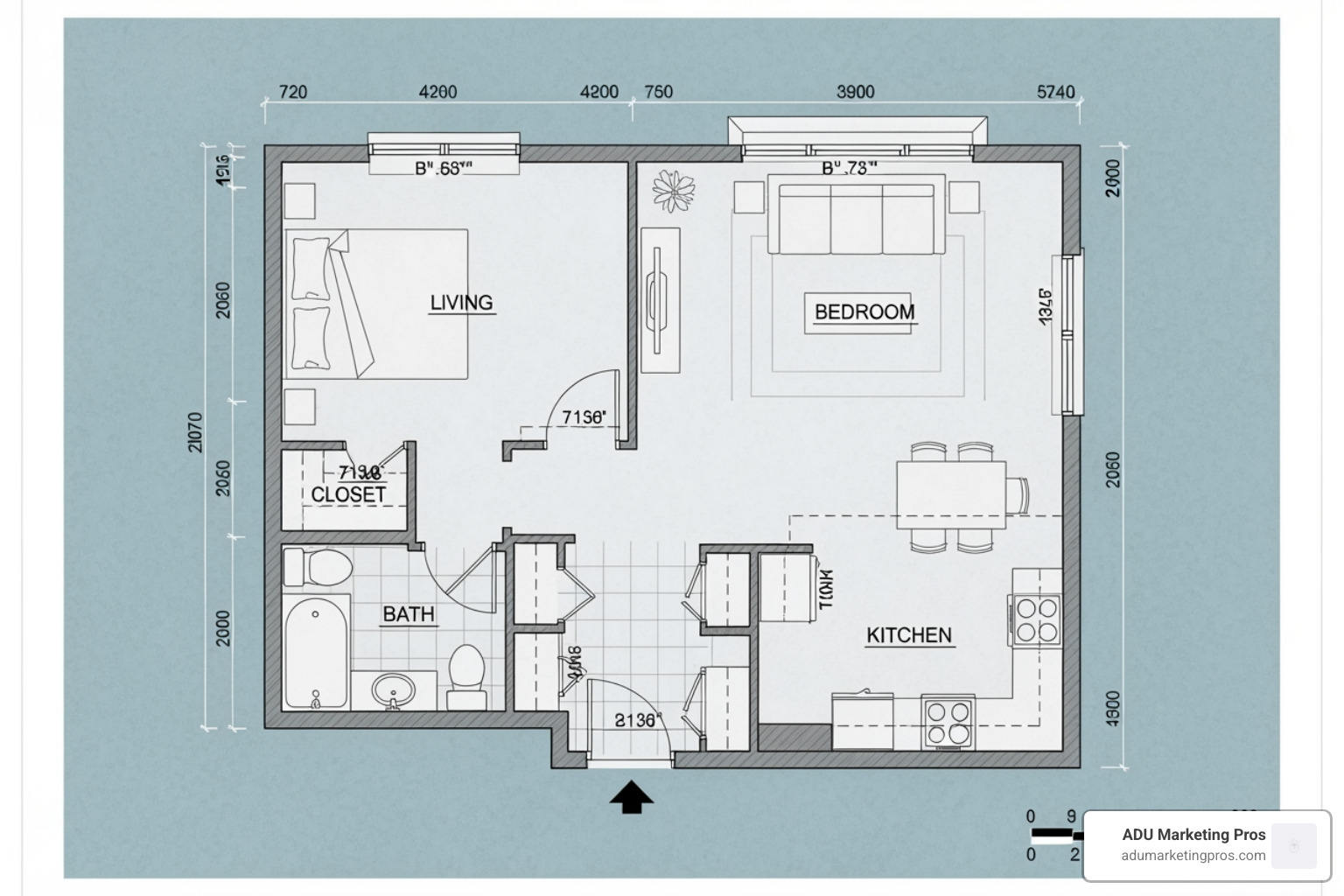
For the perfect balance of efficiency and privacy, one-bedroom ADU Floor Plans are the undisputed champion. Typically ranging from 400 to 850 square feet, they offer a separate bedroom, which is a major advantage for long-term rentals and multi-generational living arrangements. This crucial separation of public and private space gives occupants a true sense of independence and home. This layout is often considered the “sweet spot” for generating rental income, appealing to the widest possible pool of tenants, from single professionals to couples.
Even a compact 500-square-foot one-bedroom ADU can comfortably include a functional kitchen, a small dining nook, and an in-unit laundry closet. As the square footage increases towards 850 square feet, layouts can accommodate more luxurious features like full-size appliances, private patios or decks, walk-in closets, and more generous living areas. The key to a successful design is a thoughtful layout that places the kitchen and bathroom along a shared “wet wall” to save on plumbing costs, without dominating the living space. Most designs keep the kitchen open to the living area to maintain a spacious, flowing feel, which is crucial for making the unit feel welcoming. Our collection of Modern ADU Floor Plans showcases how contemporary designs masterfully balance style and practicality in this popular format.
Two-Bedroom and Multi-Bedroom ADU Floor Plans

When you need more space for a small family, roommates, or to maximize rental income in a college town or dense urban area, two-bedroom ADU Floor Plans are the answer. These units typically range from 700 to 1,200 square feet, the maximum allowed for new detached ADUs in most California jurisdictions. This is enough space to comfortably house a small family, two roommates sharing costs, or provide a guest room in addition to a master bedroom.
The primary design challenge is maintaining a sense of spaciousness while accommodating two private bedrooms. Successful layouts often feature an open-plan kitchen, dining, and living area as the central heart of the home, with bedrooms branching off for privacy. As the size increases, there’s more room for larger bedrooms, functional kitchens with islands, and even a second bathroom—a huge plus for renters and families. A “Jack and Jill” bathroom, situated between the two bedrooms, is a clever space-saving solution. Some ambitious designers have even created three or four-bedroom plans within the 1,200-square-foot limit, which requires careful trade-offs (like smaller bedrooms and living areas) but proves what’s possible with smart, efficient design.
To prevent the unit from feeling cramped, architects use high ceilings, large windows, and sliding glass doors that open to a patio or yard, effectively extending the living space outdoors. For inspiration on larger layouts, explore our resources on 1000 Sq Ft ADU, 1200 Sq Ft ADU, and ADU Floor Plans California.
How to Choose the Right ADU Floor Plan for Your Property
Selecting a floor plan is about more than just picking a favorite layout or desired square footage. It requires a holistic analysis of your property, lifestyle, and financial picture to ensure a perfect, future-proof fit. This strategic decision will impact everything from permit approval to long-term return on investment.
Assessing Your Lot, Lifestyle, and Budget
Choosing the right ADU Floor Plans starts with a thorough assessment of your property. This site analysis goes beyond just measuring your backyard. You must consider your lot’s size, shape, and topography. Is the ground flat or sloped? A sloped lot might lend itself to a multi-level design or require a more expensive foundation. Are there mature trees, sheds, or other existing structures to work around? Crucially, you must understand local setback requirements, which dictate how close your ADU can be to property lines and the main house. In California, state law mandates a minimum of 4 feet from rear and side lines for many ADUs, but local rules can vary. You also need to identify the location of utility lines (sewer, water, gas, electric), as the cost to connect to them can significantly influence where the ADU is placed. Our guide on ADU Minimum Lot Size can help with these initial steps.
Next, think deeply about the ADU’s intended use, both now and in the future. Will it be a full-time rental unit to generate income? If so, durability, privacy, and amenities like in-unit laundry are paramount. Is it for aging parents? Then accessibility features like a zero-step entry, wider doorways, and a walk-in shower are non-negotiable. Will it be a home office, art studio, or guest house? This might prioritize natural light and open, flexible space over a full kitchen. Thinking about future flexibility is key; a home office today might need to become a rental unit tomorrow, so designing a versatile space can save you significant money and hassle later.
Finally, establish a realistic budget. An ADU budget has two main components: soft costs and hard costs. Soft costs include non-construction expenses like design and engineering plans ($5,000 – $15,000+), permit fees ($2,000 – $10,000+), and utility connection fees. Hard costs are the physical construction expenses, including labor and materials. Use our ADU Building Costs guide and ADU Cost Calculator to get a clearer picture of the total investment required.
Pre-Approved vs. Custom ADU Plans
When sourcing ADU Floor Plans, you have two main options: pre-approved plans or a fully custom design.
Pre-approved plans (also called pre-vetted or standard plans) are an excellent choice if speed and cost-effectiveness are your top priorities. These are architectural plans that have already been reviewed and vetted by a local building department, which can dramatically speed up the permitting process and reduce design fees. Cities like Los Angeles, San Jose, and San Diego have robust programs offering a gallery of pre-approved designs from various architects. You can find more information on our Pre-Approved ADU Plans page and through official city resources like the ADU Standard Plan Program from LADBS. The main limitation is that only minor, non-structural customizations are typically allowed.
Custom-designed plans offer complete creative freedom to create a unique ADU tailored to your specific property, aesthetic, and vision. This is the best route if you want to perfectly match your main home’s architectural style, work around challenging site constraints like a steep slope or protected tree, or incorporate highly specific features like custom accessibility or unique materials. While custom plans have a higher upfront cost and a longer design and permitting timeline, they result in a perfectly personalized, site-specific solution. Our team can help with Custom ADU Blueprints to bring your ideas to life.
Regardless of your choice, your plans will require architect or engineer stamping to certify they comply with all structural, safety, and energy codes before a building permit can be issued.
| Feature | Pre-Approved ADU Plans | Custom ADU Plans |
|---|---|---|
| Cost | More affordable (around $5,000 for plans) | More expensive ($8,000-$15,000+ for custom engineering/design) |
| Timeline | Faster, streamlined permitting process | Longer design and permitting phase |
| Flexibility | Limited to minor, non-structural customizations | Full design flexibility, unique and site-specific solutions |
| Best For | Standard lots, budget/time-conscious projects | Unique properties, specific aesthetic goals, complex site challenges |
The best choice depends on your priorities. Pre-approved plans are ideal for speed and savings on standard lots, while custom plans are best for homeowners seeking a personalized, site-specific design.
Navigating Costs, Codes, and Construction
The journey from a floor plan on paper to a finished ADU involves a complex landscape of regulations, expenses, and logistical hurdles. Understanding this process is crucial for any homeowner, architect, or builder to ensure the project stays on track and on budget.
Understanding Zoning Laws and Building Codes
While California state laws have created a favorable environment for ADU development, you must still navigate a web of local zoning laws and building codes. These two sets of rules govern different aspects of your project, and it’s important to understand the distinction.
Zoning laws dictate the use, placement, and size of structures on a property. They directly impact your ADU Floor Plans by determining the type of ADU you can build (detached, attached, conversion), where it can be located (setbacks), and its maximum size and height. Key California state laws have set helpful standards, such as allowing detached ADUs up to at least 850 square feet (or 1,000 for two+ bedrooms) and a minimum height of 16 feet, mandating 4-foot side and rear setbacks, and waiving parking requirements for ADUs near public transit or in historic districts. However, cities like Los Angeles and San Diego have their own specific ordinances that may offer additional flexibility or impose unique requirements. Our guide on ADU Zoning Laws and the California ADU Guidelines offer more context.
Building codes (like the California Building Code) focus on safety and structural integrity. They cover everything from the foundation’s strength to fire safety, electrical and plumbing systems, energy efficiency, and structural requirements for seismic activity. For example, in High Fire Hazard Severity Zones, you may be required to use specific fire-resistant materials for siding and roofing or install interior fire sprinklers. Partnering with an experienced ADU builder or architect who is an expert in local codes is non-negotiable; they can save you from costly mistakes and significant delays. For more details, see our ADU Building Requirements resource or official local guides like the one from the County of San Diego.
The True Cost of an ADU: From Plans to Permits
The true cost of an ADU begins long before the first shovel hits the ground. Understanding the full scope of pre-construction expenses, often called “soft costs,” is key to budgeting realistically and avoiding surprises.
First, you have design and planning costs. Architectural and engineering plans for an ADU typically cost between $8,000 and $20,000. If you opt for a fully custom design, these fees will be on the higher end, while pre-approved or stock plans are more affordable. Next, you’ll need to pay for a variety of permits and fees, which can range from $5,000 to $25,000+ depending on your jurisdiction and the project’s scope. These can include:
- Plan Check Fees: Paid to the city for reviewing your plans.
- Building Permit Fees: The primary permit to allow construction.
- Impact Fees: Fees from school districts, parks, or other local agencies. State law has waived impact fees for ADUs under 750 sq ft.
- Utility Connection Fees: Costs charged by utility companies to connect new water, sewer, and electrical lines.
In total, you can expect to invest $10,000 to $40,000 or more on these soft costs before construction even starts. The entire pre-construction process, from initial design to having a permit in hand, typically takes 4 to 8 months. While these upfront costs are significant, they are a necessary investment in a safe, legal, and successful project. For a comprehensive look at the overall investment, our ADU Construction Cost resource offers detailed breakdowns.
Maximizing Your Investment: Benefits, ROI, and Design Tips
An ADU is more than just a building; it’s a powerful financial and lifestyle asset that can pay dividends for years to come. This section explores the tangible returns of building an ADU and offers practical design strategies to improve its long-term value, functionality, and livability.
The Financial and Lifestyle Advantages of an ADU
Building an ADU can transform your property into a wealth-building engine. The most immediate and obvious benefit is rental income potential. In California’s competitive housing markets, a well-designed ADU can generate $1,500 to $3,500 or more per month, providing a steady income stream that can cover your mortgage, pay for the ADU itself, or accelerate your savings. Our guide on ADU Rental Income breaks down realistic rates by region.
Beyond rental income, ADUs are a perfect solution for multi-generational living. They allow aging parents or adult children to live close by, fostering family connections while maintaining crucial independence and privacy. This arrangement can provide immense peace of mind and can also represent significant financial savings compared to the high cost of senior living facilities. Learn more in our article, ADU for Aging Parents.
Finally, an ADU significantly increases your property value. You are adding a complete, legal, and functional dwelling unit to your lot, which is a major selling point for future buyers. While the exact amount varies by market, it’s not uncommon for an ADU to add several hundred thousand dollars in value. The return on investment (ROI) can be stunning; one analysis shows a potential 1,739% return over 30 years when factoring in rental income, property appreciation, and tax benefits. This incredible flexibility to rent the unit, house family, or sell a more valuable property makes an ADU one of the most powerful and adaptable assets a homeowner can have. Our breakdown at ADU Return on Investment shows how these numbers work.
Design Strategies to Maximize Space and Functionality
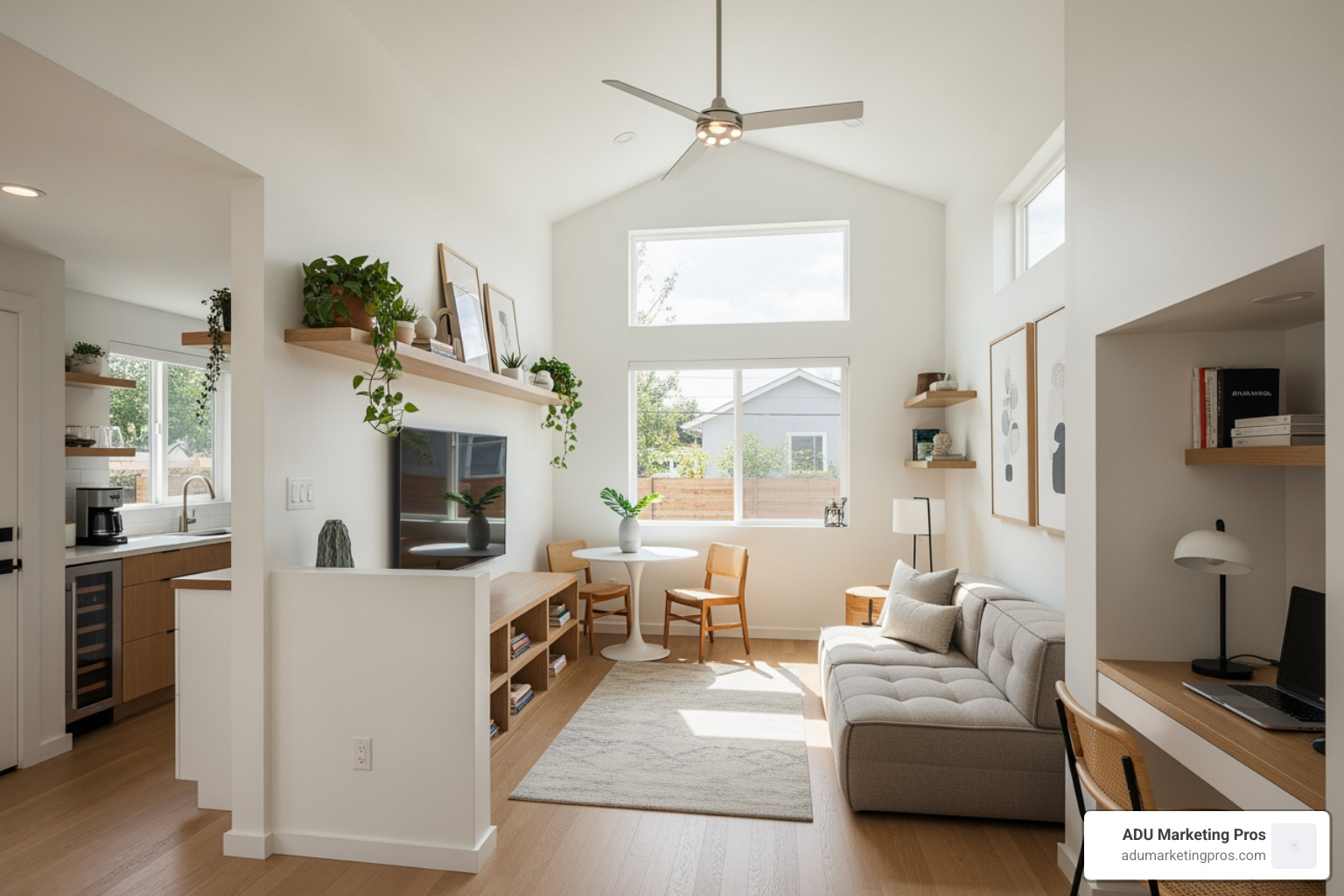
The secret to a great ADU isn’t raw square footage—it’s smart, intentional design. Thoughtful architectural choices can make even a compact unit feel spacious, functional, and welcoming.
- Open Layouts and High Ceilings: Eliminating unnecessary interior walls and incorporating vaulted or high flat ceilings creates a sense of volume and openness, making the entire unit feel larger than its footprint suggests. Explore examples in our ADU Interior Design Ideas.
- Strategic Use of Natural Light: Large windows, skylights, and glass doors flood the interior with light and visually connect the space to the outdoors, preventing any sense of confinement.
- Compact and Clever Kitchens: A well-designed kitchen is the heart of an ADU. Use panel-ready appliances that blend in, under-counter microwave drawers, and smart storage like vertical pantries to maximize functionality without consuming too much space. Our ADU Kitchen Ideas page has innovative solutions.
- Integrated Smart Storage: Built-in cabinetry, under-bed storage drawers, toe-kick drawers in the kitchen, and multi-functional furniture (like an ottoman with storage) are essential for keeping a small space organized and clutter-free.
- Seamless Indoor-Outdoor Flow: Large sliding or bifold glass doors that open onto a private patio or deck can effectively double your living area, which is a perfect strategy for California’s mild climate.
- Incorporate Universal Design: Designing for accessibility from the start adds immense value. Features like a zero-threshold entry, wider doorways (36 inches), a curbless shower, and reinforced walls for future grab bars make the unit suitable for anyone, including aging relatives or tenants with mobility challenges.
- Sustainable and Efficient Design: Quality insulation, energy-efficient windows, and properly sized HVAC systems (like a ductless mini-split) not only reduce utility bills for the occupant but also increase comfort and appeal to eco-conscious renters. Learn more in our guide to Sustainable ADU Designs.
By combining these strategies, even the most compact ADU Floor Plans can be transformed into comfortable, functional, and highly desirable homes.
Frequently Asked Questions about ADU Plans
Navigating the world of ADUs can bring up many questions. Here are answers to some of the most common queries about ADU Floor Plans, size, and requirements.
What is a good size for an ADU and its bathroom?
A “good size” for an ADU depends entirely on its intended use and your lot’s capacity. For rentals or home offices, a studio or one-bedroom unit between 400 and 600 square feet is often a sweet spot for balancing construction cost and rental income. For families or long-term living, a two-bedroom unit from 700 to 1,200 square feet provides more comfort. California state law allows detached ADUs up to 1,200 square feet and has a minimum size of 150 square feet, though some cities require at least 220 square feet. Always check your local jurisdiction’s rules in our ADU Size Restrictions guide.
For bathrooms, California generally does not impose a minimum size. A space-efficient 3/4 bathroom (toilet, sink, shower) is very popular in smaller ADUs, often measuring around 5’x7′. Larger units may feature a full bathroom with a tub, and some two-bedroom plans even include a second bathroom or a powder room for guests.
What defines a “full kitchen” in an ADU?
A full kitchen is what legally distinguishes an ADU as an independent living unit. While local definitions can vary slightly, a full kitchen in California must include, at a minimum: a sink with hot and cold running water, a stove or cooktop with burners, a refrigerator, and adequate countertop space and cabinetry for food preparation and storage. This ensures the unit is fully self-sufficient, which is critical for permitting, financing, and establishing its long-term value as a separate dwelling.
What is a JADU and how is it different from a studio ADU?
A Junior Accessory Dwelling Unit (JADU) is a specific type of ADU created by converting space within the existing, primary single-family home. It cannot be larger than 500 square feet. Unlike a detached studio ADU, a JADU can share a bathroom with the main house and must have an efficiency kitchen (smaller appliances, no gas stove). Critically, state law requires the owner to occupy either the main house or the JADU. A studio ADU, by contrast, is a more general term for a self-contained unit with a combined living/sleeping area, and it can be attached, detached, or a conversion.
Can I build a two-story ADU?
Yes, in many cases you can. California state law allows a maximum height of at least 16 feet for detached ADUs, which is generally sufficient for a modest two-story structure. If the ADU is attached to an existing two-story home, it can often be built to the same height. Some local jurisdictions may allow for even greater heights (e.g., 18-25 feet), especially on larger lots. A two-story design is an excellent strategy for maximizing square footage on a small footprint, often placing living areas on the ground floor and bedrooms above for privacy.
Does an ADU count towards the main home’s square footage?
No, an ADU does not count towards your main home’s square footage. It is legally considered a separate, accessory structure. When your property is appraised or listed for sale, the ADU is valued and marketed as a distinct asset with its own bedroom/bathroom count and square footage. This clearly highlights the additional utility and income potential your property offers. Building an ADU will, however, trigger a reassessment of your property taxes, as you are adding a new taxable structure. You can learn more about this in our guide to ADU Property Taxes.
Conclusion: Bringing Your ADU Vision to Life
Choosing the right ADU Floor Plan is the foundational and most exciting step in creating a valuable, functional, and beautiful addition to your property. As we’ve explored, the perfect layout is a careful balance of your lot’s potential, your budget’s realities, and your lifestyle’s demands. From efficient studios and versatile one-bedrooms to family-friendly multi-bedroom units, the possibilities are vast. A successful project hinges on smart design that maximizes space, light, and functionality, regardless of the square footage.
Navigating the complexities of local codes, site constraints, and construction costs can be challenging, but the rewards are immense. A well-planned ADU is a powerful investment that can provide a steady stream of rental income, offer a dignified home for loved ones, and significantly increase your property’s value for decades to come. The ROI on a thoughtfully designed and constructed ADU can be exceptional, making it one of the smartest financial decisions for California homeowners today.
For builders, architects, and designers, this booming market represents an incredible opportunity to showcase your expertise in creating these unique and highly sought-after spaces. However, connecting with homeowners who are ready to build and who value quality design is the biggest challenge in a crowded marketplace.
At ADU Marketing Pros, we specialize in bridging that gap. We help construction and architecture firms across California, from Los Angeles to San Jose, stand out from the competition. We connect you with qualified, project-ready clients who are looking for your expertise. If you’re ready to grow your ADU business and fill your pipeline with high-quality leads, explore our ADU architectural plan marketing services to see how we can help your firm thrive.