
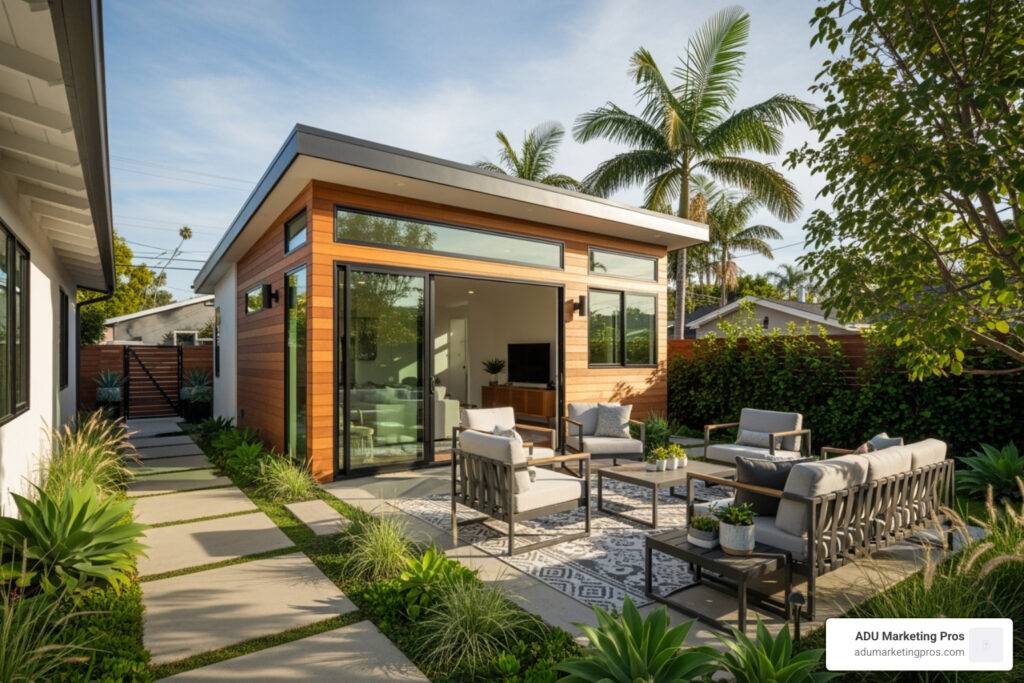
What Qualifies as an ADU? Defining the Different Types
An Accessory Dwelling Unit Los Angeles property can transform your backyard into a powerful asset. Whether you call it a granny flat, in-law unit, or backyard cottage, ADUs have become LA’s answer to the housing crisis—and a smart investment for homeowners.
What is an ADU? An Accessory Dwelling Unit is a secondary housing unit on your property that includes:
- Complete living facilities – kitchen, bathroom, sleeping area
- Independent entrance – separate from your main home
- Multiple types – detached, attached, garage conversions, or JADUs
- Flexible uses – rental income, family housing, home office, or guest space
Quick Facts:
- Garage conversions typically cost $100,000-$125,000
- New ADU construction ranges from $180,000-$400,000
- Expect $300-$450 per square foot for construction
- Garage conversions take 5-6 months to complete
- New construction takes 6-9 months from start to finish
- 61% of ADUs are built for multigenerational housing
Los Angeles homeowners are building ADUs for good reason. They offer a solution to high housing costs while creating passive income. The city’s ADU Ordinance (Ordinance 186,481), adopted in December 2019, has made building an ADU more straightforward and affordable than ever. These units increase property values, provide housing for family, and generate rental income. Recent state laws have further streamlined the process, reducing permitting times to just 60 days and removing many previous barriers.
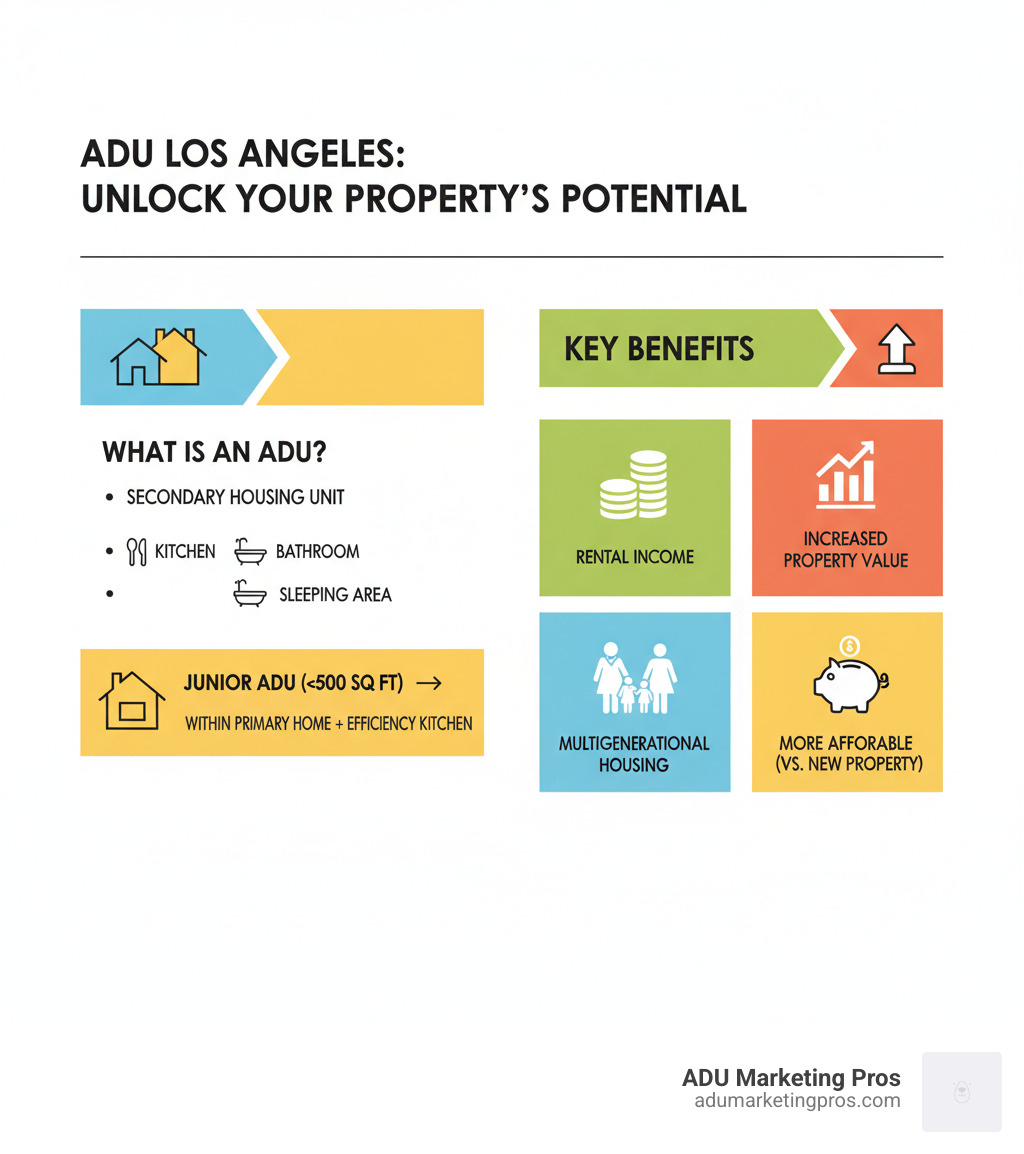
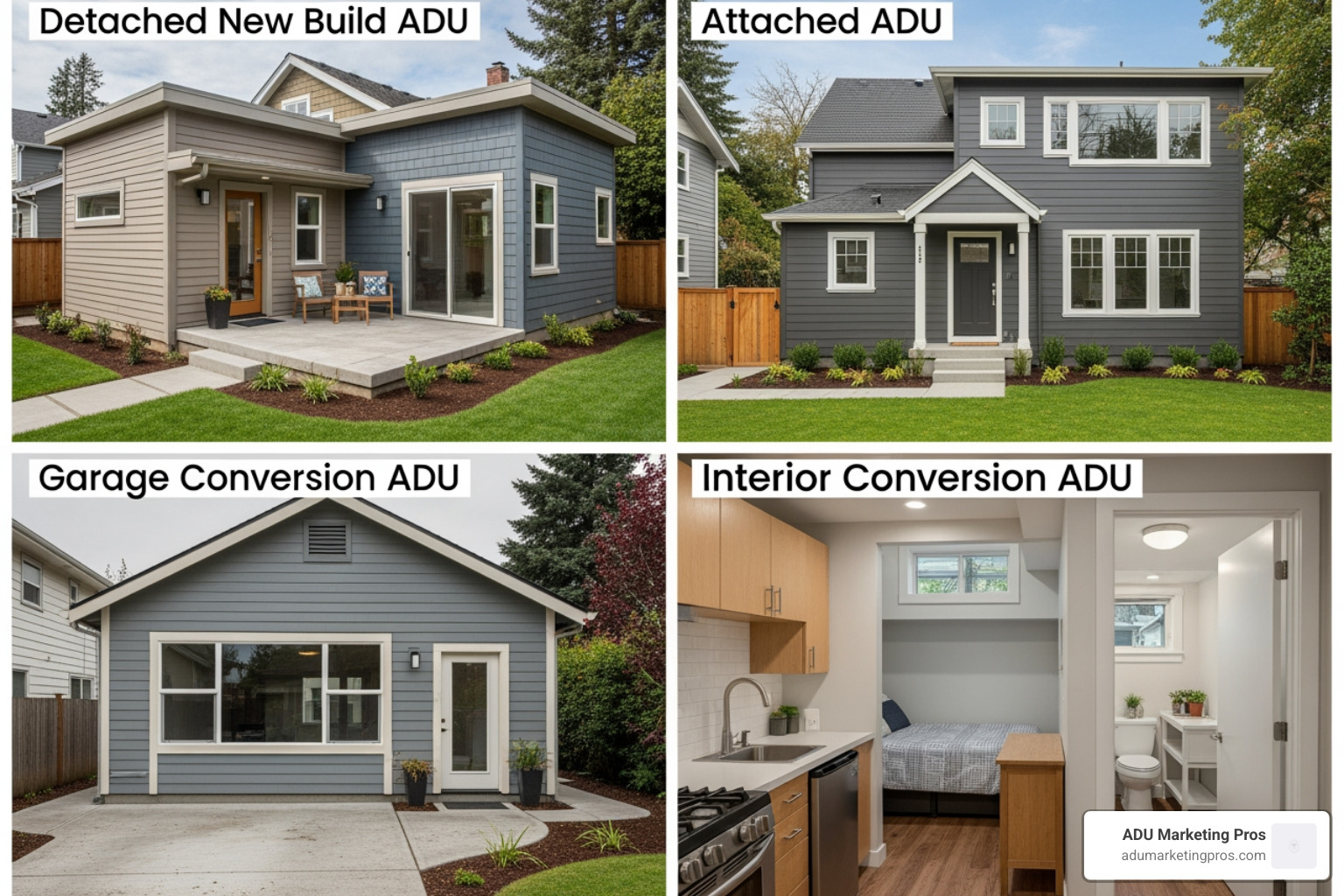
An Accessory Dwelling Unit (ADU) is a second, smaller home on your property with its own kitchen, bathroom, and sleeping area. The primary types of ADUs in Los Angeles include:
- Detached ADUs: Freestanding structures built in your backyard, offering maximum privacy.
- Attached ADUs: Units connected to the main house with a shared wall and a separate entrance.
- Garage Conversions: A cost-effective option that transforms an existing garage into a living space. Learn more about the Garage Conversion Los Angeles process.
- Junior Accessory Dwelling Units (JADUs): Smaller units with specific requirements, located within the main home.
- Movable Tiny Houses (MTHs): Recognized as ADUs in Los Angeles under specific state and local regulations.
Understanding Junior Accessory Dwelling Units (JADUs)
A JADU is a smaller, more integrated type of ADU, perfect for adding space without major expansion. Key features include:
- Size Limit: Cannot exceed 500 square feet.
- Location: Must be contained within the existing walls of a single-family home or an attached garage.
- Kitchen: Requires an “efficiency kitchen” with a sink, cooking appliance, and small refrigerator.
- Bathroom: Can share a bathroom with the primary dwelling, reducing construction costs.
- Owner Occupancy: In some cases, the property owner may be required to live in either the main house or the JADU.
Detached vs. Attached ADUs
Choosing between a detached or attached ADU is a primary decision based on your property, budget, and privacy needs.
- Detached ADUs (Backyard Cottages): These separate structures offer the most privacy. They can be built from the ground up or converted from an existing accessory building.
- Attached ADUs (Home Additions): These units share a wall with the main house, which can simplify utility connections but offers slightly less privacy.
The construction process and available ADU Floor Plans Los Angeles will vary significantly depending on your choice, so it’s wise to explore designs that fit your preferred type.
The Evolving Landscape of Accessory Dwelling Unit Los Angeles Regulations
Building an Accessory Dwelling Unit Los Angeles is more achievable than ever. Gone are the days of tangled red tape; California’s housing crisis prompted a wave of legislation to simplify the process. The key change was the City of Los Angeles’s Accessory Dwelling Unit Ordinance (Ordinance 186,481), adopted in December 2019.
This ordinance, incorporating state laws, created a clear framework for ADUs, JADUs, and Movable Tiny Houses. The goal was to make it genuinely easier for homeowners to add housing. The regulations cover zoning, development standards, parking, and size restrictions, all designed to remove roadblocks. If you own a home on a residentially zoned lot in Los Angeles, you almost certainly have the right to add an ADU. Understanding the current Los Angeles ADU Regulations is your first step.
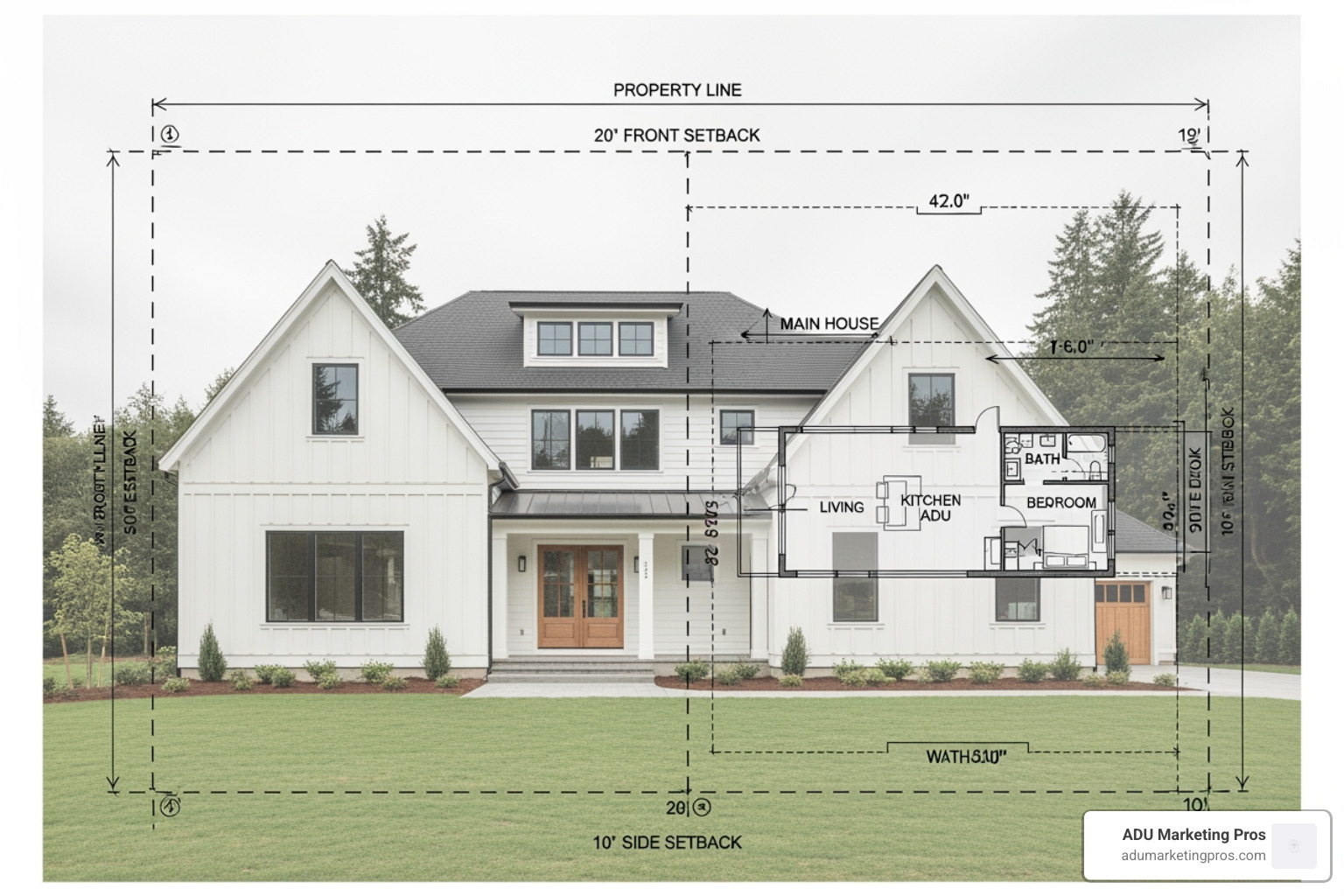
Key LA City Development Standards
Los Angeles has designed its ADU standards to encourage construction. When planning your Accessory Dwelling Unit Los Angeles project, you’ll need to work within these guidelines.
-
Size: New detached ADUs can be up to 1,200 square feet. Attached units are generally limited to 1,200 square feet or 50% of the main home’s size, whichever is less. JADUs are capped at 500 square feet. For more details, see our guide on ADU Size Restrictions.
-
Setbacks: New detached ADUs must typically be at least 4 feet from rear and side property lines. However, if you’re converting an existing garage, you are often exempt from these setback requirements, making garage conversions a very popular option.
-
Height: Most ADUs are limited to 16 feet in height, though some situations may allow for up to 25 feet.
-
Parking: This has been a change. You typically don’t need to provide any parking for your ADU if your property is within a half-mile walk of public transit. Furthermore, if you convert a garage, you are not required to replace that parking. This opens up ADU potential for thousands of homeowners. Learn more in our article on ADU Parking Requirements.
-
Solar Panels: If you build a new detached ADU, you must include solar panels, aligning with California’s push for sustainable energy.
Major ADU Law Updates for 2024 and 2025
California continues to pass laws that remove barriers to ADU construction. Here are the most significant recent changes:
-
AB 1033 (Selling ADUs): This law allows homeowners to sell an ADU separately from the main house, but it requires a complex and costly process of converting the property into a condominium.
-
AB 976 (Owner-Occupancy): As of 2025, cities can no longer require property owners to live in either the main house or the ADU to rent one out. This is a huge win for investors. You can read the full text of AB 976.
-
AB 434 (Pre-Approved Plans): By January 1, 2025, all California cities must develop a program for pre-approved ADU plans. This is intended to dramatically speed up the permitting process for homeowners who use these standardized designs. See the details in AB 434.
-
SB 1211 (Multifamily Properties): Starting in 2025, this law significantly increases the number of ADUs allowed on multifamily properties, from the current two detached units to as many as eight, depending on the lot. This is a game changer for multi-family property owners.
-
AB 2533 (Unpermitted ADUs): This law makes it easier to legalize unpermitted ADUs built before January 1, 2020, as long as they meet health and safety standards.
-
SB 1077 (Coastal Zone): This law simplifies ADU construction for properties in California’s Coastal Zone by requiring clearer guidance from the California Coastal Commission. Read the text of SB 1077.
These fundamental shifts open up possibilities that didn’t exist just a few years ago. For a full overview, explore our guide on New ADU Regulations California.
From Blueprint to Build: The ADU Process, Timeline, and Costs
Building an Accessory Dwelling Unit Los Angeles is a rewarding journey from idea to asset. Understanding the steps makes the process feel much smoother.
The ADU Building Process unfolds in a few key stages. It starts with the Feasibility and Design phase, where you work with a designer to create plans that meet your needs and comply with local codes. Next is the Permit Application and Review stage. You’ll submit your plans to the Los Angeles Department of Building and Safety (LADBS), which by state law must approve or deny them within 60 days. With permits in hand, Construction begins. Throughout this phase, city inspectors conduct regular Inspections to ensure everything is built to code. Finally, after passing all inspections, you’ll receive your Final Approval and Certificate of Occupancy, and your ADU is ready for use.
So, how long does this take? A garage conversion typically wraps up in about 5-6 months. A new detached or attached ADU usually takes 6-9 months from design to completion. These timelines can vary based on design complexity and contractor efficiency. For a deeper dive into the paperwork, our guide on the ADU Permit Process has you covered.
Breaking Down the Cost of an Accessory Dwelling Unit Los Angeles
The cost of building an Accessory Dwelling Unit Los Angeles varies based on the unit’s type, size, and finishes. The total price includes “soft costs” (design, permits, fees) and “hard costs” (labor and materials).
Here’s a general breakdown of what you can expect to pay:
- A garage conversion is the most budget-friendly option, typically costing $100,000 to $125,000 since you’re using an existing structure.
- Building a new detached or attached ADU from scratch generally falls in the range of $180,000 to $400,000. The final price depends on size, site accessibility, and custom features.
- A good rule of thumb for ADU cost per square foot is to budget around $300 to $450. High-end finishes will push you toward the higher end of that range. Learn more in our article on ADU Cost Per Square Foot.
- Great news for your budget: impact fees are completely eliminated for ADUs under 750 square feet. For larger units, these fees are proportional to the size of your main home, offering significant savings.
While a substantial investment, building an ADU is much less expensive than buying a new property because you already own the land. Explore a more detailed breakdown in our guide on Los Angeles ADU Cost.
How to Finance Your Los Angeles ADU
Don’t let the investment deter you; multiple financing options are available. While personal savings is the most direct route, most homeowners explore other avenues.
Many tap into their home’s equity through a Home Equity Line of Credit (HELOC), which provides flexible access to funds during construction. Construction loans are another popular choice, designed specifically for building projects with funds disbursed at key milestones. You might also consider renovation loans, which are custom for property improvements.
Keep an eye out for the CalHFA ADU Grant Program. This fantastic program offers up to $40,000 to reimburse eligible homeowners for pre-development costs. These grants are often available on a waitlist basis for lower-income households, so check the CalHFA ADU Grant Program website for eligibility and application windows.
It’s also worth exploring local programs from organizations like NHS of Los Angeles County, which may offer financial assistance and workshops. To steer this landscape, check out our comprehensive guide on ADU Financing Options.
Maximizing Your Investment: Benefits, Pitfalls, and Pro Tips
Building an Accessory Dwelling Unit Los Angeles is a strategic investment that can reshape your finances and provide valuable housing solutions. The key is to understand both the tremendous upside and the potential stumbling blocks.
The financial benefits are compelling. Your return on investment can be substantial, as ADUs significantly increase property values. Many homeowners see immediate returns through ADU Rental Income, which can generate $1,500 to $3,000 or more per month in Los Angeles, helping to offset mortgage payments.
Beyond finances, 61% of ADUs are built for multigenerational housing. A Multi-Generational ADU allows families to keep loved ones close while maintaining independence, whether for aging parents or adult children. ADUs also offer incredible flexibility, easily changing from a home office or creative studio to a guest house as your needs change.
Hiring the Right ADU Builder Los Angeles
Your choice of contractor will make or break your ADU experience. To get it right, first, always verify their license on the Contractors State License Board website to ensure they are insured and accountable. Prioritize builders with specific ADU experience, as they understand the unique zoning and permitting rules. Talk to previous clients and review their portfolio to gauge quality and reliability. Avoid hiring based on the lowest bid, which often leads to cut corners, and insist on a detailed written contract outlining the scope, timeline, and costs. Finally, assess their communication style; a responsive and clear contractor will make the process much smoother.
Navigating Rent Control and Housing Codes
If you plan to rent your ADU, understanding Los Angeles’ rental regulations is essential. A newly constructed detached ADU is generally exempt from the Rent Stabilization Ordinance (RSO), giving you more flexibility in setting rent. However, if you convert space in a pre-1978 RSO-covered home, your ADU might also fall under RSO.
When you add an ADU, your entire property falls under the Los Angeles Housing Code. This may require rental unit registration and annual fees. Be aware of tenant rights under RSO, which can prohibit short-term rentals. The Housing Department also conducts periodic inspections to ensure compliance with health and safety standards. For specific questions, use the LAHD’s “Ask-Housing” portal.
Smart Design and Additional Considerations for your Accessory Dwelling Unit Los Angeles
Thoughtful design choices separate an adequate ADU from an exceptional one.
-
Storage: Since space is limited, incorporate creative solutions like built-in shelving and under-bed storage platforms from the start.
-
HVAC: Ductless mini-split systems are a popular, energy-efficient choice for ADUs, providing zone control without extensive ductwork.
-
Sustainability: Sustainable ADU Designs with energy-efficient appliances, proper insulation, and LED lighting reduce operating costs. New detached ADUs in LA require solar panels.
-
Outdoor Space: Even a small patio or garden extends the living area and improves quality of life. Plan for landscaping that creates privacy between the main house and the ADU.
-
Privacy: Use strategic fencing, plantings, and window placement to create visual separation and avoid direct sightlines into neighboring spaces.
-
Utilities: Installing separate meters for electricity, gas, and water simplifies billing and prevents tenant disputes.
-
Soundproofing: For attached ADUs, quality insulation and solid-core doors are essential to minimize sound transmission and ensure harmony between units.
Conclusion: Is an ADU the Right Move for Your LA Property?
Building an Accessory Dwelling Unit Los Angeles is a smart move for many homeowners, offering financial gains, increased property value, and flexible living space. Relaxed state and local regulations have made ADU construction more accessible than ever.
However, success hinges on careful planning. This includes understanding development standards, navigating financing, and, most critically, hiring a qualified, licensed contractor. The future for ADUs in LA is bright, providing a key solution to housing challenges and a great opportunity for homeowners.
For ADU builders and architects looking to connect with these homeowners, standing out in a crowded market is key. ADU Marketing Pros specializes in helping construction and design firms effectively reach their target audience.
Explore our complete guide to the Accessory Dwelling Unit Los Angeles for more detailed information.