

Cracking the Code on LA’s ADU Parking
Navigating the world of adu parking requirements los angeles can feel like deciphering a complex legal puzzle. For years, restrictive parking rules were a primary obstacle for homeowners looking to add an Accessory Dwelling Unit (ADU). However, in response to California’s housing crisis, state and local laws have dramatically shifted, creating a landscape where building an ADU is more feasible than ever. The fantastic news is straightforward: most ADUs in the City of Los Angeles do not require any new parking spaces.
This change is a direct result of a concerted effort to encourage ADU construction as a vital solution for increasing housing density. California state law and the City of Los Angeles have systematically dismantled the biggest parking barriers. Whether you’re planning to convert an existing garage, build a new unit near a bus stop, or create a compact Junior ADU (JADU) within your home, you are very likely to qualify for a complete parking exemption.
Quick Answer: Does Your LA ADU Need Parking?
To simplify the process, here is a quick summary of the current rules. The answer for most homeowners is a resounding “no.”
-
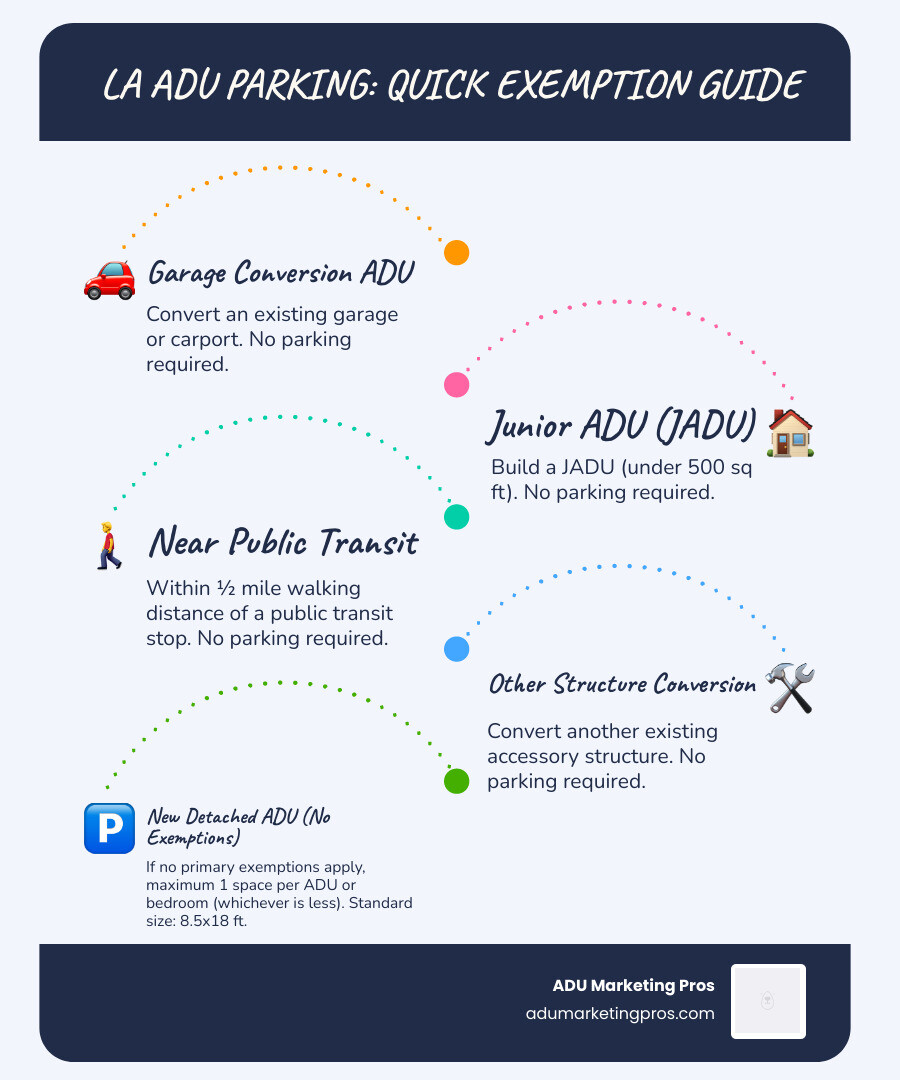
No parking is required if your ADU meets ANY of these conditions:
- It is located within a one-half-mile walking distance of public transit (a bus stop or rail station).
- It is created through the conversion of an existing structure, such as a garage, carport, or storage shed.
- It is a Junior ADU (JADU), which is a unit up to 500 sq. ft. created within an existing single-family home.
- It is located within a designated historic district.
- It is on a property where on-street parking requires a permit, but the ADU occupant would not be eligible for one.
- A car-share vehicle is located within one block of your property.
-
If parking is required (a rare scenario):
- The absolute maximum is one space per ADU or one space per bedroom, whichever is less. A studio or one-bedroom ADU would only require one space. A three-bedroom ADU would still only require one space.
- Guest parking is never required for an ADU.
- Required spaces must be a standard size of 8.5 feet by 18 feet. Compact spaces are not permitted.
- If you convert or demolish a garage to build an ADU, you are not required to replace those parking spaces for your primary home.
The relaxation of parking rules has been a primary catalyst for the ADU boom across California, removing a significant financial and logistical barrier for countless homeowners. This comprehensive guide will walk you through exactly when parking is required, how to confirm you’re exempt, and how to navigate the Los Angeles Department of Building and Safety (LADBS) process with confidence. A clear understanding of these regulations is the first and most critical step toward a smooth, successful, and cost-effective ADU project.
Understanding the Core ADU Parking Requirements Los Angeles Mandates
The good news about adu parking requirements los angeles is that the rules are far more flexible and homeowner-friendly than most people expect. While statewide legislation has driven the simplification of these regulations, understanding precisely how the City of Los Angeles interprets and applies them is crucial for a seamless permitting process. Many of our clients begin their ADU journey assuming they’ll need to carve out one or even two new parking spaces, a daunting prospect on a typical city lot. The reality, however, is that the vast majority of projects require less parking—or, most often, none at all. Let’s break down the specific requirements for those rare cases where parking is necessary.
The General Rule: When is Parking Required?
Here’s the baseline that surprises most people: even when parking is required for a newly constructed, detached ADU that doesn’t meet any exemptions, the maximum is just one parking space per ADU or one space per bedroom, whichever is less. This “whichever is less” clause is incredibly important. Consider what it means in practice: a spacious two-bedroom ADU still only needs one parking space. A studio or one-bedroom ADU? Just one space. A large three-bedroom ADU? Still only one space. The rule effectively caps the requirement at a single space for any ADU, regardless of its size or number of bedrooms. Furthermore, the city explicitly states that guest parking is never required for ADUs, which frees up significant valuable space on your property that would have otherwise been dedicated to asphalt. This general rule is the fallback for when no exemptions apply, but as we will explore, most projects easily qualify for at least one exemption, making this rule the exception rather than the norm. At most one space per ADU or per bedroom, whichever is less, is the maximum required parking, a standard set by the state to prevent cities from imposing prohibitive requirements.
Required Parking Space Dimensions and Placement
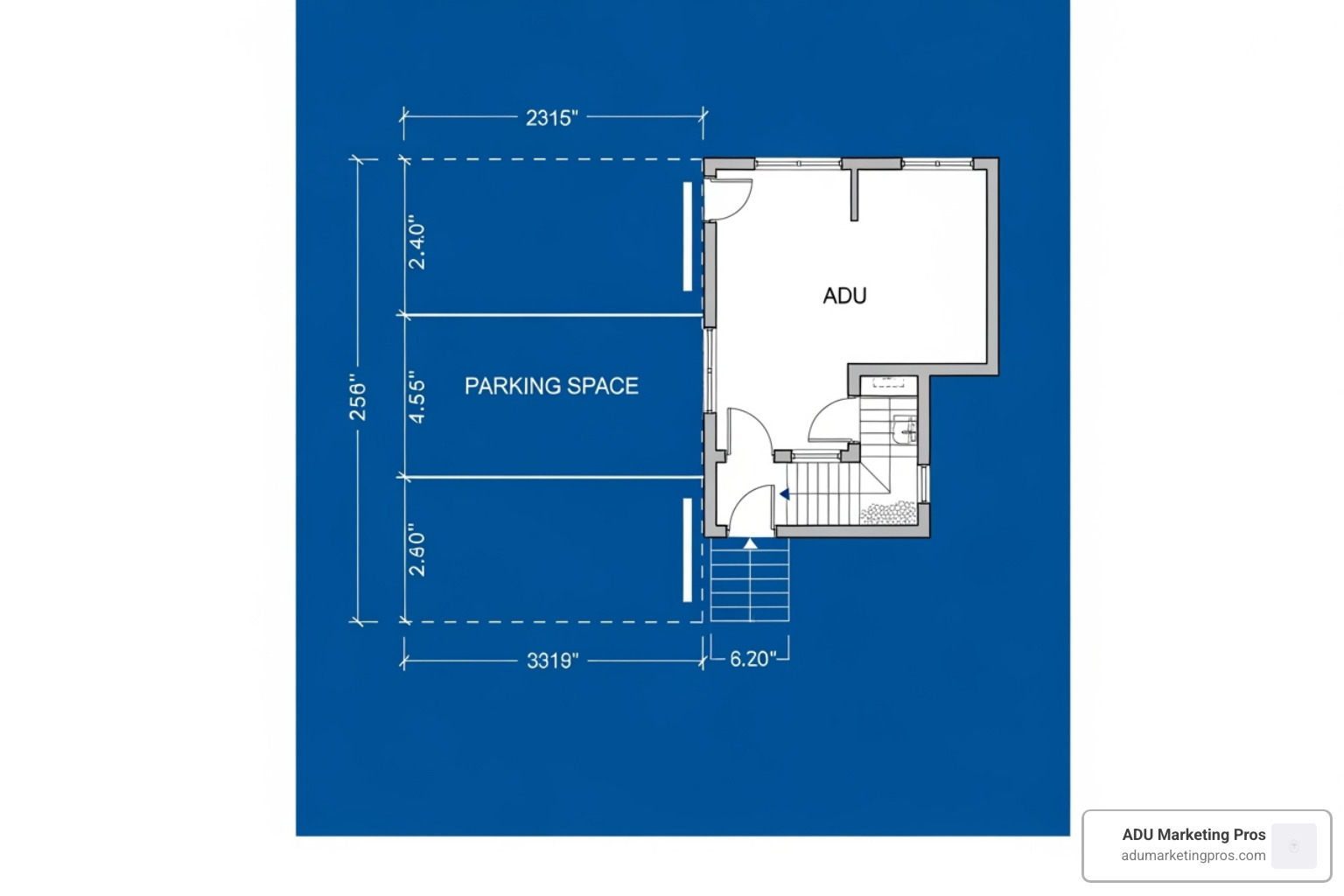
In the event your project does require a parking space, Los Angeles has clear and objective standards. Each required space must measure a minimum of 8.5 feet wide by 18 feet long. This is a standard, full-sized parking stall. It’s important to note that compact parking spaces are not allowed for ADUs, a common misconception that can lead to plan check corrections and delays. The space must be unobstructed and accessible.
Don’t worry if your lot feels cramped. Los Angeles allows for significant flexibility in where you can place this required spot. Tandem parking is permitted, which means one car can park directly behind another in a shared driveway. This is often the simplest and most cost-effective solution for narrow lots, as it utilizes existing paved areas. You can also use setback parking with wheel stops, creating a designated spot in a side or rear yard. This can be an attractive option, allowing for the use of permeable pavers and landscaping to soften the visual impact. However, there are firm restrictions on placement to protect neighborhood aesthetics and safety: Parking is strictly prohibited in required front yard and corner side yard setbacks, except on an existing, approved driveway. This rule maintains clear sightlines for traffic and preserves the green space at the front of properties. Your architectural plans must clearly dimension and label the parking area to demonstrate compliance and avoid LADBS delays.
How State Law Shapes Local Rules
California’s ADU statutes, primarily outlined in Government Code sections §§ 66310–66342, have fundamentally reshaped what cities like Los Angeles can demand from homeowners. The foundational principle is ministerial approval: if your ADU project meets all objective, black-and-white standards outlined in the ordinance (like height, setbacks, and size), the city must approve it. There is no subjective review, public hearing, or discretionary decision-making involved. This framework severely limits a city’s ability to add extra hurdles, including burdensome parking requirements.
State law also prevents cities from using other local regulations to indirectly block ADU construction. For example, one of the most powerful recent laws, AB 2097, prohibits cities from imposing any minimum parking requirements on most new residential and commercial developments located within a half-mile of a major transit stop. While aimed at broader development, its principles reinforce the state’s commitment to reducing parking mandates. The City of Los Angeles adopted its current, progressive ADU framework through Ordinance 186,481, which was specifically written to align with and implement these state mandates. Understanding that local rules are shaped by these powerful state laws gives you a significant advantage and empowers you to confidently plan your project knowing the regulations are on your side.
The Ultimate Exemption Checklist: When You DON’T Need ADU Parking
Here’s where the process gets truly exciting for homeowners. Many people come to us worried about the cost and complexity of squeezing a new parking space onto their lot, only to discover they don’t need one at all. State and local laws provide several powerful, automatic exemptions that can save you space, thousands of dollars in construction costs, and countless administrative headaches. For most Angelenos, this is the moment when the adu parking requirements los angeles puzzle suddenly clicks into place and their project becomes dramatically more feasible.
The Public Transit Exemption
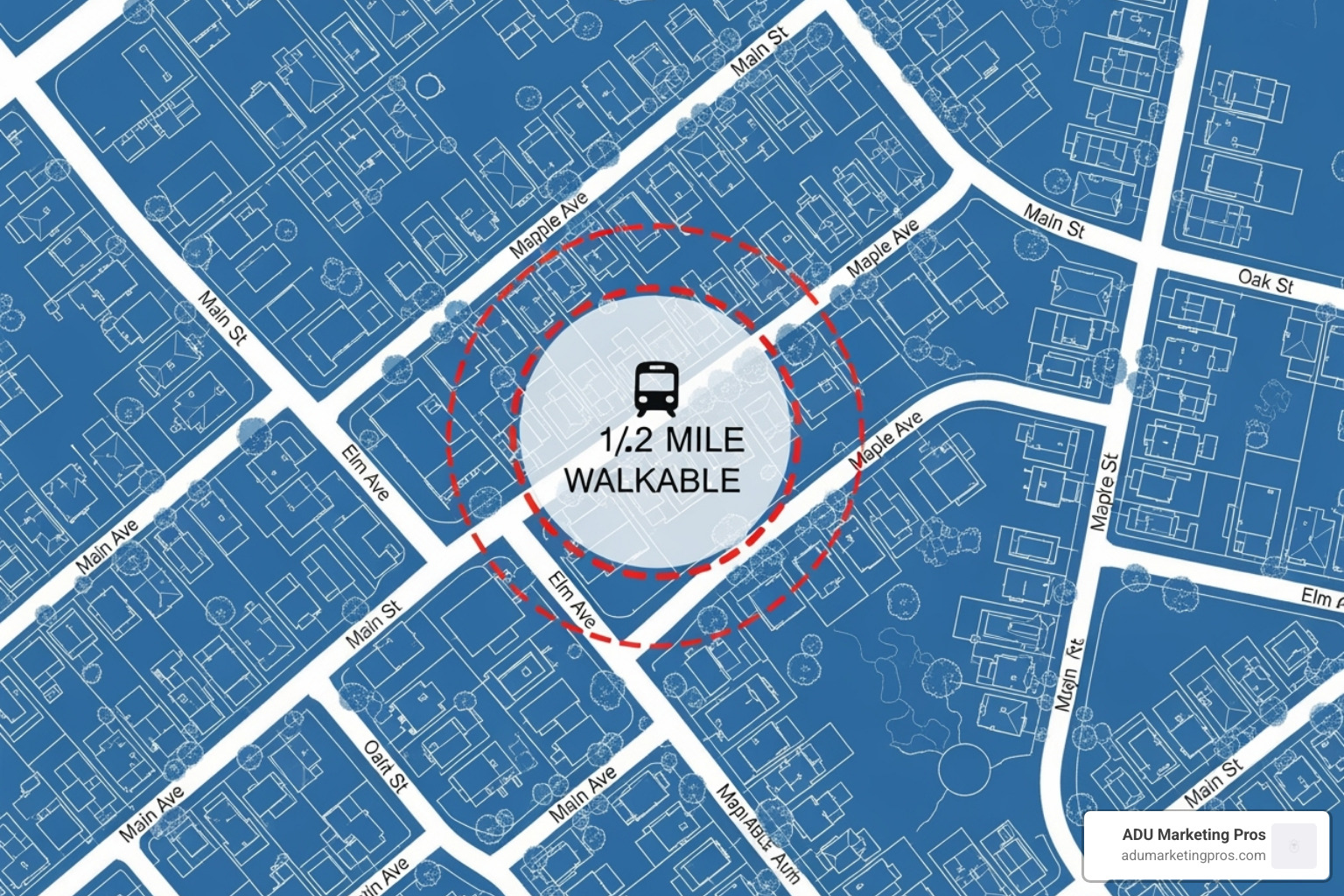
One of the most common and impactful exemptions is proximity to public transportation. If your property is located within a one-half mile walking distance of public transit, no parking is required for your ADU. Period. In a city as vast as Los Angeles, “public transit” is broadly defined to include any Metro bus stop, DASH bus stop, or Metro rail station (like the Expo, Red, or Purple lines). With LA’s extensive transit network, a huge number of residential properties qualify for this exemption.
The critical detail here is walking distance—not “as the crow flies.” The City of Los Angeles will verify the actual, measured walking route along public streets and sidewalks from your property line to the transit stop. A half-mile circle drawn on a map might look promising, but if the real-world path has to wind around a freeway, a park, or a series of cul-de-sacs, the distance could be longer and disqualify you. To avoid any ambiguity during the plan check process, it is a best practice to use a mapping exhibit that shows a measured walking route to transit. You can easily generate this yourself using Google Maps (in walking mode) and include a screenshot with your application. This small, proactive step demonstrates professionalism and helps ensure a swift approval.
Exemptions for Conversions and JADUs
Working with the structures you already have is one of the most cost-effective and surefire paths to avoiding new parking requirements. The state has made it exceptionally easy to repurpose existing space.
| Feature | Standard ADU (New Construction, Not Exempt) | JADU (Junior ADU) | Garage/Carport Conversion to ADU |
|---|---|---|---|
| Max Parking Required | 1 space per ADU or bedroom (whichever less) | 0 spaces | 0 spaces |
| Guest Parking | Not required | Not required | Not required |
| Replacement Parking | N/A | N/A | Not required for primary home |
| Max Size | Varies (up to 1200 sq ft) | 500 sq ft | Varies (up to 1200 sq ft) |
| Location | Detached, Attached, or Conversion | Within existing single-family home/structure | Existing garage/carport |
Navigating ADU Parking Requirements Los Angeles for Garage Conversions
Converting your garage into an ADU is perhaps the most popular and straightforward route to avoiding parking requirements. State law is unequivocal: if you convert an existing garage, carport, or any other covered parking structure into an ADU—or even demolish it to build a new ADU on its footprint—you are not required to provide replacement parking for either your primary home or the new ADU. This single rule represents a dramatic and intentional shift from past policies that made garage conversions financially and logistically impossible for most. California state law is crystal clear on this point, and cities cannot override it: if you convert or demolish a garage or carport to build an ADU, the city cannot require you to replace those spaces for the primary home. This powerful exemption also extends to the conversion of other legally established accessory structures, such as workshops, pool houses, or large storage sheds, making it an environmentally smart and economically advantageous way to add housing.
Junior Accessory Dwelling Unit (JADU) Rules
Junior Accessory Dwelling Units (JADUs) offer another excellent, guaranteed avenue for sidestepping parking requirements. A JADU is a compact living unit of no more than 500 square feet, created entirely within the existing, habitable footprint of a single-family home. The parking benefit is absolute: no parking is ever required for a JADU, period. This applies universally, regardless of your property’s location, proximity to transit, or any other factor. JADUs are a popular choice for homeowners looking to create a small, efficient space for an aging parent, a college student, or a small rental unit without the expense of new construction. Because they utilize existing space and are integrated into the main home, the state has determined they do not generate a need for additional parking.
Other Key Parking Exemptions
Beyond the major exemptions for transit proximity and conversions, several other specific scenarios will exempt your ADU project from any parking requirements. No parking can be required if your ADU is:
- Located within a designated architecturally and historically significant historic district. This policy helps preserve the unique character and streetscapes of these neighborhoods, which often feature older homes with limited off-street parking.
- In an area where on-street permit parking is required, but permits are not offered to the occupant of the ADU. This prevents an unfair situation where a tenant would have no legal place to park.
- Located where a car share vehicle is available within one block of the property. Access to shared transportation options (from services like Turo, Getaround, or a dedicated service pod) is recognized as a valid substitute for private car ownership.
When combined, these exemptions cover the vast majority of properties in Los Angeles, meaning most homeowners can move forward with their ADU plans without the cost or complication of adding a new parking space.
Special Cases and Strategic Planning for Your ADU
Even with the numerous exemptions available, some properties fall into special categories that require a bit more careful consideration. Planning strategically around these unique rules and knowing how to properly document your project are crucial for a successful build and ensuring you are not caught off guard by unexpected requirements from plan checkers.

Special Cases: JADU and VHFHSZ ADU Parking Requirements Los Angeles
Properties located in a Very High Fire Hazard Severity Zone (VHFHSZ) are subject to special development standards designed to ensure emergency vehicle access and resident safety during a wildfire. For ADUs, the city may impose a requirement for one uncovered parking space to keep driveways and streets clear for fire apparatus. However, this requirement is often waived, as all the general exemptions we have already discussed still apply. If your property in a VHFHSZ is also near transit, is part of a garage conversion, is located in a historic district, or meets any other standard exemption criteria, the VHFHSZ parking requirement is nullified. The exemptions take precedence.
Furthermore, even if no other exemptions apply, no parking is needed for an ADU in a VHFHSZ if the unit meets specific criteria aimed at minimizing its impact, such as if the ADU:
- Has no bedroom (i.e., it is designed as a studio).
- Is a detached ADU smaller than 800 square feet that also meets the standard 4-foot side and rear yard setbacks and is under 16 feet in height.
It’s refreshing to see that the state’s commitment to streamlining ADU development holds strong even in these special safety zones. The layering of these exemptions means that most homeowners in VHFHSZ areas we work with still qualify for a complete parking waiver.
How to Plan Effectively and Avoid Common Pitfalls
Navigating the adu parking requirements los angeles is entirely manageable with proactive and informed planning. Our top piece of advice is to do your homework before you spend money on design or submit any plans.
First, verify your property’s specific zoning and any applicable overlays using the City of Los Angeles’s powerful and free online tool, ZIMAS (Zone Information and Map Access System). By simply entering your address, you can instantly see if your property is in a VHFHSZ, a historic district (HPOZ), a permit parking area, or any other special zone. This is the same tool the city’s plan checkers use. Next, consult the official ADU page on the Los Angeles Department of Building and Safety website. It contains the official ordinance, comprehensive guides, FAQs, and contact information for the ADU squad. A quick call to a city planner can often clarify your specific situation in minutes.
Avoid these common and costly mistakes:
- Mismeasuring Transit Distance: As mentioned, the city checks the actual pedestrian walking route. Don’t eyeball it. Use a tool like Google Maps to measure the path from your property line to the transit stop and include a screenshot in your plans.
- Forgetting Flexible Options: If you do need a space, don’t assume it requires a whole new concrete pad. Tandem parking on an existing driveway is the most common and accepted solution.
- Over-providing Parking: Cities cannot require more than one space. Building extra, unrequired parking adds significant cost, reduces your usable yard space, and increases the amount of impermeable surface area on your lot, which can trigger more complex and expensive stormwater mitigation requirements (LID Plan).
- Ignoring Driveway Width and Access: If you plan to use tandem parking, ensure your driveway is wide enough (typically 10 feet minimum for a single stall) and that the path is clear of obstructions for fire department access.
Non-compliance with these objective standards is the number one cause of project delays and can even lead to permit denial. Strategic, informed planning is the best way to avoid these frustrating and expensive issues.
Creative Solutions for Parking Challenges
If your project is one of the rare few that requires a parking space and tandem parking isn’t an option, there are several creative, cost-effective, and aesthetically pleasing solutions beyond a simple concrete slab:
- Setback Parking with Wheel Stops: This allows you to integrate a parking space into a side or rear yard. Using simple concrete wheel stops clearly defines the 8.5′ x 18′ space. This can be combined with other solutions below.
- Permeable Pavers: Instead of pouring concrete, consider using attractive, eco-friendly permeable pavers. These materials (including interlocking concrete pavers, gravel grids, or grass pavers) allow rainwater to filter into the ground, reducing stormwater runoff and potentially helping you avoid more complex drainage plans.
- Mechanical Lifts and Turntables: For properties with extreme space constraints, mechanical parking solutions like a car stacker (to park two cars in one vertical space) or a turntable (to allow a car to turn around in a tight space) can be used. While more expensive, they can solve seemingly impossible parking dilemmas, though they require careful engineering and city approval.
- Promoting Bike Storage and EV Charging: While not a substitute for a required car space, adding secure, covered bicycle storage and making the ADU “EV-ready” with a 240V outlet near the parking area are huge selling points for modern renters. Highlighting these features can increase your unit’s market appeal and rental value.
Frequently Asked Questions about Los Angeles ADU Parking
We hear the same questions over and over from homeowners who are just beginning to explore their ADU options. The regulations can seem confusing at first, so we’ve compiled clear, direct answers to the most common concerns about adu parking requirements los angeles.
What happens if I convert my garage into an ADU? Do I have to replace the parking spots?
No, you absolutely do not have to replace those parking spaces. This is one of the most important and beneficial changes in ADU law. California state law, which the City of Los Angeles has fully adopted, explicitly states that when a garage, carport, or any covered parking structure is converted into an ADU or demolished to make way for a new ADU, you are not required to replace those parking spaces. This applies to parking for both the primary home and the new ADU. The old rule requiring replacement parking was a huge financial and logistical barrier for homeowners, and its complete removal has made garage conversions the most popular and cost-effective type of ADU project in the city.
Is parking ever required for a Junior ADU (JADU)?
No, parking is never required for a Junior Accessory Dwelling Unit (JADU). This exemption is absolute and applies in every situation, with no exceptions. A JADU is a smaller unit of no more than 500 square feet that is created entirely within the existing walls of a single-family home. Because of their compact size, integration within the main house, and owner-occupancy requirement on the property, the state has determined that they do not create a need for additional parking. This makes a JADU an extremely accessible and low-cost option for adding a living space.
How close to public transit do I need to be to get a parking exemption?
Your property must be within a one-half mile walking distance of a public transit stop to qualify for the parking exemption. This includes any official stop for a bus (Metro, DASH, etc.) or a passenger rail station (Metro Rail). The crucial detail that often trips up homeowners is that this distance is not a straight-line radius on a map. The city will verify the actual measured walking route on public streets, sidewalks, and pathways. If there are physical barriers like a freeway, a gated community, or a winding street grid, the actual walking distance could be longer than half a mile. We always recommend preparing a simple mapping exhibit showing the exact walking path and distance (using Google Maps walking directions is sufficient) to include with your permit application. This prevents any questions or delays from the plan checker.
Can the city make me add a new driveway for the ADU parking space?
Generally, no. If parking is required, the city allows for flexible solutions like tandem parking in an existing driveway. You are not typically required to create a second curb cut or a new, separate driveway for the ADU, which would be a significant expense and is often discouraged. The goal is to utilize existing infrastructure whenever possible. The parking space simply needs to be accessible and meet the required dimensions.
Do these parking rules apply to ADUs on multi-family properties?
Yes, the state’s ADU laws and the associated parking exemptions apply to ADUs built on properties with existing multi-family dwellings as well. State law now allows for at least one ADU (through conversion of non-livable space like storage rooms or garages) and up to two detached ADUs on a multi-family property, subject to height and setback rules. The same parking exemptions—proximity to transit, conversions, etc.—apply in these scenarios, further encouraging the creation of new rental units across the city.
I’m converting my garage, but I still want to have off-street parking. What are my options?
This is a great question. Even though you are not required to replace the parking, you may still want to. You have several options. You can create a new parking pad or space elsewhere on your property, provided it is not in the required front yard setback. This could be a new concrete pad in the backyard, a space paved with permeable pavers in a side yard, or simply designating a tandem spot on your existing driveway. You are free to add as much parking as you like, as long as it complies with other zoning regulations.
Conclusion: Build Your ADU with Confidence
You’ve made it through the maze of adu parking requirements los angeles, and the key takeaway should be a feeling of empowerment and confidence. The regulatory landscape has fundamentally shifted in favor of homeowners. The truth is, the vast majority of ADU projects in Los Angeles do not require any new parking at all. Thanks to powerful exemptions for transit proximity, garage conversions, and JADUs, the path forward is often far clearer and more affordable than homeowners initially believe.
Your first step should always be to assume you are exempt and work backward from there. Verify your property’s details, confirm your proximity to a bus stop, and understand the incredible benefits of converting an existing structure. Even in the rare case that you do need to provide a space, remember that the maximum is just one, and you have flexible and creative options for its placement. Strategic planning is your best friend: use the city’s online resources like ZIMAS and the Los Angeles Department of Building and Safety’s ADU page, understand your exemptions, and avoid common pitfalls. The financial savings from not having to design and build unnecessary parking can be substantial, often amounting to tens of thousands of dollars that can be better invested into the quality of your ADU.
For ADU construction and architecture firms, mastering these nuanced parking regulations is a significant competitive advantage. In a crowded market, you can’t just compete on price. When you can confidently and authoritatively guide homeowners through the complexities of adu parking requirements los angeles, you build immediate trust and demonstrate an expertise that sets your firm apart. ADU Marketing Pros specializes in helping ADU-focused businesses translate this deep regulatory knowledge into a powerful marketing engine that attracts high-quality, educated leads and grows revenue. We help you create content that showcases your expertise, building a brand that is known for client success and smooth project delivery, not just for being the cheapest option.
Ready to transform your regulatory expertise into your most effective marketing message? Learn more about how to market your ADU business effectively and start attracting the clients who value the knowledge and peace of mind your firm provides.