
State of ADU Regulations in 2025: What You Need to Know
ADU regulatory updates are happening across multiple states, with California, Massachusetts, Maine, and Illinois leading significant changes to make accessory dwelling units easier to build. Here’s a quick overview of the most important recent changes:
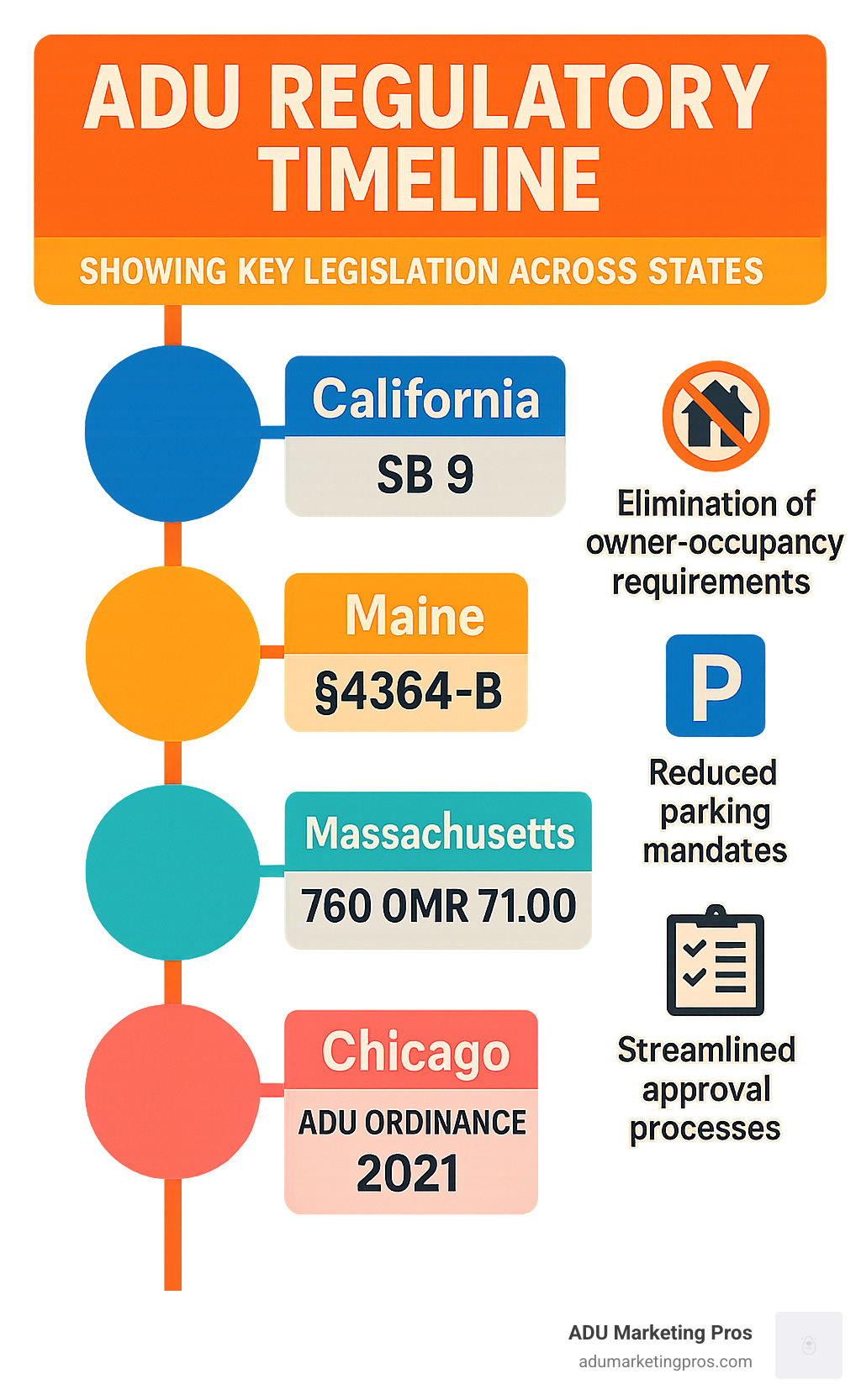
- California: New laws allow up to 8 detached ADUs on multifamily lots (SB 1211), permit separate sale of ADUs (AB 1033), and create pathways to legalize unpermitted units built before 2020 (AB 2533)
- Massachusetts: New regulations (effective February 2025) require cities to allow ADUs up to 900 sq ft by right in single-family zones
- Maine: State law now mandates one ADU per single-family lot with no additional parking requirements
- Chicago: ADU ordinance allows coach houses and conversion units with affordability requirements for properties adding multiple units
These regulatory changes are reshaping housing possibilities across the country, creating new opportunities for homeowners and builders alike.
The surge in ADU-friendly regulations comes in response to the nationwide housing crisis. As Commissioner June Speakman of Rhode Island noted: “One of the drivers of our housing crisis is the low construction rate. We need to be creative and be willing to allow construction of housing, particularly affordable, moderate and small units like ADUs.”
The impact is already visible in places like California, where ADUs now make up to 20% of new housing construction following regulatory reforms.
For construction professionals and property owners, staying current with these changes isn’t just about compliance—it’s about capitalizing on expanding market opportunities as barriers to ADU development fall.
The Accelerating ADU Movement: Why It Matters
The ADU movement isn’t just another housing trend—it’s a thoughtful response to fundamental shifts in how we think about our communities, families, and living spaces. As housing costs continue to climb in cities across America, ADUs offer a practical solution that works within the fabric of existing neighborhoods.

What Is an ADU and Who Benefits?
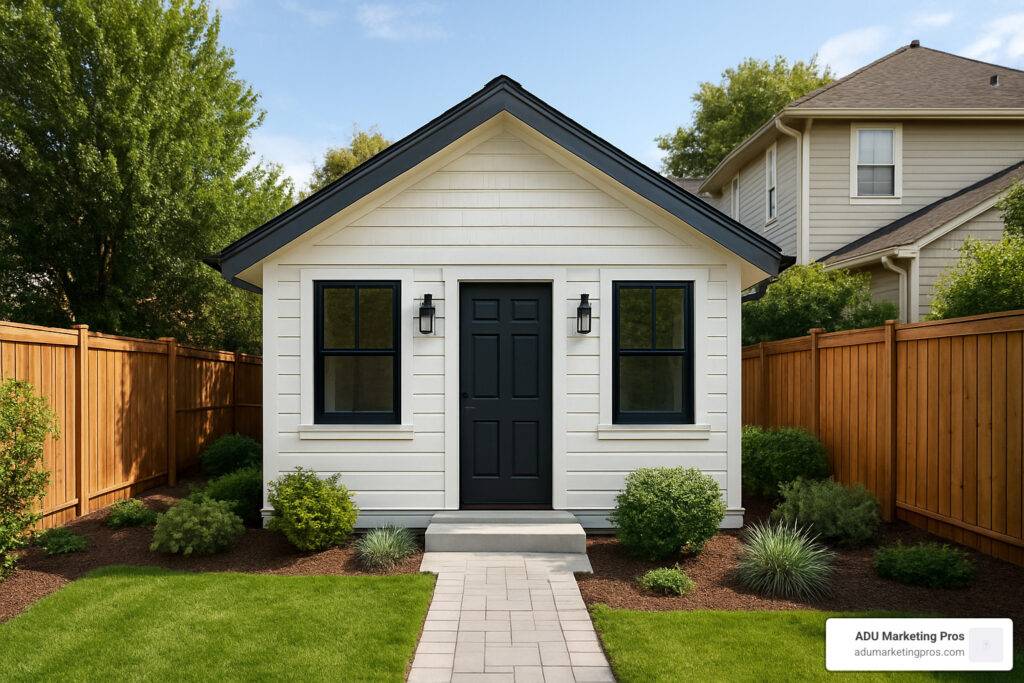
An Accessory Dwelling Unit (ADU) is a smaller, independent residential dwelling located on the same lot as a single-family home. You might know them by their friendlier nicknames—granny flats, in-law suites, backyard cottages, or casitas—but they all serve similar purposes.
When you peek inside an ADU, you’ll typically find everything needed for independent living: a full kitchen, bathroom, living space, and a separate entrance from the main house. These compact homes pack a lot of value into a small footprint!
The beauty of ADUs is how they benefit so many different people. For homeowners, they can generate substantial rental income—often between $1,500-$3,000 monthly in California markets. They create perfect spaces for aging parents who want to maintain independence while staying close to family. Many families use them to provide affordable housing for adult children struggling with today’s housing costs. And of course, they boost property values by making more efficient use of existing land.
Communities win too. ADUs add much-needed housing without disrupting neighborhood character or requiring massive redevelopment projects. They naturally increase density in a gentle, organic way. As Senator Victoria Gu of Rhode Island so aptly put it: “ADUs offer the ‘missing middle:’ housing that is smaller, more affordable and smartly repurposes our existing buildings and garages.”
For our aging population, ADUs are particularly valuable. Catherine Taylor, AARP Rhode Island State Director, notes that “Aging in community – where 87% of Rhode Islanders 45 and older have told us they wish to be – is possible if homes can be modified to accommodate changing needs.”
National Momentum & Market Signals
The national momentum behind ADU regulatory updates is impossible to ignore. Places that once restricted these dwellings are now actively encouraging them through forward-thinking reforms.
The market is responding with enthusiasm. Even in municipalities that have only recently opened their doors to ADUs, permit applications are steadily climbing. Take Oak Park and Evanston, Illinois, for example—each has issued 10 ADU building permits since adopting their respective ordinances.
We’re also seeing an exciting boom in prefabricated ADU options. Companies specializing in factory-built ADUs are expanding rapidly, offering more affordable and streamlined construction processes that make these units accessible to more homeowners.
Financial institutions are catching up too, developing specialized loan products specifically for ADU construction. They recognize the growing importance of these structures in today’s housing landscape and are adapting accordingly.
The professional building community is evolving as well. Architects, builders, and contractors increasingly offer ADU-specific expertise as demand continues to grow. Many are creating dedicated ADU divisions within their companies to better serve this specialized market.
Beyond housing benefits, ADUs offer impressive environmental advantages. They leverage existing infrastructure rather than requiring new development in undisturbed areas. They typically use less water and energy than conventional housing. And by increasing density in already-developed neighborhoods, they reduce the need for sprawling development that consumes precious open space.
As ADU regulatory updates continue to reshape the housing landscape, these versatile dwellings are proving they’re not just a temporary solution—they’re becoming an essential component of sustainable, flexible communities built for the future.
State-Level ADU Regulatory Updates Breakdown
While the ADU movement is gaining momentum nationwide, the real action is happening state by state. Each region is crafting its own approach to making accessory dwelling units more accessible. Let’s take a look at how key states are reshaping their ADU policies:
| State | Key Legislation | Main Provisions | Effective Date | Notable Features |
|---|---|---|---|---|
| California | AB 2533, SB 1211, AB 1033 | Legalization pathway, up to 8 ADUs on multifamily lots, separate ADU sales | January 1, 2025 | Most comprehensive ADU laws nationally |
| Massachusetts | 760 CMR 71.00 | 900 sq ft ADUs by right in single-family zones | February 2, 2025 | Model zoning templates forthcoming |
| Maine | §4364-B | One ADU per single-family lot, no additional parking | June 25, 2024 | Minimum 190 sq ft size requirement |
| Illinois/Chicago | ADU Ordinance | Coach houses, conversion units with affordability requirements | May 1, 2021 | Zone-specific implementation, affordability focus |
California ADU Regulatory Updates 2025
California continues to lead the pack with its ambitious ADU regulatory updates that take effect in 2025. The Golden State has been refining its approach to make ADUs more accessible than ever before.
SB 477 has cleaned up the legal landscape by consolidating California’s ADU rules into a single framework (sections 66310–66342). This makes navigating the regulations much simpler for homeowners and local officials alike – no more hunting through scattered sections of code!
The most exciting changes come from three key pieces of legislation:
AB 2533 offers a fresh start for unpermitted ADUs built before January 2020. If you’ve got an existing unit that wasn’t properly permitted, you now have a clear path to legitimacy. The focus is on meeting current health and safety standards without getting bogged down in non-safety requirements. There’s even a pre-application inspection process to help owners understand exactly what needs fixing.
SB 1211 is a game-changer for multifamily property owners. You can now build up to eight detached ADUs on your multifamily lot – a significant jump from the previous limit of two. The actual cap depends on how many existing units you have on the property. The law also clarifies what counts as “livable space” for conversions and protects your right to build ADUs even if it means removing some uncovered parking.
Perhaps most is AB 1033, which finally allows separate sale of ADUs under certain conditions. This opens up entirely new possibilities for property ownership and wealth creation. The law also permits condo conversion of ADUs and permanently eliminates owner-occupancy requirements.
For a deeper dive into these changes, you can download the California HCD Accessory Dwelling Unit Handbook here. And if you’re ready to start your project, our guide to ADU Permits California walks you through the process step by step.
Massachusetts ADU Regulatory Updates 2025
Massachusetts has jumped into the ADU game with both feet, launching bold new regulations effective February 2, 2025. The Bay State’s approach tackles the housing crisis head-on by requiring municipalities to allow ADUs by right.
The final regulations (760 CMR 71.00) create a homeowner-friendly framework that includes:
Size flexibility – ADUs up to 900 square feet must be allowed as of right in most single-family zones. This gives homeowners plenty of room to create functional living spaces.
Streamlined standards – Cities can’t impose tougher environmental requirements on ADUs than they do on single-family homes, and they can’t mandate separate utility connections unless utilities require them.
Practical permissions – ADUs are allowed in existing non-conforming structures without minimum lot size limits, making it easier to convert garages or other outbuildings.
Family-friendly policies – Municipalities cannot restrict who lives in an ADU to just family members of the primary homeowner.
The state isn’t just mandating these changes and walking away – they’re providing support through model zoning provisions and compatibility checklists. Local governments must also keep detailed records of ADU applications, approvals, and denials to ensure transparency.
As one Massachusetts real estate attorney put it: “This represents a fundamental shift in Massachusetts land use law, prompting municipalities across the state to revise their zoning bylaws to incorporate these mandatory ADU provisions.”
Maine ADU Regulatory Updates
Maine’s approach to ADU regulatory updates is refreshingly straightforward. The state’s law (§4364-B), effective June 25, 2024, cuts through red tape by requiring every municipality to allow at least one ADU on any lot with a single-family home.
The Pine Tree State’s common-sense provisions include a minimum size requirement of 190 square feet – enough space to create a functional living area without excessive restrictions. ADUs are exempt from density calculations and growth caps, meaning they won’t count against any development limits in your area.
Parking requirements often kill ADU projects before they start, but Maine’s law prohibits municipalities from requiring additional parking beyond what’s needed for the main house. Setbacks and dimensional requirements must be the same for ADUs as for primary dwellings, creating consistency and fairness.
Maine’s law also makes existing structure conversions much simpler. That old barn or detached garage could become a charming ADU as long as it meets basic standards. Property owners just need to verify they have adequate water and wastewater systems – a practical consideration for Maine’s many rural areas.
The approach balances state-level guidance with local implementation, giving municipalities flexibility while ensuring they can’t create unnecessary barriers to ADU development.
Illinois/Chicago ADU Regulatory Updates
Chicago’s ADU regulatory updates take a targeted approach, focusing on five designated areas of the city. The ordinance, effective May 1, 2021, represents a return to the city’s roots – ADUs were common in Chicago before being banned in 1957.
The Windy City’s approach is notable for balancing housing expansion with affordability goals:
Coach houses can be up to 700 square feet and 22 feet in height, but are only permitted in certain zones. These standalone structures offer privacy and independence for residents.
Conversion units provide a way to use space in existing buildings that are at least 20 years old – perfect for Chicago’s stock of vintage apartment buildings and homes.
What makes Chicago’s approach unique is its affordability requirements. For properties adding two or more conversion ADUs, every other unit must be legally restricted as affordable housing at 60% Area Median Income for 30 years. This ensures ADUs help address housing needs across income levels.
To help make these units financially viable, Chicago offers support through the ADU Neighborhood Lending Program, which provides forgivable loans to households earning up to 80% AMI. Additional resources are available through the Chicago Low Income Housing Trust Fund.
The ordinance also creates a path to legitimize existing unpermitted ADUs built before the ordinance took effect, bringing many “unofficial” units into the formal housing stock and ensuring they meet safety standards.
ADU Regulatory Updates & Cross-Cutting Issues
Beyond state-specific regulations, several common themes are emerging in ADU regulatory updates across the country. Understanding these shared trends helps homeowners and builders steer this quickly evolving landscape with confidence.
Parking & Setbacks: New Flexibility
Remember when parking requirements killed many ADU dreams before they started? Those days are fading fast.
Recent updates show a clear shift toward more practical approaches to parking. California’s SB 1211 now protects homeowners by prohibiting the replacement of uncovered parking spaces that are removed for ADU construction. Maine has taken a common-sense approach with its “parity rule,” preventing towns from requiring extra parking beyond what’s needed for the main house. Massachusetts goes even further, offering special parking exemptions for ADUs located near bus routes—even those with simple flag stops.
Setback requirements—those critical measurements from your property line—are also becoming more reasonable. Multiple states now insist that ADU setbacks match those of the primary dwelling, creating a level playing field. Massachusetts specifically requires that dimensional standards align perfectly with those for primary homes, even on those tricky non-conforming lots. California has simplified matters by establishing maximum setback requirements of just 4 feet from side and rear property lines for detached ADUs.
These practical changes are opening doors for countless homeowners, particularly in established neighborhoods with smaller lots that previously couldn’t accommodate ADUs under strict requirements.
Owner-Occupancy & Rental Rules
The controversial owner-occupancy requirement—which forced property owners to live onsite—is gradually disappearing from ADU regulations:
California’s AB 1033 has permanently eliminated owner-occupancy requirements, giving property owners complete flexibility. Maine’s forward-thinking law doesn’t include any owner-occupancy provisions at all. Massachusetts has taken a family-friendly approach, prohibiting towns from limiting ADU occupancy to family members only.
Rental regulations, however, show more variety as communities balance housing needs with neighborhood concerns. Rhode Island’s new law specifically prohibits using ADUs as short-term rentals, ensuring these units contribute to long-term housing solutions rather than vacation inventory. Chicago takes a different approach to affordability, requiring that when properties add multiple conversion units, every other unit must remain affordable at 60% AMI for a full 30 years.
These evolving rules reflect thoughtful attempts to expand housing while ensuring ADUs fulfill their promise as genuine housing solutions.
Utility & Environmental Standards
The practical matters of utilities and environmental requirements are becoming more streamlined, removing unnecessary barriers to ADU construction.
Massachusetts has taken a practical stance by prohibiting requirements for separate utility connections unless specifically mandated by utility providers—a change that can save homeowners thousands in construction costs. The state also ensures that environmental requirements for ADUs can’t exceed those for standard single-family homes, creating a level playing field.
California continues its leadership by prohibiting impact fees for ADUs under 750 square feet, significantly reducing the financial barriers for building smaller, more affordable units. This change alone can save homeowners $5,000-$15,000 depending on the jurisdiction.
These thoughtful provisions help make ADU development more accessible to average homeowners by reducing both costs and complexity. By removing unnecessary technical problems, regulations are increasingly focusing on what matters most: creating safe, functional homes that expand our housing options.
As these cross-cutting issues continue to evolve, staying informed about the latest ADU regulatory updates becomes essential for anyone looking to add an accessory dwelling to their property. The trend is clear—regulations are becoming more practical, more flexible, and more supportive of ADU development across the country.
Legalizing Existing Units and Selling ADUs Separately
Two groundbreaking developments in ADU regulatory updates are creating new opportunities for property owners: pathways to legalize existing unpermitted units and the ability to sell ADUs separately from the primary residence.
Amnesty & Compliance Pathways
Let’s face it—many homeowners have built ADUs without permits over the years. Rather than punishing these property owners, cities and states are now taking a more practical approach by creating paths to bring these units into the fold legally.
California’s AB 2533 offers relief to owners of unpermitted ADUs built before January 1, 2020. Instead of requiring complete reconstruction to meet current codes, the law focuses on ensuring these units meet basic safety standards. As one homeowner who recently legalized their garage conversion told us, “I was terrified they’d make me tear everything out, but the inspector was really just concerned about making sure the electrical was safe and I had proper smoke detectors.”
Chicago has taken a similar approach with its ordinance, acknowledging that many “illegal” units have been providing safe, affordable housing for decades. These amnesty programs typically include safety-focused inspections that address the most critical concerns without breaking the bank for homeowners.
Municipalities are sweetening the deal with fee relief programs that reduce or waive permit costs for those voluntarily coming forward. One city planner explained, “We’d rather have these units on the books and safe than continue pretending they don’t exist.”
The process usually involves a public notification to neighbors, but the focus remains on bringing units into compliance rather than creating obstacles. For homeowners sitting on unpermitted ADUs, these pathways offer a chance to sleep better at night—both legally and knowing their rental unit meets safety standards.
As one California legal expert noted with a hint of understatement: “Nearly every city and county will need to amend their local ADU ordinances to avoid nullification” and incorporate these new legalization provisions. That’s bureaucrat-speak for “things are changing fast!”
Separate Sale & Condo Conversion
California’s AB 1033 may be the most change in the ADU landscape yet. For the first time, homeowners can sell their ADUs separately from their primary residence, fundamentally changing the economics of ADU development.
Think about it: previously, you could invest $300,000 in building an ADU but could only recoup that investment through rental income or overall property appreciation. Now, you can potentially sell that unit outright as its own property. This creates entirely new possibilities for homeowners and small-scale developers alike.
The law enables condominium conversion of ADUs, allowing them to be sold as separate real estate parcels. For homeowners nearing retirement, this could mean building an ADU, selling the main house, and continuing to live in the smaller unit while pocketing the difference.
Tenancy-in-common models are also emerging as alternative ownership structures in some markets. These arrangements allow for separate ownership without formal condominium conversion, potentially simplifying the process.
The financial industry is catching up quickly, with title insurance companies and lenders developing new products specifically for these unique property arrangements. One mortgage broker noted, “We’re seeing tremendous interest from buyers who want to purchase just the ADU portion of properties, especially in high-cost areas where this might be their entry point to homeownership.”
For builders and property investors working in California markets, this creates exciting new business models. Properties can be purchased, improved with ADUs, and then sold as two separate units—potentially increasing returns significantly. It’s no wonder we’re seeing more developers reaching out to ADU Marketing Pros to help position these unique opportunities.
The separate sale provision addresses one of the most significant barriers to ADU development—the substantial upfront investment—by creating a clear path to directly capture that value through sale. For many homeowners, this could be the financial incentive that finally makes an ADU project pencil out.
Frequently Asked Questions about ADU Regulatory Updates
Do the new laws remove owner-occupancy requirements?
The landscape of owner-occupancy rules is shifting dramatically across states. If you’re in California, you’re in luck—AB 1033 has permanently eliminated owner-occupancy requirements, opening doors for investors to own both the primary residence and ADU as rental properties. This change represents a significant shift in how ADUs can be used as investment vehicles.
Maine has taken a similar approach by simply not including owner-occupancy provisions in their state law, while Massachusetts has gone a step further by actually prohibiting municipalities from restricting ADU occupancy to family members of the primary owner.
That said, it’s not a universal change. Some local jurisdictions still maintain owner-occupancy requirements where state law permits them to do so. Chicago’s ordinance, for example, includes certain occupancy restrictions that reflect their focus on housing for existing community members.
Always check your specific location’s regulations before getting too far along in your ADU planning process—these rules can make or break your project’s feasibility depending on your goals.
Can I build more than one ADU on a multifamily lot?
Yes, and the possibilities are expanding! California’s recent SB 1211 has dramatically increased the potential, now permitting up to eight detached ADUs on multifamily lots. The only limitation is that the number can’t exceed the total number of existing units on the property. This is a huge leap from the previous two-unit maximum.
In Chicago, the approach is more nuanced but still offers flexibility. Properties with 5+ units may add up to 33% more conversion units (though coach houses aren’t allowed). Smaller properties with 1–4 units can add either one coach house or one conversion unit, provided the building is at least 20 years old.
The trend across the country is clearly moving toward allowing multiple ADUs, particularly on larger properties or multifamily lots. This shift recognizes both the housing crisis and the efficiency of using existing developed land more intensively.
How long does ministerial approval take now?
The good news is that approval timelines have been getting shorter in many places. “Ministerial review” means your application is evaluated against objective criteria without subjective public hearings or discretionary decisions—if your plans check all the boxes, approval should happen automatically.
California now requires local agencies to process ADU applications within 60 days under state law—a clear deadline that gives homeowners and builders more certainty. Massachusetts has eliminated discretionary hearings for ADUs meeting baseline requirements, while Maine now mandates that municipalities create ADU permitting processes that bypass planning board review entirely.
The reality on the ground, however, can still vary quite a bit. Some forward-thinking cities have created dedicated ADU permit streamlining programs that can approve plans in as little as 2-3 weeks. Others might take the full 60 days allowed (or sometimes longer, despite the legal requirements).
If you’re planning an ADU project, building in some buffer time for the approval process is still wise, but the trend toward faster, more predictable approvals is definitely working in your favor. For professional assistance navigating these changing timelines, More info about ADU marketing services can help connect you with experts who understand local approval processes.
Conclusion
The landscape of ADU regulatory updates continues to evolve rapidly, creating unprecedented opportunities for property owners, builders, and housing advocates. These changes reflect a growing recognition that ADUs offer a practical solution to our housing challenges – adding homes without changing neighborhood character.
For construction and architecture firms navigating these new waters, the regulatory shifts aren’t just about compliance – they’re about possibility. California’s groundbreaking separate sale provisions, Massachusetts’ streamlined approval processes, Maine’s straightforward approach, and Chicago’s innovative affordability focus all point to a housing future where ADUs play a central role.
The timing couldn’t be better for forward-thinking builders and designers. As housing costs continue to climb and families seek flexible living arrangements, ADUs provide exactly what many communities need. The most successful firms will be those who not only understand these regulatory nuances but can translate them into compelling value propositions for clients.
Think about it – just a few years ago, many of these options simply didn’t exist. Now, homeowners can build multiple ADUs on multifamily lots, convert existing structures with fewer problems, and in some cases, even sell ADUs as separate real estate assets. Each regulatory update creates new business opportunities for firms ready to adapt.
As Senator Victoria Gu so aptly put it, ADUs truly offer the “missing middle” in housing – smaller, more affordable options that make efficient use of existing properties and infrastructure. By staying ahead of the regulatory curve, you position your business to help create this missing middle while building a thriving enterprise.
At ADU Marketing Pros, we understand these changes aren’t just legal technicalities – they’re the foundation of your business growth strategy. Our specialized marketing approaches highlight your expertise in navigating these regulations, positioning your firm as the trusted guide clients need in this complex landscape.
The ADU revolution is happening now, with or without you. The question is: will your firm be leading the way or playing catch-up?
For more information about ADU marketing services custom to these evolving regulations, contact ADU Marketing Pros today. We’ll help you leverage these fresh regulations to position your projects ahead of the curve, turning regulatory knowledge into your competitive advantage.