

Why the ADU Rental Market Matters Now
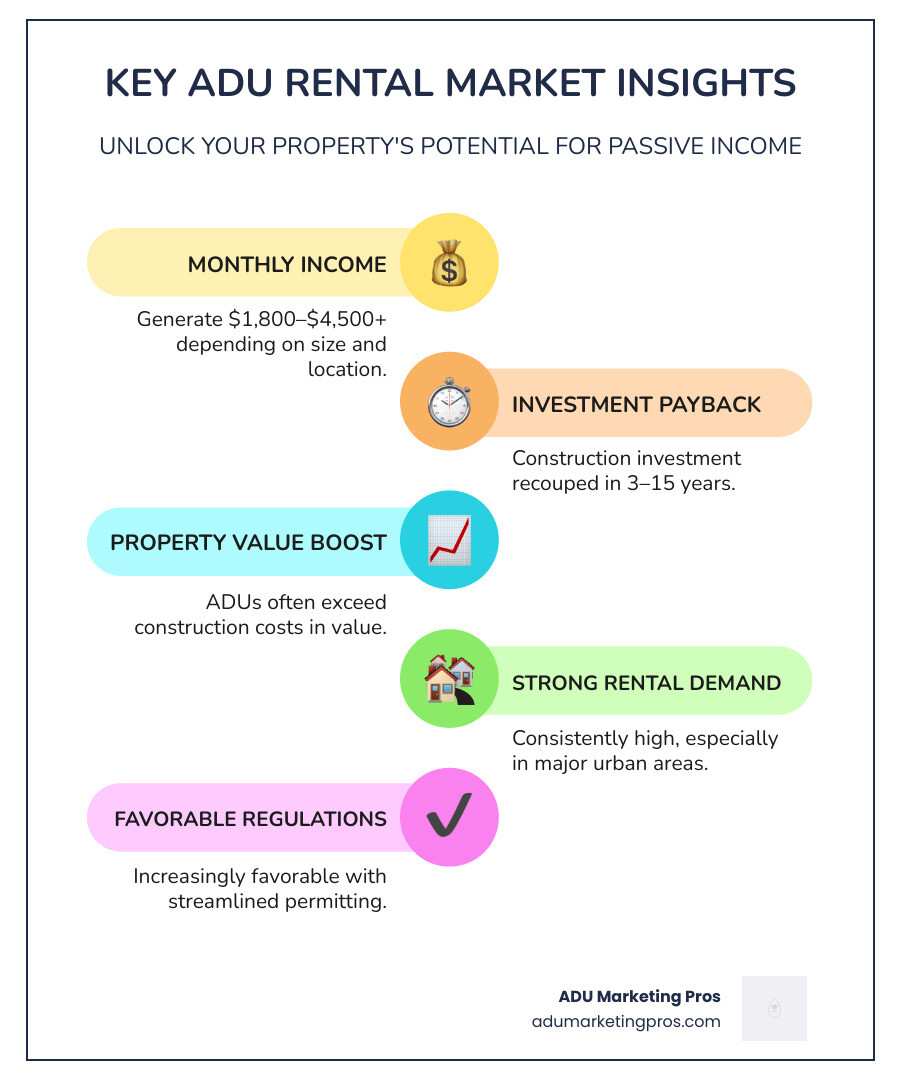
The ADU rental market is rapidly becoming one of the smartest investment opportunities for California homeowners. Here’s what you need to know:
Quick Overview:
- Monthly Income Potential: $1,800–$4,500+ depending on size and location
- Payback Period: 3–15 years for construction investment
- Property Value Impact: Often exceeds construction costs
- Rental Demand: Consistently strong, especially in urban areas
- Regulatory Environment: Increasingly favorable with streamlined permitting
Between 2016 and 2023, California’s annual ADU permits grew from just 1,336 to 26,924—a twentyfold increase. In 2023 alone, ADUs comprised more than 21 percent of all homes permitted statewide. This isn’t a trend. It’s a change.
Why the surge? Three forces are converging. First, housing costs that consistently outpace incomes. Second, state legislation that eliminated many construction barriers. Third, a rental market where vacancy rates hover below 2% in major metros.
For homeowners, an ADU offers something rare: a path to passive income without selling or leaving your property. You can generate $2,000–$3,000 monthly while your primary residence sits on the same lot. The investment typically pays for itself within 5–7 years through rental income alone.
For builders and architects, this represents a massive market opportunity. Homeowners want ADUs, but they need guidance navigating permits, design choices, and financial projections. The firms that can clearly communicate the rental market potential will capture this growing demand.
The data is compelling. ADUs often outperform traditional apartments on a per-square-foot basis because tenants value privacy and a home-like environment. They’re willing to pay premium rates for standalone units with separate entrances. Meanwhile, your operating expenses stay lower than condos—no HOA fees, no shared maintenance headaches.
But success requires more than just building a unit. You need to understand local regulations, set competitive prices, screen tenants effectively, and position your ADU correctly in the rental landscape. That’s what this guide covers.
Know your ADU rental market terms:
Why the ADU Rental Market is a Goldmine for Homeowners
The ADU rental market in California is not just a trend; it’s a strategic move for homeowners looking to bolster their financial future. With housing costs consistently high in areas like Los Angeles, San Diego, and the San Francisco Bay Area, an Accessory Dwelling Unit (ADU) offers a tangible solution for both homeowners and the broader housing crisis.
The Powerful Return on Investment (ROI) of an ADU
Building an ADU is a smart investment that often pays for itself, sometimes surprisingly quickly. For homeowners in Los Angeles, for example, monthly rental income for an ADU can range from $1,800 for a studio to over $4,500 for a two-bedroom unit. Garage conversions can fetch $2,000–$3,000+, and even Junior ADUs (JADUs) can bring in $1,200–$1,800 monthly. This significant income potential means that the investment required for ADU construction can often pay for itself within 5 to 15 years, with some sources suggesting a payback period as short as 3-7 years. The exact ROI, of course, is heavily influenced by location. An ADU in a highly walkable neighborhood close to public transit, major employment hubs, and a desirable school district will command higher rents and appreciate faster than one in a more remote, car-dependent area.
Beyond the immediate cash flow, ADUs are a powerful tool for increasing your property’s overall value. Well-designed ADUs increase property values by amounts that often exceed their construction costs, making them a dual-purpose investment for both rental income and long-term appreciation. This added value provides homeowners with significant financial flexibility, allowing them to offset their primary mortgage payments, property taxes, and maintenance costs. The beauty of it all? You don’t have to sell your home to open up its full potential.
California’s supportive legislative environment, with laws passed in 2021 and the HOME Act in 2022 aimed at streamlining permitting and removing barriers like owner-occupancy mandates, further improves this investment’s appeal. These changes signal a long-term commitment to ADU development, making it a safer and more predictable investment.
For a deeper dive into how ADUs improve property value, visit our guide on ADU Return on Investment.
Calculating Your Costs in the Current ADU Rental Market
Understanding the financial picture involves more than just potential income; it requires a clear grasp of costs. The initial construction cost is the primary outlay. In Los Angeles, building a 900 sq. ft. ADU typically costs around $385,000. While this might seem substantial, various financing options and grants can help ease the burden. Common financing routes include a Home Equity Line of Credit (HELOC), a cash-out refinance of your primary mortgage, or a construction or renovation loan. For instance, the CalHFA ADU Grant offers up to $40,000 to help cover pre-development costs for eligible homeowners. Additionally, loan options through Fannie Mae, Freddie Mac, and FHA are increasingly available, allowing homeowners to finance their ADU projects by factoring in future rental income.
Beyond construction, consider ongoing expenses like property taxes, insurance, and maintenance. While an ADU will likely increase your property’s assessed value and thus your property taxes, the rental income typically far outweighs this increase. We cover these details in our ADU Property Taxes resource. Maintenance for a smaller, newer unit is often lower than for an older, larger primary residence.
To illustrate the financial viability, let’s look at a hypothetical comparison between an ADU and a traditional condo in a competitive California market like Los Angeles:
| Financial Metric | ADU (900 sq. ft.) | Traditional Condo (900 sq. ft.) |
|---|---|---|
| Initial Cost | ~$385,000 | ~$700,000 – $900,000+ |
| Expected Monthly Rent | ~$2,800 – $4,500+ (2-bedroom) | ~$2,500 – $4,000+ |
| Annual Operating Expenses | ~$3,000 – $6,000 (taxes, insurance, minimal maintenance) | ~$10,000 – $18,000+ (incl. HOA fees, taxes, insurance) |
| 5-Year Value Appreciation | 20-30% (often exceeding construction cost increase) | 10-20% |
| Payback Period (from rent) | 5-15 years | N/A (direct investment) |
As you can see, while the upfront cost for an ADU might be significant, the lower ongoing expenses and strong rental income potential can make it a more attractive financial proposition. For more on the initial investment, check out our insights on ADU Building Costs.
How ADUs Compare to Condos and Other Traditional Rentals

When considering rental properties, ADUs stand out against traditional condominiums and apartments, particularly in markets like Los Angeles, San Diego, and the Bay Area. One of the most significant advantages of an ADU is the absence of monthly condo or Homeowners Association (HOA) fees. These fees, which can run hundreds of dollars per month, cover shared amenities and maintenance in a condo complex but represent a substantial drain on a condo owner’s income. An ADU owner avoids this entirely, leading to significantly lower ongoing expenses and higher net rental income.
From the landlord’s perspective, management is also simpler. You have direct oversight of your property without needing to navigate HOA rules, regulations, and politics. When a repair is needed, you call your own trusted contractor, not a property management company beholden to an entire building.
ADUs also offer a unique and powerful tenant appeal. In a market saturated with cookie-cutter apartments, renters increasingly value the privacy and home-like feel of a standalone unit. An ADU offers no shared walls, its own private entrance, and often a small, dedicated outdoor space like a patio or garden. This allows ADUs to often outperform traditional apartments on a per-square-foot basis in terms of rental rates. The ability to customize your ADU’s design, finishes, and amenities to attract a specific tenant demographic—such as adding high-end appliances or creating a pet-friendly space—further improves its desirability and potential rental yield. Imagine a bright, well-designed ADU interior, showcasing a compact but highly functional kitchen and living area, offering a serene retreat from the busy city. This level of privacy, autonomy, and personalization is rarely found in multi-unit buildings, making ADUs a premium product in the rental market.
Navigating the Legal Labyrinth: Regulations and Requirements
Becoming a successful ADU landlord in California means more than just building a beautiful unit; it means understanding and complying with the intricate web of legal and regulatory requirements. We’re here to help you steer this labyrinth.
Essential Steps Before Your ADU is Tenant-Ready
Before you can welcome your first tenant, several crucial steps ensure your ADU is legally ready for occupancy. The journey begins with the permitting process, which, thanks to recent state legislation, has become significantly more streamlined. California’s ADU laws mandate ministerial approval, meaning local agencies must approve or deny completed ADU applications within 60 days, based solely on objective standards. This removes much of the subjectivity and delays that plagued past projects. You can learn more about this process in our guide on the ADU Permit Process.
Once construction is complete, a final inspection is mandatory. After passing, your local agency will issue a Certificate of Occupancy. This document is your official green light, confirming that your ADU meets all building codes and is safe for residential use. Without it, your unit cannot be legally rented.
Before move-in, ensure all utility services (water, electricity, gas, internet) are properly set up and metered, ideally separately from your main residence, to avoid disputes. Finally, and critically, secure the right landlord insurance. Your standard homeowner’s policy will not cover a rental unit. You’ll need a specific landlord policy (or an endorsement to your existing policy) that includes liability protection (in case a tenant is injured on the property), property damage coverage (for the structure itself), and consider loss of rent coverage, which can reimburse you for lost income if the unit becomes uninhabitable due to a covered event like a fire. Staying on top of these preparations ensures a smooth transition to renting and protects you from potential legal and financial headaches. For comprehensive details on what’s required, consult our ADU Building Requirements.
Understanding Landlord Responsibilities and Tenant Rights
As an ADU landlord in California, you’ll have specific responsibilities, and your tenants will have protected rights. It’s crucial to familiarize yourself with state and local housing laws, particularly concerning fair housing and anti-discrimination. These laws prohibit discrimination based on protected characteristics like race, religion, gender, familial status, and disability in all aspects of renting.
Your primary responsibility is to provide a safe, habitable living environment. This includes maintaining the property, ensuring all systems (plumbing, electrical, heating) are in good working order, and promptly addressing repairs. A well-drafted lease agreement is your best friend, clearly outlining expectations for both landlord and tenant regarding rent, utilities, maintenance, and property use.
It’s also vital to understand the rules governing security deposits. In California, the maximum security deposit you can charge is typically two months’ rent for an unfurnished unit or three months’ for a furnished one. After a tenant moves out, you have 21 days to either return the full deposit or provide an itemized list of deductions for repairs (beyond normal wear and tear) and cleaning, along with any remaining balance.
Tenants in California are entitled to privacy, meaning you generally cannot enter their unit without providing at least 24 hours’ written notice, except in emergencies. Understanding the rules around rent increases and the eviction process is also paramount. Eviction laws are strict and require due process; illegal evictions can lead to severe penalties. We highly recommend reviewing resources like A guide to tenants’ and landlords’ rights to ensure full compliance and a harmonious landlord-tenant relationship.
The Rules of Short-Term vs. Long-Term Rentals
The allure of short-term rentals (like Airbnb) can be tempting, but in California, particularly in major metros like Los Angeles and San Diego, regulations are strict and generally favor long-term housing. Most Accessory Dwelling Units and Junior ADUs are not permitted to be rented for less than 30 days. This policy is deliberately designed to encourage ADUs as a means to increase the permanent housing stock for residents, rather than contributing to tourist accommodations.
In Los Angeles, for instance, short-term rentals are generally restricted for ADUs unless it’s the host’s primary residence, and even then, a minimum stay of 30 days is often imposed. Some jurisdictions may even require you to file a deed restriction agreeing that the unit will not be used for short-term rentals. Violating these ordinances can result in hefty fines, cease-and-desist orders, and other legal penalties, making it a risky proposition. It’s essential to check your local city ordinances (e.g., Los Angeles’s Ord. 186,481) for specific rules in your area, as they can vary.
Focusing on long-term rentals (12 months or more) offers significant benefits, including tenant stability, reduced turnover costs, and more predictable income. While short-term rentals might promise higher per-night rates, the overhead of constant cleaning, marketing, and tenant management can quickly erode profits, not to mention the regulatory problems. For a deeper understanding of the income potential and strategies, explore our comprehensive guide on ADU Rental Income.
Becoming a Savvy ADU Landlord: From Pricing to Tenants
Once your ADU is built and ready, the next step is attracting the right tenant at the right price. This is where savvy landlord strategies come into play.
How to Set Competitive and Fair Rental Prices
Setting the right rental price is a delicate balance. You want to maximize your income, but you also want to attract and retain reliable tenants quickly. Our advice? Start with thorough market research and neighborhood analysis. Look at comparable rentals in your immediate area—not just ADUs, but also apartments and smaller homes. What are they charging per square foot? What amenities do they offer? Websites like Zillow, Craigslist, and local real estate listings can provide valuable data.
Consider the unique advantages of your ADU: privacy, a dedicated entrance, potentially a small yard or patio area. These features often allow ADUs to command higher per-square-foot rates than traditional apartments. Amenities like in-unit laundry, dedicated parking, and energy-efficient appliances (which lead to lower utility bills for tenants) can also justify a higher price point. For instance, in Los Angeles, a studio ADU might rent for $1,800–$2,500, while a two-bedroom could go for $2,800–$4,500+.
Before listing, decide how you’ll handle utilities. Will you include them in the rent for a higher, all-inclusive price? Or will you have the tenant pay for them separately? If the ADU has its own meters (submetering), the latter is straightforward. If not, you might charge a fixed monthly fee for utilities. Clearly stating this in your listing prevents confusion and attracts the right applicants.
While it might seem counterintuitive, sometimes setting your rent slightly under the absolute market peak can be a strategic move. A fair, competitive price helps you attract high-quality tenants who are more likely to stay long-term and take good care of your property. It also positions your ADU as an attractive, affordable option in a tight housing market.
For more insights on how to effectively position your rental, check out our tips on Accessory Dwelling Unit Marketing.
Strategies for Finding and Screening Reliable Tenants
Finding reliable tenants is perhaps the most critical aspect of successful ADU renting. It protects your investment and ensures a positive landlord experience. A bulletproof lease and a thorough screening process are your best tools.
- Craft Compelling Listings: Use high-quality photos and detailed descriptions that highlight your ADU’s unique features and amenities. Emphasize privacy, separate entrance, natural light, and any outdoor space. Online platforms like Zillow, Apartments.com, and even local community groups on social media can be effective. We offer more detailed advice on ADU Marketing Strategies.
- Robust Application Process: Require a comprehensive rental application that asks for employment history, previous rental addresses, references, and permission for background and credit checks.
- Credit and Background Checks: These are non-negotiable. A credit check provides insight into a prospective tenant’s financial responsibility, while a background check can reveal criminal history. There are many reputable online services for landlords to perform these checks.
- Verify Income: Request proof of income, such as pay stubs or an offer letter, to ensure the tenant can comfortably afford the rent. A common guideline is that a tenant’s gross monthly income should be at least three times the rent.
- Call References: Speak to previous landlords (not just friends or family). Ask about payment history, property care, and adherence to lease terms.
- Tenant Interview: A brief, in-person or video interview can provide valuable insights. Prepare a consistent set of open-ended, legal questions for all applicants to avoid any appearance of discrimination. Good questions include: “What is your reason for moving?” “What is your ideal move-in date?” “Do you have any questions about the property or the lease terms?” Avoid questions about race, religion, national origin, family status, or disability, as this is illegal.
Finally, secure your relationship with a strong, state-specific lease agreement. This legal document should clearly define all terms: rent amount and due date, security deposit, utility responsibilities, rules regarding guests, pets, and property alterations, and the landlord’s right of entry. Using a template from a reputable source like a local apartment association and having it reviewed by a lawyer is a wise investment. The goal is not just to fill the vacancy, but to find a tenant who will respect your property and fulfill their lease obligations, making your ADU rental venture truly passive and profitable.
The Big Picture: ADUs’ Role in Housing and Future Trends
Beyond individual financial gains, ADUs are playing a pivotal role in shaping California’s housing landscape, offering solutions to long-standing challenges and pointing towards innovative future trends.
How ADUs Help Solve the Housing Affordability Crisis
California, particularly in busy cities like San Jose, San Francisco, and Los Angeles, faces a persistent housing affordability crisis. ADUs are emerging as a powerful, ground-up solution. By allowing homeowners to build additional dwelling units on their existing properties, ADUs effectively increase housing supply without requiring new land development. This concept, known as “gentle density” or “infill development,” adds housing units within established neighborhoods, utilizing existing infrastructure more efficiently. This approach often faces less community opposition than large-scale apartment projects, which can drastically alter a neighborhood’s character and strain resources.
ADUs are frequently among the least expensive rental options in the cities where they are built, offering more affordable housing choices for diverse populations, including young professionals, students, seniors, and essential workers. This is crucial in a state where housing costs consume significant portions of household incomes. Research funded by HUD anticipates that the increased production of ADUs could improve overall housing affordability, contributing to a more balanced and accessible rental market. Furthermore, ADUs support multi-generational living and aging-in-place, allowing families to house elderly parents or adult children nearby, fostering family cohesion and providing caregiving solutions that are otherwise financially prohibitive.
By maximizing the use of existing residential lots, ADUs also reduce urban sprawl. This aligns with environmental goals, as denser, infill development typically leads to shorter commutes, greater use of public transit, and reduced greenhouse gas emissions. ADUs are a win-win: they provide homeowners with income and flexibility, while simultaneously offering much-needed, often more affordable, housing options to the broader community. For more on the broader impact, dig into Research on ADU legislation’s impact.
The Future of the ADU Rental Market and Emerging Trends
The ADU rental market is dynamic, constantly evolving with new regulations, financing options, and construction innovations. California has been at the forefront of this evolution, with legislation continually streamlining the process. The California HOME Act, for example, removed significant barriers like owner-occupancy mandates and further simplified approval processes. As of January 1, 2024, the California Department of Housing and Community Development (HCD) even gained enforcement authority over state ADU laws, signaling a robust commitment to their widespread adoption. Local agencies are now required to develop programs for the preapproval of ADU plans by January 1, 2025, making the process even smoother for homeowners.
Innovative financing solutions are also expanding, making ADUs more accessible. Beyond the CalHFA ADU Grant, which offers up to $40,000 for pre-development costs, entities like Fannie Mae and Freddie Mac are increasingly factoring in potential ADU rental income when evaluating mortgage applications, easing the path to construction loans. We’ve compiled detailed information on this topic, including Fannie Mae ADU Rental Income.
Beyond policy and finance, several key trends are shaping the future of ADUs:
-
Sustainable and Eco-Friendly Designs: There’s a growing emphasis on green building. This includes features like solar panels (often required for newly constructed ADUs in California), high-efficiency windows, energy-efficient appliances, and the use of sustainable or recycled building materials. These features not only reduce the environmental footprint but also lower utility costs for tenants, making the unit more attractive. Check out our insights on Eco Friendly ADU for more on sustainable building.
-
Prefabricated and Modular Construction: Prefab and modular ADUs are gaining traction for their ability to offer faster construction times, reduced costs, and consistent quality control. Built in a factory and assembled on-site, these units minimize neighborhood disruption and can often be completed in a fraction of the time of a traditional stick-built ADU.
-
Smart Home Integration: To stand out in a competitive rental market, new ADUs are increasingly being equipped with smart home technology. Features like smart thermostats, keyless entry locks, smart lighting, and integrated security systems are becoming a key selling point for tech-savvy renters, justifying premium rental rates and improving ease of management for landlords.
-
Adaptive and Flexible Designs: The most forward-thinking ADU designs are built for flexibility. This might mean including a movable wall to convert a one-bedroom unit into a studio with a large workspace, or designing the space to easily transition from a rental unit to a home office, art studio, or in-law suite as the homeowner’s needs evolve over time. This adaptability maximizes the long-term value and utility of the investment.
Start Your Journey to Passive Income
An ADU is more than just a building; it’s a powerful financial tool that generates passive income, boosts your property’s value, and provides much-needed housing. By understanding the market, navigating the regulations, and employing smart landlord strategies, you can turn your backyard into a source of significant and stable revenue. The journey requires careful planning, but the rewards—both financial and personal—are substantial. For builders and architects looking to capitalize on this trend, showcasing this potential to homeowners is key. ADU Marketing Pros can help you craft that message.
Explore how to maximize your ADU rental income; Smart investment; Financial freedom; Housing solutions.