
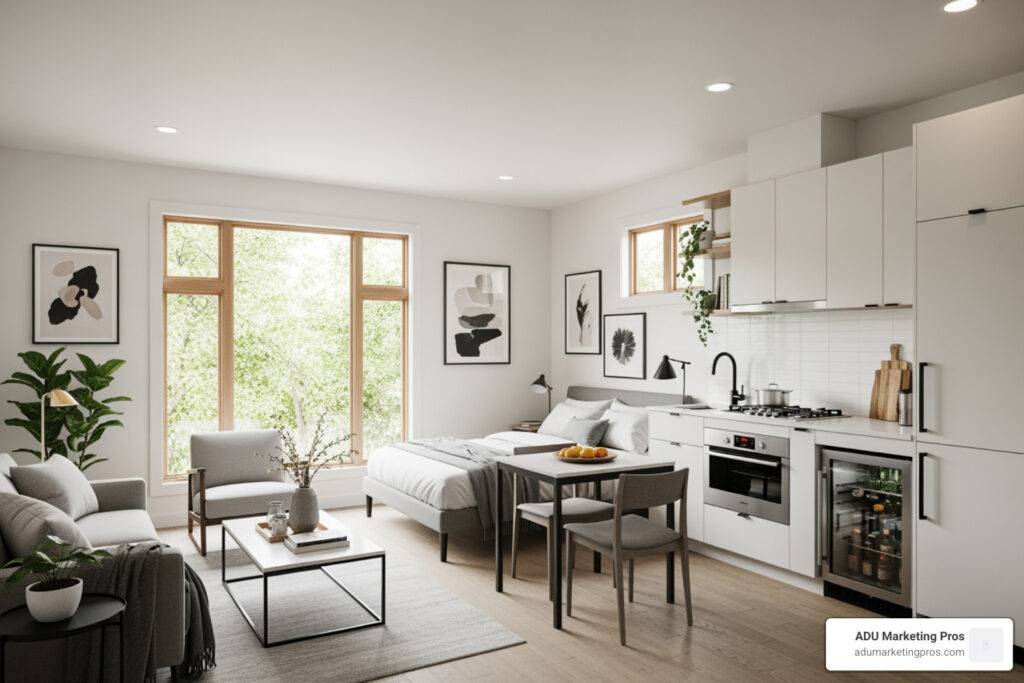
Understanding Your ADU Studio Plans Options
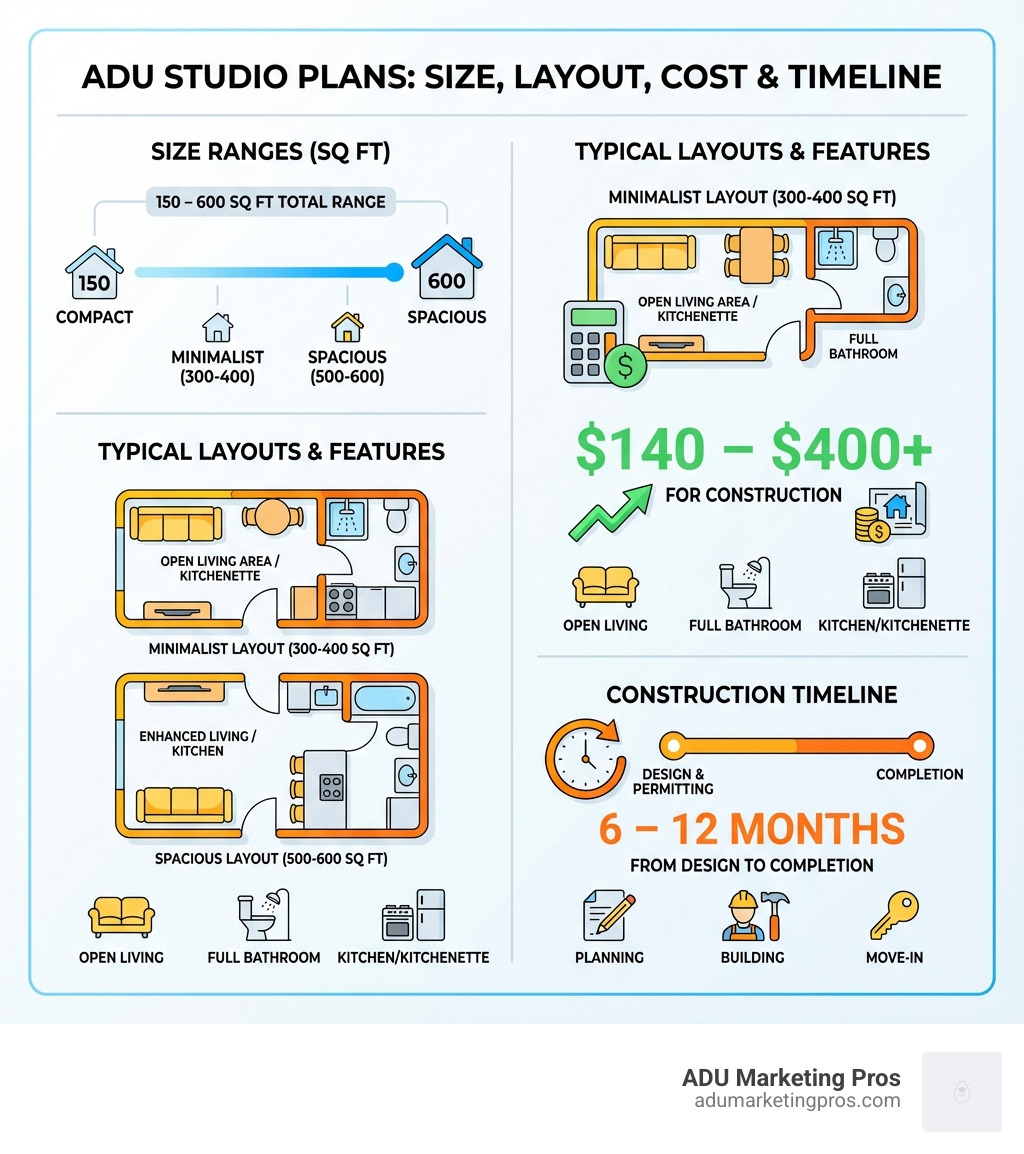
ADU studio plans are comprehensive blueprints for compact, self-contained living spaces typically ranging from 150 to 600 square feet. Here’s what you need to know:
Key Features of Studio ADU Plans:
- Open-concept layout combining living, sleeping, and dining areas
- Full bathroom with shower or tub
- Kitchen or kitchenette with essential appliances
- Typical sizes: 300–400 sq ft (minimalist) or 500–600 sq ft (spacious)
- Starting costs: $140–$400+ per square foot for construction
- Build timeline: 6–12 months from design to completion
Popular Uses:
- Rental income generation
- Guest house for visitors
- Home office or creative studio
- Multi-generational living space
Accessory Dwelling Units have exploded in popularity across California. Since 2016, when the state began streamlining ADU regulations, permit applications have increased dramatically. Homeowners are finding that these compact units offer an unprecedented opportunity to maximize property value while addressing the state’s housing shortage.
Studio ADUs represent the most accessible entry point into ADU construction. They require less square footage than one-bedroom or two-bedroom layouts, which translates to lower construction costs, faster build times, and smaller property footprints. For homeowners with limited backyard space or tight budgets, a well-designed studio plan can deliver full functionality without compromise.
This guide walks you through everything you need to select the right ADU studio plan for your property. We’ll explore defining characteristics, layout options, customization possibilities, and the practical considerations that impact your project timeline and budget. Whether you’re a builder helping clients steer their options or a homeowner planning your first ADU, understanding the fundamentals of studio plans is the essential first step.
Relevant articles related to ADU studio plans:
Decoding ADU Plans: What Defines a Studio?
When we talk about an ADU studio plan, we’re referring to a very specific type of accessory dwelling unit designed for efficiency and compact living. Unlike a one-bedroom or two-bedroom ADU, a studio integrates multiple living functions into a single, open space.
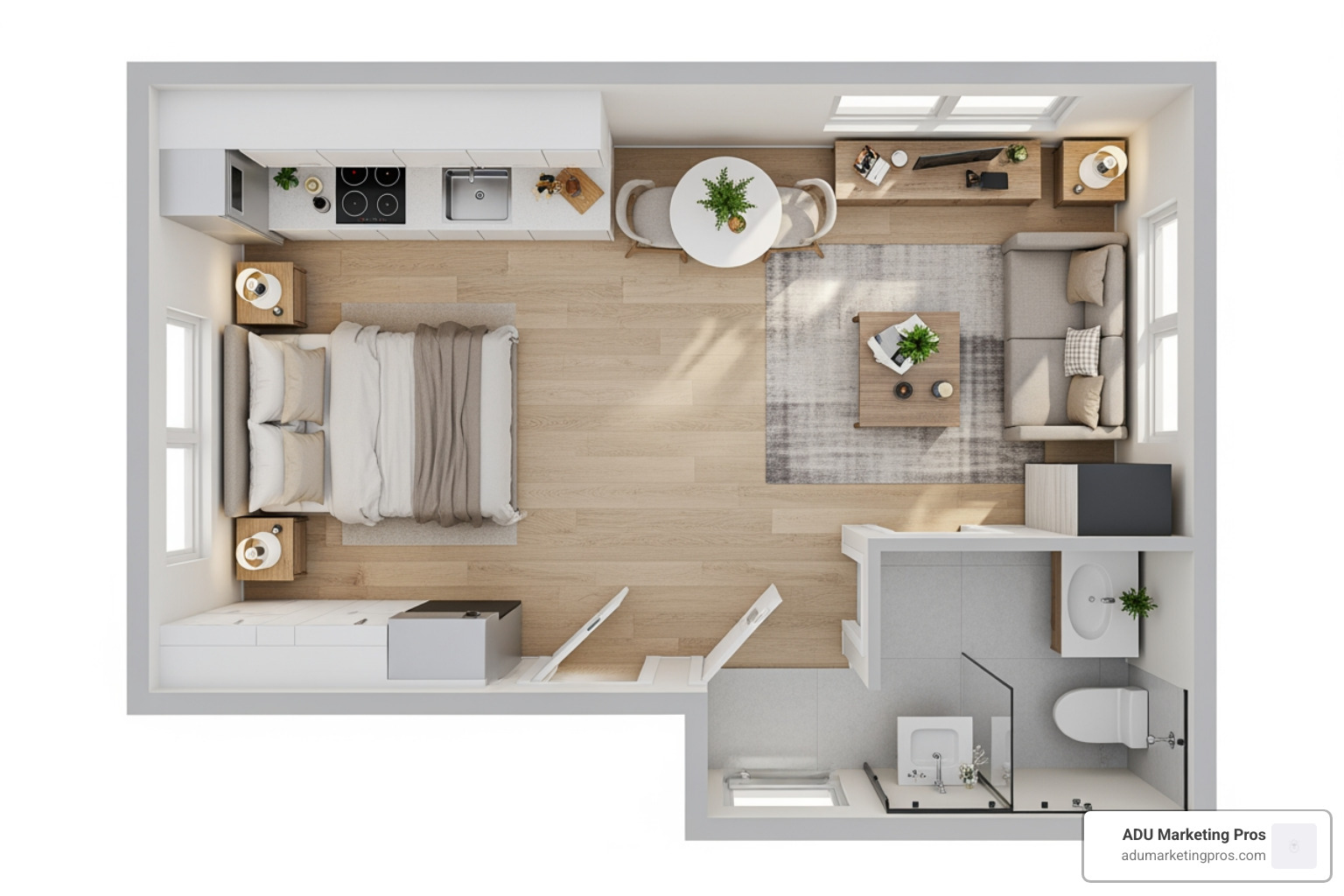
The defining characteristics of a ADU studio plan include:
- Open-concept living: The living, sleeping, and often dining areas are combined into one continuous space. This open layout is crucial for making smaller footprints feel more expansive and functional.
- Combined sleeping and living space: There are no separate walls enclosing a bedroom. Instead, the sleeping area is part of the main living space, often featuring clever solutions like Murphy beds or distinct zones created by furniture arrangement.
- Self-contained unit: Despite its compact size, a studio ADU is a fully independent living space, complete with its own entrance, kitchen (or kitchenette), and bathroom.
- Full bathroom: Every studio ADU we design includes a full bathroom, typically with a shower, toilet, and sink. For very compact units, a 3/4 bathroom (shower only) is a common and acceptable choice.
- Kitchenette or full kitchen: Depending on the size and intended use, a studio ADU will feature either a compact kitchenette with essential appliances (sink, mini-fridge, microwave, hot plate) or a more complete kitchen with a sink, stove/range top, refrigerator, and adequate countertops and cabinetry for food preparation and storage. In San Diego, for instance, a full kitchen requires all these components.
The typical square footage for ADU studio plans can vary significantly, ranging from approximately 150 square feet (the state minimum in California) up to around 600 square feet. For example, the Micro 200 plan maximizes usability in a tiny 200 sq ft footprint, while the Abodu Studio offers a surprisingly spacious 340 sq ft. Many of our designs start from just 300 sq ft, ideal for small lots, and can extend to 500-600 sq ft for more spacious, long-term options.
It’s important to understand the key difference between a ADU studio plan and a tiny home. A studio ADU is a permanent structure built on a foundation, legally recognized as an accessory dwelling unit on a property with an existing primary residence. It is subject to all local and state building codes, including stringent California regulations like Title 24 energy standards. A “tiny home” on the other hand, particularly a “tiny home on wheels” (THOW), is legally considered a recreational vehicle (RV). It’s not a permanent structure and falls under different regulations, often not allowing it to be a permanent dwelling in a residential backyard. This distinction is critical for permitting and long-term property value. By adding a legal, code-compliant ADU, homeowners significantly increase their property’s value and utility.
The Advantages of Choosing a Studio ADU
Choosing a ADU studio plan offers a compelling set of advantages, making it a popular choice for homeowners across California:
- Versatility: Studio ADUs are incredibly flexible. They can serve as guest houses, income-generating rentals, private home offices, creative studios, or even a comfortable space for aging parents or adult children.
- Cost-effectiveness: Generally, studio ADUs are the most economical ADU option due to their smaller size. This translates to lower material and labor costs compared to larger units. Our research shows that shell kits can start around $140 per square foot, offering a more affordable entry point.
- Smaller property footprint: For homeowners with limited backyard space, a studio ADU is a perfect fit. We specialize in layouts starting from just 300 sq ft, making them ideal for small lots in cities like Los Angeles, San Jose, and the San Francisco Bay Area, where space is at a premium.
- Faster construction timeline: With fewer walls and a simpler layout, studio ADUs typically have a quicker construction process. This means you can start benefiting from your new space sooner.
- Lower utility and maintenance costs: A smaller living space naturally requires less energy to heat and cool, and less time and money to maintain.
- Ideal for small lots: As mentioned, their compact nature makes them suitable for properties where a larger ADU simply wouldn’t fit or wouldn’t meet setback requirements.
- Minimalist living: For those embracing a minimalist lifestyle, a studio ADU provides a functional and comfortable space without excess.
Common Uses for a Studio ADU
The beauty of a well-designed ADU studio plan lies in its adaptability. We’ve seen homeowners use them in a myriad of ways, each adding significant value to their property and lifestyle:
- Rental income generation: This is one of the most popular uses. A studio ADU can provide a steady stream of rental income, helping with mortgage payments or generating passive revenue. Many homeowners find that the ROI for an ADU, particularly in California’s high-demand housing market, can be substantial.
- Guest house for family and friends: Provide a private and comfortable space for visitors, allowing them to enjoy their stay without impacting the privacy of the main home.
- Private home office: With the rise of remote work, a dedicated, quiet workspace separate from the main house has become invaluable. A studio ADU can be the perfect solution for a productive home office or even a small business.
- Creative studio for art or music: Artists, musicians, or writers can find inspiration and focus in a detached studio space, free from household distractions.
- In-law suite for multi-generational living: Offer independence and privacy for aging parents or adult children, allowing families to stay close while maintaining separate living quarters.
- Aging-in-place solution: For homeowners looking to downsize or needing accessible living options as they age, a studio ADU can provide a single-level, low-maintenance home on their existing property.
- Short-term rental (e.g., Airbnb): In areas where short-term rentals are permitted, a studio ADU can be a lucrative option for accommodating tourists or temporary residents.
Exploring Popular ADU Studio Plans and Layouts
Even within the compact world of ADU studio plans, there’s a surprising variety of layouts and design strategies to maximize space and comfort.
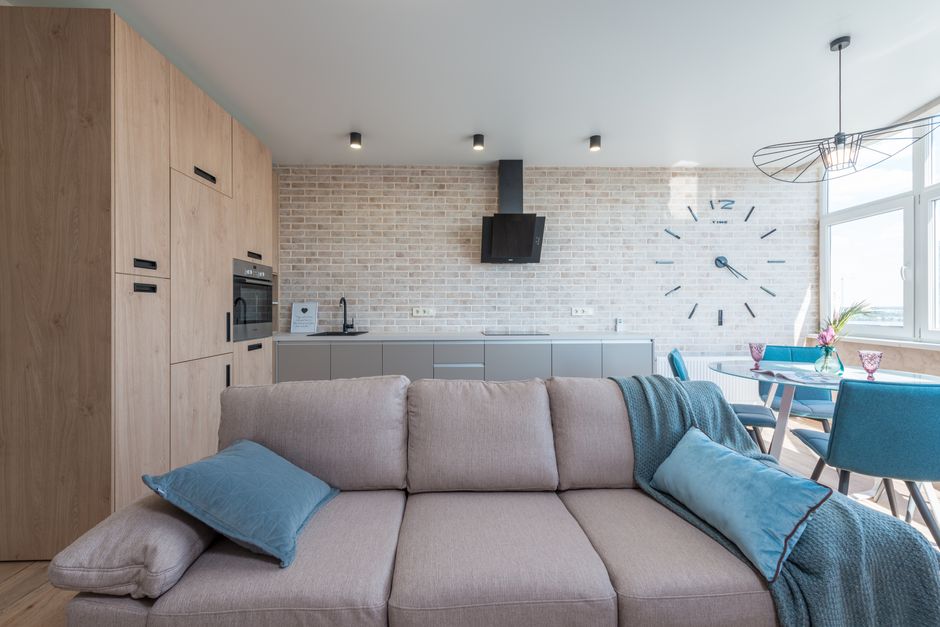
Common layouts we see include:
- Linear design: This layout typically arranges the kitchen, bathroom, and living/sleeping area along one wall or in a straight line, making efficient use of narrow or rectangular spaces.
- L-shape layout: An L-shaped design can help define different zones within the open space, such as a distinct sleeping nook or a more separated living area.
- Square footprint: A square layout offers great flexibility for furniture arrangement and can often feel more spacious. The Micro 200 plan, for instance, has a 15′ x 14′ dimension, creating a near-square footprint.
- Garage conversion ADUs: These are particularly popular in California cities like Los Angeles and San Jose, where existing garages can be transformed into stylish, self-contained units. These plans typically range from 350 to 500 sq ft, offering a fantastic way to add living space without expanding your property’s footprint.
Maximizing space and functionality within a small footprint is an art form. We often incorporate several key strategies:
- High ceilings: Designs like the Abodu Studio feature cathedral ceilings, which dramatically improve the sense of space and openness in a compact unit.
- Large windows for natural light: Abundant natural light makes any space feel larger and more inviting. Strategically placed windows also offer views and connect the interior with the surrounding environment.
- Built-in storage solutions: Custom cabinetry, wall-mounted shelving, and integrated storage under beds or benches are essential for keeping a studio ADU clutter-free and organized.
- Vertical space utilization: Thinking upwards for storage and even sleeping areas (like a loft bed) can free up valuable floor space.
To help you decide between different approaches, here’s a comparison of pre-designed versus custom ADU studio plans:
| Factor | Pre-Designed Plans | Custom Designs |
|---|---|---|
| Cost | Generally lower (around $5,000 for plans) | Higher (typically $8,000 – $15,000 for architectural plans) |
| Timeline | Faster (plans are ready, quicker permitting) | Slower (design process, more complex permitting) |
| Customization | Limited to minor adjustments | Full personalization to specific needs |
| Permit Speed | Often faster, especially with pre-approved plans | Can be longer due to unique elements |
Customizing Your ADU Studio Plans
Even with a compact ADU studio plan, personalization is key to making the space truly yours or appealing to future tenants. We believe that every ADU should reflect individual needs and preferences.
- Exterior siding and style: From modern minimalist to craftsman charm, the exterior can be customized to match your main home or create a distinct aesthetic.
- Interior color palettes: Light and neutral colors tend to make small spaces feel larger and brighter, but bold accents can add personality.
- Upgrading fixtures and finishes: Small details like plumbing fixtures, lighting, flooring, and countertop materials can lift the entire space.
- Window and door placement: Strategic placement of windows can maximize natural light and views, while options like sliding glass doors or large windows can create a seamless indoor-outdoor flow.
- Creating indoor-outdoor flow: Connecting the interior to a private patio or deck can effectively extend the living space, making the studio feel larger and more integrated with the backyard.
- Using an online 3D Design Center to visualize changes: Tools like this allow you to experiment with various options, adjust windows, doors, sizes, and colors, and get a realistic preview of your future ADU. This is an invaluable step in tailoring your studio ADU to your preferences.
Maximizing Functionality in Small ADU Studio Plans
The magic of a well-executed ADU studio plan lies in its ability to live large within a small footprint. It’s all about intelligent design choices:
- Smart storage solutions: This is paramount. Think built-in wardrobes, under-bed drawers, vertical shelving units, and even hidden compartments. The goal is to ensure every item has a designated place, preventing clutter.
- Multi-functional furniture: A sofa that converts into a bed (like a Murphy bed), a dining table that folds away, or ottomans with storage are excellent examples. This allows the same space to serve different purposes throughout the day.
- Defining zones with rugs or furniture placement: In an open-concept space, rugs can delineate a living area from a sleeping area, while strategically placed furniture (like a bookshelf or a console table) can create subtle divisions without building walls.
- Incorporating mirrors to create a sense of space: Mirrors are a designer’s trick to reflect light and visually expand a room, making it feel larger and brighter.
- Choosing light color palettes: Light colors on walls, ceilings, and even large furniture pieces can make a small space feel more open and airy.
- Ensuring ample natural and artificial lighting: Beyond large windows, thoughtful artificial lighting, including task lighting, ambient lighting, and accent lighting, can improve functionality and mood.
From Blueprint to Build: Key Project Considerations
The essential project necessities when planning a studio ADU include:
- Feasibility study: This initial step involves assessing your property for suitability, considering factors like lot size, available space, utility access, and existing structures. It’s crucial for understanding what’s possible within local regulations.
- Site assessment: A detailed evaluation of your specific site conditions, including topography, soil, and potential challenges, will inform the design and construction process.
- Selecting a builder or designer: Partnering with experienced professionals who specialize in ADUs, especially in your local California market (like Los Angeles, San Jose, or the San Francisco Bay Area), is vital. They can steer regulations and bring your vision to life.
- Securing financing: Explore various options such as home equity lines of credit (HELOC), cash-out refinances, or construction loans. Understanding your budget early is key to making informed decisions.
- Creating a realistic timeline: From design to final inspection, an ADU project typically takes 6-12 months. Having a clear timeline helps manage expectations and coordinate efforts.
Navigating Zoning Laws and Building Codes
Understanding and adhering to local zoning laws and building codes is perhaps the most critical aspect of any ADU project in California. These regulations dictate nearly every aspect of your ADU studio plan, from its size and placement to its design and construction materials.
- Local regulations overview: Each city and county within California has its own specific set of ADU ordinances. While state laws provide a framework, local jurisdictions can add their own requirements.
- Setback requirements: In California, a minimum 4-foot setback from the side and rear property lines is common for ADUs. Always verify with your local planning department, whether you’re in San Jose, Sunnyvale, Mountain View, or Menlo Park.
- Height restrictions: There are typically limits on how tall an ADU can be, often tied to the height of the main dwelling or a fixed maximum.
- Maximum lot coverage: Some areas may have restrictions on the total percentage of your lot that can be covered by structures.
- Parking mandates (often waived): State law has significantly reduced or eliminated parking requirements for ADUs in many situations, especially if the ADU is near public transit or an existing garage is converted.
- California-specific codes: All ADUs must comply with the California Building Code (CBC) and the California Green Building Standards Code (CALGreen).
- Title 24 energy standards: These are stringent energy efficiency requirements unique to California, ensuring your ADU is built to be environmentally friendly and cost-efficient to operate.
- ADU Standard Plan Program in Los Angeles: Cities like Los Angeles offer pre-approved ADU plans that can significantly streamline the permitting process, reducing both time and cost.
- Pre-approved ADU plans in San Diego County: Similarly, San Diego County provides resources for pre-approved plans, helping homeowners steer the process more easily. Many other cities in the San Francisco Bay Area, including San Jose, Mountain View, and Menlo Park, also offer or encourage pre-approved ADU plans to expedite construction.
Budgeting for Your Studio ADU Project
One of the first questions homeowners ask is, “How much will this cost?” Budgeting for your ADU studio plan involves several components:
- ADU plan costs: The cost for architectural plans typically ranges from $5,000 to $15,000. Pre-made plans can be more affordable, starting around $5,000, while custom engineering and design plans can range from $8,000 to $13,000.
- Construction costs: This is the largest portion of your budget. While shell kits can start around $140 per square foot, fully finished, move-in ready studio ADUs can range from $250 to over $400 per square foot, depending on materials, finishes, and complexity. For example, a high-end prefab like the Abodu Studio, at 340 sq ft, starts around $228,800, which translates to approximately $673 per square foot. This figure often includes delivery and installation, highlighting the range in pricing models.
- Site preparation expenses: Costs for grading, excavation, and foundation work can vary widely based on your property’s specific conditions.
- Utility connection fees: Connecting your ADU to water, sewer, electrical, and gas lines can involve significant costs, including trenching and hook-up fees. These are often overlooked but essential expenses.
- Permit and impact fees: These fees, paid to your local jurisdiction, can range from a few thousand dollars to upwards of $10,000 or more, depending on the city and the scope of your project.
- Return on Investment (ROI): Despite the upfront costs, a studio ADU can offer a significant return. Research suggests an estimated ROI for an ADU can reach 1,739%. This comes from:
- Calculating potential rental income: Many homeowners can generate substantial monthly income, especially in California’s competitive rental markets.
- Long-term property value appreciation: Adding a legal, functional living unit to your property almost always increases its overall market value.
Typical Project Timeline
Building a studio ADU is a multi-stage process, and understanding the typical timeline helps set realistic expectations:
- Design and planning phase (1-3 months): This includes initial consultations, feasibility studies, architectural design, and selecting materials and finishes.
- Permitting and approval (2-6 months): This stage can be the most variable, depending on your local city’s planning department efficiency and whether you’re using pre-approved plans or a custom design. California’s streamlined regulations have helped, but patience is still key.
- Site preparation and foundation (2-4 weeks): Once permits are in hand, the ground is prepared, utilities are brought in, and the foundation is laid.
- Construction and assembly (2-4 months): This is where your ADU takes shape, from framing to interior finishes. Modular or prefab units can significantly shorten this phase.
- Final inspections and utility hookup (2-3 weeks): The last step involves final inspections by the city and connecting all utilities to make your ADU habitable.
- Total estimated timeline (6-12 months): From the moment you conceive your idea to the day you can move in or rent it out, the entire process typically spans 6 to 12 months.
Frequently Asked Questions about ADU Plans
We often encounter common questions from homeowners exploring ADUs. Here are some of the most frequent inquiries about ADU studio plans:
What is a good size for a studio ADU?
The “good” size for a studio ADU largely depends on its intended use and your local zoning regulations.
- 300–400 sq ft: This range is often ideal for minimalist living, a dedicated home office, or short-term stays. It provides enough space for essential living functions while keeping the footprint small and costs manageable. The Abodu Studio (340 sq ft) and Westport Studio (364 sq ft) are great examples of this size range.
- 500–600 sq ft: For those seeking a more spacious feel, perhaps for long-term rentals or extended family use, this size range offers greater comfort and flexibility. It allows for more generous living areas, larger kitchens, and more robust storage solutions.
- Local zoning: Always remember that local zoning ordinances in cities like San Jose, Los Angeles, or San Diego may dictate maximum ADU sizes for your property, so check these limits before finalizing your plan.
What is the smallest ADU allowed in California?
The state of California mandates a minimum size of 150 square feet for an ADU. This means you cannot build a permanent ADU smaller than this statewide minimum. However, it’s crucial to note that individual cities or counties within California have the authority to establish higher minimums. Many municipalities, including some in the San Francisco Bay Area, may require a larger minimum, often around 200 or 220 square feet. Therefore, we always advise verifying the specific minimum size requirements with your local planning department in your city, whether it’s Sunnyvale, Palo Alto, or Mountain View.
What is the difference between an ADU and a tiny home?
This is a common point of confusion. The key distinctions are legal classification and permanence:
- An ADU (Accessory Dwelling Unit) is a legal and permanent structure built on a foundation on a property with an existing primary residence. It is subject to all local and state building codes, permits, and zoning regulations. It adds to the property’s assessed value and is considered real estate. ADU studio plans fall squarely into this category.
- A tiny home can refer to several things, but often it implies a “tiny home on wheels” (THOW). A THOW is legally considered an RV (Recreational Vehicle). It is not a permanent structure, can be moved, and is governed by different regulations than traditional housing. While some communities or specific parks may allow THOWs as permanent residences, they are generally not permitted as legal ADUs in most residential backyards in California. There are also tiny homes built on foundations, which are essentially small traditional homes and could function as ADUs if they meet all the necessary local and state requirements.
Conclusion: Taking the Next Step in Your ADU Journey
Exploring ADU studio plans opens up a world of possibilities for maximizing your property’s potential. From the versatility of their uses—whether generating rental income, hosting guests, or providing a dedicated workspace—to their cost-effectiveness and smaller footprint, studio ADUs offer a smart solution for many California homeowners. Their ability to deliver full functionality within a compact design makes them an attractive option, especially in our densely populated regions like Los Angeles, San Diego, and the San Francisco Bay Area.
We’ve seen how thorough planning, from understanding defining characteristics and exploring layouts to navigating zoning laws and budgeting effectively, is paramount for a successful project. By partnering with experienced professionals who understand the nuances of California’s ADU landscape, you can transform your property and improve your lifestyle. The right ADU studio plan isn’t just a blueprint; it’s an investment in your future.
For builders ready to connect with homeowners starting on their ADU journey, it’s crucial to have a strong digital presence. ADU Marketing Pros specializes in helping construction and architecture firms stand out in this competitive market. We empower firms to attract high-quality leads and grow revenue by focusing on their expertise. If you’re a builder looking to tap into this booming market, let us help you connect with the right clients.