
Why California ADU Parking Requirements Matter for Your Project
California ADU parking requirements have changed dramatically, making it easier and more affordable than ever to build an accessory dwelling unit. Understanding these updated rules is the first step to saving thousands of dollars and avoiding months of permitting headaches.
Here’s what you need to know right now:
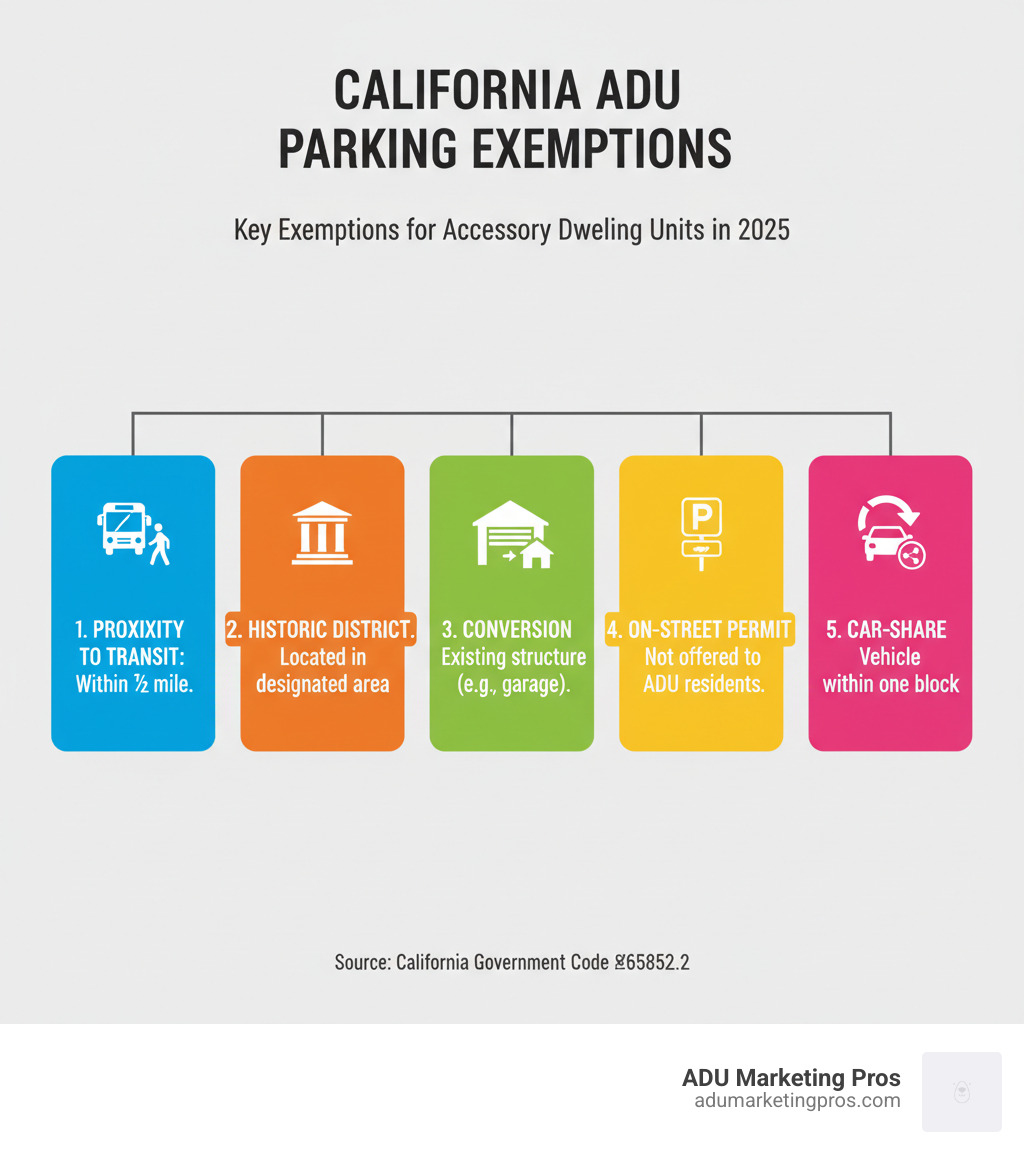
- No parking required for ADUs within a ½-mile of public transit.
- No parking required for ADUs in designated historic districts.
- No parking required when converting an existing structure (like a garage).
- No parking required if on-street parking permits aren’t offered to ADU residents.
- No parking required if a car-share vehicle is within one block.
- Maximum of one space per ADU or bedroom (whichever is less) for new builds, and only if no exemptions apply.
These changes, driven by state legislation, have removed one of the biggest financial and logistical barriers to ADU construction. Before 2020, a patchwork of restrictive local rules often made projects unfeasible. Today, uniform statewide standards have streamlined the process, eliminating parking requirements in many common scenarios. Converting a garage or building near a bus stop no longer requires expensive driveway expansions or new parking pads. This guide will walk you through the current landscape, from the general rules to the powerful exemptions that can bring your ADU project within reach.
The Big Shift: How California ADU Parking Requirements Evolved
To appreciate today’s simplified California ADU parking requirements, it helps to understand how much has changed. The evolution from a complex local system to a streamlined state standard is the primary reason building an ADU is more feasible now than just a few years ago.
Before 2020: A Patchwork of Difficult Rules
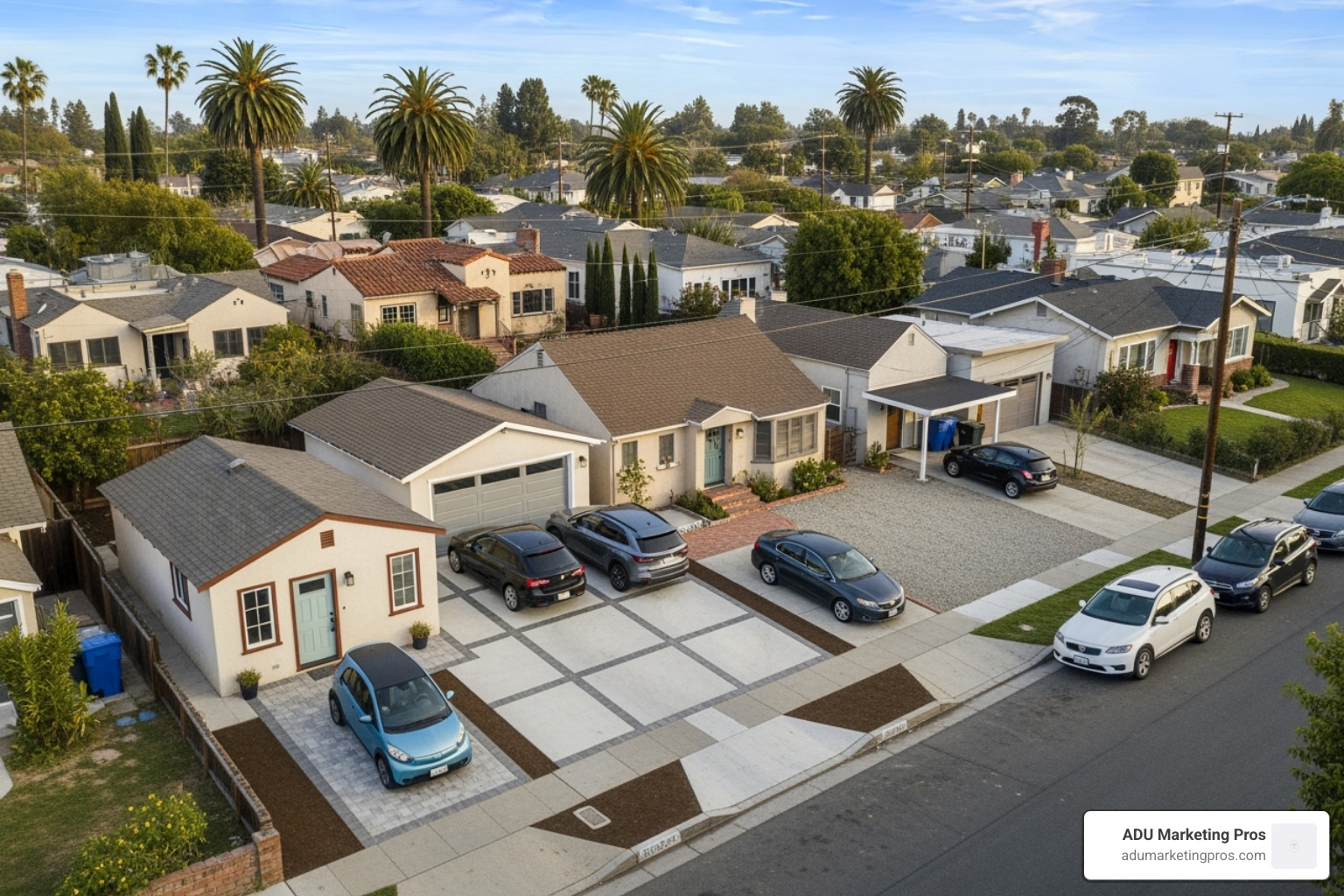
Prior to 2020, each city and county had its own parking regulations for ADUs, creating a confusing and costly maze for homeowners. Some jurisdictions demanded one or even two parking spaces per unit, often requiring expensive site modifications like new concrete pads or reconfigured driveways. These costs could add $20,000 to $40,000 to a project, making many ADUs financially impossible. This inconsistency meant a project approved in one city could be rejected just a few miles away for the same design, stifling the development of much-needed housing.
After 2020: A New Statewide Standard
On January 1, 2020, a package of state laws—AB 68, AB 881, and SB 13—took effect, creating a uniform standard for ADU parking across California. These laws established Government Code Section 65852.2 (see the statute at https://leginfo.legislature.ca.gov/faces/codes_displaySection.xhtml?sectionNum=65852.2.&lawCode=GOV), which sets clear, objective rules that limit what local agencies can demand.
Under the new system, state law overrides more restrictive local ordinances. This shift has been one of the most significant changes in California housing policy, ensuring consistency and predictability. ADU projects that meet these state requirements now receive ministerial approval, meaning they are approved based on objective standards without subjective reviews or public hearings. The California Department of Housing and Community Development (HCD) provides detailed guidance in its official memorandum on ADU law changes, clarifying what cities can and cannot require. This streamlined process has been transformative, removing major barriers and paving the way for the surge in ADU construction across the state. For more context, see our guides on California ADU Regulations and California ADU Guidelines.
The General Rule for New ADUs (And How It’s Often Waived)
While many ADU projects are exempt from parking requirements, it’s important to understand the baseline rule for newly constructed units. Think of it as a default setting that is often overridden by one of the five key exemptions.
One Space Per Unit or Bedroom
For new construction ADUs, state law limits local agencies to requiring a maximum of one parking space per ADU or per bedroom, whichever is less. This “whichever is less” clause is highly favorable to homeowners.
- For a studio or one-bedroom ADU, the requirement is one space.
- For a two-bedroom ADU, the calculation is one space (per unit) or two spaces (per bedroom). Since the rule is “whichever is less,” only one space is required.
This represents a significant reduction from old local rules that might have demanded two or more spaces for a multi-bedroom unit. This baseline is a key part of the overall ADU Building Requirements.
What Kind of Parking Counts?
State law also provides flexibility in how you provide a required parking space.
- Tandem parking, where one vehicle parks behind another in a driveway, is explicitly allowed.
- Parking in setback areas (the required distances from property lines) is also permitted unless the local jurisdiction can provide specific findings that it would be unsafe due to fire safety concerns or steep topographical conditions.
Cities cannot issue blanket prohibitions on setback parking; they must prove an adverse impact on your property’s unique characteristics. This flexibility allows homeowners to work with their existing lot configuration instead of undertaking expensive modifications, a crucial consideration when navigating ADU Zoning Laws.
The Five Key Exemptions: When No Parking is Required for Your ADU
Here’s where the rules get exciting for homeowners. State law provides five powerful exemptions that can eliminate parking requirements for your ADU entirely. If your project qualifies for just one of these, you are not required to provide any parking spaces, which can save you thousands in construction costs and simplify the ADU Permit Process.
These exemptions are objective and ministerial—if you meet the criteria, the city must grant the exemption. They apply to many common scenarios, making ADU projects feasible for a much wider range of properties. Let’s explore each one.
1. Proximity to Public Transportation
If your property is located within a half-mile walking distance of public transit, your local government cannot require you to add parking for your ADU. This single exemption has opened up ADU potential for countless homeowners in urban and suburban areas.

The logic is simple: residents with easy access to transit are less reliant on personal vehicles.
- What is “public transit”? The definition is broad, including bus stops and train stations (light rail, subway, commuter rail). Recent legislation has emphasized routes with frequent service, but even less frequent routes may qualify depending on local classifications.
- How is “half-mile walking distance” measured? The distance is measured along actual pedestrian pathways (sidewalks, etc.) from your property line to the transit stop, not as a straight line on a map.
Many city planning departments offer online mapping tools to help you verify this distance. Checking with your local jurisdiction early in the process is always a wise step.
2. Location in a Historic District
If your home is located in an officially designated architecturally or historically significant district, your city cannot require parking for your ADU.
This exemption is designed to protect the unique character of historic neighborhoods, which could be harmed by modern parking additions like concrete pads or widened driveways. To qualify, your neighborhood must be formally recognized as a historic district by your local government—it’s not enough for it to simply feel historic.
You can verify your property’s status by checking your city or county’s online zoning maps or contacting the local planning department. While this exemption eliminates California ADU parking requirements, be aware that ADU designs in historic districts often face additional review to ensure they are compatible with the neighborhood’s character.
3. The ADU is Part of an Existing Structure
This is one of the most impactful exemptions. If you create an ADU by converting or repurposing an existing structure on your property, no new parking is required.
This applies to:
- Garage conversions
- Basement or attic conversions
- Attached ADUs created from existing space in the primary home
- Conversions of carports, sheds, or other legal accessory structures
The rationale is that you are repurposing an existing footprint, not adding a new building that creates new parking demand. This exemption has made garage conversions incredibly popular, as they leverage an existing structure and eliminate parking concerns, which significantly lowers construction costs. The exemption applies whether the conversion results in an attached or detached ADU. While you must still meet building codes and ADU Size Restrictions, the parking requirement is waived.
4. On-Street Parking Permit Issues
This exemption addresses a specific issue of fairness related to residential parking permit programs. Many dense neighborhoods restrict on-street parking to residents with city-issued permits.
The rule is simple: if your city has a permit parking district but specifically excludes ADU occupants from being eligible for those permits, the city cannot then require you to provide off-street parking for the ADU.
Essentially, a city can’t have it both ways by denying an ADU resident access to on-street parking while simultaneously forcing the homeowner to build expensive off-street parking. To see if this applies to you, check your local parking authority’s rules on both permit parking districts and ADU occupant eligibility. Many cities have updated their policies to include ADU residents, but it’s worth verifying.
5. Proximity to a Car Share Program
Reflecting the rise of modern transportation options, this final exemption eliminates parking requirements if a car-share vehicle is located within one block of your property.
The state recognizes that easy access to a shared car reduces the need for personal vehicle ownership.
- What is “one block”? This is generally defined as a short walking distance, often around 500 feet, from your property line to the car-share vehicle’s designated location.
- How do I verify this? Check with your city’s planning department for their specific definition of “one block.” Then, use the apps or websites of car-share operators like Zipcar or Gig Car Share to find vehicle locations near you.
This exemption is most common in urban areas where car-sharing services are prevalent and provides another path to a zero-parking ADU project.
Special Cases and Common Questions for California ADU Parking Requirements
Beyond the five main exemptions, several specific scenarios and common questions arise regarding California ADU parking requirements. Understanding these nuances can clarify your project’s path and budget.
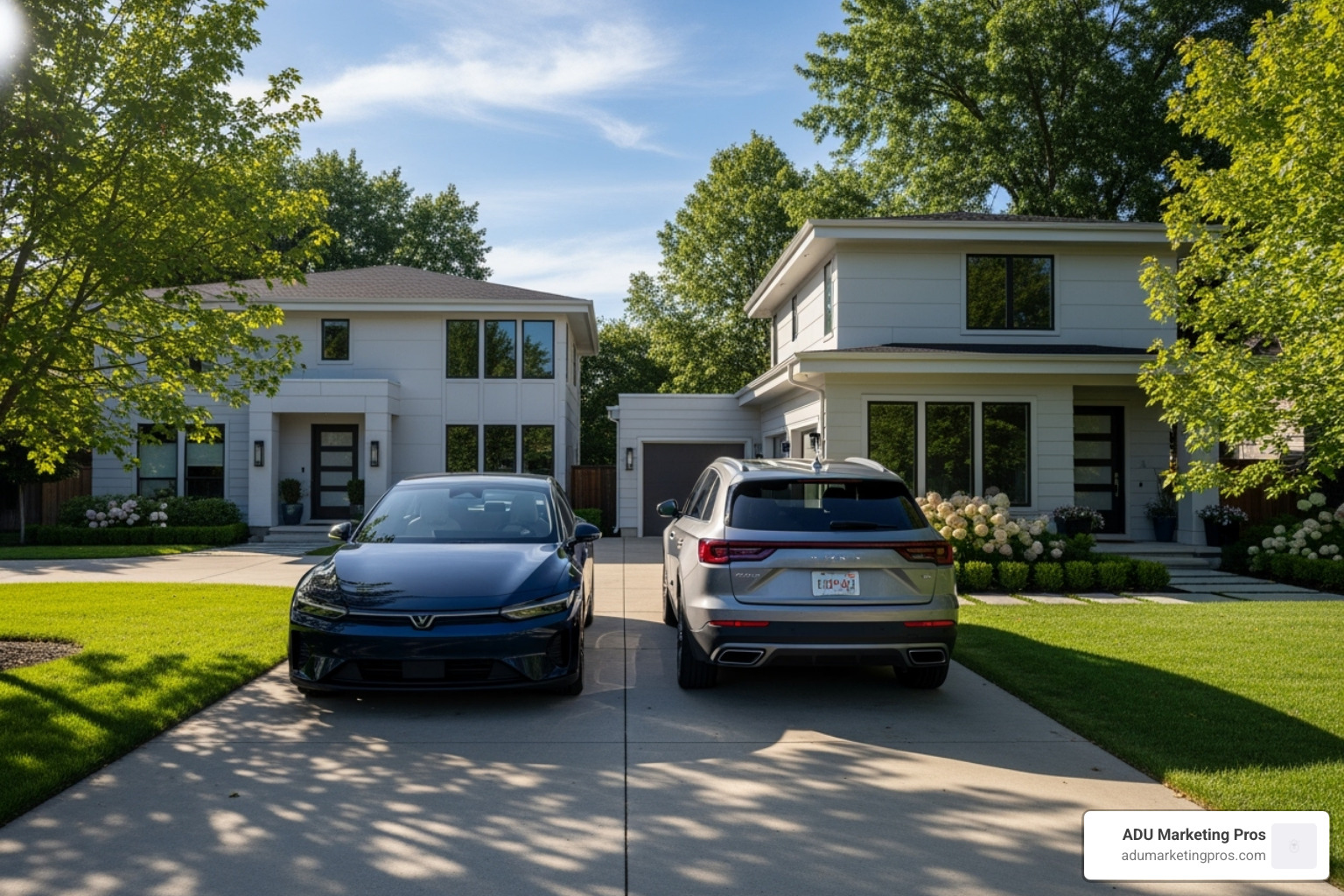
What About Garage Conversions and Demolitions?
This is a critical, game-changing rule. State law is unequivocal: if you demolish or convert a garage, carport, or other covered parking structure to build an ADU, you are not required to replace those parking spaces.
This provision removes what was once a massive financial barrier. The thousands of dollars once needed for pouring new concrete or reconfiguring a lot can now be invested in the ADU itself. This single change has made garage conversions one of the most financially viable ADU projects, directly lowering the overall Cost to Build ADU. This rule applies statewide, with very limited exceptions in specific coastal zones.
Are JADU Parking Requirements Different?
Yes, the rules for Junior Accessory Dwelling Units (JADUs) are even more lenient. A JADU is a small unit (up to 500 sq. ft.) created within the existing walls of a single-family home.
For JADUs, no parking is ever required. This includes conversions of attached garages, where you also do not need to replace the parking. The main condition for a JADU is an owner-occupancy requirement, meaning the property owner must live in either the primary home or the JADU. This is a key distinction within ADU Construction Regulations.
What are the California ADU Parking Requirements in Coastal Zones?
While state law is supreme, the California Coastal Commission can approve local coastal programs that add layers of regulation. This means parking rules can be more complex in designated coastal zones.
For example, in San Diego, no parking is required for ADUs outside the Coastal Overlay Zone. However, within it, parking may be required if the property is in a Beach Impact Area of the Parking Impact Overlay Zone and outside a transit priority area. Even then, many of the standard state exemptions still apply (e.g., for units under 500 sq. ft. or for garage conversions in most cases).
The key takeaway: if your property is in a coastal community, you must review your local coastal program and consult the planning department. Don’t assume standard state rules apply without verification. This is especially relevant for those reviewing Los Angeles ADU Regulations for properties near the coast.
Frequently Asked Questions about California ADU Parking
We hear these questions all the time from homeowners exploring ADU projects, and honestly, they’re great questions. The rules have changed so much in recent years that even city officials sometimes need a refresher. Let’s clear up the most common confusion around California ADU parking requirements.
Do I have to replace the parking spot for my main house if I convert my garage to an ADU?
No. State law explicitly prohibits local agencies from requiring you to replace off-street parking spaces when a garage, carport, or covered parking structure is converted into an ADU. This rule has made garage conversions one of the most popular and cost-effective ADU projects. The only potential exception is in very specific, narrowly defined coastal zone areas.
How many parking spots does a new, detached 1-bedroom ADU need?
The default requirement is one space. However, this requirement is waived if your project qualifies for any of the five key exemptions. For example, if your property is within a half-mile of public transit, in a historic district, or near a car-share spot, no parking is required. Given how common these scenarios are, many new ADUs legally require zero parking.
Do these parking rules apply in every city, like San Diego and San Jose?
Yes. The state laws governing ADU parking are mandatory for all local jurisdictions in California, including charter cities like San Diego and San Jose. A local ordinance cannot be more restrictive than state law. While you may encounter city planners unfamiliar with the latest updates, the state rules take precedence. For an authoritative source, refer to the official California ADU Handbook from the Department of Housing and Community Development: https://www.hcd.ca.gov/policy-research/accessory-dwelling-units
Conclusion: Park Your Worries and Start Building
If there’s one thing we hope you take away from this guide, it’s this: California ADU parking requirements are no longer the roadblock they once were. What used to be a maze of conflicting local rules and expensive mandates has transformed into a streamlined, homeowner-friendly system designed to encourage, not discourage, ADU development.
Gone are the days of mandatory replacement parking for garage conversions or expensive new driveways for projects near transit. With powerful exemptions and flexible rules, building an ADU is more accessible and affordable than ever. Tandem parking is allowed, existing structures can be converted without penalty, and many new builds require no parking at all.
While state law provides a strong foundation, always verify the specific rules with your local planning department, especially if you are in a coastal or historic zone. With a clear understanding of what’s required—and what’s not—you can move forward with confidence. If you’re ready to take the next step, exploring the complete ADU Building Process will provide the comprehensive roadmap you need to bring your project to life.