
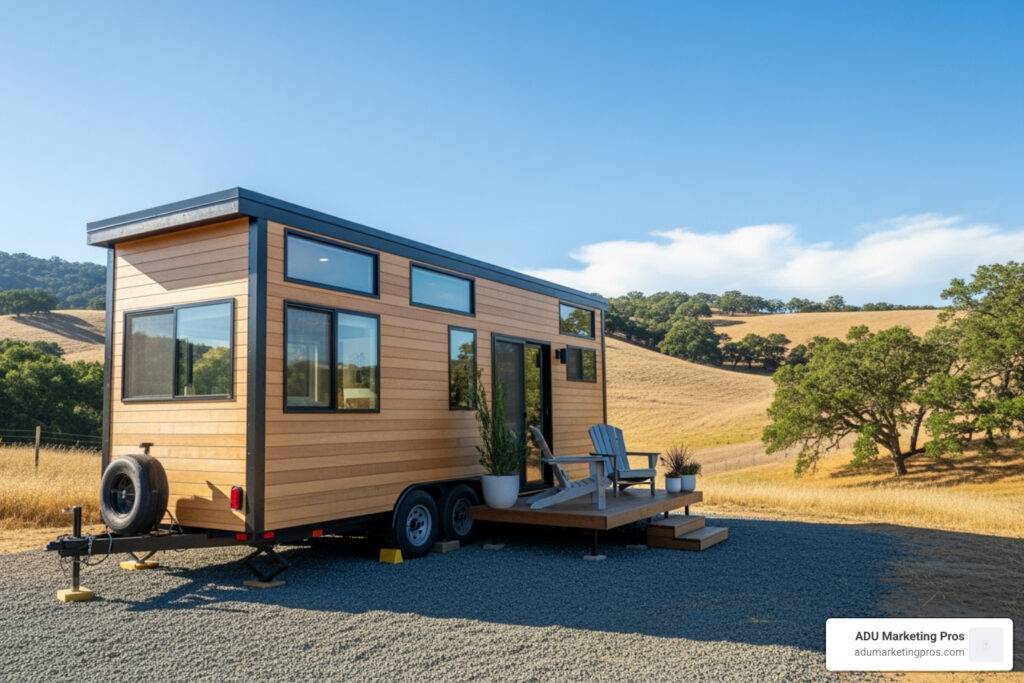
Why California Tiny Houses Are Redefining the Golden State Dream
California tiny houses offer a compelling solution to the state’s housing affordability crisis, with costs ranging from $30,000 to $100,000 compared to the median home price exceeding $800,000. Beyond the staggering numbers, there’s a cultural shift at play. Californians are increasingly questioning the traditional definition of the American Dream, which often involves decades of mortgage debt and ever-larger homes. The tiny house movement champions a different set of values: financial independence, environmental responsibility, and a life rich in experiences rather than possessions. Here’s what you need to know:
Top California Tiny House Builders:
- California Tiny House (Fresno) – 10+ years, advocacy leaders, custom builds
- Forever Tiny Homes – RVIA certified, premium materials, 10+ years experience
- Tiny Topanga – Custom designs, van conversions, collaborative process
Key Regulations:
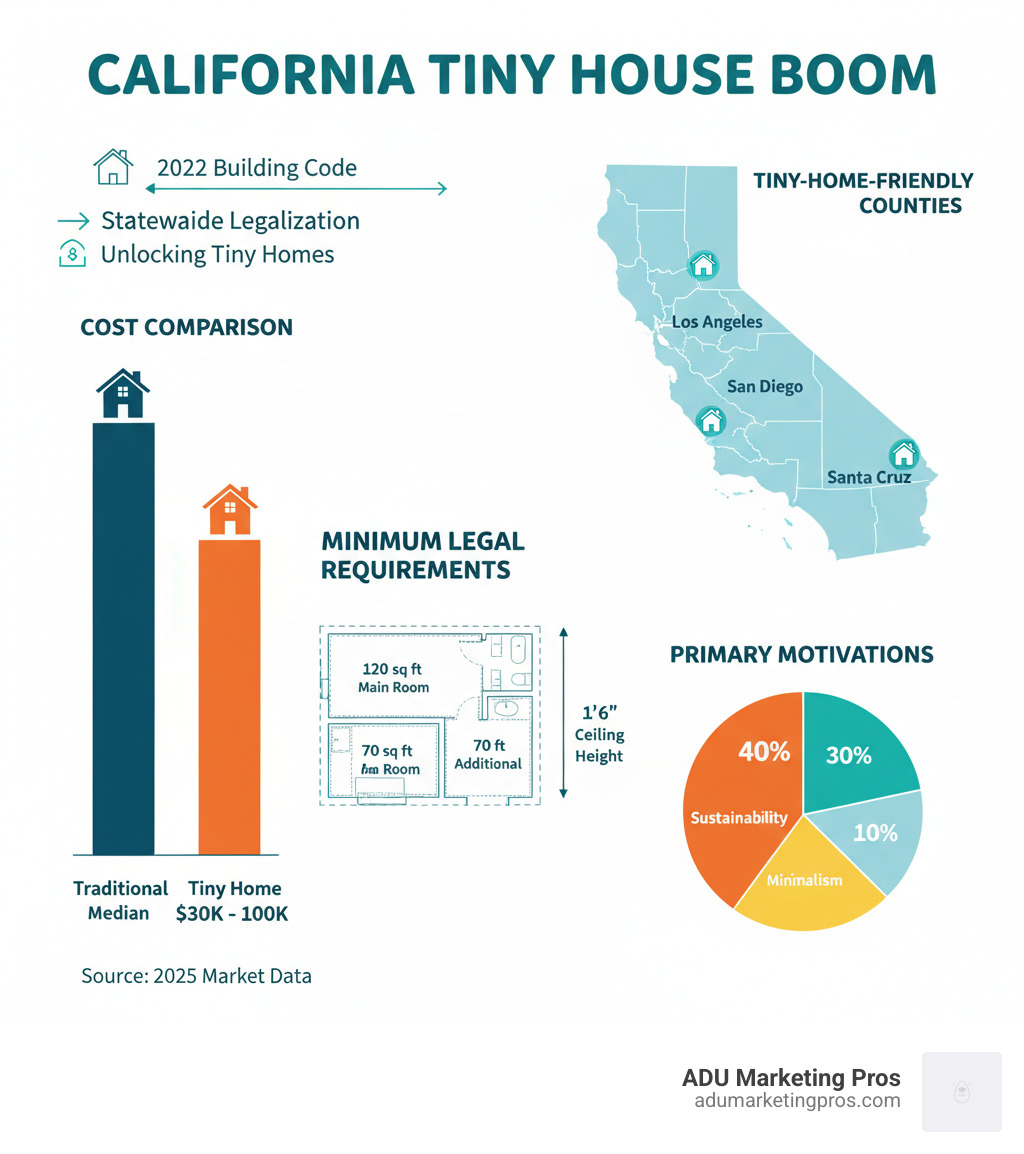
- Minimum 120 sq ft for one room, 70 sq ft for others
- 7’6″ ceiling height required
- RVIA or NOAH certification needed for park models
- Nearly all California counties allow tiny homes in some form
- Many areas permit them as ADUs (Accessory Dwelling Units)
Typical Costs:
- Basic builds: $30,000–$60,000
- Luxury park models: $90,000–$100,000
- DIY kits: Starting at $7,200
The California dream, once synonymous with sprawling suburban homes and two-car garages, is reinventing itself—and getting smaller. Across the state, from the redwood forests of the north to the sun-drenched deserts of the south, California tiny houses are offering a new vision of homeownership focused on sustainability, financial freedom, and minimalist living. As a practical and inspiring solution to the state’s severe housing affordability crisis, these homes (typically 400 sq ft or less) provide a tangible path to ownership without the burden of crushing debt.
The state has become increasingly friendly to tiny living, with the 2022 California Building Code including specific provisions for tiny homes and many counties allowing them as Accessory Dwelling Units (ADUs). This legal framework has opened the floodgates for innovation and adoption. However, navigating the complex web of regulations, certifications, and builders still requires knowledge and diligence. This guide cuts through the confusion, highlighting the best builders and clarifying the legal landscape to help you realize your tiny home dream in the Golden State.
Navigating California’s Tiny Home Legal Landscape
Understanding tiny home regulations in California is crucial, as the rules can vary dramatically between cities and counties. While nearly all counties allow California tiny houses in some form, what’s legal in Fresno may require different permits, setbacks, or aesthetic standards in San Diego. Your due diligence is the single most important investment you can make in your tiny home journey.
One of the most important concepts is the distinction between an ADU vs Tiny House. Many areas now permit tiny homes as Accessory Dwelling Units (ADUs), which has become a primary pathway for legal placement on residential properties. This pathway was significantly bolstered by state-level legislation designed to increase housing supply, which streamlined the approval process for ADUs. This means that in many cases, a tiny home intended as an ADU can be approved with a simple building permit, bypassing more complex and discretionary local reviews. This allows for both movable and permanent foundation tiny homes, offering flexibility for homeowners to add rental income or house family members.
The Foundation: Statewide Building Codes and Certifications
California’s tiny house regulations are based on the 2022 California Building Code. This code sets minimum standards for safety and habitability, ensuring that “tiny” doesn’t mean unsafe:
- Ceiling Height: At least 7 feet 6 inches in habitable spaces. This ensures the home doesn’t feel cramped and allows for proper ventilation.
- Main Room: At least one habitable room must have a minimum of 120 square feet of floor space. This provides a functional primary living area.
- Other Rooms: All other habitable rooms (like a separate bedroom) must have at least 70 square feet.
- Egress: Emergency escape and rescue openings are required, just as in a traditional home.
Beyond state code, third-party certifications are critical, especially for tiny homes on wheels (THOWs). The two most prominent are:
- RVIA (Recreational Vehicle Industry Association): This certification ensures compliance with standards for plumbing, safety, and electrical systems (NFPA 1192). It is widely recognized by banks, insurance companies, and RV parks. An RVIA seal is essential for mobility and acceptance in parks across the country.
- NOAH (National Organization of Alternative Housing): This certification focuses specifically on the safety, durability, and livability of tiny homes as dwellings. NOAH uses a hybrid code that inspects to ANSI and NFPA standards but is specifically tailored for tiny houses intended for more permanent or semi-permanent living, focusing on structural integrity and residential-quality systems.
For park models, compliance with ANSI 119.5 is often required. These certifications provide peace of mind, prove quality construction, and can be instrumental in getting approval from local building inspectors and securing financing.
Understanding Park Model Regulations in California
Park models are a premium type of THOW, typically limited to 400 square feet (excluding lofts) to maintain their classification as a recreational vehicle. While mobile, they are designed for longer-term placement and often have specific requirements in RV parks, mobile home parks, or special occupancy parks.
Increasingly, California allows park models to serve as ADUs, opening up opportunities for homeowners to add a secondary dwelling to their property. For example, Los Angeles County allows movable tiny homes as ADUs if they meet size requirements and have third-party certification. San Diego has a similar approach, even providing a public checklist to guide homeowners through the process. Some counties, like Fresno, add aesthetic requirements, mandating that park models have siding and roof materials that resemble conventional homes to ensure they blend into residential neighborhoods. This ‘conventional look’ requirement might include pitched roofs, lap siding, and covered porches, effectively discouraging the classic ‘RV’ appearance in favor of a cottage or bungalow style. If the home remains on wheels, it generally requires DMV registration and is subject to annual fees, just like any other recreational vehicle.
To learn more about regional rules, explore resources like Places in Southern California That Allow Tiny Houses.
Spotlight on Key Cities and Counties
Many California cities and counties have created specific pathways for tiny homes, building on the state’s progressive framework.
- Los Angeles County: A leader in ADU adoption, LA County allows both traditional and movable tiny homes (park models) as permanent ADUs, provided they meet size and certification standards (ANSI 119.5 or NFPA 1192).
- Fresno County: A pioneer in tiny living, Fresno was one of the first to legalize THOWs as permanent structures for use as secondary dwellings. It permits homes over 100 sq ft that meet ANSI requirements and are designed to look like conventional buildings.
- San Diego: The city actively encourages tiny homes and even publishes a “movable tiny homes” guide to help residents navigate the process of placing one as an ADU, simplifying a once-confusing process.
- San Jose: Located in the heart of Silicon Valley, the city allows tiny homes primarily as ADUs that comply with the 2022 California Building Code, providing a much-needed affordable housing option in an expensive market.
- Other Friendly Counties: Alameda, Placer, Nevada, and Santa Cruz counties have also established favorable regulations for various types of tiny homes, each with its own local nuances.
The trend is clear: California is becoming more welcoming to California tiny houses. However, the mantra for any prospective tiny homeowner remains the same: always contact your local planning department to confirm the specific rules for your area before you build or buy.
What Defines the “Best” California Tiny House Builders?
Choosing the right builder for your California tiny house is the most critical decision in your journey. This is more than a construction project; it’s a partnership. You need a partner who understands your vision, can navigate complex regulations, and delivers a high-quality, safe, and durable home. For a list of options, see our guide to Tiny House Builders California. Beyond a list, here are the key traits that define the best builders.
Key Trait 1: Deep Experience & Industry Advocacy
Look for builders with a decade or more of experience. This longevity indicates they have adapted to market changes, refined their craft, and consistently satisfied clients. The best builders are also advocates for the tiny living movement, actively working to shape policy and promote best practices.
For example, California Tiny House, Inc., building since 2014, has been instrumental in advancing tiny house legislation nationwide. They partner with schools to teach tiny house curricula, training the next generation of builders. Their leadership in industry associations means they are ahead of regulatory changes and can handle challenges that would stump others. Their deep involvement means they don’t just follow the rules; they help write them, giving their clients a significant advantage in navigating a still-evolving legal environment. You can see their work on their Instagram: View More on Instagram. Choosing a builder with this level of involvement ensures you’re working with a true expert.
Key Trait 2: A Clear, Collaborative Building Process
The journey to tiny home ownership should be empowering, not stressful. Top builders offer a transparent, collaborative process that keeps you involved and informed from start to finish. The process should feel like a partnership, not a transaction.
Tiny Topanga exemplifies this approach, starting with a free consultation to align your vision with practical reality. From there, you work with their design team to create custom blueprints. Many top builders collaborate with specialized architects, like those featured in Architects in Southern California Who Design Tiny Houses, who excel at maximizing small spaces. Throughout construction, you should receive regular updates with photos and progress reports. This partnership transforms the process into an enjoyable, creative experience, often involving 3D renderings to help you visualize the space, physical material samples to touch and feel, and scheduled site visits to see your home take shape.
Key Trait 3: Commitment to Quality Materials & Certification
A tiny home’s safety and longevity depend on its materials and construction standards. The best builders are meticulous about quality and transparent about what goes into your home. They should be able to explain not just what materials they use, but why they use them.
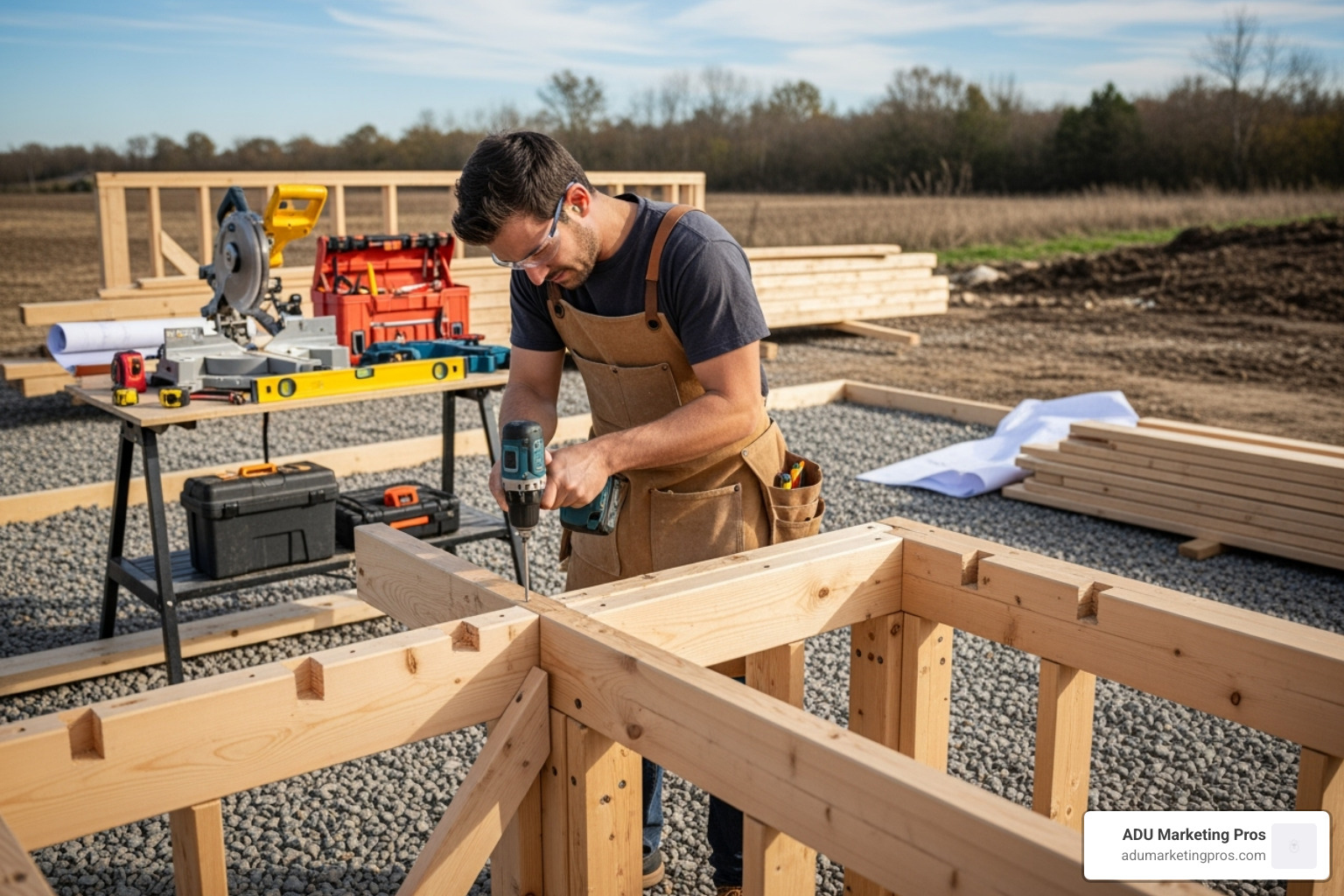
Forever Tiny Homes is a prime example, using premium materials like non-combustible, Class A fire-rated fiber cement siding and standing seam metal roofs—critical choices in a state prone to wildfires. They build robust structures with Douglas Fir lumber and use high-performance insulation for energy efficiency.
Most importantly, top builders pursue certifications. RVIA certification is proof that a builder meets comprehensive safety standards. Forever Tiny Homes undergoes quarterly RVIA inspections, demonstrating an ongoing commitment to excellence. This certification not only ensures quality but also simplifies financing and insurance. Conversely, a major red flag is a builder who is hesitant to discuss certification or tries to downplay its importance. You should also be wary of builders who are vague about their process, pricing, or material sources. A reputable builder will proudly showcase their certifications, provide detailed material spec sheets, and offer references from past clients without hesitation.
Types of Tiny Homes Available in California
The beauty of California tiny houses is their variety. The market has matured to offer a wide spectrum of styles, sizes, and functions. Whether you’re interested in Eco-Friendly Small Homes built with reclaimed materials or a sleek, modern park model, understanding the different types helps you choose the right fit for your lifestyle. The first major decision is whether to go with a custom build or a pre-designed model.
Custom Builds vs. Pre-Designed Models
Custom builds offer complete personalization. You work directly with builders and architects to create a home that is uniquely yours, from the layout and window placement to the cabinet hardware and light fixtures. Builders like Tiny Topanga specialize in these bespoke creations. The process is highly collaborative but typically involves a longer timeline (often 6-12 months) and higher cost due to the design work and unique material sourcing. The result is a one-of-a-kind sanctuary perfectly tailored to your needs and aesthetic.
Pre-designed models (or “stock plans”) offer a streamlined, often more affordable, path to ownership. These are proven layouts that builders have refined over time, ensuring an optimized use of space and efficient construction process. The construction timeline is usually shorter (as little as 2-4 months) and the budget more predictable. Many builders still offer customization options for finishes, colors, and fixtures, allowing you to add a personal touch. If you’re looking for a turnkey solution, browsing Small Houses for Sale can reveal move-in ready options. The choice depends on your budget, timeline, and how much you value personalization versus predictability.
Van Conversions and Other Mobile Options
For those who prioritize mobility above all else, options beyond traditional THOWs include van conversions and skoolies. The van life movement offers incredible freedom in a compact, functional package. Builders like Tiny Topanga convert vans into comfortable living spaces with kitchens, sleeping areas, and off-grid systems for power and water.
Skoolies (converted school buses) offer more space than a van while remaining mobile. They can accommodate more distinct living areas, making them a popular choice for couples or small families who want more room to roam. These mobile options are typically classified as recreational vehicles, meaning they are subject to different regulations and are placed in RV parks or campgrounds rather than on residential lots as ADUs.
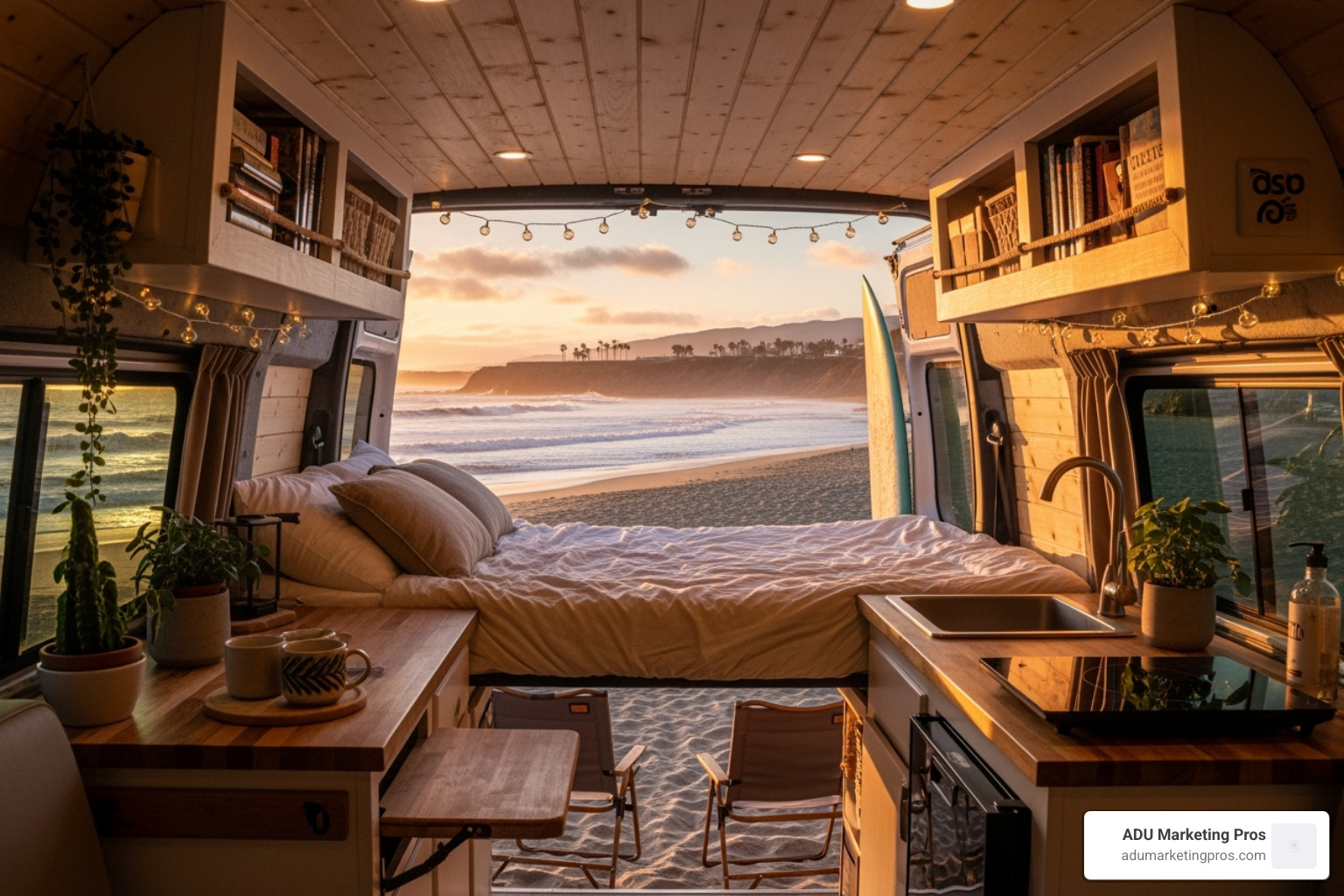
This lifestyle requires adaptability, but for those who crave adventure, it’s an unparalleled way to experience California. However, the reality of ‘van life’ also includes challenges like finding safe and legal overnight parking, managing limited resources like water and power, and dealing with the mechanical upkeep of the vehicle itself. It’s a trade-off that exchanges the stability of a fixed location for ultimate freedom and mobility.
The Financials: Cost and Financing for your California Tiny House
While California tiny houses are significantly more affordable than traditional homes, it’s important to understand the full financial picture. The total project cost goes far beyond the price of the structure itself. Budgeting accurately from the start is key to a successful, stress-free project.
Beyond the sticker price, you must budget for a range of potential costs. Land acquisition is the largest variable, ranging from tens of thousands in rural areas to hundreds of thousands in desirable coastal zones. Utility hookups can cost anywhere from $5,000 to $30,000+, depending on the distance to public lines and the complexity of the work (e.g., trenching for water, sewer, and electricity). Permitting fees with the local jurisdiction can add several thousand dollars. If you’re going off-grid, a robust solar panel and battery system can cost $10,000-$25,000, and a high-quality composting toilet is another $1,000-$2,000. If your home is on wheels, don’t forget to factor in transportation expenses, which can be significant for long-distance moves.
Typical Costs for California Tiny Houses
The price range for tiny homes in California is broad, accommodating various budgets and levels of finish.
- DIY Kits: Starting around $7,200, this is the most budget-friendly option for those with the time, skills, and tools to build themselves. This price typically only covers the shell and plans.
- Basic Builds: Professionally constructed homes typically range from $30,000 to $60,000. These are often pre-designed models with standard finishes, offering excellent value and a quick path to ownership.
- Luxury & Custom Builds: High-end park models and fully custom homes can range from $90,000 to $100,000+, sometimes exceeding $150,000. This price includes premium materials (like hardwood floors and quartz countertops), custom cabinetry, high-end appliances, and unique architectural features.
While the cost per square foot can be higher than traditional construction due to the specialized craftsmanship and compact systems required, the overall investment is dramatically lower. You can get a complete, move-in-ready home for less than the typical 20% down payment on a conventional California house.
How to Finance Your Tiny Home Purchase
Financing a tiny home differs from a traditional mortgage, as many are not considered real property (i.e., permanently attached to land). However, several solid options exist:
- RV Loans: This is the most common route for RVIA-certified tiny homes on wheels. Lenders like LightStream or credit unions are familiar with these chattel loans, which finance the movable property itself. Terms are typically shorter than mortgages (5-15 years).
- Personal Loans: An option for any type of tiny home, certified or not. These unsecured loans from banks or online lenders often have higher interest rates and shorter terms but offer maximum flexibility.
- Builder Financing: Some larger builders offer in-house financing or partner with specialized lenders who understand the tiny home market, streamlining the process for buyers.
- Home Equity Loans/Lines of Credit (HELOC): If you own a property, you can leverage its equity to finance a tiny home as an ADU. This often provides the most favorable interest rates and terms.
Generally, certified homes (RVIA, NOAH, or ANSI-compliant) have much smoother financing pathways. Lenders see certification as a form of risk mitigation, as it proves the home was built to recognized safety and construction standards. An uncertified, DIY home, while cheaper upfront, may be nearly impossible to finance, requiring you to pay in cash.
Frequently Asked Questions about California Tiny Houses
Navigating the world of California tiny houses raises many questions. The rules are new and can be confusing, but with a little research, the path becomes much clearer. Here are answers to some of the most common ones.
How small can a house legally be in California?
Under the 2022 California Building Code, a tiny home’s size is governed by room requirements, not an overall minimum square footage for the entire structure. This is a key distinction.
- At least one habitable room must be a minimum of 120 square feet.
- All other habitable rooms (e.g., a small, separate bedroom) must be at least 70 square feet.
- The minimum ceiling height must be 7 feet 6 inches for habitable spaces.
These rules effectively set a practical minimum size. For example, a single-room studio-style tiny home must be at least 120 sq ft. A home with a separate bedroom would need to be larger. Some local jurisdictions, like Fresno County (which allows a 100 sq ft minimum for a secondary dwelling), may have slight variations, so always check with your local planning department for the final word.
Do I need a permit for a tiny home in California?
Yes, in almost all cases, you will need a permit. The idea of placing a tiny home without any oversight is a myth. The type of permit depends on your home and its location:
- Foundation Homes: These require a standard building permit, just like a conventional house. They are inspected at various stages of construction to ensure they meet all building, safety, and energy codes.
- Tiny Homes on Wheels (THOWs): If placed in an RV park, the park’s permits apply. If used as an ADU on private land, you will need an ADU permit. This process often requires removing the wheels, placing the home on a proper foundation system, and connecting it permanently to utilities.
Many counties use the APPENDIX AQ TINY HOUSES from the California Residential Building Code as a framework for permitting. The bottom line is to always consult your local city and county planning departments before you buy a home or land. Many have dedicated staff or online resources for ADUs and can provide a checklist of requirements. Going in with a clear plan will make the process much smoother.
Where can I legally place a tiny home in California?
Legal placement depends on local zoning laws and how your tiny home is classified. Here are the most common options:
- As an Accessory Dwelling Unit (ADU): This is the most popular and legally secure pathway. Many residential zones across California allow tiny homes (both on foundations and certain certified THOWs) to be placed on properties with an existing single-family or multi-family home.
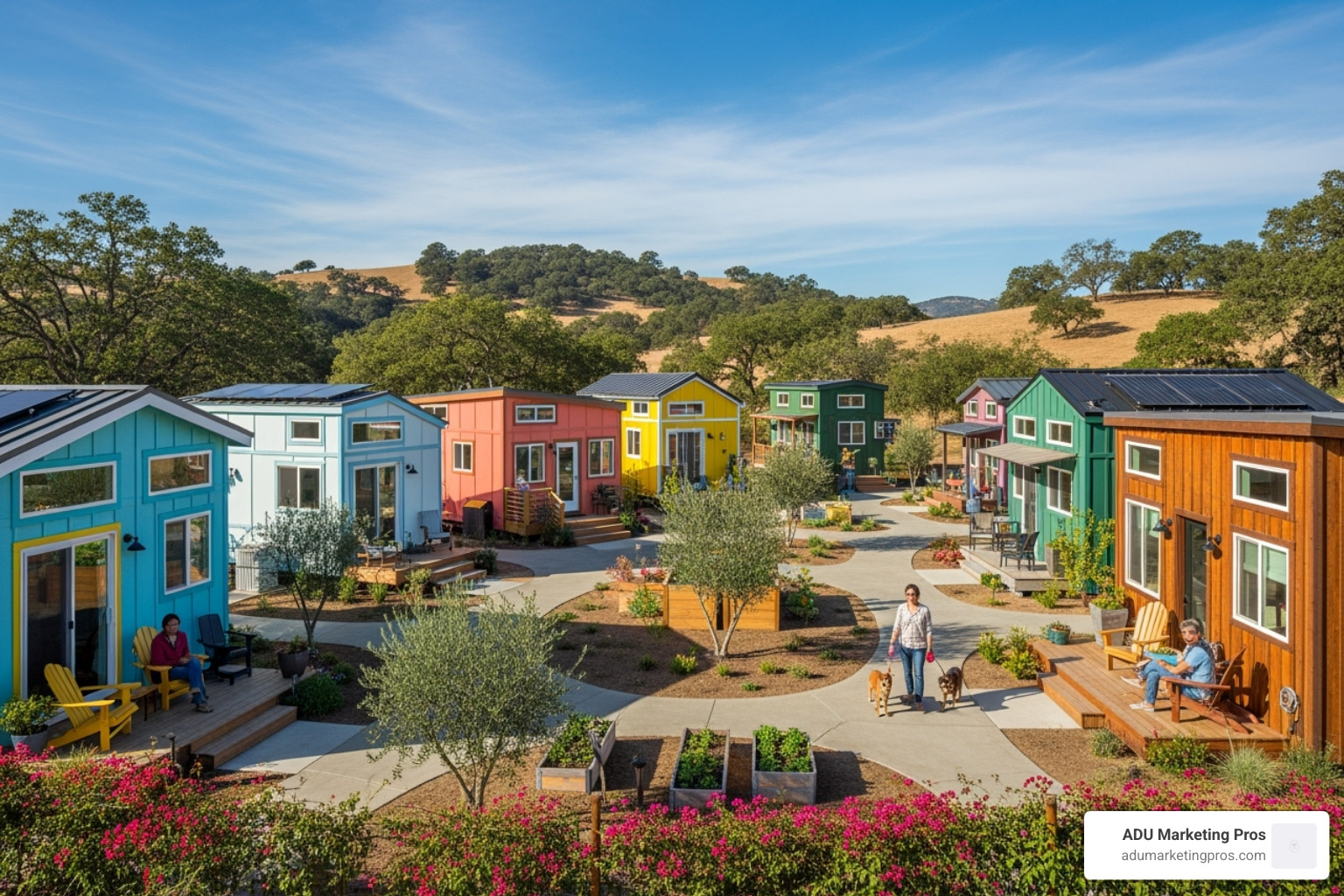
- Tiny Home Communities: Dedicated communities like Delta Bay in the Sacramento-San Joaquin River Delta or Paradise Tiny Home Community in the Sierra Nevada foothills are specifically zoned for tiny homes. They offer pre-approved lots with utility hookups, creating a ‘plug-and-play’ solution and a strong sense of community.
- RV and Mobile Home Parks: If your tiny home is RVIA-certified, you can often place it in parks that allow long-term residents. This is a great option for those who value mobility or are not ready to purchase land.
- Rural/Unincorporated Land: Some rural areas offer more zoning flexibility. However, the challenges here include not just zoning but also proving access to water (often by drilling a well), getting approval for a septic system, and meeting California’s stringent fire safety regulations, which may dictate building materials and vegetation clearance.
If you’re buying land, resources like Land for Sale in Southern California for Tiny Houses can help you find appropriately zoned properties. Thorough research into your local ordinances is the key to finding a legal, permanent home for your tiny house.
Conclusion
The journey through California tiny houses reveals that the Golden State dream is not dead; it’s being redefined. It’s shifting from sprawling houses and overwhelming mortgages to thoughtfully designed small spaces that offer financial freedom, sustainability, and a more intentional lifestyle.
California has become a national leader in the tiny living movement, thanks to its progressive 2022 Building Code, welcoming ADU regulations, and growing county-level acceptance of movable tiny homes. This has created legal pathways that simply didn’t exist a decade ago, transforming tiny living from a fringe concept into a mainstream housing solution.
The financial case is compelling. With tiny homes costing between $30,000 and $100,000, homeownership is becoming accessible again, even in a state with a median home price soaring over $800,000.
The key to success is partnering with the right builder—an experienced, certified professional who understands California’s unique regulatory landscape and is committed to quality craftsmanship. This partnership is the bridge between your vision and a legally compliant, beautifully built home. From navigating the nuances of building codes to choosing between a mobile THOW and a permanent ADU, the path requires diligence. Yet, the reward is immense: a home that aligns with your finances, values, and vision for a life well-lived in the Golden State.
Here at ADU Marketing Pros, based in San Jose, CA, we have a deep understanding of the ADU and tiny home market. While we specialize in marketing for construction and architecture firms, our expertise gives us unique insight into what makes these projects succeed. We know that the right professional partnership is everything.
Your tiny home adventure is waiting. The Golden State has never been more ready to welcome it.
Ready to connect with experienced professionals who can bring your tiny home vision to life? Find the right Tiny House Builders in California and start building your dream today.