
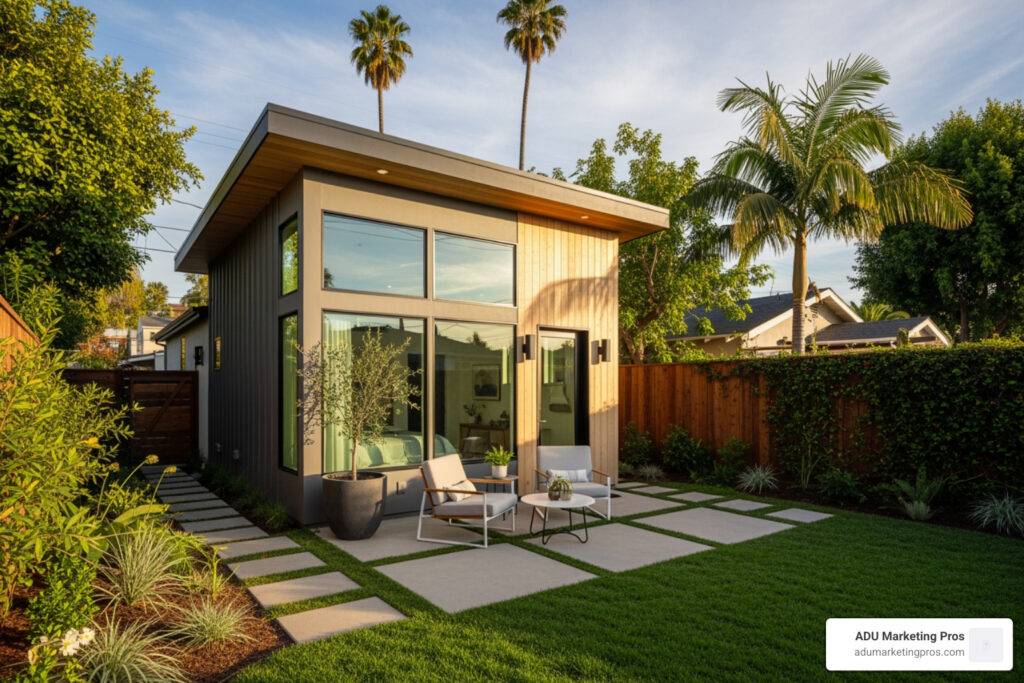
Why Finding the Right ADU Builder in Los Angeles Matters
ADU builders los angeles are changing how homeowners maximize their property’s potential. Whether you’re looking to generate rental income, house aging parents, or create a dedicated workspace, choosing the right builder is the single most important decision you’ll make.
Top ADU Builders in Los Angeles Offer:
- Full-Service Management – Design, permitting, and construction handled by one expert team
- Transparent Pricing – Fixed-price contracts with no hidden fees or surprise costs
- Proven Track Record – Portfolios showing 50–100+ completed ADU projects across LA County
- Permitting Expertise – Deep knowledge of local regulations and streamlined approval processes
- Quality Construction – Licensed contractors with CSLB credentials, insurance, and warranties
Los Angeles is experiencing an ADU boom. With over 2,296 ADU professionals registered on Houzz serving the Los Angeles area, homeowners have more options than ever—but that abundance can feel overwhelming. The stakes are high: a well-built ADU can increase your property value by $100,000 or more and generate $10,000–$50,000 in annual rental income. A poorly executed project can lead to cost overruns, permit delays, and subpar construction that diminishes your investment.
The challenge isn’t just finding a builder—it’s finding the right builder for your specific project, budget, and timeline. California laws AB-68 and SB-13 have made ADU construction more accessible, but navigating local building codes, zoning requirements, and the permitting process still requires expertise. That’s where this guide comes in.
We’ve researched the landscape of ADU construction in Los Angeles to help you understand what separates exceptional builders from the rest. You’ll learn how to evaluate credentials, assess construction processes, and identify red flags before signing a contract. Whether you’re considering a garage conversion, a custom backyard cottage, or a prefabricated unit, this guide will equip you with the knowledge to make an informed decision.
Easy ADU builders los angeles glossary:
Introduction: Opening Up Your Property’s Potential with an ADU
Accessory Dwelling Units (ADUs) are rapidly transforming the Los Angeles housing landscape, turning underutilized backyards and garages into valuable assets. With soaring property values and a persistent need for flexible living solutions, ADUs offer homeowners a powerful opportunity to maximize their investment. Whether you dream of generating passive rental income, creating a private haven for family members, or designing the ultimate home office, an ADU can be the key to unlocking your property’s hidden potential. In this comprehensive guide, we’ll walk you through everything you need to know about building an ADU in Los Angeles, from understanding your options to choosing the perfect builder to bring your vision to life.
Why Los Angeles is the Perfect Place for Your ADU Project
Los Angeles is uniquely positioned for ADU success. Homeowners benefit from increased property values, new income streams, and the flexibility to accommodate multi-generational living or home offices. With strong state and local support, building an ADU is more accessible than ever.
The Financial Windfall: Boosting Equity and Earning Income
ADUs can increase property value by $100,000 or more and generate $10,000–$50,000 in annual rental income. This financial benefit can significantly help offset mortgage payments, provide a steady stream of passive income, and build long-term financial security. For many homeowners, building an ADU is seen as a smart, long-term investment, essentially killing two birds with one stone: creating a rental unit to help pay the mortgage while simultaneously increasing property value.
The Lifestyle Upgrade: Space for Family, Work, and Life
Beyond financial gains, ADUs offer immense versatility for enhancing your lifestyle. They provide excellent solutions for aging-in-place, allowing elderly parents to live close by while maintaining independence. They can house adult children, provide private guest suites, or serve as dedicated home offices or creative studios, giving you the extra space you need without moving. This flexibility allows properties to adapt to changing family needs and personal aspirations, turning underused space into a functional and comfortable extension of your home.
Understanding Your ADU Options: Types and Trends
Explore the most popular ADU types and the latest design trends in Los Angeles. Learn how zoning regulations, smart home integration, and sustainable materials are shaping the future of ADU construction.
| ADU Type | Cost Range | Timeline | Customization Level |
|---|---|---|---|
| Prefabricated ADU | Lower | Fastest | Moderate |
| Custom-Built ADU | Higher | Longer | High |
Common ADU Types in Los Angeles
When considering an ADU in Los Angeles, you have several primary types to choose from. Each offers a unique blend of benefits, costs, and considerations to fit your property and goals.
- Detached New Construction (Backyard Cottage): A standalone structure built from the ground up in your backyard. Pros: Offers maximum privacy for both the main house occupants and ADU residents. Provides complete design freedom to create a custom living space. Cons: Typically the most expensive and time-consuming option due to the need for a new foundation, structure, and utility lines. They range from 300 to 1,200 sq ft and are usually traditional stud-framed buildings.
- Attached ADU (Home Addition): An ADU that is physically connected to the primary residence, often by expanding an existing wall or adding a new section. Pros: Can be more cost-effective than a detached unit due to shared walls and potentially shorter utility runs. Ideal for homeowners who want to keep family members close, such as aging parents. Cons: Offers less privacy than a detached unit. Construction can be more disruptive to the main household.
- Garage Conversion: A highly popular and cost-effective option in Los Angeles, encouraged by state laws like AB-68 and SB-13. Pros: Often the most affordable and fastest to build, as the foundation, walls, and roof already exist. Preserves valuable backyard space for landscaping or recreation. Cons: The design is limited by the garage’s existing footprint and condition. May require significant structural upgrades and the loss of covered parking or storage space.
- Junior Accessory Dwelling Unit (JADU): A smaller ADU (up to 500 sq ft) created within the existing footprint of a single-family home, such as a converted bedroom. Pros: The lowest-cost option with minimal construction. Requires an exterior entrance and an efficiency kitchen. Cons: Limited in size. Must share a bathroom with the main house or have one constructed. The owner must occupy either the main house or the JADU.
- Above-Garage ADU: This type involves building a new living unit on top of an existing detached or attached garage. Pros: Excellent use of vertical space, preserving the entire backyard. Can offer better views and privacy than a ground-level unit. Cons: Structurally complex and expensive, as the existing garage foundation and framing must be reinforced to support a second story. Not all builders offer this option due to its complexity.
Innovations in ADU Construction
The ADU landscape in Los Angeles is constantly evolving, driven by homeowner demand, regulatory changes, and technological advancements. Modern ADUs feature a range of innovations aimed at improving livability, sustainability, and efficiency:
- Smart Home Technology: Many new ADUs integrate smart home systems as a standard feature. These can include smart speakers, thermostats, smart plugs, video doorbells, security cameras, and Wi-Fi mesh systems, offering convenience and energy efficiency.
- Energy-Efficient Appliances and Solar Panels: To reduce utility costs and environmental impact, ADUs often come equipped with energy-efficient appliances and can be fitted with solar panels, contributing to California’s green building initiatives.
- Durable Low-Maintenance Materials: Builders are increasingly using materials that require minimal upkeep and offer long-term durability, reducing maintenance headaches for homeowners and tenants.
- Thoughtful Design for Small Spaces: Expert ADU builders los angeles focus on spatial perception techniques to make smaller ADUs feel larger and more varied. This includes open floor plans, custom millwork for maximized storage, bi-fold doors that open to outdoor spaces, and clerestory windows for abundant natural light. These design elements ensure that even compact ADUs offer comfortable and functional living.
- Prefabricated (Prefab) ADUs: These units are built off-site in a factory setting and then transported and assembled on your property. They offer significant advantages in terms of speed and cost certainty. Prefabricated ADUs can sometimes cost under $100,000 (excluding site work and utility connections), making them a cost-effective option. They also reduce on-site construction time and minimize disruption to your property.
The A-to-Z ADU Building Process in Los Angeles
Building an ADU in Los Angeles is a multi-phase process. Here’s how to move from concept to completion with confidence.
Phase 1: Feasibility, Design, and Financing
Your ADU journey begins with a thorough understanding of your property’s potential and your financial capacity.
- Site Assessment and Feasibility Study: This critical first step involves evaluating your property to determine the best ADU design and layout. It includes reviewing local zoning laws, setback requirements, easements, and utility access. Many builders offer a free property evaluation or a detailed feasibility report (some for a fee, like Villa’s $500 study), which includes custom site maps, zoning details, permitting research, and budget estimates. This ensures your project is compliant and feasible from the start.
- Design and Blueprints: Once feasibility is confirmed, you’ll move to the design phase. This involves creating detailed architectural plans and blueprints that reflect your vision, whether it’s a custom design or a pre-designed option. A licensed architect or an experienced ADU builder’s design team will work with you to optimize every square foot for aesthetics and functionality. For ground-up construction in Los Angeles-area cities and unincorporated Los Angeles County, these plans will include diagrams and exact measurements.
- Financing Options: Establishing your budget and securing financing is crucial. Options include home equity loans, construction loans, and ADU-specific loans. We can connect you with specialized lenders who understand the unique aspects of ADU financing. Additionally, programs like the CalHFA 40K ADU Grant Funds can help low-income Californians get started. NHS of Los Angeles County acts as an affordable lender and financial counseling agency for ADU programs. For more information on available grants and to see if you qualify, visit NHS LA County’s ADU Program.
Phase 2: Navigating Los Angeles Permits and Regulations
This is often considered the most daunting phase, but an experienced ADU builder in Los Angeles will make it seamless.
- Plan Submission and Review: Your builder will prepare all necessary documentation, including architectural plans, structural engineering, and compliance with California’s Title 24 energy standards. Title 24 compliance involves detailed calculations and specifications for elements like high-performance windows, insulation levels, efficient HVAC systems, and potentially “cool roofs” to ensure your ADU is energy-efficient. These plans are then submitted to your local Department of Building and Safety, such as the LADBS for projects in the City of LA.
- Permit Acquisition: California state law has streamlined the ADU permitting process, mandating a 60-day review period for complete applications. Your builder will manage every ADU building permit, drawing, document, and approval with the city and county, coordinating with agencies and responding to city feedback. Builders with direct relationships with local permitting offices can further expedite this process. Understanding legislation like SB9, which allows for duplexes and ADUs on single-family lots, is also key. Learn more about SB9 at California YIMBY.
- Addressing Specific Regulations: ADUs are subject to specific zoning regulations and building codes in Los Angeles. For example, in an R1 zone, garages can be converted into habitable dwelling units. However, local cities have discretion on whether ADUs can be listed on short-term rental sites like Airbnb, with some like Santa Monica, Long Beach, and Los Angeles County imposing limitations. Your builder will guide you through these nuances.
Phase 3: Construction, Inspection, and Move-In
With permits in hand, construction can begin, bringing your ADU to life.
- Construction Management: Your builder will handle all aspects of construction, including site preparation, laying the foundation, framing, utility hookups (electrical, plumbing, sewer), roofing, exterior finishes, and interior work (drywall, flooring, cabinetry, fixtures). Top builders provide comprehensive project management, including vetting subcontractors, collecting bids, and maintaining clear communication with you through project dashboards or mobile apps. Ordering key fixtures and materials early helps prevent construction delays.
- City Inspections: Throughout the construction process, city inspectors will perform mandatory checks at various stages (e.g., foundation, framing, electrical, plumbing). Your builder will coordinate these inspections, ensuring compliance with all codes and regulations.
- Final Walkthrough and Certificate of Occupancy: Once construction is complete and all final inspections are passed, you’ll have a final walkthrough with your builder. Upon satisfaction, the city will issue a Certificate of Occupancy, officially declaring your ADU safe and ready for use.
- Connecting with Renters (if applicable): If your goal is rental income, some full-service builders may even assist in connecting you with qualified renters, helping you start earning income from your new ADU sooner.
How to Choose the Right ADU Builder in Los Angeles
Selecting the right builder is crucial for a successful ADU project. Here’s how to ensure you partner with a qualified, experienced professional.
Key Credentials for Top ADU Builders in Los Angeles
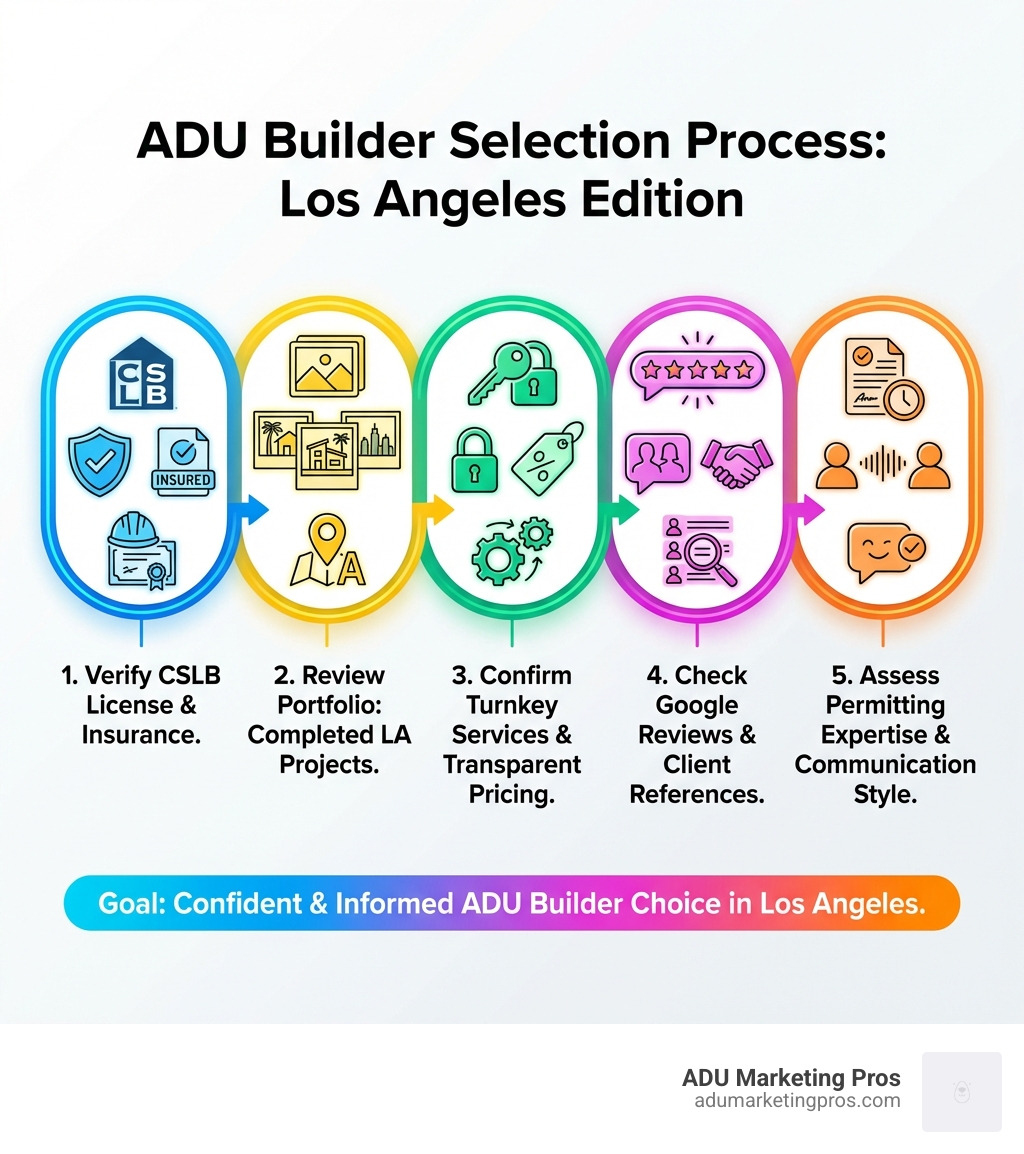
When evaluating ADU builders los angeles, certain credentials are non-negotiable. We always advise homeowners to look for these indicators of reliability and professionalism:
- Valid California State License Board (CSLB) General Contractor License: This is fundamental. A licensed contractor has met the state’s requirements for experience, financial solvency, and competency. Always verify the license status on the CSLB’s official license lookup page.
- Liability Insurance and Workers’ Compensation Coverage: These protect you from financial responsibility in case of accidents or damage during construction. Never work with an uninsured contractor.
- Specialization in ADU Construction: While many general contractors can build an ADU, those specializing in ADUs possess deep knowledge of the specific regulations, design trends, and permitting processes unique to these units in Los Angeles. Look for builders who have completed a significant number of ADU projects, ideally 50 to 100+.
- Local Experience: A builder with a strong portfolio of completed Los Angeles ADU projects will be familiar with the nuances of different city departments and neighborhood-specific requirements. This includes practical knowledge of dealing with hillside ordinances in areas like the Hollywood Hills, understanding soil conditions in coastal zones like Venice or Manhattan Beach, or knowing the specific preferences of plan checkers in jurisdictions like Burbank or Pasadena. This local expertise can save significant time and prevent costly mistakes.
Evaluating the Process of an ADU Builder in Los Angeles
A builder’s process speaks volumes about their efficiency and client focus. We recommend looking for:
- Comprehensive, Turnkey Services: The best ADU builders los angeles offer end-to-end solutions, managing everything from initial design and blueprints to permitting, construction, and final move-in. This “one team, one process, zero headache” approach minimizes stress for homeowners.
- Transparent Pricing and Fixed-Price Contracts: Hidden fees and unexpected costs are a homeowner’s nightmare. Look for builders who provide upfront, detailed bids after assessing the project, offering transparent pricing and guaranteed costs and completion dates. This ensures financial predictability.
- Detailed Scope of Work: A good builder will provide a clear, itemized scope of work that outlines every aspect of the project, including materials, labor, and timelines. This document should leave no room for ambiguity.
- Effective Project Management and Communication: Inquire about their project management tools (e.g., homeowner portals, mobile apps for updates) and communication frequency. You want a builder who provides weekly/daily updates and involves you throughout the building process. Consistent, clear communication is highly valued by clients.
- Permitting Expertise: Navigating Los Angeles’s complex permitting process is a significant challenge. A top ADU builder will demonstrate extensive knowledge of local building codes and regulations, handling all necessary permits, drawings, and approvals with efficiency. They should be able to explain the process clearly and manage it on your behalf.
Reading Reviews and Seeking Referrals
Social proof is invaluable when choosing an ADU builder.
- Online Reviews: Check platforms like Google reviews, Houzz testimonials, and Yelp ratings. Look for consistent themes in positive feedback, such as “efficient,” “communicative,” “outstanding quality,” and “professional.” Conversely, be wary of recurring negative comments regarding delays, cost overruns, or poor communication. With over 1 million total reviews from homeowners on Houzz, there’s a wealth of information available.
- Client References: Ask prospective builders for a list of recent clients you can contact. Speaking directly with past clients provides insight into their experience with the builder’s workmanship, dedication, integrity, and adherence to budget and timeline.
- Visit Completed Projects: If possible, ask if you can visit a few of their recently completed ADU projects. This allows you to visually inspect the quality of their work and get a feel for the finished product.
Frequently Asked Questions about Building an ADU
How much does it cost to build an ADU in Los Angeles?
The cost of building an ADU in Los Angeles can vary significantly based on the type, size, complexity, and finishes. Generally:
- Garage Conversions: These are often the most cost-effective option, typically ranging from $80,000 to $150,000. This is because they use existing structures, reducing foundation and framing costs.
- Prefabricated ADUs: These units can be very affordable, with many costing under $100,000 for the unit itself. However, you must also factor in site work, utility connections, transportation, and installation, which can add substantially to the total.
- Custom-Built Detached ADUs: These ground-up constructions offer the most flexibility but come with a higher price tag, typically ranging from $150,000 to $400,000 or more. The final cost depends heavily on square footage (ADUs can range from 300 sq ft to 1200 sq ft), site conditions (e.g., sloped lots, difficult access), quality of finishes, and complexity of utility connections.
An experienced builder will provide a transparent, upfront bid after assessing your specific project, ensuring no hidden fees or last-minute surprises.
How long does the ADU permitting process take in LA?
While the state of California mandates a 60-day review period for complete ADU permit applications, the actual timeline can vary. An experienced ADU builder in Los Angeles is crucial here. They can help streamline the process by ensuring all documentation, blueprints, and engineering plans are accurate and complete upon submission to the local Department of Building and Safety. Delays typically arise from:
- Incomplete or inaccurate submissions: Missing information or errors can lead to requests for corrections, restarting the review clock.
- Complex site conditions: Properties with unique challenges (e.g., hillside lots, easements, septic systems) may require additional reviews or reports.
- Jurisdictional variations: While state law sets a maximum review time, local city departments may have their own internal processes that can influence overall speed.
With expert navigation, the permitting process can be significantly smoother and closer to the 60-day target.
What are the setback requirements for ADUs in Los Angeles?
Setback requirements define the minimum distance your ADU must be from your property lines. Thanks to state laws, these have become much more favorable for homeowners. For most new, detached ADUs in California, the requirement is a minimum of four feet from the side and rear property lines. For existing structures being converted, such as a garage or accessory building (even if it’s located on the property line), no additional setbacks are required. JADUs, being within the primary home, also do not have setback requirements. It’s important to note that front yard setbacks usually still apply, and specific local conditions or overlays (like hillside areas) might have different rules. An expert ADU builder will verify the exact requirements for your specific property during the initial feasibility study.
Can I rent my ADU on Airbnb in Los Angeles?
The ability to rent your ADU on short-term rental platforms like Airbnb depends heavily on local city ordinances within Los Angeles County. California rules leave it up to individual cities to decide.
- City of Los Angeles: In the City of Los Angeles, ADUs can generally only be used for short-term rentals if they are part of your primary residence, meaning you must live on-site and it’s considered your primary residence.
- Other LA County Cities: Some cities within Los Angeles County, such as Santa Monica and Long Beach, have chosen to impose limitations or outright bans on short-term rentals for ADUs.
- Long-Term Rentals: Generally, longer rental periods (30 days or more) are less restricted across Los Angeles County.
Before planning to use your ADU for short-term rentals, it is absolutely essential to verify the specific local ordinances in your property’s jurisdiction. Your chosen ADU builders los angeles should be knowledgeable about these regulations and can advise you accordingly.
Conclusion: Start Your ADU Journey with Confidence
Building an ADU in Los Angeles offers significant financial and lifestyle benefits, from increasing property value by $100,000+ and generating substantial rental income to providing flexible space for family or work. The availability of diverse ADU types, coupled with innovative construction methods and supportive legislation, makes now an opportune time to open up your property’s full potential.
However, navigating the complexities of design, permitting, financing, and construction requires expertise. Partnering with a qualified ADU builders los angeles ensures a smooth, successful project from start to finish. By focusing on builders with strong credentials, transparent processes, and excellent client testimonials, you can start on your ADU journey with confidence, knowing your investment is in capable hands.
If you’re ready to open up your property’s potential, take the first step today. For builders looking to connect with homeowners, working with a marketing expert like ADU Marketing Pros can lift your visibility and attract qualified leads. Learn how to find the best ADU builder in Los Angeles.