
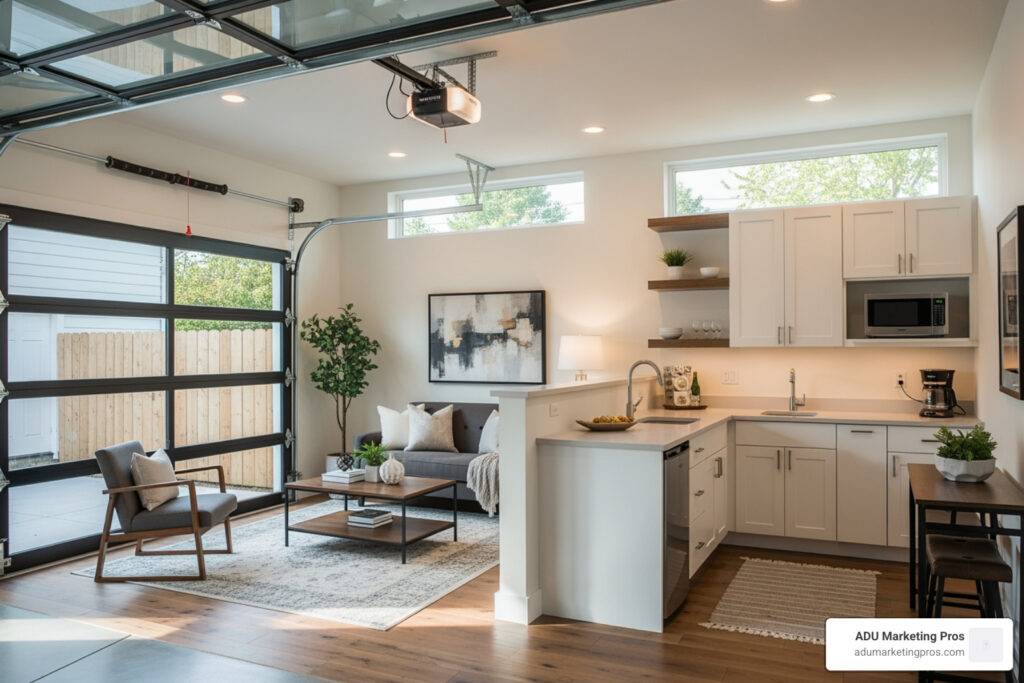
Why Garage Conversion Value Matters to Your Bottom Line
Garage conversion value is one of the most compelling reasons homeowners and property investors are changing underused garage spaces into functional living areas. If you’re searching for a quick answer, here’s what you need to know:
Quick Value Summary:
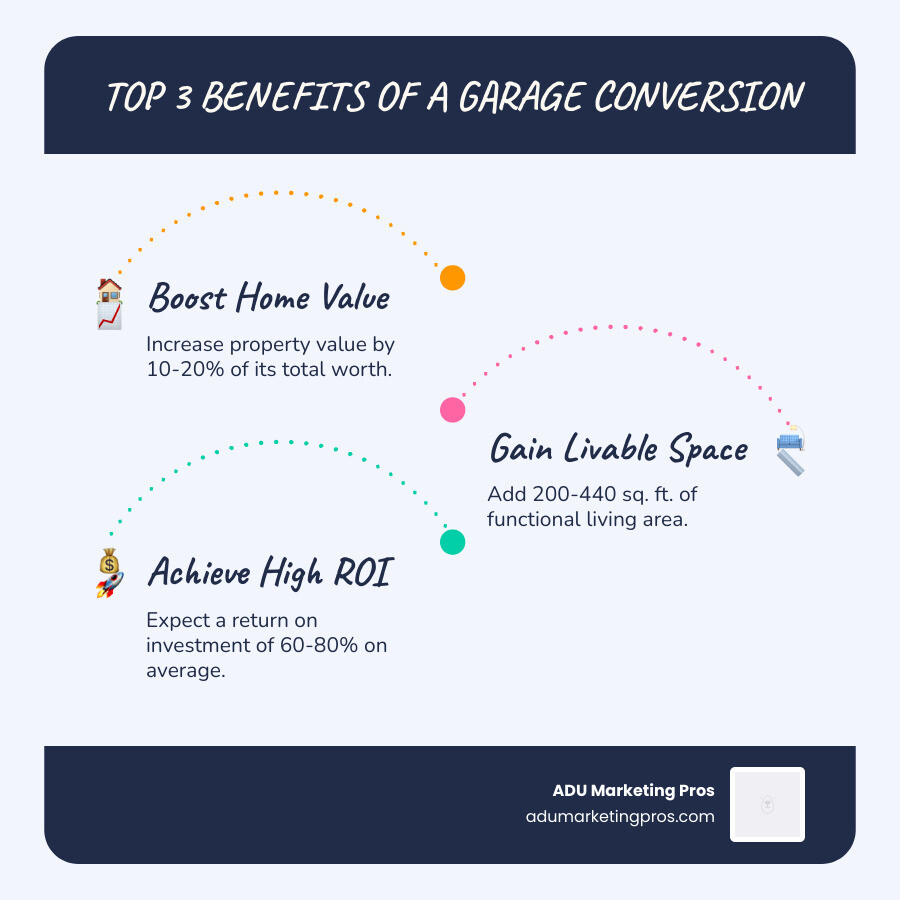
- Property Value Increase: 10-20% of your home’s total value
- Return on Investment (ROI): 60-80% on average
- Average National Cost: $16,617 (ranging from $6,000 to $28,000), though California costs are significantly higher (see cost breakdown below).
- Added Square Footage: 200-440 sq. ft. of livable space
- Timeline: 4-8 weeks for construction, plus 2-8 weeks for permits
The financial case for garage conversions is strong, especially in high-value markets. According to multiple industry sources, a well-executed conversion can boost your home’s resale value by as much as 10-20%, depending on your local housing market and the quality of the renovation. For a home valued at $800,000 in California, that translates to a potential value increase of $80,000 to $160,000.
What makes garage conversions particularly attractive is that they leverage an existing structure. You already have the foundation, walls, and roof in place. This means you’re not starting from scratch like you would with a traditional home addition. The result? Lower costs and faster completion times compared to building new square footage.
The reality is this: most garages end up as cluttered storage spaces, filled with old furniture, sports equipment, and items destined for a yard sale that never happens. Meanwhile, that same 200 to 440 square feet could be generating rental income as an ADU, providing a dedicated home office for remote work, or serving as a guest suite that makes your home more appealing to buyers.
The key question isn’t whether a garage conversion adds value—the data clearly shows it does. The real question is how much value it adds to your specific property, and whether that return justifies the investment in your particular market and situation.
This guide breaks down everything you need to know about garage conversion value, from the financial breakdown and key factors that influence your ROI, to the step-by-step process of planning and executing a successful conversion project.
Explore more about Garage conversion value:
Does a Garage Conversion Add Value? The Financial Breakdown
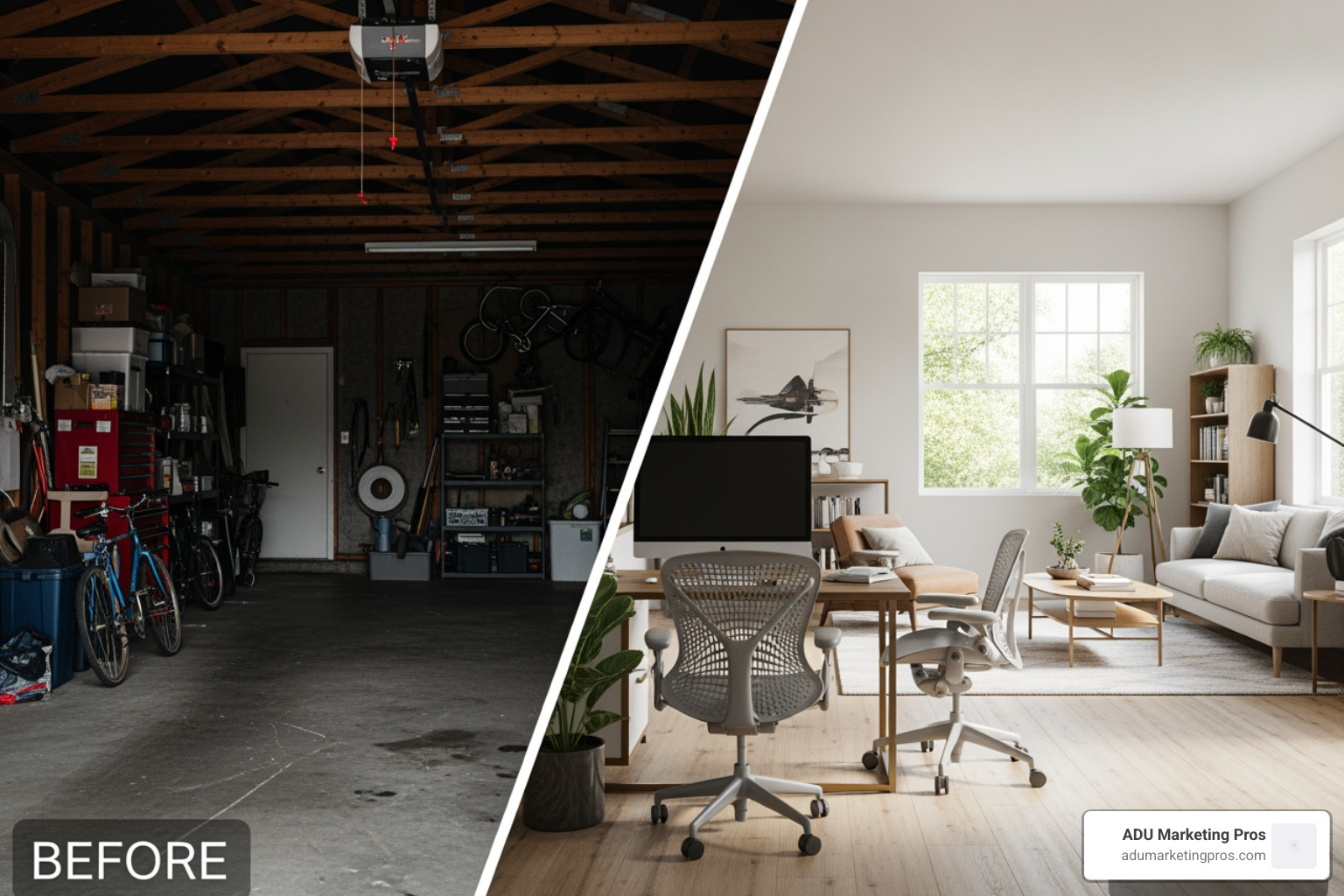
The short answer is a resounding yes. A well-executed garage conversion adds significant value by changing what is often considered low-value storage into high-value, conditioned living space. Unlike building an extension from scratch, a conversion uses an existing structure, making it a more affordable project with one of the highest returns on investment in home remodeling. While the final value depends on several factors, the data consistently shows a positive financial outcome.
How Much Value Can You Expect?
When we talk about garage conversion value, we’re looking at a dual impact: an increase in your home’s overall market value and a strong return on your initial investment.
First, let’s consider the value increase. A well-executed garage conversion can boost your home’s resale value by as much as 10-20%. This range is consistently cited by industry experts. For instance, many real estate professionals note that a garage conversion can add up to 20% to the value of your home, with conversions into a bedroom with an en-suite bathroom often yielding the highest increases. Even a simple home office or playroom conversion can add around 10% to your property’s worth. In our competitive California markets, where space is at a premium, this percentage can translate into substantial dollar figures.
Next, let’s look at the Return on Investment (ROI). Garage conversions offer one of the highest returns on investment for home renovation projects, typically ranging between 60% and 80%. Sources like Realtor.com and cost data from sources like Angi (formerly HomeAdvisor) suggest that well-executed garage projects can return roughly 80% of your investment when you sell your home. This makes a garage conversion a financially savvy move, allowing you to recoup a significant portion of your costs while enjoying the benefits of the new space.
However, it’s important to approach the added value with an appraiser’s perspective. It’s not as simple as multiplying the added square footage by the average price per square foot of your home. Appraisers consider a more complex set of factors. They look at the site value (the land itself), the depreciated cost of the existing structures, and crucially, the loss of garage amenity. In areas where parking is highly valued, the absence of a garage might slightly temper the value added by the new living space. For example, while a 400 sq ft conversion might seem to add $160,000 in value based on a simple $400/sq ft calculation, the actual appraised increase could be lower, perhaps in the $50,000 range, after accounting for the loss of the garage. This nuance is especially relevant in dense urban areas like Los Angeles, San Jose, or San Francisco.
The goal is to create valuable, functional added square footage that improves your home’s appeal and utility.
Understanding the Average Cost of a Garage Conversion
To truly understand garage conversion value, we must also factor in the costs involved. Nationally, the average cost to convert a garage into a living space is approximately $16,617, with a typical range between $6,021 and $27,699. However, it’s crucial to understand that these are national averages. In California’s high-cost-of-living areas, particularly in the markets we serve like the San Francisco Bay Area and Los Angeles, these figures represent a starting point, not the final destination.
In California, you should realistically budget for costs to be significantly higher. A more accurate cost per square foot for a garage conversion in California can range from $100 to $300+, a significant jump from the national average. This is due to several factors:
- Higher Labor Costs: Skilled labor is more expensive in major California metro areas.
- Permit Fees: Navigating the permit process in cities like San Jose or San Francisco can be more complex and costly.
- Seismic Retrofitting: Many garage conversions require structural upgrades to meet California’s strict earthquake safety codes.
- Title 24 Compliance: California’s energy code (Title 24) mandates specific standards for insulation, windows, and HVAC systems, which can increase material and installation costs.
This means a standard one-car garage (around 240 sq ft) might cost between $24,000 and $72,000, while a two-car garage (around 440 sq ft) could range from $44,000 to over $132,000, especially if it’s being converted into a full ADU with a kitchen and bathroom.
Several key factors will influence your final cost:
- Project Scope: Are you aiming for a basic finish, or a premium, high-end space? A simple home office will be far less expensive than a full Accessory Dwelling Unit (ADU) with a kitchen and bathroom, which is a more complex construction project.
- Plumbing and Electrical Costs: These are often the largest line items. Adding new electrical wiring to support a living space can cost $2,000-$4,000. New plumbing for a bathroom or kitchen, which often involves cutting into the concrete slab foundation, can range from $4,000 to $15,000 or more. If your conversion requires extensive utility work, these costs can significantly drive up your overall project budget.
- Structural Changes: Modifying load-bearing walls, raising the ceiling, leveling a sloped garage floor, or adding new windows and doors will add to the expense.
- Finishing Materials: The quality of flooring, drywall, paint, cabinetry, and fixtures will significantly impact your final bill. Opting for high-end finishes can easily add tens of thousands to the cost.
While the upfront cost might seem substantial, remember the high ROI and the long-term benefits of increased living space and potential rental income, which are especially valuable in the California market.
Key Factors That Influence Your Garage Conversion Value
Not all garage conversions are created equal. The final value added to your property is a direct result of strategic planning, quality execution, and market-specific demands. From your home’s location to the type of room you create, several critical factors will determine whether your project yields a good return or a great one. Understanding these variables is the first step in maximizing your investment.
Location, Location, Location: How Geography Impacts Value
Just like with any real estate venture, location is paramount when assessing garage conversion value. In our service areas across California—from the busy urban centers of Los Angeles and San Francisco Bay Area to the vibrant communities of San Jose, Sunnyvale, Palo Alto, Mountain View, and Menlo Park—the impact of location is particularly pronounced.
- Urban vs. Rural: In urban areas, where land is scarce and housing demand is high, converting a garage into additional living space often adds substantial value. The premium for extra square footage in cities far outweighs the utility of a garage in many cases. In contrast, in more rural or suburban areas with ample parking, the value added might be less dramatic, though still significant.
- Parking Scarcity: In densely populated neighborhoods with limited street parking, losing a garage could be a drawback for some buyers. However, in many California cities, the demand for living space or rental units (ADUs) often outweighs the need for covered parking, especially if off-street parking alternatives exist.
- Neighborhood Comparables: The value of your conversion will always be benchmarked against similar properties in your neighborhood. If other homes have successfully converted garages, it sets a precedent for value.
- Local Housing Market: A strong seller’s market, like we often see in California, amplifies the value added by any home improvement that increases functional living space.
- California ADU Regulations: Our state’s progressive ADU laws make garage conversions particularly valuable. The ability to create an Accessory Dwelling Unit (ADU) from an existing garage structure means you can add significant rental income potential, which dramatically increases your property’s overall financial appeal. This is a unique advantage in our California markets.
Quality and Design: The Difference Between a Bonus Room and a True Asset
The quality of your garage conversion is paramount to its long-term garage conversion value. A poorly executed conversion can detract from your home’s value, while a well-designed and professionally built space can lift it significantly.
- Professional Craftsmanship: Hiring experienced contractors is non-negotiable for a high-quality finish. Professionals ensure structural integrity, proper code compliance, and aesthetic appeal. For complex projects, an architect can be invaluable in optimizing space and integrating the new area seamlessly.
- High-Quality Materials: Durable, high-quality materials not only look better but also last longer, requiring less maintenance and signaling a well-cared-for home to potential buyers.
- Seamless Integration: The converted garage should feel like an organic part of your home, not an afterthought. This means harmonizing its design with the rest of your house, from flooring and paint colors to trim and window styles.
- Architectural Style: The design should respect and complement your home’s existing architectural style.
- Natural Light: Incorporating adequate windows and doors is crucial for making the space feel bright, inviting, and livable.
- Proper Insulation: Insulation is vital for comfort, noise reduction, and energy efficiency. A well-insulated space will be more comfortable year-round and reduce utility bills, adding to its value.
- HVAC Systems: Integrating the converted space into your home’s existing HVAC system or installing a dedicated system (like a ductless mini-split) ensures year-round comfort, a key factor for any livable space.
The Trade-Off: Losing Parking vs. Gaining Living Space
One of the most significant considerations for any homeowner contemplating a garage conversion is the trade-off between losing a parking spot and gaining valuable living space. This decision directly impacts garage conversion value.
- Buyer Preferences: While additional living space is highly desirable, a significant portion of homebuyers still value garage storage and parking. According to the National Association of Home Builders’ What Home Buyers Really Want, 2021 Edition, 82% of homebuyers consider garage storage essential or desirable. Furthermore, the same study revealed that 42% of prospective buyers prefer a two-car garage over any other parking option. This means that completely eliminating your garage could deter a segment of potential buyers.
- Off-Street Parking Availability: In areas with ample street parking or where alternative parking solutions are readily available, the impact of losing a garage is less severe. However, in dense urban neighborhoods of Los Angeles or San Francisco, where parking is a constant challenge, losing your only off-street spot can be a significant drawback.
- Partial Conversions: A clever solution to this dilemma is a partial garage conversion. This allows you to retain a portion of your garage for parking or storage while converting the remainder into living space. This approach offers the best of both worlds, mitigating the loss of a valuable amenity.
- Alternative Storage Solutions: If a full conversion is your goal, consider where you will store tools, seasonal items, and other garage essentials. Investing in a shed, optimizing attic or basement storage, or installing built-in cabinetry can help offset the loss of garage storage.
The decision depends on your local market’s priorities. In many parts of California, the demand for additional living space, especially ADUs, often outweighs the perceived loss of a garage, making the conversion a net positive for property value.
| Conversion Type | Average Cost Range | Potential Value Add | Key Considerations |
|---|---|---|---|
| Home Office | $5,000 – $15,000 | ~10% | Electrical outlets, lighting, soundproofing, internet connectivity |
| Extra Bedroom | $10,000 – $25,000 | ~15-20% | Egress window, closet space, code compliance, privacy |
| ADU / In-Law Suite | $30,000 – $80,000+ | ~20% + rental income | Kitchenette, bathroom, separate entrance, local zoning, utility hookups |
| Home Gym | $6,000 – $16,000 | ~10% | Durable flooring, ventilation, ceiling height, sound insulation |
The Conversion Process: From Planning to Payoff
A successful garage conversion is a multi-stage process that requires careful planning long before the first hammer swings. From defining the purpose of your new space to navigating local regulations and managing construction, each step is crucial for staying on budget and achieving a high-quality result that adds maximum value to your home.
Step 1: Key Considerations Before You Start
Before starting on your garage conversion journey, meticulous upfront planning will save you time, money, and headaches down the road.
- Define Purpose: What will this new space be? An ADU for rental income? A home office? A guest suite? A children’s playroom? Clearly defining the purpose will guide all design and budgeting decisions.
- Set a Realistic Budget: Based on your defined purpose and desired finishes, work with professionals to create a detailed budget. Remember to factor in not just construction costs, but also professional fees (architects, engineers), permits, and materials.
- Contingency Fund: Always allocate a contingency fund of at least 10-15% of your total budget for unforeseen costs. Surprises, like finding old pipes or unexpected structural issues, can and do happen.
- Assess Garage Condition: A thorough assessment of your existing garage is crucial. Check for issues like damp, water intrusion, structural integrity, and the condition of the foundation. Addressing these early can prevent costly problems later.
- Contractor Selection: We cannot stress this enough: hire experienced contractors. Look for professionals with a proven track record in garage conversions, especially ADUs, in your local California market. Ask for references and view their past projects.
- Vet Professionals: Don’t just settle for the first quote. Obtain detailed estimates from at least three top-rated remodeling experts. Compare not just the total cost, but the line-item breakdowns to ensure you’re comparing apples to apples.
Step 2: Navigating Permits and Building Regulations
Understanding and complying with local permits and building regulations is perhaps the most critical—and often most daunting—aspect of a garage conversion. Skipping this step can lead to costly fines, rework, and even necessitate tearing down your new space.
- Permits are Required: In California, virtually all home construction projects, including garage conversions, require permits and inspections. This is especially true for ADUs, which have specific zoning and building code requirements.
- Building Codes: These are in place to ensure safety, health, and structural integrity. Key areas include:
- Egress Windows: All habitable rooms must have an emergency egress window or door that meets specific size and height requirements.
- Fire Safety: Conversions must meet fire separation requirements, especially if creating an ADU.
- Electrical Codes: Existing electrical systems often need significant upgrades to meet modern living space codes.
- Plumbing Codes: If adding a bathroom or kitchen, plumbing must be correctly installed and connected to existing lines, often requiring cutting into concrete.
- Insulation and Ventilation: Proper insulation for walls, floors, and ceilings, along with adequate ventilation, is mandatory for livable spaces.
- Zoning Laws: For ADUs, local zoning laws will dictate requirements such as maximum size, setbacks, and parking provisions. Our teams at ADU Marketing Pros are well-versed in the specific ADU regulations across Los Angeles, San Diego, and the Bay Area, helping our clients steer these complexities.
- Resources: Always consult with your local planning and building department early in the process. While some general guidance on householder permitted development rights exists, specific rules vary significantly by location. We recommend working with professionals who are familiar with your city’s unique requirements.
Step 3: The Construction Timeline and Common Uses
Once permits are secured, the physical change of your garage can begin. The construction phase is typically much quicker than building an entirely new addition, contributing to the strong garage conversion value.
- Typical Duration: The actual construction portion of a garage conversion usually takes between four and eight weeks. Simpler projects, like a basic home office, might be completed in just 2-3 weeks, while more complex ADUs with full kitchens and bathrooms could extend to 6-8 weeks or more.
- Planning and Permit Phase: Don’t underestimate the time needed for the pre-construction phase. Design, plan submission, and permit approvals can add an additional 2-8 weeks (or even longer in some busy jurisdictions) before any physical work can start.
- Common Uses: The beauty of a garage conversion lies in its versatility. Here are some of the most popular and value-adding uses we see in our California markets:
- Home Office: With the rise of remote work, a dedicated, quiet workspace is invaluable.
- Home Gym: Convert clutter into a convenient fitness haven, saving on gym memberships.
- ADU/Guest Suite: This is a top choice for maximizing garage conversion value by providing potential rental income or comfortable space for family and guests.
- Extra Bedroom with En-suite: Adding a bedroom, especially one with its own bathroom, significantly boosts a home’s appeal and functionality.
- Children’s Playroom: A dedicated space for kids keeps the main living areas tidy and provides room for imagination.
- Art Studio/Hobby Room: A quiet, dedicated space for creative pursuits.
- Utility Room/Laundry Room: Free up space in your main home by moving laundry and utility functions to the converted garage.
- Living/Entertainment Space: An extra living room, media room, or entertainment hub adds flexible space for families.
Frequently Asked Questions About Garage Conversion Value
Here are answers to some of the most common questions homeowners have about the value and return on a garage conversion project.
What is the typical ROI on a garage conversion?
A garage conversion consistently offers one of the highest returns on investment of any home renovation, typically yielding an ROI between 60% and 80%. Projects like garage door replacements can have an even higher return, as noted in Remodeling magazine’s 2023 Cost vs. Value report, highlighting the value buyers place on this part of the home. The final ROI depends on your project’s cost, quality, and local market conditions. This impressive return makes garage conversions a smart financial decision, allowing you to recoup a significant portion of your investment while enjoying the benefits of your new space.
How long does a garage conversion take from start to finish?
The construction phase of a typical garage conversion takes between four and eight weeks. However, the total project timeline is longer. You should factor in an additional two to eight weeks (or more) for the initial design, planning, and permit approval process before any physical work can begin. Factors such as the complexity of the design, the need for extensive utility work (plumbing, electrical), and the responsiveness of your local planning department can all influence the overall duration.
Will removing my garage hurt my home’s resale value?
This is a valid concern, and it’s one we hear often, especially in communities where covered parking is a premium. In neighborhoods with scarce street parking or harsh weather, removing the only covered parking spot could deter some buyers. A 2021 study by the National Association of Home Builders found that 42% of prospective home buyers prefer a two-car garage.
However, in most cases, the value gained from adding a well-designed, fully permitted living space—like an extra bedroom, a home office, or especially an ADU—far outweighs the perceived loss of the garage, particularly in our high-demand California markets. In areas like Los Angeles or San Jose, where demand for living space is exceptionally high, a smart conversion can significantly boost your home’s worth.
If you have a two-car garage, a partial conversion can offer the best of both worlds, allowing you to retain some parking or storage space while still creating valuable living area. This approach can mitigate the potential negative impact on resale value for buyers who prioritize covered parking.
Conclusion: Is a Garage Conversion the Right Investment for You?
A garage conversion is more than just a home improvement project; it’s a strategic investment in your property. By changing an underused area into a beautiful and functional living space, you can significantly increase your home’s value, achieve an impressive return on investment, and create a home that better suits your lifestyle. The key to success lies in meticulous planning, adherence to building codes, and a commitment to quality craftsmanship. For construction and architecture firms looking to attract clients for these high-value projects, having a targeted marketing strategy is essential. ADU Marketing Pros helps these businesses connect with homeowners ready to open up their property’s potential. If you’re ready to explore the possibilities for your own home, a garage conversion is one of the smartest investments you can make.
Learn more about how to plan and execute successful ADU garage conversions.