
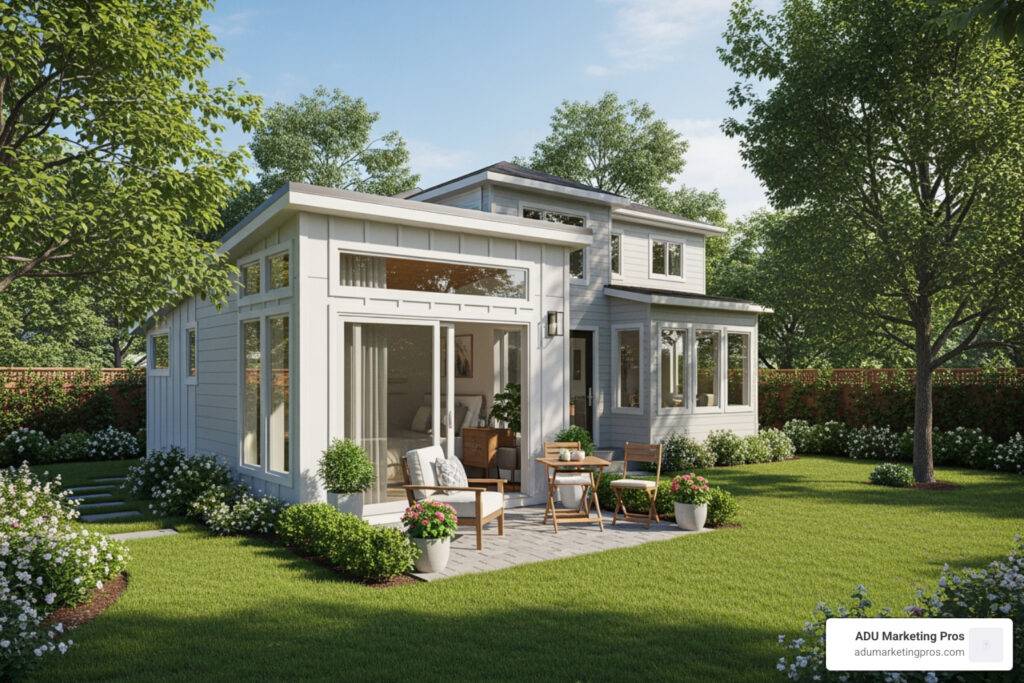
Why Studio Granny Flats Are Redefining Backyard Living
A Granny flat studio is a compact, self-contained dwelling unit built on the same property as a main house, featuring an open-plan living area with a separate bathroom. Ranging from 200 to 550 square feet, these versatile accessory dwelling units (ADUs) offer an affordable solution for housing family members, creating rental income, establishing a home office, or providing guest accommodations—all while preserving valuable yard space.
Quick Overview: What You Need to Know
- Size Range: Typically 200-550 sq ft (or roughly 20-55 sqm)
- Layout: One open-plan room combining living, sleeping, and kitchen areas, plus a separate bathroom
- Cost: Generally 30-50% less expensive than traditional granny flats with separate bedrooms
- Build Time: Prefabricated options can be installed in as little as 2 hours to a few weeks; custom builds take 4-9 months
- Primary Uses: Rental income, home office, family housing, guest suite, art studio
The housing landscape has shifted dramatically, especially in states like California. Decades of rising property prices, a structural housing shortage, the explosion of remote work, and a growing need for multigenerational living solutions have all converged to make small-footprint dwellings increasingly attractive. Studio granny flats answer these modern challenges by delivering maximum functionality in minimal space—without the hefty price tag and lengthy construction timeline of traditional home additions.
Unlike conventional granny flats with separate bedrooms, studio designs embrace open-plan living. This philosophy translates to a smarter use of every square foot, leading to lower construction costs and often simpler, faster approval processes. For homeowners with smaller properties, narrow lots, or a desire to maintain a spacious backyard, a granny flat studio can be the difference between adding valuable, flexible living space or settling for an underused patch of grass.
This guide will walk you through everything you need to understand about studio granny flats: what distinguishes them from traditional ADUs, their standout benefits, proven design strategies for maximizing compact spaces, realistic cost expectations and ROI potential, and the regulatory landscape you’ll need to navigate. Whether you’re an ADU professional helping clients make informed decisions or a homeowner exploring your options, you’ll find clear, actionable insights backed by industry data and real-world examples.
What is a Granny Flat Studio? Definition, Size, and Key Differences
At its core, a granny flat studio is a self-contained living unit characterized by its open-plan layout. Imagine one main room that ingeniously combines the living, sleeping, and often cooking areas, with a separate, dedicated bathroom. This design philosophy prioritizes efficiency and versatility, making every square foot count.
Typical Size Ranges for Studio Granny Flats
When we talk about sizes, a granny flat studio typically ranges from less than 20 square meters (approximately 200 sq ft) up to about 55 square meters (around 550 sq ft). This means they can be as compact as half the floor space of a traditional granny flat. For instance, some designs can fit comfortably in less than 45 square meters, offering an open-plan living/dining area, a full kitchen, a bedroom with a built-in wardrobe, another room for a home office, and even a patio. The maximum size for a detached studio specifically, which is often classified differently for regulatory purposes, is usually around 36 square meters. This smaller footprint is a key differentiator, allowing for placement on properties where larger structures might not fit.
How a Studio Granny Flat Differs from a Traditional Granny Flat
The main distinction lies in the layout. A traditional granny flat often includes one or more separate bedrooms, a dedicated living room, and a full kitchen, mimicking a smaller version of a standard home. In contrast, a granny flat studio consolidates these functions into one cohesive, open space, with only the bathroom enclosed. This open concept is crucial for maximizing the feeling of space and light within a smaller footprint. From a construction perspective, studio granny flats are generally less complex and quicker to build than their multi-room counterparts. This can translate to significant savings in both time and cost.
Prefabricated vs. Custom-Built Studio Granny Flats
The choice between prefabricated and custom-built options significantly impacts your project. Prefabricated studios, often delivered as flat-packed or panelized kits, offer substantial savings and speed. Some models can be set up in as little as two hours, while others might take a few weeks to install and finish. This off-site manufacturing minimizes on-site disruption, weather delays, and labor costs. Custom-built studio granny flats, on the other hand, offer complete design flexibility but typically involve longer construction times (4-9 months) and higher costs.
Regulatory Distinctions: Ancillary vs. Secondary Dwelling
Understanding the regulatory classification is vital, especially in areas like Los Angeles, San Diego, and the San Francisco Bay Area, where ADU laws are evolving. A traditional granny flat is typically classified as a “secondary dwelling” or Accessory Dwelling Unit (ADU), meaning it’s a fully self-contained residence. A granny flat studio, particularly a smaller one, might sometimes be classified as an “ancillary” structure or a “non-habitable” space (like a detached studio), depending on its size and features (e.g., absence of full kitchen/laundry).
This distinction can have a big impact:
- Simplified Approvals: Detached studios, when classified as ancillary, can often bypass the extensive planning permits and council approvals required for full granny flats.
- Cost Savings: They may also bypass significant council contribution fees (like Section 94/7.11 fees) that can exceed $20,000 for secondary dwellings. For example, in a city like San Jose, building a full 750+ sq ft ADU might trigger these impact fees, whereas a 350 sq ft ancillary studio for a home office might be exempt, representing an immediate and substantial saving.
- Flexibility: In some cases, a property can accommodate a main house, a traditional granny flat (secondary dwelling), and a detached studio (ancillary structure), providing even more usable space. It’s also worth noting the related category of Junior Accessory Dwelling Units (JADUs), which are created within the walls of the primary residence and are typically under 500 sq ft. A detached studio offers more privacy and separation than a JADU. However, it’s critical to verify local zoning and building codes in your specific California location, as regulations can vary.
The Big Advantages of Going Small: Why Choose a Studio ADU
Opting for a granny flat studio offers a compelling list of advantages that make it an increasingly popular choice for homeowners across California, from San Jose to Sunnyvale and beyond. We’ve seen how these compact dwellings open up immense potential for properties.
Cost-Effectiveness
This is often the primary draw. Studio granny flats are, without a doubt, the most cost-effective choice among all granny flat options. Their smaller footprint naturally means:
- Lower Construction Costs: Less material, less labor, and a simpler build process. This includes reduced costs for foundation, framing, and roofing compared to a larger structure.
- Reduced Material Needs: Fewer internal walls, simpler plumbing, and electrical layouts all contribute to savings.
- Bypassing Significant Fees: As we mentioned, if classified as an ancillary structure, they can sometimes bypass costly Section 94/7.11 contribution fees levied by many councils, which can reach over $20,000. Prefabricated studios, in particular, offer significant savings compared to traditional construction by streamlining labor and material procurement.
Versatility
Don’t let the small size fool you; these units are incredibly versatile. We’ve seen them used for a multitude of purposes:
- Housing Relatives: A studio provides a comfortable, independent, and accessible space for elderly parents or adult children saving for their own home. It offers privacy while keeping family close.
- Guest House: It serves as a welcoming retreat for visiting family and friends, offering them their own private space instead of a spare bedroom in the main house.
- Generating Rental Income: A studio is a fantastic way to boost your property’s value and provide an additional income stream. In high-demand rental markets like the Los Angeles, San Diego, and San Francisco Bay Area, a well-designed studio can attract students, young professionals, or single occupants, demonstrating strong demand for such compact living spaces.
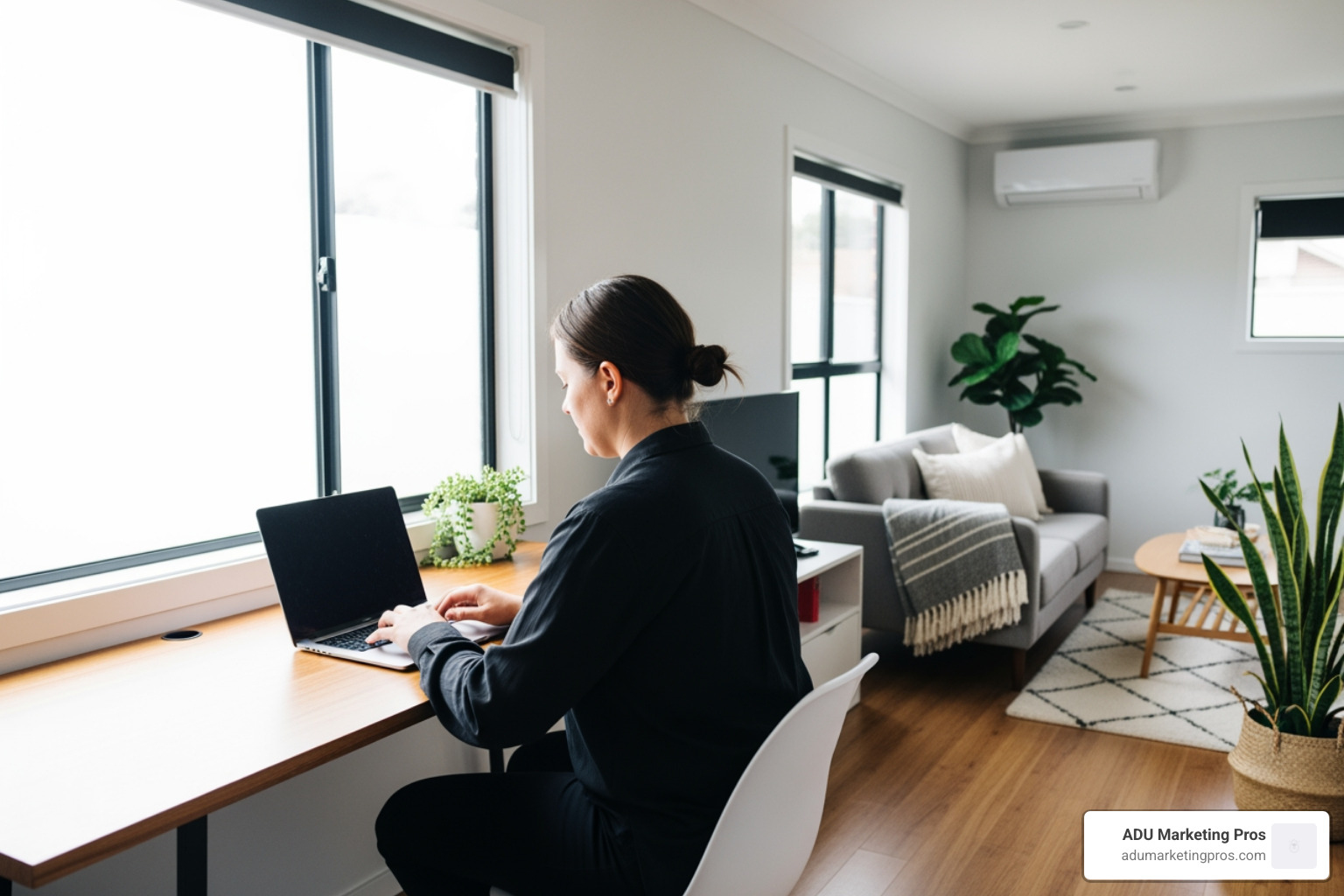
- Home Office: In the age of remote work, a detached studio offers a dedicated, quiet workspace away from the main house. This physical separation helps create a healthy work-life balance and a professional environment for calls and focused work.
- Art Studio or Hobby Space: The open-plan layout and potential for great natural light make it the perfect creative sanctuary for artists, musicians, writers, or anyone needing a dedicated hobby room.
- Teen Retreat: A studio can function as a semi-independent space for growing teenagers, giving them a sense of autonomy while still being safely on the family property.
Space Efficiency
For properties in densely populated areas like Palo Alto or Mountain View, where every square foot is precious, space efficiency is paramount. A granny flat studio shines here:
- Ideal for Smaller Properties: Its compact size allows it to fit on lots where a larger ADU might not be feasible due to setback requirements or lot coverage limits.
- Perfect for Narrow Blocks: Clever linear design can make them work even in challenging layouts, turning previously unusable side yards into valuable assets.
- Preserves Yard Space: By taking up less footprint, you retain more of your backyard for gardening, recreation, or simply the open space that enhances your quality of life.
Faster Construction
Time is money, and studio granny flats are often built much faster.
- Prefabricated Options: These are game-changers. Some modular studios can be set up in a matter of hours, while others are completed within a few weeks or months, significantly reducing the typical construction timeline of 4-9 months for a custom build.
- Less On-Site Disruption: Off-site manufacturing means less noise, mess, and contractor traffic on your property, a definite plus for busy homeowners and their neighbors.
Lower Ongoing Costs
The benefits extend beyond the build. A smaller space naturally means:
- Reduced Utility Bills: Less area to heat and cool, leading to lower energy consumption and a smaller environmental footprint.
- Less Maintenance: Fewer rooms and a smaller exterior mean less time and money spent on upkeep.
- Minimalist Lifestyle: The compact nature of a studio encourages a clutter-free, efficient way of living, which many find liberating.
Designing Your Perfect Granny Flat Studio: Layouts, Features, and Smart Tech
Designing a granny flat studio is an exciting challenge, where creativity meets efficiency. The goal is to make a small space feel expansive, functional, and deeply comfortable.
Key Design Considerations for a Granny Flat Studio
When we approach studio design, we focus on maximizing every inch:
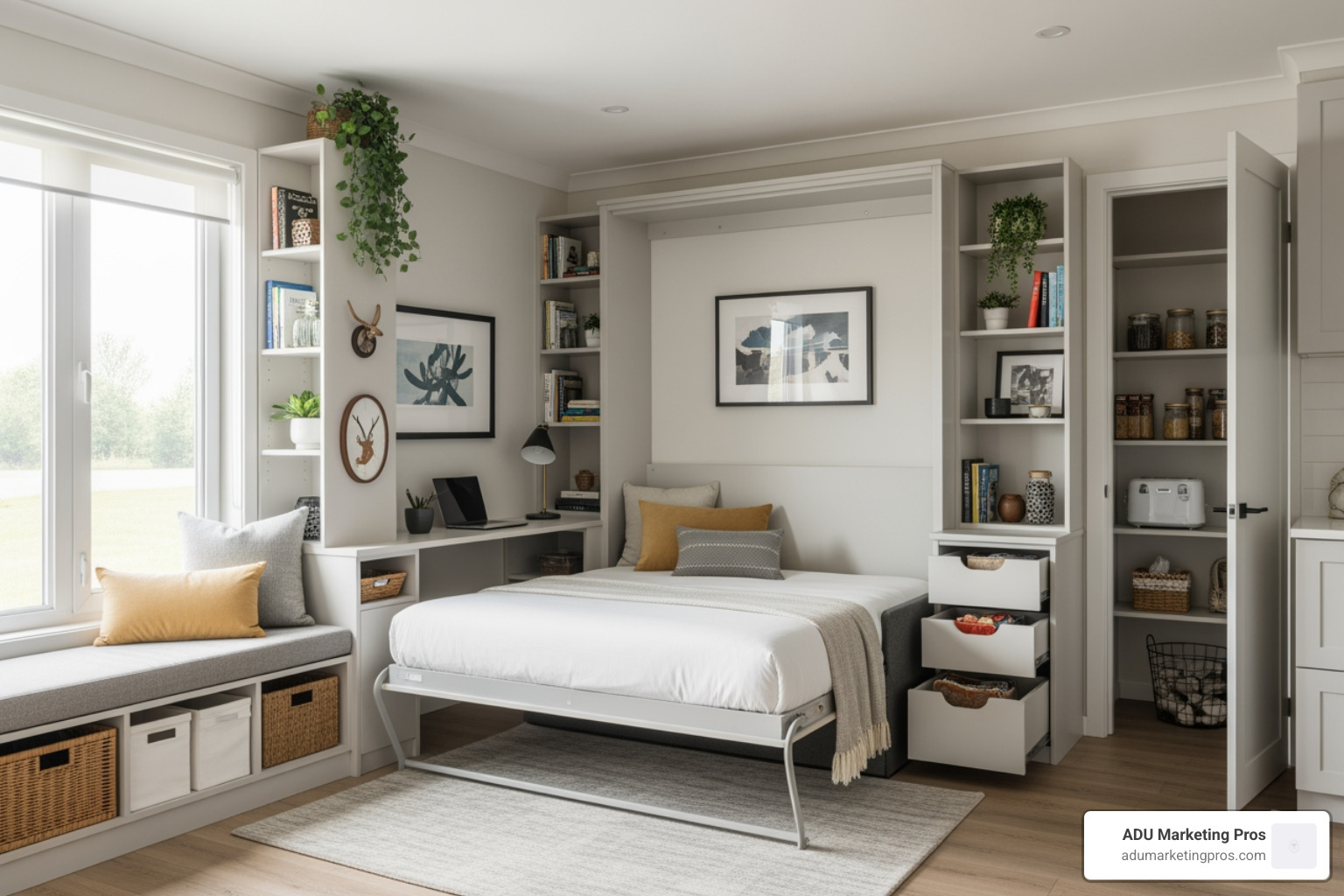
- Space Optimization: This is paramount. Think multi-functional furniture, like a Murphy bed that folds away to reveal a desk or seating area. Vertical storage, built-in shelving, and custom cabinetry are your best friends, ensuring everything has its place.
- Maximizing Natural Light: Natural light is a game-changer for small spaces, making them feel larger and more inviting. We recommend large windows, glass sliding doors, and strategically placed skylights. You can draw inspiration from innovative designs, such as sun-trap home designs, which are masterclasses in using daylight.
- Creating Zones: Even in an open-plan layout, you can define distinct areas. Use clever furniture arrangement, area rugs to delineate spaces, partial dividers (like open shelving units), or different lighting schemes to create a sense of separate living, sleeping, and working zones.
- Indoor-Outdoor Flow: Extending your living space outdoors is a brilliant strategy. Incorporate patios or decks that open directly from the studio. This outdoor area is often not counted in the allowable floor space by councils, meaning you can have a spacious extension without impacting your indoor footprint.
- Acoustic Planning: In an open-plan studio, sound can travel easily. Consider incorporating sound-absorbing materials like acoustic wall panels, thick area rugs, heavy curtains, and soft furnishings (cushions, upholstered furniture) to reduce echo and create a more peaceful environment.
- Essential Inclusions:
- Kitchenette vs. Full Kitchen: A kitchenette with essential appliances (mini-fridge, microwave, hotplate) can free up significant space compared to a full kitchen. However, if the unit is a full ADU, a full kitchen is usually required and feasible.
- Bathroom Layout: A full-size bathroom is entirely possible in a studio granny flat. Focus on smart layouts that maximize space, perhaps with a walk-in shower instead of a tub if space is tight.
- Omitting Laundry: If the main house has laundry facilities, you might consider omitting it from the studio to save space for other amenities or a larger patio.
- Space-Saving Doors: For privacy or to separate a multi-purpose room, consider using a space-saving pocket door that slides into the wall, eliminating the swing space of a traditional door.
Popular Layouts for a Granny Flat Studio
We’ve observed several popular design ideas that make the most of studio living:
- Linear Layout: This design groups the bathroom and kitchenette at one end, maximizing the open living area that stretches along the length of the unit. This creates a clear flow and a sense of depth, making it ideal for narrow lots.
- L-shaped Design: An L-shaped layout naturally carves out a semi-private sleeping nook, subtly separating it from the main living space without the need for a full wall. This is a great compromise for those who want a hint of separation.
- Studio with a Loft Bed: For those comfortable with vertical living, a loft bed dramatically frees up floor space below, allowing for a larger living area, dedicated office, or even a small dining space. This works best in units with higher ceilings.
- Open-Concept Square Layout: This design maintains an airy, spacious feel by having a central furniture grouping, with the kitchen and bathroom neatly tucked into corners or along one wall. It’s highly flexible and easy to reconfigure.
Making it a ‘Smart Studio’
Integrating technology can lift a granny flat studio from a simple dwelling to a sophisticated, efficient ‘smart studio’. This improves convenience, security, and energy efficiency. We recommend setting up a central control system, manageable from a smartphone or tablet, often through a smart home hub.
Here are some recommended smart devices:
- Smart Lighting allows for mood setting, energy savings, and automated schedules.
- Smart Thermostats learn your preferences and optimize heating and cooling, saving energy and ensuring comfort.
- Smart Plugs turn any appliance into a smart device, allowing remote control and energy monitoring.
- Smart Locks offer keyless entry, remote access control, and improved security.
- Security Cameras provide peace of mind with remote monitoring and alerts.
Sustainability and Climate-Conscious Planning
In California, where we operate, sustainable building practices are not just good for the planet, they’re often mandated and highly valued. When planning your granny flat studio, consider these aspects:
- Passive Solar Design: This involves strategically placing the unit and its windows to maximize natural heating and cooling. A north-facing orientation (in the Northern Hemisphere) for the longest wall and main windows allows for optimal sun exposure in winter and easier shading in summer.
- Natural Ventilation: Cross-ventilation, achieved through operable windows on opposite sides of the unit, helps maintain comfortable indoor temperatures and fresh air without relying heavily on air conditioning.
- Sustainable Materials: Opt for materials with a low environmental impact. This could include reclaimed wood, recycled steel, low-VOC (volatile organic compound) paints, and bamboo flooring.
- Energy and Water Efficiency: High-quality insulation in walls, roofs, and floors is critical. Double-glazed windows prevent heat loss and gain. Consider integrating solar panels for renewable energy and installing energy-efficient heating and cooling systems. For water conservation, use low-flow toilets, faucets, and showerheads. A cool roof with reflective materials can also significantly reduce cooling costs in the summer.
Financials and Regulations: Cost, ROI, and the Approval Process
Undertaking a granny flat studio project involves both financial investment and navigating local regulations. We aim to provide clarity on both fronts so you can make informed decisions.
Cost Implications and Return on Investment (ROI)
The cost of building a granny flat studio can vary widely, but it’s generally significantly less than a traditional granny flat or a full home addition.
Cost Factors:
- Size: Naturally, a larger studio will cost more.
- Materials and Finish Level: High-end finishes and custom materials will increase costs.
- Site Conditions: Difficult terrain, extensive tree removal, or complex utility connections can add to the budget.
- Prefab vs. Custom: As discussed, prefabricated options are typically more affordable and faster.
Return on Investment (ROI):
A granny flat studio can be a smart financial move. We often see clients recoup their investment through:
- Potential Rental Income: A steady stream of income from long-term or short-term rentals (e.g., Airbnb) can significantly offset costs. The demand for studio rentals in areas like Los Angeles, San Jose, and the Bay Area is consistently high.
- Increased Property Value: Adding a legal ADU almost always boosts your property’s overall market value.
- Home Office Savings: If used as a dedicated home office, you save on commercial rent or the cost of commuting.
Here’s a comparison of estimated costs and ROI for different studio ADU uses:
| Use Case | Estimated Upfront Cost Range | Potential Monthly Income/Savings | Estimated Years to Recoup Investment |
|---|---|---|---|
| Long-Term Rental | $90,000 – $180,000 | $1,500 – $2,500 | 4 – 8 years |
| Short-Term Rental (e.g., Airbnb) | $90,000 – $180,000 | $2,000 – $4,000+ (variable) | 3 – 6 years |
| Home Office | $70,000 – $150,000 | $500 – $1,500 (vs. commercial rent) | 6 – 12 years |
Note: These figures are estimates and can vary based on location, design, and market conditions.
While short-term rentals can offer higher monthly income and a faster ROI, they also require more active management, including cleaning, guest communication, and managing bookings. Long-term rentals provide a more stable, passive income stream with less day-to-day involvement. Your choice will depend on your financial goals and how hands-on you want to be.
Navigating the Regulatory and Approval Process
Understanding local regulations is perhaps the most critical, and sometimes the most challenging, part of building a granny flat studio in California. While the state has made significant efforts to streamline ADU approvals, local jurisdictions (like those in San Diego, San Francisco, or Sunnyvale) still have their own specific requirements.
The Typical Approval Journey:
- Feasibility & Consultation: Start by consulting with an ADU specialist to assess your property’s eligibility, discuss your goals, and understand the potential costs and local rules.
- Design & Engineering: Work with a designer or architect to create plans that meet your needs and comply with all building codes, zoning laws, and energy standards.
- Permit Application Submittal: Your completed plans are submitted to the local planning and building departments for review.
- Plan Check & Revisions: The city reviews your plans. They may request corrections or clarifications. This back-and-forth is a normal part of the process.
- Permit Issuance: Once all requirements are met, the city issues the building permits, and construction can begin.
Key Regulations to Watch:
- Local Zoning Laws: These dictate key aspects such as:
- Setbacks: The minimum distance your studio must be from property lines. Building taller than 3.8 meters (approx. 12.5 ft) can sometimes increase setback requirements.
- Height Restrictions: Maximum allowable height for the structure.
- Lot Coverage: The percentage of your lot that can be covered by structures.
- Maximum Size: While state law sets minimums, local ordinances might have their own specific maximums for ADUs, though these have generally been eased.
- State-Level Influence: California ADU laws have been instrumental in easing restrictions, making it easier and more affordable for homeowners to build ADUs. These laws often override more restrictive local ordinances, standardizing many aspects of the approval process. This has been a huge win for homeowners in places like San Jose and Menlo Park looking to add value and living space.
- Professional Consultation: We cannot stress this enough: engage with experienced ADU specialists, architects, or builders who are intimately familiar with California’s ADU laws and your specific local council’s requirements. Their expertise is invaluable for navigating bureaucracy, ensuring compliance, and avoiding costly delays or mistakes.
Frequently Asked Questions about Studio Granny Flats
We often hear similar questions from homeowners exploring the possibility of adding a granny flat studio to their property. Here are some of the most common ones we address:
Can a studio granny flat have a full kitchen?
Yes, in most jurisdictions, a granny flat studio classified as a habitable Accessory Dwelling Unit (ADU) can have a full kitchen. California state laws for ADUs generally require them to be fully self-contained, which includes kitchen facilities. However, some homeowners opt for a smaller, more efficient kitchenette to maximize living space and potentially simplify the permitting process if the unit is classified as an ancillary structure rather than a full dwelling. It’s always best to confirm the specific requirements with your local planning department in Los Angeles, San Diego, or the Bay Area.
How long does it take to build a studio granny flat?
The timeline varies significantly based on the construction method. A prefabricated or modular granny flat studio can often be installed and finished in just a few weeks to a couple of months, sometimes with parts of the setup happening in as little as two hours for certain models. A fully custom, site-built studio granny flat will typically take longer, ranging from 4 to 9 months. This timeline includes design, permitting, and construction, with the permitting process in your local area (like Sunnyvale or Palo Alto) being a major variable.
Do I need an architect to design a granny flat studio?
While not always legally required for smaller or simpler projects, hiring an architect or an experienced ADU designer is highly recommended. Their expertise is invaluable for maximizing functionality in a small footprint, creating an aesthetically pleasing design, and ensuring the plans meet all local building codes and regulations, which can save you time and money in the long run. An architect can also help you strategically place the unit to optimize for climate and passive solar design, ensuring a comfortable and energy-efficient living space in places like Mountain View or Menlo Park.
What are the property tax implications of adding a studio ADU?
Adding a studio ADU will trigger a reassessment of your property’s value for tax purposes, but it’s not as scary as it sounds. California’s Proposition 13 protects your main home’s assessed value. Only the value of the new construction (the ADU itself) will be added to your property tax bill. This is called a “blended assessment.” The increase is typically modest relative to the value and potential income the ADU adds.
How can I finance the construction of a studio granny flat?
Several financing options are available. The most common include a cash-out refinance of your existing mortgage, a Home Equity Line of Credit (HELOC), or a home equity loan. Some lenders also offer specific construction loans or renovation loans (like the FHA 203k loan) that are well-suited for ADU projects. It’s wise to speak with a mortgage broker who has experience with ADU financing to explore the best option for your financial situation.
Does a studio granny flat need its own address and utility meters?
This depends on local regulations and your intended use. Many jurisdictions do not require a separate address for an ADU, but it can be beneficial for mail and emergency services. Similarly, separate utility meters (for electricity, water, and gas) are often not required but are highly recommended if you plan to rent the unit out. Separate meters allow for easy and accurate billing, making the landlord-tenant relationship much simpler. If the studio is for personal use, tying into the main house’s utilities is usually the most cost-effective approach.
Conclusion: Is a Granny Flat Studio Right for You?
The granny flat studio represents a powerful, modern solution for homeowners seeking flexibility, affordability, and increased property utility. We’ve seen how these compact dwellings, despite their small footprint, offer big potential to meet a diverse range of needs in today’s challenging housing environment.
Key Benefits Summary
To recap, the primary advantages of a granny flat studio are clear and compelling:
- Affordability: They are typically the most cost-effective ADU option, often saving significant money on construction, fees, and long-term utilities.
- Versatility: They are the ultimate flexible space, perfect for generating rental income, creating a dedicated home office, hosting guests, or housing family members.
- Space Efficiency: Their compact nature makes them ideal for smaller lots and narrow blocks, preserving valuable outdoor space and fitting where larger units cannot.
A Smart Investment for Modern Homeowners
In today’s dynamic housing market, a granny flat studio is more than just an extra room; it’s a strategic financial asset. It demonstrably improves your property’s value, provides a flexible tool to adapt to life’s changes, and helps address the growing demand for diverse housing solutions in communities across California. Whether you’re looking to generate passive income, enable multigenerational living, or carve out a much-needed personal sanctuary, the return on investment—both financial and personal—can be substantial.
Final Encouragement
As you consider this exciting option, we encourage you to assess your personal needs, evaluate your property’s unique potential, and most importantly, understand your local regulations in Los Angeles, San Diego, the San Francisco Bay Area, San Jose, Sunnyvale, Palo Alto, Mountain View, or Menlo Park. With careful planning and the right professional guidance, a granny flat studio can be a transformative and rewarding addition to your home and your life.
For ADU construction and architecture firms aiming to connect with homeowners interested in these innovative projects, ADU Marketing Pros provides specialized marketing strategies to showcase your expertise and grow your business in a competitive market.
Explore our comprehensive guide to Studio ADU Floor Plans for more design inspiration.