
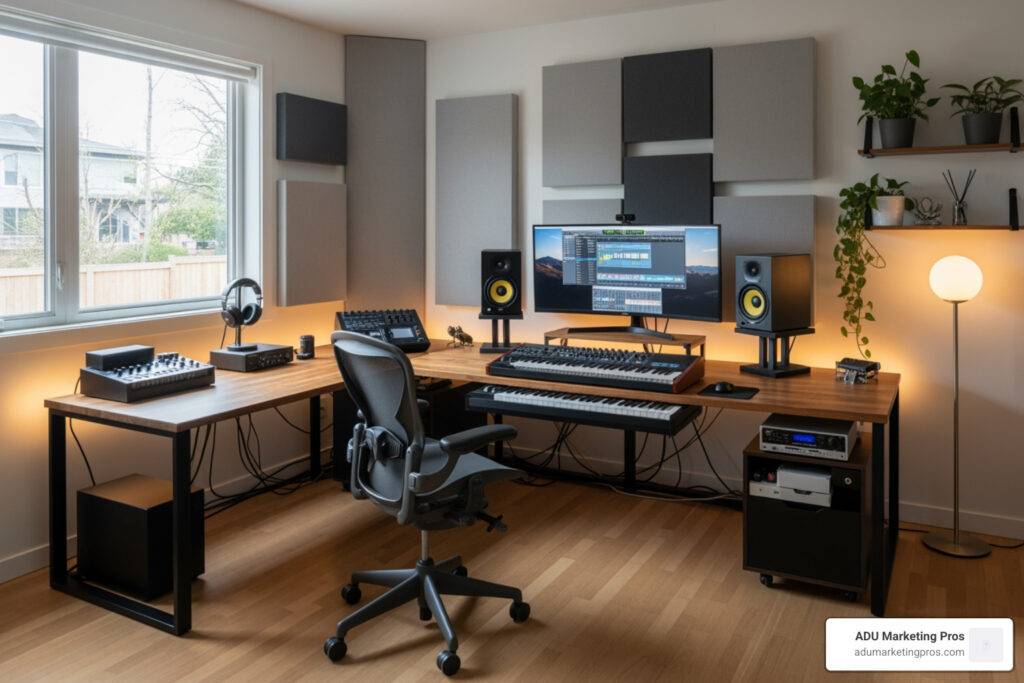
Why a Home Office Studio is More Than Just a Desk
A Home office studio combines the best of two worlds: a dedicated workspace for focused productivity and a creative environment for artistic pursuits. Whether you’re looking to escape household distractions, need professional-grade acoustics for music production, or simply want a room of your own to think and create, the right setup can transform how you work and live.
Quick Answer: What You Need for a Home Office Studio
- A dedicated space – Separate room, backyard shed, or converted closet
- Essential furniture – Ergonomic desk and chair, storage solutions
- Proper lighting – Natural light plus layered artificial lighting
- Acoustic treatment – Soundproofing and sound absorption (especially for music/recording)
- Core equipment – Computer, relevant software, and any specialized gear for your work
The shift to remote work has been dramatic. Since before the pandemic, the number of people working from home has increased by 47%. This isn’t just about convenience—it’s about creating a space that genuinely supports your goals.
Working from home provides you with a flexible schedule, saves you on travel costs, and will keep you closer to your family, as one backyard studio provider notes. But it also comes with distractions that can derail productivity. That’s where a purpose-built home office studio makes all the difference.
The beauty of a dedicated studio space is its versatility. You might use it as a traditional home office during the day, then switch to recording music in the evening. Or it could serve as a photography studio, a writing sanctuary, or a place for client meetings that keeps your personal living space private.
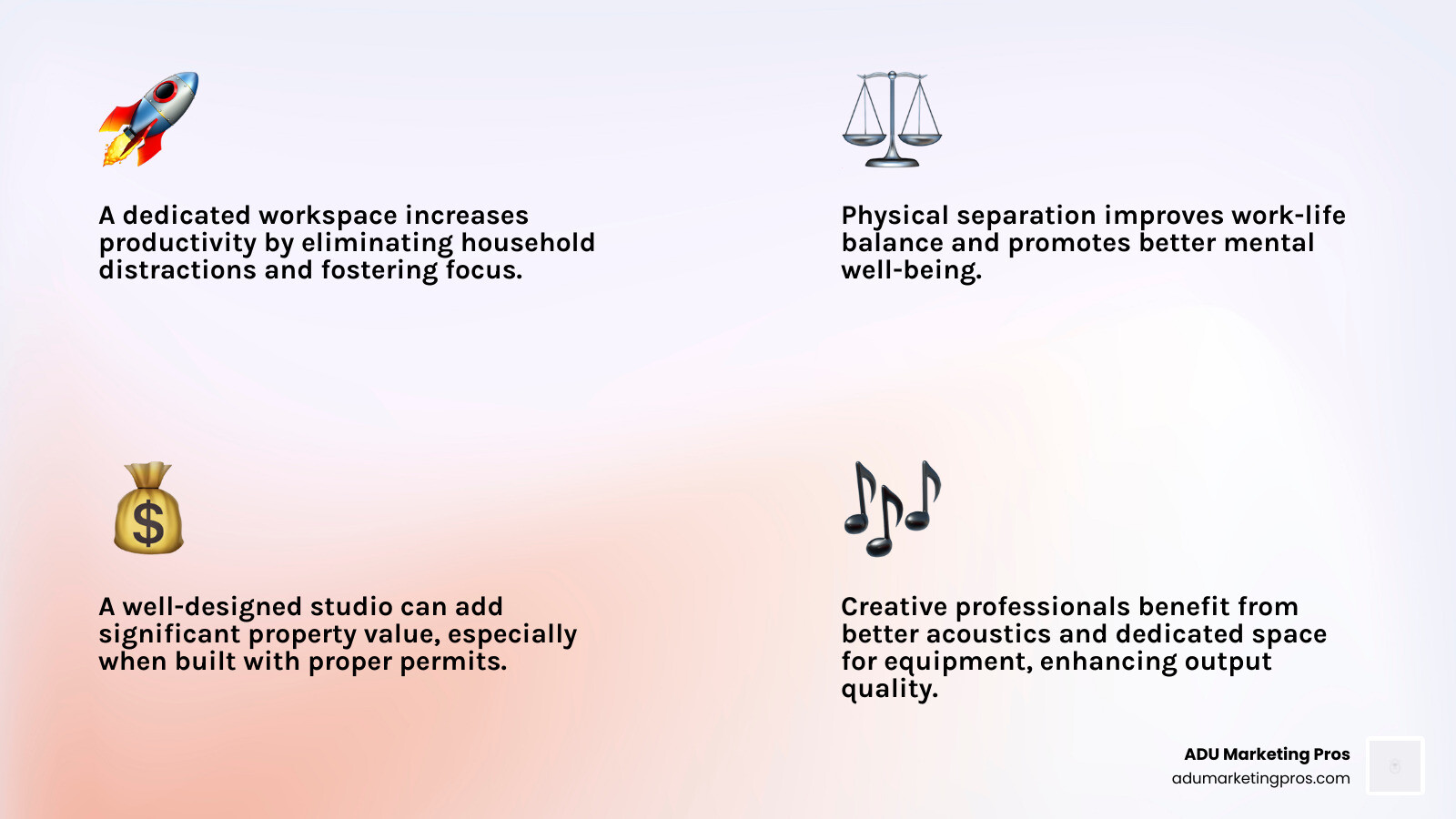
Research shows that a dedicated home office space can lead to increased productivity and performance. It’s not just about getting more done—it’s about creating an environment where your best work happens naturally. For creative professionals, that might mean pristine acoustics and specialized equipment. For remote workers, it could mean separating work life from home life in a meaningful way.
Some home office studios are simple corner setups in existing rooms. Others are elaborate backyard structures that feel like a completely separate building. The right solution depends on your needs, budget, and available space—but the benefits are universal.
Planning Your Home Office Studio: Key Considerations Before You Start
Starting on the journey to create your ideal home office studio requires thoughtful planning. It’s more than just picking out a desk; it’s about designing a space that aligns with your professional and creative aspirations.

Defining Your Needs: Office, Studio, or Hybrid?
The first step in planning your home office studio is to clearly define its purpose. Will it primarily be a place for general office tasks, such as answering emails and managing projects? Or are you aiming for a creative hub—perhaps a music production studio, an art studio, a photography space, or a dedicated area for podcasting? Many of us need a hybrid space that seamlessly transitions between these roles.
Consider whether you’ll be hosting client meetings, either virtually or in person. This will influence factors like privacy, aesthetics, and overall setup. If it’s a personal retreat, your focus might shift more towards comfort and inspiration. The more specific you are about your needs, the better we can tailor the space to support your unique workflow and well-being.
Budgeting for Your Build: From DIY to Detached
Understanding the costs associated with building or purchasing a home office studio is crucial. Budgets can vary widely depending on the type and scale of your project.
- DIY Desk Setups: For those in small apartments or with limited funds, budget-friendly DIY desk solutions can be incredibly effective. This might involve repurposing furniture, using a console table, or even a folding table for a temporary workspace. Costs here are minimal, focusing on the desk surface itself and perhaps a comfortable chair.
- Room Conversion Expenses: Changing an existing room, such as a spare bedroom or a portion of a basement, involves costs for renovations, furniture, and potentially some light construction or acoustic treatment. These can range from a few hundred to several thousand dollars, depending on the extent of the remodel.
- Prefab Shed Pricing: Prefabricated backyard office sheds offer a mid-range solution. These units can be ordered and installed relatively quickly. While prices vary based on size and customization, they typically offer a significant saving compared to custom builds. Installation of popular sizes can take less than a week, including interior finishes and electrical connections.
- Custom ADU Investment: A custom Accessory Dwelling Unit (ADU) represents a more significant investment but offers unparalleled flexibility, value, and permanence. ADUs are increasingly popular in California, including our service areas like Los Angeles, San Diego, and the San Francisco Bay Area, as they can add substantial value to a property and provide a truly dedicated, independent workspace.
Regardless of your chosen path, it’s wise to explore financing options if needed. You might find resources available to help with renovation costs. Ready to renovate, but need financing?Learn More.
Location, Location, Location: Inside or Outside?
Where you place your home office studio profoundly impacts its functionality and your work-life balance.
- Attached Options: Converting an existing room inside your home (e.g., a spare bedroom, a corner of the living room, or even a closet) offers convenience and immediate access to utilities. However, it can present challenges with noise isolation and maintaining a clear separation between work and home life. Maximizing natural light is key for mood and productivity; positioning your desk near a window can make a significant difference.
- Detached Options: A backyard shed or an ADU provides physical separation from the main house, offering a “commute” of mere seconds. This separation is invaluable for reducing household distractions and establishing a clear boundary between personal and professional time. Detached units also allow for greater control over noise, making them ideal for music or creative studios. When planning, consider proximity to utilities (electricity, internet) and accessibility to your backyard.
For those of us in the busy areas of California, like San Jose, Sunnyvale, or Palo Alto, a detached unit can be a game-changer, offering a quiet sanctuary away from the main house.
Types of Home Office Studios: Finding the Perfect Fit for Your Space
The beauty of creating a home office studio lies in the sheer variety of options available. Whether you have ample backyard space or are working with a cozy apartment, there’s a solution that can meet your needs.
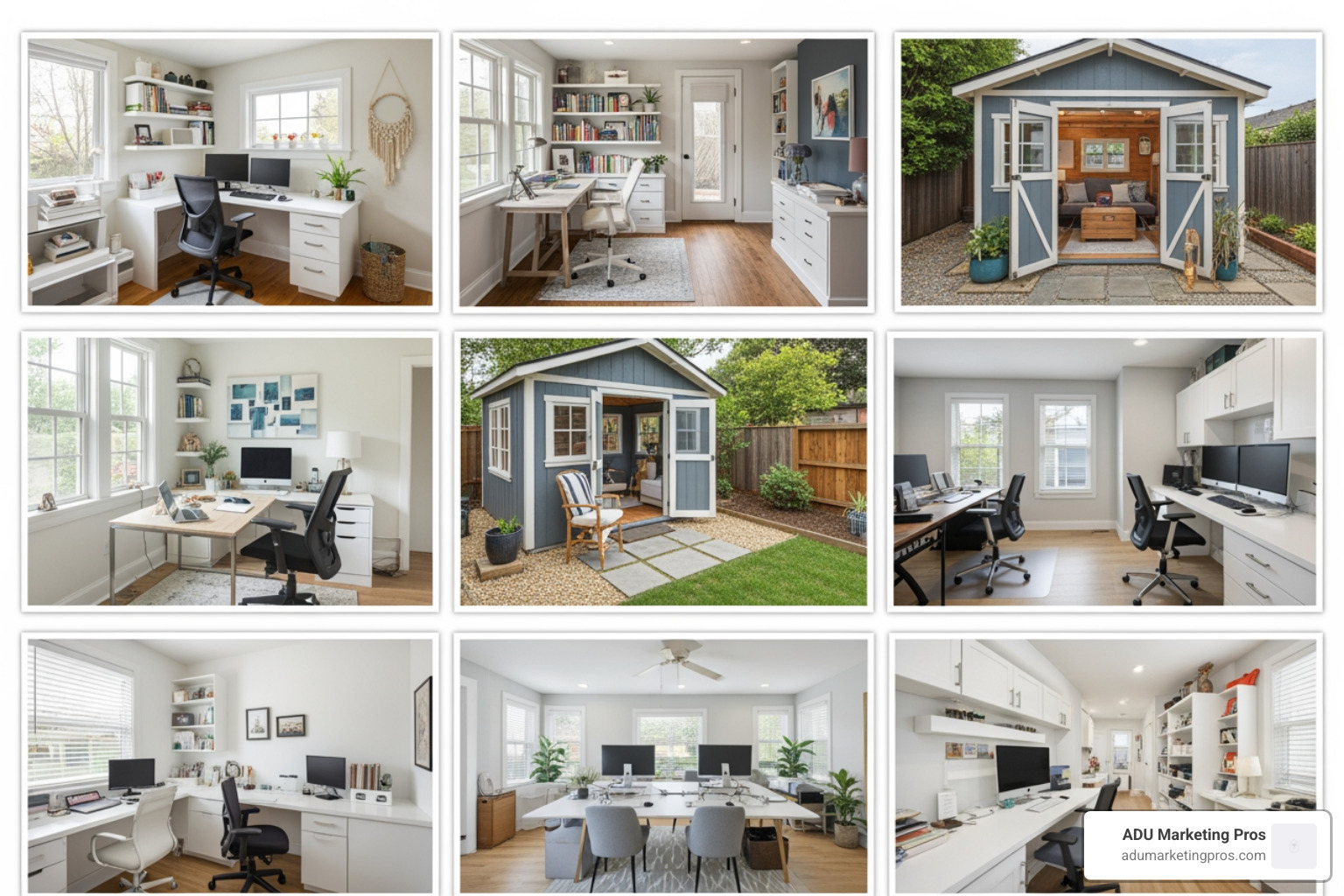
The Detached Retreat: Backyard Sheds and ADUs
For the ultimate work-life separation, a detached home office studio in your backyard is often the ideal choice. This option provides a physical boundary that helps minimize household distractions and offers a true sense of “commuting” to work, even if it’s just a few steps.
- Prefab Backyard Office Sheds: These units are a popular and efficient choice. They offer a quick turnaround and can be designed to match your aesthetic. Many come with customization options for sizes, door, and window placements. They are built with efficiency in mind, often using green materials, and can be installed relatively quickly. As one provider highlights, “A Studio Shed backyard office is a place you can commute to in seconds, without the distractions of an office in your home.” Owners have even found that these sheds can add more to their home’s appraised value than they paid for them, making them a smart investment. You can Design & Price Prefab Backyard Office Sheds to explore options.
- Modular Units: Similar to prefab sheds, modular units offer flexibility and a faster construction timeline than traditional builds. They can be delivered as pre-built sections and assembled on-site, offering a robust and customizable solution.
- Custom ADUs (Accessory Dwelling Units): For those seeking a more permanent, fully integrated, and highly customized solution, a custom ADU is an excellent choice. Especially in California’s competitive housing market, ADUs are gaining immense popularity in places like Los Angeles, San Diego, and the San Francisco Bay Area. They can be designed as fully functional living spaces, complete with plumbing and extensive electrical, offering far greater flexibility than a simple shed. ADU Marketing Pros specializes in helping construction and architecture firms stand out in this booming sector, recognizing the value these units bring to both homeowners and the broader community. A custom ADU can truly become a multi-purpose studio, guest house, or rental unit, significantly increasing your property’s value and utility.
The Integrated Workspace: Carving Out Space Inside
Not everyone has a backyard suitable for a detached unit, but that doesn’t mean a dedicated home office studio is out of reach. We can ingeniously integrate workspaces within our existing homes.
- Spare Room Conversion: The most straightforward approach is converting a spare bedroom into an office. This provides a clear boundary and often has existing windows for natural light.
- Guest Room Office: A popular hybrid solution, a guest room office combines a bed (perhaps a Murphy bed or a daybed) with a functional desk setup. This allows the room to serve dual purposes without feeling cluttered.
- Basement or Attic Remodel: These areas, if properly finished and insulated, can offer a quiet, secluded space away from the main living areas. They often require more extensive renovation but can yield highly personalized and sound-isolated studios.
- Repurposing Alcoves and Under-Stair Nooks: Don’t overlook the potential of small, often unused spaces. An alcove can be fitted with built-in shelving and a desk, while the space under stairs can become a surprisingly functional workstation. These solutions are perfect for making the most of every square foot in smaller homes or apartments in places like San Jose.
Small Space, Big Impact: A Functional Home Office Studio in an Apartment
Living in a small apartment, common in urban centers like San Francisco and Los Angeles, requires creativity to carve out a dedicated home office studio. But it’s absolutely achievable!
- Closet Office (Cloffice): One ingenious solution is converting a closet into a “cloffice.” Simply remove the doors, install a desk surface and shelving, and you have a dedicated, albeit compact, workspace that can be closed off at the end of the day.
- Multi-functional Furniture: Invest in furniture that serves multiple purposes. A console table can act as a desk during the day and a decorative surface in the evening. A secretary-style desk folds down when not in use, creating a seamless look in a studio apartment.
- Wall-Mounted Desks and Vertical Storage: When floor space is limited, go vertical! Wall-mounted desks fold up when not needed, and floating shelves or wall-mounted pegboards provide essential storage without occupying precious square footage.
- Using Mirrors to Expand Space: Mirrors are a designer’s trick to make small rooms feel larger and brighter. Strategically placed mirrors can bounce light and create the illusion of more space, making your compact studio feel less confined.
- Living Room Desk: If space is truly at a premium, placing a narrow console table behind a floated sofa can create a functional desk area, as suggested by one expert. This uses existing furniture arrangements to create a dedicated workspace without adding clutter. Alternatively, a console table in front of a bed can serve as a temporary workspace. The key is a hard, flat surface at an appropriate height.
The Core Setup: Essential Elements for Productivity and Comfort
Ergonomics: Designing for Health and Well-being
Long hours at a desk can take a toll on our bodies if we’re not careful. Investing in ergonomic principles for your home office studio is an investment in your long-term health and productivity.
- Ergonomic Chairs: This is perhaps the most critical piece of furniture. Look for a chair with excellent lumbar support, comfortable cushioning, and adjustable features (seat height, armrests, back tilt) to maintain optimal posture. Don’t worry about “frumpy” office chairs—plenty of stylish options exist, some even resembling unique dining or accent chairs.
- Adjustable-Height Desks: The debate of standing vs. sitting is ongoing, but an adjustable-height desk allows us to switch positions throughout the day, reducing static posture and improving circulation.
- Correct Monitor Height: Your monitor should be positioned so the top third of the screen is at eye level. This prevents neck strain.
- Keyboard and Mouse Placement: Keep your keyboard and mouse close to your body, allowing your elbows to remain at a 90-degree angle when typing. This minimizes strain on your wrists and shoulders.
Lighting the Way to Success
Lighting plays a huge role in our mood, focus, and eye comfort. A well-lit home office studio can boost energy and reduce fatigue.
- Natural Light: Whenever possible, position your desk to take advantage of natural light. Facing a window or having one to your side can be incredibly beneficial. Natural light improves mood and overall productivity.
- Layered Lighting: Relying on a single overhead light isn’t enough. We recommend a combination of:
- Ambient Light: General room illumination, often from ceiling fixtures.
- Task Lighting: A desk lamp provides focused light for reading or writing, reducing eye strain.
- Accent Lighting: Decorative lighting that highlights artwork or architectural features, adding personality and warmth.
- Avoiding Screen Glare: Position computer monitors to avoid glare from windows or overhead lights. Strategic placement of lamps is also key for adequate illumination without reflections.
- Color Temperature: Cool-toned (bluish-white) light can be energizing for work, while warm-toned (yellowish-white) light is more relaxing. Consider smart bulbs that allow you to adjust the color temperature throughout the day.
Smart Storage and Organization
A cluttered space often leads to a cluttered mind. Effective storage and organization are paramount for a functional and calming home office studio.
- Built-in Shelving: An neat solution for books, files, or decorative items, built-in shelves maximize vertical space and create a seamless look.
- Filing Cabinets and Drawer Organizers: For papers and smaller supplies, filing cabinets (rolling or lockable) keep things tidy. Drawer organizers prevent pens, cables, and other small items from becoming a jumbled mess.
- Wall-Mounted Pegboards: These versatile tools offer flexible storage for tools, supplies, or even decorative elements, freeing up desk space.
- Effective Cable Management: Nothing detracts from a clean workspace like a tangle of cables. Use cable ties, sleeves, or surface-mounted cable ducts to keep wires organized and out of sight.
- Maintaining a Clutter-Free Zone: Regularly declutter your workspace. As one expert suggests, “De-clutter your workspace before starting work.” A clear desk allows for clear thinking. Use visual aids like a large to-do list to stay organized and motivated.
From Office to Studio: A Guide to Acoustics and Audio Gear
For those of us whose home office studio involves audio—whether it’s music production, podcasting, or voice-overs—acoustics and specialized gear become paramount. Achieving professional-quality sound at home is entirely possible with the right approach.
Soundproofing vs. Acoustic Treatment
These two terms are often used interchangeably, but they serve distinct purposes in a home office studio. Understanding the difference is key to getting the sound right.
- Soundproofing: This is about blocking external noise from entering your studio and preventing internal sound from escaping. It involves creating a physical barrier to sound waves. Think heavy, solid doors, sealed windows, and mass-loaded vinyl. For example, if you live in a busy area like San Francisco or Los Angeles, soundproofing is essential to keep city noise out of your recordings.
- Acoustic Treatment: This focuses on controlling internal reflections and managing how sound behaves within your room. It improves the clarity and accuracy of the sound you hear.
- Sound Absorption: Materials like acoustic panels, thick rugs, and heavy curtains absorb sound waves, reducing echo and reverberation. Walk-in closets, with their clothing, are naturally good absorbers, making them surprisingly effective for vocal booths.
- Sound Diffusion: Diffusers scatter sound waves, preventing harsh reflections and creating a more even, natural-sounding space.
- Bass Traps: These are crucial for managing low-frequency sounds, which tend to build up in room corners and can muddy your audio. Placing them in corners helps to “trap” these frequencies.
For budget-conscious options, heavy curtains, area rugs, door sweeps, and weatherstripping can offer significant improvements. DIY acoustic panels made from dense materials can also be effective.
Essential Gear for Your Home Recording Studio
Setting up a home recording studio like a pro involves selecting the right tools for the job.
- Computer Specifications: Your computer is the brain of your studio. We recommend a machine with a 64-bit operating system, a multi-core processor, and at least 8 GB of RAM (16 GB or 32 GB is ideal for demanding audio tasks). Don’t let the “spinning beach ball of death” kill your creativity! Internal hard drive space is important for software, but an external hard drive (SSD recommended for speed) is crucial for storing project and audio files.
- Digital Audio Workstation (DAW): This is your primary software for recording, editing, and mixing. What is a DAW in music? DAWs like Pro Tools, Ableton, Reaper, and Reason are popular on both Mac and PC, though Logic is Mac-only. Each DAW has unique functionality; for example, Ableton is great for beat-making, while Pro Tools excels in film scoring.
- Audio Interface: This device connects your microphones and instruments to your computer, converting analog signals into digital data. When choosing, consider how many microphones you’ll need to record simultaneously. A two-channel interface is often sufficient for voice or a single instrument.
- Microphones (Condenser vs. Dynamic):
- Condenser Microphones: More sensitive, capture finer details, and have a high-frequency response. They usually require “phantom power” (48V) from your audio interface. Ideal for vocals and acoustic instruments in treated rooms.
- Dynamic Microphones: More robust, less sensitive, and better at rejecting background noise. Excellent for loud sounds like vocals, drums, or electric guitar amps, especially in less-than-ideal acoustic environments.
- Studio Monitors: These are specialized speakers designed to provide a “flat” (linear) frequency response, meaning they reproduce sound accurately without coloration. This is crucial for mixing, as it ensures your music sounds good on various playback systems.
- Headphones (Open-back vs. Closed-back):
- Closed-back Headphones: Provide good sound isolation, making them ideal for recording (to prevent click tracks or other instruments from bleeding into the microphone) and monitoring.
- Open-back Headphones: Offer a more natural, airy sound, often preferred for critical listening and mixing, but they don’t provide much isolation.
Optimal Layout for Pristine Audio
Even with top-notch gear, a poor layout can compromise your sound. We focus on optimizing your home office studio for acoustic performance.
- The Listening Triangle: Position your studio monitors and your listening position to form an equilateral triangle. This ensures an accurate stereo image and balanced frequency response.
- Speaker Placement: Place monitors 1-2 feet from the back wall to prevent bass buildup. Raise them to ear level using stands or isolation pads.
- Desk Position: Your desk should ideally be positioned with the monitors facing the shortest wall of the room. This helps to minimize early reflections.
- Minimizing Reflections: Hard, flat surfaces (like your desk) can cause unwanted reflections. Consider placing acoustic treatment at “first reflection points” on your side walls and ceiling.
- Microphone Placement Techniques: Experiment with microphone placement relative to the sound source. Even small adjustments can dramatically change the recorded sound.
- Isolating Gear from Vibrations: Place monitors on isolation pads to prevent vibrations from transferring to your desk, which can color the sound. Ensure your computer is quiet or isolated to minimize fan noise in recordings.
Conclusion: Your Questions Answered & Next Steps
Creating a dedicated home office studio is a significant step towards enhancing your productivity, fostering creativity, and improving your overall work-life balance. We’ve explored the myriad options, from DIY solutions in compact apartments to custom ADUs in spacious backyards, and digd into the essential elements that make these spaces truly functional.
| Home Office Studio Type | Cost Range (Estimated) | Time to Implement | Separation from Home |
|---|---|---|---|
| Room Conversion | Low to Mid ($500 – $10,000+) | Weeks to Months | Moderate |
| Prefab Shed | Mid ($10,000 – $50,000+) | Weeks | High |
| Custom ADU | High ($100,000 – $300,000+) | Months to Year+ | Very High |
How much does it cost to build a home office studio?
The cost to build a home office studio varies widely based on the complexity and type of setup.
- DIY budget solutions can be as low as a few hundred dollars for a console table and ergonomic accessories.
- Mid-range room conversions, including furniture, some renovations, and basic acoustic treatment, might fall between $1,000 and $10,000.
- High-end prefab and custom builds, such as a fully equipped backyard office shed or a custom ADU, can range from $10,000 to well over $100,000, especially in California’s market. Factors like size, materials, customization, utility hookups, and permits all influence the final price.
Can a backyard office add value to my home?
Absolutely! A well-designed backyard office, especially a prefab shed or an ADU, can significantly add value to your home. Many owners have found that their dedicated backyard studio has added more to their home’s appraised value than they paid for it. This isn’t just about monetary value; it also improves the marketability of your property, appealing to the growing number of remote workers. Quality of construction and adherence to local permits in areas like Los Angeles, San Jose, or San Diego are crucial for maximizing this value.
How can I soundproof my home office studio on a budget?
Soundproofing doesn’t have to break the bank. Here are some budget-friendly tips:
- Heavy Curtains: Thick, floor-to-ceiling curtains on windows can absorb a surprising amount of sound.
- Area Rugs: A large, dense area rug can significantly reduce reflections from hard floors.
- Door Sweeps & Weatherstripping: Seal gaps around doors and windows to block external noise from entering or escaping.
- DIY Acoustic Panels: You can create simple acoustic panels using rigid insulation wrapped in fabric.
- Using Furniture for Diffusion: Strategically placing bookshelves, cabinets, or even a comfortable sofa can help diffuse sound waves, breaking up harsh reflections.
Build Your Dream Workspace
Creating a space that inspires both work and creativity is a powerful investment in your professional and personal life. For those considering the ultimate detached solution, connecting with expert ADU builders is the first step. We understand the unique needs of property owners in California, from the San Francisco Bay Area to San Diego, and are committed to helping you find the perfect solution. Ready to explore floor plans and find a builder? View our studio ADU floor plans for inspiration.