
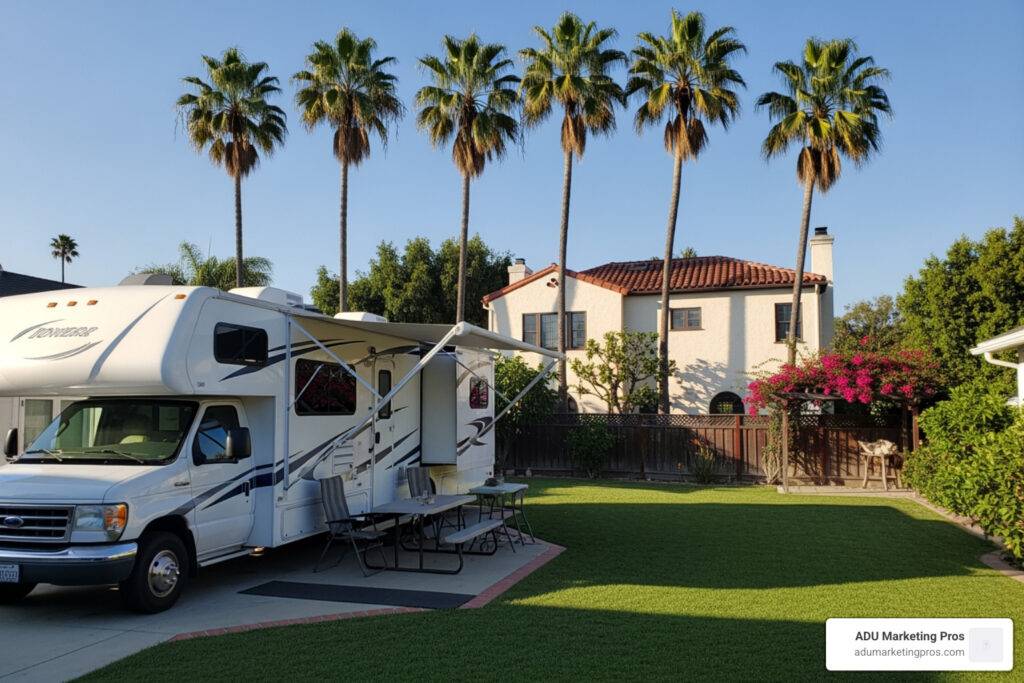
Navigating LA’s Housing Rules: The RV and ADU Question
The Los Angeles accessory dwelling unit ordinance use an RV question comes up a lot, driven by a housing crisis that has pushed residents to seek creative and affordable living solutions. The short answer, however, remains firm: No, you cannot legally use an RV as a permanent Accessory Dwelling Unit (ADU) in Los Angeles under normal circumstances. While limited exceptions exist for temporary housing during declared emergencies, they are not a loophole for permanent living and come with stringent health and safety regulations.
As the cost of living in Los Angeles continues to soar, the appeal of using a recreational vehicle as a backyard rental or family home is understandable. It seems like a fast, affordable alternative to traditional construction. However, the city’s legal framework prioritizes safety, sanitation, and long-term community planning, placing RVs and ADUs in entirely different categories. Misunderstanding these laws isn’t just a minor oversight; it can lead to significant legal trouble, including code violation notices, fines of up to $500, or even misdemeanor charges punishable by up to six months in jail.
Quick Answer Expanded:
- RVs are NOT Permitted for Habitation: Los Angeles Municipal Code (LAMC) broadly prohibits using vehicles, including RVs, for living or sleeping overnight on most private residential properties. This is a zoning and public health rule.
- RVs are NOT Classified as ADUs: The legal definition of an ADU under LAMC Section 12.22.A.33 requires a permanent foundation and compliance with residential building codes. RVs, being vehicles on wheels, fail this fundamental test.
- Temporary Exceptions are Rare and Specific: The city only allows temporary RV habitation during a formally declared shelter crisis or after a natural disaster destroys a primary residence. These are not permanent solutions.
- Movable Tiny Houses (MTHs) are Different: An MTH is a distinct category that can be an ADU, but it must be built to residential standards (not RV standards) and receive special certification. It is not the same as a standard travel trailer or motorhome.
- ADUs Require Full Legal Compliance: A legal ADU involves a formal process of obtaining building permits, undergoing inspections, and securing permanent utility connections to ensure it is a safe, habitable, and lasting structure.
- RVs Lack Permanent Dwelling Status: The very features that make an RV great for travel—its wheels, temporary hookups, and vehicle registration—are what disqualify it as a legal, permanent dwelling unit in the eyes of the law.
This guide cuts through the confusion to provide a comprehensive overview of the rules. We’ll explore what the law says, when the rare exceptions apply, and what you absolutely must know about public health requirements if you’re considering temporary RV housing during a sanctioned emergency.
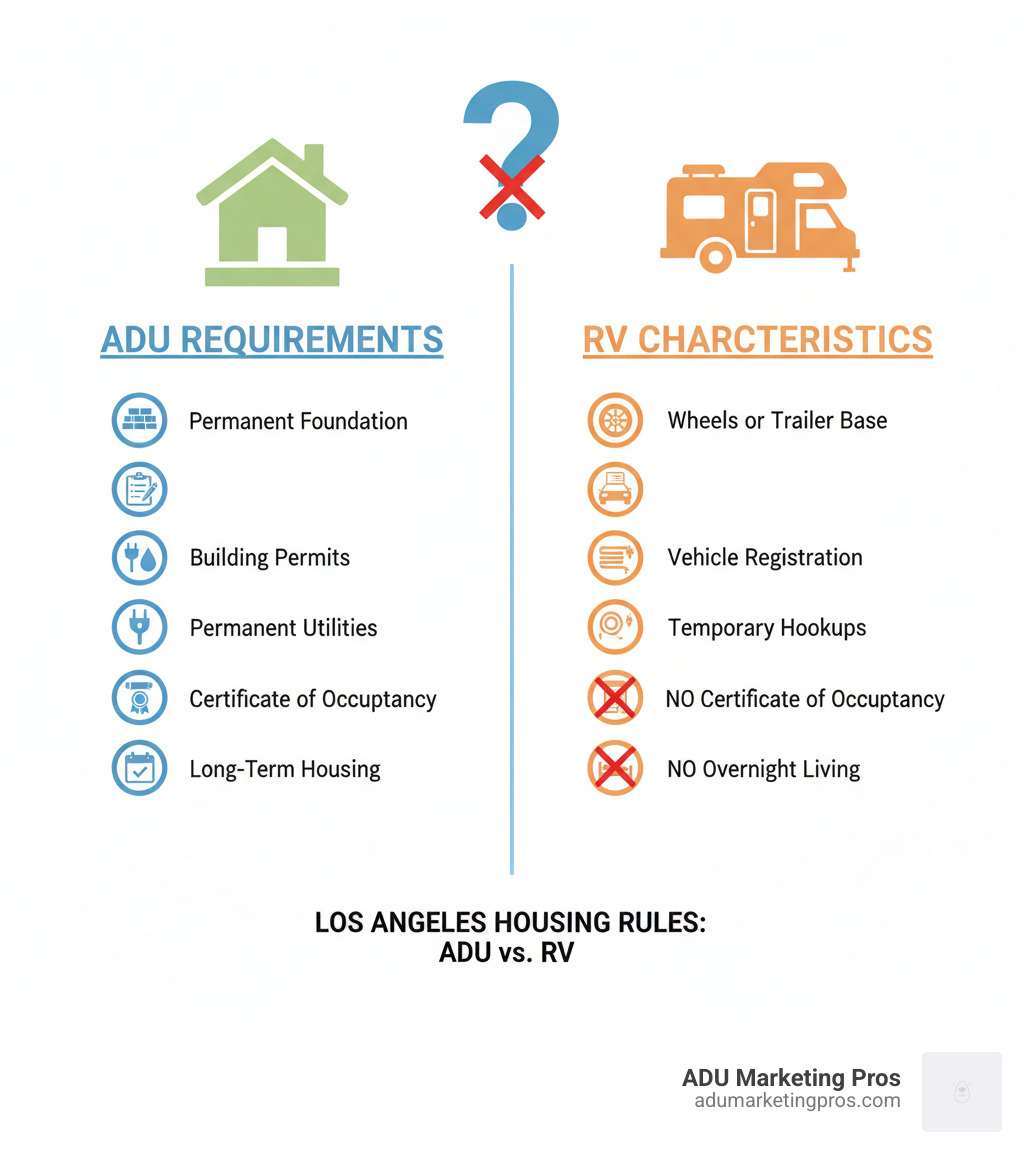
What’s the Difference? Defining ADUs and RVs in Los Angeles
To fully grasp the Los Angeles accessory dwelling unit ordinance use an RV issue, we must first clearly define our terms. While both can provide living space, Los Angeles law, influenced by California state regulations, treats ADUs and RVs as fundamentally different entities with distinct purposes, standards, and legal statuses.
An Accessory Dwelling Unit (ADU), often called a “granny flat” or backyard cottage, is a secondary housing unit with its own kitchen, bathroom, and sleeping area on a residential lot. Critically, it is built as a permanent structure adhering to the same state and local residential building codes as a primary home. It is legally recognized as a dwelling intended for long-term habitation.
A Recreational Vehicle (RV) is legally defined as a vehicle or trailer designed for temporary recreational, camping, or travel use. This category includes a wide range of products, from large Class A motorhomes and fifth-wheel trailers to smaller travel trailers and camper vans. Though they contain living amenities, they are constructed to vehicle manufacturing standards (not residential building codes), sit on wheels, and were never intended by manufacturers or regulators to serve as permanent, stationary residences.
A newer, distinct category, Movable Tiny Houses (MTHs), has emerged as a hybrid option. These can sometimes qualify as ADUs under specific city and state guidelines, but they must meet stringent requirements, including residential construction standards and third-party certification, that explicitly separate them from standard RVs.
The core legal distinction is permanence versus mobility. An ADU is real estate, permanently affixed to a foundation. An RV is personal property, a vehicle designed to be mobile.
| Criteria | Accessory Dwelling Unit (ADU) | Recreational Vehicle (RV) |
|---|---|---|
| Permanence | Permanent structure, fixed to a foundation | Mobile, designed for temporary use, on wheels |
| Legal Status | Considered a legal dwelling unit, requires building permits and inspections | Classified as a vehicle, generally prohibited for overnight living on private property |
| Building Codes | Must comply with California Residential Code and local building ordinances | Complies with vehicle codes (e.g., ANSI/NFPA standards for RVs), not residential codes |
| Utility Connections | Permanent, inspected connections to sewer/septic, water, electricity, gas | Temporary hookups or self-contained holding tanks for water and waste |
| Permitting Process | Requires full building permits, architectural plans, multiple inspections, and a final Certificate of Occupancy | Requires vehicle registration with the DMV; limited temporary housing permits may be available during emergencies |
| Allowed Use | Long-term housing, rental income, family housing | Temporary travel, camping; limited emergency temporary housing under strict conditions |
| Property Value | Increases property value as a permanent, legal addition | Depreciates over time; does not add to the property’s assessed value |
| Financing | Can be financed with traditional mortgages, home equity loans, or construction loans | Financed with personal or vehicle loans, typically with higher interest rates and shorter terms |
The Anatomy of a Legal ADU
A legal ADU in Los Angeles must provide “complete independent living facilities,” as defined by state law. This means it must contain its own entrance, kitchen, bathroom, and sleeping area. These units can be created in several ways: as a detached, stand-alone structure in the backyard; as an attached addition to the primary home; as a conversion of existing space like a garage or basement (Garage Conversion ADU); or as a Junior ADU (JADU) of up to 500 square feet created within the walls of the main house.
Crucially, every ADU project is a formal construction process. It requires permanent utility connections (water, sewer, electricity) that are inspected and signed off by city officials. The entire project is governed by a building permit, involves a series of inspections at key construction stages (foundation, framing, plumbing, electrical), and is only legalized for habitation upon receiving a final Certificate of Occupancy. These rigorous standards, detailed by the Los Angeles Department of Building and Safety, ensure the unit is safe, sanitary, energy-efficient, and a lasting structure.
Understanding the RV Classification
RVs—including motorhomes, campers, and travel trailers—are built to serve a different purpose: temporary use. They are manufactured in compliance with vehicle codes and industry safety standards like ANSI 119.5 or NFPA 1192. These standards focus on road safety, mobility, and the integrity of systems for short-term travel, not the long-term durability, energy efficiency, and sanitation required for permanent housing.
Most RVs are designed to be self-contained, featuring holding tanks for fresh water and wastewater (gray water from sinks/showers and black water from toilets). This system is perfect for a weekend camping trip but presents significant public health challenges when used for long-term residential living, as the tanks require frequent and proper disposal. Because RVs are legally classified as vehicles and built to temporary-use standards, Los Angeles prohibits using them for living or sleeping overnight on private property. Their vehicle registration, mobile nature, and reliance on temporary hookups are the very characteristics that disqualify them from serving as legal permanent housing.
The Los Angeles Accessory Dwelling Unit Ordinance: Use an RV vs. Build an ADU
The Los Angeles accessory dwelling unit ordinance use an rv question is answered directly by the legal definitions enshrined in local law. The Los Angeles Municipal Code (LAMC) Section 12.22.A.33, which governs the creation of ADUs, explicitly defines an ADU as a permanent residential structure. A recreational vehicle, being legally classified as a vehicle designed for mobility, fundamentally fails to meet this primary criterion.
The city’s position is not arbitrary; it is rooted in decades of zoning and public health codes designed to ensure safe, sanitary, and stable living conditions for all residents. Allowing vehicles to be used as permanent homes would undermine these foundational regulations, creating potential risks related to fire safety, sanitation, and neighborhood stability. Therefore, using RVs for living or sleeping overnight on a residential property is generally prohibited.
Can you use an RV under the Los Angeles accessory dwelling unit ordinance?
No, an RV cannot be considered or used as a legal ADU in Los Angeles. The core reason is its lack of a permanent foundation and its classification as a vehicle. The ordinance requires ADUs to be permanent structures, meaning they are physically attached to the ground and built to the same standards as a traditional home. An RV, with its wheels, trailer chassis, and DMV registration, is the opposite of a permanent structure. Its reliance on temporary utility hookups and holding tanks further disqualifies it from meeting the legal requirements for a permanent dwelling. The explosive growth in ADU permits across Los Angeles is a direct result of these units complying with rigorous building and safety standards, making them a viable, legal, and safe long-term housing solution that RVs cannot replicate for permanent use.
The Rise of Movable Tiny Houses (MTHs)
While standard RVs are definitively out, the city of Los Angeles has created a pathway for a unique category called Movable Tiny Houses (MTHs). An MTH offers a degree of flexibility by bridging the gap between traditional structures and mobile living, but it is crucial to understand that they are not the same as RVs. An MTH can be legally permitted as a type of detached ADU, but only if it meets a specific and demanding set of criteria.
To qualify as a legal ADU in Los Angeles, an MTH must:
- Be licensed and registered with the California DMV: Like an RV, it has a vehicle registration.
- Comply with specific construction standards: It must be built to the ANSI 119.5 or NFPA 1192 standard, which is similar to RVs, but with a key difference.
- Be certified for compliance: It must be inspected and certified by a recognized third-party agency, proving it meets the required standards for use as a permanent dwelling.
- Meet size requirements: The unit must be between 150 and 430 square feet, consistent with the size definitions for many tiny homes.
- Be non-motorized: It must be unable to move under its own power (i.e., it is a trailer, not a motorhome).
- Be placed on a permitted foundation system: Although it is ‘movable,’ for use as an ADU it must be secured to the site in a manner approved by the Department of Building and Safety.
When Can You Legally Live in an RV on Your LA Property?

While the Los Angeles accessory dwelling unit ordinance use an RV question is typically met with a definitive “no,” there are specific, narrowly defined, and temporary exceptions. These allowances are not loopholes for creating permanent housing but are compassionate, policy-driven responses to crises where providing immediate shelter is a matter of urgent public health and safety. It is critical to understand that these exceptions are temporary by nature and are strictly regulated.
Exception 1: During a Declared Shelter Crisis
In response to the region’s homelessness emergency, the City of Los Angeles adopted the Interim and Supportive Housing Ordinance (Ordinance No. 187,012), which went into effect on April 6, 2021. Under this ordinance, during a county-declared shelter crisis, property owners may be allowed to temporarily house a friend or family member who is experiencing homelessness in an RV on their property. This is strictly intended as emergency, temporary shelter and not as a permanent rental solution or a way to bypass ADU regulations. To utilize this exception, the property owner must still meet essential public health requirements for providing potable water and sanitary wastewater disposal to ensure the living conditions are safe and do not pose a risk to the individual or the community.
Exception 2: After a Declared Disaster (e.g., Wildfire, Earthquake)
When a natural disaster, such as a wildfire, earthquake, or major flood, damages or destroys a primary residence, local jurisdictions may issue temporary permits for RV placement on the affected property. This practical measure allows displaced families to remain on their land while they navigate the complex process of rebuilding and dealing with insurance claims. This is a common practice in disaster recovery zones across California.
Even in these emergency situations, you cannot simply park an RV and move in. You must obtain formal approval from your local jurisdiction, which involves working with the Los Angeles Department of Building and Safety (LADBS) and the Department of Public Health. These agencies will review your plan for providing safe water and waste management to ensure that even this temporary disaster housing meets basic health and safety standards. The duration of these permits is limited and tied to the progress of rebuilding the permanent home. If you are navigating a post-disaster situation, the LADBS website offers critical resources and guidance for the rebuilding process. The process requires strict adherence to public health rules, especially for water and waste management, to prevent further crisis.
The Strictly Temporary Nature of Exceptions
It cannot be overstated that these exceptions are temporary and conditional. They do not grant permanent residential status to an RV. The permits come with expiration dates, and once the declared emergency or crisis period ends, or the primary home is rebuilt, the RV must be removed or cease to be used as housing. Attempting to use these emergency provisions as a long-term strategy will ultimately result in code violations and penalties.
Critical Health and Safety Rules for Temporary RV Housing
Even when an RV is legally permitted for temporary housing during a declared emergency, public health and safety requirements are absolute and non-negotiable. These regulations, enforced by the Los Angeles County Department of Public Health, are designed to prevent the spread of disease, protect groundwater, and ensure a basic standard of living. Ignoring these rules can lead to the immediate revocation of your temporary permit, serious legal penalties, and the creation of a public health nuisance that endangers your family and community.
Potable Water Supply: It’s More Than Just a Hose
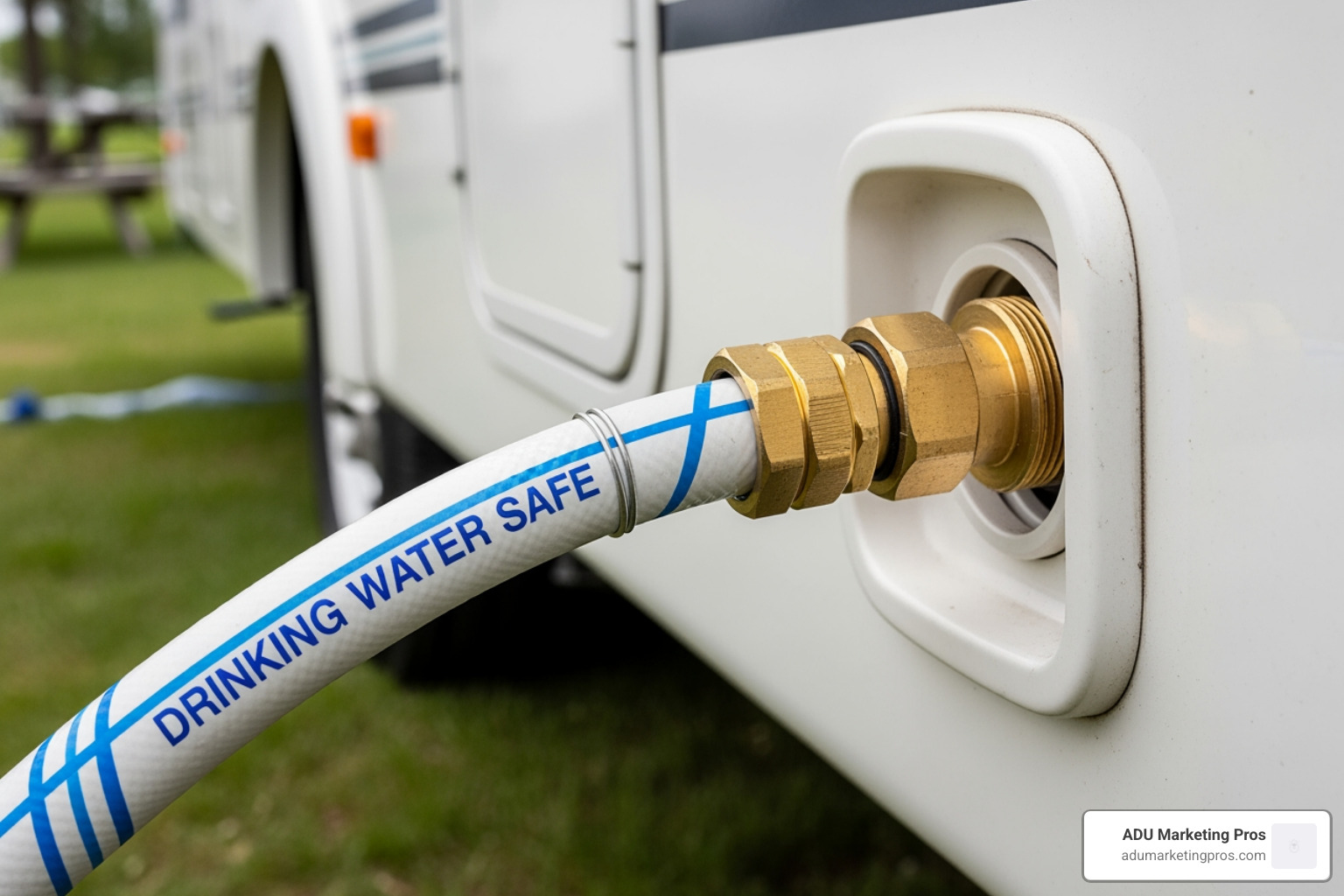
Providing a reliable source of clean, safe drinking water (potable water) is a fundamental requirement. A common and dangerous mistake is using a standard green garden hose to supply water to an RV. These hoses are not rated for potable water and are often made with materials that can leach harmful chemicals, such as lead, phthalates, and BPA, into the water. These contaminants can pose serious health risks, especially with long-term exposure.
You must only use food-safe hoses that are specifically manufactured and labeled for drinking water. These are typically white or blue and are made from FDA-approved materials. If you are connecting this hose to an existing outdoor faucet (hose bib) on your property, you generally do not need additional approval, as the home’s plumbing is already a verified potable source. However, if you need to install a new water line or hose bib to reach the RV’s location, this constitutes new plumbing work and requires a permit from the Department of Public Works, Building & Safety Division. You can navigate this process through online portals like the Los Angeles County Electronic Permitting & Inspections page.
Wastewater Disposal: Your Options and the Law
Properly managing and disposing of wastewater is the most critical public health concern associated with RV living. This waste is separated into two types: gray water (from sinks and showers) and black water (from toilets, containing human waste). Illegally dumping this waste onto the ground, into a storm drain, or into a creek is a serious offense. It can contaminate soil and groundwater with dangerous pathogens like E. coli and hepatitis, creating a severe risk of disease. The county takes this very seriously.
You have four legal options for wastewater disposal, each requiring verification or permits:
- Connect to a Sewer Line: This is the most stable solution but also the most complex. It involves hiring a licensed plumber to install a temporary connection from the RV’s sewer outlet to your property’s main sewer lateral. This work requires a permit from the Department of Public Works, Building & Safety Division to ensure the connection is properly trapped, vented, and sealed to prevent sewer gas leaks. The connection must be professionally removed after the temporary housing period ends.
- Use a Septic System: If your property uses a septic system instead of a public sewer, you cannot simply connect the RV to it. You must hire a qualified septic contractor to evaluate the system’s size and condition to determine if it can handle the additional load from the RV. An undersized or failing system can be quickly overwhelmed, leading to system failure and raw sewage backups. This evaluation and a plan for connection must be submitted for approval to the Department of Public Health or Building & Safety.
- Hire a Pumping Service: This is often the most practical and straightforward option for temporary situations. You contract with a licensed and registered sewage pumping company (pumper truck service) to periodically come to your property, pump out the RV’s holding tanks, and legally dispose of the waste at an approved facility. You will need to provide a copy of your service agreement to the health department as proof of your disposal plan.
- Use a Dump Station: The occupant can periodically move the RV to a designated sanitation dump station (found at many RV parks, campgrounds, and some truck stops) to empty the holding tanks. While legal, this can be logistically challenging and inconvenient for someone living on the property full-time, and you may still need to prove to officials how you plan to manage this regularly.
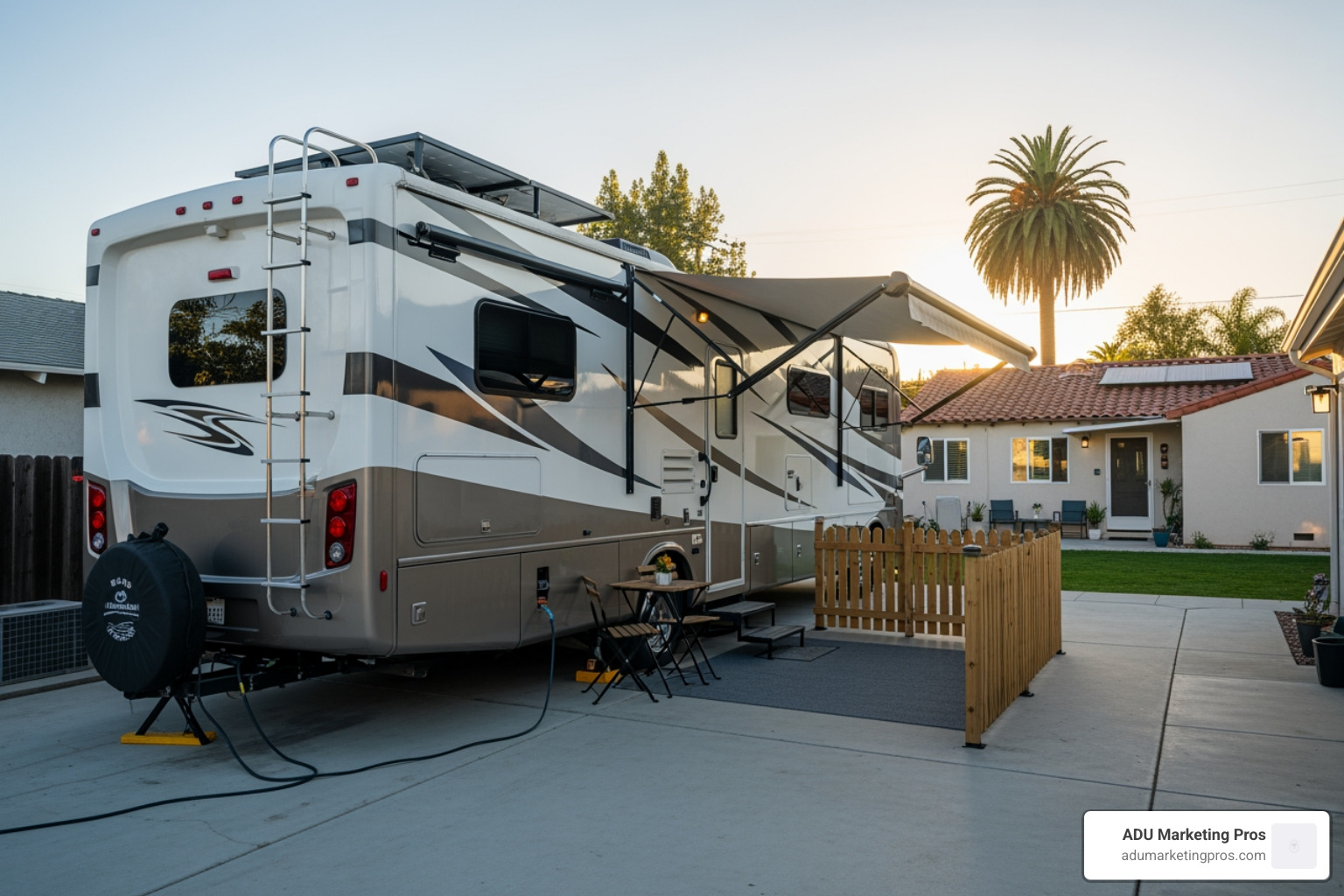
The High Cost of Improper Disposal
Improper disposal of wastewater is a direct violation of the Los Angeles County Code, and the penalties reflect the severity of the public health risk. Violators can be charged with a misdemeanor and face fines of up to $500.00, imprisonment in the County Jail for up to six months, or both. These penalties underscore the serious public health and environmental risks of water contamination. The cost of proper disposal is a small price to pay to avoid legal trouble and protect the health of your community.
Your Next Steps: Permits for Temporary RVs vs. Permanent ADUs
Whether you are pursuing a temporary emergency solution or a permanent housing addition, navigating the permitting process in Los Angeles requires careful planning and interaction with multiple agencies. These typically include the Department of Building and Safety (LADBS), the Department of Public Health (DPH), and the Department of City Planning. Fortunately, many of these agencies have robust online portals that help streamline the submission and review process for both temporary and permanent housing solutions.
Getting Approval for Temporary RV Use
If your situation qualifies for one of the rare emergency exceptions, your first step is to formally seek approval. Do not begin housing someone in an RV until you have the necessary permissions.
- Confirm Eligibility: First, verify that a shelter crisis or disaster has been officially declared and that your situation meets the specific criteria of the ordinance.
- Contact the Department of Public Health (DPH): This is your primary contact for sanitation requirements. You will need to submit a clear plan for how you will provide potable water and, most importantly, how you will legally dispose of wastewater.
- Provide Documentation: Be prepared to provide proof of your plans. This may include a copy of a service contract with a licensed sewage pumping company or a septic system evaluation report.
- Secure Plumbing Permits (if needed): If you need to install a new water line or a temporary sewer connection, you must obtain a plumbing permit from the Department of Public Works, Building & Safety Division. This ensures the work is done to code.
- Use Online Portals: Familiarize yourself with portals like ePlanLA and the LA County EPIC system, as they are the primary tools for submitting applications and tracking their status.
Navigating the Los Angeles accessory dwelling unit ordinance for an RV alternative
If your goal is a stable, long-term housing solution, building a fully compliant ADU is the correct and most valuable path. While the process is more involved and requires a greater upfront investment than buying an RV, the result is a substantial, permanent, and legal asset that enhances your property.
The ADU permit and construction process can be broken down into key phases:
- Feasibility and Design: The journey begins with hiring a qualified architect or designer. They will assess your property’s zoning, setbacks, and other limitations to create a site plan and architectural drawings that comply with all city and state codes.
- Plan Submission and Plan Check: The completed plans are submitted to LADBS for a formal plan check. Reviewers from multiple departments (Building, Planning, Fire, etc.) will scrutinize the plans to ensure they meet all safety, zoning, and structural requirements. This can take several weeks or months, depending on complexity and city workload.
- Permit Issuance and Construction: Once the plans are approved, the city issues a building permit. You can then hire a licensed general contractor to begin construction. Throughout the build, a city inspector will visit the site at critical milestones (e.g., foundation, framing, rough electrical/plumbing, insulation) to verify the work is being done according to the approved plans and code.
- Final Inspection and Certificate of Occupancy: After construction is complete and all final inspections are passed, the city issues a Certificate of Occupancy. This is the final, crucial document that legally certifies the ADU as a safe and habitable dwelling, allowing someone to officially move in.
Building a legal ADU is about creating a compliant and valuable asset that can generate rental income, house family members, and significantly increase your property value. Unlike the temporary and depreciating nature of an RV, an ADU is a permanent investment in your future.
Conclusion: A Temporary Fix vs. a Permanent Investment
The answer to the Los Angeles accessory dwelling unit ordinance use an rv question is unequivocally clear: no, you cannot legally use an RV as a permanent dwelling or ADU on your residential property. The city’s regulations are built on a foundational distinction: RVs are vehicles designed for temporary, recreational use, while ADUs are permanent homes built to rigorous safety and construction standards. An RV lacks the permanent foundation, permanent utility connections, and Certificate of Occupancy required to be considered a legal dwelling unit.
While extremely narrow exceptions exist for temporary emergency shelter—specifically during a declared shelter crisis or after a natural disaster destroys a home—these are not workarounds. They are strictly regulated, short-term measures that come with non-negotiable public health rules for providing safe water and sanitary waste disposal. The penalties for violating these rules, including hefty fines and potential jail time, highlight the seriousness with which the city treats public health and safety.
For any homeowner in Los Angeles seeking a lasting housing solution, a permanent, fully permitted ADU is the only legally compliant and financially sound option. The process of building an ADU is a formal construction project, but it results in a true asset being added to your property. It provides a safe, dignified, and legal living space for a tenant or family member, generates potential rental income, and substantially increases your property’s overall value. Unlike a depreciating vehicle like an RV, a well-built ADU is a smart, long-term investment in your property, your financial future, and the housing capacity of your community.
At ADU Marketing Pros, we specialize in helping homeowners navigate the complexities of California’s ADU landscape. We understand that an ADU isn’t just about adding square footage—it’s about building a strategic, lasting investment that complies with the law and maximizes your property’s potential. If you’re ready to move beyond temporary fixes and explore a permanent solution, we invite you to learn more about building a legal ADU in Los Angeles and discover how to navigate the process with clarity and confidence.