

The Two Faces of Tiny Homes in Los Angeles
In Los Angeles, the term los angeles tiny homes refers to two very different realities. On one hand, they are a key part of the city’s emergency response to its homelessness crisis, with over 75,000 people unhoused in LA County. On the other, they represent a growing lifestyle movement for homeowners seeking affordability, rental income, or minimalism through private builds and Accessory Dwelling Units (ADUs).
Quick Answer: What You Need to Know About LA Tiny Homes
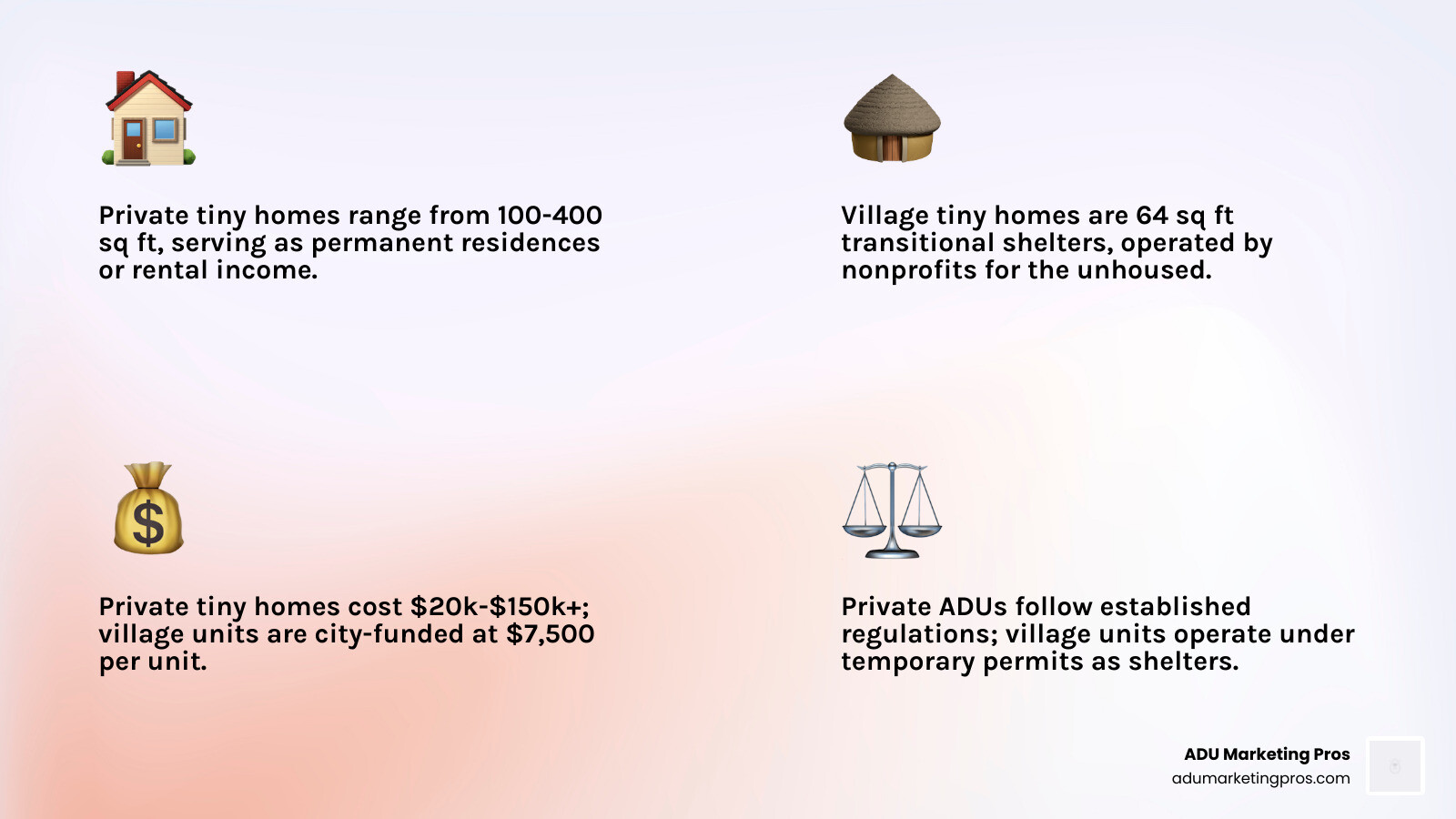
- For the Unhoused: Transitional villages with 64 sq. ft. units providing temporary shelter and services, operated by non-profits.
- For Homeowners: Private tiny homes, from DIY builds to permitted ADUs, serving as permanent residences or rental properties.
- Key Difference: Village units are temporary shelters with shared amenities; private tiny homes are permanent, self-contained dwellings.
- Legal Status: ADUs are the most legally straightforward option for permanent tiny homes; tiny homes on wheels (THOWs) face significant zoning problems.
This guide explores both worlds, examining how LA’s tiny home villages function and the realities of building a private tiny home in the City of Angels.
Glossary for los angeles tiny homes:
A Tale of Two Cities: LA’s Tiny Home Villages for the Unhoused
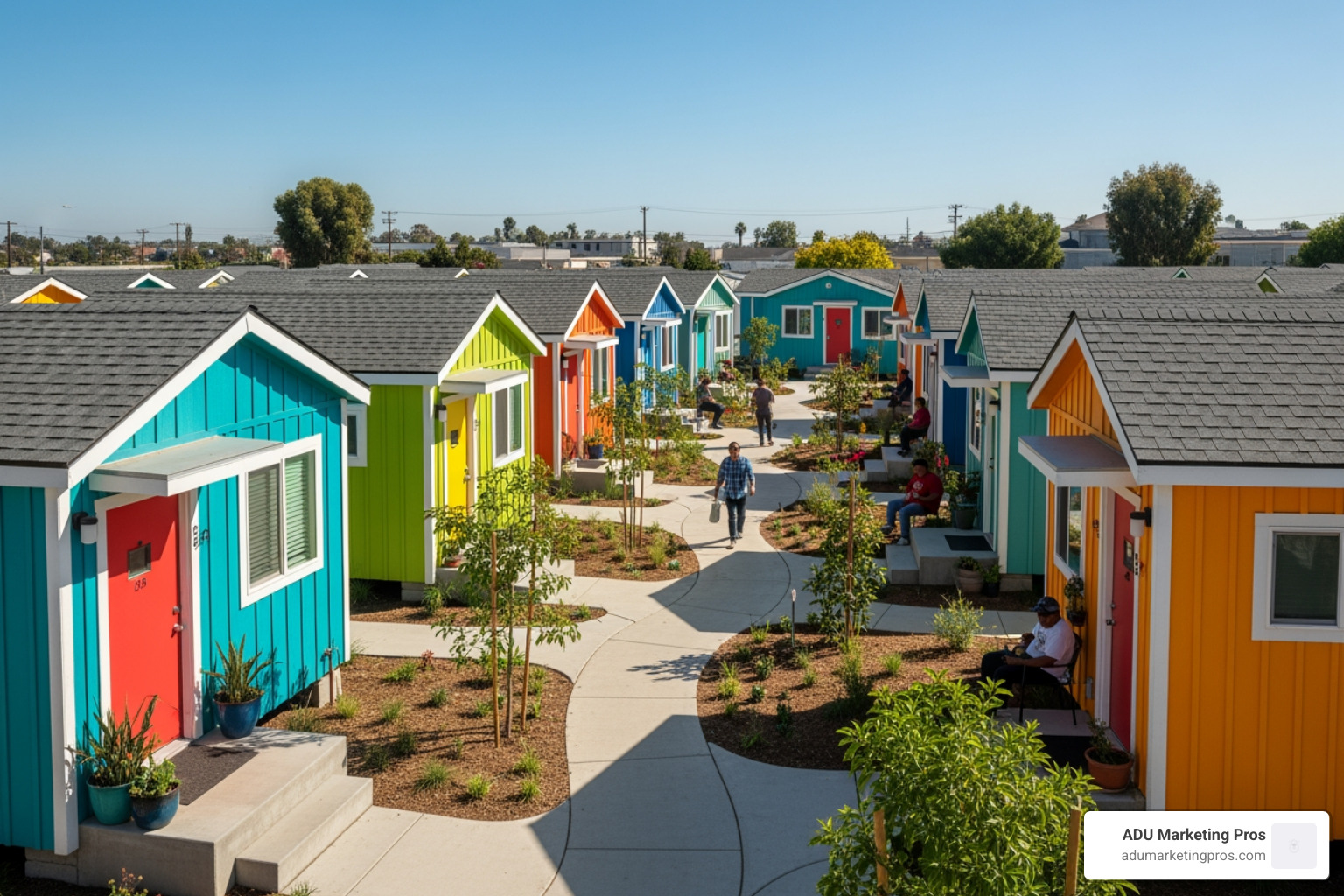
With over 75,000 people experiencing homelessness in LA County, the city has turned to tiny home villages as a form of transitional housing. These villages are designed to be a bridge from the streets to permanent housing, offering a safe and stable environment for residents to access services and regroup.
Launched in 2021, the program quickly established 1,300 units across 10 villages, with the first being the Chandler Blvd Tiny Home Village in North Hollywood. Non-profit organizations, such as Hope the Mission, are key operators, managing the day-to-day functions of these city-funded sites. For a closer look at one of these pioneering projects, you can explore the Chandler Tiny Homes Village project details.
Notable villages include:
- Chandler Blvd Tiny Home Village (North Hollywood)
- Alexandria Park Tiny Home Village
- Arroyo Seco Tiny Home Village (the largest in California)
- Reseda Tiny Home Village
- Tarzana Tiny Home Village
- Whitsett West Tiny Home Village
Life in a Tiny Home Village
Each los angeles tiny homes unit in these villages is a compact 64 sq. ft. space, but it provides critical amenities: two beds, heating and air conditioning, windows, a small desk, and a locking front door for privacy and security. The cost to build each unit is around $7,500, though total village costs are much higher due to infrastructure.
Life is communal, with shared restrooms, showers, laundry facilities, and dining areas where residents receive three meals a day. Recognizing the importance of companionship, many villages include dog runs and allow pets. Security is a priority, with 24-hour monitoring and perimeter fencing.
Beyond shelter, the villages offer a suite of support services, including case management, housing navigation, mental health and substance abuse counseling, and job training. To qualify, individuals must be experiencing homelessness, often within a specific radius of the village. The Los Angeles Homeless Services Authority manages outreach and assessment. The model is designed to be inclusive, with units that can accommodate couples, pet owners, and individuals with disabilities.
The Reality Check: Successes, Challenges, and Criticisms of the Village Model
While the tiny home villages are a well-intentioned response to the homelessness crisis, their implementation has faced a mix of success and significant challenges.
On the positive side, the villages provide immediate safety, dignity, and a crucial starting point for recovery. Having a locking door and a roof overhead allows residents to move from surviving to living. The ability to keep pets and stay with a partner are also major benefits.
However, the reality inside can be difficult. Residents and city documents have highlighted numerous problems, including units flooding during storms, broken heaters, and safety concerns like the presence of drugs. Other common complaints involve poor food quality, long waits for communal restrooms, and unresponsive staff. These issues, detailed in resident complaints filed with the city, point to systemic operational struggles.
High Costs and Low Success Rates
The financial and human costs of the program have drawn heavy scrutiny. While a single unit costs around $7,500, a full village project can cost millions (e.g., $4.9 million for the 39-unit Chandler Blvd village) due to infrastructure needs. Operating costs are also substantial, with non-profits spending $38 million in one fiscal year to run the villages.
Despite this investment, the results are troubling:
- Low Transition Rate: Only 23% of residents successfully move into permanent housing.
- High Return to Homelessness: A staggering 53% of people who leave the villages end up homeless again.
- Extended Stays: The average stay is 153 days, far exceeding the 90-day goal.
- Tragic Outcomes: In the 13 months ending March 1, 2024, 33 residents died in the villages.
Expert Criticisms and Alternative Solutions
Many experts argue that while better than the streets, tiny home villages are a costly, temporary patch, not a long-term solution. The high rate of return to homelessness suggests a systemic failure. Critics advocate for shifting focus and funds toward more evidence-based, permanent solutions, such as:
- Building more public and low-income housing.
- Expanding housing voucher and subsidy programs.
- Providing emergency grants to prevent evictions.
- Streamlining zoning for multi-family housing and Accessory Dwelling Units (ADUs), which can increase housing supply more sustainably. For more on this, see Your Guide to Los Angeles ADU Regulations: What You Need to Know.
Buying and Building Private Los Angeles Tiny Homes
Separate from the city’s shelter program, los angeles tiny homes are part of a vibrant private market for homeowners and lifestyle minimalists. This movement is driven by a desire for affordability, potential rental income, and simpler living. These private homes range from mobile units to permanent structures, with Accessory Dwelling Units (ADUs) being the most popular and legally sound option for adding a small home to a residential property. For those exploring smaller living spaces, you can also look into Small Houses for Sale.
Types of Tiny Homes for Sale and Their Costs
The private market offers several distinct types of tiny homes:
- Tiny Homes on Wheels (THOWs): Built on a trailer for mobility, these are what many people picture as a “tiny home.” Prices range from $45,000 to over $90,000.
- Modular/Prefab Tiny Homes: Built in a factory and assembled on-site, offering faster construction. Costs often start at $100,000.
- Accessory Dwelling Units (ADUs): Permanent structures built on a foundation on a residential lot. They add long-term value and are a popular investment. The Los Angeles ADU Cost typically ranges from $100,000 to over $300,000.
Here’s a table comparing these different types of los angeles tiny homes:
| Feature | Tiny Homes on Wheels (THOWs) | Modular/Prefab Tiny Homes | Accessory Dwelling Units (ADUs) |
|---|---|---|---|
| Cost | $45,000 – $90,000+ | $100,000+ | $100,000 – $300,000+ |
| Legality/Zoning | Often considered RVs; tricky for permanent residence; parking restrictions. | Easier to permit on foundation than THOWs. | Fully legal as permanent structures under state/local regulations. |
| Mobility | High; designed to be moved. | Limited; transported to site, then largely permanent. | None; permanent structure. |
| Size | Typically 100 – 400 sq. ft. | Varies, often 300 – 1,200 sq. ft. | Up to 1,200 sq. ft. (or more, depending on local rules). |
Navigating the Legal Landscape for your los angeles tiny homes
Understanding local regulations is crucial. For homeowners, ADUs are the most legally straightforward path. California and Los Angeles have streamlined laws to encourage ADU construction, making them a fully permitted, permanent housing solution. You can find detailed information in our guide to Los Angeles ADU Regulations.
Tiny Homes on Wheels (THOWs) present a more complex legal challenge. They are often classified as recreational vehicles (RVs), and city zoning typically prohibits living in an RV parked in a backyard full-time. Legal residency in a THOW is usually limited to designated RV parks or specific communities. For those seeking land for a tiny home project, research local zoning, and resources like Land for Sale in Southern California for Tiny Houses can be a starting point.
The Future of Tiny Living in LA
The landscape of los angeles tiny homes is continuously evolving, shaped by housing needs, policy innovation, and lifestyle trends. Both public and private sectors are embracing small-scale living as part of a broader strategy for a more affordable city.
California’s state government has committed to tiny homes for homelessness, with Governor Gavin Newsom’s $80 million plan for tiny homes helping to fund projects in Los Angeles. This signals a continued government interest in small-scale housing solutions.
Meanwhile, Accessory Dwelling Units (ADUs) are ready to play an even more critical role in easing LA’s housing crisis. ADUs increase the housing supply on existing residential land and provide homeowners with rental income. The rise of Prefab ADU Los Angeles solutions is making construction faster and more accessible. ADUs are becoming a sustainable, long-term component of the urban housing fabric.
The tiny home movement reflects a broader shift toward minimalism and sustainability. As smaller homes require fewer resources, they align with the growing interest in Eco-Friendly Small Homes. In Los Angeles, tiny living is no longer a niche interest but an integral part of the city’s housing strategy.
Frequently Asked Questions about Los Angeles Tiny Homes
Can I legally live in a tiny house on wheels in Los Angeles?
This is a nuanced question, and the short answer is: it’s complicated. While you can legally own a tiny house on wheels (THOW) in Los Angeles, using it as a permanent residence on private property typically falls into a legal gray area or is outright prohibited by zoning laws. THOWs are often classified as recreational vehicles (RVs) and are subject to RV parking regulations, which don’t usually permit long-term habitation in residential backyards. Your best bets for legal long-term living in a THOW would be in designated tiny home communities (which are rare in LA itself), RV parks, or on private land in more rural parts of Southern California with permissive zoning. If you’re looking for permanent small-scale living on your property, an ADU (Accessory Dwelling Unit) is the most straightforward and legally compliant option. For more details on where tiny houses are allowed in the broader region, check out Places in Southern California That Allow Tiny Houses.
How much does a private tiny home in Los Angeles cost?
The cost of a private tiny home in Los Angeles varies significantly based on its type, size, and level of customization.
- DIY or Used THOWs: You might find a used Tiny House on Wheels (THOW) or build one yourself for as little as $20,000 to $50,000.
- New THOWs: A new, professionally built THOW can range from $60,000 to $150,000, depending on features and finishes.
- Modular/Prefab Tiny Homes: These can start around $100,000 for smaller units and go upwards.
- Accessory Dwelling Units (ADUs): As permanent structures, ADUs typically represent a larger investment, ranging from $100,000 to $300,000 or more in Los Angeles, depending on whether it’s a garage conversion, an attached, or a detached new build, and the complexity of the design.
For more information on builders and options, you can explore resources like Tiny House Builders California.
Are the tiny home villages a permanent solution for homelessness?
No, the tiny home villages in Los Angeles are explicitly designed and operated as an interim or transitional housing solution, not a permanent one. Their purpose is to provide a safe, temporary bridge for individuals and couples coming directly from the streets, offering stability and services while they work towards securing permanent housing. The goal is for residents to transition to long-term housing within a relatively short period, ideally 90 days, though the average stay has been longer. While they offer crucial immediate relief and a pathway to recovery, they are not intended to be a final housing destination for the unhoused population.
Conclusion: Building Your Tiny Dream in the City of Angels
The story of los angeles tiny homes is one of contrast: compact shelters deployed as an emergency response to a humanitarian crisis, and stylish small homes acceptd as a private lifestyle and investment choice. While the city’s villages provide essential interim support for the unhoused, they face significant challenges. In the private sector, tiny living is flourishing, with Accessory Dwelling Units (ADUs) emerging as a financially savvy and legally sound solution to LA’s housing crunch.
Whether you are inspired by minimalism, seeking rental income, or creating space for family, an ADU is a powerful tool. They offer the permanence and value that make them an ideal investment for homeowners in Los Angeles.
At ADU Marketing Pros, we specialize in connecting homeowners with the top-tier builders and architects who bring these projects to life. If you’re ready to explore the ADU process, from design to permitting and construction, connect with an expert ADU Builder in Los Angeles. Let us help you build your tiny dream.