Why California Homeowners Are Turning to Prefab ADUs
Prefab ADU California projects are revolutionizing how homeowners add space and value to their properties. In the face of a persistent statewide housing crisis, Accessory Dwelling Units (ADUs) have emerged as a powerful, practical solution. They offer a lifeline for families seeking to house relatives, a smart path for generating substantial rental income, or a quiet, dedicated space for a home office. The demand is driven by an affordability gap, where housing costs have far outpaced wage growth, particularly in major metropolitan areas.
A prefab ADU is a Prefabricated Accessory Dwelling Unit constructed in a controlled factory environment and then transported and assembled on your property. This modern construction method presents significant, tangible advantages over traditional, stick-built construction, which is often plagued by delays and budget overruns.
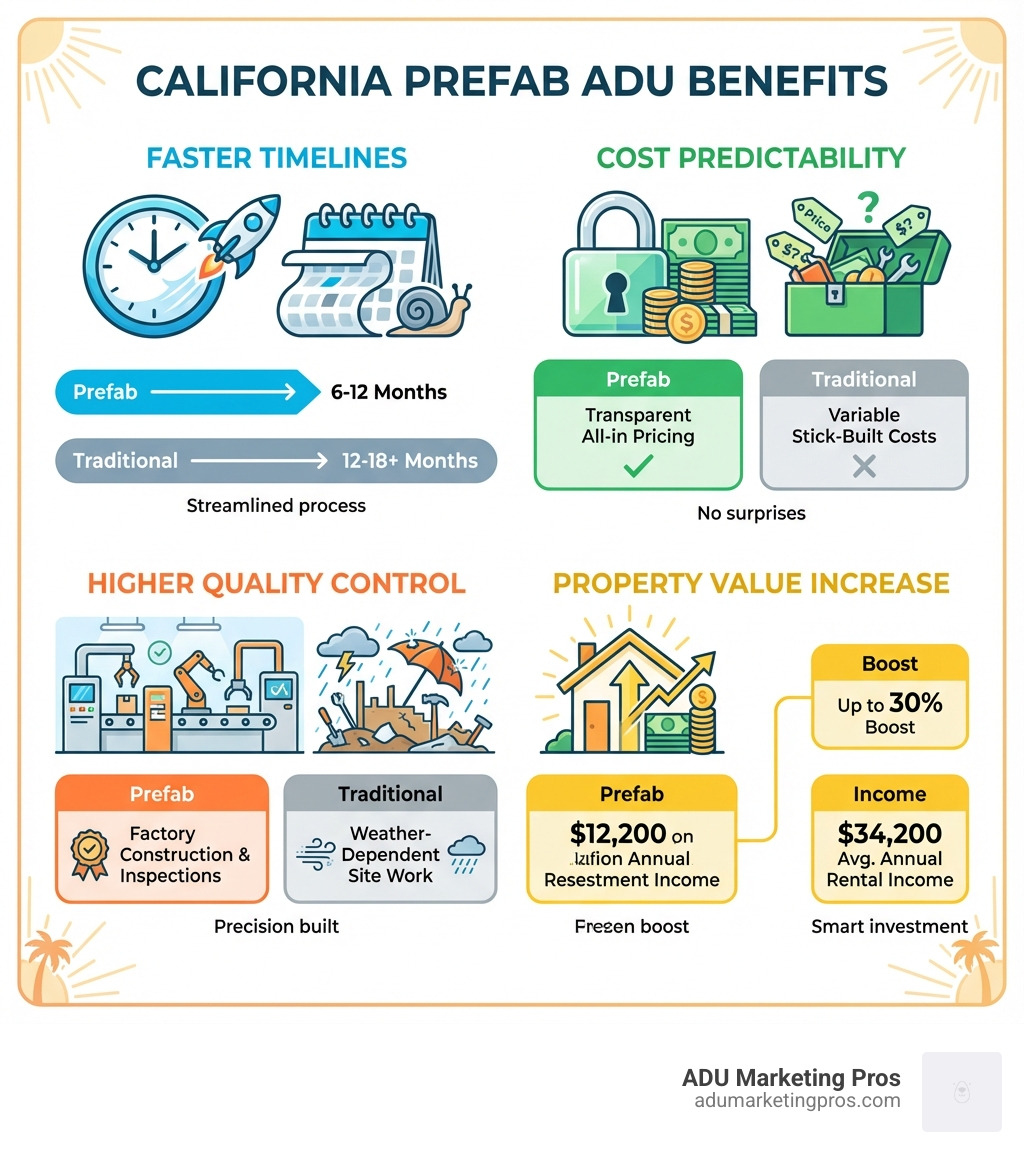
- Faster Construction: The entire prefab process, from signing a contract to receiving the keys, can be completed in as little as 6-12 months. This is a stark contrast to the 12-18+ months typical for a conventional site-built ADU.
- Predictable Costs: Reputable prefab builders provide transparent, all-in project costs, which for most California projects range from $228,800 to $360,000+. This financial certainty is a major relief for homeowners navigating a large investment.
- Higher Quality: Building within a factory eliminates weather-related risks and allows for a level of precision and quality control that is difficult to achieve on an open construction site. The result is a more durable and resilient home.
These secondary homes are more than just extra space; they are a strategic financial asset. An ADU can boost your property value by up to 30% and generate significant rental income—with the median California rent currently at $2,850 per month, the potential for passive income is undeniable. This guide provides a comprehensive overview of everything you need to know about building a prefab ADU in California, from understanding different construction methods and costs to navigating the permitting process and selecting the right builder. Whether you’re in the Bay Area, Southern California, or the Central Valley, you’ll find the insights needed to make a confident, informed decision.
Why Choose a Prefab ADU Over Traditional Construction?
Choosing a prefab ADU California project offers a compelling, modern alternative to traditional, “stick-built” construction. Homeowners across the state, from the tech hubs of San Jose and the San Francisco Bay Area to the sprawling neighborhoods of Los Angeles, are realizing the immense benefits of this innovative approach.

Here’s a deeper look at why prefab ADUs are gaining so much traction:
-
Speed of Construction: The most significant advantage is the compressed timeline. Prefab units are built in a factory concurrently with on-site foundation and utility work. This parallel process cuts the total project time dramatically. While a traditional build is vulnerable to weather delays, subcontractor scheduling conflicts, and material delivery issues, factory production moves forward unimpeded. Your ADU can be move-in ready in as little as 6-9 months after permit approval, a fraction of the time for a stick-built project.
-
Cost Predictability: Prefab companies excel at providing transparent, all-in pricing packages. Because they operate on a standardized process with controlled labor and material costs, they can quote a fixed price that covers everything from design and permits to installation and finishes. This helps you budget with confidence and avoid the notorious cost overruns and surprise change orders common in traditional construction, making it a truly affordable ADU California solution.
-
Reduced On-Site Disruption: A traditional construction project turns your backyard into a noisy, dusty work zone for a year or more. With prefab, the disruption is minimized. The on-site phase—consisting of site preparation, delivery, and final installation—is reduced to just a few weeks. The most dramatic part, the craning of the unit onto its foundation, often takes only a single day. This means less stress for you, your family, and your neighbors.
-
Factory-Controlled Quality: Building in a climate-controlled factory ensures a higher standard of quality. Materials are protected from rain, sun, and humidity, preventing warping, mold, and other damage. Jigs and advanced machinery allow for precision cuts and assembly that are difficult to replicate in the field. Every stage of construction is monitored and inspected, often by both the company’s quality control team and third-party inspectors, resulting in a durable, high-quality structure built to exacting specifications.
-
Return on Investment (ROI) and Increased Property Value: Adding an ADU is one of the most reliable ways to increase your property value, with some estimates showing a boost of up to 30%. In California’s competitive real estate market, this makes a prefab ADU a sound and lucrative investment. The faster build time of prefab also means you can start realizing this return, whether through rental income or increased equity, much sooner.
-
Rental Income Potential: An ADU can become a powerful engine for generating passive income. With a median rent in California of $2,850, you could earn approximately $34,200 annually. This income can offset your mortgage, cover the cost of the ADU itself in a matter of years, or provide a significant boost to your household budget.
A Focus on Sustainability and Energy Efficiency
Many prefab builders are at the forefront of green building practices. The factory setting is inherently less wasteful; material scraps can be easily sorted and recycled, and bulk purchasing reduces packaging waste. Furthermore, many companies prioritize sustainable materials and energy-efficient designs to comply with California’s strict Title 24 energy code and CalGreen building standards. Common features include:
- High-Performance Insulation: Using advanced insulation like Structural Insulated Panels (SIPs) or high-density spray foam creates a tight building envelope, reducing heating and cooling costs.
- Energy-Efficient Windows and Doors: Low-E coated, dual-pane windows minimize heat transfer, keeping the interior comfortable year-round.
- Cool Roofs: Reflective roofing materials reduce heat absorption, lowering air conditioning demand.
- Solar-Ready Systems: Most prefab ADUs are built to easily accommodate solar panel installation, which is a requirement for most new construction in California.
- Efficient Appliances: Energy Star-rated appliances and water-saving fixtures are often standard, further reducing your carbon footprint and utility bills.
For more insights on turning your backyard into a valuable and sustainable asset, explore our guide on Prefab Granny Flat California.
Understanding Prefab Construction: Modular vs. Panelized/Kit Homes
When exploring options for your prefab ADU California project, you’ll encounter a few different construction methods. While all fall under the “prefabricated” umbrella, understanding their distinctions is key to selecting the right approach for your property, budget, and timeline.
-
Modular Construction: This is often what people picture when they think of prefab. Modular ADUs are built as complete, three-dimensional sections, or “modules,” in a factory. These modules are typically 80-95% complete upon arrival, with plumbing, electrical, flooring, cabinetry, and even appliances pre-installed. The modules are transported to your property, craned onto a permanent foundation, and then seamed together. This method, used by leading companies like Abodu and Villa, offers the fastest possible on-site installation, often taking just a few days to set and weatherproof the unit.
-
Panelized/Kit Homes: This method involves manufacturing structural components—such as walls, floors, and roof trusses—as flat panels in a factory. These panels are then shipped to your property for on-site assembly, much like a large-scale model kit. This process is significantly faster than traditional stick-building but requires more on-site labor and time than a modular installation. The primary advantage of panelized systems is their flexibility; they can be more easily transported to sites with difficult access (e.g., narrow streets or hillsides) and can offer greater customization in design.
-
Manufactured Homes (HUD Homes): It’s important to distinguish prefab ADUs from manufactured homes. While also factory-built, manufactured homes are constructed to a federal standard (the HUD Code) rather than local building codes. They are typically placed on a non-permanent chassis. Using a manufactured house as an ADU can be challenging in California, as most jurisdictions require ADUs to be built on a permanent foundation and adhere to the same local building, fire, and energy codes as traditional homes.
Turnkey vs. DIY-Friendly Options
Beyond the construction type, prefab companies also differ in their service models:
-
Turnkey Service: This is the most popular and hassle-free option. A turnkey provider manages the entire project from start to finish. Their scope of work includes site assessment, design, securing all necessary permits, site preparation (foundation and utilities), manufacturing, delivery, installation, and final inspections. This all-inclusive approach provides homeowners with a single point of contact and a clear, fixed price for the entire project.
-
DIY-Friendly / Partial Service: Some companies, particularly those offering panelized kits, provide more flexibility for homeowners who want to be more involved. They might only provide the building shell or kit of parts, leaving the homeowner or their chosen general contractor responsible for permitting, site work, foundation, assembly, and interior finishing. While this can sometimes offer cost savings, it requires significant time, expertise, and project management skills from the homeowner.
Both modular and panelized methods offer significant advantages for your ADU Modular Homes project. For a deeper dive into modular options, see our insights on Modular Granny Flats California.
The All-In Cost of a Prefab ADU in California
Understanding the true cost of a prefab ADU California project is one of the most critical steps for any homeowner. It’s essential to look beyond the advertised “base price” of a unit and focus on the final “all-in cost,” which encompasses every expense required to make your ADU move-in ready.
A comprehensive all-in cost from a reputable prefab builder typically includes:
- The ADU Structure: The cost of the factory-built unit itself, with standard finishes and fixtures.
- Design & Engineering: Architectural plans and structural engineering needed for permitting.
- Permitting Fees: All city or county fees for plan checks, building permits, and inspections. These can vary dramatically by location.
- Site Work: This is a major cost category and includes land preparation, grading, excavation, and sometimes demolition of old sheds or concrete.
- Foundation: The concrete slab or permanent pier system your ADU will be secured to.
- Utility Connections: The cost to trench and run new water, sewer/septic, electrical, and gas lines from the primary residence to the ADU. This can be a significant variable.
- Delivery & Installation: Transportation of the unit or panels to your property and the cost of a crane to lift it into place.
- Upgrades & Finishes: Any customizations you choose beyond the standard options, such as higher-end appliances, custom cabinetry, or premium flooring.
- Project Management: The builder’s fee for overseeing the entire process, coordinating all trades, and ensuring a smooth project flow.
While the average ADU cost in California can be around $300,000, prefab options provide much-needed cost certainty. For example, Abodu’s studios start at a transparent $228,800 all-in, while Villa’s all-in estimates range from $200K to $360K+ depending on size and site conditions.
Here is a general breakdown of estimated all-in costs. For a more detailed analysis, see our guide on Prefab ADU California Cost.
| ADU Type | Square Footage (approx.) | Estimated All-In Cost Range (California) |
|---|---|---|
| Studio | 300-450 sq ft | $228,800 – $280,000 |
| 1-Bedroom | 450-700 sq ft | $225,000 – $320,000 |
| 2-Bedroom | 700-1,200 sq ft | $300,000 – $450,000+ |
Note: These are estimates. Costs vary significantly based on location, site conditions, and chosen finishes.
Financing Your ADU and Regional Cost Differences
Several financing options can make your project an Affordable ADU California reality. The most common are Home Equity Lines of Credit (HELOCs), cash-out refinancing, and construction loans. A HELOC or cash-out refi allows you to borrow against the existing equity in your home, often at a competitive interest rate. A construction loan is a short-term loan used to finance the build itself, which is then typically refinanced into a traditional mortgage. Some prefab builders also have partnerships with lenders who specialize in ADU financing, simplifying the process for their clients.
Costs also fluctuate dramatically by region. The San Francisco Bay Area (including San Jose, Palo Alto, and Oakland) has some of the highest construction and labor costs in the nation, with median prices often exceeding $329 per square foot. A 1,200 sq ft ADU in this region could approach $400,000 in construction costs alone. Southern California (Los Angeles, San Diego, Orange County) is also a high-cost market, though pricing can vary widely between coastal and inland areas. Site-specific challenges, such as building on hillside lots, in coastal zones with special requirements, or on properties with difficult access for a crane, will invariably increase costs in any region. For more on Bay Area pricing, see our guides on ADU Cost Bay Area and Bay Area ADU Cost.
Navigating the Process for Your Prefab ADU California Project
Embarking on a prefab ADU California project is a significant undertaking, but with a reputable turnkey partner, the journey can be remarkably streamlined and predictable. Here’s a detailed breakdown of what to expect from start to finish.
Step 1: Feasibility, Design, and Customization
This initial phase is where your vision begins to take concrete form. It starts with a thorough feasibility study of your property. Your builder will assess zoning regulations, setback requirements, lot coverage limits, and access for delivery to determine what size and type of ADU is possible. Once feasibility is confirmed, you move to the exciting part:
- Floor Plans: Prefab companies offer a curated selection of highly efficient floor plans. These typically include studios (150-450 sq ft), 1-bedroom units (450-700 sq ft), and 2-bedroom units (700-1,200 sq ft). You can find layouts optimized for various uses, whether it’s a private rental unit, an in-law suite designed with accessibility in mind, or a spacious home office. Explore various options in our guide to ADU Floor Plans California.
- Customization: While the structural plans are standardized, many builders offer extensive customization for finishes. You’ll typically work with a design team to select flooring, cabinetry, countertops, tile, paint colors, and fixtures. This ensures your new ADU reflects your personal style and feels like a true, high-end extension of your home. Find inspiration with these Modern Prefab Granny Flats.
Step 2: The Legal and Permitting Maze
Navigating California’s permitting process is often the most daunting step for homeowners, but it’s where experienced prefab builders provide immense value. They handle this entire complex phase on your behalf. While statewide California ADU Guidelines have been created to encourage ADU construction, each city and county has its own specific interpretations, submission requirements, and fee structures. A builder with deep experience in your local jurisdiction (e.g., Los Angeles, San Diego, or San Jose) can anticipate requirements and expedite approvals. Some builders even use pre-approved plans that can dramatically shorten the city’s review timeline.
Recent state laws have significantly streamlined this process, mandating that municipalities approve or deny ADU applications within 60 days. This has eliminated much of the uncertainty and delay that plagued projects in the past. Stay informed on the latest rules with our guide to New ADU Regulations California.
Step 3: The Construction and Installation Timeline
The accelerated timeline is a hallmark of the prefab process. A typical project unfolds over 6 to 12 months, a significant improvement over the 12-18+ months for a traditional build.
- Permitting (2-6 months): This remains the most variable part of the timeline and is largely dependent on the efficiency of your local building department.
- Factory Production (1-2 months): As soon as permits are issued, your ADU goes into production. This happens off-site in the factory, completely shielded from weather delays.
- Site Preparation (1-2 months): While your ADU is being built, crews work on your property to prepare the foundation and trench for utility connections. This parallel activity is key to the compressed schedule.
- Delivery & Installation (1-3 days): This is the main event. The completed modules are transported to your site and expertly craned into place on the foundation.
- Final Connections & Inspection (2-4 weeks): On-site crews connect the utilities (water, sewer, electrical), complete any final trim or seam work, and touch up finishes. The city then performs a final inspection before issuing a Certificate of Occupancy, officially making your ADU a legal, habitable dwelling.
For a full overview of legal and building standards, see our guide on California ADU Requirements.
How to Choose the Right Builder
Selecting the right builder is the single most important decision you will make for your prefab ADU California project. The right partner ensures a smooth process, a high-quality product, and a sound investment. A thorough vetting process is essential.
-
Evaluate Their Service Model: First, decide what level of involvement you want. A turnkey provider is ideal for most homeowners, as they manage every single aspect: design, permits, site work, manufacturing, and installation. This provides a single point of accountability and a fixed price. A partial service provider may be cheaper upfront but requires you to act as the general contractor for significant portions of the project, a role that demands time and expertise.
-
Verify Credentials and Insurance: This is non-negotiable. Confirm that the builder holds a valid California contractor’s license (typically a B-General Contractor license). You can verify this on the CSLB (Contractors State License Board) website. Also, ensure they carry adequate general liability insurance and workers’ compensation coverage. This protects you from financial risk in case of accidents or property damage.
-
Review Their Work and Reputation: Scrutinize their portfolio of completed projects. Do their designs and quality align with your expectations? Read online reviews and customer testimonials on multiple platforms. Don’t just look at the star rating; read the details of both positive and negative reviews to understand their communication style and problem-solving process.
-
Demand Transparent, All-In Pricing: A reputable builder will provide a detailed, itemized proposal that clearly outlines the all-in price. Be extremely wary of low “base prices” or “unit-only” costs that exclude critical expenses like site work, permits, crane rental, and utility connections. These are often used to hook customers, with the true cost being revealed much later.
-
Prioritize Local Expertise: A builder with a proven track record in your specific city or county is invaluable. They will have established relationships with the local building department, understand the nuances of local codes, and be able to navigate the permitting process far more efficiently. They can also anticipate local challenges, whether it’s a specific soil condition or a strict design review board.
Key Questions to Ask a Potential Builder
During your interviews, arm yourself with these critical questions:
- Is your price truly “all-in”? Please provide a detailed list of what is included and, more importantly, what is excluded.
- What is a realistic, conservative timeline for a project in my specific city, including permitting?
- How do you handle unforeseen site conditions, like hard rock or a high water table, and how are associated costs handled?
- Can I see a completed project in person or speak with a few of your past clients?
- What specific warranties do you offer on the structure, materials, and installation labor?
- Who will be my dedicated point of contact throughout the entire project?
Regional Considerations and Red Flags
California’s diverse geography presents unique challenges. In the dense Bay Area, builders must be adept at managing projects on tight lots and navigating complex seismic requirements. In Southern California, particularly in hillside areas or Wildland-Urban Interface (WUI) zones, builders need expertise in fire-hardening materials and construction methods. A good local builder will be well-versed in these specific requirements.
Be on the lookout for red flags, such as builders who pressure you for a large upfront deposit, are unwilling to provide a detailed written contract, cannot show you proof of license or insurance, or give vague answers to your questions. Your builder is your partner in a major financial investment; choose wisely.
Frequently Asked Questions about Prefab ADUs in California
We hear many excellent questions from homeowners who are considering a prefab ADU California project. Here are detailed answers to some of the most common inquiries.
What is the maximum size for a prefab ADU in California?
State law provides a strong framework for ADU size. It mandates that all local jurisdictions must permit a detached ADU of at least 850 square feet for a studio or one-bedroom unit, or at least 1,000 square feet for a unit with two or more bedrooms. The absolute maximum size allowed by state law for a detached ADU is 1,200 square feet. However, your local city or county ordinance can influence the final allowable size based on factors like lot coverage ratios and floor area ratios (FAR). It is always critical to check your specific local regulations, but the state law provides a generous baseline. For more details, see our guide on California ADU Regulations.
Can I put a prefab ADU on a vacant lot?
Generally, no. The “A” in ADU stands for “Accessory,” meaning the unit must be accessory to a primary, existing or proposed single-family or multi-family residence on the same lot. However, recent legislation like Senate Bill 9 (SB9) has created new pathways for development. SB9 allows homeowners in single-family zones to split their lot and/or build a duplex. This could potentially involve building new units on what was previously the backyard of a single-family home. This is a more complex process than building a standard ADU. You can find more info on SB9 from California YIMBY, a non-profit housing advocate. For the vast majority of homeowners, the rule remains: an ADU requires a primary home on the property.
Are prefab ADUs a good investment?
Absolutely. A prefab ADU California is widely considered one of the best home improvement investments you can make, for several key reasons:
- Significant Property Value Increase: Adding square footage and a legal rental unit to your property can boost its market value by up to 30%. In California’s high-cost real estate market, this can translate to hundreds of thousands of dollars in new equity.
- Powerful Rental Income Stream: With the median California rent at $2,850 per month, an ADU can generate over $34,000 in gross annual income. This passive income can pay for the ADU itself over time, cover a large portion of your mortgage, or fund other financial goals.
- Unmatched Family Flexibility: Beyond the numbers, an ADU provides invaluable flexibility. It can be a comfortable and private home for aging parents (allowing them to age in place), a launching pad for adult children saving for their own home, or a welcoming space for guests, all while keeping family close.
Do I have to pay more property taxes on my ADU?
Yes, building an ADU will increase your property taxes, but not on your entire property. California’s Proposition 13 limits tax increases on your existing home. When you build an ADU, the county assessor will perform a “blended reassessment.” This means your existing home’s assessed value remains the same, and only the value of the new construction (the ADU) is added to your tax bill. The increase is typically manageable and is a small price to pay for the significant value and income the ADU adds.
Are solar panels required on a new prefab ADU?
Yes, in most cases. California’s Building Energy Efficiency Standards (Title 24, Part 6) require that all new residential construction, which includes newly constructed detached ADUs, must have a solar photovoltaic (PV) system. The system must be sized to meet the forecasted annual electrical usage of the dwelling. Most prefab ADU builders will include a compliant solar package as part of their all-in pricing and project scope.
Conclusion
We’ve explored the compelling reasons why prefab ADU California projects have become the definitive solution for homeowners seeking to expand their living space and financial opportunities. From the bustling streets of Los Angeles to the tech-driven communities of the San Francisco Bay Area, prefab ADUs deliver a faster, more cost-predictable, and higher-quality alternative to traditional construction.
The advantages are clear and substantial: dramatically reduced construction timelines, the financial certainty of all-in pricing, and a significant return on investment through both increased property value and robust rental income. Whether you opt for a sleek modular unit or a flexible panelized system, the prefab method brings unparalleled efficiency and precision to your backyard construction project.
However, the success of your project hinges on one critical factor: choosing the right partner. Navigating designs, complex permitting, and the construction process requires an experienced, reputable builder with deep local expertise. They are your guide and advocate, ensuring your ADU meets all state and local regulations and is built to the highest standards.
At ADU Marketing Pros, we specialize in connecting homeowners with California’s top-tier ADU construction and architecture firms. We understand the nuances of the California market and are dedicated to helping you find the ideal professionals for your unique project.
Ready to unlock the full potential of your property? Find expert ADU builders in the Bay Area and take the first step on your ADU journey today.