
Why San Francisco Homeowners Are Turning to ADUs
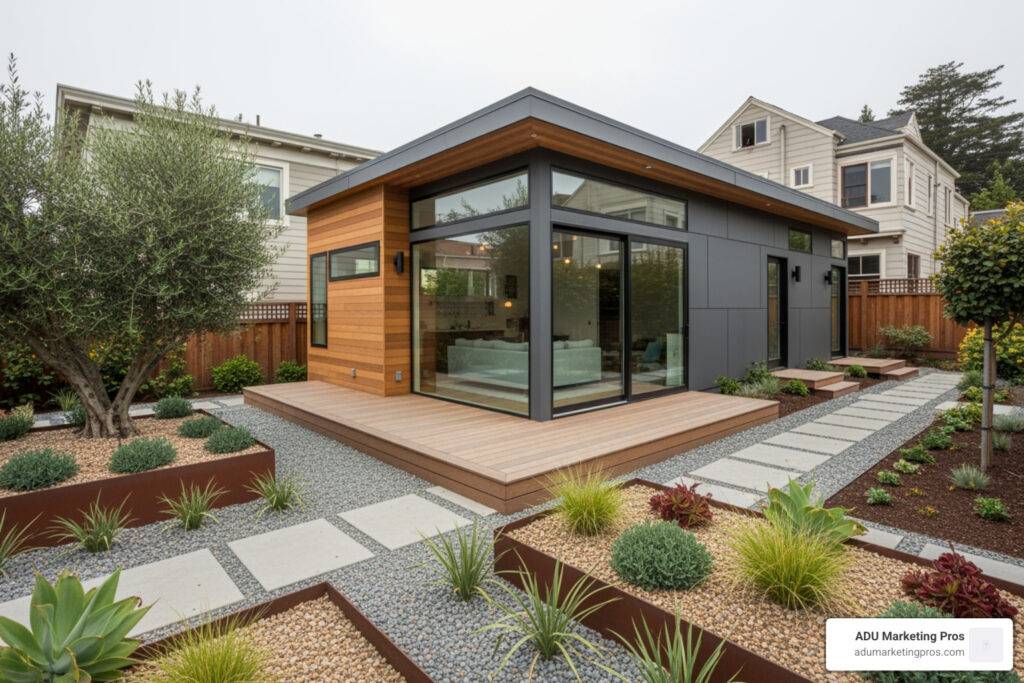
ADU San Francisco projects have surged in popularity, evolving from a niche concept into a mainstream strategy for homeowners navigating the city’s notoriously challenging housing market. An Accessory Dwelling Unit (ADU)—often called an in-law unit, granny flat, or backyard cottage—is a self-contained residential unit located on the same lot as a primary single-family or multi-family home. In a city where space is the ultimate luxury and the median home price consistently ranks among the highest in the nation, ADUs represent a powerful tool to unlock a property’s hidden potential. They can generate substantial rental income, provide dignified housing for family members, and add significant, tangible value to your real estate asset.
A Snapshot: What to Know About SF ADUs
For years, building a secondary unit in San Francisco was a bureaucratic nightmare. However, a wave of pro-housing state legislation has dismantled the most restrictive local barriers, creating a more predictable and streamlined path for homeowners. Here’s a summary of the current landscape:
- Feasible ADU Types: The options are diverse, including detached new-construction cottages in a backyard, attached additions that expand the home’s footprint, conversions of underutilized spaces like garages and basements, and Junior ADUs (JADUs) created within the primary home’s existing walls.
- Typical Investment: The financial outlay is significant. Construction costs generally start around $150,000 for a simple conversion and can easily exceed $400,000 for a custom detached unit. On top of this, budget an additional 10-15% for professional services (architects, engineers) and another 6-9% for city permit and impact fees.
- Streamlined Approval: Thanks to state law, projects that comply with objective standards now qualify for a 60-day ministerial review. This is a simple administrative sign-off, meaning no subjective design reviews, no public hearings, and no required neighbor notifications that could previously derail a project.
- Key Restrictions: ADUs cannot be used for short-term rentals (less than 30 days). They also cannot be sold separately from the primary home like a condominium, ensuring they remain part of the property’s overall housing stock.
- Financial Assistance: To help offset the high upfront costs, the state’s CalHFA ADU Grant Program offers up to $40,000 for pre-construction expenses to eligible low- and moderate-income homeowners.
This guide provides a comprehensive overview of the benefits, challenges, costs, and regulations involved in an adu san francisco project. We’ll explore the different types of ADUs, demystify the permitting process, and connect you with the resources needed to confidently navigate the system and maximize your property’s potential.
Essential adu san francisco terms:
The Pros and Cons of Building an ADU in San Francisco
Embarking on an adu san francisco project is a major decision with significant financial and personal implications. While the advantages are compelling, the challenges are equally real. A clear-eyed assessment of both sides is essential before you begin.

Primary Benefits of an SF ADU
Building an ADU offers a multi-faceted return on investment that aligns perfectly with the needs of many San Francisco homeowners.
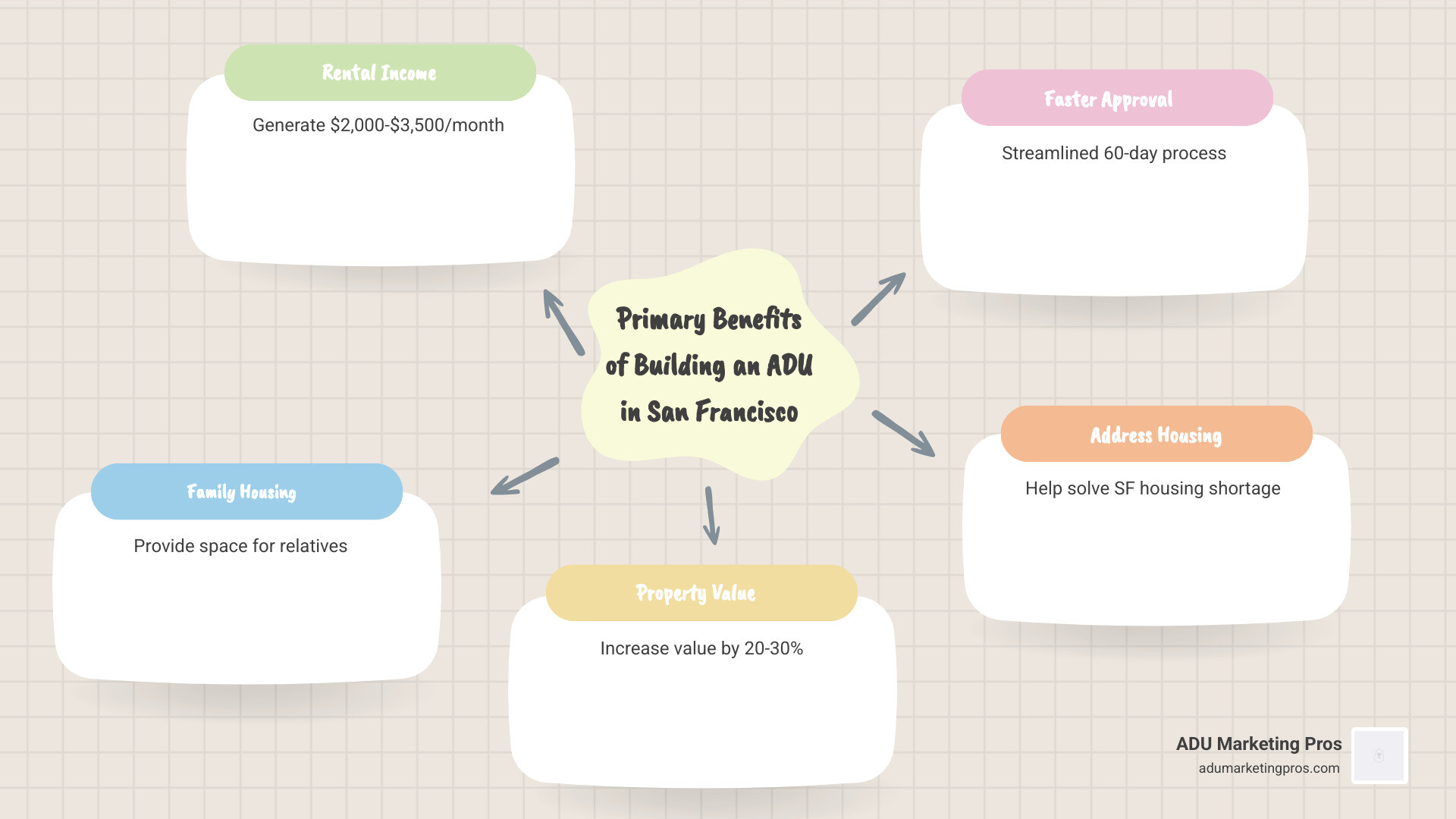
- Substantial Rental Income: In a city with one of the highest rental rates in the world, an ADU can generate thousands of dollars in passive income each month. This revenue stream can offset a significant portion of your mortgage, cover the unit’s construction costs over time, and provide long-term financial security.
- Flexible Housing for Family: ADUs are an ideal solution for multi-generational living. They provide a safe, independent, and nearby home for aging parents, allowing them to retain their autonomy while having family support close by. They also offer a launching pad for adult children saving for their own home or a private space for a live-in caregiver. Explore options in our guide on granny flats in San Francisco.
- Significant Increase in Property Value: Adding a legal, permitted living unit to your property is one of the most effective ways to boost its market value. Appraisers recognize the added square footage and rental income potential, which can translate to a substantial increase in your property’s overall worth, making it more attractive to future buyers.
- Faster, More Predictable Approval: State-mandated streamlining has transformed the permitting process. Compared to other major renovations, ADUs benefit from a 60-day review timeline and exemption from discretionary reviews, saving you months of uncertainty and potential delays.
- Versatile and Flexible Space: Beyond being a rental or family home, an ADU can adapt to your changing needs. It can serve as a dedicated home office, a quiet art or music studio, a private gym, or a luxurious guest suite for visiting friends and family, offering a level of flexibility that a simple room addition cannot.
- Contributing to Housing Solutions: By building an ADU, you are actively participating in the solution to San Francisco’s severe housing shortage. Every new unit helps alleviate pressure on the rental market and contributes to a more diverse and accessible city.
Key Drawbacks and Challenges
It’s crucial to approach an ADU project with a realistic understanding of the potential hurdles.
- Extremely High Construction Costs: San Francisco is one of the most expensive places to build in the world. High labor costs, expensive materials, and complex logistical challenges mean that even a small ADU is a major financial undertaking. Costs often exceed initial estimates, requiring a healthy contingency fund.
- Higher Cost Per Square Foot: An ADU is not just extra space; it’s a complete, independent home. This means it requires its own kitchen, bathroom, foundation, and separate utility connections (electrical, water, sewer). These requirements make the cost per square foot for an ADU significantly higher than for a simple home expansion.
- Complex and Evolving Regulations: While streamlined, the regulatory environment is still a dense thicket of state and local rules. Navigating zoning codes, building codes, fire safety requirements, and specific tenant protection laws requires expertise and meticulous attention to detail.
- Application of Rent Control: Many ADUs, particularly those created under the city’s Local Program or in multi-family buildings, are subject to San Francisco’s stringent Rent Ordinance. This limits how much you can raise rent and governs the eviction process, impacting your long-term financial projections and landlord responsibilities.
- Strict Eviction History Restrictions: The city is protective of existing tenants. You are prohibited from building an ADU on a property where a no-fault eviction has occurred within the last 5 years (for an owner move-in) or 10 years (for other reasons like the Ellis Act). This rule is designed to prevent displacement.
- No Separate Sale (Condo Conversion): An ADU cannot be sold as a separate asset. It is legally tied to the primary residence and must be sold with it. This limits your ability to cash out on the ADU’s value independently, except in very specific and rare circumstances involving the primary home also being sold to a low-income household.
For a deeper dive into conversions, check out our insights on in-law units in San Francisco.
Navigating the Rules: Key ADU Regulations in San Francisco
Success in any adu san francisco project hinges on a thorough understanding of the regulatory landscape. While recent state laws have dramatically simplified the process, the rulebook remains thick with critical details that can make or break your project. A misstep here can lead to costly delays and redesigns.
How Recent Legislation Changed the Game
For decades, building an ADU in San Francisco was notoriously difficult. Local planning codes, such as the old rules in Planning Code Section 311, often required discretionary review. This meant your project could be subjected to public hearings and neighborhood notification, giving opponents an opportunity to delay or even kill your plans based on subjective concerns like neighborhood character or parking.
However, a series of landmark state laws, including AB 68, AB 881, and SB 9, have fundamentally altered this dynamic by asserting state authority over local obstructionism. These laws were designed with a single goal: to encourage the creation of new housing by making the ADU approval process fast, predictable, and objective.
Here’s what this legislative shift means for you:
- Mandatory Ministerial Approval: This is the most important change. If your ADU plans meet all the objective, black-and-white standards laid out in state and local codes (e.g., size, height, setbacks), the city must approve your application. There are no more subjective judgments about design or neighborhood compatibility.
- Elimination of Neighborhood Notification: For compliant ADU projects, the requirement to notify neighbors has been eliminated. This removes a major source of conflict and delay, allowing you to proceed with certainty once your plans are finalized.
- Strict 60-Day Review Clock: Once you submit a complete application, the city’s permitting agencies have a maximum of 60 days to provide comments or approve the project. This enforceable timeline prevents applications from languishing in bureaucratic limbo for months or years, as was common in the past. You can still read the SF Planning Code Section 311 to appreciate how much the process has improved.
Essential Design and Construction Requirements for an adu san francisco
While the approval process is streamlined, the building standards for an adu san francisco remain rigorous to ensure the unit is safe, habitable, and durable.
Your architect and builder must design the unit to meet these key requirements:
- Minimum Unit Size: An ADU must be at least 220 square feet to provide adequate living space.
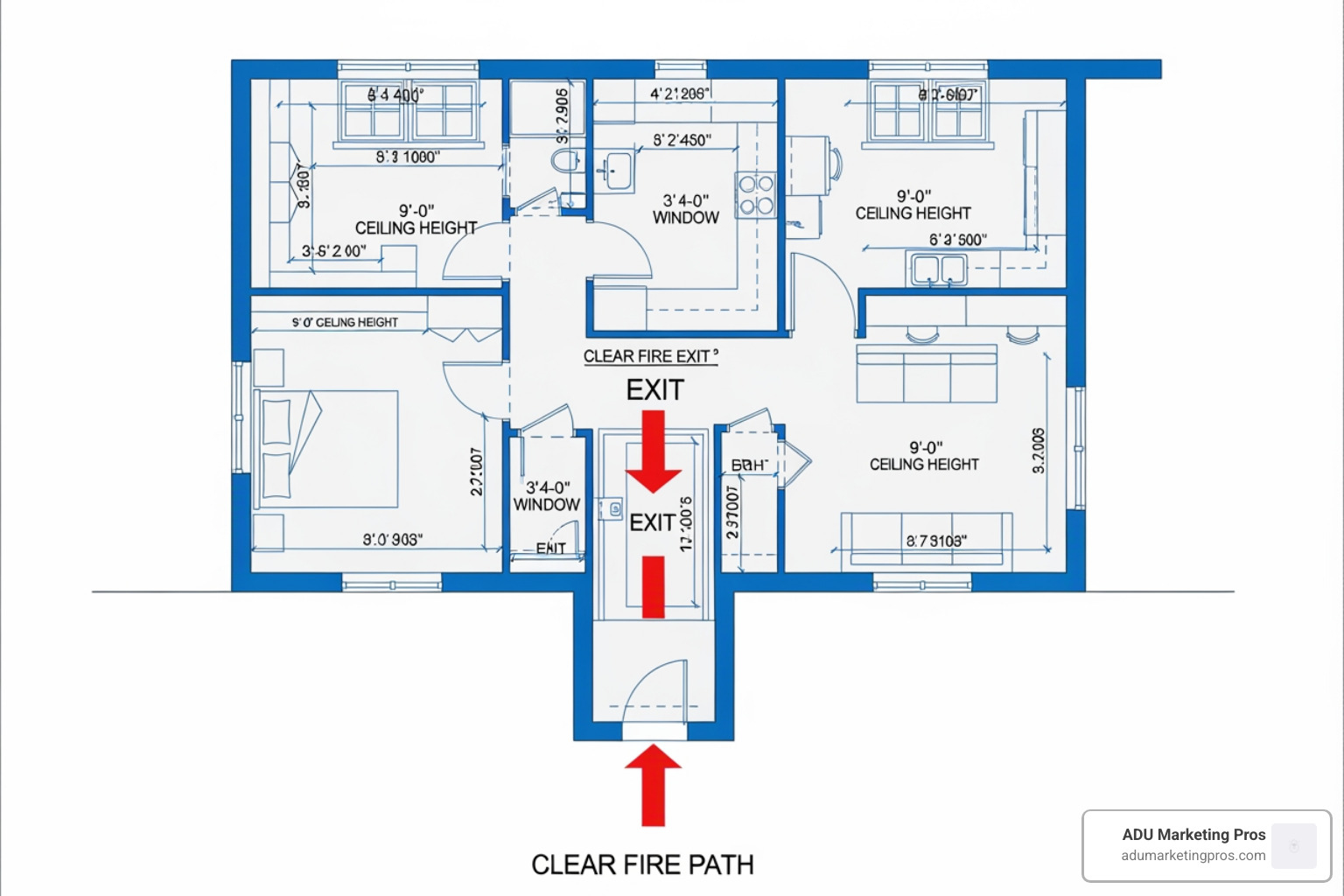
- Ceiling Heights: Habitable spaces like living rooms and bedrooms, along with hallways, must have a minimum ceiling height of 7.5 feet. For kitchens and bathrooms, a height of 7 feet is permissible.
- Natural Light and Ventilation: To ensure a healthy living environment, habitable rooms must have windows (glazing) equal to at least 8% of the room’s floor area. Operable windows or other natural ventilation sources must equal at least 4% of the floor area. Bathrooms require a mechanical exhaust fan.
- Fire Safety: This is a non-negotiable and highly scrutinized aspect of any ADU plan in a dense urban environment.
- Fire-Rated Construction: Walls and ceilings separating the ADU from the main house or an attached garage must have a 1-hour fire rating. This typically involves using specific types of drywall and insulation to slow the spread of a fire. Walls built on or near a property line often require this as well.
- Egress and Rescue Openings: Every sleeping area must have a designated rescue opening—either a door to the outside or a large window—of at least 5.7 square feet, with minimum dimensions for height and width to allow a firefighter to enter.
- Clear Path of Travel: The exit path from the ADU’s main door to the public street must be clear, unobstructed, and generally less than 125 feet long.
- Smoke and Carbon Monoxide Detectors: Hardwired, interconnected detectors are required in all sleeping areas, hallways outside bedrooms, and on each level of the home.
- Automatic Fire Sprinklers: While a single-family home adding a detached ADU is typically exempt, sprinklers are often required if the primary home already has them. They are also frequently required in multi-family buildings adding ADUs. This is a critical cost factor to verify early with the San Francisco Fire Department.
Key Restrictions: Rent Control, Evictions, and Condo Conversion
- SF Rent Ordinance: This is a complex area. While state law (the Costa-Hawkins Rental Housing Act) exempts most newly constructed, detached ADUs from local rent control, this protection may require filing a specific Costa Hawkins agreement with the city. ADUs created through the city’s Local Program or within existing multi-family buildings are generally subject to the SF Rent Ordinance.
- Eviction and Tenant Notification: You cannot build an ADU if a no-fault eviction occurred on the property in the past 5-10 years. Furthermore, before applying for a permit, you must provide existing tenants on the property with a Notice of Addition of ADU(s) to inform them of the planned construction.
- Short-Term Rental Ban: ADUs are intended for long-term housing and cannot be legally rented for periods of less than 30 days on platforms like Airbnb or Vrbo.
- Condo Conversion Prohibition: An ADU cannot be legally subdivided and sold as a separate condominium. It remains an “accessory” part of the primary property and must be sold with it.
Types of ADUs and The Approval Process for an ADU San Francisco
The adu san francisco landscape is remarkably versatile, offering a range of unit types to suit different properties, budgets, and objectives. Understanding these options, along with the dual-track approval system, is the first step in formulating a successful project strategy.
What Kind of ADU Can You Build?
An ADU is defined as a complete, independent living facility with its own kitchen, bathroom, and sleeping area. In San Francisco, these generally fall into four categories:
- Detached ADUs: These are new, stand-alone structures, often called backyard cottages or garden suites. They offer the greatest privacy for both the occupant and the main home’s residents. State law allows for a detached ADU of at least 800 square feet, up to 16 feet in height, with four-foot side and rear setbacks, on most single-family lots. They are often the most expensive type to build due to the need for a new foundation, structure, and utility trenching. Learn more in our guide on detached ADUs in San Francisco.
- Attached ADUs: This type of ADU is built as an addition connected to the primary home, sharing at least one wall. It can feel like a natural extension of the house while still providing a separate living space. Attached ADUs generally must comply with the same zoning requirements as the primary home but can often be built up to 25 feet tall or the height of the main house, whichever is lower.
- Conversion ADUs: One of the most popular and cost-effective options, a conversion ADU transforms existing, non-livable space into a legal dwelling unit. Common examples include converting a garage, a basement, or a large storage room. Because they utilize an existing structure, they can save significant costs on foundation and framing, though they often present unique challenges related to ceiling height, window placement, and utility routing.
- Junior Accessory Dwelling Units (JADUs): A JADU is a specialized, smaller unit (no more than 500 square feet) created entirely within the existing walls of a single-family home (e.g., converting a spare bedroom). It must have its own entrance and an efficiency kitchen. It may share a bathroom with the main house. A key restriction is that the property owner must reside in either the main home or the JADU.
Single-Family vs. Multi-Family Building Regulations
The rules and opportunities for ADUs differ dramatically depending on your property type.
For Single-Family Homes:
State law provides a powerful baseline: you are entitled to build at least one standard ADU (up to 1,200 sq ft, depending on the type) and one JADU (up to 500 sq ft) on the same property. This allows a single-family lot to be transformed into a three-unit property. Critically, no additional parking is required for any ADU built on a single-family lot in San Francisco.
For Multi-Family Buildings:
This is where San Francisco’s rules create a massive opportunity.
- State Law: The state mandates that multi-family property owners can convert non-livable spaces (like storage rooms, boiler rooms, or garages) into at least one ADU, and potentially more—up to a quantity equal to 25% of the existing units in the building.
- San Francisco’s Local Program: The city’s own program goes even further. For buildings with five or more existing units, the city allows for an unlimited number of ADUs to be added through conversions, as long as the space is available and building codes can be met. This has enabled owners of apartment buildings to add significant numbers of new, rent-generating units within their existing footprint.
The Critical Choice: State Program vs. Local Program
San Francisco offers two parallel but distinct approval paths for ADUs. You must choose one program for your project; you cannot mix and match.
- State Program: This is the default, streamlined path. It guarantees the 60-day ministerial review timeline, has no appeals process, and offers stronger protections from local rent control for certain new construction ADUs. It is the fastest and most certain path to approval if your project fits within its objective standards.
- Local Program: This path may be necessary if your project needs a waiver from a specific Planning Code requirement that the State Program doesn’t allow. It also enables the “unlimited ADU” option for multi-family buildings. However, choosing the Local Program subjects your project to a longer review process, potential appeals, and guarantees that the new unit will fall under the SF Rent Ordinance.
Choosing the right program is a critical strategic decision. SF Planning provides a detailed comparison table on ADUs in single- and multi-family dwellings that is essential reading.
The Step-by-Step Permitting Process
- Feasibility and Strategy: The first step is a consultation with an experienced architect or ADU specialist. They will analyze your property, discuss your goals, and determine which type of ADU is feasible. This is when you’ll make the crucial State vs. Local program decision.
- Design and Plan Creation: Your design professional will create a detailed set of architectural and structural plans. This package will include floor plans, elevations, site plans, structural calculations, and energy compliance reports (Title 24) that demonstrate adherence to all relevant codes.
- Pre-Application Clearances: Before submitting for the building permit, you may need to complete other reviews. This can include a Historic Resource Review (HRR) if your property is in a historic district, or preparing an asbestos report if any demolition is involved.
- Permit Submission and Review: Your complete application package is submitted to the Department of Building Inspection (DBI). Under the State Program, this triggers the 60-day clock for a coordinated review by all relevant departments (Planning, DBI, Fire, Public Works) in a process often called the Permit Review Roundtable.
- Corrections and Revisions: It is common for city plan checkers to return comments or request corrections. Your architect will address these comments and resubmit the plans.
- Permit Issuance and Construction: Once all departments have approved the plans, the building permit is issued. You can now hire a licensed contractor and begin construction.
Budgeting for Your Build: ADU Costs and Financial Resources
Building an adu san francisco is a significant financial investment, and developing a realistic, comprehensive budget is one of the most critical steps in the entire process. Underestimating costs can jeopardize your project, while a clear understanding of the financial landscape allows for confident planning and execution.
Breaking Down the Costs
ADU costs in San Francisco are highly variable, influenced by the unit’s type, size, level of finish, and specific site conditions. It’s essential to think in terms of “all-in” costs, which extend far beyond the construction contract.
-
Soft Costs (10-20% of Total Budget): These are the pre-construction expenses required to get your project shovel-ready.
- Professional Services: This includes fees for your architect or designer, structural engineer, and potentially a surveyor or soils engineer. Expect this to be 10-15% of your construction cost.
- City Fees: Permit fees, plan review fees, and various impact fees (e.g., for schools and transit) levied by the city typically amount to 6-9% of the construction valuation.
-
Hard Costs (80-90% of Total Budget): This is the money paid to your contractor for labor and materials.
- Garage/Basement Conversions: Often the most budget-friendly option, these typically range from $150,000 to $275,000. Costs can rise if significant structural work, foundation upgrades, or excavation is needed.
- Attached ADUs: These additions generally cost between $200,000 and $350,000, depending on the complexity of tying into the existing structure.
- Detached New Construction ADUs: As entirely new buildings, these are the most expensive, with typical costs ranging from $300,000 to $500,000+. The price per square foot can be very high ($600-$1,000+) due to the need for a new foundation, full utility trenching, and four exterior walls.
- Utility Hookups: A major variable cost. Connecting the ADU’s new, independent sewer, water, and electrical lines to the city’s mains can cost anywhere from $10,000 to $30,000+, depending on the distance and complexity.
Financing Your ADU Project
Few homeowners have enough cash on hand to fund an entire ADU project. Fortunately, there are several common financing strategies:
- Cash-Out Refinance: This involves replacing your current mortgage with a new, larger one, allowing you to take out the difference in cash. It’s a popular option if interest rates are favorable and you have significant equity in your home.
- Home Equity Line of Credit (HELOC): A HELOC works like a credit card secured by your home. You can draw funds as needed up to a certain limit, which is ideal for paying contractors in phases. Interest rates are often variable.
- Renovation or Construction Loan: These short-term loans are specifically designed to finance construction projects. The lender releases funds in stages as work is completed. Once the ADU is finished, the loan is typically refinanced into a conventional mortgage.
Financial Assistance and Key City Resources
- CalHFA ADU Grant Program: This state-run program provides up to $40,000 to reimburse pre-construction and non-recurring closing costs. It is a grant, not a loan, but is restricted to homeowners who meet specific low-to-moderate income qualifications.
- San Francisco Planning Department: This is your primary resource for understanding zoning rules, setbacks, height limits, and the differences between the State and Local ADU programs. We can help you steer the California ADU guidelines they reference.
- Department of Building Inspection (DBI): The DBI is the agency that reviews your plans for code compliance and issues the final building permit. Their website contains numerous checklists and guides, and they offer Pre-Application Meetings to discuss your project with plan checkers before formal submission.
- San Francisco Fire Department: Given the city’s focus on fire safety, engaging with the SFFD early is wise, especially to clarify sprinkler requirements for your specific project.
Frequently Asked Questions about San Francisco ADUs
Here are detailed answers to some of the most common questions we hear from homeowners considering an adu san francisco project.
Can I legalize an existing unpermitted unit?
Yes, this is a major focus of the city’s ADU programs. San Francisco has a program specifically designed to help homeowners bring unauthorized dwelling units (UDUs) up to code and legalize them as ADUs. The process involves submitting plans to show how the existing unit will be modified to meet current health and safety standards, particularly regarding fire safety, ceiling height, and ventilation. The city offers some leniency for pre-existing conditions, making it a viable path to add legal value and safety to your property.
Do I need to provide parking for my new ADU?
No. Under current state and local law, you are not required to add any new off-street parking for an ADU in San Francisco. This applies whether you are converting an existing garage into an ADU (meaning you can eliminate that parking spot) or building a new unit. This single rule change removed one of the biggest historical obstacles to ADU construction in the city.
Can I build an ADU in a historic district?
Yes, but it requires extra care and review. If your property is a designated historic landmark or located within a historic district, your project will likely require a Historic Resource Review (HRR) from the Planning Department. The review will focus on ensuring the ADU’s design (especially if it’s a visible detached unit or addition) is compatible with the historic character of the property and district. Using an architect with experience in historic preservation is highly recommended to navigate this process successfully.
How long does the entire process take from start to finish?
Be prepared for a marathon, not a sprint. A realistic timeline for an adu san francisco project is typically 12 to 24 months. This can be broken down as follows:
- Design & Planning (3-6 months): This phase includes hiring your team, developing the design, and preparing the detailed construction documents for submission.
- Permitting (3-6 months): While the state mandates a 60-day review, this clock only starts once a complete application is accepted. The process of submission, initial review, addressing comments, and final approval often takes several months.
- Construction (6-12+ months): The construction timeline varies widely based on the ADU type. A simple garage conversion might be done in 6-8 months, while a complex custom detached ADU could take a year or more to build.
Will building an ADU increase my property taxes?
Yes, but not on the full value of your property. Under California’s Proposition 13, your property’s existing assessed value is protected. When you build an ADU, the County Assessor will perform a “blended assessment.” This means your original home’s assessment remains the same, and only the value of the newly constructed ADU is added to your tax bill. For example, if your home is assessed at $800,000 and the new ADU is determined to have a market value of $300,000, your new assessed value would be $1,100,000, and your property taxes would increase based on that new total.
Conclusion: Your Path to Building an ADU in San Francisco
Building an adu san francisco is a journey that transforms a patch of dirt or an underused garage into a new home, a source of income, and a valuable asset. Thanks to sweeping legislative changes, the path forward is clearer and more predictable than ever before. The era of subjective neighborhood opposition and endless bureaucratic delays has been replaced by a streamlined, objective ministerial approval process for compliant projects. This shift has unlocked immense potential for homeowners across the city to enhance their properties, house loved ones, and contribute a desperately needed housing unit to the community.
However, this opportunity is paired with significant challenges. The high costs of construction in the Bay Area and the intricate web of building codes, rent control laws, and program-specific regulations demand a well-researched, strategic approach. This is not a DIY project; success hinges on assembling a team of experienced professionals. An architect who understands San Francisco’s unique rules, a contractor with a proven track record, and other specialists are essential partners in navigating the complexities from initial design to final inspection.
For builders, architects, and other ADU professionals, the booming market presents its own challenge: standing out from the competition. This is where a targeted marketing strategy becomes critical. At ADU Marketing Pros, we specialize in connecting top-tier firms with qualified homeowners, helping you showcase your expertise and attract the high-quality leads that build a successful business.
If you’re a homeowner ready to explore the possibilities of an adu san francisco, the time to act is now. We encourage you to dive into the resources available, begin the conversation with seasoned experts, and take the first confident step toward building your future.