
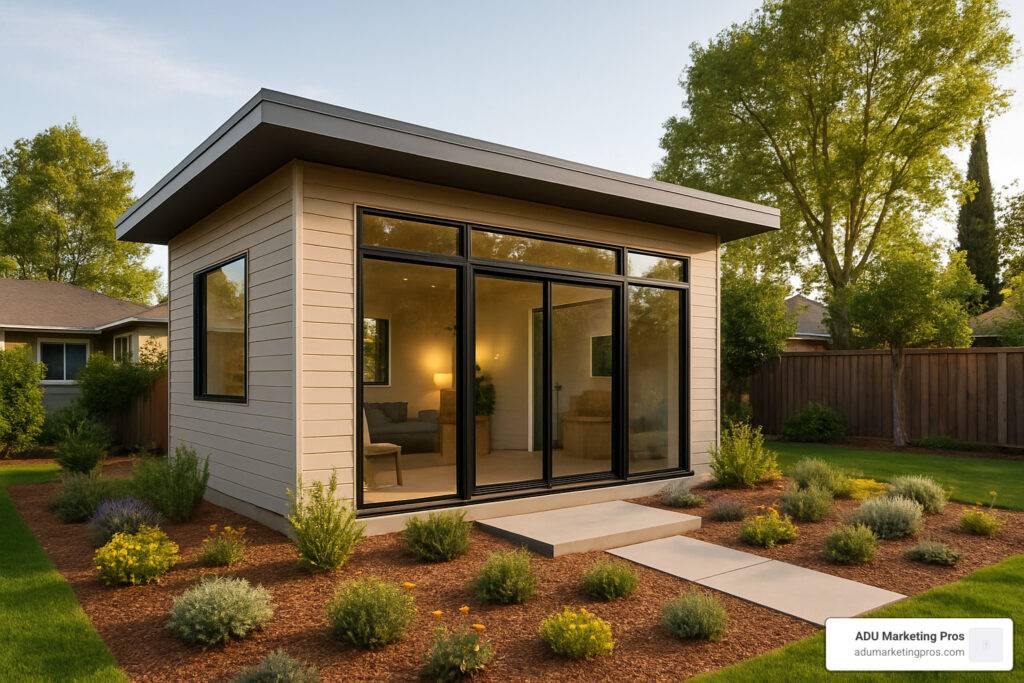
Simplifying San Jose’s ADU Revolution
Looking for San Jose ADU plans to fast-track your accessory dwelling unit project? Here’s what you need to know:
| San Jose ADU Plan Types | Size Range | Permit Timeline | Key Benefit |
|---|---|---|---|
| Pre-approved Studio/1BR | 330-750 sq ft | As little as 1 day | No impact fees |
| Pre-approved 2BR | 750-1,000 sq ft | 1-7 days | Standardized design |
| Pre-approved 3BR | 1,000-1,200 sq ft | 1-7 days | Maximum rental potential |
| Custom ADU Plans | Any size | 20+ business days | Full customization |
The housing crunch in the Bay Area has made San Jose ADU plans more valuable than ever. These accessory dwelling units—also called granny flats or backyard homes—have become a critical solution for adding affordable housing and generating rental income for homeowners.
What makes San Jose’s approach special is their innovative pre-approved ADU program. This city-backed initiative can shave months off the traditional permitting process, with some homeowners receiving same-day approval when using standardized plans.
“When it comes to pre-approved ADU plans, San Jose takes the cake for one of the best programs in the game,” notes one industry expert who has helped dozens of homeowners steer the process.
The city offers a diverse library of pre-approved designs ranging from compact 330 sq ft studios to spacious 1,200 sq ft three-bedroom units. By choosing one of these plans, you can bypass the lengthy custom design review that typically takes several months.
For property owners and builders looking to maximize efficiency, these plans offer a golden opportunity to reduce costs, accelerate timelines, and create valuable living space with minimal bureaucratic headaches.

Key San Jose ADU plans vocabulary:
– ADU building costs
– Energy-efficient ADU
– Multi-generational ADU
Why Pre-Approved San Jose ADU Plans Matter
Have you ever tried getting a building permit in the Bay Area? The traditional path to building an ADU in San Jose can feel like you’re stuck in quicksand. Custom designs typically need multiple review cycles, with each round potentially taking 20 business days or more. That’s almost a month of waiting each time the city asks for changes!
Pre-approved San Jose ADU plans completely transform this experience. These city-vetted designs have already passed the rigorous structural, health, and safety reviews, dramatically speeding up the permitting process. If your site-specific documents are complete and accurate, you might even walk out with a building permit the same day you submit your application.
“Using a pre-approved plan can reduce the permitting process from several months to as little as one week, and sometimes even same-day approval,” explains the City of San Jose’s ADU Ally program.
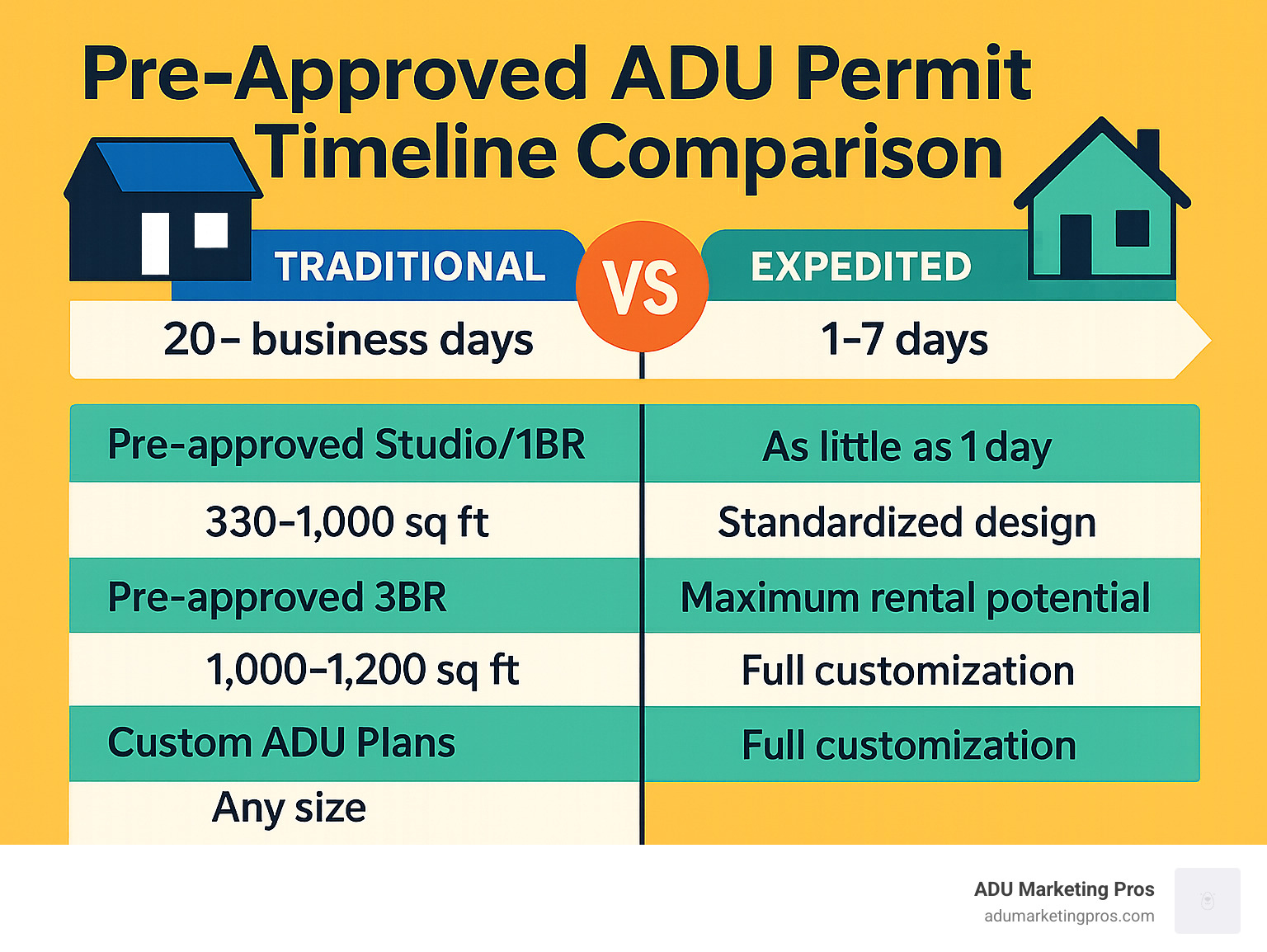
This time savings translates directly to your wallet. Every month your project sits in permit review means another month of rising construction costs, delayed rental income, extended design fees, and continued housing pressure for whoever will eventually live there.
San Jose’s program includes over 25 vendors offering a wonderful variety of plans. You’ll find everything from cozy 330 sq. ft. studios to spacious 1,200 sq. ft. 3-bedroom units, available in architectural styles ranging from sleek contemporary to warm traditional. There’s truly something for every taste and neighborhood.
For more detailed information about the permitting process throughout California, check out our guide on ADU Permits in California.
Benefits of Pre-Approval for Homeowners
The advantages of choosing pre-approved San Jose ADU plans go far beyond just faster permitting:
Reduced Red Tape means less bureaucratic headache. These standardized plans eliminate much of the back-and-forth with city reviewers since they’ve already been vetted for building code compliance.
Impact Fee Exemptions can save you thousands. ADUs under 750 sq. ft. in San Jose don’t pay impact fees, and many pre-approved plans are specifically designed to stay under this threshold.
Property Value Boost is almost guaranteed. A thoughtfully designed ADU can increase your property value by 20-30%, according to real estate experts. Pre-approved plans ensure professional design quality that appeals to future buyers.
Passive Income Potential starts sooner with faster approvals. With average ADU rental rates in San Jose ranging from $2,500 to $4,000 per month, these units generate significant income. The faster you build, the sooner those rent checks arrive.
Aging-in-Place Solutions provide peace of mind. Many homeowners build ADUs for aging parents or to move into themselves while renting out the main house. Pre-approved plans often include accessibility features that make this transition smoother.
“I was able to get my permit in just one week,” shared Maria, a San Jose homeowner who used a pre-approved plan. “My neighbors who went with custom designs are still waiting months later. The time savings alone was worth it.”
Pre-Approved Program Eligibility Checklist
Before you get too excited about these pre-approved San Jose ADU plans, make sure your property qualifies for the expedited process:
Your property must be zoned R-1, R-2, R-M, or PD, or designated for residential or mixed-use development. Properties in geohazard zones, landslide areas, flood zones, or Wildland-Urban Interface (WUI) zones aren’t eligible for the expedited process.
For fire safety, your ADU must be within 600 feet of a fire hydrant, and the path from the street to the ADU cannot exceed 200 feet. Your property can’t have any open code enforcement violations, and your project can’t require a Fire Variance.
You’ll also need an accurate site plan showing exactly where the ADU will sit on your property, including setbacks and utility connections. The City of San Jose provides the ADU Universal Checklist, which walks you through all these requirements.
Address visibility is another often-overlooked requirement – emergency services need to clearly see your address from the street.
“It’s critical to verify your property’s eligibility before investing in plans or construction,” our team at ADU Marketing Pros often reminds clients. “We’ve seen homeowners waste thousands of dollars on designs that couldn’t be approved due to site constraints.”
The good news? Most residential properties in San Jose do qualify, and the pre-approval process makes building your ADU faster, more affordable, and significantly less stressful than going the custom route.
For a comprehensive look at all available pre-approved options, visit our detailed guide on Preapproved ADU Plans San Jose.
Round-Up of the Best San Jose ADU Plans
Now, let’s explore some of the standout San Jose ADU plans available through the city’s pre-approved program. These designs represent the best balance of efficiency, livability, and permit-readiness.
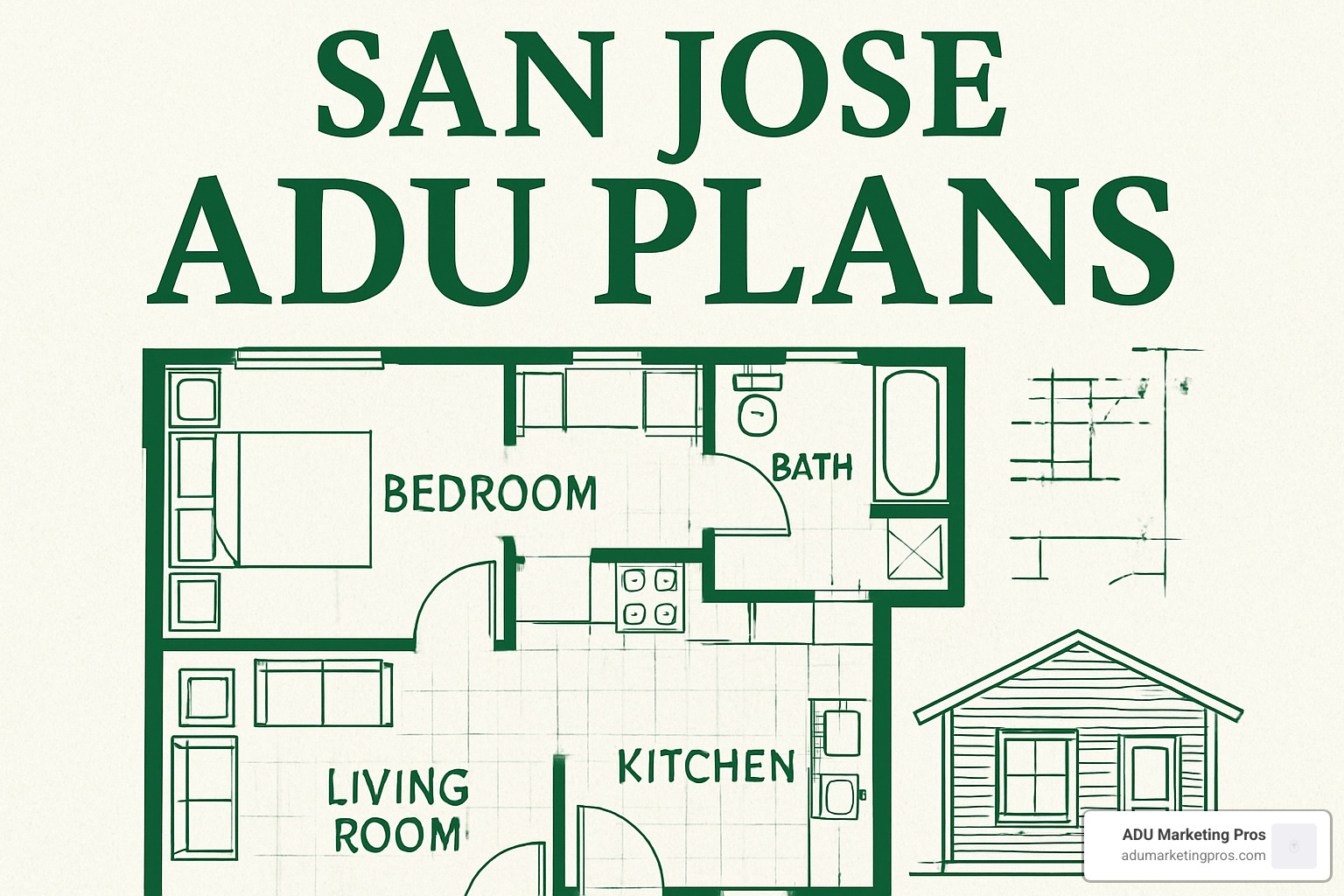
Compact Studios (330-500 sf) – Beat Impact Fees
If you’re looking to maximize savings while creating functional living space, these smaller units are your best bet. Designed specifically to stay under the 750 sq. ft. threshold, they exempt you from those pesky parkland and school impact fees – potentially saving thousands in permit costs.
The Abodu Studio at just 340 sq. ft. packs a surprising punch with its 17′ x 20′ footprint. Despite its compact size, it includes a full kitchen, bathroom with shower, and a versatile living/sleeping area. Many homeowners use these as home offices with guest accommodations or as rental units for single occupants. Since they’re factory-built and delivered to your site, you could have your permit in as little as a week with complete documentation.
For something with a bit more breathing room, the Mews ADU (532 sq. ft.) offers a dedicated bedroom, full bathroom, and galley kitchen within its 17′ x 32′ footprint. The vaulted ceilings and large windows create an airy, light-filled space that feels much larger than its square footage suggests – perfect for couples or aging parents.
“I was shocked at how spacious my 390-square-foot Jake unit felt,” one San Jose homeowner told us. “The prefabricated panels went up quickly, and the all-electric design means my energy bills stay remarkably low.”
Our ADU marketing team often points out that these smaller units frequently provide the best return on investment. They cost less to build, qualify for those valuable fee exemptions, and still command strong rental rates in the competitive San Jose market.
Mid-Size One-Beds (600-800 sf) – Balance Space & Cost
These mid-range units strike that sweet spot between spaciousness and affordability. Many clever designs hover just under the 750 sq. ft. impact fee threshold while providing all the comforts of a full apartment.
The Agrarian ADU (749 sq. ft.) exemplifies smart design with its split-bedroom layout, two bathrooms, and full kitchen with pantry – all while staying 1 square foot under the impact fee threshold. With a 23′ x 33′ footprint and optional covered porch, it’s ideal for long-term rentals or work-from-home professionals who need a bit more elbow room.
For those drawn to Scandinavian minimalism, the Abodu One (500 sq. ft.) offers clean lines and bright interiors within its 16′ x 32′ footprint. The factory-built modules mean consistent quality and faster installation – a huge plus for homeowners eager to start generating rental income.
| Feature | 610 sq. ft. Plan | 748 sq. ft. Plan |
|---|---|---|
| Bedrooms | 1 | 2 |
| Bathrooms | 1 | 1 |
| Kitchen | Full | Full with island |
| Ceiling Height | 9 feet | Vaulted (up to 12 feet) |
| Parking Required | No (if within ½ mile of transit) | No (if within ½ mile of transit) |
| Impact Fees | Exempt | Exempt (just under 750 sq. ft.) |
| Construction Cost Estimate | $183,000-$244,000 | $224,000-$299,000 |
These mid-size units become even more attractive for properties within a half-mile of public transit, as they qualify for parking requirement exemptions. This means you can maximize your available yard space without sacrificing precious square footage for a parking spot.
“The 749 square foot plans are brilliant,” a San Jose architect we work with recently shared. “They’re deliberately designed to stay just under the impact fee threshold while offering nearly the same living space as larger units. It’s a clever hack that saves homeowners thousands.”
Family-Ready Two- & Three-Beds (800-1,200 sf) – Maximum Livability
When you need space for a family or want to maximize rental potential, these larger pre-approved plans deliver full-featured living without the custom design headaches.
The Barnhouse ADU (900 sq. ft.) offers a generous 24′ x 42′ footprint with two bedrooms, two bathrooms, and open-concept living spaces. The skylights and optional patio create an indoor-outdoor flow that’s perfect for San Jose’s climate. While you’ll face impact fees at this size, the potential for premium rental rates often offsets the additional costs.
For those determined to avoid impact fees while still accommodating more residents, the David (640 sq. ft.) achieves the seemingly impossible – squeezing two bedrooms, a bathroom, and full kitchen with pantry into a space that remains under the 750 sq. ft. threshold. The efficient layout and prefabricated construction make it a smart choice for budget-conscious homeowners.
The ultimate in ADU living comes with the Three-Bedroom ADU options (1,000-1,200 sq. ft.). With three bedrooms, two bathrooms, and generous living areas, these units require approximately 28′ x 45′ of clear yard space. While they come with higher construction costs (generally mid-$200,000s for rough construction to low/mid-$300,000s finished), they can generate monthly rental income of $3,500-$4,000 in today’s market. Just note that units over 1,000 sq. ft. may trigger fire sprinkler requirements.
Junior ADU & THOW Alternatives
Not ready to build a standalone structure? San Jose offers streamlined pathways for two alternative housing types that might better suit your needs and budget.
Junior ADUs (JADUs) provide an neat solution for many homeowners. Limited to 500 sq. ft. and located within the existing footprint of your single-family home (including attached garage), these units typically cost less to create since you’re converting existing space rather than building from scratch. The main requirement is owner-occupancy – either you live in the main house or the JADU itself. For detailed information on requirements, check the official JADU rules in San Jose’s municipal code.
If flexibility is your priority, Tiny Homes on Wheels (THOWs) offer an interesting alternative. These portable structures with living facilities enjoy a streamlined, lower-cost permit process compared to standard ADUs. While they’re only allowed on single-family parcels, their ability to be relocated makes them ideal for temporary housing needs or situations where your long-term plans might change.
“Converting my attached garage into a JADU was the best decision I made,” one San Jose homeowner explained. “The process was simpler than building a detached ADU, the costs were lower, and now my mother-in-law has her own space while still being close enough to help with the kids.”
Looking for more information about pre-approved ADU plans in San Jose? Visit our detailed guide at Preapproved ADU Plans San Jose for a deeper dive into your options.
Fast-Track Permitting & Construction Workflow
There’s something truly magical about the streamlined permitting process for pre-approved San Jose ADU plans. Instead of months of back-and-forth with city planners, you could be breaking ground in a matter of days. Here’s the journey your project will take:
Start by exploring the City’s vendor list to find a design that speaks to you and fits your property. Once you’ve fallen in love with a plan, you’ll work with your chosen vendor or contractor to create a site-specific plan showing exactly where your ADU will sit on your property, including all the necessary setbacks and utility connections.
When your documentation is ready, you’ll submit everything through SJePlans, San Jose’s electronic plan review system. The beauty of pre-approved plans really shines at this stage—if your documentation is spot-on, you might walk away with a permit that very same day!
“I was honestly shocked when my permit was approved within 24 hours,” shares Maria, a San Jose homeowner who recently completed her ADU. “My neighbors with custom designs were stuck in permit limbo for months while my construction was already underway.”

Of course, a few things can extend your timeline. Deferred structural submittals (like those roof truss designs) might delay your permit. Any modifications to the pre-approved plans will need additional review time. And if your site plan has inaccuracies, you’ll need to correct and resubmit.
For comparison, if you go the custom route without pre-approved plans, prepare for an initial review of about 20 business days—and that’s just the beginning. Additional revisions could stretch your permitting process for months.
A contractor we partner with puts it plainly: “The difference in permitting time between custom and pre-approved plans can’t be overstated. I’ve seen custom plans take 6-8 months to get approved, while pre-approved plans can be permitted in days.”
For more details on the permitting process, the City’s Accessory Dwelling Units resource page is an excellent reference.
Step-by-Step Timeline
Let’s walk through a realistic timeline for building your ADU using pre-approved San Jose ADU plans:
Your journey begins with a quick site eligibility check (about 1 day), where you’ll use the ADU Universal Checklist to verify your property qualifies. You’ll check zoning, hazard zones, and other potential restrictions.
Next comes the vendor consultation (1-3 days), where you’ll reach out to multiple vendors to compare options and pricing. This is when you’ll discuss any site-specific requirements and desired modifications.
During plan selection and site documentation (3-7 days), you’ll choose your perfect pre-approved plan and prepare site-specific drawings showing exactly where your ADU will go, gathering all required documentation for your permit application.
Permit submittal takes just 1 day—simply upload everything through SJePlans with all required documentation. Then comes the exciting part: permit issuance. This could happen the same day if your documentation is flawless, or take up to a week if revisions are needed.
The construction phase (90-180 days) is where your ADU comes to life, starting with site preparation (2-4 weeks), followed by foundation work (2-3 weeks), framing (2-4 weeks), utilities and interior work (4-8 weeks), and finishing with inspections (4-6 weeks).
Finally, final inspection and occupancy takes just 1-2 days. Schedule that final inspection, receive your certificate of occupancy, and pop the champagne!
“The construction timeline really depends on your building method,” explains James, an ADU specialist we work with. “Factory-built modules can have you hosting a housewarming party in as little as 90 days, while traditional site-built methods typically need 4-6 months before you’re hanging curtains.”
Converting an ADU to a Condo (AB 1033)
Here’s an exciting development for forward-thinking homeowners: California’s AB 1033 (effective January 2024) and San José Ordinance No. 31095 (approved June 2024) now allow you to convert your ADU into a separate condominium unit that you can sell.
This innovative pathway requires completing the ADU Condominium Checklist, submitting an AB 1033 Parcel Map application, recording the Parcel Map, Condominium Plan, HOA documentation, and CC&Rs, and obtaining a fresh address for your converted ADU using Form #302.
This opens up fascinating possibilities for homeowners, potentially boosting your property value and creating more flexible ownership arrangements. While the process is still relatively new, it represents a significant shift in how we think about accessory dwelling units.
“The ability to sell an ADU separately is a game-changer,” says Elena, our real estate specialist. “It creates a whole new financial equation for homeowners who might prefer to recoup their investment through a one-time sale rather than years of rental income.”
This condo conversion option adds yet another compelling reason to consider building with pre-approved San Jose ADU plans—not just for today’s needs, but as a flexible asset for tomorrow’s possibilities.
Cost, Financing & ROI
Let’s talk money – the part everyone wants to know about when considering an ADU project. Building an accessory dwelling unit in San Jose is a significant investment, but one that can deliver impressive returns both financially and in quality of life.
San Jose ADU plans vary widely in cost, primarily depending on size and complexity:
For compact studios between 330-500 sq. ft., expect to invest between $165,000-$250,000, averaging about $500 per square foot. Mid-size units ranging from 600-800 sq. ft. typically run $240,000-$320,000 (about $400/sq. ft.), while larger units from 800-1,200 sq. ft. generally cost $320,000-$480,000 (also averaging $400/sq. ft.).
These figures aren’t just for the structure itself – they include everything from initial site preparation and foundation work to utility connections, interior finishes, and permit fees. Of course, your actual costs may vary based on your property’s unique conditions, how complex your design is, and the quality of finishes you select.
Speaking of permits, the fee structure in San Jose works like this: Building permit fees are calculated based on your construction’s valuation, with plan review fees typically running about 65% of the building permit fee. Here’s where choosing smaller can really pay off – units under 750 sq. ft. are exempt from school and parkland impact fees, which can save you thousands.
“Many of our clients strategically choose plans just under the 750 square foot threshold specifically to avoid impact fees,” notes our ADU specialist. “The savings can be substantial – often $10,000 or more.”
For a precise estimate of what you might pay in permit fees, check out the Building Fee Estimator on San Jose’s official website. It’s a handy tool that takes the guesswork out of budgeting for your project.
Now for the exciting part – what kind of return can you expect on this investment? Current rental rates for ADUs in San Jose range from $2,500 to $4,000 monthly, depending on size, location, and amenities. Beyond rental income, you’ll likely see your property value increase by approximately 20-30% of your main home’s value.
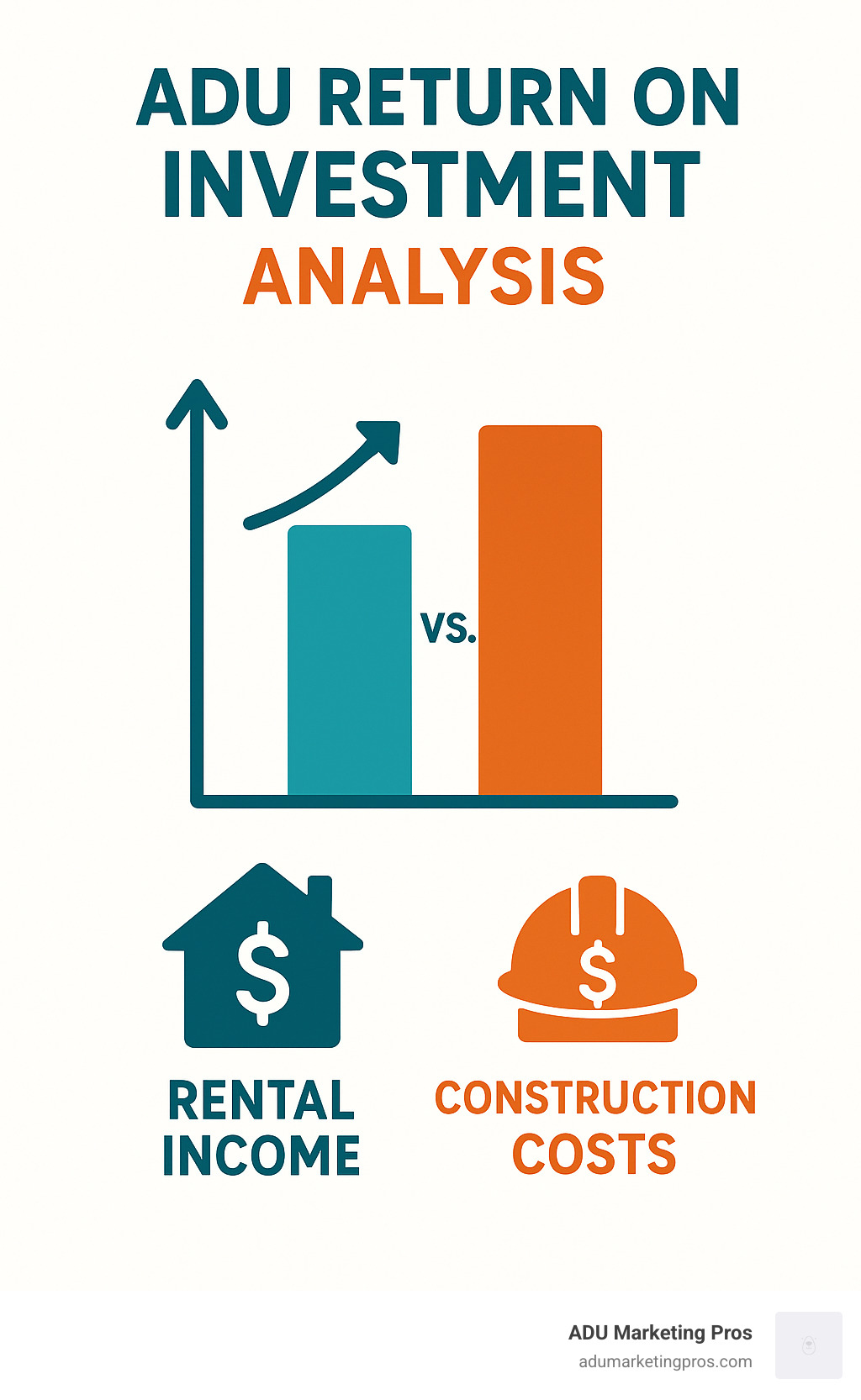
Most homeowners reach their payback point within 5-7 years through rental income alone. After that, your ADU essentially becomes a positive cash flow asset that continues generating returns for decades. Not to mention the flexibility it provides for housing family members or creating work-from-home space – benefits that go beyond dollars and cents.
For a deeper dive into construction costs, check out our comprehensive guide on ADU Construction Cost. And if you’re interested in the broader impact of ADUs on housing affordability, the California Department of Housing and Community Development offers scientific research on housing affordability.
Funding Options
Not many homeowners have $250,000+ sitting in their checking account, so how do people typically finance these projects? Here are the most popular options:
A Home Equity Line of Credit (HELOC) leverages your home’s existing equity, typically offering lower interest rates than personal loans. The flexible draw period allows you to pull funds as needed during construction, and the interest may be tax-deductible (though you should always consult your tax advisor about this).
Some homeowners opt for a Cash-Out Refinance, replacing their existing mortgage with a larger one and using the difference for construction. This approach often secures lower interest rates than a HELOC but does extend your mortgage term.
Renovation Loans are specifically designed for home improvements and are based on your home’s post-renovation value. Options like FHA 203(k) and Fannie Mae HomeStyle loans provide a single loan covering both your mortgage and the renovation costs – streamlining the whole process.
San Jose residents have occasionally had access to a Zero-Interest Pilot Program offering 0% interest and no payments for six months. These loans are designed to cover the construction period before refinancing and are specifically for pre-approved ADU designs. Availability is limited on a first-come, first-served basis, so check with the city for current status.
Don’t overlook Green Energy Rebates and Incentives which can offset some construction costs. All-electric ADUs may qualify for additional incentives, and features like solar panels or energy-efficient appliances often come with tax credits or rebates.
“Most of our clients use a combination of these financing options,” explains our financial consultant. “A common approach is using a HELOC for the construction phase, then refinancing once the ADU is complete and can be appraised as part of the property’s total value. This strategy often secures better long-term rates.”
Financing an ADU is an investment in your property’s future value – not just an expense. With San Jose’s strong rental market and housing shortage, well-designed accessory dwelling units continue to be one of the smartest additions homeowners can make to their properties.
Frequently Asked Questions about San Jose ADU Plans
How long does it take to get a permit using pre-approved plans?
One of the biggest advantages of using San Jose ADU plans from the pre-approved program is the dramatically shortened permit timeline. Many homeowners are shocked to find they can potentially receive their permit the same day they submit their application!
While same-day approval is the best-case scenario (and does happen when your documentation is flawless), most homeowners can realistically expect to receive their permits within 1-7 days. This is a night-and-day difference compared to the traditional custom plan review process, which drags on for at least 20 business days for just the initial review, often followed by multiple back-and-forth revision cycles that can extend for months.
“I couldn’t believe how quick it was,” shares one San Jose homeowner who used a pre-approved plan. “My neighbor spent nearly six months in permit limbo with their custom design while I was already framing my ADU.”
What lots do NOT qualify for the fast-track program?
Not every property in San Jose can take advantage of the expedited process, unfortunately. Your property won’t qualify if it falls into any of these categories:
Properties in geohazard or landslide zones face additional engineering requirements that necessitate a more thorough review. Similarly, homes in flood zones (designated as A, AE, AH, or AO) require special considerations for safety. If your property sits within a Wildland-Urban Interface (WUI) zone, fire safety concerns will require additional scrutiny.
Other disqualifying factors include having open code enforcement violations on your property (you’ll need to resolve these first), needing a Fire Variance for your project, or if your home is listed on the Historic Resources Inventory.
Wondering about your property’s status? The City’s ADU Universal Checklist and online property profile tools make it easy to check your eligibility before investing time and money in plans.
Can I customize finishes without losing pre-approved status?
Good news for those who want to add personal touches! You absolutely can customize interior finishes, fixtures, appliances, and exterior materials without losing the valuable pre-approved status.
Most vendors building San Jose ADU plans allow you to personalize elements like countertops, flooring, bathroom fixtures, and paint colors. You can typically select your preferred doors and windows (as long as they fit within the same openings), cabinet styles, and even exterior siding and roofing materials (within structural limitations).
However, there’s an important distinction to understand: structural modifications, changes to the floor plan, or alterations to the building envelope will trigger additional review and may negate the time-saving benefits of using a pre-approved plan. The core structure and layout need to remain consistent with the approved design.
Are ADUs under 750 sq. ft. really exempt from impact fees?
Yes! This is one of the most significant cost-saving opportunities when building an ADU in San Jose. Since January 1, 2020, ADUs under 750 square feet are completely exempt from parkland and school impact fees, which can save homeowners thousands of dollars in permit costs.
This exemption explains why so many pre-approved plans are cleverly designed to maximize living space while staying just under this magical 750 square foot threshold. It’s no coincidence that you’ll find many options at 748 or 749 square feet – designers are helping you get the most space while avoiding these substantial fees.
Can I build an ADU if my property is a rental?
Many investors are pleased to learn that yes, you can absolutely build an ADU on a property where the single-family house is already a rental. Even better, you can rent both the main house and the ADU to different tenants, potentially creating two income streams from a single property.
The one exception to this flexibility involves Junior ADUs (JADUs). If you’re building a JADU rather than a standard ADU, owner-occupancy is required – meaning either you must live in the main house or in the JADU itself. This requirement reflects the more integrated nature of JADUs with the primary dwelling.
Do I need separate utilities for my ADU?
When it comes to utilities for your San Jose ADU plans, you have options. Utilities may be combined with the main house or separated – the decision is yours as the homeowner.
If you’re planning to rent out your ADU, separate utilities often make sense for clearer billing and tenant responsibility. Should you want a separate electric meter, you’ll need to coordinate with PG&E to confirm the design meets their requirements.
One requirement that doesn’t have flexibility: ADUs must have their own address, which is assigned as part of the building permit process. This ensures emergency services can locate the unit and mail can be properly delivered.
Can I sell my ADU separately from my main house?
This is an exciting new development! Thanks to the passage of AB 1033 (effective January 2024) and San José Ordinance No. 31095 (approved June 2024), homeowners now have the option to convert their ADUs into separate condominium units that can be sold independently.
This represents a significant shift in how homeowners can realize value from their ADU investment. Rather than being limited to rental income, you now have a pathway to potentially sell your ADU outright.
The process requires completing a condominium conversion, which includes submitting a parcel map application and creating HOA documentation. While more involved than simply building an ADU, this option creates new financial possibilities that may make ADU construction even more attractive to homeowners looking for diverse investment strategies.
For many San Jose homeowners, this new option represents the best of both worlds – the ability to add housing to their property now, with the flexibility to either keep it as a rental or sell it separately in the future.
Conclusion
San Jose ADU plans have truly transformed the accessory dwelling unit landscape, offering homeowners a golden opportunity to bypass months of red tape while saving thousands in design and permit costs. I’ve seen how San Jose’s pre-approved program stands out as one of California’s most forward-thinking initiatives, with enough design variety to match almost any property type or family need.
The beauty of these plans lies in their versatility. Whether you’re looking at a cozy 330-square-foot studio or a spacious three-bedroom unit maxing out at 1,200 square feet, these pre-approved designs create a clear path to:
Build additional living space for your growing family or aging parents
Boost your property’s market value by 20-30% (a significant return in today’s real estate market)
Generate substantial monthly rental income between $2,500 and $4,000
Slash your construction timeline by weeks or even months
Sidestep those hefty impact fees by choosing strategically-sized units
Many homeowners I talk with feel overwhelmed by the thought of tackling an ADU project. That’s where pre-approved plans truly shine – they take the guesswork out of the equation. You’re not just getting a blueprint; you’re getting a professionally designed home that’s already survived the city’s rigorous review process. This dramatically reduces your risk while ensuring the final product meets high quality standards.
Here at ADU Marketing Pros, we’ve made it our mission to connect San Jose’s finest ADU builders and architects with homeowners who are ready to break ground. Being based in San Jose ourselves gives us an intimate understanding of both the local market dynamics and the regulatory landscape – knowledge we leverage to create laser-focused marketing strategies that deliver qualified leads to ADU professionals.
Whether you’re just beginning to explore ADU options for your property or you’re an established ADU professional looking to grow your client base, we’re passionate about guiding you through this exciting housing revolution. San Jose’s neighborhoods are evolving one backyard at a time, and with pre-approved plans, that evolution happens faster, more affordably, and with greater confidence than ever before.
For ADU professionals wanting to learn more about our specialized marketing solutions custom specifically to your business growth needs, I encourage you to visit our ADU Marketing Solutions page. Let’s transform San Jose’s housing landscape together.