
Why San Diego Homeowners Are Turning to ADU Contractors for Extra Space and Income
In the face of a challenging housing market, San Diego homeowners are discovering a powerful solution right in their own backyards. Finding the right San diego adu contractor can transform your property into a multi-faceted asset that generates significant rental income, increases your home’s value by up to 50%, and provides flexible, independent living space for family or guests. The time to act is now, as recent state laws have made building an Accessory Dwelling Unit (ADU) easier and more financially viable than ever before.
Top Considerations When Hiring a San Diego ADU Contractor:
- Deep Experience with Local Permits: San Diego has specific regulations for ADUs. A top-tier contractor will have a proven track record of navigating the City of San Diego’s Development Services Department, understanding nuances in zoning, size limits (up to 1,200 sq ft), setback requirements, and the streamlined approval processes.
- Integrated Design-Build Capabilities: The most efficient projects are managed by contractors who handle both architectural design and construction. This single-source responsibility saves homeowners time, reduces coordination headaches, and ensures the design vision is executed flawlessly within budget.
- Transparent and Detailed Pricing: A trustworthy contractor provides a comprehensive, line-item budget. Expect costs ranging from approximately $120,000 for a compact 300 sq ft studio to $580,000 or more for a spacious 1,200 sq ft multi-bedroom ADU, depending on site conditions and finishes.
- A Strong Portfolio and Verifiable Reviews: Look for contractors with a substantial portfolio of 100+ completed ADUs in the San Diego area and consistently high ratings. Verifiable 5-star reviews on platforms like Google and Yelp are a strong indicator of client satisfaction and reliability.
- Comprehensive, End-to-End Services: The best contractors are full-service partners. They manage every single step, from initial feasibility studies and site assessments to permit acquisition, all phases of construction, and final city inspections, delivering a turnkey solution.
San Diego’s housing market continues to put pressure on homeowners to maximize their property’s potential. With new state laws like SB9 and SB10 further encouraging density and making ADU construction easier, the demand for housing is at an all-time high. Building an accessory dwelling unit has become one of the smartest and most accessible real estate investments a homeowner can make.
The numbers tell a compelling story. Adding an ADU to your San Diego property can increase its market value by 30% to 50% or more. If you’re considering it as a source of income, San Diego’s high rent prices mean your ADU could generate substantial passive income while simultaneously helping to address the local housing shortage.
But here’s the challenge: building an ADU is a complex undertaking that typically takes 8 to 12 months. It requires navigating intricate permit processes, managing a multi-stage construction project, and making hundreds of decisions about design, materials, and finishes. That’s why choosing the right contractor isn’t just an important step—it is the single most critical factor in your project’s success.
The best San Diego ADU contractors don’t just build structures; they act as your expert guide. They conduct in-depth feasibility studies, handle all permit submissions and correspondence with the City of San Diego, manage every phase of construction with precision, and deliver a finished unit that perfectly aligns with your vision and budget. Some even offer post-construction rental support services to help you maximize your investment from day one.
San diego adu contractor word roundup:
Why Build an ADU in San Diego? The Financial and Lifestyle Benefits
Building an Accessory Dwelling Unit (ADU) in San Diego isn’t just about adding square footage; it’s about unlocking incredible financial and lifestyle advantages for your property. We’ve seen firsthand how these versatile structures can transform homes and lives, offering a powerful response to the city’s unique economic landscape.
The San Diego housing market is notoriously competitive and expensive. An ADU offers a brilliant solution to this challenge, providing homeowners with flexible options that benefit both their finances and their family’s needs. From generating significant rental income to providing much-needed space for loved ones, the benefits are substantial and immediate.
Maximizing Your Property’s Value and Earning Potential
One of the most compelling reasons to build an ADU is its potential to dramatically increase your property’s value and generate a new income stream. Statistics consistently show that adding an ADU to your property in San Diego can boost its value by up to 30%, with some projects seeing an impressive 50% or more. This isn’t just a short-term gain; it’s a long-term investment that builds substantial equity and provides lasting financial freedom.
Imagine a passive income stream that helps offset your mortgage or provides extra funds for your family’s goals. With San Diego’s high rent prices, an ADU can generate substantial monthly income, turning your backyard into a revenue-generating asset. For a tangible example, a $300,000 ADU financed over 30 years might add approximately $1,500 to your monthly housing payment. However, if that same unit rents for $2,500 per month in a desirable San Diego neighborhood, you’re not only covering the cost but also generating $1,000 in positive cash flow. Detached ADUs, in particular, often command the highest rent and deliver the greatest value increase due to their superior privacy and independence. This makes an ADU a powerful tool for addressing both your personal financial objectives and the broader housing crisis in the region. The return on investment (ROI) for an ADU can be significant, far outpacing traditional savings or investment accounts.
Enhancing Your Lifestyle with Flexible Space
Beyond the impressive financial gains, an ADU offers unparalleled flexibility to improve your lifestyle. Think of it as a custom-built solution for your family’s evolving needs, adapting as your life changes.
Need a dedicated, accessible space for an aging parent to live independently yet close by? An ADU can serve as an ideal “granny flat” or elder cottage, ensuring their comfort, safety, and your peace of mind. Have an adult child returning home after college or saving for their own place? A self-contained unit provides them with the privacy and autonomy they desire while keeping them connected to family.
For families with young children, a “nanny flat” or caregiver suite within an ADU can provide convenient, on-site childcare, simplifying daily logistics. But the possibilities extend far beyond that. Perhaps you’ve been dreaming of a private home office away from the distractions of the main house, a dedicated home gym, or a creative art studio where your hobbies can flourish. An ADU can also serve as a luxurious guest house for visiting friends and family, offering them a private retreat. An ADU makes all these possibilities a reality, truly maximizing every inch of your property’s potential and adapting to your needs for years to come.
The ADU Building Process in San Diego: From Concept to Completion
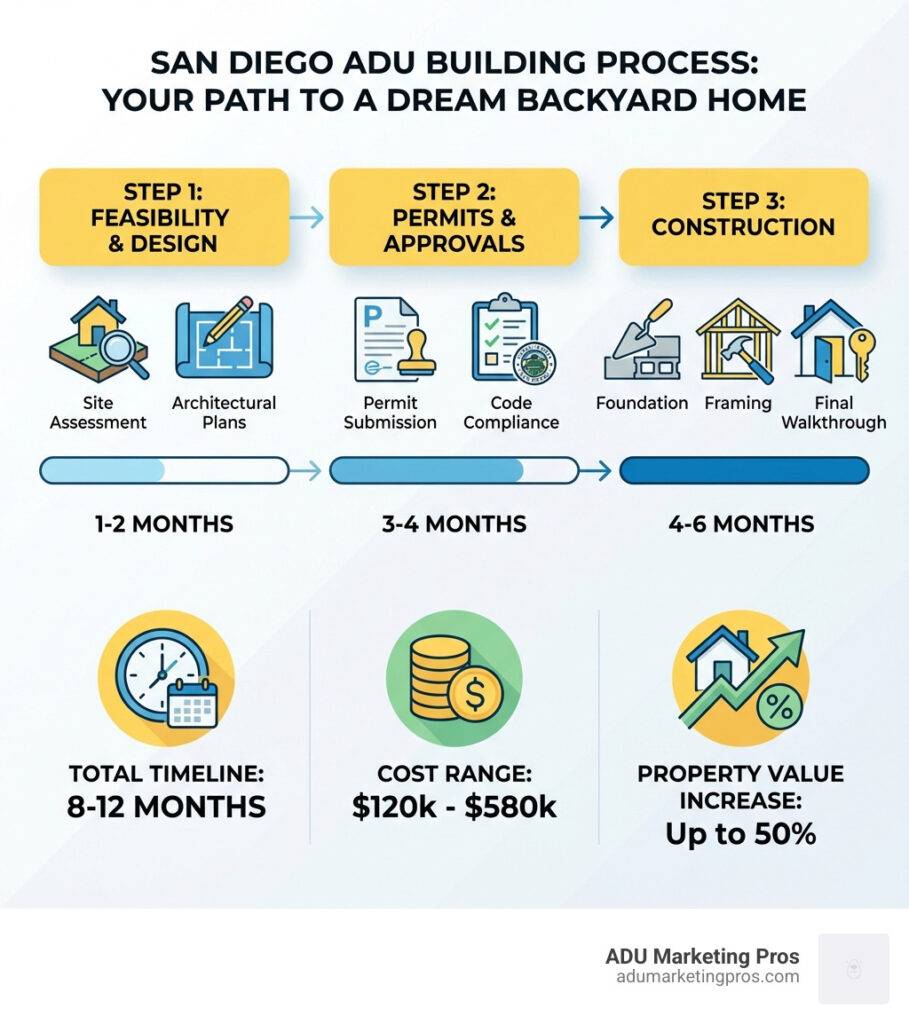
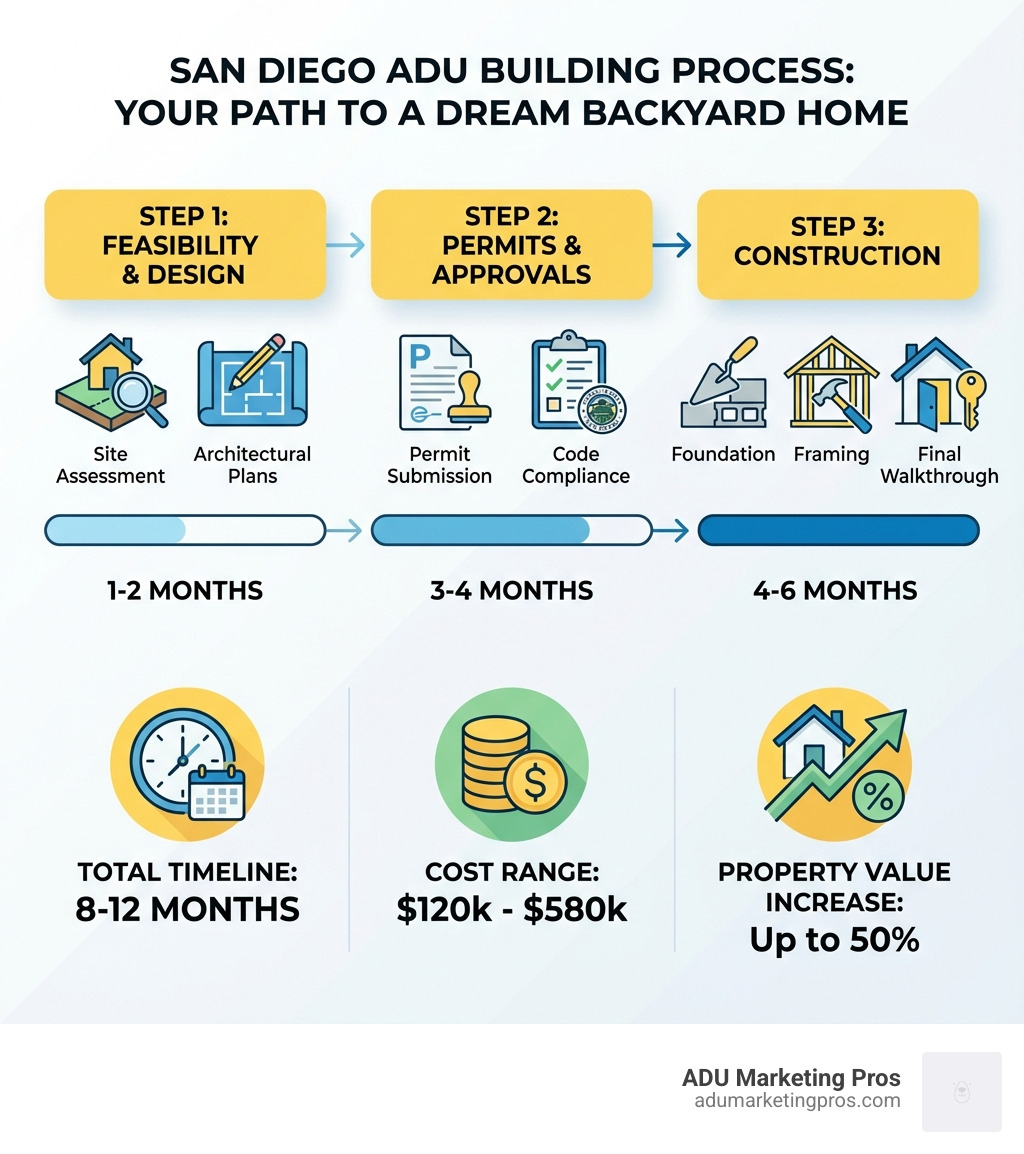
Embarking on an ADU project can feel like a marathon, but with the right San diego adu contractor, it becomes a structured and exciting journey. The typical timeline for building an ADU in San Diego spans about 8 to 12 months, encompassing everything from initial design concepts to the final construction walkthrough. Understanding this process step-by-step is crucial for setting realistic expectations and avoiding common bottlenecks.
Step 1: Feasibility, Design, and Planning (1-2 Months)
The first phase is all about vision and viability. It begins with a thorough site assessment to understand your property’s unique characteristics, opportunities, and limitations. This crucial step involves analyzing zoning regulations, checking utility access points (sewer, water, power), evaluating soil conditions, and assessing the topography of your lot. This is where your dreams meet reality, as we work with you to develop a realistic budget and explore design possibilities that are both beautiful and buildable.
Whether you opt for a fully custom design tailored to your specific aesthetic and functional needs or choose from a set of pre-approved plans to expedite the process, the design phase is critical. Many reputable ADU contractors, especially integrated design-build firms, have in-house architects and designers who can translate your ideas into detailed architectural plans. They can even provide immersive 3D visualizations, allowing you to “walk through” your future ADU before construction even begins. This ensures that every square foot is optimized for aesthetics, functionality, and flow, reflecting your unique style and goals.
Step 2: Navigating San Diego’s Permits and Regulations (3-4 Months)
Once your design is finalized, the next hurdle is securing the necessary permits and approvals. This phase can often be the most daunting for homeowners, as it involves navigating a complex web of local building codes, zoning laws, and the specific regulations set forth by the City of San Diego.
A skilled San diego adu contractor will manage the entire permitting process on your behalf, from application submission to final approval. This includes preparing and submitting plans for various permits, including building, electrical, mechanical, and plumbing. Depending on your location, you may also need grading or coastal development permits. An experienced contractor is well-versed in San Diego’s ADU-friendly regulations, which include smaller setbacks, expedited approvals, relaxed parking requirements, and greater build sizes. They’ll ensure your plans adhere to all code compliance, including maximum size limits (up to 1,200 square feet), height restrictions, and lot coverage exemptions. For comprehensive information directly from the source, we always refer to official government resources like the City of San Diego’s Development Services Department and the Accessory Dwelling Unit Information From The State of California. Their expertise helps streamline this often-complex stage, preventing costly delays and ensuring a smooth transition to construction.
Step 3: Construction and Final Walkthrough (4-6 Months)
With permits in hand, the exciting construction phase begins. This is where your ADU truly takes shape from the ground up. The process typically starts with site preparation and laying the foundation, followed by framing the structure’s walls and roof. Utilities integration (electrical, plumbing, HVAC) is a critical next step, ensuring your ADU is fully functional and comfortable year-round.
Throughout this period, your contractor’s team will install insulation, drywall, and all interior and exterior finishes, from flooring and cabinetry to roofing and siding. Regular inspections are conducted at key milestones by city officials to ensure all work meets stringent safety and code standards. A dedicated project manager from your San diego adu contractor should oversee every detail, ensuring timely progress, consistent quality, and clear, proactive communication with you. The final step is a thorough walkthrough with you, the homeowner, to ensure every detail meets your expectations before the city grants the certificate of occupancy and you receive the keys to your new backyard home.
ADU Types, Costs, and Construction Methods in San Diego
San Diego offers a variety of ADU types, each with its own unique benefits, costs, and construction methods. Understanding these options is the key to choosing the right fit for your property, lifestyle, and budget.
Common ADU Types and Their Typical Costs
The landscape of ADUs is diverse, offering solutions for almost every property and need.
- Detached ADUs: These are standalone, new-construction structures built separately from your main home, offering the most privacy for both occupants and homeowners. They can be built up to 1,200 square feet and often provide the highest increase in property value and rental income. Costs for a detached ADU can range significantly, from around $120,000 – $175,000 for a 300 sq ft studio, up to $415,000 – $580,000 for a 1,200 sq ft home.
- Attached ADUs: These units are physically connected to your primary residence, often sharing a wall or roofline. They can be a great option for creating a multi-generational living setup and may leverage existing utilities, which can sometimes reduce construction costs.
- Garage Conversions: Transforming an existing garage into a legal ADU is an extremely popular choice in San Diego. It’s an excellent way to utilize an existing structure efficiently and often offers a higher return on investment due to lower structural building costs.
- Junior ADUs (JADUs): These are smaller units (up to 500 sq ft) created within the existing footprint of a single-family home, such as converting a spare bedroom. They must have an external entrance and an efficiency kitchen, and can share a bathroom with the main house. JADUs typically have the lowest costs due to minimal new construction.
The typical cost of building an ADU in San Diego varies widely based on size, complexity, and finishes. For instance:
- 300 sq ft: $120,000 – $175,000
- 500 sq ft: $180,000 – $250,000
- 800 sq ft: $250,000 – $350,000
- 1,000 sq ft: $330,000 – $465,000
- 1,200 sq ft: $415,000 – $580,000
The significant cost range is influenced by several key factors. Site-specific conditions play a major role; a flat, easily accessible lot will be far less expensive to build on than a sloped lot requiring significant grading and a complex foundation. The distance to existing utility hookups (sewer, water, electricity) can also add thousands to the budget. Finally, the level of finishes you choose—from standard-grade appliances and flooring to high-end, custom cabinetry and luxury fixtures—will have a substantial impact on the final price tag. This highlights the importance of detailed budgeting with your San diego adu contractor.
Prefab vs. Stick-Built: Which is Right for You?
When it comes to construction methods, homeowners often weigh the pros and cons of prefab (prefabricated) ADUs versus traditional stick-built construction.
| Feature | Prefab ADUs | Stick-Built ADUs |
|---|---|---|
| Cost | Potentially lower due to factory efficiency | Generally higher, more variable |
| Timeline | Often faster, as components are built off-site | Longer, dependent on on-site weather and labor |
| Customization | Limited to available models and finishes | High degree of customization, unique designs |
| Quality | Consistent factory-controlled quality | Highly dependent on builder skill and supervision |
| Resale Value | Can be comparable, but custom designs may appeal more | Often higher perceived value due to custom nature |
Prefab ADUs can offer speed and cost predictability, with components built in a factory setting and then assembled on-site. This can be appealing for homeowners looking for a quicker turnaround. However, they may offer less customization and can sometimes face logistical challenges with site access for delivery and craning the modules into place.
Stick-built ADUs, constructed entirely on your property from the ground up, allow for maximum design flexibility and customization. This ensures your ADU perfectly matches your vision and integrates seamlessly with the architectural style of your existing home. While the timeline might be longer and costs potentially higher, many homeowners prefer the bespoke nature and perceived long-term quality of a custom-built structure. Some contractors, like RiseCon, advocate for full-build, on-site construction to avoid issues like delivery restrictions and to ensure lasting quality and value.
How to Choose the Right San Diego ADU Contractor
Selecting the right San diego adu contractor is arguably the most critical decision you will make in your ADU journey. A great contractor will not only deliver a high-quality product but will also make the entire process smooth, predictable, and stress-free. Conversely, a poor choice can lead to significant delays, budget overruns, and endless headaches.
Key Factors for Selecting a San Diego ADU Contractor
We recommend a thorough vetting process to ensure you partner with a reputable and experienced firm. Here are some essential questions to ask and factors to consider during your interviews:
- Experience with local codes and permits: “How many ADUs have you built specifically within the City of San Diego and surrounding municipalities? How do you stay current with the latest local and state regulations?” Your contractor must demonstrate mastery of San Diego’s specific ADU rules.
- Portfolio and references: “Can I see your portfolio of recently completed ADU projects, and can you provide references from the homeowners?” Look for contractors with a strong, diverse track record and consistent 5-star reviews. Companies like Crest Backyard Homes boast over 300 5-star Google reviews, indicating strong client satisfaction.
- Licensing and insurance: “Can I see proof of your contractor’s license, general liability insurance, and workers’ compensation insurance?” Always verify their license number on the California Contractors State License Board (CSLB) website to ensure it is active and in good standing. This protects you from liability.
- Communication and project management: “What is your communication process? Who will be my main point of contact, and how often can I expect updates?” Clear, consistent communication is paramount. You want a contractor who uses modern project management tools and keeps you informed every step of the way.
- Services offered: “What specific services do you cover? Is everything from design and engineering to permit pulling and final inspection included?” A comprehensive, all-in-one service offering can save you significant time and stress.
- Transparent pricing and change orders: “How do you structure your pricing? Is it a fixed-price contract or cost-plus? What is your process for handling change orders?” Ensure there are no hidden fees and that the estimate is detailed. A clear change order process is crucial for managing any adjustments during construction.
- Warranty: “What kind of warranty do you offer on your workmanship and the materials used?” A reputable contractor will stand behind their work with a comprehensive warranty.
The Design-Build Advantage for Your San Diego ADU Contractor
For many homeowners, choosing a design-build firm for their ADU project in San Diego offers significant advantages. This integrated approach means one company and one team are responsible for the entire project, from the initial architectural drawings to the final construction, providing a single point of accountability.
The design-build model streamlines the entire process, fostering better communication and collaboration between the design and construction teams from day one. This synergy often leads to faster project delivery, better cost control, and a more innovative final product. For example, some design-build firms, like SnapADU, offer a price lock within the first few weeks of a project, thanks to their integrated approach. This provides homeowners with immense peace of mind and budget certainty.
Firms like Moore Construction, which specialize in ADUs and custom homes, are excellent examples of design-build contractors who guide clients through design and budget considerations from the very beginning. This integrated team approach ensures that your vision is maintained from concept to completion, minimizing potential conflicts between architect and builder and maximizing overall efficiency.
Common Challenges and Financing Your ADU Project
Building an ADU, while a highly rewarding investment, isn’t without its potential challenges. However, with the right preparation and a competent San diego adu contractor, these problems can be easily anticipated and managed. Financing is another crucial aspect that requires careful planning and exploration of all available options.
Overcoming Potential ADU Problems
- Unexpected Costs: Construction projects can encounter unforeseen expenses. These might stem from discovering poor soil conditions that require engineered foundations, needing to upgrade the main home’s electrical panel to support the ADU, or sudden spikes in material costs. A good contractor mitigates this by including a contingency fund in the budget and providing detailed estimates upfront.
- Permitting Delays: While San Diego has streamlined ADU permitting, delays can still occur due to incomplete documentation, required plan revisions, or city backlogs. An experienced contractor who is adept at navigating the local bureaucracy and has strong relationships with plan checkers is invaluable here.
- Material Sourcing and Supply Chain: Global supply chain issues can sometimes impact project timelines and costs for specific materials like windows, appliances, or lumber. Working with a contractor who has established relationships with multiple suppliers can help mitigate these risks and find suitable alternatives if needed.
- Finding Reliable Builders: The high demand for ADUs has led to a proliferation of contractors, not all of whom are qualified. It’s essential to diligently research and choose a San diego adu contractor with a proven track record, as discussed in the previous section, to avoid shoddy workmanship or abandoned projects.
- Privacy and Disruption: For homeowners living on the property during construction, noise, dust, and privacy can be concerns. Discuss a clear plan with your contractor for site cleanliness, work hours, and how they will minimize disruption to your daily life.
Financing Your San Diego ADU
Fortunately, several excellent financing options are available to help homeowners fund their ADU projects:
- Home Equity Loans and HELOCs (Home Equity Lines of Credit): These are popular options that allow you to borrow against the equity you’ve built in your home. They typically offer competitive interest rates and can be a flexible way to fund construction, drawing funds as you need them.
- Cash-Out Refinancing: This option involves refinancing your existing mortgage for a higher amount than you currently owe and taking the difference in cash. This can be a great strategy if current interest rates are favorable, allowing you to fund your ADU with a single, long-term loan.
- Construction Loans: Specifically designed for new construction or major renovations, these short-term loans are disbursed in stages (draws) as construction progresses and milestones are met. They are often converted into a traditional mortgage upon project completion.
- Government Programs: California is actively encouraging ADU construction. Be sure to investigate programs like the CalHFA ADU Grant Program, which can provide up to $40,000 in assistance to help reimburse pre-development and non-recurring closing costs for low- to moderate-income homeowners. You can check your eligibility and learn more on the official CalHFA website.
We always encourage homeowners to explore all available options and consult with financial advisors and mortgage brokers who specialize in renovation or construction financing to determine the best strategy for their unique situation.
Frequently Asked Questions about Building an ADU in San Diego
We understand you likely have many questions as you consider building an ADU. Here are some of the most common inquiries we receive from San Diego homeowners:
How many ADUs can I build on my property in San Diego?
San Diego’s regulations are quite favorable for ADU construction, thanks to state laws aimed at increasing housing density. On a typical single-family residential lot, you can potentially build one detached or attached ADU plus one Junior ADU (JADU). On multi-family lots, you can generally build two detached ADUs, plus you may be able to convert non-livable spaces (like storage rooms or garages) into additional ADUs. Your San diego adu contractor will conduct a detailed feasibility study to determine the exact number and type of units allowed on your specific property.
What is the maximum size for an ADU in San Diego?
An Accessory Dwelling Unit in San Diego can be built up to 1,200 square feet, regardless of whether it’s detached or attached to the main dwelling. There are also excellent provisions for smaller units; for example, detached ADUs up to 800 square feet are often exempt from lot coverage requirements, which can be a significant advantage on smaller lots. Regarding height, detached ADUs can typically be built up to 16 feet high, or even higher in some cases depending on specific zoning and proximity to the main house. Attached ADUs can generally reach up to 25 feet in height or match the primary dwelling’s height, whichever is less restrictive.
Do I have to live on the property to build an ADU?
No. Under current California state law, owner-occupancy requirements have been eliminated for all new ADUs permitted through 2029. This means you do not have to live on the property (either in the primary dwelling or the ADU) to build or rent out an ADU in San Diego. This legislative change has made ADUs even more attractive as pure rental property investments, offering greater flexibility for homeowners and investors.
Are there parking requirements for my ADU in San Diego?
In most cases, no. To encourage ADU development and ease the housing crisis, California state law exempts ADUs from parking requirements if the property is located within a half-mile walking distance of public transit (like a bus stop or trolley station), is in a historically significant district, or when an ADU is part of the existing primary residence (like a JADU). Since a large portion of San Diego falls under one of these categories, it’s very likely you will not need to provide an additional parking space for your new unit. Your contractor can confirm the specific requirements for your address during the feasibility phase.
Conclusion
Building an ADU in San Diego is a uniquely powerful investment in today’s market. It offers a multitude of benefits, from significantly increasing your property’s value and generating substantial rental income to providing flexible, independent living spaces for your family’s evolving needs. The journey from concept to completion involves several key phases—in-depth design, diligent permitting, and quality construction—each requiring careful planning and expert execution.
The ultimate success of your ADU project hinges on choosing the right San diego adu contractor. We’ve seen that reputable firms with extensive local experience, transparent financial processes, a portfolio of glowing client reviews, and an integrated design-build approach can make all the difference. They are your partners in navigating complex regulations, managing costs effectively, and delivering a high-quality, valuable asset that enhances both your property and your lifestyle.
We are passionate about helping firms like yours stand out in the competitive ADU market. By deeply understanding the intricacies of ADU construction and the homeowner’s journey, we can help you connect with clients who are eager to transform their properties and unlock their full potential.
Ready to explore the possibilities for your backyard home? Explore pre-approved ADU plans for San Diego and take the first step toward realizing your property’s full potential.