
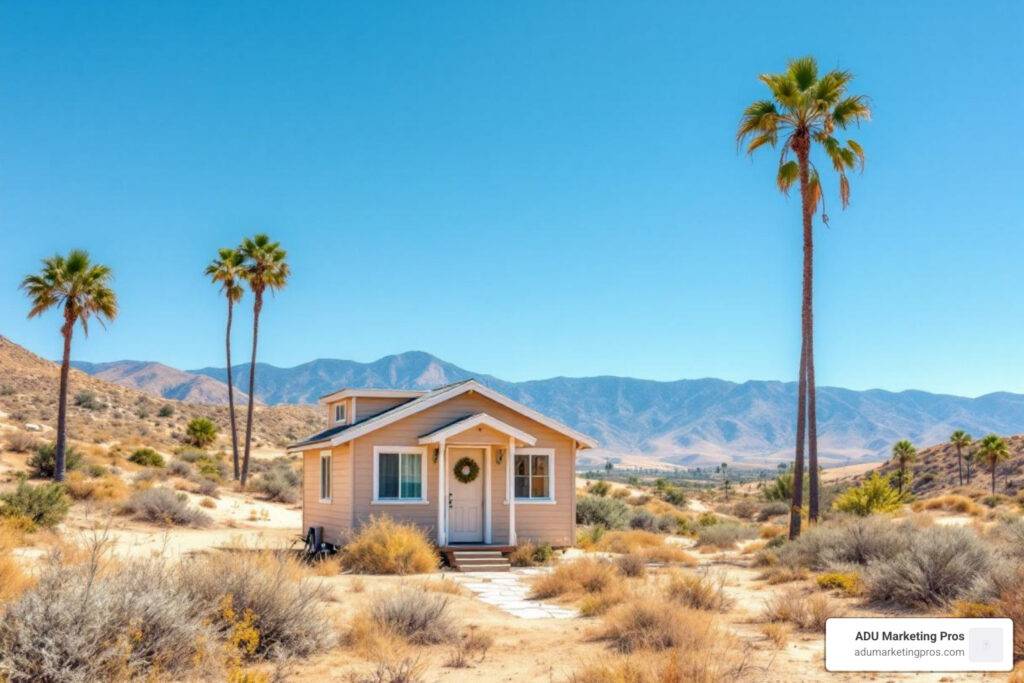
Why Tiny House Hunting in Southern California is Capturing Hearts
Tiny house hunting southern california is more than a real estate searchit’s a lifestyle shift. Drawn by shows like Tiny House Hunters and the promise of affordable, sustainable living under the California sun, many are starting on this exciting but complex journey.
Quick Start: How to Begin Your Tiny House Hunt in Southern California
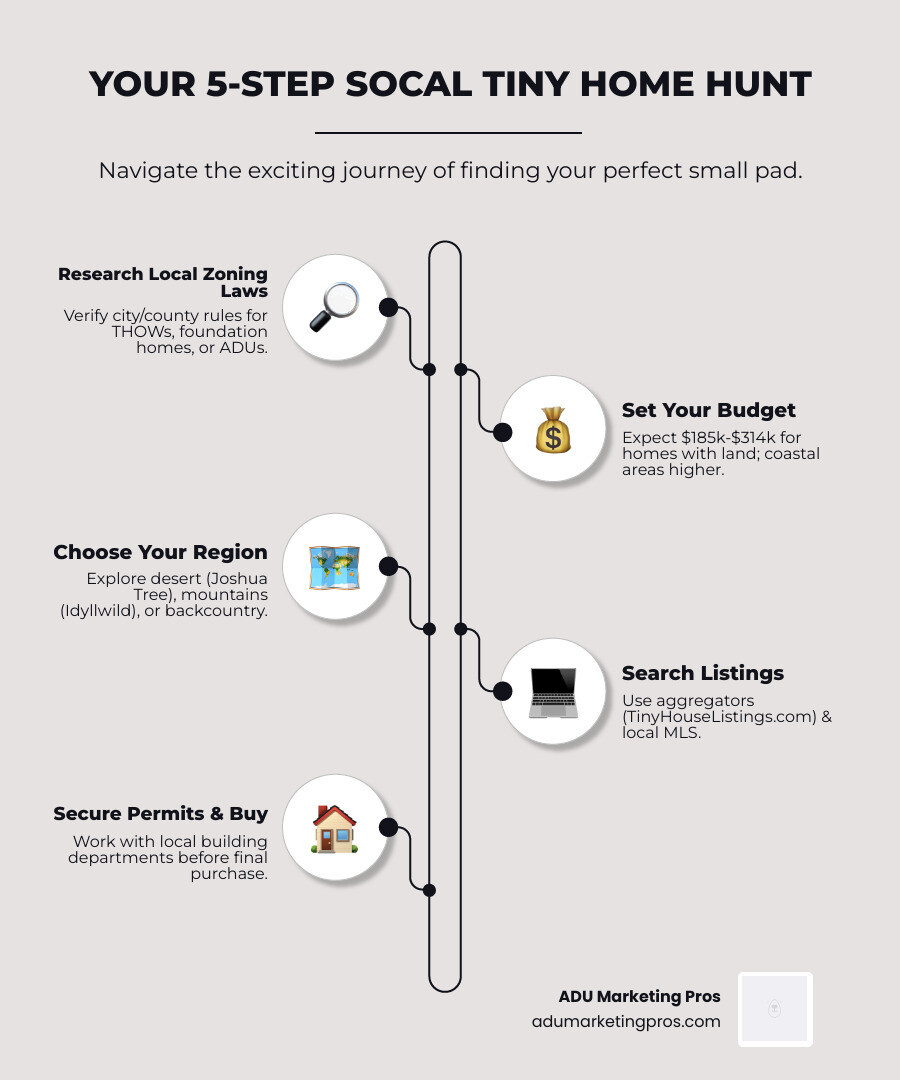
- Research Local Zoning Verify city and county rules for Tiny Homes on Wheels (THOWs), foundation homes, and ADUs before you spend money on plans or a build.
- Set Your Budget Expect roughly $185k$314k on average for homes with land, often higher in coastal or resort areas. Separate your budget into home, land, and site work/utilities.
- Identify Your Region Decide whether you want the desert (e.g., Joshua Tree), mountains (e.g., Idyllwild), backcountry/rural, or suburban backyard ADU living.
- Find Listings Use aggregators like LandSearch.com, TinyHouseListings.com, and public MLS feeds (via sites like Redfin or Zillow) with filters and keywords such as “tiny home,” “small cabin,” or “ADU.”
- Understand Legal Categories Learn the difference between RVIA-certified THOWs, permanent foundation homes, and ADUs so your home fits into an existing legal box.
- Secure Permits Early Contact the local building or planning department before purchase or placement to confirm what is allowed and which permits or inspections are required.
The dream is real: dozens of tiny homes with land are typically for sale in Southern California at any given time, many on multi-acre parcels. California’s relatively friendly zoning laws, including robust Accessory Dwelling Unit (ADU) regulations, allow Tiny Homes on Wheels in certain RV parks, on private property in some jurisdictions, and in ADU-permitted zones when they meet specific criteria.
However, the reality isn’t always like TV. The average cost per acre hovers around tens of thousands of dollars, land with existing utilities is scarce, and regulations vary dramatically between counties. This guide cuts through the complexity, showing you where to search, how to avoid legal problems, and what to budget for. It is designed as a practical, research-based starting point and is not a substitute for legal or financial advice.
Tiny house hunting southern california terms you need:
- land for sale in southern california for tiny houses
- places in southern california that allow tiny houses
- tiny home prices
For a broader context on housing trends and affordability in the region, resources such as the California Department of Housing and Community Development and the U.S. Department of Housing and Urban Development provide data, reports, and policy updates that can inform your planning.
The SoCal Tiny Living Dream: Weighing the Pros and Cons
Starting on a tiny house journey in Southern California offers a unique blend of freedom and challenges. Understanding both sides is the first step toward making your dream a reality.
The Benefits: Sunshine, Savings, and Simplicity
The allure of tiny living in Southern California is strong, driven by several key benefits:
- Lower Cost of Ownership: With the median home price in Southern California often exceeding $800,000, a tiny home offers a far more accessible path to homeownership. This translates to financial freedom through a smaller (or nonexistent) mortgage, lower property taxes, and reduced utility bills, freeing up capital for other life goals.
- Sustainable & Minimalist Lifestyle: Less space naturally encourages less consumption, reducing your energy use and environmental footprint. Many tiny homes are designed with sustainability in mind, incorporating features like solar panels, composting toilets, and greywater recycling systems. This intentional lifestyle often leads to greater psychological clarity and less stress.
- Zoning Flexibility: California has some of the nation’s most progressive legislation regarding alternative housing. State-level mandates have made it easier for property owners to add Accessory Dwelling Units (ADUs), and many jurisdictions are creating clear pathways for placing Tiny Homes on Wheels (THOWs) on private property, in RV parks, and in designated communities.
- Indoor-Outdoor Living: The region’s celebrated climate is perfect for blurring the lines between inside and out. A well-designed tiny home setup extends your living space with a deck, patio, outdoor kitchen, or container garden, effectively doubling your usable area for much of the year. For more insights, check out our resources on Small Houses.
The Challenges of Your Southern California Tiny House Hunt
While the benefits are compelling, it’s crucial to be realistic about the problems of tiny house hunting southern california.
- High Cost of Land: Land is the most significant and variable expense. In desirable areas, an acre can cost hundreds of thousands of dollars. The average cost of $37,885 per acre for tiny home properties often applies to more remote, undeveloped parcels. Don’t forget to budget for hidden costs like soil percolation tests for septic systems, land surveys, and title insurance.
- Complex Local Regulations: Rules vary dramatically between cities and counties. A THOW might be welcomed as a backyard ADU in Fresno, while a neighboring city might restrict it to designated RV parks with stay limits. You must perform due diligence on a specific parcel’s zoning before purchase.
- Competition and Infrastructure: The dream is popular, and you’ll face intense competition, especially for parcels with existing utility hookups (water, sewer/septic, electricity). Raw land requires significant investment to connect to the grid and public water, with costs for trenching, septic installation, and utility connection fees easily running into the tens of thousands of dollars. For a deeper dive into finding plots, explore our guide on Land for Sale in Southern California for Tiny Houses.
Decoding the Law: Zoning and Permits for SoCal Tiny Homes

California is a relatively progressive state for tiny living, but “legal” is a nuanced term. State law provides a framework, but the real rules are set at the city and county level. Understanding the legal classifications and the permitting pathway is crucial for a successful hunt.
THOWs, Foundation Homes, and ADUs: What’s the Difference?
Tiny homes fall into a few legal categories, each with its own rules and implications:
-
Tiny Homes on Wheels (THOWs)
Built on a trailer chassis, these are often classified as recreational vehicles. To be legally placed as a dwelling in many areas, a THOW typically needs an RVIA (Recreational Vehicle Industry Association) seal or equivalent third-party certification, confirming it meets safety standards like ANSI 119.5 (for RVs) or NFPA 1192. California law allows local governments to permit certified THOWs as ADUs or on private property, but rules on full-time occupancy and utility connections are determined locally. -
Foundation-based Tiny Homes
These are permanent structures built on a fixed foundation and must comply with the California Residential Code (CRC), often with local amendments. Many jurisdictions have adopted Appendix Q of the CRC, which provides specific regulations for sleeping lofts and other features of tiny homes under 400 square feet. They are treated like small conventional houses and must meet all structural, energy, fire, and health standards. -
Accessory Dwelling Units (ADUs)
This is a common legal pathway for tiny homes in backyards. An ADU is a secondary housing unit on a residential parcel. California has streamlined the ADU permitting process statewide, setting standards for size, setbacks, and parking. A foundation-built tiny home is often permitted as a detached ADU. Some cities, like Los Angeles and San Diego, have also explicitly allowed movable tiny houses (THOWs) to serve as ADUs, provided they meet specific criteria. For a comprehensive comparison, you can dig into our guide on ADU vs Tiny House.
Your First Call: The Local Planning Department
Before you fall in love with a piece of land or a tiny home model, your most critical task is to contact the planning and building departments of the specific city or county. Do not rely on verbal assurances; ask for links to the specific ordinances and get confirmations in writing if possible. Be prepared to ask targeted questions:
- What is the zoning of this specific parcel (APN)?
- Are tiny homes on foundations permitted as a primary dwelling or an ADU in this zone?
- Does the ordinance allow for movable tiny houses (THOWs) as ADUs or for long-term occupancy?
- What are the minimum and maximum square footage requirements for a dwelling/ADU?
- What are the setback, height, and lot coverage limitations?
- What are the requirements for water, sanitation (sewer or septic), and electricity?
Navigating City and County Regulations
Because ordinances can change, always consult official city or county websites for the latest requirements. The California ADU handbook published by the California Department of Housing and Community Development is an essential reference, but your local ordinance is the final authority. Our team helps clients understand the requirements for Places in Southern California That Allow Tiny Houses, but this is no substitute for direct verification with local officials.
Where to Start Your Tiny House Hunting in Southern California
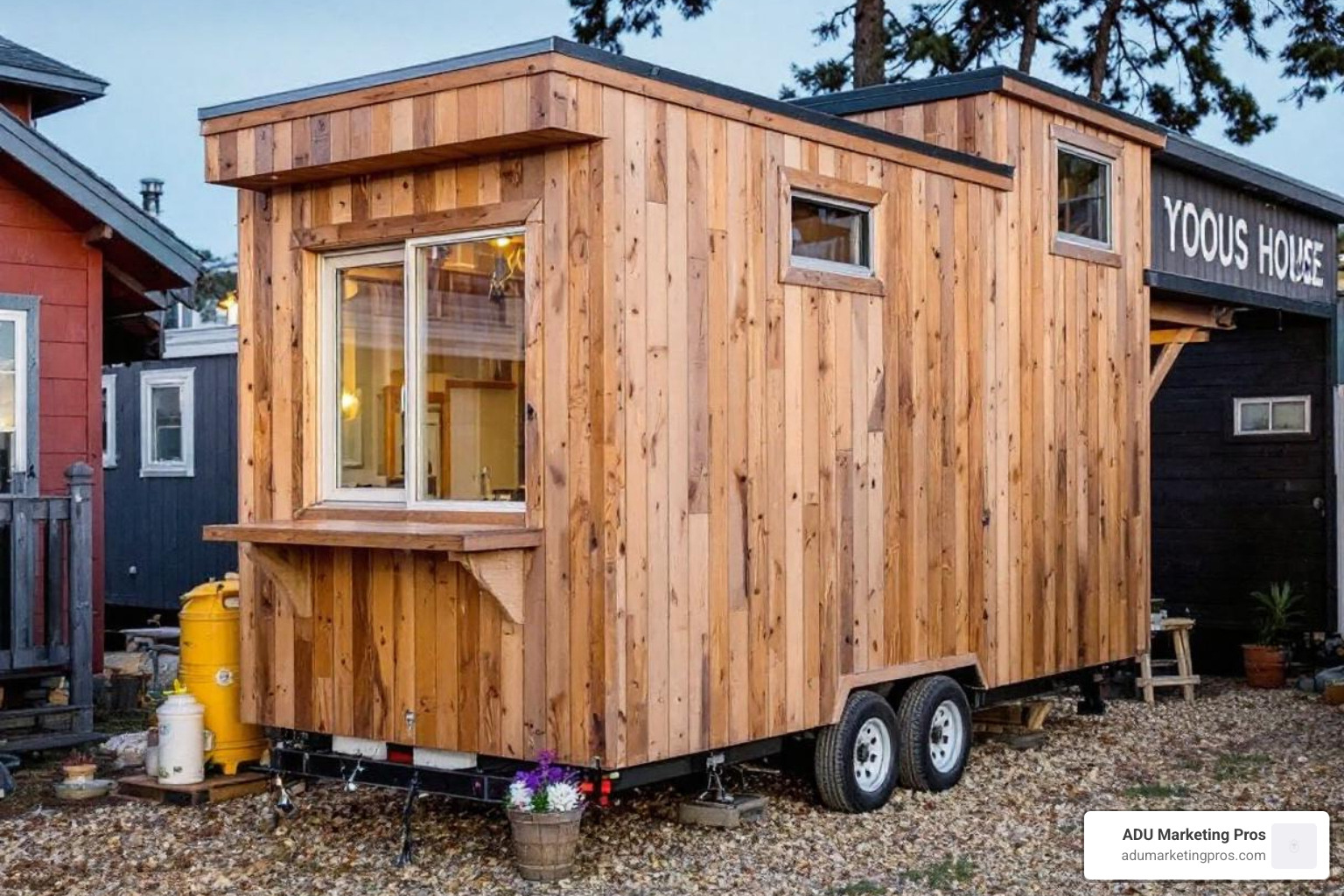
Southern California is vast, with each region offering a different flavor of tiny living. From desert solitude to mountain communities, knowing where to look is half the battle in your tiny house hunting southern california expedition.
Top Regions for Tiny Home Living
- San Diego County: Highly diverse, from the pricey coastal zones with ADU potential to the rural backcountry of Julian and Warner Springs, where larger, more affordable parcels can be found. It has some of the state’s most well-defined tiny home ordinances.
- Kern County: A top choice for affordability and true off-grid living. Areas like Tehachapi and the Kern River Valley offer expansive acreage and fewer regulations, providing the solitude many tiny dwellers seek, but be prepared for rugged conditions and fewer services.
- Riverside County: A massive county with everything from the alpine retreat of Idyllwild to the wine country of Temecula and the desert landscapes near Palm Springs. Zoning varies widely, so research is key.
- San Bernardino County: The epicenter of the desert tiny home movement. Joshua Tree, Yucca Valley, and Twentynine Palms are hotspots known for their unique landscapes, vibrant arts scene, and a culture that embraces unconventional housing. Water access is a critical consideration here.
- Santa Barbara County: While generally pricier, its inland areas like the Santa Ynez Valley or Cuyama Valley can offer opportunities for tiny homes on agricultural land, often with stunning mountain views and a more temperate climate.
Advanced Search Strategies
Go beyond basic searches to uncover hidden gems. On real estate sites, use advanced filters and keywords like:
- “ADU potential”
- “Guest house”
- “Well on property”
- “Septic installed”
- “Agricultural zoning”
- “Owner will carry” or “Seller financing” (can help with non-traditional properties)
Essential Online Resources for Your Search
Your search will rely heavily on online resources. Here’s where to start:
- Listing Aggregators: Websites like LandSearch.com and TinyHouseListings.com compile listings from various sources, giving you a broad overview.
- Builder Directories: Many tiny home builders have websites showcasing models and land packages. Our Tiny House Builders California guide is a great resource.
- Local Multiple Listing Service (MLS): Public real estate sites like Redfin or Zillow pull from the MLS. Use the keywords above to refine your search.
- Specialized Marketplaces: Sites like Tiny Houses For Sale in California (US) and Find Amazing New and Used Tiny Homes in California offer filtered searches for tiny homes.
The Price of Paradise: Budgeting for Your SoCal Tiny Home
While a tiny home is more affordable than a traditional house, the “tiny” price tag in Southern California can still be significant, especially once you factor in land and site work. “Affordable” is very relative in this market.
Understanding the Costs: Tiny Homes with Land
During your tiny house hunting southern california process, you’ll see a wide range of prices. At any given time, listings often show many tiny homes with land for sale, with average list prices in the low- to mid-$300,000s and median prices under that figure. The average property size can be several acres, especially in rural and desert markets, but prices vary dramatically by location; a remote desert parcel is far less expensive than land near the coast or in popular mountain towns.
Approximate market examples include:
| Property Location | Square Footage | Acreage | List Price | Notes |
|---|---|---|---|---|
| 36890 Highway 79, Warner Springs, CA 92086 | 192 sq ft | 44.78 acres | $420,000 | Built 2020, off-grid potential |
| N Ridge, Idyllwild, CA 92549 | 392 sq ft | 0.37 acres | $275,000 | Tiny home under construction |
| 929 Chumash Trl, Vista, CA 92084 | 4,308 sq ft (main home) | 1.54 acres | $1,498,777 | Large estate with ADU potential, RV spots |
These examples illustrate the market’s diversity and how price is influenced by location, existing infrastructure, and whether the tiny home is the primary dwelling or part of a larger estate. For more insights, see our resources on Small Houses for Sale.
Types of Tiny Homes and Their Price Points
-
Tiny Homes on Wheels (THOWs)
Often the most affordable path into tiny living. New, professionally built THOWs generally range from about $40,000 to over $100,000, depending on size, finishes, and off-grid features. -
Prefab & Park Models
These units are often larger, built to RV or park model standards, and may come RVIA-certified. Prices commonly span from around $60,000 to $150,000+ for new units, especially when high-efficiency systems or premium finishes are included. -
Foundation-built Homes
A permanent tiny home or small ADU built on-site or from prefab modules is typically priced closer to conventional construction on a per-square-foot basis. In many Southern California markets, a complete, code-compliant foundation tiny home or detached ADU can run from roughly $150,000 to $300,000+ depending on size, site conditions, and local labor and materials. -
DIY vs. Professional Build
A DIY build can reduce labor costs but requires tools, skills, time, and a strong understanding of applicable codes if it will be permitted. Professional builds cost more but bring expertise, warranties, and often a smoother permitting and inspection process. Explore options with our guide on Tiny House Builders in Southern California.
To Bundle or Not to Bundle? Land vs. Package Deals
This is a critical decision for many buyers.
-
Buying Land Separately
Offers maximum control over location, layout, and design. However, it is more complex: you must evaluate access, zoning, septic feasibility, fire requirements, and distance to utilities or the cost of off-grid systems. Site preparation (grading, driveways, trenching, and utility connections) can be a major line item. -
Buying a Home/Land Package
Some sellers and builders offer tiny homes already sited on land or package deals that include both the unit and placement. This can be a simpler, more turnkey solution and sometimes is easier to finance. The trade-off is usually less customization and a premium for convenience.
When budgeting for tiny living, remember to account for closing costs, permit fees, impact fees where applicable, utility connection charges, ongoing maintenance, and insurance. Checking public resources like county assessor databases and local utility providers can help you build a more accurate budget before you commit.
From TV Screen to Reality: What to Expect on Your Hunt
Shows like Tiny House Hunters have glamorized the search, but the reality in a competitive market like Southern California is far more complex than choosing between three perfect options.
The ‘Tiny House Hunters’ Effect vs. Real-Life tiny house hunting southern california
TV shows present a simplified narrative that can set unrealistic expectations for tiny house hunting southern california. The reality involves navigating expensive real estate, complex zoning, and a scarcity of ready-to-go properties. Instead of a simple choice, you’ll likely face a lengthy search involving dozens of rejected properties, budget compromises, and extensive due diligence. For a peek behind the curtain, you might find this Home.Made.Nation episode interesting.
Real-World Property Viewing Checklist:
- Access: Is the road paved and publicly maintained? If not, who is responsible for upkeep?
- Utilities: Pinpoint the exact location of the nearest power pole and water line. Get quotes for connection costs.
- Connectivity: Is there reliable cell service and internet access? This is non-negotiable for many.
- Natural Hazards: Check for signs of flooding, fire risk (vegetation density), and unstable slopes.
Key Features Southern California Buyers Demand
When tiny house hunting southern california, buyers consistently prioritize these features:
- Off-grid capability: Solar panels and water collection/storage systems are highly sought after for self-sufficiency and to bypass costly grid connections.
- Expansive acreage: Many buyers seek a retreat from urban density, prioritizing privacy, space for gardens, and a buffer from neighbors.
- Mountain or desert views: Southern California’s stunning landscapes are a primary motivation for many buyers.
- Outdoor living spaces: Decks, patios, and shade structures are essential to extend living areas and embrace the climate.
- Smart storage solutions: Innovative, space-saving designs are a must in any tiny home.
- High-quality insulation: Crucial for comfort and energy efficiency, good insulation dramatically lowers heating and cooling costs in California’s diverse climates.
For those building from scratch, consider exploring our resources on Architects in Southern California Who Design Tiny Houses.
Real-World Examples in Southern California
These examples illustrate the realities of the hunt:
- Warner Springs (Off-Grid Success): A 192 sq ft tiny home on 44.78 acres listed for $420,000 showcases a successful off-grid setup with a solar-powered well. This teaches buyers that true self-sufficiency on a large parcel is possible but comes at a significant price point.
- Idyllwild (Project Home): A 392 sq ft tiny home under construction on a 0.37-acre lot for $275,000 offers a chance for buyers to personalize their retreat. This highlights the “sweat equity” route, where buyers can save money by finishing a project themselves, but must have the skills and time.
- Vista (ADU Potential): A large property on 1.54 acres listed for $1,498,777 demonstrates how tiny living can be integrated into a larger estate. This strategy is for buyers with a larger budget who want to use an ADU or THOW for rental income or multi-generational living.
Frequently Asked Questions about Tiny House Hunting in Southern California
Are tiny homes legal in Southern California?
Yes, in many circumstances, but with conditions. California is generally friendly to Tiny Homes on Wheels (THOWs) that meet applicable safety standards and to small foundation-built homes that fit within ADU or residential codes. Tiny homes on a permanent foundation must comply with local building codes, often by being permitted as an Accessory Dwelling Unit (ADU) or a small primary dwelling. State laws have streamlined the ADU permit process, but it is crucial to verify specific ordinances for your target city and county, as rules and interpretations vary.
How much does a tiny home with land cost in Southern California?
Costs vary dramatically by region, size, and level of infrastructure. Listings frequently show tiny homes with land in a broad range, with some remote desert parcels priced under the regional median and more developed or coastal properties commanding a substantial premium. Land alone can range from relatively modest amounts per acre in rural areas to many times that figure in high-demand zones. Always review recent comparable sales and consult a local real estate professional to understand current market conditions.
Can I put a tiny house in my backyard in Southern California?
In many cases, yes, especially if it qualifies as an Accessory Dwelling Unit (ADU) under state and local rules. State laws have made it easier for homeowners to add secondary homes to residential properties. A foundation-built tiny home can often be permitted as an ADU when it meets size, height, setback, and utility requirements. A THOW may also be allowed in some jurisdictions if local ordinances specifically permit movable tiny houses or long-term RV occupancy. Always check with your local planning department for written requirements. For more on your options, explore our guide on ADU vs Tiny House.
How do I finance a tiny home and land in Southern California?
Financing is one of the biggest hurdles. Traditional mortgages are rarely an option for THOWs and can be difficult for unconventional properties. Common financing routes include:
- RV Loans: For THOWs with an RVIA certification. These often have shorter terms and higher interest rates than mortgages.
- Personal Loans: An unsecured personal loan can be used for the home, but amounts may be limited.
- Builder Financing: Some tiny home builders offer in-house financing or partner with lenders.
- Land Loans: Securing a separate loan for the land is possible but often requires a large down payment (20-50%).
- Cash: Due to financing difficulties, cash buyers have a significant advantage in the market.
What about insurance for a tiny home?
Insurance depends on the type of tiny home. For a THOW, you’ll typically need a specialized RV insurance policy that covers the home both in transit and when parked. For a foundation-built tiny home, you can usually get a standard homeowner’s insurance policy, similar to a conventional house. If you are building it yourself, you will also need builder’s risk insurance to cover the construction phase. It’s essential to work with an insurance agent who has experience with tiny homes to ensure you have proper liability and property coverage.
Conclusion
The great tiny house hunt southern california is an adventure—one that requires research, patience, and a clear vision. From navigating the legal landscape to finding that perfect plot of land with a view, the journey is as unique as the homes themselves. With the right information, your dream of a small, sustainable life in the Golden State is well within reach. As experts in the housing and ADU market, the team at ADU Marketing Pros understands the nuances that builders and architects face in this dynamic environment. We’re here to help streamline the process for those looking to build or place these innovative structures.
Your tiny house journey starts with a single step. Explore our guide to eco-friendly small homes to learn more.