Understanding the Tiny Home Movement: More Than Just Small Spaces
The tiny home movement is a social and architectural trend where people choose to downsize their living spaces—typically to homes between 100 and 400 square feet. While its modern form gained significant traction after the 2008 financial crisis, the philosophy of simple, intentional living has deep historical roots, echoing the sentiments of figures like Henry David Thoreau who sought clarity in simplicity at Walden Pond. Today, the movement is driven by a powerful trifecta of desires: achieving financial freedom, embracing environmental sustainability, and consciously rejecting a culture of consumerism that often equates happiness with accumulation. It fundamentally challenges the long-held mantra that “bigger is better.”
The appeal is starkly illustrated by the numbers. Compared to the average U.S. home of roughly 2,600 square feet, a tiny home is drastically more affordable to build and maintain. With typical build costs ranging from $23,000 for a DIY project to over $60,000 for a professional build, homeownership becomes accessible without a lifetime of debt. This financial reality is why an impressive 68% of tiny home owners have no mortgage, a figure that stands in sharp contrast to the rest of the housing market. This liberation from financial burden, combined with a significantly smaller environmental footprint, has propelled the movement from a niche curiosity into a significant and influential housing trend, amplified by social media and popular television shows that showcase its possibilities.
For decision-makers in the ADU construction and architecture industry, understanding this movement is not just relevant; it’s essential. Tiny homes and Accessory Dwelling Units (ADUs) are closely related, both serving as critical responses to the housing affordability crisis. They meet a growing demand for flexible, sustainable, and innovative housing solutions. This is particularly true in markets like California, where progressive regulatory changes have unlocked unprecedented opportunities for smaller, smarter dwellings, creating a fertile ground for architects and builders who can master the art of compact design.
What is the Tiny Home Movement and Why is it Growing?
At its core, the tiny home movement is a conscious decision to downsize in pursuit of a more meaningful life. It’s a social shift that asks: What if having less could actually give us more? Fueled by the 2008 financial crisis, ever-rising home prices, and widespread media exposure from shows like Tiny House Nation, what was once a fringe concept has blossomed into an aspirational lifestyle. The movement’s continued growth stems from its ability to offer a tangible, practical solution to the intersecting pressures of housing affordability, environmental anxiety, and the overwhelming complexities of modern life.

Core Principles and Features
The movement is built on a few key principles that resonate deeply with a growing segment of the population:
- Simplicity and Intentionality: Closely aligned with a minimalist lifestyle, tiny living forces a deliberate curation of one’s possessions. Every item must serve a distinct purpose or bring genuine joy, shifting the focus from material accumulation to life experiences, relationships, and personal growth. This intentionality often leads to reduced stress and a greater sense of control over one’s life.
- Financial Prudence: With dramatically lower construction costs, utility bills, and maintenance expenses, tiny living offers a clear path to financial freedom. For the 68% of owners who are mortgage-free, this translates to less financial stress, the ability to build substantial savings, and the freedom to pursue passions, travel, or work less.
- Environmental Consciousness: A smaller home inherently means a smaller carbon footprint. Eco-Friendly Small Homes consume a fraction of the resources during construction and require significantly less energy to heat, cool, and power. Many tiny dwellers take this further by incorporating reclaimed materials, composting toilets, and off-grid systems like solar panels.
- Freedom and Mobility: Particularly for Tiny Houses on Wheels (THOWs), this lifestyle offers unparalleled geographic freedom. It caters to digital nomads, travel enthusiasts, and anyone who rejects the idea of being tied down by a 30-year mortgage in a single location. This mobility allows owners to move for work, adventure, or simply a change of scenery.
To make this possible, tiny homes—typically 100 to 400 square feet—rely on ingenious and creative design. Sleeping lofts are a hallmark, freeing up the main floor for living space. Multi-functional furniture is essential, such as tables that fold down from walls, sofas that convert into beds with hidden storage, and staircases with built-in drawers. Kitchens are compact yet highly functional, and bathrooms often feature water-saving fixtures. Many tiny homes also incorporate off-grid capabilities like solar panels with battery storage and sophisticated rainwater collection and filtration systems, providing true independence. This intense focus on efficiency and smart design is also a defining characteristic of well-designed Small Houses and ADUs.
The Financial and Environmental Case for Going Tiny
For many people drawn to the tiny home movement, the decision isn’t just about downsizing square footage—it’s about upsizing their lives in ways that truly matter. The financial and environmental data provides a powerful, logical foundation for what is often a deeply personal and philosophical choice. The numbers clearly illustrate why this alternative path is so compelling.
Financial and Environmental Advantages
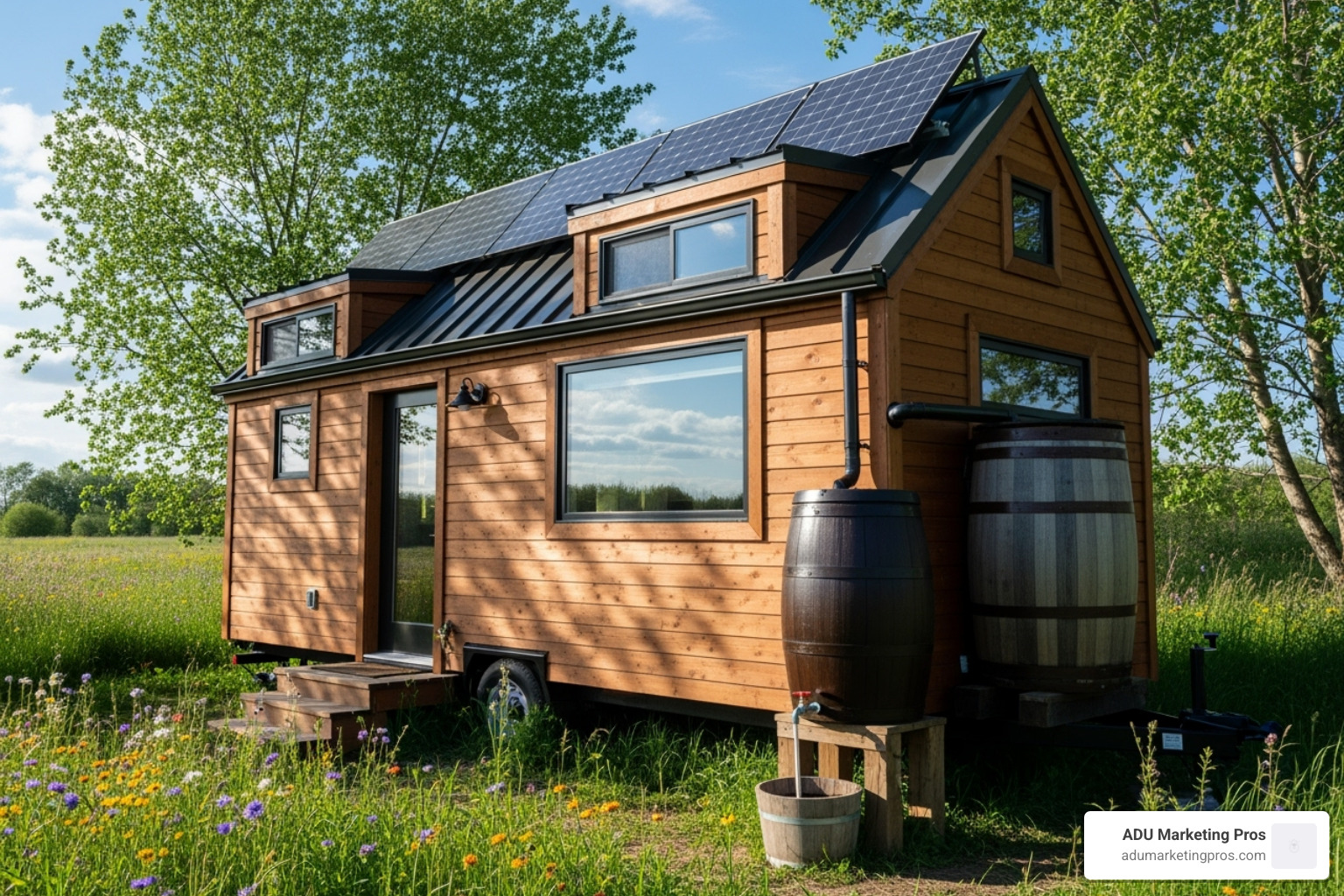
The most significant and immediate advantage is the potential for profound financial liberation. With drastically lower purchase prices, it’s no wonder that 68% of tiny home owners are completely mortgage-free, compared to just 29.3% of all U.S. homeowners. This freedom from decades of debt allows for greater savings—55% of tiny dwellers have more money saved than the average American—and opens up life possibilities that remain out of reach for many. This newfound capital can be redirected toward travel, starting a business, investing, or simply working less to spend more time with family. The savings continue month after month with drastically reduced utility bills, property taxes (in some cases), and maintenance costs. For those weighing their options, considering if a smaller home could be your best option often leads them to these compelling figures.
Environmentally, the benefits are just as stark. A tiny home’s smaller physical and ecological footprint translates to a massive reduction in energy consumption and carbon emissions. Building one also requires far fewer raw materials, and the movement’s ethos strongly encourages the use of reclaimed, recycled, or sustainable resources, as detailed in research like “Small House, Big Impact.” This commitment extends beyond construction to daily living, promoting lower water usage and less waste production. This makes eco-friendly small homes a practical and impactful way for individuals to align their lifestyle with their environmental values.
Here’s a direct comparison:
| Feature | Traditional Home (US Average) | Tiny Home (US Average) |
|---|---|---|
| Size | 2,600 sq ft | 186 sq ft (100-400 sq ft range) |
| Purchase Price | $272,000 | $23,000 (DIY) – $60,000 (Pro) |
| Mortgage Status | 29.3% mortgage-free | 68% mortgage-free |
| Annual Energy | 12,733 kWh | 914 kWh |
| Annual CO2 | 16,000 lbs | 1,144 lbs |
| Savings | Average | 55% have more than average |
Designing Your Life: Types of Tiny Homes
The beauty of the tiny home movement lies in its incredible diversity and adaptability. It’s not a one-size-fits-all concept but a rich tapestry of structures, each offering a different blend of mobility, permanence, style, and philosophy. Understanding these distinctions is key to finding the right fit for your lifestyle goals.
Tiny Houses on Wheels (THOWs)
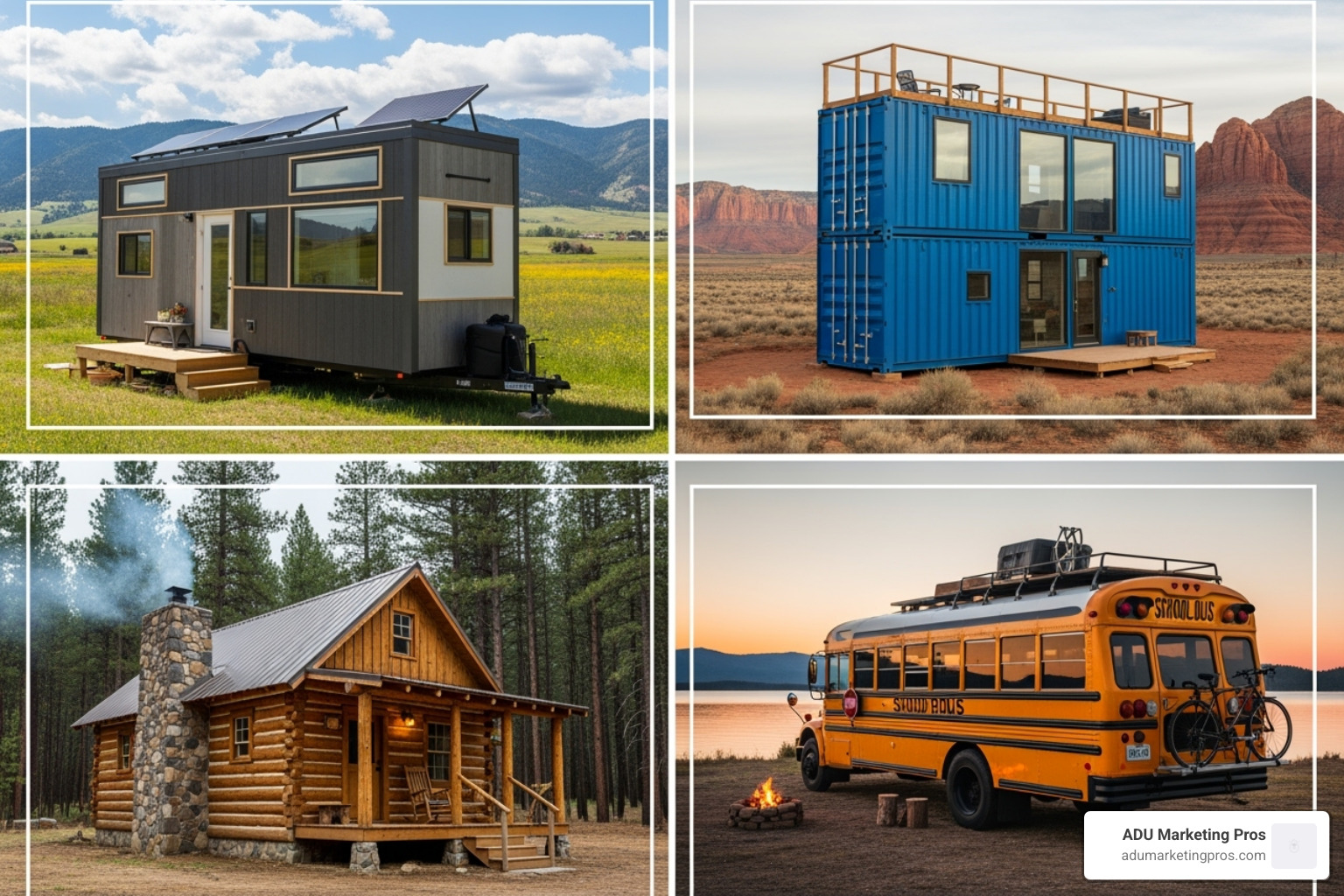
THOWs are the most iconic and recognizable symbol of the movement. Built on trailer chassis, they offer unparalleled mobility for those who crave a nomadic lifestyle or simply want the flexibility to relocate without selling their home. They are typically designed to meet RV classification standards for legal road travel, which means adhering to strict size limitations (usually under 8.5 feet wide, 13.5 feet tall, and under a certain weight). The DIY spirit is particularly strong in the THOW community, with many owners building their own custom homes from the trailer up. However, a growing number of professional builders offer certified, turnkey models that provide peace of mind and often make financing and insurance easier to obtain.
Foundation-Based Tiny Homes
For those seeking the small-footprint lifestyle with more stability and permanence, foundation-based tiny homes are the answer. These structures are built on permanent foundations just like traditional houses and must comply with local building codes. They are most often utilized as Accessory Dwelling Units (ADUs)—also known as backyard cottages, granny flats, or in-law suites. In states like California, where the housing crisis has spurred relaxed regulations, ADUs have become an incredibly popular solution for homeowners to add rental income, house family members, or create a dedicated home office. Unlike THOWs, which are often considered personal property, foundation-based homes are real property that can appreciate in value and contribute to a property’s overall worth. Understanding the key differences between an ADU vs. Tiny House is a crucial first step for any homeowner considering adding a second unit to their property.
Alternative and Converted Structures
This category is where creativity and ingenuity truly flourish, proving that a tiny home can take almost any form. These structures embrace the ethos of reuse and adaptation:
- Shipping container homes: Valued for their extreme durability, modular nature, and industrial-chic aesthetic. They can be stacked and combined to create larger, unique living spaces, but require significant work for insulation and finishing.
- Bus conversions (“skoolies”): Reimagined school buses are transformed into fully functional, mobile homes on wheels. The skoolie community is known for its creativity and resourcefulness in maximizing the long, narrow space.
- Van conversions (“vanlife”): The most compact and mobile option, popular with solo travelers and couples who prioritize adventure and minimalism above all else.
- Other unique dwellings: The movement also includes yurts, geodesic domes, A-frame cabins, and even houseboats, each demonstrating that the core principle is not the structure itself, but the commitment to living simply and intentionally within a smaller space.
The Realities of Tiny Living: Challenges and Legal Problems
While the tiny home movement offers an inspiring vision of freedom and simplicity, it’s crucial to approach it with a clear-eyed understanding of the real-world challenges. The path to tiny living is not always easy; it requires significant adaptability, meticulous planning, and patience in navigating a complex and often contradictory legal landscape.

Common Challenges and Legal Problems
On a practical, day-to-day level, dwellers must contend with severely limited space. This demands constant organization, a “one in, one out” policy for new items, and creative multi-purpose solutions for every square inch. The process of downsizing personal possessions can be emotionally taxing, forcing difficult decisions about what is truly essential. For couples or families, maintaining privacy and personal space in such close quarters requires excellent communication, mutual respect, and established routines.
The biggest structural barriers, however, are legal and financial. Zoning regulations in many cities and counties were written with traditional single-family homes in mind and often include minimum square footage requirements that effectively outlaw tiny homes as primary residences. For THOWs, the challenge is finding a legal, long-term place to park. Many municipalities restrict living in an RV (which a THOW is often classified as) outside of designated RV parks, and many of those parks have age or appearance restrictions. Financing and insurance also present hurdles. Traditional mortgages are not available for THOWs, forcing buyers to seek out personal loans, RV loans, or pay in cash. Insurance can be equally tricky to secure.
The good news is that the landscape is slowly but surely evolving. The International Code Council’s Appendix Q provides a specific set of building standards for tiny homes on foundations (under 400 sq ft), giving local governments a clear model for legalization. As more jurisdictions adopt it, the legal pathway for permanent tiny homes is becoming clearer. Despite this progress, the tiny house movement still faces barriers related to inconsistent regulations and a lack of public understanding. This is why consulting with experts, such as Architects in Southern California Who Design Tiny Houses, is crucial to navigate the process successfully.
The Movement in Action: Communities and Future Outlook
The tiny home movement is evolving beyond an individual lifestyle choice into a powerful tool for community building and systemic social change. Across the country and around the world, innovative projects are demonstrating how clusters of small homes can provide effective solutions to some of society’s biggest challenges, from homelessness to social isolation.
Community Projects and Future Trends
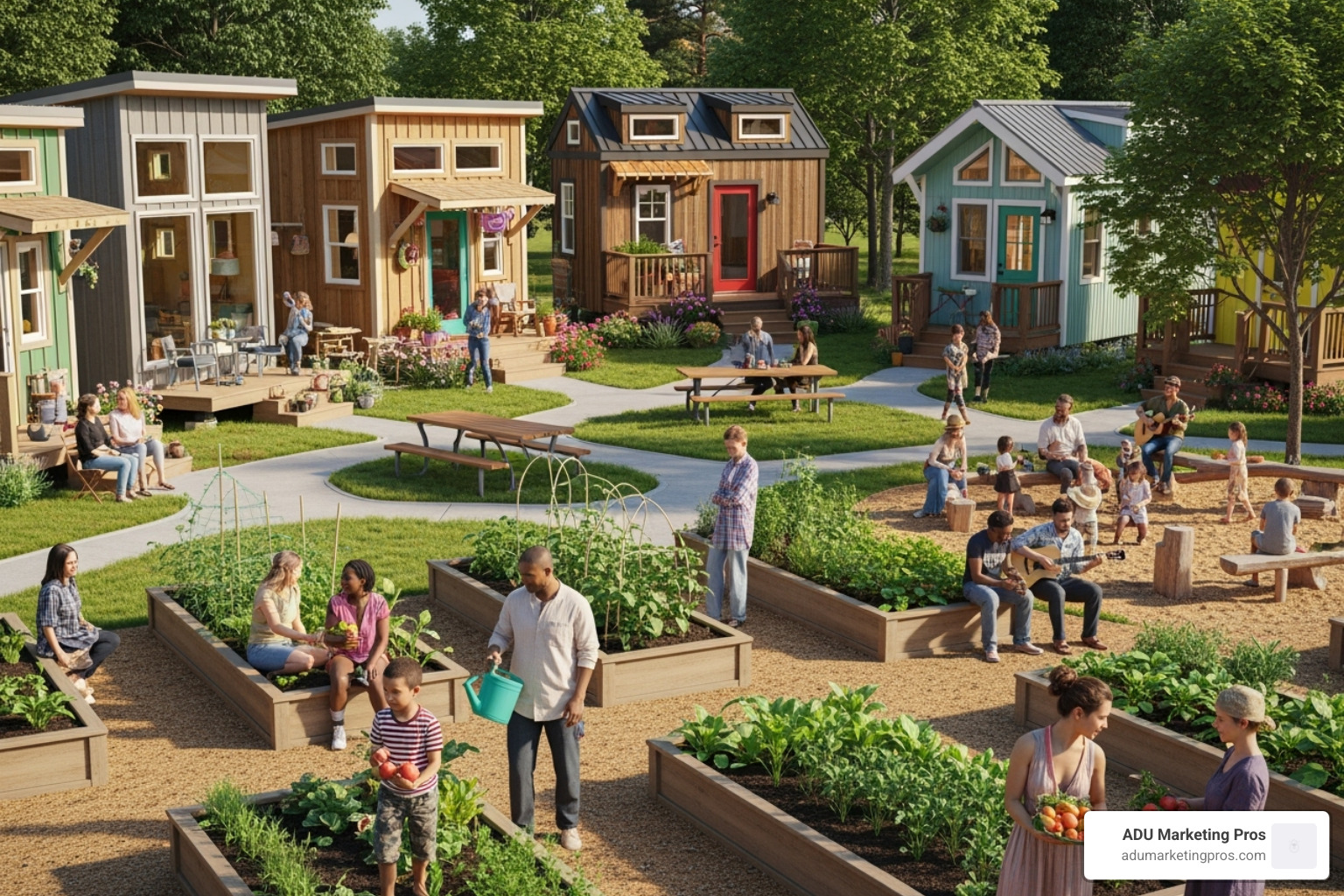
Inspiring examples showcase the movement’s profound potential. The Social Bite Village in Edinburgh, Scotland, and Opportunity Village in Eugene, Oregon, use tiny homes to provide safe, dignified housing and a supportive, managed community for people transitioning out of homelessness. These villages offer not just shelter but also access to counseling, job training, and a sense of belonging, proving to be a cost-effective and humane alternative to traditional shelters. Similar models are emerging to serve specific populations like veterans and low-income seniors. Meanwhile, co-housing projects like The Tiny House Community Bristol in the UK are creating affordable, sustainable neighborhoods with shared resources and the full support of local authorities. These intentional communities are proving that small homes can foster big connections, growing from just 34 in the U.S. in 2019 to 123 by summer 2024.
Looking ahead, the movement is poised for even more significant growth and integration into the mainstream.
- Mainstream Acceptance and Commercialization: As more cities adopt tiny-house-friendly zoning and building codes like Appendix Q, the legal path is clearing. This legitimacy is attracting larger companies and modular construction firms, which could lead to mass-produced, more affordable models.
- Integration with Urban Planning: Planners and policymakers increasingly see tiny homes, especially in the form of ADUs, as a key strategy for increasing housing density gently within existing neighborhoods. Cities like Los Angeles, San Jose, and Portland are at the forefront, creating a high demand for experienced Tiny House Builders in Southern California and beyond.
- Expanding Applications: The versatility of tiny structures is being recognized in new sectors. They are being deployed as rapid-response disaster relief housing, unique tourist accommodations (tiny house hotels and resorts), pop-up retail spaces, and remote work pods.
The future of the movement is not just about smaller individual houses, but about building more diverse, resilient, affordable, and interconnected communities.
Frequently Asked Questions about the Tiny Home Lifestyle
As the tiny home movement continues to capture the public imagination, many practical questions arise for those considering this unique lifestyle. Here are detailed answers to some of the most common inquiries.
How much does it really cost to build a tiny house?
The cost can vary dramatically based on size, materials, and labor. A DIY build, where you provide all the labor, can range from $10,000 to $50,000. The lower end involves extensive use of reclaimed and salvaged materials, while the higher end allows for new materials and higher-quality finishes. Hiring professional builders for a custom home typically costs between $50,000 and $100,000+. High-end, luxury builds with premium appliances, complex designs, and sophisticated off-grid systems can easily exceed $150,000. Key factors influencing the final price are the trailer foundation (for THOWs), quality of windows and insulation, complexity of utility systems (solar, water), and the choice of interior finishes.
Can a family live comfortably in a tiny house?
Yes, but it requires immense intentionality, organization, and a shift in mindset. Families who thrive in tiny homes often choose larger models (300-400 sq ft) with clever, family-friendly layouts like separate sleeping lofts, built-in bunk beds, or ground-floor bedrooms. The outdoor space becomes a critical, non-negotiable extension of the living area for play and relaxation. Success hinges on strong communication, established routines for tidiness, and a shared family philosophy that prioritizes experiences over personal space and possessions. It’s a lifestyle that fosters closeness, but it’s not for every family.
Is buying a tiny house a good financial investment?
This depends entirely on the type. Tiny Houses on Wheels (THOWs) are legally considered personal property, not real estate. Like RVs or vehicles, they tend to depreciate in value over time. Their value is primarily in the lifestyle flexibility and low cost of living they provide, not in asset appreciation. In contrast, foundation-based tiny homes, especially when legally permitted as Accessory Dwelling Units (ADUs), are real estate. They can appreciate in value along with the primary residence and significantly increase a property’s overall worth and appeal. Furthermore, both types can be excellent investments for generating rental income, whether through long-term tenants or as short-term vacation rentals on platforms like Airbnb, often yielding a high return on the initial investment. When looking at Small Houses for Sale, foundation-based options are generally the stronger long-term financial investment.
Where can I legally park or place a tiny house?
This is the most significant challenge for tiny home dwellers. For THOWs, options include: designated tiny house communities (growing but still rare), RV parks (check for size/age restrictions), and private land in rural areas with lax zoning. Parking in a friend’s or family’s backyard is often a legal gray area unless the municipality has specific ordinances allowing it. For foundation-based tiny homes, they must be built on land you own and comply with local zoning and building codes, often as an ADU. The legal landscape is changing rapidly, so always check with your local planning and zoning department first.
What about utilities like water, sewer, and electricity?
Tiny homes can be set up for on-grid or off-grid living. On-grid homes connect to municipal services just like a traditional house or RV, using standard electrical hookups, water hoses, and sewer connections. This is the simplest and most common setup. Off-grid living provides ultimate freedom but requires significant investment in systems like solar panels with a battery bank for electricity, large water storage tanks with pumps and filters for fresh water, and a composting or incinerating toilet to handle waste. Many tiny homes use a hybrid approach, such as using solar power while still connecting to a water source.
Conclusion
The tiny home movement represents something far more significant than a fleeting architectural trend. It is a deliberate and powerful reimagining of what “home” means in the 21st century. It offers a clear, actionable path toward financial freedom, a tangible way to practice daily environmental sustainability, and a conscious step away from the pressures of consumer culture. With 68% of owners living completely mortgage-free and a carbon footprint that can be over 90% smaller than that of an average American home, the quantitative benefits are as compelling as the philosophical ones.
From highly mobile THOWs that enable a life of travel to permanent ADUs that create gentle density in our cities, the movement’s diversity provides flexible solutions for a wide spectrum of lifestyles and needs. While significant legal and zoning challenges remain, real progress is being made as pioneering cities and states adopt friendly regulations like Appendix Q, paving the way for broader acceptance. Looking forward, tiny homes are uniquely positioned to play a vital role in addressing the national housing affordability crisis and providing dignified, community-based solutions for vulnerable populations.
At ADU Marketing Pros, we recognize the powerful and undeniable synergy between the tiny home movement and the explosive growth of ADUs, particularly in California. The core principles of efficient design, sustainable construction, and flexible living are the driving forces behind both markets. For the forward-thinking construction and architecture firms we serve, this cultural shift represents a significant and growing opportunity to meet consumer demand and help build a better, more accessible housing future.
The movement’s ultimate message is both simple and profound: a home is not measured in square feet, but in the freedom, security, and quality of life it provides. If you’re ready to explore this transformative path, start by researching places in Southern California that allow tiny houses and discover how living smaller can empower you to live bigger.