
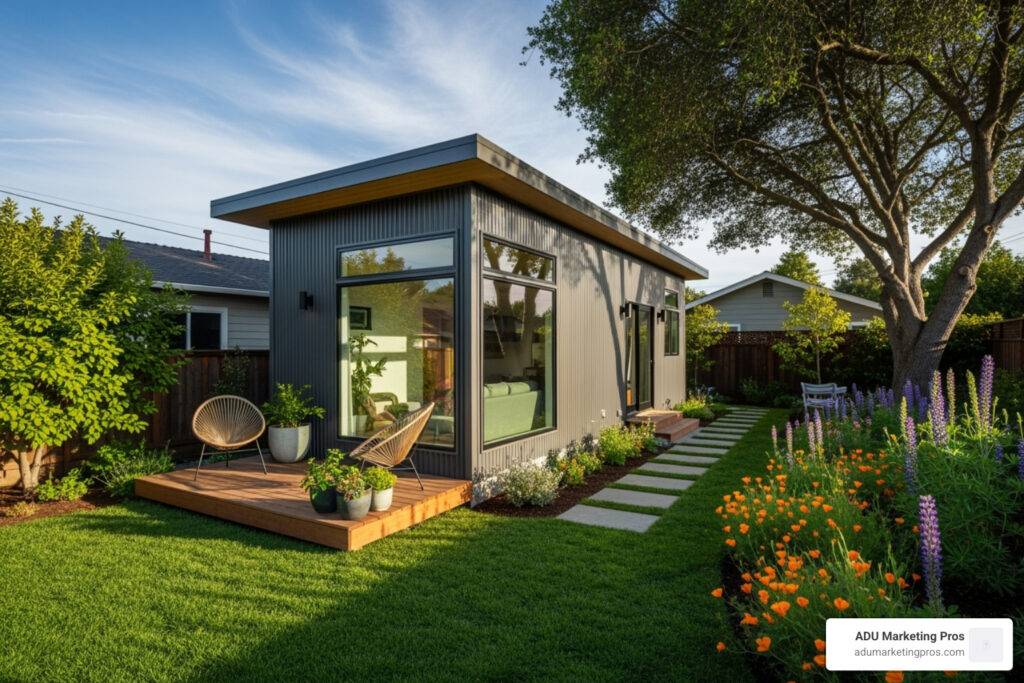
Why the Bay Area Housing Crisis Makes Backyard Solutions Essential
Searches for tiny home or adu bay area have exploded as homeowners seek creative, tangible solutions to the region’s relentless housing affordability crisis. For decades, the Bay Area has been the epicenter of a perfect storm: a booming tech economy driving salaries up, geographical constraints limiting new construction, and restrictive zoning policies that have stifled housing supply. The result is a market where the median home price consistently hovers in the millions and rental costs are among the highest in the nation. In this environment, building a secondary dwelling unit in your backyard has transitioned from a novel idea to an essential strategy for financial stability and family well-being.
Quick Answer for Bay Area Homeowners:
- ADUs: Permanent structures built on a foundation, legally considered part of your real property, which significantly increases its value.
- Tiny Homes: Dwellings typically under 400 sq ft. They can be built on a foundation (making them a type of ADU) or on wheels (classifying them as RVs), which dictates where they can be placed.
- Average Cost: The median cost for a Bay Area ADU is around $177,500, while tiny homes can range from $47,900 for a basic model to over $149,900 for a high-end, ADU-compliant unit.
- Timeline: A traditional, custom-built ADU can take 9-12 months, whereas prefabricated options can shorten the timeline to as little as 3-7 months.
The housing shortage doesn’t just create headlines; it has profound effects on families. It impacts adult children who can’t afford to live near their jobs and families, aging parents who need accessible, nearby housing without sacrificing their independence, and remote workers who desperately need dedicated office space. ADUs and tiny homes directly address these needs, offering practical solutions for generating rental income, enabling multi-generational living, creating home offices, or hosting guests. Understanding the key differences is the first step. ADUs are a long-term investment in your property, while tiny homes offer flexibility and lower upfront costs but come with unique regulatory hurdles. Fortunately, a wave of recent California legislation has streamlined the process for both, with cities like San Jose and Oakland creating pilot programs to actively encourage their development.
ADU vs. Tiny Home: What’s the Key Difference in the Bay Area?
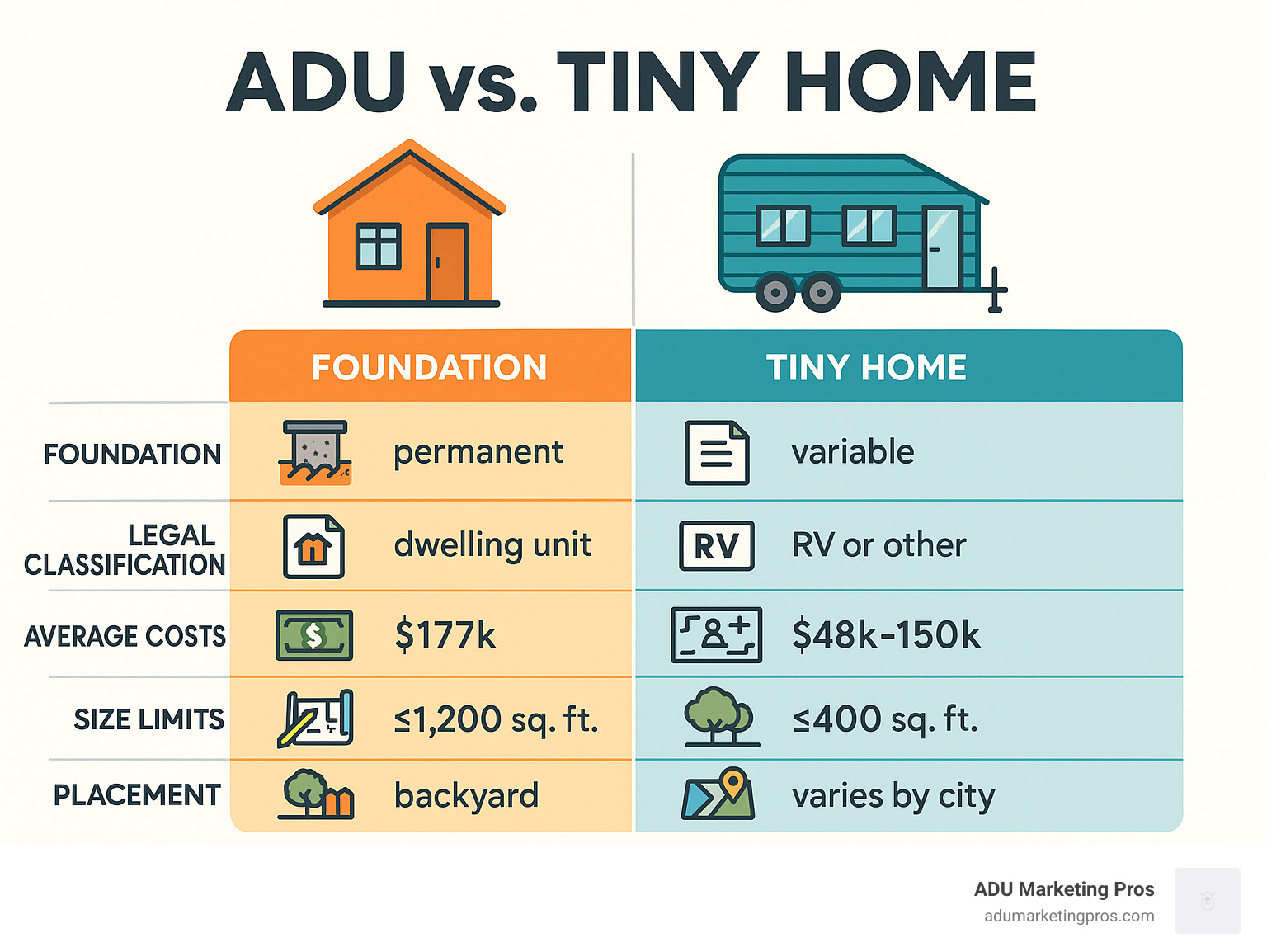
When you begin to explore a tiny home or adu bay area project, it’s critical to understand the fundamental differences between these two housing types. The distinction impacts every stage of the process, from securing financing and pulling permits to long-term financial returns. The primary dividing line comes down to one simple concept: foundations versus wheels.
Defining the Dwellings: Foundation vs. Wheels
An Accessory Dwelling Unit (ADU), often called a granny flat or backyard cottage, is a smaller, independent residential unit located on the same lot as a standalone single-family home. The defining characteristic of an ADU is that it is permanently attached to the land via a foundation. This legally classifies it as real property, meaning it is taxed, valued, and can be sold as part of your primary property. ADUs offer a variety of forms to fit different properties and needs:
- Detached ADU: A standalone structure, often built in the backyard. It provides the most privacy for both the main home occupants and the ADU residents, making it ideal for renters or independent family members.
- Attached ADU: An addition that shares at least one wall with the primary residence. This is an excellent option for smaller lots where setback requirements might prohibit a detached unit.
- Garage Conversion ADU: One of the most cost-effective options, this involves transforming an existing garage into a fully functional living space. It leverages an existing structure to reduce construction costs.
- Junior ADU (JADU): A specialized unit no larger than 500 square feet, created within the existing footprint of the main home (e.g., a converted spare bedroom). A JADU must have its own separate entrance and an efficiency kitchen, but it can share a bathroom with the main house, further reducing costs.
A tiny home is broadly defined as a dwelling under 400 square feet. While a tiny home built on a permanent foundation can be legally permitted as an ADU, the term most often refers to Tiny Homes on Wheels (THOWs). These are structures built on a trailer chassis, designed for mobility. This mobility is a key feature, but it also legally classifies them as Recreational Vehicles (RVs). This RV classification has significant legal and practical implications for where and how they can be used as a full-time residence.
Regulations, Construction, and Long-Term Value
ADUs are governed by the California Building Codes and local city ordinances. The permitting process is comprehensive, but recent state laws have mandated that cities streamline and accelerate ADU application approvals. Because they are considered real property, ADUs can be financed with traditional methods like home equity loans, cash-out refinancing, or construction loans, often with favorable interest rates. Most importantly, ADUs are appreciating assets. They are a significant long-term investment that can add substantial value to your property, often exceeding the cost to build.
THOWs, on the other hand, must comply with RV industry standards, not residential building codes. Their primary challenge is legal placement. Parking a THOW in a backyard for permanent occupancy is restricted by most local zoning laws, which often prohibit living in an RV outside of designated parks. While some progressive Bay Area cities have created pilot programs to allow THOWs as ADUs, these require a rigorous permitting process to ensure safety and utility connections. You can find more details on the evolving regulations at the Legislation in California for THOWs page. Financing for THOWs typically involves RV loans or personal loans, which can have higher interest rates and shorter terms than mortgages. Unlike ADUs, THOWs are depreciating assets, much like a car or boat. They offer incredible lifestyle flexibility and mobility but come with potential hidden costs for transportation, hookups, and parking fees.
For construction, both ADUs and foundation-based tiny homes can be either stick-built on-site for maximum customization or built as prefabricated/modular units. Prefab construction happens in a factory, which ensures cost predictability and speeds up the timeline dramatically. Once permits are secured and the foundation is laid, a prefab unit can be installed in a matter of weeks.
The Top Benefits of Building a Tiny Home or ADU in the Bay Area
Adding a small second home to your property unlocks a wealth of advantages that directly combat the pressures of the expensive Bay Area market, ranging from immediate financial gains to long-term family and lifestyle benefits.
Addressing the Housing Affordability Crisis
The Bay Area is infamous for its high cost of living, which makes traditional housing unattainable for many. ADUs and tiny homes provide a powerful solution by enabling multi-generational living, a practice that allows families to stay geographically close and mutually supportive. Imagine providing an independent, affordable home for an adult child saving for their own down payment, or creating a safe, accessible space for an aging parent who wants to maintain their autonomy while having family nearby for support. This approach not only strengthens family bonds but also adds housing density to established neighborhoods in a responsible, gentle way, utilizing existing infrastructure without contributing to urban sprawl.
Opening up Financial Returns: ROI and Rental Income
From a purely financial perspective, building an ADU is one of the smartest investments a Bay Area homeowner can make. A new prefab ADU can generate significant rental income, with one-bedroom units in the region often fetching around $2,200 a month or more. This consistent revenue stream can be used to offset your primary mortgage, pay off the ADU construction loan, or simply provide a substantial boost to your monthly income. Beyond the cash flow, an ADU significantly increases your property’s resale value. The return on investment (ROI) is often impressive, as the value added to the property frequently exceeds the initial construction cost. The versatility is another key benefit. If not used for rental, the unit can serve as a dedicated home office, a private guest suite for visitors, a personal gym, or a creative studio, adding immense functional value to your daily life. If you do plan to rent it out, it’s wise to review some tips for new landlords to ensure a smooth experience.
Sustainability and Energy-Efficient Living

Modern ADUs and tiny homes are at the forefront of sustainable design. Their inherently smaller footprint translates directly to a reduced carbon footprint, requiring less energy for heating and cooling and fewer materials for construction. Many builders specializing in tiny home or adu bay area projects prioritize green features that go far beyond the basics. For instance, many ADUs can be designed to be highly energy-efficient with superior insulation, high-performance windows, and options for a full solar array to achieve net-zero grid energy use. Builders may also be an EPA Energy Star Partner and adhere to EPA Indoor Air Plus standards, which ensures healthier indoor air quality and exceeds California’s already stringent energy codes. Other sustainable features can include rainwater harvesting systems, greywater recycling for landscaping, and the use of reclaimed or sustainably sourced building materials. These elements not only lead to significant savings on utility bills but also contribute to a healthier planet and a more sustainable lifestyle.
Your Step-by-Step Guide to the Building Process
Navigating the journey from a backyard idea to a completed home can seem complex, but it can be broken down into a logical sequence of steps. Here’s a detailed guide to the process for your Bay Area backyard home.
Step 1: Feasibility, Design, and Planning
This initial phase is all about due diligence and vision. Before you get attached to a specific design, a thorough property assessment is essential. This feasibility study confirms if your property is eligible for an ADU and involves checking key factors like lot size, available space, access for construction equipment, and the location of underground utilities. A professional can help you determine your property’s specific zoning requirements, including setbacks (the required distance from property lines, typically 4-10 feet) and maximum lot coverage. Next, define your purpose. Is this unit primarily for rental income, a home for an aging parent, or a flexible home office? Your answer will heavily influence the design. A unit for an elderly relative might prioritize single-story, accessible features like a zero-threshold shower, while a rental unit might focus on maximizing bedroom count and durable finishes. Finally, you’ll make the crucial decision between prefab vs. stick-built. Prefabricated units are built in a factory, offering a fixed cost and a much faster construction timeline. Stick-built construction is done entirely on-site, allowing for unlimited customization to perfectly match your main home’s architecture, but it typically takes longer and has a higher potential for budget overruns. Most companies, whether prefab or custom, offer a wide floor plan selection to serve as a starting point for your vision.
Step 2: Navigating Bay Area-Specific Regulations for your tiny home or adu bay area
While California state law has created a friendly environment for ADUs by streamlining approvals and overriding some restrictive local policies, local zoning codes still play a critical role. Each city in the Bay Area has its own set of rules that govern the fine details. These local ordinances will dictate the maximum size limitations (which can range from 850 to 1,200 sq ft depending on your lot size and number of bedrooms), height restrictions (usually capped at 16 feet for a detached ADU, but can be higher in some zones), and parking rules. The good news is that state law provides parking requirement waivers for ADUs located within a half-mile of public transit, which applies to a vast number of Bay Area properties. You will also need to plan for utility connections (water, sewer, electricity, gas), which may require a new, separate connection or a tie-in to the main house’s systems. Don’t forget to check for Homeowners Association (HOA) rules, as they may have additional aesthetic or use restrictions.
To help you navigate this landscape, here are links to the ADU guidelines for major Bay Area cities:
- San Jose: ADU Portal
- San Francisco: Planning Department Site
- Oakland: Secondary Units Page
It is crucial to check with your specific city’s planning department directly, as these regulations are updated frequently.
Step 3: Permitting, Construction, and Timelines
Once your design is finalized, you officially enter the permitting process. This involves submitting a full set of architectural and structural plans to your local building department for a plan review. This review ensures your project complies with all building codes, safety standards, and zoning regulations. In California, agencies have a 60-day window to respond to an ADU application, though the entire review and revision process typically takes 2-4 months. Once your permit is issued, construction can begin. Throughout the build, your project will be subject to multiple inspections at critical milestones. These include inspections for the foundation, framing, electrical wiring, plumbing, and insulation. Each inspection must be passed before the next phase of work can proceed. The final step is the final inspection, after which you are granted a Certificate of Occupancy, the official document that declares the unit safe and legal to live in.
Construction timelines vary significantly by build type:
- Stick-built ADUs: The on-site construction phase alone typically takes 4-6 months. The total process, from initial design to move-in, usually lasts 9-15 months.
- Prefab ADUs: This is a much faster route. The unit is constructed in a factory while your permits are being processed and your foundation is being prepared. Once the unit is delivered, on-site installation and hookups can take just 3-4 weeks, bringing the total project timeline down to 6-8 months.
- THOWs: The timeline is highly unpredictable and is less about construction and more about securing legal permission for placement, which can be a lengthy and uncertain process.
Cost and Financing for Your Tiny Home or ADU Bay Area Project
Understanding the full financial scope of your project is one of the most critical steps. This section breaks down the typical costs you can expect and explores the various financing avenues available for your tiny home or adu bay area project.
What’s the Typical Cost? A Bay Area Budget Breakdown
Building any structure in the Bay Area is a significant investment, but the costs for an ADU can vary dramatically based on size, build type, and level of finish. A comprehensive UC Berkeley report on ADU costs found the median cost for a Bay Area ADU to be around $177,500, which translates to about $329 per square foot. However, this figure often represents just the construction cost and doesn’t include all associated expenses.
It’s essential to budget for both hard and soft costs:
- Hard Costs: This is the physical construction of the unit. For a custom stick-built ADU, this can range from $300 to $700+ per square foot, potentially reaching $500,000 or more for high-end, multi-bedroom projects.
- Soft Costs: These are the other necessary expenses, which can add up significantly. Budget an additional $40,000-$60,000 or more for things like architectural design fees, structural engineering, soil reports, permit and impact fees (which can range from a few thousand to over $20,000 in some cities), and utility connection fees.
- Site Preparation: Costs for grading the land, trenching for utilities, and pouring the foundation are also substantial.
Here’s how different types of units generally compare:
- Prefab and Modular ADUs: These offer greater cost predictability. Companies like Samara offer studio units starting around $269,000 (inclusive of site work and permits). Cottage provides a range of options, from a $200,000 one-bedroom to a $470,000 two-bedroom.
- Tiny Homes: This remains the most budget-friendly path. A company like Pacifica Tiny Homes has simple models starting at just $47,900, with fully finished, ADU-compliant units on a foundation costing around $149,900.
How to Fund Your Project: A Look at Financing Options
Fortunately, there are several well-established financing paths to make your ADU project a reality:
- Home Equity Line of Credit (HELOC): A very popular choice. This acts like a credit card secured by your home’s equity, allowing you to draw funds as needed during the construction process. This is ideal for managing variable construction costs.
- Cash-out Refinancing: With this option, you refinance your existing mortgage for a larger amount than you currently owe and receive the difference in cash. This can be a great choice if you can secure a lower interest rate than your current mortgage.
- Construction Loans: These are short-term loans specifically designed for building projects. The funds are disbursed in stages (draws) as construction milestones are met and inspected. They are typically converted into a traditional mortgage once the project is complete.
- Renovation Loans: Loans like the FHA 203(k) are designed for home improvements and can be used for smaller projects, especially garage conversions.
- State Grants: Look into programs like the CalHFA ADU Grant Program, which provides up to $40,000 to reimburse pre-development costs for low- to moderate-income homeowners.
For Tiny Homes on Wheels (THOWs), financing is handled differently since they are classified as personal property (RVs), not real estate. You will typically need an RV loan, which can be secured through specialized lenders like 21st Mortgage. Many prefab ADU companies also offer in-house or partner financing to simplify the process for their customers.
Frequently Asked Questions about Bay Area ADUs and Tiny Homes
What are the main types of ADUs I can build in the Bay Area?
When you’re planning a tiny home or adu bay area project, you have several distinct types of ADUs to consider, each with its own benefits:
- Detached New Construction: This is a completely separate, standalone backyard cottage. It offers the highest degree of privacy for both the main home and ADU occupants, making it the premier choice for rental units or independent family members.
- Attached Additions: This type of ADU is built as an addition to your primary residence, sharing a wall and/or roof. It’s an excellent solution for properties with smaller backyards or for homeowners who want a more direct connection between the two living spaces.
- Conversions of Existing Spaces: This is often the most cost-effective and fastest route. It involves transforming a part of your existing property—most commonly a garage, but also potentially a basement or a large master suite—into a fully independent living unit.
- Junior ADUs (JADUs): A JADU is a specific type of conversion unit that must be under 500 sq ft and created within the existing walls of your home. It requires an efficiency kitchen and its own separate exterior entrance but is allowed to share a bathroom with the main house, which can simplify construction.
How long does it take to build an ADU from start to finish?
A typical custom ADU project in the Bay Area takes approximately 9 to 15 months from the very first design sketch to the final move-in day. This comprehensive timeline can be broken down into two main phases: a design and permitting phase (which generally takes 3-6 months) and a construction phase (which takes 6-9 months for a traditional stick-built home). However, opting for a prefabricated ADU can dramatically shorten this timeline. Because the unit is built in a factory at the same time your foundation is being prepared and permits are being approved, the total project time can be reduced to as little as seven months.
Can I legally place a Tiny Home on Wheels (THOW) in my backyard as an ADU?
This is one of the most common but complex questions. The answer is highly dependent on your specific city’s ordinances. While state law has made building foundation-based ADUs much easier, THOWs are legally classified as RVs, which creates a regulatory gray area for using them as permanent housing. The good news is that several progressive Bay Area cities, including San Jose, Oakland, and Alameda, have created pilot programs or specific ordinances that allow THOWs to be used as ADUs. However, these programs have strict requirements. The THOW must typically be certified by a recognized agency, have proper utility hookups (no extension cords or garden hoses), and be officially registered with the city as a dwelling unit. You must always check with your local planning department first, as regulations are constantly evolving and vary significantly from one jurisdiction to the next.
Do I have to pay more property taxes on an ADU?
Yes, building an ADU will increase your property taxes. However, it’s not as drastic as you might think. Your entire property will not be reassessed at its new, higher market value. Instead, California’s tax laws use a blended assessment. Your primary home’s assessed value remains the same (protected by Prop 13), and only the value of the new construction (the ADU) is added to your tax bill. For example, if your ADU cost $200,000 to build, your annual property tax bill would increase by approximately 1-1.25% of that amount, or about $2,000-$2,500 per year, which is often easily covered by rental income.
Can I sell my ADU separately from my main house?
No, in almost all cases in California, you cannot sell your ADU separately from the primary residence. An ADU is considered an “accessory” unit and is legally tied to the main property on a single parcel of land. You cannot split the lot or sell the ADU with its own title, a process known as a fee-simple sale. The entire property—main house and ADU—must be sold together. This is a key distinction from a duplex, where units can sometimes be sold separately.
Conclusion
Embarking on a tiny home or adu bay area project is far more than a simple home renovation; it’s a strategic and powerful response to the unique economic and social pressures of the region. These small homes represent a tangible solution to the housing crisis, offering flexible spaces that can adapt to a family’s changing needs over a lifetime. ADUs stand out as superb long-term investments, significantly boosting property value while providing a steady stream of rental income or a comfortable home for a loved one. Tiny homes, particularly those on wheels, appeal to a desire for minimalism, financial freedom, and mobility, presenting a more accessible entry point into the alternative housing movement.
The path to building one is clearer than ever before. The key to success lies in understanding the critical distinctions in regulations, financing, and long-term value. ADUs are permanent, appreciating real estate assets governed by building codes. THOWs are mobile, depreciating personal property governed by RV and local placement rules. Thanks to progressive state legislation and innovative local city programs, both options are now within reach for many homeowners.
With well-defined financial pathways, a growing industry of experienced builders, and an emphasis on sustainable design, Bay Area residents can confidently unlock their property’s hidden potential. This movement is not just about building smaller; it’s about living smarter. For ADU builders and architects looking to connect with these motivated and informed homeowners, ADU Marketing Pros offers specialized marketing strategies to showcase your expertise in this dynamic market. We help you build your brand by focusing on the quality, value, and solutions you bring to the table.