
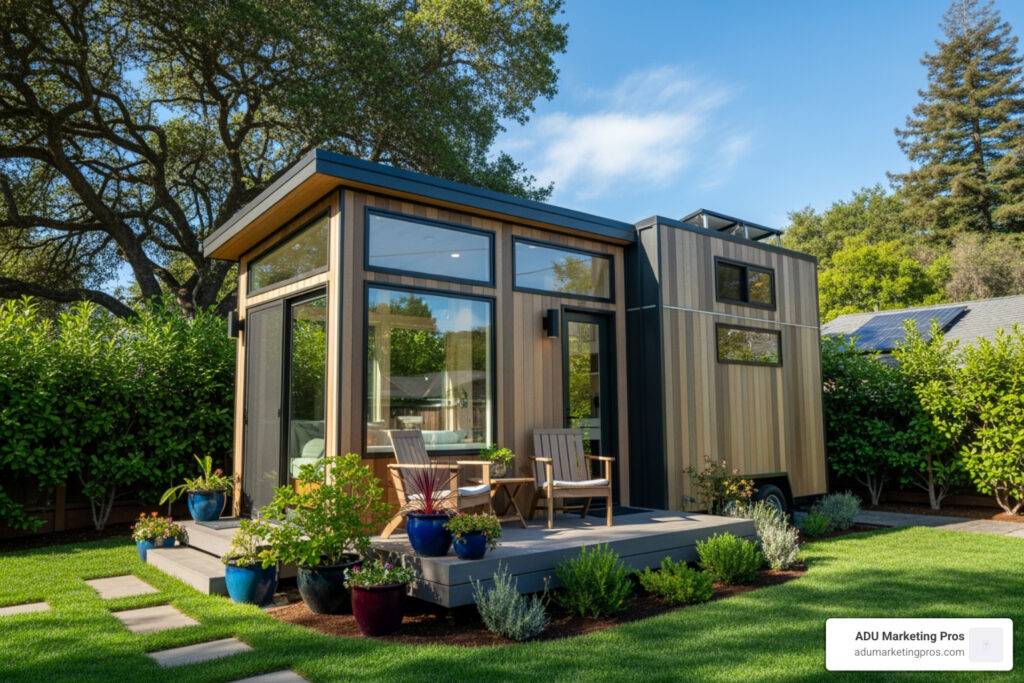
Why Bay Area Homeowners Are Going Tiny
If you’re exploring tiny house builders bay area, you’re joining a growing movement of homeowners seeking affordable, sustainable housing alternatives in one of the nation’s most expensive markets. Here are the top builders serving the Bay Area right now:
Leading Bay Area Tiny Home & ADU Builders:
- Bay Modular – California’s largest prefab ADU builder, specializing in container-based construction with pre-approved HCD designs.
- Villa – Five-star rated builder offering 20+ configurable floor plans and turnkey ADU services.
- H2 Prefab – Energy-efficient contemporary homes with innovative delivery methods for difficult sites.
- Acton ADU – 30+ years of experience with a 4.98-star review average and designer-curated floor plans.
- Pacifica Tiny Homes – 300+ tiny homes built, specializing in affordable RV-certified tiny homes on wheels.
- Forever Tiny Homes – RVIA-certified manufacturer focusing on quality materials and detailed craftsmanship.
- RiseCon North America – A trusted tiny house builder in California, serving San Jose and Sunnyvale.
- Little House on the Trailer – Specializing in “Little Houses” that are legal and feasible to install where recreational trailers are permitted.
The Bay Area housing crisis has pushed median home prices well beyond reach for most residents. Tiny homes and Accessory Dwelling Units (ADUs) offer a practical solution—whether you’re seeking financial freedom through lower housing costs, creating rental income from your backyard, or simply embracing a more sustainable lifestyle.
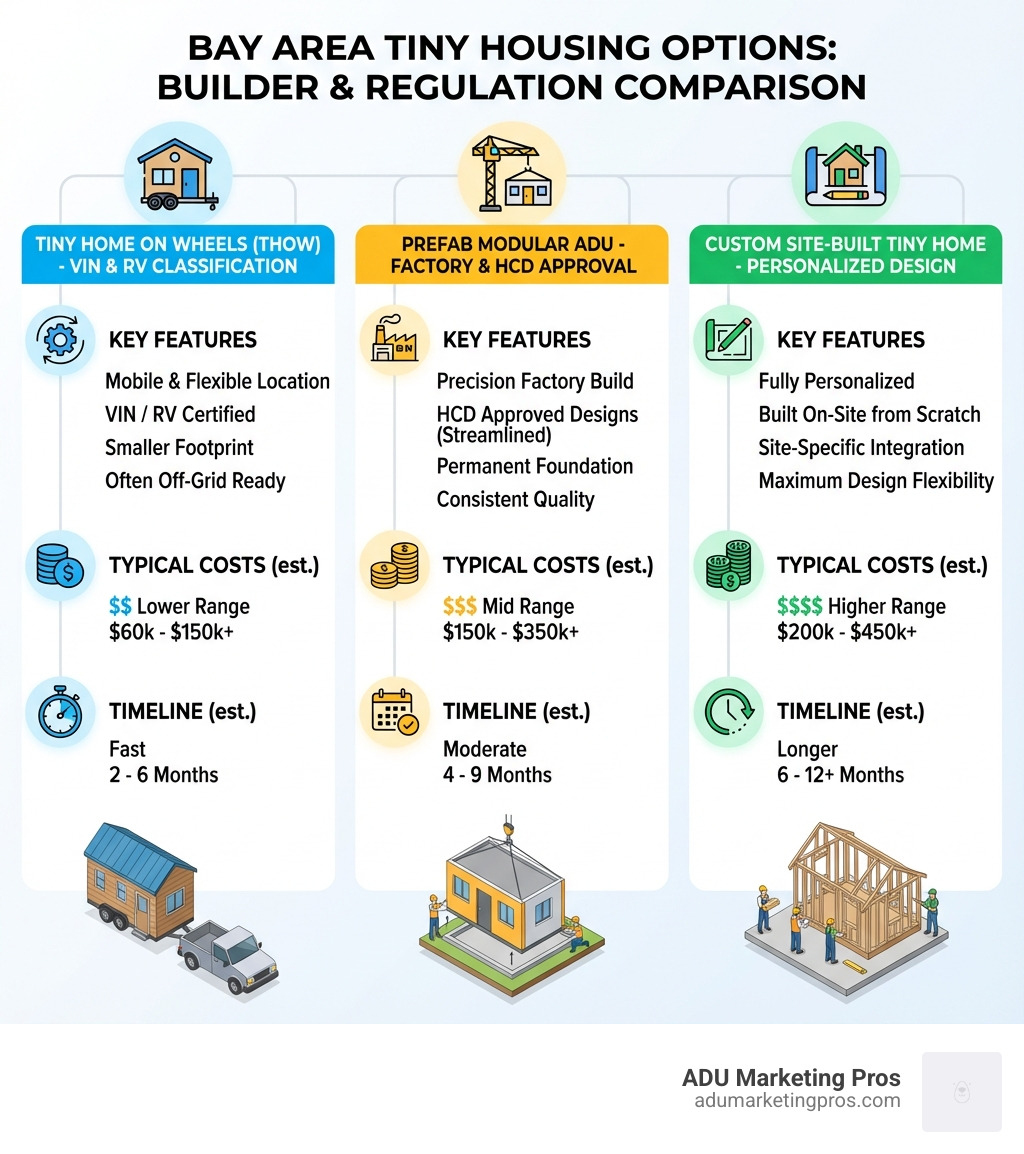
These compact dwellings come in three main types: Tiny Homes on Wheels (THOWs) that function as RVs, prefabricated modular ADUs built in controlled factory environments, and custom site-built tiny homes designed specifically for your property. Each option offers distinct advantages depending on your goals, budget, and property constraints.
Finding the right builder is crucial. The best tiny house builders bay area steer complex local regulations, deliver quality craftsmanship, and guide you through every step—from initial design to final inspection. They understand California’s unique permitting landscape and have established relationships with local building departments that can save you months of delays.
This guide will walk you through everything you need to know: the benefits of going tiny, your building options, the construction process, realistic costs, and most importantly, how to choose a builder who’ll turn your compact living dream into reality.
Tiny house builders bay area glossary:
Why Go Tiny in the Bay Area? The Best Benefits
Choosing to build a tiny home or ADU in the Bay Area offers a multitude of benefits, from significant financial advantages to a lifestyle that accepts sustainability and simplicity. We’ve seen how these smaller dwellings can transform lives in a region known for its high cost of living.
The Financial Freedom of Small-Scale Living
The Bay Area is notorious for its housing prices, making traditional homeownership a distant dream for many. Tiny homes and ADUs provide an accessible pathway to owning your own property. Imagine a lower mortgage, reduced utility bills, and significantly lower maintenance costs compared to a conventional home. This translates directly into greater financial freedom, allowing you to save, invest, or simply enjoy more of what the Bay Area has to offer.
Beyond personal savings, ADUs in particular can be an excellent investment. They can generate substantial rental income, helping to offset your primary mortgage or provide a steady stream of passive income. Furthermore, adding an ADU can significantly increase your property’s overall value, offering a strong return on investment in this competitive market.
Embracing Sustainability and a Lighter Footprint
For many, going tiny isn’t just about saving money; it’s about making a conscious choice for the planet. Tiny house builders bay area are at the forefront of sustainable construction, designing homes that minimize environmental impact. These dwellings often feature energy-efficient designs, all-electric appliances, and options for rooftop solar panels, like those offered by H2 Prefab and Bay Modular, which can achieve 100% offset per California Energy Efficiency Standards (T24).
Builders like H2 Prefab prioritize sustainably designed homes, often using Structural Insulated Panels (SIPs) for superior insulation and minimizing waste by constructing in a controlled environment. Bay Modular leverages repurposed shipping containers, further reducing resource consumption. We see water-saving fixtures, eco-friendly materials, and less construction waste as standard practices among leading builders. This commitment to sustainability means a smaller carbon footprint for homeowners and a healthier planet for all of us.
Navigating the Options: Types of Tiny Homes and ADUs
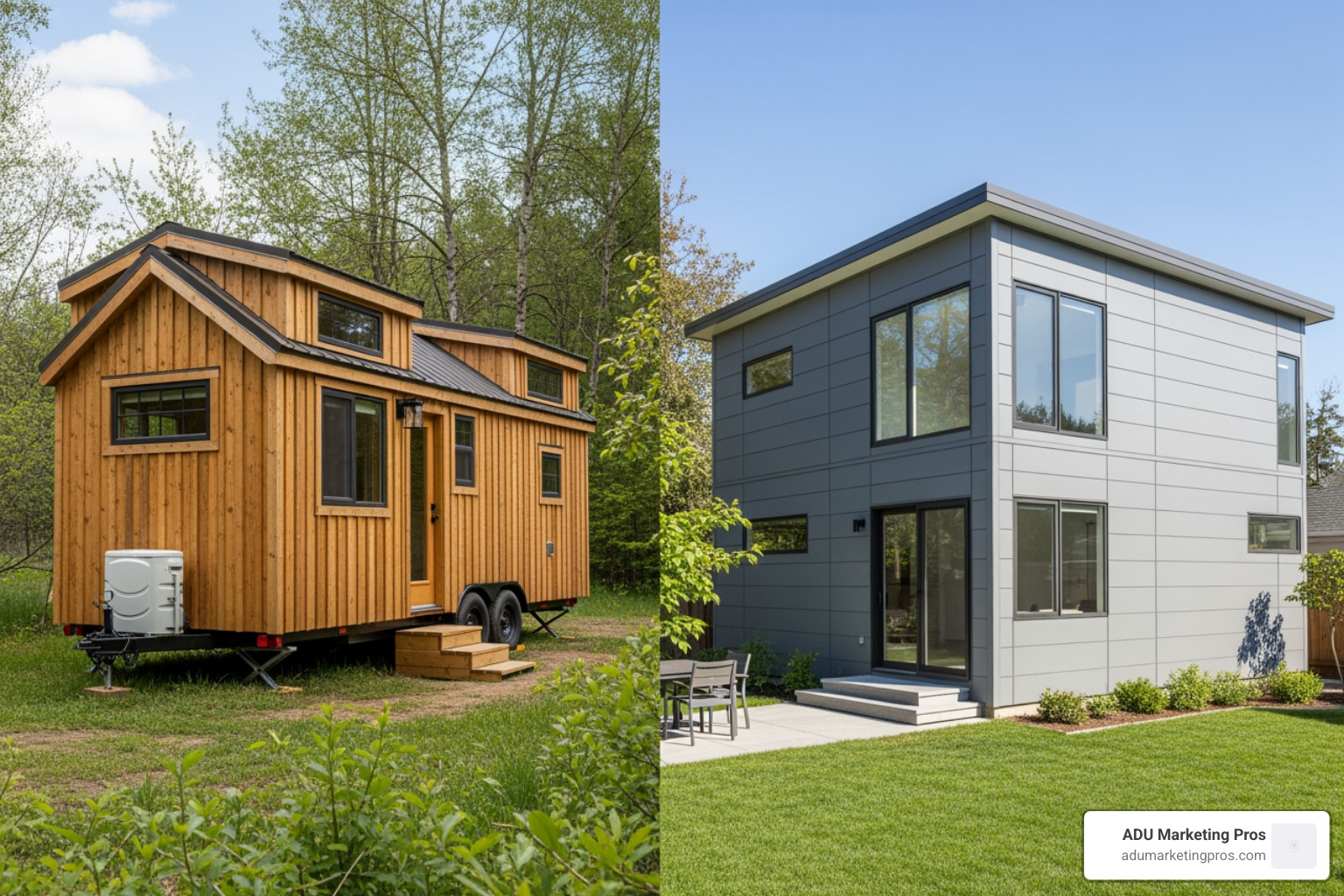
When considering a tiny home or ADU in the Bay Area, you’ll encounter a variety of options, each with its own characteristics and best use cases. Understanding these types is key to choosing the right solution for your needs.
Tiny Homes on Wheels (THOWs)
Tiny Homes on Wheels are essentially larger, more luxurious RVs. They are built on a trailer chassis, making them mobile. Builders like Pacifica Tiny Homes and Forever Tiny Homes specialize in THOWs, with Pacifica having built over 300. These homes are classified as Recreational Vehicles (RVs) and adhere to the same standards and regulations, meaning they are assigned Vehicle Identification Numbers (VINs) and are commonly insured under RV policies. Forever Tiny Homes are RVIA certified and NHTSA registered, ensuring high safety and quality standards.
The mobility of THOWs offers unparalleled flexibility, ideal for those seeking a minimalist, travel-friendly lifestyle. While not typically “towable” by a standard vehicle once set up, they can be relocated with professional movers. Little House on the Trailer, for instance, notes their homes are legal and feasible to install where recreational trailers are permitted, though they require permits and professional movers for relocation. Lofts are generally permitted in THOWs, offering creative space-saving solutions.
Prefabricated and Modular ADUs
Prefabricated (prefab) and modular ADUs are built off-site in a factory setting, then transported and assembled on your property. This method offers significant advantages, including superior quality control due to the controlled environment, and faster on-site installation, which minimizes disruption to your neighborhood. Bay Modular, California’s largest prefab ADU builder, specializes in container-based construction and works directly with CA HCD as a permitted manufacturer. This means their completed units, like their “Solo” model, often require no local permitting, only infrastructure work, simplifying the process for homeowners.
Villa, a five-star rated builder, offers over 20 configurable floor plans for their prefab detached ADUs. Their designs are HUD-approved, which streamlines the permitting and inspection process. H2 Prefab also constructs their energy-efficient, sustainably designed homes in a controlled environment, ensuring high-quality craftsmanship. They even boast innovative delivery methods that allow them to install units on sites with access constraints or difficult terrain using specialized dolly systems, often without the need for large cranes.
Common ADU configurations offered by Bay Area builders include:
- Studio units: Ideal for home offices, guest quarters, or single occupants. (e.g., H2 Prefab’s The Tempe at 172 SF or The Rockridge at 287 SF).
- 1-Bedroom units: Perfect for couples, small families, or rental income. (e.g., H2 Prefab’s The Silver Lake at 448 SF).
- 2-Bedroom units: More spacious options for families or higher rental income potential. (e.g., Villa offers 2-bedroom units up to 1,200 sq. ft., H2 Prefab’s The Bed-Stuy or The Dimond).
Fully Custom Tiny Homes and ADUs
For those with a very specific vision, fully custom tiny homes and ADUs offer the ultimate personalization. This option allows for unique architectural features, personalized layouts, and maximum optimization of space to meet your exact needs. Builders like Acton ADU offer custom ADU design services, working closely with clients to bring their unique ideas to life. While typically involving higher costs and longer timelines than prefab options, the result is a dwelling perfectly custom to your lifestyle and property.
The Blueprint to Your Backyard Oasis: The Building Process Explained
Building a tiny home or ADU might seem daunting, but with the right tiny house builders bay area, the process can be surprisingly smooth. Many leading builders offer turnkey services, managing everything from initial concept to final move-in. While timelines can vary, a typical ADU project from consultation to completion often ranges from four to six months.
Step 1: Consultation and Feasibility
Your journey begins with an initial conversation. Builders like Villa offer a free estimate, and many, including Little House on the Trailer, conduct a site visit. During this crucial step, we analyze your property, discuss your budget, and most importantly, listen to your vision. This helps determine the feasibility of your project, considering factors like access, utilities, and local regulations. Villa even offers a detailed feasibility study for $500, providing an in-depth analysis to ensure confidence before proceeding.
Step 2: Design and Planning
Once feasibility is confirmed, the design phase kicks into gear. This is where your dream home starts to take shape. You’ll work with designers to select floor plans, explore customization options, and choose materials and finishes. Acton ADU, for example, provides a library of designer-curated floor plans and also offers custom ADU design services, including 3D visualization and model building. Villa offers over 20 configurable floor plans with designer-approved finishes. This collaborative process ensures your tiny home or ADU is not just functional, but also a true reflection of your style.
Step 3: The Permitting Maze: How the best tiny house builders bay area can help
Navigating the Bay Area’s complex permitting and zoning regulations can be one of the most challenging aspects of building a tiny home or ADU. This is where the expertise of local tiny house builders bay area truly shines. They are well-versed in local zoning laws, state-level regulations, and crucial legislation like SB9, which allows for the construction of duplexes and ADUs on certain lots.
Builders like Villa boast a dedicated permitting team with direct relationships with many local permitting offices, helping to streamline the process. Bay Modular, as a CA HCD permitted manufacturer, builds units that often require no local permitting for the structure itself, only for infrastructure work. Acton ADU simplifies the permitting process by handling all the necessary paperwork, allowing you to focus on other aspects of your project. This insider knowledge and established relationships are invaluable in avoiding costly delays and ensuring your project is fully compliant.
Step 4: Construction and Final Inspection
With permits in hand, construction begins. For prefab and modular ADUs, much of the construction happens off-site in a controlled factory environment, as is the case with Bay Modular, Villa, and H2 Prefab. This ensures consistent quality and allows for quicker on-site assembly. H2 Prefab, for instance, can erect a unit in just 1-3 days once precision components are delivered. For site-built homes, construction takes place entirely on your property.
Regardless of the method, quality craftsmanship is paramount. This includes proper foundation work, ensuring all utility hookups are correctly installed, and rigorous inspections throughout the process. Forever Tiny Homes emphasizes meticulous attention to detail and rigorous quality inspections before delivery. The final step is a thorough walkthrough to ensure everything meets your expectations before you receive your move-in ready tiny home or ADU.
Budgeting for Your Build: Costs and Financing for Bay Area Tiny Homes
Understanding the costs associated with building a tiny home or ADU in the Bay Area is crucial for planning your project. While generally more affordable than traditional housing, several factors influence the final price, and knowing your financing options can make your tiny dream a reality.
Typical Cost Ranges in the Bay Area
The cost of a tiny home or ADU in the Bay Area varies significantly based on type, size, materials, and customization.
- Tiny Homes on Wheels (THOWs): Pacifica Tiny Homes offers models starting from around $47,900 for a Bay Cottage and $49,900 for a Tiny Victorian, with larger 2.0 Models starting at $79,900. These prices typically cover the unit itself.
- Prefabricated ADUs: The base unit cost for prefab ADUs can be competitive, but the “all-in” project cost, which includes site prep, foundation, utility hookups, and delivery, will be higher. Little House on the Trailer, for example, states a base price of $60,000 for their “Little Houses,” with typical installation costs landing around $15,000. Villa offers a turnkey service, so their prices reflect the entire process.
- Custom Site-Built ADUs: These will generally have the highest cost due to bespoke design and on-site labor, but offer the most personalization.
It’s important to seek transparent pricing from tiny house builders bay area and understand what’s included in an estimate. Always ask about potential hidden costs like extensive site work, utility upgrades, or specific permit fees.
Securing Funds for Your Tiny Dream
Financing your tiny home or ADU in the Bay Area requires exploring various options:
- Home Equity Loans: This is a common method for ADUs, as you can leverage the equity in your primary residence. Little House on the Trailer notes their homes are typically financed this way.
- Construction Loans: These short-term loans cover the building phase and convert to a permanent mortgage once construction is complete.
- Personal Loans: While often having higher interest rates, personal loans can be an option for smaller projects or to cover initial costs.
- Specialized RV Lenders: For THOWs classified as RVs, specialized RV financing can be available. You can explore financing resources for tiny homes through lenders like 21st Mortgage.
- Builder Connections: Builders like Villa can connect you with lenders specializing in ADU financing, simplifying your search.
Choosing the Right Partner: What to Look for in Tiny House Builders Bay Area
Selecting the right tiny house builders bay area is perhaps the most critical decision in your entire project. The right builder ensures a smooth process, quality craftsmanship, and a home that meets your expectations. Here’s what we recommend looking for during your vetting process.
Key Considerations for Vetting tiny house builders bay area
- Experience and Track Record: Look for builders with a proven history. Acton ADU boasts over 30 years of experience, while Pacifica Tiny Homes has built over 300 tiny homes. Forever Tiny Homes has been in business for over 10 years, demonstrating longevity and expertise.
- Portfolio of Completed Projects: A strong portfolio, like Pacifica Tiny Homes’ project page, showcases their capabilities and style. Pay attention to projects in locations similar to yours (e.g., San Jose, Oakland, Berkeley, Menlo Park).
- Customer Testimonials and Reviews: What do past clients say? Villa has a five-star average Google review, and Acton ADU maintains an impressive 4.98-star average. These indicate high customer satisfaction.
- Licensing and Insurance: Ensure your builder is properly licensed and insured to protect yourself and your investment. Forever Tiny Homes is a licensed dealership and manufacturer, RVIA certified, and NHTSA registered.
- Warranty Offerings: A good warranty provides peace of mind. Acton ADU offers an industry-leading two-year warranty, while Little House on the Trailer provides a 7-year limited factory warranty and a 2-year guarantee on site work.
- Communication Style: Look for a builder who is transparent, responsive, and keeps you informed throughout the process. Clients commend Acton ADU for their honesty and straightforward communication.
What Makes a Builder Stand Out?
Beyond the basics, certain qualities make tiny house builders bay area truly exceptional:
- Specialization: Do they specialize in THOWs, prefab ADUs, or custom site-built homes? Builders like Pacifica Tiny Homes are experts in RV-certified THOWs, while Bay Modular focuses on prefab container-based ADUs.
- In-House Teams: Builders with in-house design and permitting teams, such as Acton ADU and Villa, can offer a more streamlined, turnkey experience. H2 Prefab partners with MESH dbs for design and permit navigation.
- High-Quality, Sustainable Materials: Look for commitments to durability and eco-friendliness. Forever Tiny Homes uses Fiber Cement Board siding and 24-gauge standing seam metal roofs for longevity and fire rating. H2 Prefab uses SIPs and aims for zero net energy equivalency. Bay Modular uses repurposed containers and all-electric systems.
- Innovative Construction Techniques: H2 Prefab’s unique delivery method, which allows them to install units without large cranes on difficult sites, is a prime example of innovation. Bay Modular’s container-based approach is another.
- Transparency: A builder who offers clear, detailed estimates and avoids hidden costs (as Golden State ADUs emphasizes) fosters trust.
Examples of Successful Bay Area Projects
We’ve seen numerous inspiring projects come to life across the Bay Area:
- A 450 sq. ft. 1-bedroom ADU in San Jose built by Villa, providing rental income for a homeowner.
- Pacifica Tiny Homes has delivered 24 ft. Bay Cottages to San Jose, 26 ft. Bay Cottages to Saratoga, and 22 ft. Tiny Victorians to Oakland.
- An ADU built by Acton ADU over an existing garage in Berkeley to house family members.
- A custom-built studio in an Oakland backyard, perfect for an artist’s workspace.
- A 24 ft. THOW by Pacifica Tiny Homes delivered to Santa Cruz, offering a mobile living solution.
- Acton ADU successfully converted and expanded an existing detached garage into an ADU in the Bay Area, for a family looking to downsize.
Frequently Asked Questions about Bay Area Tiny Homes
Here are some common questions we encounter when people are considering a tiny home or ADU in the Bay Area.
Can I have a loft in my Bay Area tiny home?
The ability to have a loft often depends on the classification of your tiny home. For Tiny Homes on Wheels (THOWs), lofts are generally permitted, offering excellent space-saving solutions for sleeping or storage. Little House on the Trailer, for example, offers loft models. However, for Accessory Dwelling Units (ADUs) that are permanently affixed to a foundation, lofts are typically not permitted due to specific building code requirements for ceiling height and egress in California. Builders will guide you on alternative space-saving designs that comply with ADU regulations.
How long does it take to build a tiny home in the Bay Area?
The timeline for building a tiny home or ADU in the Bay Area can vary, but generally, you can expect the following:
- Prefabricated/Modular ADUs: These typically have shorter on-site construction times. Villa estimates their process takes approximately 3-4 months on-site, compared to 9-12+ months for traditional stick-built construction. The factory build time adds to this, but it’s typically faster overall.
- Site-Built Tiny Homes/ADUs: From initial consultation to move-in, a full site-built project can range from four to six months, as mentioned by some custom builders.
- Factors Affecting Duration: Permitting can be a significant factor, with potential delays if not managed by experienced builders. Weather conditions, the complexity of your design, and the availability of materials can also influence the timeline. Builders like H2 Prefab boast erection times of just 1-3 days for their precision-engineered units once delivered to the site.
Are tiny homes a good investment in the Bay Area?
Yes, in the Bay Area, tiny homes and ADUs can be an excellent investment. Given the region’s high property values and ongoing housing shortage, they offer several advantages:
- Property Value Appreciation: ADUs can significantly increase your property’s value.
- Rental Income Potential: The demand for rentals in the Bay Area is consistently high, allowing ADUs to generate substantial passive income.
- Affordable Homeownership: For many, a tiny home or ADU is a more accessible entry point into homeownership in an otherwise unaffordable market.
- Lower Cost of Living: Reduced mortgage payments, utility bills, and maintenance costs free up financial resources.
Acton ADU highlights how ADUs help homeowners outsmart the tough housing market and increase property value. They are a viable and cost-effective alternative to rising housing costs, offering flexibility and financial security.
Conclusion: Start Your Tiny Living Journey Today
The dream of homeownership and sustainable living in the Bay Area is more achievable than you might think, thanks to the innovative solutions offered by tiny house builders bay area. Whether you’re drawn to the mobility of a THOW or the investment potential of a backyard ADU, the benefits are clear: financial freedom, a lighter environmental footprint, and a home perfectly custom to your needs.
Finding the right builder is your most important step. We encourage you to research, ask questions, and partner with a company that demonstrates experience, transparency, and a commitment to quality. The expert tiny house builders bay area are ready to guide you through every stage of the process, from navigating complex regulations to delivering a beautifully crafted home.
Ready to take the next step towards your tiny dream? Let us help you connect with the best in the business.