Why Tiny Houses Are Redefining Los Angeles Living
The term tiny house los angeles signifies more than just a housing trend; it represents a fundamental shift in how Angelenos approach living, investing, and community in one of the world’s most expensive real estate markets. Faced with soaring home prices, a deepening housing crisis, and a growing desire for a more sustainable and flexible lifestyle, thousands are turning to these compact, efficient dwellings. Whether you’re a homeowner looking to generate rental income from your backyard, a first-time buyer seeking an affordable entry point, or a minimalist dreaming of a life with less clutter and more freedom, this comprehensive guide will provide the clarity you need to make informed decisions.
Quick Answer: What You Need to Know About Tiny Houses in Los Angeles
- Price Range: $40,000–$130,000 for the home itself. With land, permits, and site prep, the all-in cost is typically $160,000–$500,000+.
- Legal Status: This is the most critical distinction. Tiny homes on wheels (THOWs) are legally classified as RVs, restricting their placement. Foundation-built tiny homes can qualify as Accessory Dwelling Units (ADUs), making them legal permanent residences in backyards.
- Main Benefits: Drastic cost savings compared to the median LA home price of nearly $1 million, significant rental income potential (averaging $2,200/month), a smaller environmental footprint, and increased lifestyle flexibility.
- Key Challenges: Navigating complex and varied zoning restrictions between LA City and LA County, the lengthy and costly permit process, securing non-traditional financing, and the high cost and scarcity of land.
- Popular Options: Prefabricated modular units, custom-built homes, certified park models, creative vehicle conversions, and DIY kits.
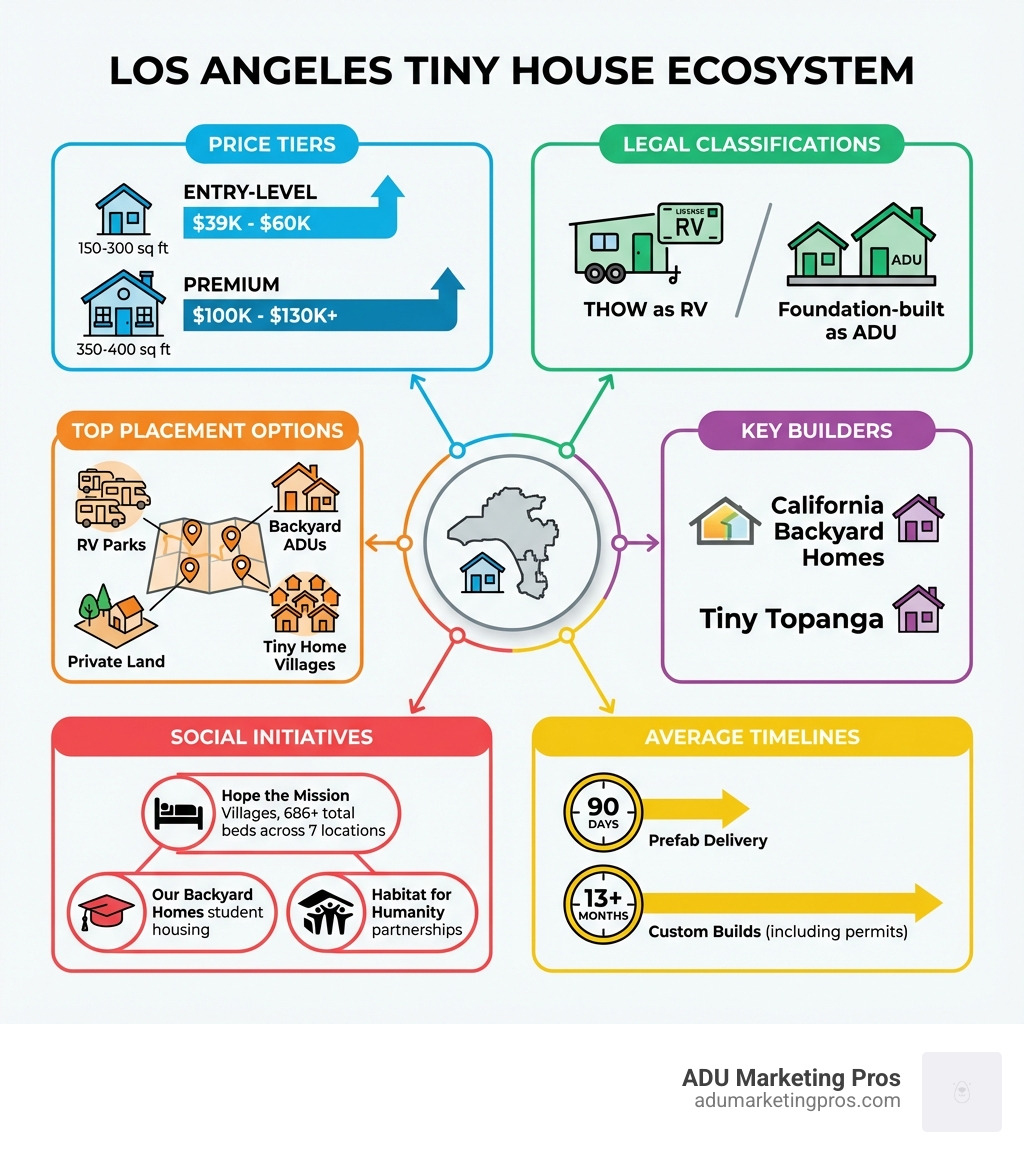
- Timeline: Varies dramatically. A custom build can take 13+ months (7 for permits, 6 for construction), while a prefab ADU can be installed in as little as 90 days after permits are approved.
The appeal is undeniable. While traditional homeownership in LA remains a distant dream for many, tiny homes present a tangible alternative. Consider the story of a Silver Lake couple who, after being priced out of the market, built a 400 sq. ft. tiny home in their parents’ backyard for $72,000. The project, which now generates $2,500–$3,500 in monthly short-term rental income, not only provides a financial windfall but also allowed them to stay in the community they love. The math is compelling.
Beyond personal finance, the tiny house movement is a direct response to pressing social issues. Visionary organizations like Hope the Mission are deploying entire villages of tiny homes, such as the 117-unit Arroyo Seco complex, to offer dignified emergency shelter for the unhoused. Meanwhile, Our Backyard Homes is placing self-sufficient tiny homes in residential backyards to combat housing insecurity among college students. This guide will delve into the real costs, legal hurdles, financing strategies, and top builders, giving you a complete picture of the tiny house los angeles ecosystem.
Simple tiny house los angeles glossary:
The Allure and a Reality Check: Benefits vs. Challenges of Tiny Living

The tiny house movement in Los Angeles is fueled by a powerful desire for a life less ordinary—and less expensive. However, embracing this minimalist lifestyle in a sprawling metropolis requires a clear-eyed assessment of its unique opportunities and obstacles. Understanding both sides of the coin is the first and most crucial step in your tiny journey.
Why Choose a Tiny House in L.A.?
The benefits of a tiny house los angeles are multifaceted and compelling, addressing financial, environmental, and lifestyle goals.
- Profound Financial Relief: This is the primary driver for most. With traditional LA homes hovering around the $1 million mark, a tiny house priced between $40,000 and $130,000 offers staggering savings. This translates to dramatically lower monthly costs. A mortgage on a $950,000 home could be over $5,000/month, while a loan for an $80,000 tiny home might be closer to $800/month. This frees up thousands of dollars for savings, investments, travel, or simply reducing work-related stress.
- A Powerful Investment Vehicle: California’s pro-ADU laws have transformed tiny homes into lucrative assets. Placing a foundation-built tiny home as an ADU in a desirable neighborhood can generate significant rental income. Many LA owners report earning $2,200/month or more from long-term tenants. With a strong ROI, the unit can often pay for itself in under a decade, creating a passive income stream that builds generational wealth.
- Sustainable and Eco-Conscious Living: A smaller footprint directly translates to a lighter environmental impact. A tiny home consumes a fraction of the energy for heating and cooling, uses significantly fewer construction materials, and drastically reduces water usage. Many owners incorporate further green tech, such as solar panels, rainwater harvesting systems, and composting toilets, allowing them to live nearly off-grid and further reduce their carbon footprint.
- Lifestyle Flexibility and Mobility: For those who choose a Tiny House on Wheels (THOW), the freedom to relocate is a major advantage. This adaptability is perfect for remote workers, travel enthusiasts, or anyone whose career or life circumstances may change. It decouples your home from a single piece of land, offering a level of freedom traditional homeowners can only dream of.
The Problems: What to Consider Before You Commit
Despite the allure, the path to tiny living in LA is fraught with real challenges that demand careful planning.
- Land Scarcity and Cost: This is the elephant in the room. While the house may be affordable, the land it sits on is not. Finding a legal, affordable plot in the dense LA basin is incredibly difficult. Small vacant lots in LA County can easily cost $200,000-$500,000, often negating the initial savings of the tiny home itself. This is why placing a tiny home as an ADU on an existing property is the most popular and viable route.
- Complex Zoning and Permitting: This is the biggest bureaucratic hurdle. The legal status of your tiny home is everything. THOWs are classified as RVs by the DMV and are restricted to RV parks or temporary placement under strict conditions. To be a legal, permanent dwelling, a tiny home must be built on a foundation and meet all the state and local building codes for an ADU, including specific requirements for size, setbacks, and utility connections. Navigating the Los Angeles Department of Building and Safety (LADBS) is a notoriously complex process.
- Financing Hurdles: You can’t get a traditional mortgage for a THOW because it’s considered personal property, not real estate. Buyers must rely on higher-interest RV loans, unsecured personal loans, or cash. While financing is more accessible for foundation-built ADUs (via HELOCs, cash-out refinancing, or construction loans), it still requires home equity and a strong financial profile.
- The Realities of Small-Space Living: Downsizing from 2,000 sq. ft. to 300 sq. ft. is a significant lifestyle adjustment. It requires ruthless decluttering, extreme organization, and a minimalist mindset. The limited space can also be challenging for couples, families, or those who work from home.
What’s the Price Tag on a Tiny House Los Angeles?
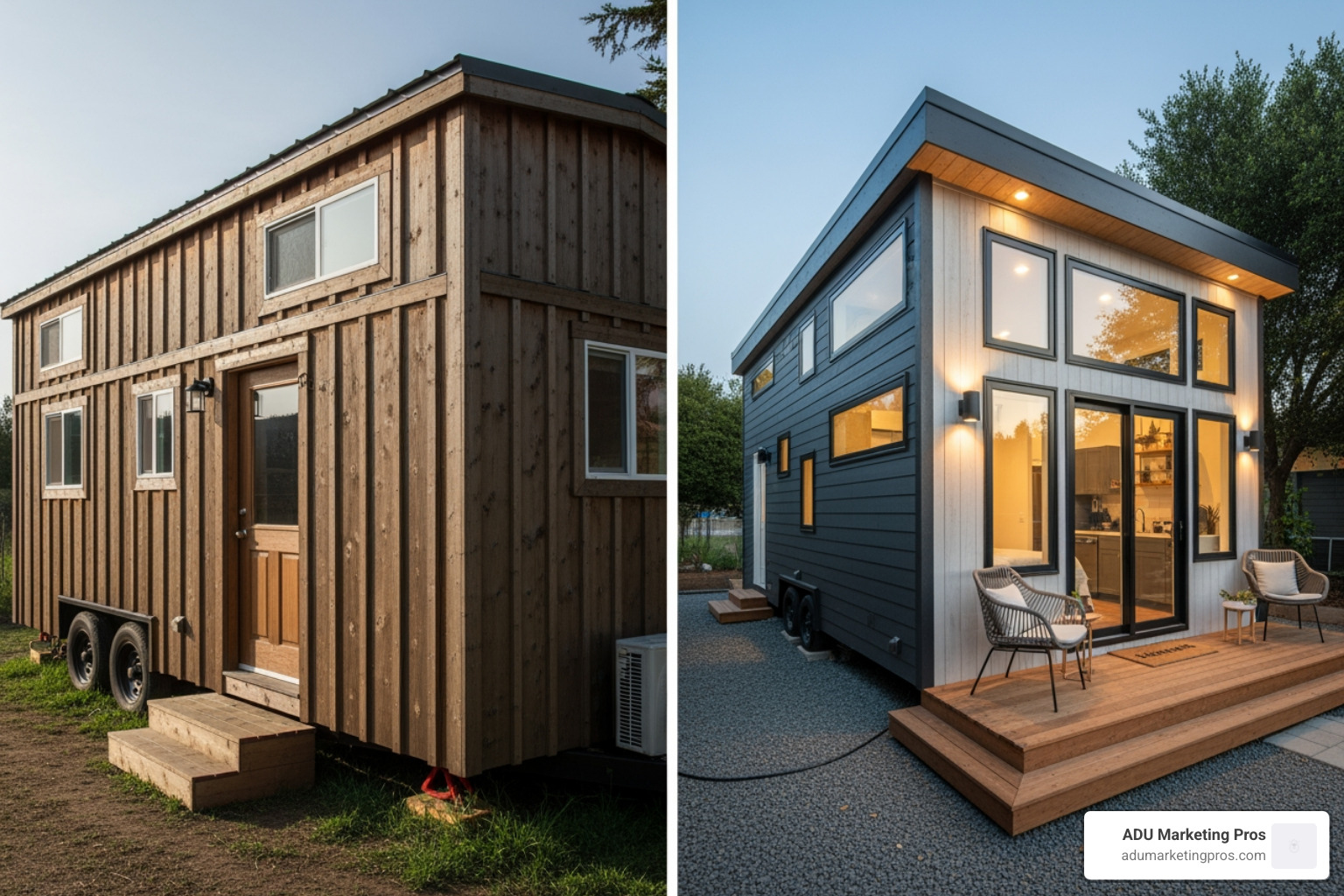
The most compelling reason for many to consider a tiny home is the price. While significantly more affordable than traditional housing, the cost of a tiny house los angeles is more than just the sticker price of the structure. It’s a complex equation involving the home itself, land, site preparation, and permits, with costs varying widely based on size, materials, and level of customization.
Breaking Down the Costs: From Entry-Level to Premium
Tiny home pricing in Los Angeles caters to a spectrum of budgets, but it’s crucial to understand what each tier includes.
- Entry-Level Tiny Homes ($39,000 – $60,000): These are typically smaller units (150-300 sq. ft.) with basic, builder-grade finishes. They are ideal for those comfortable with a more minimalist aesthetic, DIY enthusiasts looking for a solid shell to customize, or for use as a weekend retreat. Examples include simple THOWs or basic prefab kits like those from Boxabl, though waitlists can be long.
- Mid-Range Tiny Homes ($60,000 – $100,000): This is the sweet spot for most full-time dwellers and ADU investors. Sized around 300-400 sq. ft., this tier offers better quality materials, some custom features like upgraded flooring or countertops, and improved insulation. The Tiny Home Builders Parker Edition 2024, for instance, costs $88,000 for a well-appointed 288 sq. ft. home.
- Premium Tiny Homes ($100,000 – $130,000+): At the high end, these 350-400 sq. ft. homes rival luxury apartments. They boast high-end finishes like quartz countertops, custom cabinetry, designer fixtures, smart home technology, and advanced systems. Examples include the Metro 300 modular house for $108,000 or the spacious Park Model Clever 1 385 for $129,000.
The Hidden Costs: What Your Budget Must Include
Crucially, the prices above are for the structure alone. The all-in cost is often double the price of the home. A realistic budget must account for:
- Land: If you’re not using an existing backyard, this is the largest expense, easily running $200,000+ in LA County.
- Permits & Fees: Architectural plans, engineering reports, and city/county permit fees can total $10,000 to $25,000.
- Site Preparation: This includes grading the land, trenching for utilities, and pouring a foundation, which can cost $15,000 to $40,000.
- Utility Hookups: Connecting to water, sewer, and electrical grids is a major expense, often ranging from $10,000 to $30,000, depending on the distance to the main lines.
- Delivery & Installation: For prefab or modular homes, crane rental and installation fees can add another $5,000 to $15,000.
- Landscaping, Taxes, and Contingency: Don’t forget sales tax on the unit, landscaping for the finished project, and a 15-20% contingency fund for unexpected overruns.
| Price Range (Structure) | Typical Size (sq. ft.) | Key Features & Use Case | Estimated All-In Cost (ADU) |
|---|---|---|---|
| $39K–$60K | 150–300 | Basic finishes, standard appliances. Best for DIYers or weekend use. | $120K–$200K+ |
| $60K–$100K | 300–400 | Quality materials, some custom options. Ideal for full-time living or rental ADUs. | $180K–$300K+ |
| $100K–$130K+ | 350–400 | High-end finishes, custom design, smart tech. For luxury living or premium rentals. | $250K–$450K+ |
A Real-World LA Build: A Look Inside a $72,000 Project
Real-world projects offer invaluable insight. One LA resident’s journey building a tiny house los angeles provides a candid look at the realities. Initially quoted at $40,000 for a basic shell, the final cost for the finished home rose to $72,000. This highlights the importance of budgeting for upgrades, materials, and labor overruns. The timeline was also substantial: a grueling 7 months to secure permits from LADBS, followed by 6 months of construction. By acting as their own general contractor, they managed costs but faced a steep learning curve with inspections and subcontractor management. Despite the challenges, the investment proved highly lucrative. The tiny home now generates $2,500-$3,500 monthly as a short-term rental (or $1,500-$2,000 long-term) against a modest $700 mortgage payment, vividly illustrating a tiny home’s potential as a powerful, income-generating asset in LA.
Your Roadmap to Tiny Living: Legal, Financial, and Build Guide
Building or buying a tiny home in Los Angeles requires a strategic approach and careful navigation of local regulations. While recent changes in state law have streamlined the process for Accessory Dwelling Units (ADUs), success hinges on meticulous planning across legal, financial, and construction phases.
Step 1: Mastering Los Angeles Zoning and Permits
This is the most critical and often underestimated phase. Before you fall in love with a design, you must determine what is legally possible on your property. California’s ADU-friendly state laws provide a framework, but local jurisdictions like the City of LA and LA County have their own specific ordinances.
Your Due Diligence Checklist:
- Confirm Your Jurisdiction: Are you in the City of Los Angeles or an unincorporated part of LA County? Your rules will differ. Start by contacting the LA Department of Building and Safety (LADBS) for city properties or the LA County Department of Regional Planning for county land.
- Understand the Core Distinction:
- Tiny Houses on Wheels (THOWs): These are legally considered Recreational Vehicles (RVs) and are governed by the DMV. Permanent residential placement is generally prohibited. They are restricted to licensed RV parks or temporary placement with special permits, which are rare and difficult to obtain for residential use.
- Foundation-Built Tiny Homes: To be a legal, permanent residence, your tiny home must be built on a permanent foundation and permitted as an ADU. It must comply with all residential building codes, zoning requirements (like setbacks from property lines), and, in some cases, minimum square footage requirements.
- Research Movable Tiny Houses (MTHs): Some California jurisdictions are adopting ordinances for “Movable Tiny Houses,” which are built to residential building codes but remain on a chassis. This is an evolving legal area. Check with your local planning department to see if this is an option.
- Consult Professionals: Engage an architect, designer, or a specialized ADU consultant early. They can perform a feasibility study on your property and navigate the complex permit submission process. For personal insights and community advice, the blog Living Tiny in LA is an excellent local resource.
Step 2: Securing Financing for Your Small Dream
Financing a tiny home depends entirely on its legal classification.
-
For THOWs (Personal Property): Traditional mortgages are off the table. Your options are:
- RV Loans: If your THOW is certified by the RVIA (Recreational Vehicle Industry Association), you can get a standard RV loan. Terms are typically 10-15 years with higher interest rates than mortgages.
- Personal Loans: Lenders like LightStream or SoFi offer unsecured personal loans up to $100,000. These have shorter terms (5-7 years) and rates based heavily on your credit score.
- Builder Financing: Some tiny home builders offer in-house financing options.
-
For Foundation-Built ADUs (Real Estate): As part of your property, these open up traditional real estate financing:
- Home Equity Line of Credit (HELOC) or Home Equity Loan: The most common method, allowing you to borrow against the equity in your existing home.
- Cash-Out Refinance: Refinance your current mortgage for a higher amount and use the difference to fund the ADU construction.
- Construction Loan: A short-term loan specifically for building the ADU, which is then typically rolled into a new mortgage.
For those pursuing affordable housing pathways, organizations like Habitat for Humanity of Greater Los Angeles offer programs with significant mortgage assistance for eligible low-income households, making ownership a tangible reality.
Step 3: Choosing Your Style: Types of tiny house los angeles
The LA market offers a diverse range of styles to fit any vision, budget, and legal pathway.
- Tiny Houses on Wheels (THOWs): The classic mobile option, offering ultimate flexibility. Look for models with RVIA or NOAH (National Organization of Alternative Housing) certification to ensure safety and quality standards. Models like the 150 sq. ft. Catalina 150 start around $44,500.
- Modular/Prefab ADUs: Factory-built for efficiency, quality control, and speed. These are built in sections, transported to your site, and assembled on a foundation. A 300 sq. ft. model like the Metro 300 can cost around $108,000 for the unit, with delivery in as little as 90 days post-permit.
- Park Models: These are technically a type of RV but are larger (often close to 400 sq. ft.), designed for long-term placement in a single location, and require professional transport. Prices can range from $79,000 to $129,000 for a 385 sq. ft. model.
- Converted Vehicles: A creative and mobile solution for the adventurous. Sprinter van conversions offer a compact, stealthy option for around $64,999, while larger converted box trucks or school buses (“skoolies”) can provide more living space for up to $90,000.
- DIY Kits: For the hands-on builder, basic insulated building kits (SIPs panels) provide an affordable starting point, with some available for as low as $6,999. This route requires significant skill, time, and knowledge of building codes to pass inspections.
Many of these models can be explored through builders and marketplaces like California Backyard Homes, which showcases various options and provides a good starting point for your research.
Tiny Houses, Big Impact: Addressing Social Challenges in LA
Beyond personal dwellings, the tiny house concept is being harnessed as a powerful and innovative tool for social change across Los Angeles. These small structures are providing shelter, dignity, and a critical path forward for some of the city’s most vulnerable residents, from the unhoused to housing-insecure students.
Tiny Home Villages for the Unhoused
In a city grappling with a severe homelessness crisis, tiny home villages have emerged as a rapid, scalable, and humane solution. Organizations like Hope the Mission are at the forefront of this movement, using tiny homes to create structured communities that offer more than just a roof—they provide a holistic support system.
Each village consists of private, 64 sq. ft. emergency shelters. While small, they are transformative, offering heating, air-conditioning, storage space, and a locking door that restores a sense of security and personal dignity often lost on the streets. These are not just shelters; they are comprehensive service hubs. Residents receive three meals a day, have access to showers and laundry, and are connected with case managers, mental health professionals, and job training resources. The ultimate goal is to create a stable environment that serves as a bridge to permanent housing. The City of Los Angeles has funded and built several such villages, which are then operated by experienced non-profits. Notable examples include the groundbreaking Chandler Blvd. Village in North Hollywood and the Arroyo Seco Village in Highland Park, which at 117 units is the largest in California. Collectively, these sites provide hundreds of safe beds nightly and have proven to be a cost-effective and successful strategy in the fight against homelessness. You can learn more about these life-changing initiatives at Home | We Shelter People.
Pathways to Homeownership with Habitat for Humanity
For low-income families priced out of the conventional market, Habitat for Humanity of Greater Los Angeles provides another vital path to affordable homeownership. Their model is built on a partnership where families contribute “sweat equity” hours, working alongside volunteers to help build their own homes and the homes of others in the program. This innovative approach helps families who may not qualify for traditional mortgages build equity and stability.
To be eligible, households must demonstrate a need for better housing, have good credit, and fall within 50% to 80% of the Area Median Income (AMI). For a family of four in LA County, this currently means an income between approximately $66,250 and $106,000. Qualified applicants can receive up to $100,000 in down payment assistance through silent second mortgages. A key requirement is the completion of a HUD-certified pre-purchase homebuyer education workshop, ensuring new homeowners are prepared for the financial responsibilities ahead. This program creates a tangible and sustainable path to homeownership in one of the nation’s least affordable markets.
Innovative Solutions for Student Housing
Housing insecurity doesn’t just affect families; it’s a growing crisis among LA’s college student population. The non-profit Our Backyard Homes (OBH) is tackling this issue with a unique and brilliant solution. OBH provides housing-insecure students with self-sustainable tiny houses on wheels. These off-grid micro-homes are marvels of engineering, generating their own power via solar panels and managing their own water and waste through innovative systems, requiring no utility hookups.
OBH then partners with community-minded landowners who live near college campuses to host these homes in their backyards. In exchange for the use of their land, homeowners can support a student in need, fostering community connections. This model provides students with free or significantly reduced-cost housing, allowing them to focus on their studies without the crushing burden of high rent. It’s an ingenious way to leverage existing, underutilized residential space to address the student housing crisis. Learn more about their inspiring model at Tiny Houses, Big Solutions.
Frequently Asked Questions about Tiny Homes in LA
Where can I legally park a tiny house on wheels (THOW) in Los Angeles?
Legally placing a THOW in LA is challenging because they are classified as Recreational Vehicles (RVs), not permanent homes. The most straightforward legal option is a licensed RV park. Some parts of LA County and other California cities have started to allow THOWs as backyard ADUs, but only if they are connected to utilities and meet specific local ordinances, which are still evolving. For temporary placement on private residential property, you would need a special permit, which is difficult to obtain. Always consult your local planning department for the most current and precise rules for your specific address.
Can I get a traditional mortgage for a tiny house in LA?
A traditional mortgage is generally not an option for a THOW because it is considered personal property, like a car or boat. Buyers must use alternative financing like RV loans (if the unit is RVIA certified), unsecured personal loans, or cash. These loans typically have shorter terms (5-15 years) and higher interest rates than a mortgage. However, for a tiny home built on a permanent foundation and permitted as an ADU, the situation is different. Because it becomes part of your real estate, you can use traditional financing methods like a home equity loan, a HELOC, or a construction loan to fund the project.
What is the realistic timeline for building a tiny house los angeles?
The timeline varies dramatically based on the type of home and the permitting process. A custom, on-site build is the longest path, often taking over a year. The permit process alone with the Los Angeles Department of Building and Safety (LADBS) can take 7-9 months, involving plan checks, revisions, and approvals. Construction then adds another 6-8 months. In contrast, a prefabricated or modular tiny home ADU can be much faster. Once your permits are approved, some builders can deliver and install the home in as little as 90 days. This speed is a major reason why prefab ADUs have become so popular.
How do I get insurance for a tiny house in LA?
Insurance depends on the type of tiny home. For a THOW with an RVIA certification, you can get RV insurance from major providers like Progressive or Geico. For a DIY or uncertified THOW, obtaining insurance can be very difficult. For a tiny home on a permanent foundation permitted as an ADU, it is typically covered by extending your existing homeowner’s insurance policy. You must inform your insurance provider about the new structure to ensure you have adequate coverage for the increased value of your property.
What about property taxes for a tiny house?
Property taxes also depend on the classification. A THOW is considered a vehicle, so you pay an annual registration fee to the DMV, not property tax. A foundation-built ADU, however, is considered a permanent improvement to your property. Its construction will trigger a reassessment of your property’s value by the county assessor’s office. Your property taxes will increase based on the value added by the new ADU, but your original home’s assessed value remains protected under Prop 13.
Conclusion: Is a Tiny Home Your Big LA Dream?
The tiny house movement in Los Angeles is far more than a niche architectural trend; it’s a dynamic and practical response to the city’s most pressing challenges. It offers a compelling answer to the high cost of living, a tangible path to a more sustainable and intentional lifestyle, and a powerful tool for creating positive social change. For prospective homeowners, it represents a chance to own a piece of Los Angeles without succumbing to a lifetime of debt. For investors, it’s a lucrative opportunity to generate passive income through the booming ADU market. And for the community, it’s an innovative solution for sheltering the unhoused and supporting students.
While significant challenges in zoning, financing, and land acquisition still exist, the path forward is becoming clearer each year. As state and local governments increasingly embrace smaller, more flexible housing solutions, the barriers continue to fall. The journey requires diligence, research, and a realistic budget, but the rewards—financial freedom, a smaller environmental footprint, and a simplified life—can be immense. Whether you’re dreaming of a chic backyard ADU, a mobile home base for your adventures, or simply a smaller, more manageable footprint, the tiny house offers a unique and powerful opportunity to redefine your life in the City of Angels.
As the ADU market continues to boom, having the right strategy to connect with clients is crucial for builders. ADU Marketing Pros specializes in helping construction and architecture firms stand out and attract high-quality leads in this competitive space. To learn more about building your brand and growing your business, find the right ADU builder in Los Angeles for your project.