
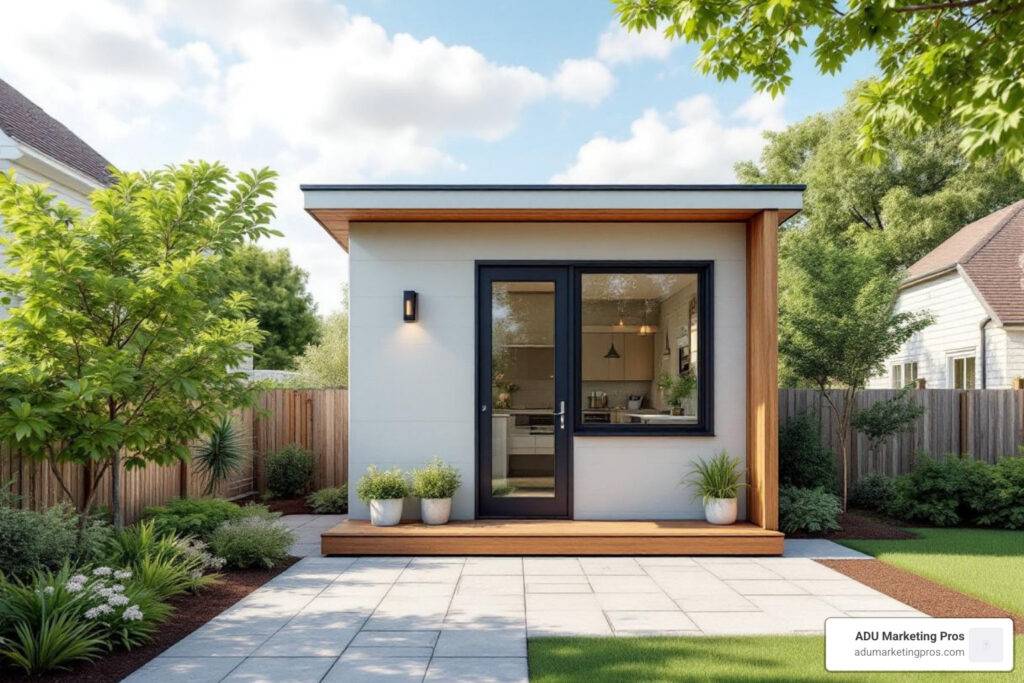
Why an Accessory Dwelling Unit Could Transform Your Property
An Accessory dwelling unit (ADU) is a self-contained residential unit on the same lot as a primary home, complete with its own kitchen, bathroom, and separate entrance. Also known as granny flats or in-law suites, ADUs cannot be bought or sold separately from the main house, creating a unique opportunity for homeowners to maximize their property’s potential without subdividing their land.
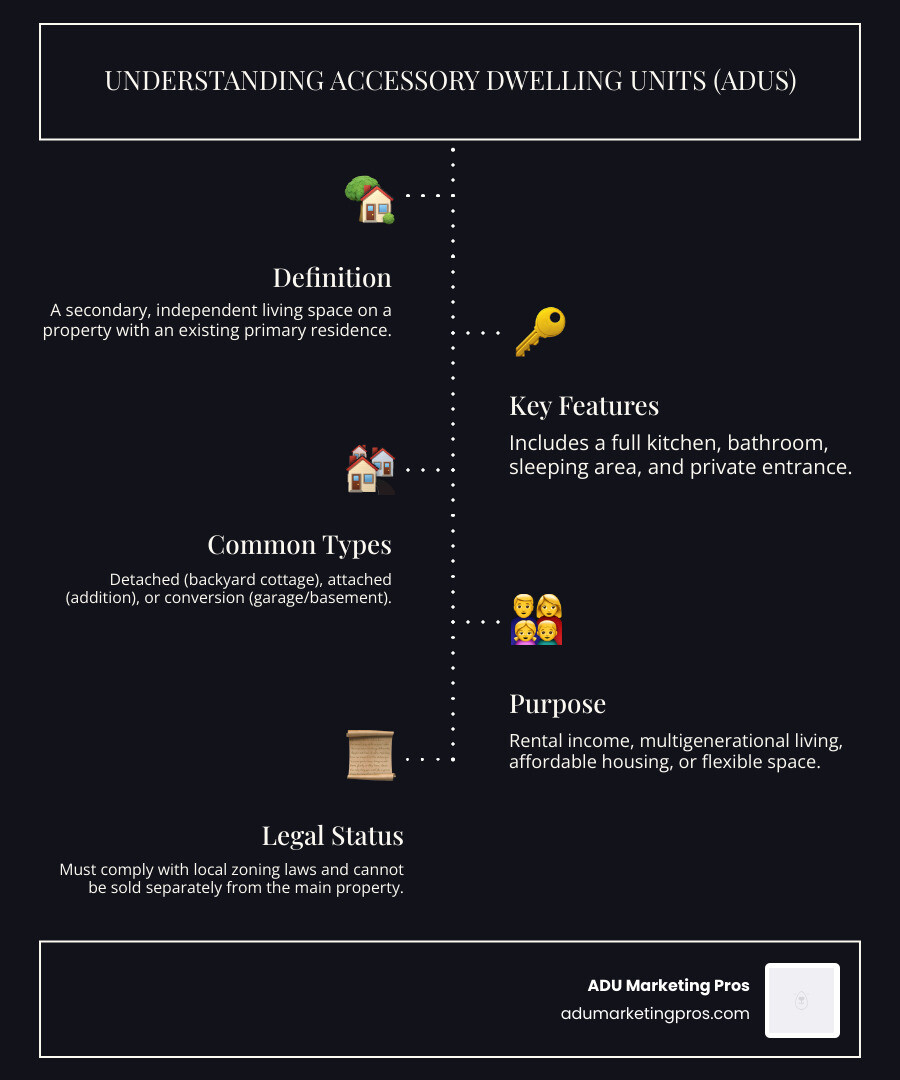
Quick Answer: What is an ADU?
- Definition: A secondary, independent living space on a property with an existing single-family home.
- Key Features: Full kitchen, bathroom, sleeping area, and a private entrance.
- Common Types: Detached (backyard cottage), attached (addition), or conversion (garage/basement).
- Purpose: Rental income, multigenerational living, flexible space for work or hobbies, or housing for caregivers.
- Legal Status: Must comply with local zoning and building codes and cannot be sold separately from the main property in most jurisdictions.
Understanding ADUs is more important than ever. In California alone, ADU permitting skyrocketed from under 10,000 in 2017 to over 83,000 in 2022, making up about 19% of all new housing statewide. This explosive growth isn’t just a statistic; it’s a reflection of a fundamental shift in how we live. Driven by soaring housing costs, the rise of remote work, and a growing desire for multigenerational living, homeowners and industry professionals are recognizing ADUs as a versatile solution to modern challenges.
This guide will walk you through the essentials of transforming your property with an ADU. Whether you’re a homeowner dreaming of passive income and keeping family close, or a builder looking to serve this booming market, we’ll break down the complex world of regulations, costs, and design into actionable steps. Let’s explore how an ADU can be more than just a building—it can be a financial asset, a family solution, and a cornerstone of community-focused growth.
Accessory dwelling unit terms made easy:
What is an Accessory Dwelling Unit (ADU)? The Complete Breakdown
An Accessory dwelling unit (ADU) is a second, smaller home built on the same property as a primary residence. To legally qualify as an ADU, the unit must be self-contained, offering its own kitchen, bathroom, and separate entrance. It’s an intelligent and efficient way to add housing density without needing new land, a strategy the California Department of Housing and Community Development (HCD) calls an “innovative and effective option for adding much needed housing.” For a comprehensive overview, AARP offers a helpful guide, The ABCs of ADUs, which details their community benefits.
Common Names and Misconceptions
You’ve likely heard terms like “granny flat,” “in-law suite,” “backyard cottage,” or “carriage house.” These are all colloquial names for ADUs, highlighting their traditional use for housing family members. The term “carriage house” dates back to the era of horse-drawn carriages, referring to outbuildings that were later converted into living quarters. While the names vary, the modern legal concept is the same: a distinct living space that is accessory to a main home.
A common misconception is that any detached structure, like a pool house or a home office, is an ADU. The key legal distinction is the presence of a full kitchen. Without full cooking facilities, a structure is typically classified as an accessory building, not a dwelling unit. This difference is critical for permitting, zoning, property assessment, and its legal use as a rental.
ADU vs. Junior ADU (JADU) vs. Tiny House
Understanding the differences between an ADU, a Junior Accessory Dwelling Unit (JADU), and a Tiny House on Wheels (THOW) is key to choosing the right option. While all offer smaller living spaces, their legal definitions, regulations, and uses differ significantly. We’ve explored the differences between an ADU vs Tiny House in more detail.
| Feature | Accessory Dwelling Unit (ADU) | Junior Accessory Dwelling Unit (JADU) | Tiny House on Wheels (THOW) |
|---|---|---|---|
| Size | Up to 1,200 sq. ft. (or more by local rules) | Max 500 sq. ft. | Typically under 400 sq. ft. |
| Location | Detached, attached, or conversion of existing space | Must be within the primary single-family home | Mobile, on a trailer chassis |
| Kitchen | Full kitchen required | “Efficiency kitchen” required (sink, cooking appliance, counter, storage) | Full kitchen or kitchenette |
| Bathroom | Full, private bathroom required | Can share with primary home in some cases, but most jurisdictions now require a private bath | Full bathroom or wet bath |
| Entrance | Separate exterior entrance required | Separate exterior entrance required | Main entrance from outside |
| Legal Foundation | Permanent residential structure | Permanent residential structure | Often classified as an RV; placement is legally complex |
| Owner Occupancy | Not required for new ADUs permitted after 2020 in California | Owner must reside in either the primary home or the JADU | Varies; often not permitted for permanent residence on a residential lot |
| Property Status | Cannot be sold separately from main house | Cannot be sold separately from main house | Personal property; can be moved and sold independently |
A JADU is a compact unit (max 500 sq. ft.) created within the existing walls of a home, making it a cost-effective option. A THOW, on the other hand, is a mobile structure often classified as a recreational vehicle (RV), making its permanent placement on a residential lot legally challenging and highly dependent on local ordinances.
The Different Types of an Accessory Dwelling Unit
ADUs come in several forms, allowing homeowners to choose the best fit for their property, budget, and local rules.
-
Detached ADU: A standalone structure, often called a backyard cottage or granny flat, that is separate from the main home. It offers the most privacy and design flexibility, making it ideal for renters or family members seeking independence. However, it typically involves the highest construction costs due to the need for a new foundation, structure, and utility connections. For more on this, see our guide on Backyard ADU Construction.
-
Attached ADU: An addition that shares one or more walls with the primary home but has its own entrance, kitchen, and bath. This can be a more cost-effective option than a detached unit by leveraging the existing structure and potentially simplifying utility hookups. It’s a great way to add space while maintaining a close connection to the main house.
-
Conversion ADU: This involves repurposing existing, underutilized space within the property’s footprint, such as a garage, basement, or attic. This is often the most budget-friendly and fastest option because it uses an existing structure, saving significant costs on foundation and framing. Our expertise in ADU Garage Conversions can help transform these spaces into valuable, income-generating living units.
The Benefits and Challenges of Building an ADU
Building an Accessory dwelling unit is a major project, but the rewards can be substantial for both the homeowner and the community. Understanding both the significant advantages and the potential problems is key to making an informed decision and ensuring a successful outcome.
Major Benefits for Homeowners and Communities
ADUs offer a unique combination of financial, personal, and societal benefits.
-
Passive Rental Income: In high-cost housing markets, renting out an ADU can generate a steady stream of ADU Rental Income. This income can offset or even cover a primary mortgage, pay for the ADU’s construction, or provide a significant boost to your monthly cash flow.
-
Housing for Family and Loved Ones: ADUs are an ideal solution for Multi-Generational ADU living. They allow aging parents to live close by while maintaining their independence (aging-in-place), or provide a stepping stone for adult children saving for their own home. They can also house caregivers, nannies, or other relatives.
-
Increased Property Value: A well-designed, legally permitted ADU is a valuable asset that significantly boosts your property’s market value. Appraisers are increasingly recognizing the value ADUs add, not just for the structure itself but for its income potential. Our analysis of ADU Return on Investment shows that the value added often exceeds the cost to build, making it a wise long-term investment.
-
Flexible Space: Life changes, and an ADU can adapt with you. It can serve as a dedicated home office, an art or music studio, a private gym, a guest suite for visitors, or a quiet retreat from the main house. This flexibility adds immense functional value to your property.
-
Affordable Housing Solutions: For communities, ADUs are a critical tool for adding to the housing supply without large-scale development. This “gentle density” provides more affordable rental options in established neighborhoods, helps combat urban sprawl, and supports local businesses by allowing more people to live in the community.
Potential Drawbacks and Challenges to Consider
While the benefits are compelling, it’s crucial to be realistic about the challenges involved.
-
Significant Upfront Costs: Building an ADU is a major financial investment. Costs for design, engineering, permits, site preparation, utility connections, and construction can add up quickly. Our article on ADU Building Costs provides a detailed breakdown to help you budget effectively.
-
Complex Permitting and Regulations: Navigating local zoning ordinances and building codes can be a time-consuming and frustrating process. Even with streamlined state laws, each municipality has its own specific requirements, and the approval process can involve multiple departments and revisions.
-
Loss of Yard Space and Privacy: A new structure will inevitably reduce your open yard space and can impact privacy for both the main home and the ADU. Careful design is essential to mitigate this, using strategic placement, fencing, landscaping, and window orientation to create distinct private zones for each dwelling.
-
The Responsibilities of Being a Landlord: If you plan to rent your ADU, you must be prepared for the duties of being a landlord. This includes marketing the property, screening tenants, creating legal lease agreements, collecting rent, and responding to maintenance requests in a timely manner. It’s a business, not just passive income.
-
Property Tax Increase: Adding a new, permitted dwelling will trigger a reassessment of your property’s value for tax purposes. This will lead to higher annual property taxes. It’s important to understand ADU Property Taxes and factor this ongoing expense into your financial planning.
The Financial Blueprint: ADU Costs, Financing, and Incentives
Understanding the complete financial picture of building an Accessory dwelling unit is non-negotiable. From initial construction costs and hidden expenses to securing the right loan and leveraging government incentives, a solid financial plan is the bedrock of a successful project.
How Much Does an Accessory Dwelling Unit Cost to Build?
The cost to build an ADU varies widely based on type (conversion vs. new build), size, quality of finishes, and location, with major metro areas like Los Angeles and the San Francisco Bay Area being significantly more expensive. Generally, homeowners should expect a range from $150,000 to $400,000+. Garage conversions typically fall on the lower end of this spectrum, while new, detached units are on the higher end. For a more granular look, see our guide on ADU Cost Per Square Foot.
Key Cost Components:
- Pre-construction (Soft Costs): Design fees (architect/designer), structural engineering, soil reports, survey costs, and permit fees. See our article on ADU Permit Cost California.
- Site Work: Grading, excavation, foundation, and utility trenching and connections (sewer, water, gas, electric). Utility upgrades can be a major expense.
- Construction (Hard Costs): Labor and materials for the structure itself, including framing, roofing, windows, plumbing, electrical, and HVAC.
- Finishes: All interior and exterior finishes, such as cabinetry, countertops, flooring, paint, lighting fixtures, and appliances.
Don’t Forget Hidden Costs: Budget an extra 10-15% for contingencies. Common unexpected costs include discovering poor soil conditions, needing to upgrade your main electrical panel or sewer line to support the new unit, and extensive landscaping to restore your yard. Exploring options like Prefab ADU California Cost can sometimes offer more cost certainty.
How to Finance Your ADU Project
Several financing options are available to fund your ADU. The best choice depends on your financial situation, home equity, and risk tolerance. Our guide, From Loans to Investments: Navigating ADU Financing, covers these in depth.
- Cash or Savings: The most straightforward option, avoiding interest payments and loan fees.
- Cash-out Refinance: Replacing your current mortgage with a new, larger one, allowing you to take out the difference in cash. This often offers a low interest rate but involves closing costs.
- Home Equity Line of Credit (HELOC): A flexible line of credit that works like a credit card, secured by your home’s equity. You only pay interest on the amount you draw, making it great for managing construction payments.
- Renovation Loan (e.g., FHA 203k, Fannie Mae HomeStyle): These loans bundle the cost of the renovation into your mortgage. The loan amount is based on the home’s future value after the ADU is built, which can be helpful if you have limited equity.
- Construction Loan: A short-term, higher-interest loan specifically for the construction phase. Funds are released in draws as work is completed. It typically converts to a traditional mortgage once construction is finished. Learn more about Construction Loans for ADU.
Government Grants and Incentive Programs
To spur ADU development, California and many local governments offer programs to help homeowners with costs. Our article on California ADU Incentives details many of these.
The California ADU Grant Program, administered by the California Housing Finance Agency (CalHFA), offers up to $40,000 to qualified low- to moderate-income homeowners to cover pre-construction and non-recurring closing costs. You can find more information on the state’s Accessory Dwelling Unit Grant Program. Additionally, many cities like Pasadena, San Diego, and San Jose offer their own local incentives, such as waived permit fees or low-interest loans. Always check your local city and county planning department websites for the most current programs available in your area.
Navigating the Maze: ADU Regulations, Zoning, and Permits
Building an Accessory dwelling unit legally requires a deep dive into local zoning laws, building codes, and the permitting process. While it can seem like a bureaucratic maze, understanding these rules is the most critical step for a smooth, successful project. We specialize in helping construction and architecture firms steer their clients through these complex regulations.
Understanding ADU Legal and Zoning Considerations
While California has passed a suite of state-level laws to encourage ADU construction, the ultimate authority for enforcement and specific rules rests with your local city or county. Regulations in Los Angeles may differ significantly from those in San Diego or a small town in San Mateo County. Your first step is always to consult your local planning department and familiarize yourself with both their local ADU Zoning Laws and the overarching California ADU Regulations. The state’s official Accessory Dwelling Unit Handbook is an excellent, authoritative resource.
Common regulations to investigate include:
- Size Limits (Max/Min): State law generally allows ADUs of at least 800 sq. ft., but local rules may permit larger sizes (e.g., 1,000 or 1,200 sq. ft.). There are also minimum size requirements. See our guide on ADU Size Restrictions.
- Height Restrictions: Typically 16 feet for a single-story detached ADU, but can be higher for ADUs built above a garage or as part of a two-story home.
- Setbacks: The minimum distance required from the ADU to your property lines and the primary home. State law has reduced these to as little as four feet for side and rear yards.
- Parking: State law has eliminated parking requirements for most ADUs, especially if the property is near public transit, in a historic district, or if it’s a conversion ADU.
- Owner-Occupancy: California has largely removed owner-occupancy requirements for new ADUs until 2025, a rule designed to encourage rental housing. However, this requirement may still apply to JADUs.
The ADU Permit Process from Start to Finish
Obtaining a building permit is a critical, multi-stage process that turns your idea into a legal reality. Here’s a general overview of the ADU Permit Process:
- Feasibility & Design: First, confirm your property is eligible. Then, work with an architect or designer to create a complete set of construction documents. Our network of ADU Architects Los Angeles can help. This plan set typically includes a site plan, floor plans, elevations, structural calculations, and energy compliance forms (like Title 24 in California).
- Plan Submission & Review: Submit your complete plan set to the local building and planning department. A plan checker will review your documents for compliance with zoning, building, fire, and safety codes. This stage often involves several rounds of comments and corrections.
- Permit Issuance: Once the plans are fully approved and all associated fees are paid, the city issues the building permit. You are now legally cleared to begin construction.
- Construction & Inspections: During construction, a city inspector must visit the site at key milestones to ensure the work is being done to code. These inspections typically include foundation, framing, rough electrical/plumbing/mechanical, insulation, and drywall. You cannot proceed to the next phase until an inspection is passed.
- Final Approval: After passing all required inspections, you will receive a final sign-off and a Certificate of Occupancy. The ADU is now officially a legal dwelling and ready for use.
This entire process can take several months to over a year. In complex jurisdictions, some homeowners hire a permit expediter to help manage submissions and communication with the city.
A Spotlight on California’s Pro-ADU Legislation
California has become the national leader in promoting ADUs as a key strategy to address its severe housing crisis. A series of landmark state laws (including SB 9, SB 13, AB 68, and AB 881) have systematically dismantled local barriers, making it faster, easier, and more affordable to build them. These reforms have directly led to the dramatic increase in ADU construction, with permits jumping from under 10,000 in 2017 to over 83,000 in 2022. Our article on New ADU Regulations California highlights these game-changing updates.
Key reforms include mandating streamlined 60-day approval timelines, eliminating or drastically reducing impact fees, and overriding restrictive local rules on parking and owner-occupancy. This pro-ADU stance is evident in cities across the state, from ADU San Diego to San Jose, which offers Pre-Approved ADU Plans San Jose to further accelerate the process.
The Future of ADU Development
The Accessory dwelling unit landscape is in a constant state of evolution, driven by innovations in construction, shifts in policy, and new technologies. As we look to the future, it’s clear that ADUs are becoming an integral and permanent part of sustainable urban growth, especially in forward-thinking regions like California.
Emerging Trends in ADU Design and Construction
The future of ADUs is being shaped by trends that prioritize efficiency, sustainability, and intelligent design. Our insights into ADU Design Trends show a clear movement towards units that are greener, smarter, and faster to build.
- Pre-Approved Plans: To slash permitting timelines, many cities like San Jose and Los Angeles now offer galleries of Pre-Approved ADU Plans. These plans are already vetted by the city’s building department, allowing homeowners to get their permits much faster.
- Modular and Prefab ADUs: Factory-built housing is gaining significant traction in the ADU space. Prefabricated units offer predictable costs, high-quality construction in a controlled environment, and a much faster, less disruptive on-site installation process. Explore ADU Modular Homes California for more details on this efficient building method.
- Sustainable and Resilient Design: Eco-Friendly Small Homes are no longer a niche. Features like high-efficiency insulation, cool roofs, solar panels, heat pump water heaters, and greywater recycling systems are becoming common in an Energy Efficient ADU, reducing long-term utility costs and environmental impact.
- Smart and Flexible Interiors: With smaller footprints, maximizing space is key. We’re seeing a rise in multi-functional furniture, clever storage solutions, and the integration of smart home technology for lighting, climate, and security control, all managed from a smartphone.
The Growing Role of ADUs in Modern Cities
Beyond individual properties, ADUs are increasingly recognized as a powerful tool for addressing systemic urban challenges.
- Gentle Density and Housing Diversity: ADUs allow cities to grow from within by adding density to existing single-family neighborhoods without the need for large, disruptive apartment complexes. This creates more housing options for different income levels and household sizes.
- Aging-in-Place and Family Support: ADUs provide a safe, affordable, and independent living option for seniors, allowing them to stay in their communities and close to family support networks.
- New Paths to Homeownership: A groundbreaking trend is the exploration of policies to allow ADUs to be sold separately from the primary home. This process, sometimes called “condominiumizing” the lot, could create a new form of small, more affordable starter homes. Cities like Austin, Seattle, and Portland are pioneers in this space, and California is actively exploring similar legislation.
- The Rise of ADU Technology and Marketplaces: The complexity of building an ADU has given rise to a new ecosystem of technology platforms. These online marketplaces connect homeowners with vetted designers, builders, and prefab companies, streamlining the entire process from feasibility and design to financing and construction management.
Frequently Asked Questions about Accessory Dwelling Units
Here are answers to some of the most common questions we hear from homeowners and professionals considering an Accessory dwelling unit project.
How long does it take to build an ADU?
The total timeline from initial concept to final move-in can range from 10 to 30 months, and sometimes longer. This process is best understood in two main phases:
- Phase 1: Design and Permitting (6-18 months): This is often the longest and most unpredictable phase. It involves hiring a designer or architect, developing a full set of construction plans, and navigating the local city’s review and approval process. While state law mandates a 60-day review period for permit applications, this clock only starts once the application is deemed complete, and multiple rounds of corrections can cause significant delays.
- Phase 2: Construction (4-12 months): Once you have an issued permit, the actual build time depends on the ADU’s type (a garage conversion is faster than a new build), size, complexity, and your contractor’s efficiency and schedule.
Will an ADU increase my property taxes?
Yes, building a permitted ADU will increase your property taxes. However, it’s not as drastic as many fear. Thanks to California’s Proposition 13, your entire property is not reassessed at its new market value. Instead, the county assessor will perform a “blended assessment.” This means your existing home’s assessed value remains the same, and the tax increase is based only on the added value of the new construction. This modest increase is often easily offset by the rental income generated or the overall boost in your property’s market value.
Can I use an ADU as a short-term rental like an Airbnb?
This depends entirely on your local city’s regulations. While the state has made it easier to build ADUs, it grants local governments the authority to regulate or even ban short-term rentals (STRs) of ADUs. Many cities in California have strict rules, such as requiring the owner to live on the property (in either the main house or the ADU) or limiting the number of days per year a unit can be rented on a short-term basis. Before you build an ADU with the primary goal of using it as an Airbnb, you must research and confirm your local municipality’s specific ordinances to avoid potential violations and significant fines.
Can I build an ADU myself (DIY)?
While technically possible, a full DIY ADU build is an enormous undertaking and generally not recommended unless you are a licensed contractor or have extensive construction experience. Building an ADU involves multiple trades (foundation, framing, plumbing, electrical, HVAC, roofing) that must be performed to current building codes and pass city inspections. A mistake in any of these areas can be costly and dangerous. A more common approach for handy homeowners is to act as their own general contractor, hiring and managing licensed subcontractors for each phase of the project. This can save money but requires significant time, knowledge, and project management skills.
Do I need an architect to design my ADU?
Not necessarily, but you do need a qualified professional. In California, you can hire a licensed architect, a building designer, or even a draftsperson to create your ADU plans. Architects offer the most comprehensive design and project management services but are also the most expensive. Building designers are often a more affordable and highly effective choice for a project of an ADU’s scale. Some contractors and prefab ADU companies also offer in-house design services. The most important thing is to hire a professional who has specific experience designing ADUs in your city and understands the local codes and submission requirements.
Conclusion
The Accessory dwelling unit has evolved from a niche concept into a powerful, mainstream solution for modern housing needs. From providing flexible living space for family and generating substantial rental income to increasing housing affordability at a community level, ADUs offer compelling and multifaceted benefits for homeowners across California and beyond. They are a unique tool that empowers property owners to transform their single-biggest asset, adapt to life’s changes, and help their cities grow more sustainably and equitably.
While navigating the process of designing, financing, and building an ADU can seem complex, it is a highly achievable and rewarding endeavor with the right knowledge, team, and guidance. California’s progressive laws and a growing ecosystem of financial incentives and professional resources are making it easier than ever for homeowners to get started on their ADU journey.
Whether you’re looking to improve your property’s long-term value, create a safe and independent home for a loved one, or build a reliable source of passive income, the potential of an Accessory dwelling unit is clear and undeniable. The first step is to create a solid plan. We encourage you to explore a variety of ADU architectural plans to find inspiration and begin envisioning the future of your property.