
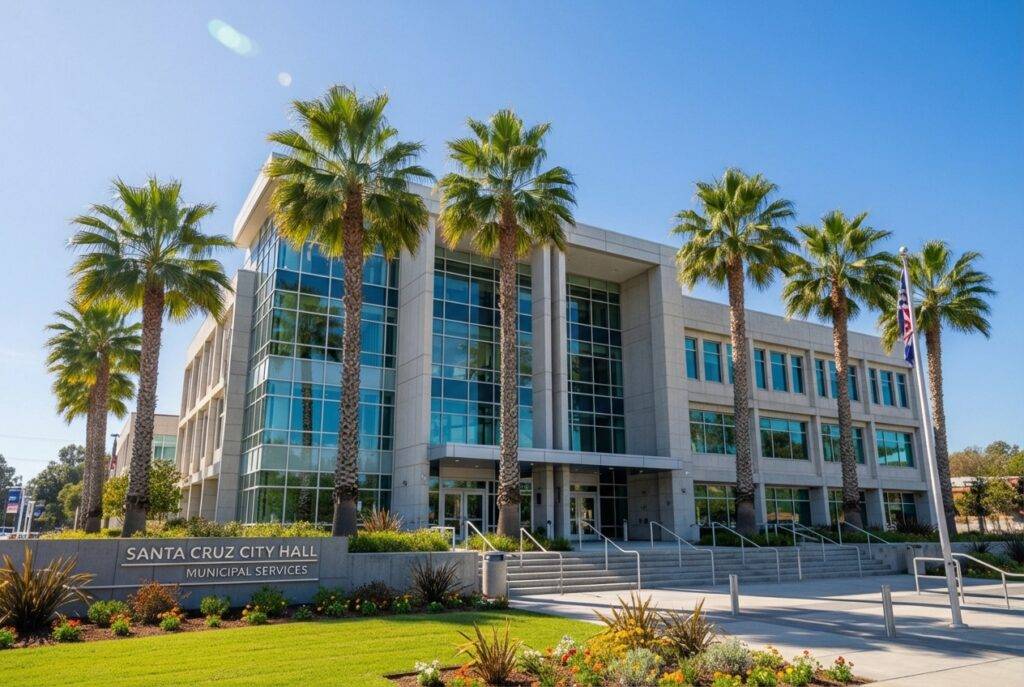
Why Understanding Your Local Planning Department Matters
The Santa Cruz planning department is the essential starting point for any development, business, or construction project in the city. It serves as the gatekeeper for ensuring that all projects, from building a backyard cottage to opening a downtown shop, align with the city’s long-term vision and safety standards. Engaging with this department isn’t just a bureaucratic step; it’s a critical part of a successful project strategy.
Ignoring or misunderstanding the department’s role can lead to significant and costly setbacks. Imagine signing a five-year lease for your dream retail space, only to discover the zoning prohibits your type of business. Or picture starting construction on a home addition and receiving a “Stop Work Order” because you lack the proper permits, resulting in fines and the potential need to demolish unapproved work. These are common pitfalls that proactive engagement with the planning department can help you avoid.
Quick Contact Information:
- Address: 809 Center Street, Room 101, Santa Cruz, CA 95060
- Phone: 831-420-5110
- Email: cityplan@santacruzca.gov
- Walk-in Hours: Monday – Thursday, 7:30 a.m. – 11:30 a.m.
- Phone Hours: Monday – Thursday, 8:00 a.m. – 4:00 p.m. (closed 12:00 p.m. – 1:00 p.m.)
- Online Portal: MyCityofSantaCruz.com
Navigating local government can be overwhelming. The Planning and Community Development Department guides homeowners, entrepreneurs, and developers through zoning requirements, permit applications, and development standards. Its mission is to improve quality of life, safety, and civic pride by providing responsive and efficient land use guidance. In practice, this means balancing new development with historic preservation, promoting sustainable building practices, and working to address the city’s housing needs while protecting its unique coastal environment.
This comprehensive guide breaks down how to interact with the department effectively. We will explore its key divisions, demystify the permit process for homeowners and businesses, outline the review stages for major development projects, and show you how to stay informed about planning activities in your neighborhood. Understanding these processes saves time and money, empowering you to move your project from concept to completion with confidence.
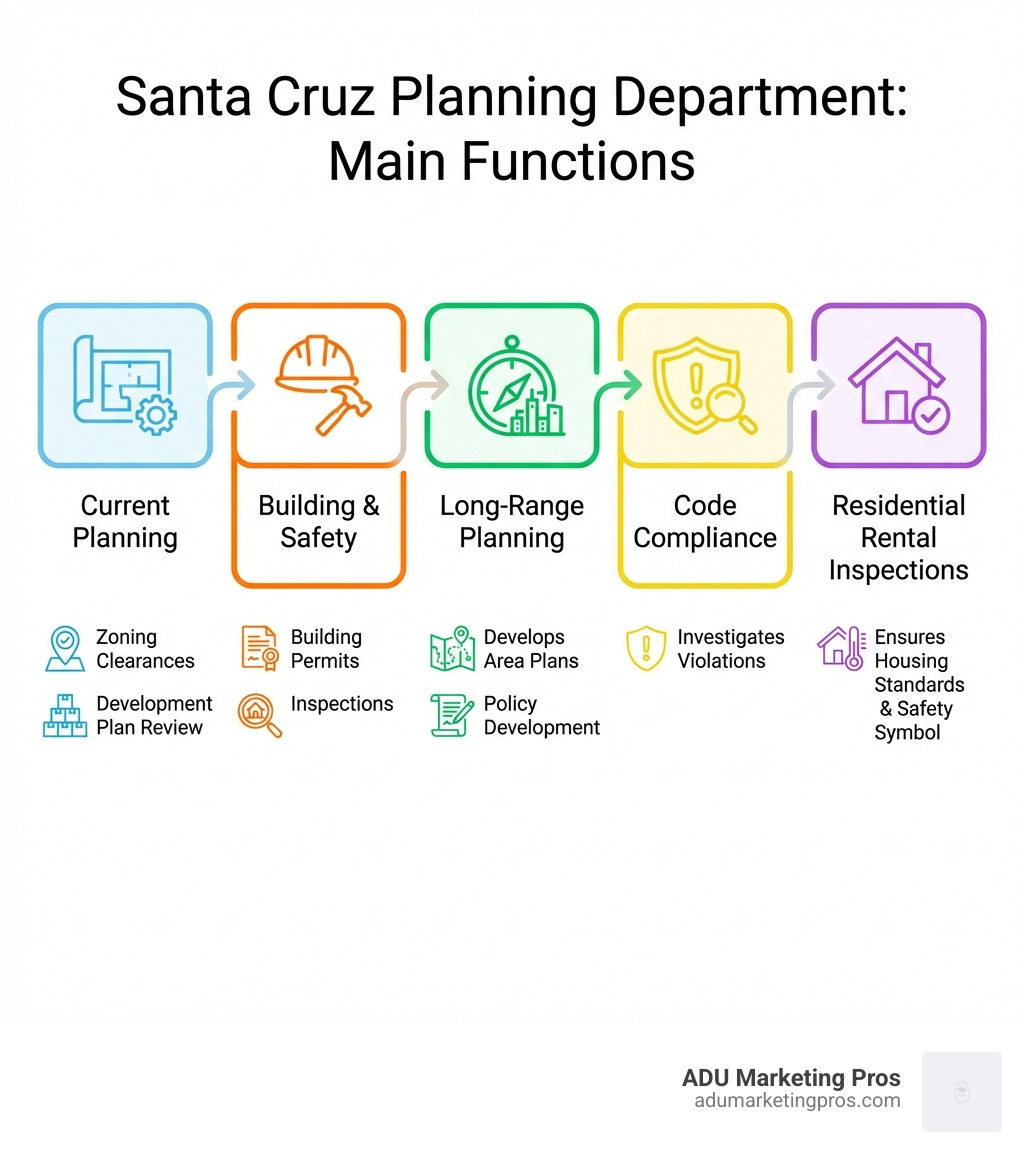
Simple guide to Santa Cruz planning department terms:
Understanding the Santa Cruz Planning and Community Development Department
The Santa Cruz Planning and Community Development Department is central to the city’s growth and preservation. Its mission is to improve quality of life, safety, and civic pride by providing clear guidance on land use and development, ensuring new projects align with the city’s vision. This involves a delicate balance: encouraging innovative housing solutions and economic vitality while safeguarding the natural beauty and historic character that define Santa Cruz.
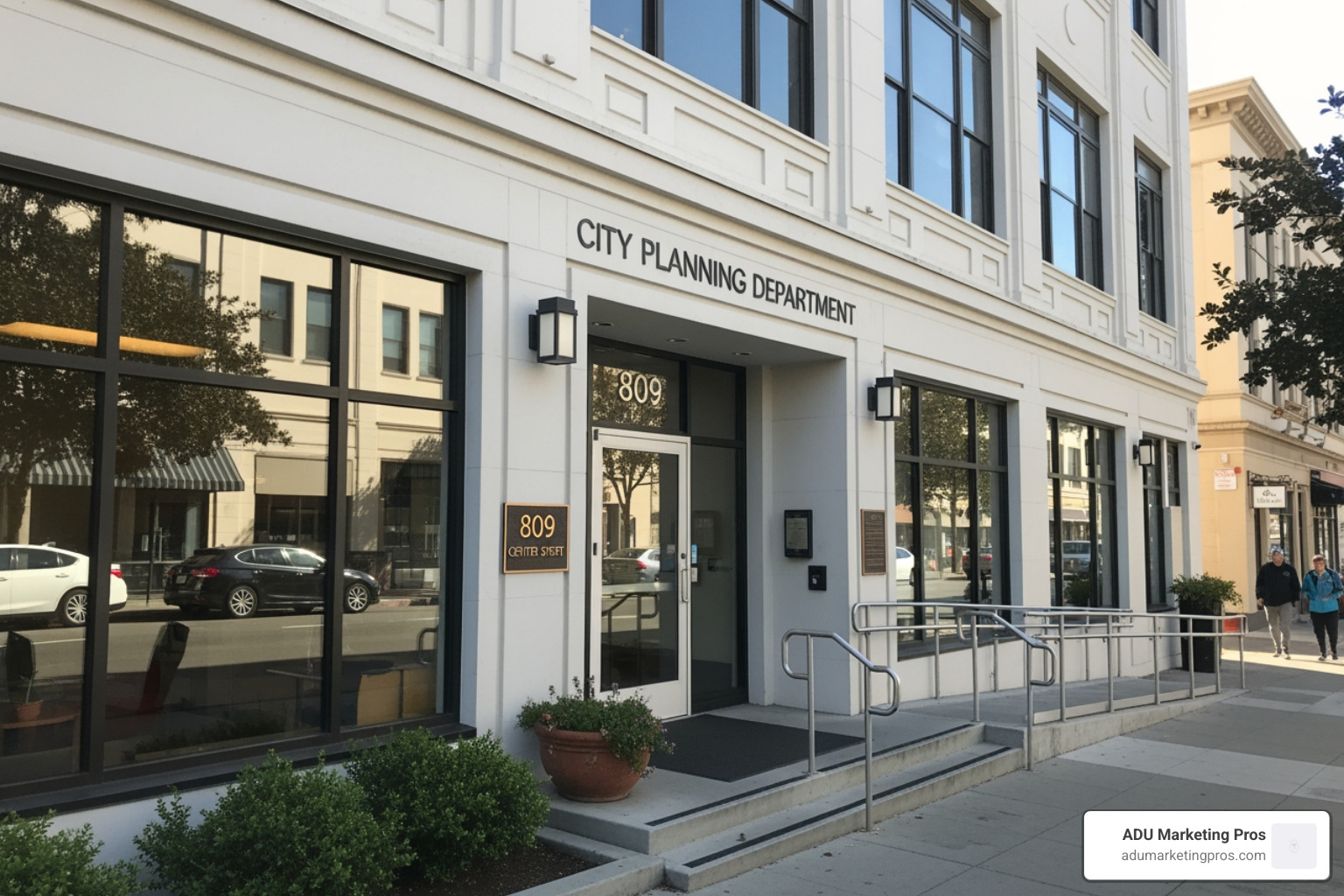
The department offers services ranging from answering a homeowner’s simple zoning question to reviewing complex, multi-year development plans. By managing this process, it helps shape a dynamic, resilient, and sustainable community. You can learn more about the department’s mission and strategic goals on their official website.
Key Departmental Divisions and Their Roles
The department is structured into several key divisions, each with a specialized function. Understanding which division to contact is the first step in navigating the process efficiently.
-
Current Planning Division: This is the public-facing frontline of the department. Planners in this division answer zoning questions, review development plans for compliance with the zoning ordinance, and process most land use applications. These include Administrative Use Permits for uses that need special consideration, Variances for minor exceptions to development standards, Design Permits for aesthetic review, and Coastal Permits for any development within the Coastal Zone.
-
Building & Safety Division: This division ensures that all construction is safe, accessible, and structurally sound. They are responsible for reviewing building plans and issuing a range of permits (Building, Electrical, Plumbing, Mechanical). Once a permit is issued, their inspectors visit the construction site at critical stages (e.g., foundation, framing, final) to verify that the work complies with the approved plans and the latest California Building Codes.
-
Long-Range & Policy Planning: This division looks to the future. Its planners develop and update the city’s foundational policy documents, including the General Plan, which is the blueprint for all future growth. They are heavily involved in creating the state-mandated Housing Element, which outlines how the city will meet its future housing needs. They also craft area-specific plans (like the Downtown Plan) and amend the zoning ordinance to reflect new state laws and community priorities.
-
Code Compliance: This team acts as the city’s neighborhood stewards, maintaining quality of life by investigating complaints about municipal code violations. Common issues include unpermitted construction, property maintenance issues (e.g., junk and debris), illegal signs, and zoning violations like running a prohibited business in a residential zone. Their process is typically complaint-driven, moving from investigation to a formal Notice of Violation and working with property owners to achieve compliance.
-
Residential Rental Inspections: This program is dedicated to ensuring safe and habitable living conditions in the city’s rental housing stock. The team inspects residential rental properties to verify compliance with health and safety standards, addressing issues like inadequate heating, faulty plumbing, pest infestations, and fire safety hazards.
City vs. County: Who Handles Your Project?
A critical first step that trips up many applicants is determining jurisdiction. Is your property located within the incorporated City of Santa Cruz, or is it in an unincorporated area of Santa Cruz County? The City and County are separate government entities with their own planning departments, zoning codes, permit fees, and approval processes. An address that says “Santa Cruz, CA” is not always within the city limits.
Misidentifying your jurisdiction can lead to weeks of wasted time and effort preparing an application for the wrong agency. We strongly advise you to verify your project address before starting. For properties in the unincorporated County, you must work with the Santa Cruz County Planning Department. For projects within the city limits, this guide applies.
To avoid confusion, use the official Zoning Lookup Tool provided by the City of Santa Cruz. This powerful tool allows you to input your address and instantly confirm if you are within city limits. It also provides your property’s specific zoning designation (e.g., R-1-5, C-C), which dictates what you can build, and identifies any special overlay zones, such as the Coastal Zone or Wildland Urban Interface, that may have additional regulations.
A Homeowner’s and Business Guide to Permits and Applications
For any home renovation, new construction, or business launch, the Santa Cruz planning department provides the essential framework for a safe, legal, and compliant project. While the array of permits and applications can seem daunting, understanding the key processes and online tools is the first step toward a smooth journey. This section breaks down the most common requirements for homeowners and entrepreneurs.
Navigating Online Portals and Services
The City of Santa Cruz has invested in several online platforms to streamline the application and review process, reducing the need for in-person visits.
-
MyCityofSantaCruz.com Portal: This is your primary online hub. You can use it to apply for business licenses, submit Zoning Clearance applications, and file for many other land use permits. The portal allows for document uploads and secure online payments, creating a centralized record of your application.
-
eTRAKiT System for Tracking: Transparency is key. Once you have a project or permit number, you can search the application status in eTRAKiT. This system provides real-time updates on review progress, scheduled inspections, and final approvals. It also serves as a public archive for a property’s permit history, which is invaluable for due diligence when buying a property.
-
ePlan Review for Projects Needing Plan Review: For projects that require detailed architectural or engineering plans (like new homes, additions, or major commercial remodels), this system allows for electronic submission. This eliminates the need for multiple paper copies and enables simultaneous review by different departments (Planning, Building, Public Works, Fire), significantly speeding up the process.
-
EZ Permit Service for Simple Projects: Not every project needs a full plan review. For straightforward, single-trade jobs like reroofing, water heater replacements, or simple electrical service upgrades, the EZ Permit service allows you to apply, pay, and often receive your permit entirely online, sometimes on the same day. Note that online payments typically include a small convenience fee.
Securing Your Zoning Clearance: A Step-by-Step Guide
Before you can obtain a business license, you must first secure a Zoning Clearance from the Santa Cruz planning department. This is a one-time review that confirms your specific business activity is a permitted use at your chosen location.
What is a Zoning Clearance?
It is the City’s official verification that your proposed business complies with the property’s zoning regulations regarding use, parking, and other standards. It is a mandatory prerequisite for getting a business license from the Finance Department.
How to Get Your Zoning Clearance:
-
Determine Your Clearance Type:
- Home Occupation Zoning Clearance: For businesses operated from a residence where no customers visit and there is no on-site signage (e.g., freelance writers, online consultants, Etsy sellers). The fee is typically around $137.
- Non-Home Occupation Zoning Clearance: For any business in a commercial, industrial, or other non-residential location. Crucially, you must verify the zoning with the planning department before signing a lease. Signing a lease for a location where your business is not permitted can result in catastrophic financial loss.
-
Gather Information: You will need the exact business address and a detailed, unambiguous description of all business activities (e.g., “retail sale of books and coffee,” not just “store”).
-
Apply Online or In-Person: The most efficient method is to apply online at MyCityofSantaCruz.com. Alternatively, you can visit the Planning Counter at the Santa Cruz planning department during walk-in hours.
-
Understand Potential Outcomes: For non-home occupations, the planner’s review will result in one of three findings:
- Principally Permitted: Your business is allowed in the zone by right. You can proceed to the Finance Department.
- Permitted with a Use Permit: Your business type is allowed, but only after a more detailed review process (a Use Permit), which involves public notification, additional fees, and potential conditions of approval.
- Prohibited: Your business is not allowed in this zone. You must find a different location.
-
Pay Fees: Fees vary based on the situation.
- New Use: ~$315 for a brand-new business or a change in business type at an existing location.
- Same Use/Ownership Change: ~$81 if you are taking over a space and continuing the exact same type of business (within 6 months of the prior business closing) or for a simple change in ownership.
-
Parking and Signs: The review will also confirm that there is adequate on-site parking for your commercial use. Note that any new business signs will require a separate Design Permit.
-
Final Step: Once you receive your approved Zoning Clearance certificate, you can take it to the Finance Department to apply for and receive your business license.
For more detailed guidance, the City’s Economic Development site is an excellent resource: www.choosesantacruz.com/resources/steps/permit/planning.
Other Common Permits and Reviews
Beyond zoning clearances, the Santa Cruz planning department oversees many other specific permits.
-
Sign Permit Process: A sign permit is required for nearly all new or altered business signs to ensure they meet size, location, and design standards. The City has a trial “Over-the-Counter Sign Permit Process” for same-day issuance on simple, qualifying projects. Always check the GIS map for area-specific requirements (e.g., Downtown, historic districts) and submit a hardcopy application to the Planning Counter.
-
Event Permitting Requirements: Public events like street fairs, festivals, or marathons require permits to manage public safety, traffic control, and noise impacts. The planning department specifically reviews event plans for compliance with the City’s Noise Regulations and rules for alcohol service. Organizers should begin this process months in advance.
-
Coastal Development Permits (CDPs): Any development project located within the designated Coastal Zone—a significant portion of the city—requires a CDP. This permit involves an additional layer of review to ensure the project is consistent with the California Coastal Act and the City’s Local Coastal Program, focusing on protecting coastal access, public views, and sensitive habitats.
-
Heritage Tree Removal Permits: Santa Cruz values its urban forest. A permit is required to remove or perform major alterations to a designated “Heritage Tree.” An arborist’s report is typically required to justify the removal, and mitigation measures, such as planting replacement trees, are often a condition of approval.
For Developers: Navigating Major Projects and Reviews
For developers, architects, and builders undertaking large-scale residential or commercial projects, the process with the Santa Cruz planning department is more complex, involving preliminary reviews, detailed design standards, and multiple layers of approval. Understanding these advanced processes is key to a project’s feasibility and timeline.

Preliminary Project Reviews: SB330 and Pre-Application
Before committing to the expense of a full formal application, developers can use preliminary reviews to gain valuable feedback and secure development rights.
-
SB330 Preliminary Review: Enacted under the Housing Crisis Accountability Act, this is a powerful tool for housing developers. Submitting an SB330 preliminary application “vests” the project to the specific development standards, fees, and ordinances in effect at the time of submission. This provides critical certainty, protecting the project from being derailed by subsequent changes in local regulations or fee increases during the lengthy review process. It is a strategic first move for any qualifying housing project.
-
Standard Pre-application Review Process: This less formal review is ideal for any type of complex project (commercial, mixed-use, or residential) seeking early, high-level feedback. The developer can present a conceptual plan to a team of staff from multiple city departments (Planning, Public Works, Fire, Building & Safety) in a single meeting. This consolidated feedback helps identify major roadblocks, clarifies application requirements, and can significantly streamline the subsequent formal application.
How to Apply for a Preliminary Review:
The process typically begins by completing the appropriate review application form (available on the department’s website) and submitting it via the online “Application Inquiry form.” A planner will then be assigned and will provide instructions for uploading the required documents and paying the initial fees.
Accessory Dwelling Units (ADUs) in Santa Cruz
Accessory Dwelling Units (ADUs) are a critical component of the city’s housing strategy, and the Santa Cruz planning department has streamlined processes to facilitate their development in line with state and local laws.
Understanding the ADU regulations overview is crucial. Key city-specific rules include size limitations (e.g., up to 850 sq. ft. for a one-bedroom ADU, 1,000 sq. ft. for two or more bedrooms), height limits (typically 16 feet for a single-story ADU), and required setbacks from property lines (often as little as 4 feet for side and rear yards). The city also allows for Junior Accessory Dwelling Units (JADUs) up to 500 sq. ft. created within the existing walls of a primary residence.
The ADU permit process is ministerial, meaning if the plans meet all objective standards, the permit must be approved within 60 days. This eliminates subjective review and public hearings. You’ll need to understand the specific ADU building requirements, which cover everything from energy efficiency to fire safety sprinklers.
To simplify the process, many homeowners explore pre-approved ADU plans in Santa Cruz. These pre-reviewed designs can significantly reduce plan check times. It’s also important to remember the strong influence of state laws, such as the comprehensive California ADU guidelines, which set the overarching framework. For example, state law prohibits local agencies from requiring replacement parking when a garage is converted to an ADU.
For those in Santa Cruz County (outside city limits), there’s even an ADU Incentives Program offered in partnership with nonprofit Hello Housing, providing free project management support. While this is a County program, it reflects the region’s commitment to expanding housing options.
Objective Design Standards for Multifamily Housing
To streamline the approval of much-needed housing, Santa Cruz has implemented Objective Design Standards for all new multifamily and mixed-use housing projects. These standards replace subjective design guidelines with clear, measurable, and uniform criteria for architectural design, site layout, and neighborhood compatibility.
By setting objective benchmarks, the Santa Cruz planning department provides developers with a clear and predictable path to approval. If a project complies with all standards, its design cannot be a basis for denial. Examples of these standards include:
- Articulation: “Building facades longer than 50 feet must be broken up by a projection or recess of at least 2 feet in depth.”
- Fenestration: “Street-facing ground floor facades must have transparent windows or doors covering at least 40% of the wall area.”
- Materials: “A minimum of three complementary exterior materials must be used on the primary facade.”
These standards aim to expedite the review process, reduce subjectivity, and ensure that new developments contribute positively to the urban fabric while meeting state housing goals.
Staying Informed: Tracking Projects and Recent Updates from the Santa Cruz planning department
Transparency and public engagement are vital to the planning process. The Santa Cruz planning department provides several powerful tools and resources for residents, business owners, and developers to stay informed about active projects, policy changes, and opportunities for involvement.
How to Track Current and Past Planning Projects
Keeping tabs on development in your neighborhood or across the city is easier than ever with these online resources:
-
Active Planning Applications and Status Page: For a high-level overview, visit this page on the city’s website. It often features a map and list of projects currently under review, with links to project details.
-
Searching Project Status in eTRAKiT: For detailed, real-time information, use a project address or application number to search the application status in eTRAKiT. You can see the current review status (e.g., “Application Accepted,” “Corrections Required,” “Ready to Issue”), review comments from city staff, and see scheduled inspection dates and results.
-
Reviewing the Significant Projects List: The department maintains a list of large-scale or high-interest projects (e.g., those with 25+ housing units, major commercial centers, or significant policy implications like the Downtown Library and Affordable Housing project). This list, typically found on the main planning pages, provides detailed information and staff reports for projects of citywide interest.
-
Accessing Monthly Submitted Application Reports: For a comprehensive look at development trends, the department publishes monthly reports listing all planning applications submitted to the city. This is an excellent resource for tracking the volume and type of new proposals.
Recent News, Code Changes, and Announcements from the Santa Cruz planning department
Planning is a dynamic field, and staying abreast of the latest regulations is crucial for anyone involved in a project.
-
New Building Code Cycles: The California Building Standards Code is updated every three years. A new building code cycle begins Jan. 1, 2026. This is a critical deadline. To be reviewed under the current 2022 Code, a complete building permit application must be deemed complete and accepted by the city by a specific date (typically early December of the preceding year). Applications submitted after this date will be subject to the new, often more stringent, 2025 code requirements, which can affect structural, energy, and accessibility designs.
-
Recent Ordinance Updates: The City Council regularly updates the zoning ordinance to comply with new state laws or implement local policies. Recent examples include significant changes to on-site parking requirements for projects near major transit stops (often reducing or eliminating them) and updates to the city’s inclusionary housing ordinance, which requires new developments to include a certain percentage of affordable units.
-
Draft Ordinances and Policy Development: Keep an eye on the agendas for the Planning Commission and City Council. They often review draft ordinances (e.g., for emerging technologies like Battery Energy Storage Systems or new rules for sidewalk vending) that signal future policy directions.
Public Participation and Getting Involved
Your voice is a crucial part of the planning process in shaping Santa Cruz.
-
Public Meetings Schedule: You can find schedules, agendas, and staff reports for Planning Commission hearings and Zoning Administrator meetings on the city’s website. The Planning Commission is a citizen body that decides on major projects and policy recommendations, while the Zoning Administrator is a staff member who decides on smaller projects like variances and use permits.
-
How to Provide Public Comment and Feedback: All public meetings offer an opportunity for public comment. You can speak in person, often for 2-3 minutes, or submit written comments via email before the meeting. For effective comments, focus on the project’s consistency with the zoning code and General Plan, rather than personal opinions. Be specific and constructive.
-
Subscribing to News Announcements: The most direct way to stay informed is to subscribe to news announcements from the department and the city. This will deliver timely updates on new ordinances, public hearing notices, and important deadlines directly to your inbox.
Key Contacts and Resources
Having the right contact information and knowing which online tool to use can make all the difference in your project’s success. This section consolidates the most important contacts and resources for the Santa Cruz planning department.
Contacting the Santa Cruz planning department
For direct assistance, it’s best to use the appropriate channel for your inquiry. This ensures a faster and more accurate response.
- Physical Address: 809 Center Street, Room 101, Santa Cruz, CA 95060. This is the location of the public Planning Counter.
- Main Phone: 831-420-5110. Best for general inquiries or if you need to be directed to a specific planner or division.
- General Email: cityplan@santacruzca.gov. A good option for non-urgent, general questions.
- Walk-in Counter Hours: Monday – Thursday, 7:30 a.m. – 11:30 a.m. This is the ideal time for in-person consultations on simple projects, asking zoning questions, or submitting over-the-counter applications like sign permits.
- Phone Hours: Monday – Thursday, 8:00 a.m. – 4:00 p.m. (closed for lunch 12:00 p.m. – 1:00 p.m.). Planners are available by phone during these hours.
For Specific Inquiries:
To expedite your request, use these direct email addresses:
- General Planning/Counter Questions: planningcounter@santacruzca.gov (This is often the best starting point for any new project inquiry).
- Building Permits & Inspections: permits@santacruzca.gov (For questions about building codes, inspection scheduling, or the status of a building permit application).
- SB9 Land Divisions: cbusenhart@santacruzca.gov (Contact Public Works for inquiries related to urban lot splits under Senate Bill 9).
- Historic Preservation: Contact the Planning Department and ask for the Historic Preservation Coordinator for questions about projects involving historic properties or districts.
Essential Online Resources and Business Support
The Santa Cruz planning department and its city partners provide a powerful suite of online tools and support systems designed to empower applicants.
- Zoning Lookup: This should always be your first step. Before you buy property or sign a lease, use this tool to confirm the property is in the city and to identify its zoning designation and any overlays (like Coastal or Historic) that will affect your plans.
- MyCityofSantaCruz.com: The central portal for submitting online applications for zoning clearances and business licenses, paying fees, and uploading required documents.
- eTRAKiT: The permit tracking system. Use this to monitor the real-time status of your application, see review comments, and check inspection results. It’s a vital tool for managing your project’s timeline.
- GIS Maps: The city’s public GIS (Geographic Information System) map is a power-user tool. It allows you to visualize property details, zoning boundaries, flood zones, heritage trees, and specific plan areas whose rules may supersede general ordinances.
For entrepreneurs and business owners, the City’s Economic Development Department and its Choose Santa Cruz initiative offer comprehensive support. They provide one-on-one assistance, step-by-step guides for navigating the permitting process, and resources to help new and existing businesses thrive in the local economy.
Conclusion
The Santa Cruz Planning and Community Development Department is not a hurdle to be overcome, but a crucial partner in the process of shaping the city’s built environment. By understanding its structure, familiarizing yourself with the key permit processes, and utilizing the wealth of available online resources, you can navigate your projects more efficiently, avoid costly mistakes, and contribute positively to the community’s thoughtful growth. Whether you are a homeowner planning a small addition, an entrepreneur launching a new business, or a developer embarking on a large-scale housing project, proactive and informed engagement with the department is the cornerstone of success.
This guide provides the foundational knowledge to get you started on that path. Remember to begin with due diligence—verifying jurisdiction and zoning—before making any financial commitments. For those embarking on an ADU project, the journey involves a unique set of state and local regulations that offer incredible opportunities. ADU Marketing Pros specializes in helping construction and architecture firms connect with homeowners ready to build, ensuring that professional expertise is at the forefront of every project.
To dive deeper into one of the most popular and impactful home development projects in the area, we invite you to explore our comprehensive guide on pre-approved ADU plans in Santa Cruz.