
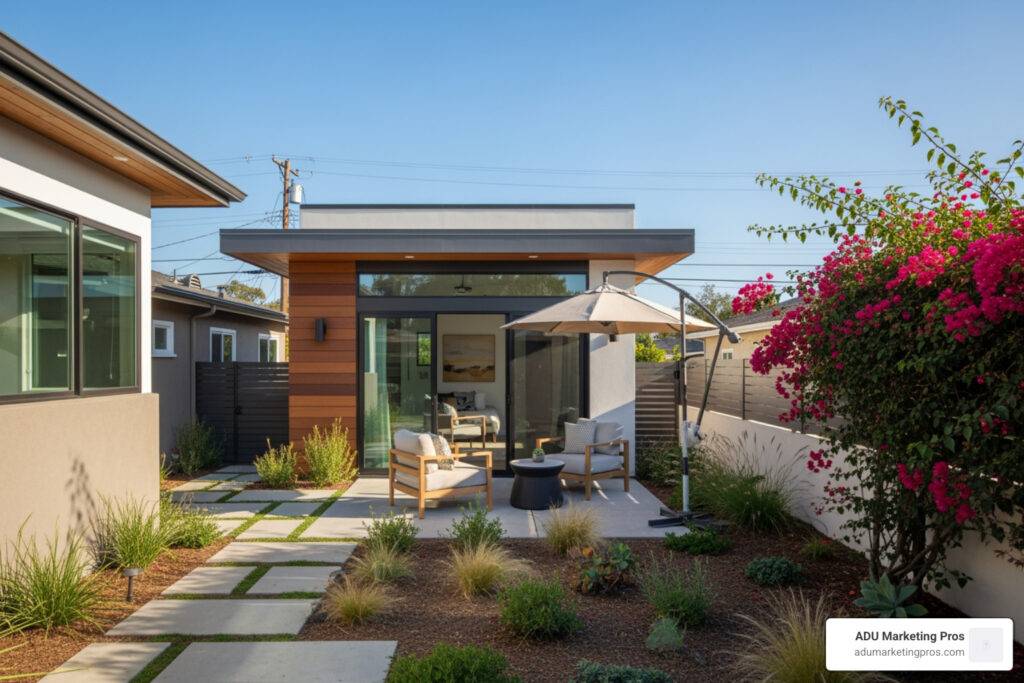
Unlocking Your Property’s Potential: A Complete Guide to ADU Designs in San Diego
In the face of San Diego’s notoriously competitive housing market and rising cost of living, homeowners are discovering a powerful tool hidden in plain sight: the Accessory Dwelling Unit (ADU). The adu designs San Diego residents are now embracing represent more than just new construction; they are strategic financial assets, flexible family housing solutions, and a direct response to the region’s housing shortage. Whether you envision a backyard cottage for rental income, a private suite for aging parents, or a dedicated home office, understanding your design options is the critical first step toward unlocking your property’s full potential.
Quick Answer: Your ADU Design Options in San Diego
- Detached ADUs: Standalone, private units built in your backyard (up to 1,200 sq ft).
- Attached ADUs: Units connected to your main home, sharing a wall (up to 50% of the primary dwelling’s size).
- Garage Conversions: A cost-effective method of transforming an existing garage into a functional living space.
- Junior ADUs (JADUs): Compact units (under 500 sq ft) created within the existing walls of your home, often from a spare bedroom.
- Pre-Approved Plans: City-vetted designs that can potentially speed up permitting but offer limited customization.
- Custom Designs: A bespoke approach tailored to your specific lot, lifestyle, and aesthetic goals, offering maximum flexibility and value.
Building an ADU is a significant undertaking, but the rewards are substantial. These units can generate over $2,000 per month in rental income, provide stable housing for loved ones, and increase your property’s value by as much as 30-50%. However, the path from concept to completion requires careful navigation of city and county regulations, a clear understanding of costs, and a well-chosen design and construction team.
Fortunately, recent state and local law changes have made the process more accessible than ever. Thousands of San Diego homeowners have already successfully built ADUs, creating a clearer path for those who follow. This comprehensive guide will walk you through every essential aspect of adu designs san diego, covering everything from the nuances of different design types and navigating the permitting maze to budgeting for your build and calculating your long-term return on investment.
Relevant articles related to adu designs san diego:
Decoding ADU Design Options: Pre-Approved vs. Custom Plans
When embarking on your ADU journey, the first major decision revolves around the type of unit and the design approach. The adu designs san diego homeowners can choose from are diverse, each with unique benefits, costs, and regulatory considerations. Your final choice will be a balance between your property’s constraints, your financial goals, and your personal vision.
First, let’s break down the four primary types of ADUs:
- Detached ADUs: Often called backyard cottages or granny flats, these are standalone structures built separately from the main house. They offer the highest degree of privacy for both the main home residents and the ADU occupants, making them highly desirable for long-term rentals. This separation often commands higher rent and adds the most significant boost to property value.
- Attached ADUs: These units are built as an addition to the primary residence, sharing at least one wall. Attached ADUs can be a more cost-effective option as they can sometimes tie into the main home’s existing utilities and foundation more easily. They are an excellent solution for creating an in-law suite or a connected but separate living space for family members.
- Garage Conversions: This is one of the most popular and cost-effective ways to add an ADU. By utilizing the existing foundation, walls, and roof of a garage, you can save significantly on structural costs. It’s a fast track to creating a livable studio or one-bedroom unit, though it does mean sacrificing covered parking.
- Junior Accessory Dwelling Units (JADUs): A JADU is a specialized unit created within the existing, habitable footprint of a single-family home. Limited to 500 square feet, they must have their own external entrance and an efficiency kitchen. JADUs are the most affordable option and are perfect for carving out a small rental space or a private room for a student or single person. Note that in most cases, the property owner must reside in either the main home or the JADU.
Once you’ve identified the best ADU type for your lot, you face the next critical choice: using a pre-approved plan or commissioning a custom design.
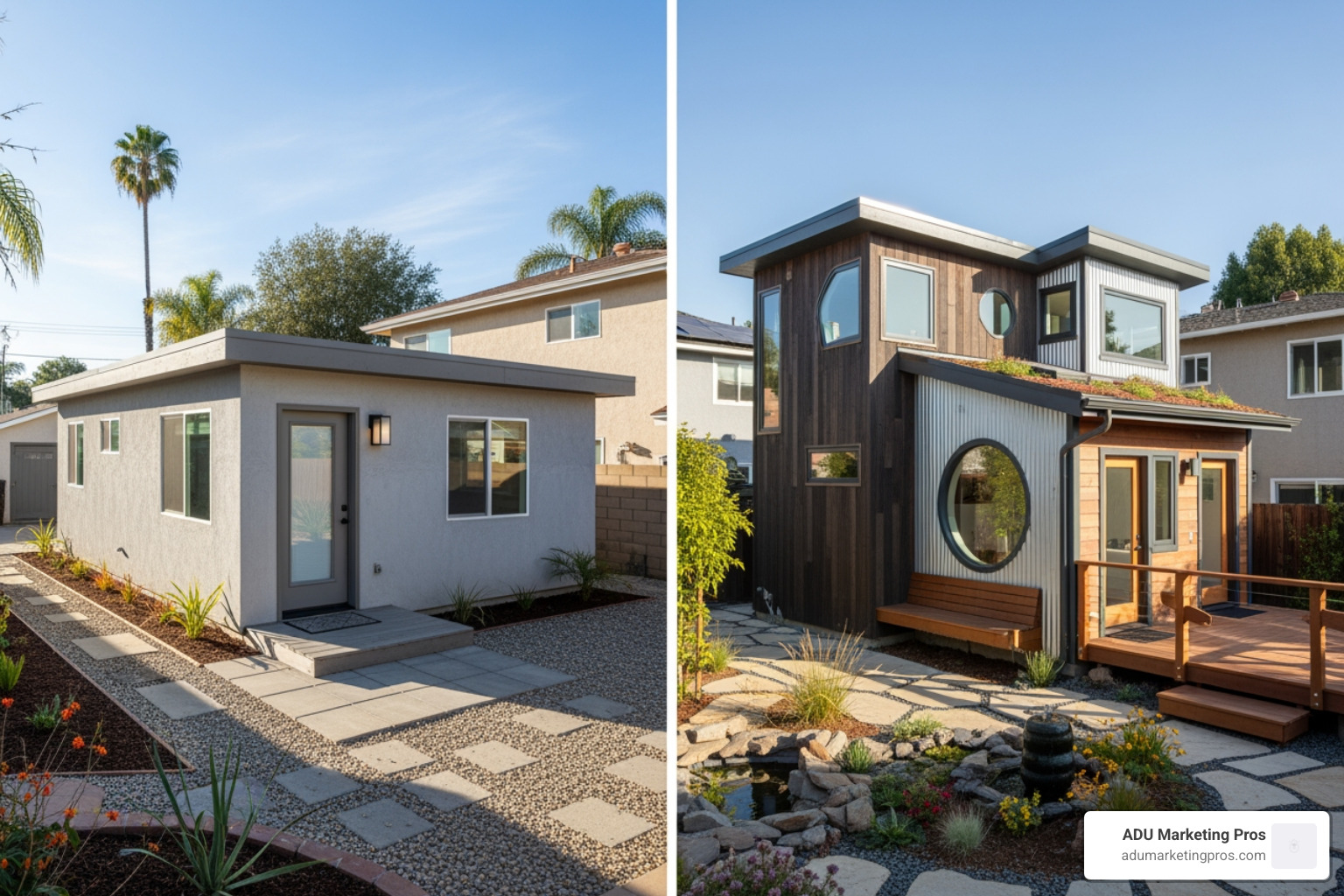
The Speed and Savings of Pre-Approved ADU Plans
To encourage ADU construction, many municipalities in San Diego County, including the City of San Diego itself, offer a portfolio of pre-approved or \”permit-ready\” ADU blueprints. The appeal is clear:
- Reduced Design Fees: Since the architectural design is complete, you can save thousands on initial design fees.
- Potentially Faster Permitting: These plans are pre-vetted for code compliance, which can lead to an expedited review process at the building department.
- Simplified Decision-Making: It removes the complexity of starting a design from scratch.
However, the promise of speed and savings comes with significant trade-offs. These plans are only about 80-85% complete. You will still need to hire professionals to create a site-specific plan, a Title 24 energy report, and structural calculations tailored to your property. The biggest drawback is the lack of flexibility. Any modification—even changing a window or door—can void the pre-approved status, sending your project back into the standard review queue and incurring redesign fees. Furthermore, many of these plans are not \”value-engineered.\” They may specify materials or construction methods that are inefficient or expensive, potentially increasing your construction budget, which accounts for 90-95% of the total project cost. A small saving on plans could lead to a much larger overage during the build.
For more details, see Pre-Approved ADU Plans San Diego or explore examples from San Diego County’s Standard ADU Building Plans.
The Freedom and Value of Custom ADU Designs San Diego
While it requires a larger upfront investment in design fees, a custom adu design san diego offers unparalleled control and often results in a better long-term investment. An experienced architect or design-build firm will create a home that is perfectly suited to you and your property.
Key advantages include:
- Site-Specific Optimization: A custom design works with your lot’s unique topography, orientation, and existing features. This is crucial for challenging sites (e.g., sloped lots, irregular shapes) and for maximizing views, natural light, and privacy.
- Tailored to Your Needs: The layout, room sizes, and features are designed around your specific goals, whether it’s creating a high-income rental, a comfortable home for family, or a multi-functional live/work space.
- Cohesive Aesthetics: The design can be crafted to seamlessly match the architectural style of your main home or to create a bold, new statement piece on your property.
- Value Engineering: This is a key benefit of a good custom design process. Your design-build team can specify standard-sized materials, efficient construction techniques, and smart layouts that actively reduce building costs, often offsetting the higher initial design fee.
The custom design process is a collaborative effort to translate your vision into a buildable reality. While design costs may range from $8,000 to $13,000 or more, the result is a space that is more functional, beautiful, and ultimately, more valuable.
Navigating San Diego’s ADU Rules and Regulations
Successfully building an ADU in San Diego hinges on a thorough understanding of local zoning and building codes. While California has passed state laws to streamline ADU development, local jurisdictions—including the City of San Diego and the various other municipalities within San Diego County—still have specific rules that guide what you can build. Adhering to these regulations from the outset is essential for a smooth permitting process and ensures your final project is safe, legal, and a true asset. For a comprehensive overview, refer to our guide on San Diego ADU Laws.
Key Zoning and Building Codes to Know
Regulations for adu designs san diego homeowners must follow can be complex. Here’s a breakdown of the most important rules:
Setbacks
Setbacks are the required distances between your ADU and your property lines. For newly constructed detached ADUs, state law generally mandates a minimum of 4-foot setbacks from the side and rear property lines. This provides space for maintenance access and fire safety. Converted structures, like a garage that is already located on a property line, can often maintain their existing footprint without needing to meet new setback requirements.
Height Limits
In most zones, a detached, single-story ADU can be up to 16 feet high. If your property is within a half-mile of a major transit stop, you may be allowed a height of up to 18 feet. For two-story ADUs, which are sometimes permissible, the limit may be 25 feet. Attached ADUs are generally limited to the height of the primary dwelling.
Lot Coverage and Size Limits
State law provides a crucial exemption: an ADU of up to 800 square feet is generally exempt from local lot coverage ratio calculations. This is a major advantage for homeowners on smaller lots who might otherwise be unable to build. The maximum size for any ADU is typically 1,200 square feet for a detached unit, while an attached ADU can be up to 50% of the size of the primary residence, not to exceed 1,200 square feet.
Parking Requirements
Parking rules have been significantly relaxed. In most cases, no additional parking is required for an ADU, especially if your property is located within a half-mile of public transit, in a designated historic district, or when the ADU is part of a garage conversion. Always verify the specific requirements for your address.
The City of San Diego’s ADU Bonus Program
Unique to the City of San Diego is an innovative incentive program. If a homeowner agrees to deed-restrict their ADU as affordable housing for low- or moderate-income residents for a set period (typically 10-15 years), the city may allow them to build an additional, market-rate \”bonus\” ADU on the same property. This program is a powerful tool for maximizing density and rental income for property owners willing to contribute to the city’s affordable housing stock.
The Permitting Process Simplified
Getting your building permit is a major milestone. The process requires submitting a comprehensive package of documents to your local building department. A typical submission includes:
- Feasibility Study: An initial analysis to confirm your project is viable based on zoning, utilities, and site constraints.
- Architectural Drawings: A complete set of plans showing floor plans, elevations, cross-sections, and construction details.
- Site Plan: A detailed map of your property showing the location of the ADU, property lines, setbacks, drainage, and utility connections.
- Structural Calculations: Engineering reports that verify the ADU’s structural integrity, including foundation and framing.
- Title 24 Energy Report: A mandatory report demonstrating that the ADU’s design meets California’s energy efficiency standards.
- Utility Plans: Detailed schematics for connecting to water, sewer, electrical, and gas lines.
- Permit Application Forms: The official paperwork required by the city or county.
Once submitted, the plans enter a review phase. In the City of San Diego, this can take up to 60 business days for the initial review. Any errors or omissions in your package can lead to corrections and significant delays. Working with an experienced design-build firm that is familiar with local requirements is the best way to ensure your application is complete and accurate, minimizing costly and frustrating delays.
Budgeting Your Build: Costs and ROI in the San Diego Market
Building an ADU is a major financial investment, but in a high-cost market like San Diego, it’s an investment with the potential for an exceptionally strong return. A clear understanding of the costs involved and a realistic assessment of your Return on Investment (ROI) are fundamental to successful financial planning for your project. The final price tag for adu designs san diego can vary widely, so it’s crucial to know what to expect.

What Does an ADU Cost in San Diego?
Your total ADU cost is a combination of soft costs (planning, design, permits) and hard costs (construction, labor, materials). While garage conversions are the most affordable, new construction offers more flexibility.
- Soft Costs: These typically make up 10-15% of your total budget. Expect to pay between $8,000 and $20,000 for architectural drawings, structural engineering, the Title 24 report, and other necessary documents. Permit and impact fees can add another $2,000 to $10,000+, depending on your jurisdiction and the size of the unit.
- Hard Costs: This is the bulk of your investment (85-90%) and covers all aspects of construction. Key cost drivers include the size and type of ADU, the complexity of the design, the quality of finishes, and site-specific conditions like the slope of your lot or the distance to utility hookups.
Table: Estimated Total Costs for ADUs in San Diego
| ADU Size (sq ft) | Type | Estimated Cost Range |
|---|---|---|
| 300 | Studio | $120,000 – $175,000 |
| 500 | 1-Bedroom | $180,000 – $250,000 |
| 800 | 2-Bedroom | $250,000 – $350,000 |
| 1,000 | 2/3-Bedroom | $330,000 – $465,000 |
| 1,200 | 3/4-Bedroom | $415,000 – $580,000 |
Note: These are 2023 estimates for planning purposes. Actual costs will vary based on your specific project. Always obtain detailed quotes from qualified contractors.
Several financing options are available to fund your ADU. The most common are home equity loans (HELOCs), cash-out refinancing of your existing mortgage, and renovation or construction loans. Additionally, homeowners should investigate government assistance. The CalHFA ADU Grant Program can provide up to $40,000 to reimburse pre-development and non-recurring closing costs. For income-qualified homeowners, the San Diego Housing Commission’s ADU Finance Program offers further support.
Calculating Your ADU’s Powerful Return on Investment (ROI)
An ADU is an income-generating, value-adding asset. The ROI for a San Diego ADU is often remarkably high, far outpacing traditional investments.
- Rental Income: A well-designed ADU can easily generate $2,000 to $3,500+ in monthly rent, creating a consistent cash flow that can cover the project’s financing costs and provide additional income. For market rates, explore ADU Rentals San Diego.
- Property Value Increase: Adding a legal, permitted ADU can increase your property’s appraised value by 30-50% or more. A $300,000 investment in an ADU could add $400,000 to $500,000 to your home’s value upon completion.
- Financial Example: Consider a $250,000 one-bedroom ADU financed with a home equity loan. If it rents for $2,800/month ($33,600/year), it can easily cover the mortgage payments and generate positive cash flow. Over the long term, as the loan is paid down and rents rise, the return grows exponentially. This doesn’t even factor in the significant increase in the underlying property value.
- Flexibility: Beyond pure financials, an ADU provides invaluable flexibility. It can house aging parents, saving on expensive assisted living costs, or provide a landing spot for adult children, fostering multi-generational living.
When you combine rental income, property value appreciation, and personal use flexibility, the total return on an ADU makes it one of the smartest financial decisions a San Diego homeowner can make.
Finding Your Perfect Fit: Choosing a Floor Plan and Contractor
The success of your ADU project lies in the details of its design and the quality of its execution. Selecting a floor plan that maximizes functionality and choosing a reputable contractor are the two most critical decisions you’ll make during the process. When evaluating adu designs san diego, the focus should always be on creating a space that is efficient, comfortable, and tailored to its intended purpose.
Popular ADU Designs San Diego Homeowners Love
While the possibilities are endless with custom design, certain configurations have proven to be exceptionally popular and effective in the San Diego market.
- Studio ADUs (300-500 sq ft): Perfect for smaller lots, these efficient units are ideal for a single renter, a guest suite, or a quiet home office. Smart design is key, incorporating features like Murphy beds, built-in storage, and open-concept layouts to make the space feel larger than its footprint.
- One-Bedroom ADUs (500-800 sq ft): This is often the sweet spot for rental units, appealing to couples or single professionals. A successful one-bedroom design provides a clear separation between public (living/kitchen) and private (bedroom) spaces. A great room concept combined with large windows or a sliding glass door can create an expansive, light-filled living area.
- Two-Bedroom ADUs (800-1,200 sq ft): Excellent for small families, roommates, or as a high-income rental property. These larger units allow for more complex layouts, potentially including a second bathroom, a dedicated laundry area, and more storage. They are a fantastic solution for multi-generational living.
- Three- and Four-Bedroom ADUs (up to 1,200 sq ft): By using efficient design, it’s possible to create a family-sized home within the 1,200 sq ft limit. These larger ADUs can serve as a primary residence for a family, offering a more affordable path to homeownership in a desirable neighborhood.
Regardless of size, the best adu designs san diego has to offer share common traits: open layouts that maximize perceived space, abundant natural light, clever storage solutions, a full kitchen (a legal requirement), and a strong connection to the outdoors through a patio or deck.
Matching Your ADU to San Diego’s Architectural Styles
A custom ADU gives you the opportunity to complement your existing home and neighborhood. Popular styles in San Diego include:
- Spanish/Mediterranean: Characterized by stucco walls, red tile roofs, and arched windows, this style is a timeless choice that fits beautifully in many San Diego neighborhoods.
- Craftsman: With its emphasis on natural materials, covered front porches, and detailed woodwork, a Craftsman-style ADU can add a warm, classic charm to your property.
- Contemporary/Modern: Featuring clean lines, large expanses of glass, flat or shed roofs, and a minimalist aesthetic, modern ADUs make a bold statement and are excellent for maximizing light and indoor-outdoor living.
Selecting the Right Team: The Design-Build Advantage
Your choice of contractor will have the single biggest impact on your project’s timeline, budget, and final quality. While a traditional approach involves hiring an architect and then bidding the plans out to general contractors, the design-build model has become increasingly popular for ADUs. In this model, one firm is responsible for the entire project, from initial concept to final construction.
The advantages are significant:
- Single Point of Accountability: There’s no finger-pointing between the designer and the builder. One team is responsible for the entire outcome.
- Streamlined Process: Communication is simplified, and the transition from design to construction is seamless, leading to faster project timelines.
- Budget Cohesion: The construction team is involved from the earliest design phases, ensuring the plans align with your budget. This “value engineering” process prevents costly redesigns down the line.
- Specialized Expertise: Firms that specialize in ADUs have an intimate knowledge of local San Diego regulations, common pitfalls, and cost-saving strategies.
When vetting potential partners, go beyond the initial price quote. Ask detailed questions: \”How many ADUs have you completed in my city?\” \”Can I visit a completed project and speak with the homeowner?\” \”What does your project management and communication process look like?\” A proven track record and transparent process are more valuable than the lowest bid. For more insights, check out our guide on ADU Contractors San Diego.
Frequently Asked Questions about ADU Designs in San Diego
We understand that building an ADU involves many questions. Here, we address some of the most common inquiries we hear from San Diego homeowners to help clarify the process.
What is the smallest and largest ADU I can build in San Diego?
State law allows for an ADU of at least 150 square feet (the size of an \”efficiency unit\”), though some local ordinances in San Diego County may have a slightly higher minimum, such as 220 square feet. On the other end of the spectrum, the maximum size for a newly constructed detached ADU is typically 1,200 square feet. An attached ADU can generally be up to 50% of the main home’s square footage, but not exceeding 1,200 square feet. It’s always best to confirm the specific size limitations for your zone with your local planning department.
Do I need a full kitchen in my ADU?
Yes. To be classified as a legal Accessory Dwelling Unit, the unit must be a self-contained living space. This requires a full kitchen, which is defined as having a sink with running water, a stove or cooktop, a refrigerator, and adequate counter space and cabinetry. An efficiency kitchen with smaller appliances is acceptable for a Junior ADU (JADU).
How long does the entire ADU design and build process take?
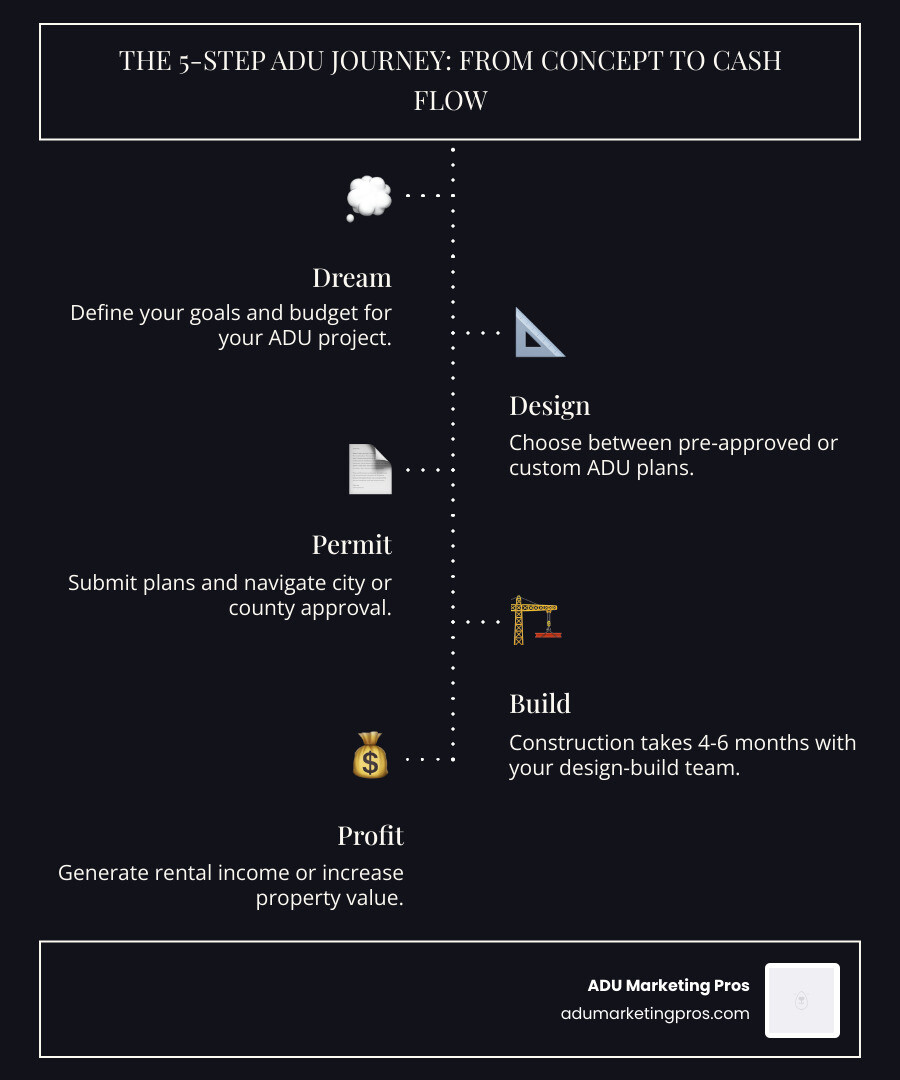
A realistic timeline for a complete ADU project in San Diego is typically 8 to 12 months, though this can vary. This timeline can be broken down into three main phases:
- Design & Planning Phase (1-2 months): This involves working with your designer or architect to create the architectural drawings, site plans, and engineering reports.
- Permitting Phase (3-4 months): Your completed plans are submitted to the city or county for review and approval. This is often the most unpredictable part of the timeline, as it depends on the jurisdiction’s workload and the accuracy of your submission.
- Construction Phase (4-6 months): This is the physical build of the ADU, from grading and foundation work to framing, finishing, and final inspections.
How will building an ADU affect my property taxes?
Your property taxes will increase, but not on the entire value of your property. California’s Proposition 13 protects your existing home’s assessed value. Your property will be reassessed, but only the value of the new construction (the ADU) will be added to your tax bill. For example, if your ADU costs $300,000 to build, your annual property tax bill will increase by approximately 1-1.25% of that new value, or about $3,000-$3,750 per year.
Can I use my ADU for Airbnb or other short-term rentals?
This is a complex and evolving issue. The City of San Diego has specific regulations for Short-Term Residential Occupancy (STRO). Generally, you can use either your primary residence or an ADU on your property as a short-term rental, but not both. Regulations vary in other cities within San Diego County, and some have stricter rules. If short-term rental income is a primary goal, you must research the specific STRO laws for your jurisdiction before building.
Conclusion: Start Your San Diego ADU Journey Today
The path to building an ADU in San Diego is a journey of transformation—for your property, your finances, and your lifestyle. From the wide array of adu designs san diego homeowners can choose from to the powerful financial returns, an ADU stands out as one of the most compelling investments in today’s real estate landscape.
By embracing this opportunity, you are not only enhancing your own property but also contributing a vital piece of the solution to San Diego’s housing needs. Whether your primary motivation is generating a steady stream of rental income, creating a safe and comfortable home for family members, or simply boosting your property’s long-term value, an ADU offers a versatile and effective strategy.
The key to success lies in diligent planning. By thoroughly understanding your design options, carefully navigating the permit process, and, most importantly, partnering with an experienced and reputable design-build team, you can turn your vision into a reality. You can unlock the hidden potential sitting right in your own backyard.
For ADU builders and architects looking to connect with motivated homeowners, ADU Marketing Pros offers specialized digital marketing services. We help top firms showcase their expertise and value, ensuring they stand out in a competitive market.
Ready to take the first step on your ADU journey? Discover pre-approved ADU plans for San Diego to kickstart your project and begin the exciting process of transforming your property into a more valuable and versatile asset.