
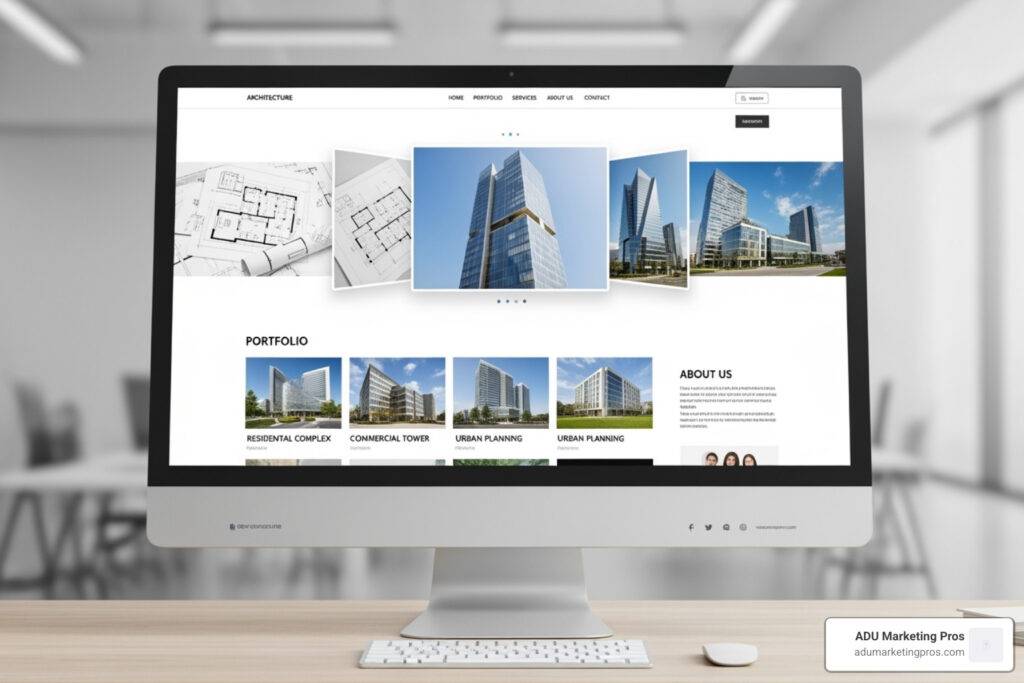
Why Professional Architecture Firms Need the Right Digital Foundation
In today’s digitally-driven world, an architect web design template is no longer a mere accessory; it’s the fundamental cornerstone of a firm’s brand and business development strategy. For architecture firms, particularly those navigating the competitive and booming Accessory Dwelling Unit (ADU) market in California, a powerful online presence is non-negotiable. The right template serves as a dynamic platform to showcase your portfolio, attract and qualify high-value leads, and articulate your unique design philosophy, ultimately helping you stand out in a crowded marketplace. Your website is your firm’s digital front door, and it’s the first impression potential clients get before they ever see your physical work. This initial interaction shapes their perception of your professionalism, creativity, and attention to detail.
With over half of all internet users browsing on mobile devices, a professional, responsive template isn’t just a bonus—it’s a critical tool for capturing leads and fueling business growth. The modern client journey almost always begins online, with homeowners and developers researching firms, comparing portfolios, and shortlisting candidates long before making a phone call. A clunky, outdated, or non-mobile-friendly site is an immediate disqualifier.
Quick Template Comparison:
- Free Options: Ideal for new firms or those on a tight budget, WordPress offers a vast library of free themes. These are a great starting point but may require more hands-on customization.
- Premium Templates: Ranging from $50–$150 on marketplaces like ThemeForest and Webflow, these offer superior design, better features, and dedicated support.
- All-in-One Platforms: Services like Squarespace and Wix provide templates as part of a monthly subscription, bundling hosting, support, and user-friendly editors into one package.
- Advanced Solutions: For design-centric firms, Webflow templates often include Figma files and robust Content Management System (CMS) integration for unparalleled control.
The architecture industry has pivoted to rely on digital portfolios as the primary vehicle for showcasing projects. Modern templates are built to make this content shine, incorporating features like parallax scrolling effects to create a sense of depth, animated statistics to highlight project successes, and seamless project galleries that allow your designs to take center stage. These tools solve a core challenge for architects: balancing design excellence with the practical demands of running a business. While a custom website can take months and cost tens of thousands, a well-chosen template provides a professional, high-impact solution in a fraction of the time and cost.
Why Choose a Template Over Custom Development?
When you’re ready to construct your firm’s online presence, you face a foundational decision: invest in a bespoke, custom-built website or leverage a pre-designed architect web design template? While the allure of a completely unique, from-scratch site is strong, the overwhelming practical advantages of templates often make them the smarter, more strategic choice for the vast majority of architectural practices, from solo practitioners to growing firms.
Let’s begin with the most compelling factor: cost-effectiveness. Custom web development is a significant capital expenditure. A typical project can easily range from $10,000 to $50,000, and sometimes much more, depending on complexity. This cost encompasses findy phases, UX/UI design, front-end and back-end development, testing, and deployment. For a firm specializing in ADU projects, that capital could be more effectively allocated toward targeted marketing campaigns, hiring new talent, or investing in better design software. In stark contrast, high-quality premium templates range from a one-time fee of $50 to a few hundred dollars. This represents a cost saving of over 95% in many cases, freeing up vital resources for growth.
Speed of deployment is another game-changing benefit. A custom website project is a lengthy endeavor, typically taking 3-6 months from initial brief to final launch. That represents an entire quarter, or even two, of missed opportunities to attract clients and build your brand online. Time really is money, especially when competing in fast-moving markets like California’s ADU sector. With an architect web design template, you can have a polished, professional, and fully functional website live in a matter of days or weeks, not months. This agility allows you to start generating leads and seeing a return on your investment almost immediately.
Many architects worry that a template will look generic or fail to capture their unique brand identity. However, modern architect web design templates are crafted by expert web designers who specialize in visual industries. They understand the need for clean lines, sophisticated typography, and layouts that prioritize stunning imagery. Furthermore, they offer extensive customization options—from color palettes and fonts to page layouts and content modules—allowing you to infuse your firm’s brand and personality into the design. The result is a site that looks and feels custom-made, without the associated cost and timeline.
Finally, the built-in features and SEO-readiness of quality templates provide immense value. Most come pre-packaged with essential components like portfolio galleries, project case study layouts, client testimonial sections, team bio pages, and integrated lead capture forms. Building each of these functionalities from scratch would add weeks to the development timeline and thousands to the budget. Moreover, reputable template developers build their products on a foundation of clean code, fast loading speeds, and mobile-responsive design—all critical ranking factors for Google. Starting with an SEO-friendly template gives you a significant head start in achieving visibility in search results.
| Feature | Pre-designed Templates | Custom Web Development |
|---|---|---|
| Initial Cost | Low to Moderate (Free – $500+) | High ($10,000 – $50,000+) |
| Launch Timeline | Days to Weeks | Months (3-6+ months) |
| Design Flexibility | Moderate to High (Customizable within framework) | Complete (Built to exact specifications) |
| Required Technical Skill | Low to Moderate (Often no-code friendly) | High (Requires developers, designers) |
| Maintenance | Simpler, with community/creator support | Can be complex, relies on original developers |
| Updates & New Features | Regular updates by template creators | Requires custom development work |
The bottom line is clear: an architect web design template empowers you to get online quickly and affordably with a professional, high-performance website. This frees you to dedicate your time and resources to what you do best—designing and creating incredible spaces for your clients. For insights on building your firm’s unique brand identity once your site is live, check out our guide on branding for architecture firms.
Essential Features of a High-Performing Architect Web Design Template
Think of your architecture website as the master blueprint for your digital success. Just as every line in a building plan has a purpose, every feature within your architect web design template must be carefully chosen to support your firm’s goals. Your template isn’t a static digital brochure; it’s your hardest-working employee, operating 24/7 to showcase your projects, articulate your value, and capture qualified leads while you sleep. A high-performing template must deliver excellence across several key areas, from visual storytelling to technical performance.
Spotlight on Your Portfolio and Project Showcase
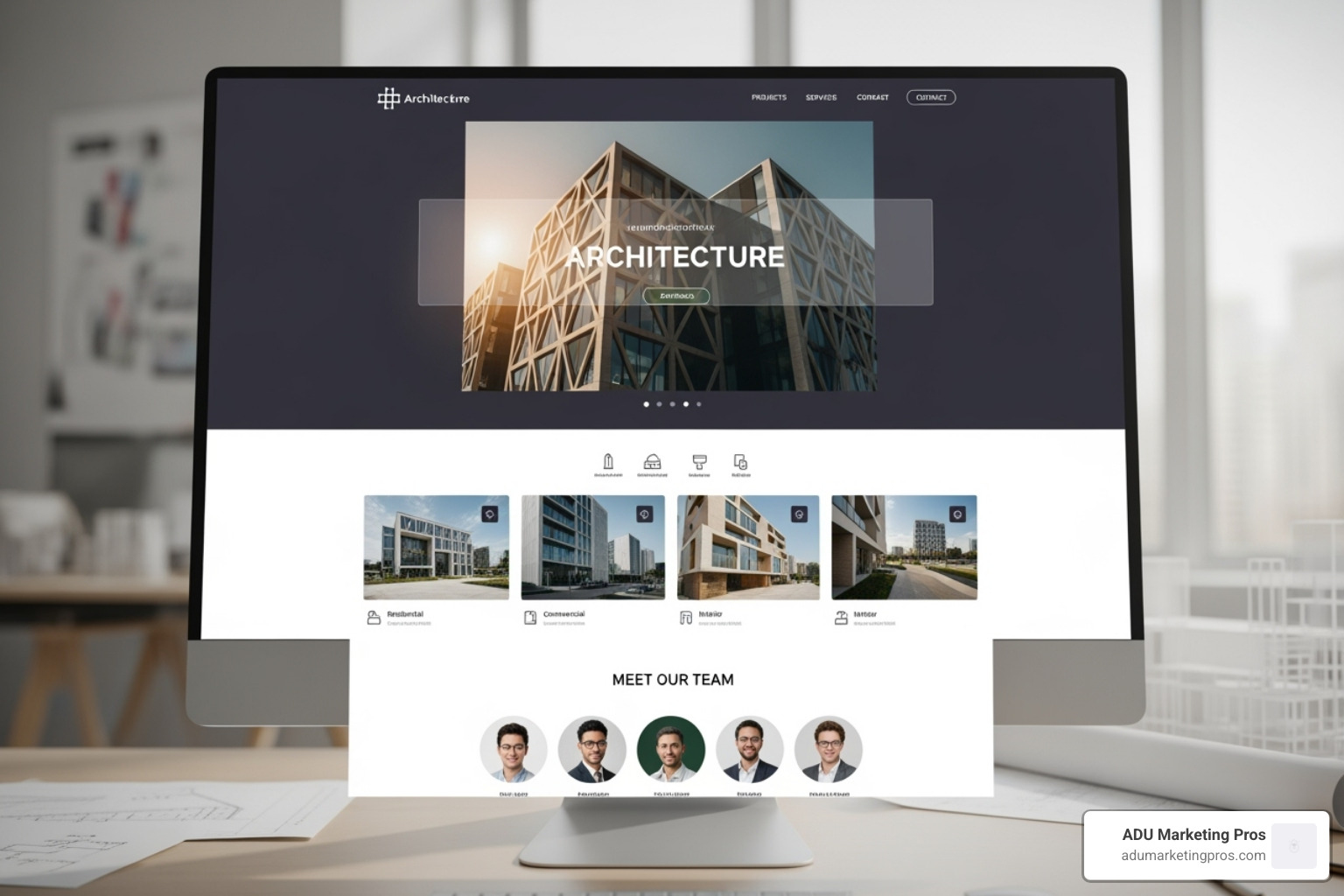
Your portfolio is the heart of your website. It’s where potential clients fall in love with your work and envision themselves in the spaces you create. The right architect web design template treats your portfolio as the crown jewel, providing a suite of tools for compelling visual storytelling. First and foremost, look for templates that support high-resolution image and video uploads without compromising site speed. Large, immersive visuals are non-negotiable. Video integration is increasingly crucial, allowing for dynamic virtual walkthroughs, drone flyovers, or client testimonials that bring a project to life. As your body of work grows, project filtering and categorization become invaluable. A great template allows visitors to easily sort projects by type (e.g., residential, commercial, ADU), status (e.g., in-progress, completed), or style, enabling them to find the work most relevant to their needs. To lift the experience, look for subtle but sophisticated interactive elements like parallax scrolling effects, which create a sense of depth, or neat hover animations that reveal project details. The goal is to create an interactive experience where your designs are the undisputed hero.
The Critical Role of Responsive Design and User Experience (UX)
In today’s mobile-first world, if your website doesn’t function flawlessly on a smartphone, you are actively turning away more than half of your potential clients. Responsive design is the baseline requirement, ensuring your template automatically adapts its layout to every screen size, from a large desktop monitor to a compact mobile device. But true mobile excellence goes beyond simply shrinking content. It involves a deep consideration of the user experience (UX) on a smaller, touch-based interface. This includes optimizing navigation with mobile-friendly menus (like a hamburger menu), ensuring buttons and links are easily tappable, and maintaining fast loading speeds over cellular connections. Visitors should find your site intuitive and effortless to steer, never feeling lost or frustrated. Furthermore, web accessibility is a crucial component of modern UX. Choosing a template that adheres to Web Accessibility Initiative (WAI) guidelines ensures that people with disabilities can access and understand your work, broadening your audience and reflecting an inclusive brand ethos. A seamless user experience is what prevents a curious visitor from becoming a lost lead.
Dedicated Sections for Services, About, and Lead Capture
Beyond the portfolio, a strong template provides well-structured sections to build trust and guide visitors toward action. You need dedicated pages or sections for service descriptions, where you can detail your process, from initial consultation to final construction. An About Us or Firm Profile page is essential for telling your story, introducing your team, and sharing your design philosophy. Client testimonials and case studies add powerful social proof. Most importantly, the template must feature clear and effective contact forms and calls-to-action for lead capture. This includes a prominent contact page, simple inquiry forms, and strategically placed buttons encouraging users to “Schedule a Consultation” or “Request a Quote.”
Top Platforms and Trends for Your Architect Web Design Template
Choosing the right architect web design template goes beyond aesthetics; it’s a strategic decision about the technological foundation of your digital presence. This is especially true for firms aiming to capture specific, high-intent audiences like those in the ADU market. Different website builders and platforms offer unique strengths, and understanding them is key to selecting the right tool for your firm’s needs, budget, and technical comfort level. Alongside the platform choice, be aware of current design trends to ensure your site feels contemporary and professional.
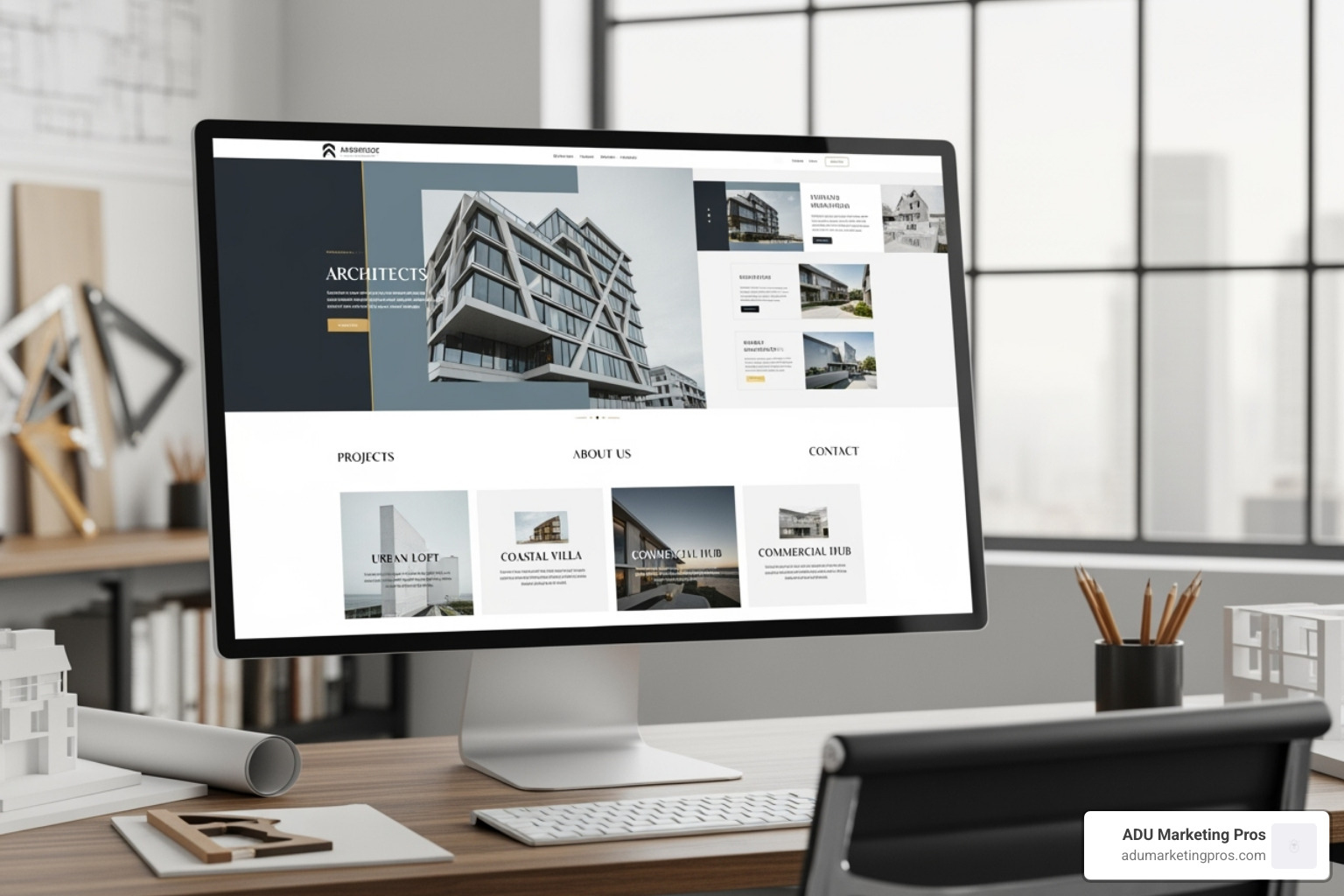
Modern architecture websites are embracing several key trends. Minimalism continues to dominate, using generous white space and clean layouts to let stunning project imagery command attention. This approach reflects the precision and focus of architectural work itself. Bold, expressive typography is used to inject personality and create a strong visual hierarchy, moving beyond standard web fonts to make a brand statement. Asymmetrical layouts are increasingly popular, breaking free from rigid grids to create a more dynamic, engaging, and contemporary user experience. Finally, the best sites are image- and video-driven, using high-impact visuals as the primary storytelling tool, improved by subtle animations and micro-interactions that guide the user and add a layer of polish.
Let’s explore the leading platforms where you can find a template that aligns with these trends.
WordPress: The Gold Standard for Flexibility and Control
WordPress powers over 40% of the internet for a reason: its unparalleled flexibility. As a content management system (CMS), it offers a massive ecosystem of themes and plugins, with countless options designed specifically for architects. Its primary strength is limitless customization. Whether you use a free theme from the official repository or a premium theme from a marketplace like ThemeForest, you have the power to modify almost every aspect of your site. With powerful page builder plugins like Elementor or Beaver Builder, you can achieve custom layouts via a visual, drag-and-drop interface. Furthermore, its vast plugin library allows you to extend functionality indefinitely, from advanced SEO optimization with Yoast SEO to sophisticated portfolio management. While there can be a slightly steeper learning curve than all-in-one builders, WordPress provides a robust, SEO-friendly, and scalable foundation for any ambitious firm. For a closer look, explore our curated list of WordPress Themes for Architects.
Webflow: The Designer’s Choice for Pixel-Perfect Execution
Webflow has rapidly become a favorite among design-forward firms that crave granular control over their website’s appearance and behavior without needing to write code. It offers advanced visual design control, essentially giving you the power of front-end coding in a visual canvas. This allows for pixel-perfect layouts, complex interactions, and seamless, sophisticated animations that can make a website feel truly alive. Many Webflow templates for architects come with a powerful, integrated CMS, making it incredibly easy to manage and update project portfolios, team members, and blog posts. A unique benefit is the occasional inclusion of Figma files with a template purchase, allowing your design team to customize the source graphics and mockups before implementing them. Webflow sites are renowned for their clean code, making them inherently speed-optimized and perfectly responsive.
Squarespace & Wix: The All-in-One Path to Simplicity and Speed
For solo practitioners, small firms, or anyone prioritizing ease of use and speed to launch, Squarespace and Wix are fantastic all-in-one solutions. Their primary appeal lies in their supremely user-friendly drag-and-drop editors, which make building a beautiful website an intuitive and straightforward process. Both platforms offer a curated selection of visually driven templates that are clean, modern, and perfectly suited for image-heavy architectural portfolios. With built-in hosting, security, and customer support, you never have to worry about the technical backend of managing a website. While they offer less granular control and flexibility compared to WordPress or Webflow, their simplicity is their greatest strength. They are the fastest way to get a highly professional, great-looking website online. For those looking to dive deeper into general web design principles, resources like Tuts+ Web Design Tutorials can be very helpful.
How to Customize Your Template and Generate Leads
Selecting the perfect architect web design template is just the first step—it’s the equivalent of choosing a prime plot of land and laying the foundation. The real architectural magic happens during customization, where you transform a pre-designed layout into a bespoke digital headquarters that is an unmistakable reflection of your firm’s unique brand, vision, and expertise. This process is what lifts your site from being merely functional to being truly memorable and effective.
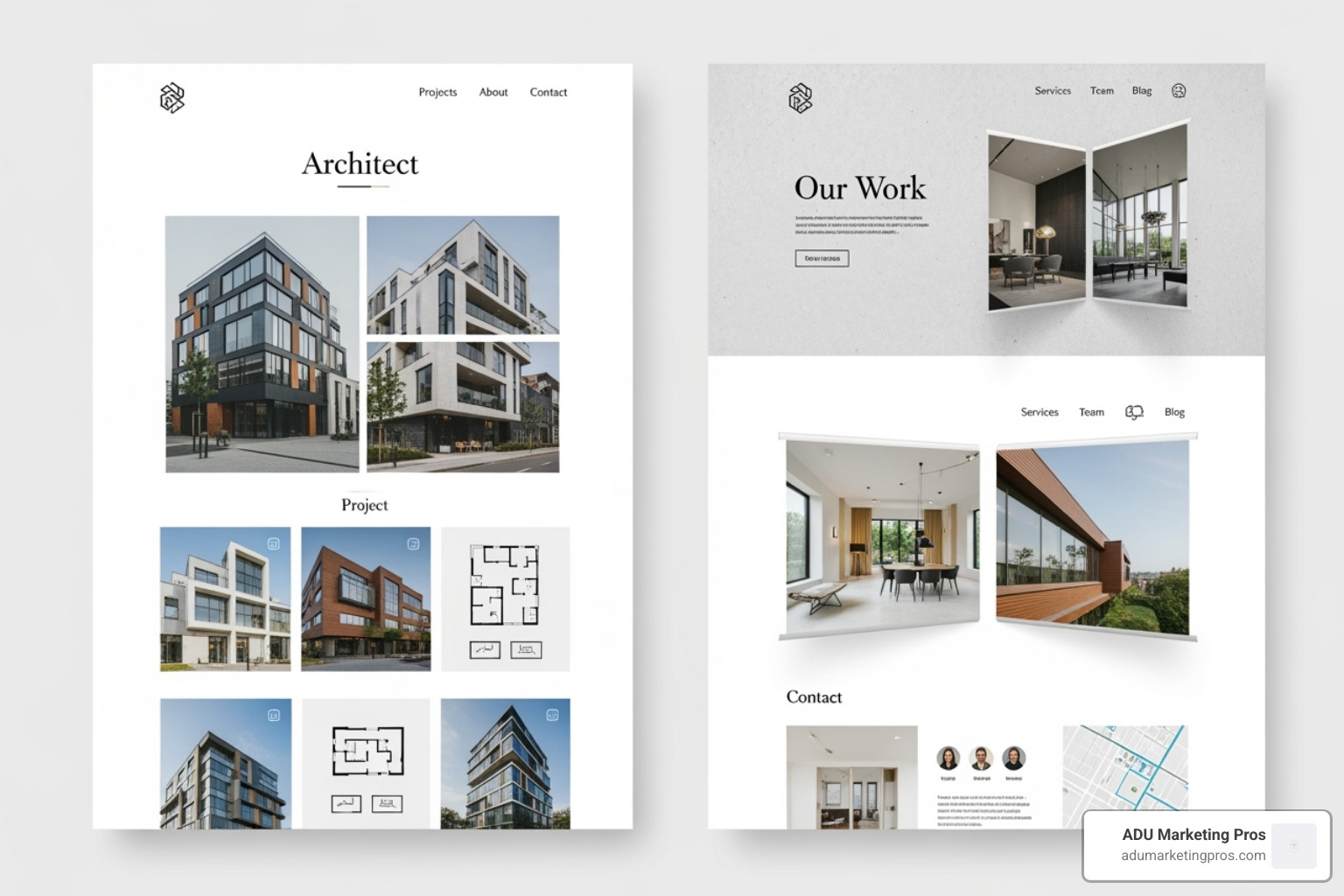
True customization involves weaving your brand identity into the very fabric of the template. This starts with the fundamentals: implementing your firm’s color scheme and typography consistently across every page to create a cohesive visual language. Your logo should be integrated prominently, typically in the header and footer, to reinforce brand recognition. The most critical step is replacing all stock photos with your own high-quality project imagery. Your completed work is your single most powerful asset; professional photos and videos are non-negotiable. Beyond visuals, you must craft compelling copywriting and content that tells your firm’s story, defines your ideal client, and speaks directly to their needs and aspirations.
Tailoring Your Chosen Architect Web Design Template to Your Niche
Your website must immediately signal your area of specialization to attract the right kind of clients. A generic site attracts generic inquiries. A niche-focused site attracts qualified leads. For example:
- Residential Focus: A template for a firm specializing in custom homes or renovations should feel warm, personal, and aspirational. Use warmer color palettes, feature intimate project narratives that tell the story of the family or homeowner, and include galleries with detailed shots of living spaces, kitchens, and bespoke details.
- Commercial Projects: A firm targeting commercial clients needs a template that projects authority, efficiency, and a strong return on investment. The design should be clean and corporate, emphasizing data, project scale, timelines, and budget adherence. Case studies should highlight business outcomes for the client.
- Interior Design Showcase: For practices where interiors are the star, the template must be highly visual and immersive. Prioritize full-screen image sliders, dramatic before-and-after galleries, and detailed descriptions of materials, furnishings, and lighting design.
- Sustainable Architecture: A firm dedicated to green building should use its site as an educational tool. The template can be used to showcase green materials, feature environmental impact data (e.g., energy savings, carbon footprint reduction), and highlight certifications like LEED or Passive House.
Turning Your Website into a Lead Generation Machine
A beautiful website that doesn’t generate business is a missed opportunity. The ultimate purpose of your architect web design template is to convert passive visitors into active, qualified leads.
- Strategic Calls-to-Action (CTAs): Don’t make visitors guess what to do next. Every page should have a clear, compelling CTA that guides them down the sales funnel. Use a mix of primary CTAs (“Schedule a Consultation”) and secondary CTAs (“View Our Portfolio,” “Download Our Process Guide”).
- Optimized Contact and Inquiry Forms: Place consultation request forms prominently on your contact page and service pages. Keep them simple to encourage completion—ask only for essential information initially (name, email, phone, project type). For more qualified leads, a detailed project inquiry form can gather more specific information like budget, timeline, and property details.
- Blog Content for Thought Leadership: A regularly updated blog is one of the most powerful lead generation tools. By publishing articles on topics your ideal clients are searching for—such as ADU regulations, zoning laws, design trends, or material comparisons—you position your firm as a trusted authority. This attracts organic traffic through SEO and builds credibility long before a potential client ever reaches out.
By thoughtfully integrating these customization and lead generation elements, you transform your website from a passive portfolio into an active, automated business development engine. For comprehensive strategies, explore our in-depth guide on Lead Generation for Architects.
Frequently Asked Questions about Architect Website Templates
Diving into web design can feel like drawing up a new set of blueprints—it’s an exciting process, but one that naturally comes with many questions. To help clarify the process, we’ve answered some of the most common questions architects have about choosing, using, and maximizing the value of an architect web design template.
How much does an architect website template typically cost?
The cost of a template varies significantly based on the platform and level of quality. There are three main tiers:
- Free Templates: Platforms like WordPress offer a vast library of free themes. These are a great starting point for new firms or those with minimal budgets, but they often require more technical skill to customize and may lack premium features and dedicated support.
- Premium Templates: This is the sweet spot for most firms. For a one-time fee, typically ranging from $50 to $150, you can purchase a high-quality template from marketplaces like ThemeForest (for WordPress) or the Webflow Marketplace. These offer more polished designs, better features, and customer support from the developer.
- Subscription-Based Platforms: Services like Squarespace and Wix operate on a subscription model. Their monthly fees (usually $15 to $50+ per month) bundle the template, website editor, hosting, security, and support into one recurring payment. This is an excellent option for those who value simplicity and an all-in-one solution.
Do I need coding skills to use an architect web design template?
For the vast majority of modern architect web design template solutions, the answer is no, you do not need coding skills. This is one of their most significant advantages. Platforms like Wix, Squarespace, and even Webflow are built around powerful visual, drag-and-drop editors. These tools allow you to build, customize, and manage your entire site without ever writing a single line of code. Even on WordPress, most premium themes are now bundled with intuitive page builder plugins (like Elementor or WP Bakery) that provide a similar visual editing experience. Unless you require highly specialized, unique functionality, you can create a stunning, professional website without any coding knowledge.
How important is SEO for my architecture firm’s website?
SEO (Search Engine Optimization) is absolutely critical to the success of your firm’s website. Think of your beautifully designed website as a masterpiece building located on an unmarked road with no signs. SEO is the process of building the highways, roads, and signposts that guide high-value potential clients directly to your front door. It provides visibility when a homeowner or developer searches Google for terms like “architect near me” or “ADU design San Jose.” It attracts qualified leads—people who are actively searching for the exact services you provide. It builds trust and credibility, as users inherently trust sites that rank highly in search results. Finally, it is a highly cost-effective marketing strategy that delivers a sustainable return on investment over time. In short, SEO ensures your incredible work is actually seen by the people who need it most. For firms in specific regions, understanding Local SEO for Architects California can be a true game-changer.
Can I switch templates later if I change my mind?
This depends heavily on the platform. On WordPress, switching themes is relatively straightforward; your core content (pages, posts, images) will remain, though you will likely need to reconfigure theme-specific settings and layouts. On all-in-one platforms like Squarespace and Wix, switching templates is more involved and often requires you to manually copy and paste your content into the new template. It’s best to choose a template you love from the start to minimize future work.
Build Your Firm’s Digital Blueprint for Success
Throughout this guide, we’ve explored how selecting the right architect web design template is a pivotal, strategic decision for your firm. It’s a choice that moves far beyond a simple online brochure; it’s about commissioning your firm’s most dedicated storyteller, its most efficient client magnet, and its most powerful engine for building a memorable brand. A well-chosen template is the digital blueprint that will support your firm’s growth for years to come.
By leveraging a template, you open up tremendous cost-effectiveness and speed, allowing you to launch a polished, professional website in weeks, not months, and for a fraction of the cost of custom development. This approach provides you with a foundation of professional design and essential built-in features, from stunning, responsive portfolio galleries to the technical SEO framework needed to get finded by search engines.
The true change, however, occurs when you customize and tailor your site to your specific niche—whether that’s sustainable commercial buildings, luxury residential homes, or innovative ADU solutions. This is how you create a powerful platform for lead generation, turning curious visitors into qualified clients. By focusing on showcasing your work with high-quality visuals, ensuring a seamless and intuitive user experience, and integrating clear, strategic calls-to-action, you will forge an online presence that perfectly mirrors the quality, precision, and spirit of your architectural work.
For architecture firms ready to lift their digital strategy and transform their website into a predictable source of high-quality leads, the experts at ADU Marketing Pros are here to help. We specialize in creating comprehensive marketing solutions for ADU construction and architecture firms. We help you attract the right leads and boost your revenue by highlighting your unique expertise, enabling your firm to not just compete, but to lead in a crowded market. Based in San Jose, CA, we have a deep understanding of the unique California market. Let’s work together to create a digital presence that doesn’t just stand out, but truly shines.
Ready to build your firm’s future? Start designing your firm’s future today.