

From Blueprints to First-Page Rankings
SEO for architects is the process of optimizing your firm’s website and online presence so potential clients can find you when they search for architectural services on Google and other search engines. Here’s what you need to know:
Quick Answer: SEO for Architects in 4 Steps
- Keyword Research – Identify what clients search for (e.g., “residential architect near me,” “sustainable home design”)
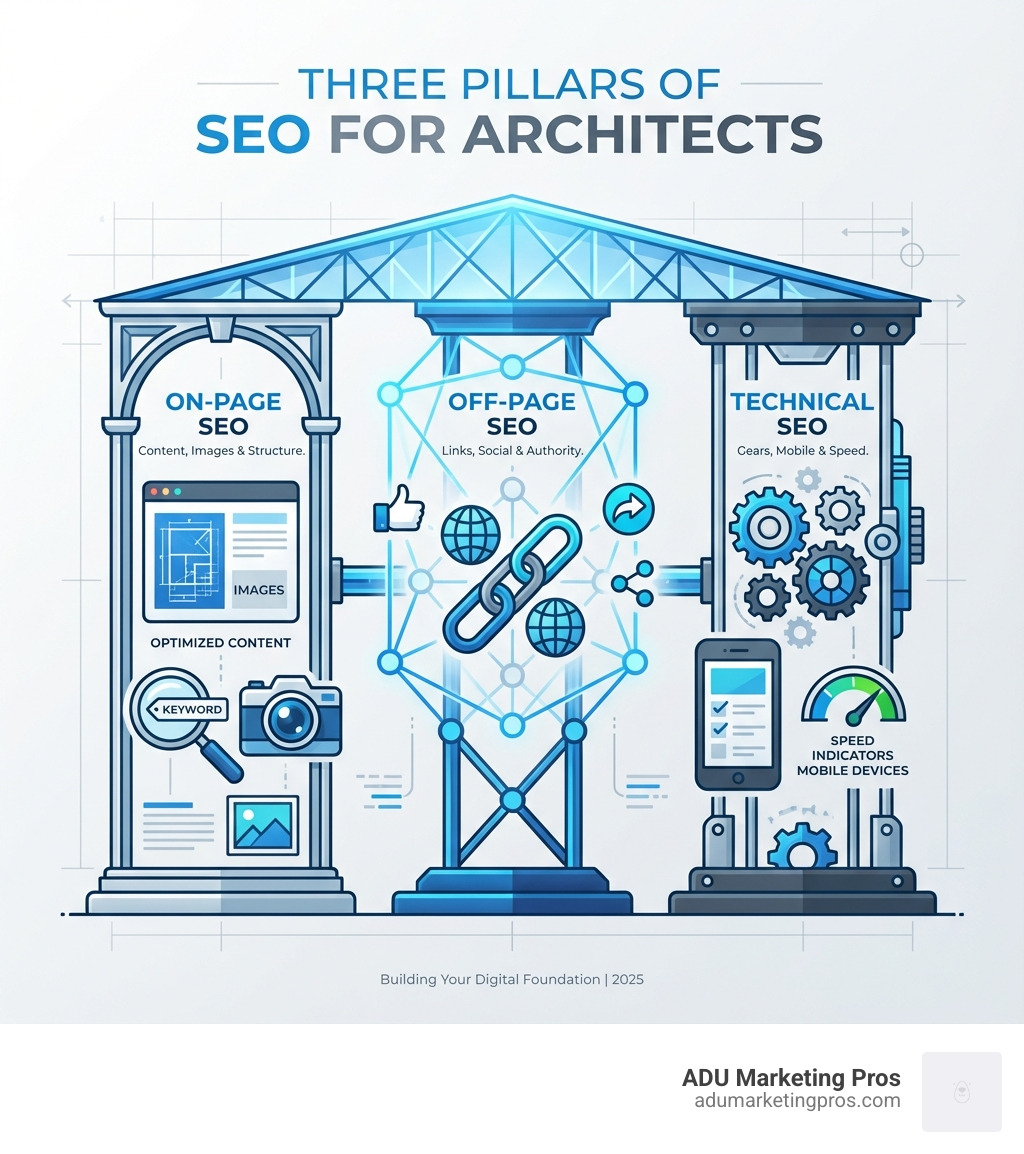
- On-Page Optimization – Optimize your website content, images, and structure for both users and search engines
- Local SEO – Claim your Google Business Profile and build consistent citations across directories
- Authority Building – Create valuable content, earn backlinks, and engage on social media
As an architect, you know the power of a strong foundation. Your online presence deserves the same careful planning and expert execution as your buildings.
A sobering fact: 70% of potential clients start their search on Google. If your firm isn’t on the first page, you’re invisible to most of them. With over 70,000 architectural firms in the U.S., standing out online is no longer optional.
The good news? SEO isn’t as complicated as building code compliance. It’s a learnable system of strategies that can transform your website from a digital portfolio into a lead-generation engine.
This guide will walk you through conducting keyword research, implementing on-page and local SEO, and building authority to expand your reach. Whether you design custom homes or commercial spaces, strong SEO connects you with clients actively looking for your expertise right when they need it.
Let’s build your digital foundation.
Basic seo for architects glossary:
Why SEO is the Cornerstone of Modern Architecture Marketing
While word-of-mouth and industry connections still have value, the way clients find architects has fundamentally shifted online. Today, potential clients are far more likely to search on Google than flip through a phone book. Digital word-of-mouth, like online reviews and social media mentions, now heavily influences high-value projects. With Google handling over 3.5 billion searches per day, failing to appear in search results means missing a massive opportunity to connect with potential clients.
The return on investment (ROI) for SEO for architects is substantial. Though it’s a long-term strategy (often 6-12 months for significant results), the consistent flow of qualified leads it generates builds lasting authority. In a market with over 70,000 U.S. architectural firms, a basic website isn’t enough—you must stand out.
The High Stakes of Search Engine Visibility
Consider a client searching for a “residential architect near me.” The top three Google results capture over 55% of all organic clicks. Since 75% of users don’t scroll past the first page, ranking on page one is critical. If you’re not there, you’re invisible to the vast majority of your potential clients.
Before making contact, clients thoroughly research and vet architects by scrutinizing portfolios, reading reviews, and comparing services. Effective SEO establishes your credibility and trust early in their journey, allowing you to showcase your expertise right when it matters most.
Understanding Your Future Client’s Search Intent
Successful SEO for architects hinges on understanding “search intent”—what a potential client hopes to achieve with their search. For example, a search for “architecture” is often informational (a student researching), while “architect” usually shows transactional intent (someone looking to hire).
Your content must align with these intents:
- Top-of-funnel keywords: These are broader, informational queries (e.g., “how to get an ADU permit in Los Angeles,” “modern home design trends”). Content answering these questions builds awareness and establishes your firm as a knowledgeable resource.
- Bottom-of-funnel keywords: These are specific, transactional queries (e.g., “ADU architect San Diego,” “commercial architect Palo Alto”). Your service pages and contact information should be optimized for these.
By creating content that answers client questions and addresses their needs, you build the trust and authority that positions your firm as the go-to expert.
Blueprint for Findy: Keyword Research & Content Strategy
Effective keyword research is the foundation of your SEO strategy, helping you understand your audience and create content that resonates. Start by brainstorming your services, client problems you solve, and unique specialties, especially within your service areas like San Jose or Los Angeles.
Next, use tools like Ahrefs or SEMrush to find what people are searching for, search volumes, and ranking difficulty. With over 128,000 keywords related to “architect”, there are plenty of opportunities.
Focus on both broad, short-tail keywords (“architect”) and specific, long-tail keywords (“sustainable residential architect near me”). Long-tail keywords often have higher intent and are easier to rank for. Analyzing competitors will also reveal content gaps and strategic opportunities.

Mastering Keyword Research for Architectural Services
Since 46% of Google searches are for local businesses, your keyword research must have a strong local focus. Clients are looking for architects nearby, so location-specific terms are paramount.
- Local Keywords: Target terms like “architects in San Jose” or “ADU architect Los Angeles,” including specific neighborhoods in your service areas.
- Service-Specific Keywords: Focus on your exact services, like “modern ADU design” or “custom home architect Sunnyvale.”
- Question-Based Keywords: Answer common client questions like “how much does an architect cost?” or “what are California’s ADU zoning laws?” to position your firm as a helpful expert.
Map your target keywords to specific pages on your site. Each service page should be optimized for a primary keyword, with related terms integrated naturally. The goal is to create content that is valuable for users while signaling relevance to search engines.
Creating High-Quality Content That Ranks
High-quality content is crucial for SEO. For architects, this means creating content that showcases your expertise and vision. Google rewards sites that consistently publish valuable, relevant material.
Content ideas that boost SEO for architects include:
- Project Showcases & Case Studies: Instead of just a gallery, create a narrative. Detail the initial client brief, the site constraints, your conceptual approach, and how your design solution uniquely addressed their needs. Include high-resolution photos, floor plans, and even client testimonials to build a compelling story that demonstrates your value and process.
- Blog Posts: A regularly updated blog signals to Google that your site is an active authority. Go beyond project announcements and write about topics your potential clients are searching for. Examples include: “Navigating the Permitting Process in [Your City],” “The ROI of Sustainable Architecture,” “Top 10 Questions to Ask Your Architect,” or “Comparing Modern vs. Contemporary Home Design.”
- Video Tours & 3D Renderings: Visuals are your strongest asset. Use powerful visual content like drone footage of a finished project, video walkthroughs, or animated 3D renderings that explain your design concepts. This type of content is highly engaging, increases time on page, and is easily shareable on social media—all positive SEO signals.
- Educational Guides: Position your firm as a thought leader by creating comprehensive, downloadable guides on complex topics like “The Complete Guide to Building an ADU in California” or “A Homeowner’s Guide to the Architectural Design Process.” These “linkable assets” can attract backlinks from other websites, significantly boosting your authority.
All content must demonstrate E-E-A-T (Experience, Expertise, Authoritativeness, Trustworthiness), a concept Google uses to evaluate content quality, especially for high-stakes “Your Money or Your Life” (YMYL) topics like professional services. For architects, this means showcasing your credentials, awards, project history (Experience), providing in-depth, accurate information (Expertise), earning mentions from reputable sources (Authoritativeness), and being transparent with contact information and client reviews (Trustworthiness). Consistently providing insightful content builds your online reputation and can increase leads by 67% more per month.
Building Your Digital Presence: On-Page, Technical, and Local SEO for Architects
Your website is your most powerful marketing tool and digital portfolio. For effective SEO for architects, its structure, speed, and local visibility are paramount. Google prioritizes sites with a great user experience (UX), so your online presence should match your design excellence. For ideas, see this Architecture Web Design Inspiration.
Essential On-Page SEO for Architects’ Websites
On-page SEO involves optimizing individual pages on your website to improve their search rankings.
- Title Tags, Meta Descriptions, & Headers: Use compelling title tags and meta descriptions with your primary keyword to entice clicks in search results. Use header tags (H1, H2, H3) to structure content for readability and SEO.
- Clean URLs: Create short, readable URLs that include relevant keywords (e.g.,
/adu-architects-los-angeles/). - Image Optimization: Your portfolio is visual, but search engines read text. Optimize your stunning visuals with descriptive, keyword-rich filenames (e.g.,
modern-adu-design-san-jose.jpginstead ofIMG_8075.jpg) and detailed alt text that describes the image for visually impaired users and search engines. Compress images using tools like TinyPNG and serve them in next-gen formats like WebP to ensure fast loading times without sacrificing quality. Remember, 23% of Google searches occur on Google Images, making your portfolio a powerful client acquisition channel. - Internal Linking: Strategically link related pages within your site (e.g., from a blog post to a service page). This helps search engines understand your site’s structure and can boost organic traffic. Good Information Architecture in Web Design is key.
Technical SEO and Website Architecture
Technical SEO ensures your website is structurally sound and easily crawlable by search engines, like a building with a strong foundation.
- Site Speed: Over 53% of visitors abandon a site that takes more than 3 seconds to load. Ensure your portfolio pages load quickly, especially on mobile.
- Mobile-First Design: With over half of SEO traffic coming from mobile, your site must be responsive. Google ranks based on the mobile version first.
- SSL Certificate (HTTPS): Secure your site with HTTPS to encrypt data. It’s a basic security measure and a minor ranking factor.
- XML Sitemap & Site Structure: An XML sitemap is a file that lists all your important pages, acting as a roadmap for search engine crawlers. A logical, flat site structure is also crucial for both users and SEO. This means any page on your site should be reachable within three to four clicks from the homepage. A typical structure might be Homepage > Services > Custom Home Design, which is intuitive and helps spread link equity throughout your site, as recommended by experts like Semrush.
- Crawlability & Indexability: Ensure search engine bots can easily access and read your content by properly configuring files like
robots.txt. For more, see our guide on ADU Website Optimization.
Dominating Your Region with Local SEO for Architects
For firms in specific locales like San Jose or Los Angeles, local SEO is a game-changer for connecting with clients searching “architect near me.”
- Optimize Your Google Business Profile (GBP): Your GBP is your most powerful local SEO tool, populating the map pack and potentially driving 200 clicks per month. Keep your category, details, and photos updated.
- Appear in the Map Pack: Since 46% of Google searches are local, an optimized GBP is key to appearing in map results for local searches like “ADU architect Sunnyvale.”
- NAP Consistency: Ensure your firm’s Name, Address, and Phone number are identical across all online directories to avoid confusing search engines.
- Manage Online Reviews: Reviews build trust and are a key ranking factor. Respond to all reviews, as 56% of people prefer businesses that do. Aim for fresh reviews, since 85% of consumers ignore those older than 3 months.
- Build Local Citations: Get your business mentioned on local chamber of commerce sites, industry directories (AIA, Houzz), and professional association websites.
- Create Location-Specific Pages: If you serve multiple cities or neighborhoods, create dedicated landing pages for each (e.g., “ADU Architects Los Angeles,” “Custom Home Architect Palo Alto”). These pages should feature unique content relevant to that specific area, such as local zoning nuances, notable projects you’ve completed there, and testimonials from local clients. This hyper-targeted approach signals strong local relevance to Google and can significantly boost organic traffic and qualified inquiries from those markets. For more, see our guide on Local SEO for Architects California.
Expanding Your Influence: Link Building and Social Media
Off-page SEO builds your authority across the internet, primarily through earning high-quality backlinks from reputable websites. Google sees these links as votes of confidence, much like a respected colleague vouching for your work. The impact is significant: pages with strong backlink profiles rank 3.8x higher. A robust backlink strategy is a critical component of successful SEO for architects.

Effective Strategies for Building Backlinks
Earning backlinks requires a proactive, strategic approach that demonstrates your value to the design community.
- Guest Posting: Contribute insightful articles to reputable design publications like ArchDaily, Dezeen, or Dwell to earn backlinks and establish thought leadership.
- Digital PR: Pitch stories about your firm’s awards, notable projects, or community involvement to local news and industry publications to earn authoritative mentions and links.
- Create Linkable Assets: Develop unique content that naturally attracts links, such as infographics, original research, or comprehensive educational guides.
- Collaborate with Partners: Work with contractors, designers, and other project partners for reciprocal linking opportunities on each other’s websites.
- Leverage Industry Directories: Ensure your firm is listed with a link on key industry sites like the AIA and Houzz.
How Social Media Improves SEO Efforts
While not a direct ranking factor, social media plays a crucial indirect role in SEO for architects by amplifying your content and brand.
- Drive Website Traffic: Share links to your website on platforms like Instagram and Pinterest to bring engaged users to your content, signaling its value to Google.
- Amplify Content: When your content is shared on social media, it reaches a wider audience, increasing visibility, brand awareness, and the potential for earning organic backlinks.
- Showcase Visual Work: Use visual platforms like Instagram and Pinterest to highlight project photos and 3D renderings to attract visually-oriented clients.
- Build a Community: Interact directly with your audience on social media to answer questions, build relationships, and foster loyalty that can lead to referrals.
- Indirect Ranking Signals: While not direct signals, the brand mentions, traffic, and backlinks generated from social media activity contribute to overall SEO performance.
- Use Paid Social Ads: Strategically use tools like Facebook Ads for Architects to target potential clients in specific locations and drive traffic to your landing pages, reaching a massive audience of nearly 5.41 billion social media users.
Measuring Success & Overcoming Problems
SEO for architects is an ongoing journey of continuous, data-driven improvement. It’s a long-term investment that requires patience and consistency. In a competitive field like architecture, it typically takes 6-12 months for search engines to recognize your site’s authority and for you to see a significant return on investment, but the results are worth the wait.
Measuring and Analyzing Your SEO Performance
Carefully measuring and analyzing SEO performance helps you understand what’s working and where to adjust your strategy.
- Key Metrics to Track:
- Organic Traffic: Visitors from search engines.
- Keyword Rankings: Your position for target keywords like “ADU architect San Jose.”
- Leads & Conversions: Inquiries, form submissions, and calls from organic search.
- Engagement Metrics: Time on page, pages per session, and bounce rate, which can indicate content or UX issues.
- Local Visibility: Your appearance in the local map pack for relevant searches.
- Tools for Tracking: Use free tools like Google Analytics to track visitor behavior and Google Search Console to monitor rankings and site health.
- Regular Reporting: Review metrics monthly or quarterly to identify trends and adjust your strategy. Tracking metrics makes you 60% more likely to hit your marketing goals.
Common Challenges and Professional Solutions
Architects often face significant SEO hurdles due to the unique demands of the profession.
- Time & Complexity: Effective SEO is a full-time job. It demands consistent content creation, technical monitoring, and strategic adjustments—time that is better spent on client projects and firm management.
- Hyper-Competitive Markets: Standing out in saturated markets like Los Angeles or the Bay Area requires an advanced, nuanced strategy that goes beyond basic SEO principles.
- Industry Compliance: All marketing content must adhere to strict professional and legal guidelines for architects, requiring a knowledgeable hand to avoid missteps.
- Budgeting & ROI: It can be difficult to justify the long-term investment of SEO when project-based revenue is the norm. It’s crucial to view SEO as an asset that builds future growth, not just an operational cost.
This is where a specialized agency like ADU Marketing Pros can provide a clear advantage:
- Industry-Specific Expertise: We understand the architectural client journey and create strategies tailored to your niche, whether it’s sustainable commercial design or luxury residential projects.
- Resources & Tools: Gain access to premium SEO software, analytics platforms, and a team of specialists without the high overhead costs.
- Efficient & Reliable Growth: Our focused expertise can achieve more reliable results faster than a trial-and-error DIY approach, accelerating your online growth and lead generation.
- Focus on Your Craft: Free up your time to do what you do best—designing incredible spaces—while we handle the complexities of digital marketing to build your online presence and architectural legacy.
Frequently Asked Questions about SEO for Architects
How long does it take to see results from SEO?
SEO is a long-term investment, not an overnight fix. While you might see initial positive movement in 3-4 months (like improved rankings for long-tail keywords), achieving significant results such as first-page rankings for competitive, high-value terms (“commercial architect Los Angeles”) typically takes 6 to 12 months. This timeline allows for comprehensive technical audits, content development, authority building through backlinks, and for Google’s algorithms to recognize and reward your site’s increased value and trustworthiness in a professional field like architecture.
Can I do SEO on my own, or should I hire a professional?
It’s possible to handle some basic SEO tasks in-house, such as optimizing page titles, writing blog posts, and setting up a Google Business Profile. However, a comprehensive SEO strategy involves deep technical knowledge, expensive analytics tools, content strategy, and consistent link building—all of which are time-consuming and complex. For most architecture firms, the time spent learning and executing advanced SEO is better spent on billable client work. Hiring a professional or a specialized agency like ADU Marketing Pros provides the expertise and resources to generate a much higher return on investment and achieve results more efficiently.
What are the most important SEO metrics for an architect to track?
While vanity metrics like overall traffic are nice to see, they don’t pay the bills. Focus on key performance indicators (KPIs) that directly impact your firm’s bottom line. The most important metrics are:
- Organic Leads: The number of qualified inquiries from contact form submissions and phone calls that originated from organic search.
- Keyword Rankings: Your position in search results for high-intent, bottom-of-funnel keywords (e.g., “residential architect San Jose,” “ADU design services”).
- Local Pack Visibility: Your frequency of appearance in the Google Map Pack for “near me” and geo-specific searches, as this is a primary source of local leads.
- Conversion Rate: The percentage of website visitors from organic search who take a desired action (like filling out a form). This tells you how effective your website is at turning traffic into leads.
Conclusion: Building a Lasting Digital Foundation
Just as a successful building project relies on a solid blueprint, a thriving architecture firm in the digital age depends on a robust SEO foundation. We’ve explored the essential strategies for mastering SEO for architects, from deciphering client search intent and crafting expert content to mastering the technical intricacies of your website and building authority with backlinks. We’ve highlighted how a targeted local SEO strategy can put your firm on the map in hyper-competitive California markets, and how social media can amplify your unique design voice.
SEO is not a fleeting marketing trend; it is a fundamental business investment that builds a sustainable pipeline of high-quality leads. A powerful online presence is your blueprint for attracting the clients you want, winning more ambitious projects, and securing the long-term legacy of your firm. It ensures that when potential clients in San Jose, Los Angeles, San Diego, or anywhere else are searching for architectural excellence, your firm is not just an option—it’s the clear and obvious choice.
Ready to move from blueprint to groundbreaking results? To implement these strategies and build a dominant online presence in your market, explore our guide on Local SEO for Architects California and start constructing your future pipeline of ideal clients today.