
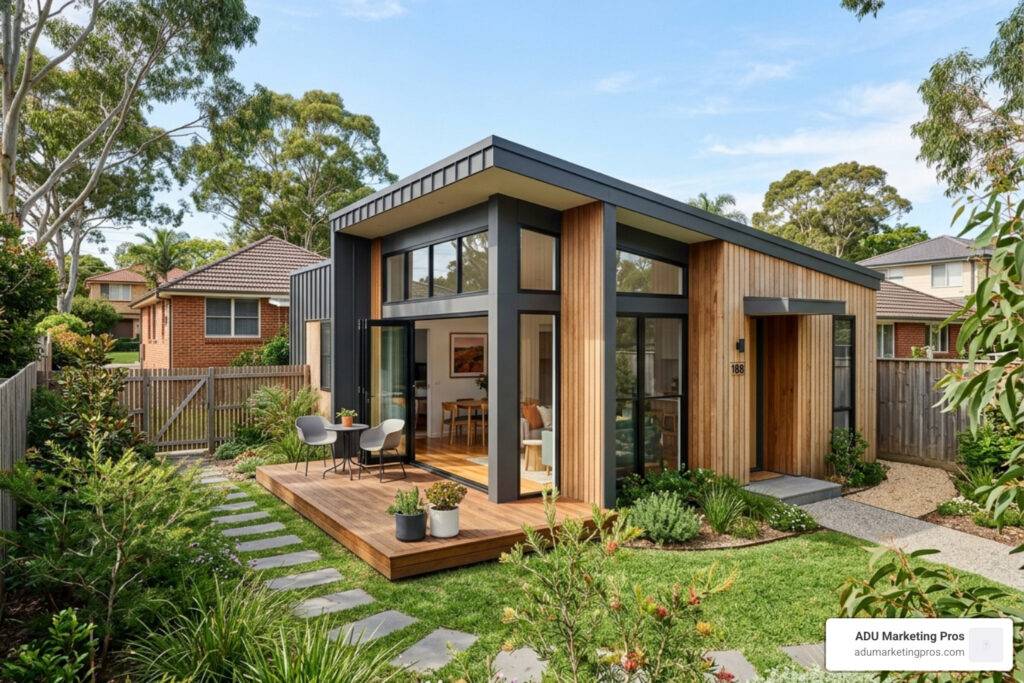
How Much Do 2 Bedroom Granny Flats Cost in NSW Right Now?
2 bedroom granny flats prices NSW typically fall between $150,000 and $200,000 for a complete, turnkey build in 2024/2025. Here’s a fast breakdown of the current market rates:
| Build Type | Price Range (NSW) |
|---|---|
| Kit / flat-pack (supply only) | $68,000 – $90,000 |
| Standard project build (turnkey) | $150,000 – $180,000 |
| Custom turnkey (full inclusions) | $170,000 – $200,000 |
| Premium / luxury build | $200,000+ |
These ranges cover a 60m2 two-bedroom design – the maximum floor area allowed under NSW Complying Development rules – and assume a reasonably flat, standard block with clear access.
So you’re thinking about housing your in-laws out the back or perhaps creating a dedicated space for adult children who can’t quite break into the Sydney property market. It is a smart move. Multi-generational living is on the rise across New South Wales, driven by a combination of housing affordability challenges and a cultural shift toward keeping families closer together. With the median Sydney house price pushing well beyond $1.6 million in many suburbs, a backyard granny flat is one of the most practical ways to keep family close while unlocking serious rental income potential when circumstances change.
The Rise of the Secondary Dwelling in NSW
In the last decade, the New South Wales government has significantly streamlined the process for building secondary dwellings. This was a direct response to the “missing middle” housing crisis. By allowing homeowners to utilize their existing land more effectively, the state has created a pathway for affordable housing that doesn’t require massive high-rise developments. For the homeowner, this represents a unique opportunity to increase property value without the massive stamp duty costs associated with buying a new investment property.
At ADU Marketing Pros, while our primary operations are based in the San Francisco Bay Area and across California’s booming ADU (Accessory Dwelling Unit) market, we recognize that the challenges faced by homeowners in Sydney, Newcastle, and Wollongong are remarkably similar to those in San Jose or Los Angeles. The global demand for secondary dwellings is exploding, and understanding the nuances of local pricing is the first step toward a successful project. Whether you are in Sunnyvale or Sylvania, the principles of high-quality construction and transparent pricing remain the same.
Why Advertised Prices Can Be Deceptive
But here’s where most people get tripped up: the price you see advertised on a roadside billboard or a social media ad is almost never the price you pay. A kit home might catch your eye at under $70,000. A builder’s website might lead with a “starting from” price of $142,000. Yet the realistic, all-in cost for a two-bedroom granny flat in NSW – once you add site preparation, council approvals, utility connections, and a proper internal fit-out – lands firmly in the $170,000 to $200,000 range for most Sydney properties.
Regional NSW can come in lower due to slightly reduced labor costs, but challenging sites, sloping blocks, or premium finishes can push costs significantly higher. This guide breaks down exactly what drives those numbers, what’s often left out of low-ball quotes, and how to budget with confidence before you sign a building contract.
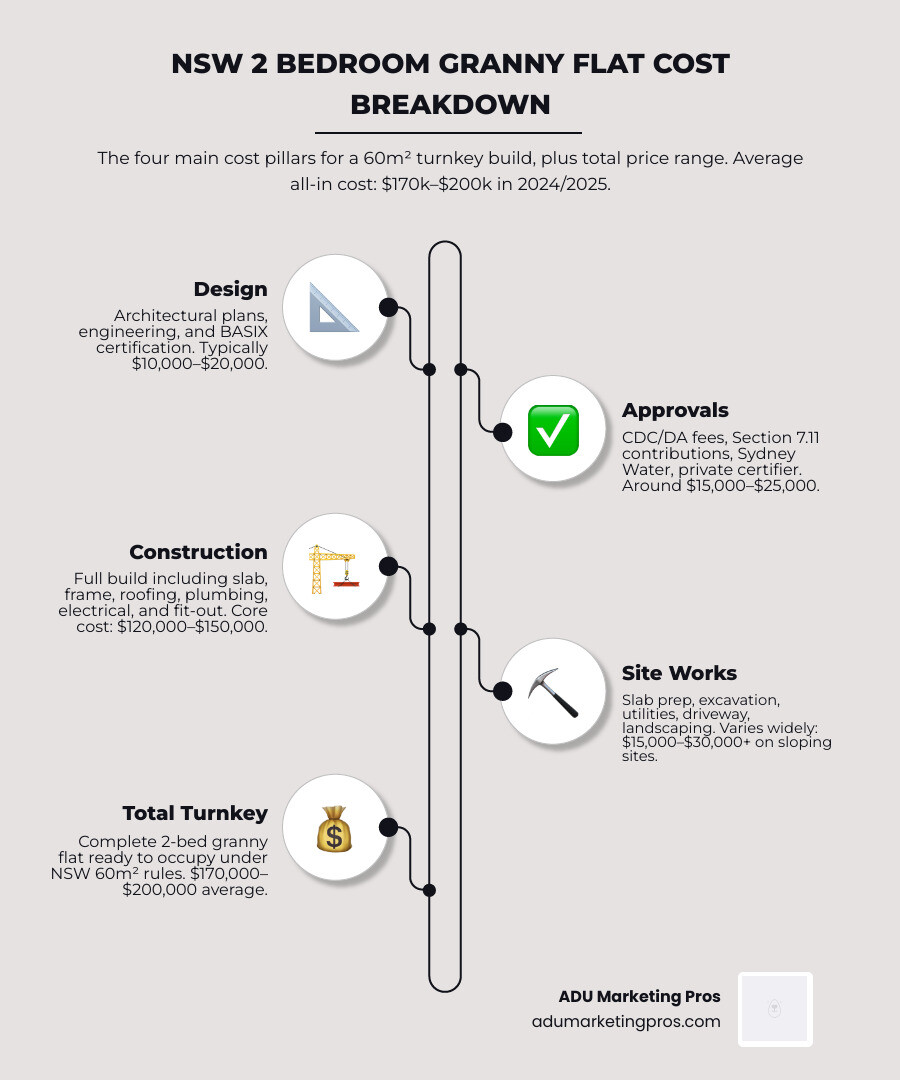
Glossary for 2 bedroom granny flats prices nsw:
Understanding 2 Bedroom Granny Flats Prices NSW: The 2024/2025 Cost Breakdown
When we look at the current market, it is clear that the “sticker price” and the “final price” are often two very different things. In NSW, the 60m2 limit is the benchmark for two-bedroom designs. This size aligns with the maximum internal floor area generally permitted for a secondary dwelling under the NSW planning framework when the project is eligible for the streamlined Complying Development pathway. It offers a practical balance between livability and a footprint that fits many suburban backyards.
The 60 Square Metre Rule Explained
It is important to understand that the 60m2 limit refers to the internal floor area. This is measured from the internal face of the external walls. This means you can often add a porch, a deck, or a small veranda that doesn’t count toward this 60m2 limit, provided it meets other setback and site coverage requirements. This is a crucial design trick to make a small home feel much larger. By adding a 15m2 deck, you effectively create a 75m2 living space, which significantly increases the comfort and rental appeal of the unit.
To help you visualize the tiers of pricing, here is a comparison of what homeowners can typically expect to pay in the current 2024/2025 market. These figures reflect ongoing pressure from labor costs, material pricing, and demand for skilled trades across Sydney and broader NSW:
| Size/Type | Basic Build (Shell) | Mid-Range Turnkey | High-End/Custom |
|---|---|---|---|
| Studio (30-40m2) | $80,000 – $100,000 | $120,000 – $140,000 | $150,000+ |
| 1-Bedroom (45-50m2) | $100,000 – $120,000 | $145,000 – $165,000 | $180,000+ |
| 2-Bedroom (60m2) | $135,000 – $150,000 | $170,000 – $195,000 | $210,000+ |
What Does “Turnkey” Actually Include?
As you can see, 2 bedroom granny flats prices NSW for a standard turnkey project average between $170,000 and $200,000. In practice, these complete packages often include architectural drawings, approvals, site preparation allowances, and full internal fit-outs. This is the most popular route for homeowners because it offers better price certainty and a single point of contact from design through handover.
A “turnkey” price means the unit is ready for someone to move in once the builder hands over the keys. This usually includes:
- Foundations: Concrete slab or engineered flooring system.
- Structure: Termite-treated timber or steel framing.
- Exterior: Cladding, roofing (Colorbond or tile), windows, and doors.
- Insulation: Meeting or exceeding BASIX requirements for thermal efficiency.
- Interior: Plasterboard, painting, flooring (carpet/hybrid/tiles).
- Kitchen: Cabinetry, stone or laminate benchtops, oven, cooktop, and rangehood.
- Bathroom: Full tiling, shower screen, vanity, toilet, and tapware.
- Electrical: LED downlights, power points, smoke alarms, and a sub-board.
If you are browsing granny flat designs, upgrades such as stone benchtops, 2.7m ceilings, premium cladding, upgraded glazing, or custom joinery can easily add $15,000 to $30,000 to the base price. It is also important to remember that the meaning of “turnkey” can vary from one builder to another. Some quotes include BASIX documentation, standard electrical upgrades, and basic landscaping, while others treat these as extras. Before comparing builders, ask for a full inclusions schedule so you can assess each quote on a like-for-like basis.
For current NSW planning rules and definitions, it is worth reviewing the official guidance from the NSW Planning Portal and the NSW legislation for housing and secondary dwellings.
Key Factors Influencing the Total Cost of Your Build
The structure itself is only part of the story. Homeowners are often surprised by how much the land conditions and service connections affect the final invoice. In many cases, the most expensive parts of a build are the elements you no longer see once the project is complete: the foundations, drainage, and underground utilities.
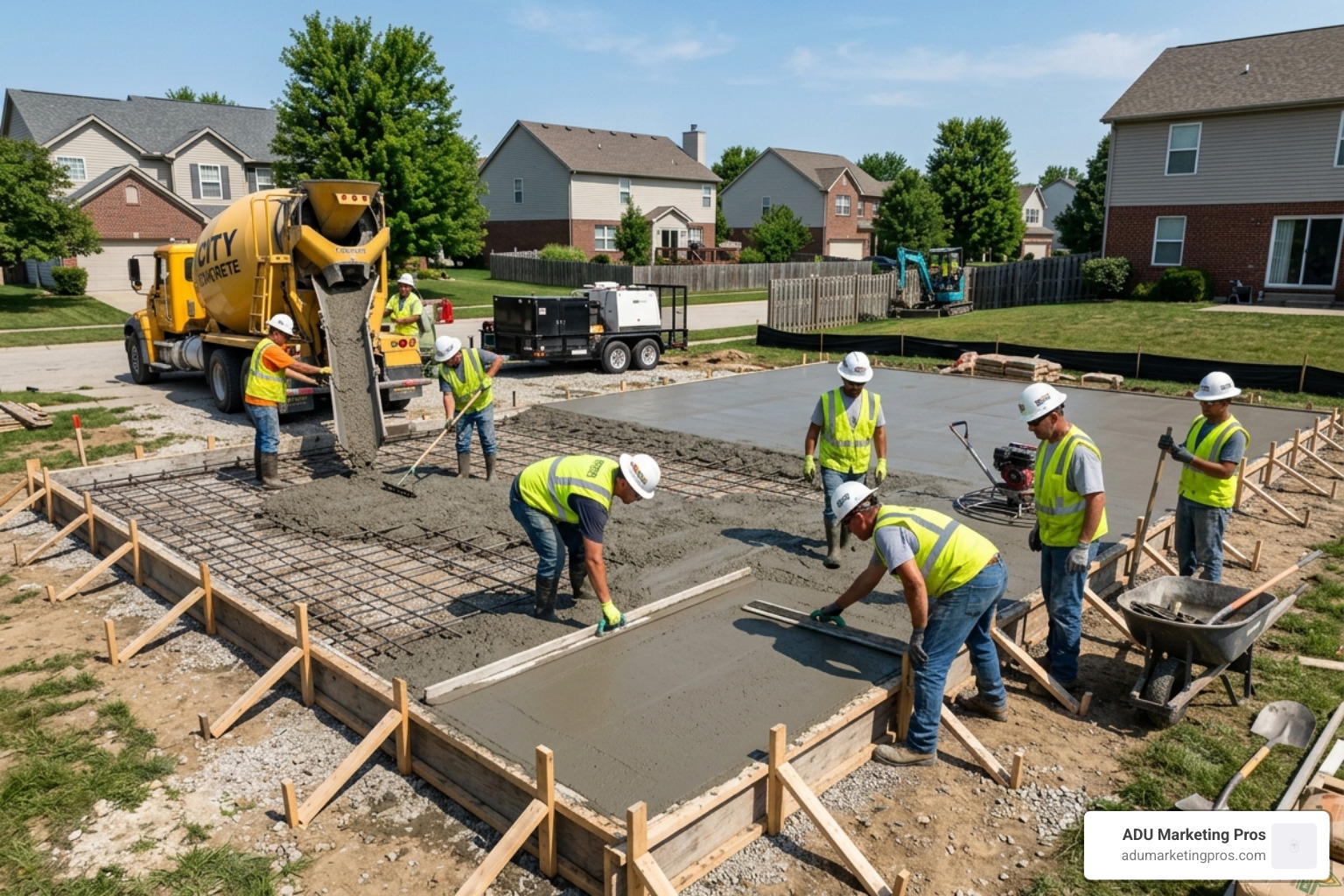
Site Preparation: The Invisible Cost
Site preparation is the biggest variable in most projects. If you have a flat block with good side access and no unusual planning constraints, costs tend to stay toward the lower end of the market range. If your backyard needs substantial excavation, drainage upgrades, or specialist engineering, the total price can rise quickly. Key cost drivers include:
- Soil Classification: A geotechnical engineer may need to assess the site conditions. Reactive clay soils (Class H or E) can require a stronger slab design and more reinforcement, often adding $3,000 to $8,000. If you are on rock, excavation costs can skyrocket.
- Utility Connections: Connecting sewer, water, electricity, and sometimes gas from the main dwelling to the granny flat is a major cost item. On some properties, this can range from $8,000 to $20,000 depending on distance and complexity. If your existing sewer line is deep or requires a new junction, expect higher costs.
- Access: If machinery, building materials, or prefabricated sections cannot easily reach the backyard, labor costs increase. Tight access (less than 1.5m) may also trigger crane hire or staged manual transport of materials, which can add $5,000 to $10,000 to the budget.
Technical Constraints and Compliance
Sloping blocks are common in many parts of NSW, including the North Shore, Illawarra, and Blue Mountains. On a slope, a standard slab may no longer be the most economical option. A raised floor system using bearers and joists can sometimes reduce the amount of excavation required, but it adds structural engineering and carpentry costs. Furthermore, you may need retaining walls to manage water runoff and soil stability.
Other hidden expenses can include:
- Bushfire Attack Level (BAL) Ratings: Building in or near bushfire-prone land can require upgraded windows, ember protection, and non-combustible materials. Depending on the BAL rating (e.g., BAL-29 or BAL-40), this may add $10,000 to $25,000.
- Trees and Root Zones: Protected trees may trigger arborist reports, specialized footing design (like screw piles), or construction exclusions around root systems. In some Sydney councils, removing a single tree can cost thousands in fees and replacement requirements.
- Sewer Encasement: If the build is close to or over existing Sydney Water sewer infrastructure, you may need to “encase” the sewer in concrete to protect it from the weight of the new building. This requires specialized contractors and inspections.
- BASIX Requirements: NSW has strict energy efficiency standards. To meet these, you might need specific insulation, double-glazed windows, or a particular type of hot water system. These are mandatory and can add $5,000 to $10,000 to a basic build.
If you are considering Modern Prefab Granny Flats, make sure the quote clearly identifies what is included beyond the delivered structure. Some prefab suppliers price the dwelling itself but leave groundwork, approvals, and services to the owner.
Regional Variations in 2 Bedroom Granny Flats Prices NSW
Location matters. Labor rates, delivery costs, local consultant fees, and builder availability all vary across the state.
- Sydney Metro: Expect a premium due to higher labor costs, tighter access, greater regulatory complexity, and generally higher overheads. Builders in Sydney are currently in high demand, which keeps prices firm.
- Central Coast and Newcastle: These markets can sometimes offer better value than inner Sydney while still supporting strong rental demand. There is a robust network of specialist granny flat builders in these regions.
- Regional NSW: Some construction costs may be lower, but transport, limited trades, and supply delays can offset those savings. If you are building in a remote area, you may have to pay for builder travel and accommodation.
Council Approvals and Compliance Fees
You cannot place a granny flat in a backyard without proper approvals. In NSW, the two main approval pathways are:
- Complying Development Certificate (CDC): Usually faster (approx. 20 days for approval) when the proposal satisfies state planning standards for setbacks, height, site coverage, and other criteria. This is the preferred route for most 60m2 builds.
- Development Application (DA): Required where the project does not qualify for CDC or where local planning controls (like heritage conservation areas) demand a more detailed assessment. This can take 3 to 6 months.
Associated costs can include:
- BASIX and energy compliance documentation ($500 – $1,500)
- Private certifier or council assessment fees ($2,500 – $5,000)
- Long service levy (0.25% of the build cost)
- Sydney Water or other authority approvals ($500 – $2,000)
- Section 7.11 contributions (Council developer contributions), which can range from $0 to over $20,000 depending on the local government area.
For official guidance, refer to the NSW Planning Portal and the Service NSW home building information pages. These sources are useful for checking current approval pathways, owner responsibilities, and licensing requirements.
Comparing Build Types: Turnkey, Custom, and Kit Homes
The method you choose to build will dictate your stress levels, the quality of the finish, and your final bank balance. While ADU Marketing Pros focuses on helping builders in California and NSW showcase their expertise, we believe homeowners should understand the pros and cons of each construction method.
The Reality of Kit and Prefab 2 Bedroom Granny Flats Prices NSW
We see many homeowners tempted by kit homes starting at $68,000. While these are great for experienced DIYers or licensed owner-builders, the “supply only” price is just the tip of the iceberg. You still need to pay for:
- Concrete slab or footings ($12,000 – $20,000)
- Licensed plumbing and electrical assembly ($15,000 – $25,000)
- Internal fit-out, including kitchens, bathrooms, and tiling ($20,000 – $40,000)
- Council approvals, insurances, and certificates ($8,000 – $12,000)
- Labor for assembly ($30,000 – $50,000)
When you add it all up, a kit home often ends up costing nearly as much as a professional build, but with significantly more risk. You won’t have a structural warranty from a single head builder, and if something goes wrong, the kit supplier will often blame the installer and vice versa. For those looking for speed, a Prefab Granny Flat California style modular build can save time on-site, but in NSW, site access remains the biggest hurdle for these pre-made units. If a crane can’t reach your backyard, the modular advantage disappears.
Check out our insights on Modular Granny Flats California to see how factory-built homes compare to traditional on-site construction in high-demand markets.
Custom Turnkey Solutions vs. Standard Project Builds
A Standard Project Build uses a pre-existing floor plan that the builder has constructed dozens of times. Companies like Clarendon Homes or Backyard Grannys offer these at a lower price point because the engineering, design work, and material take-offs are already done. For example, a standard 60m2 model often starts around $145,000 for the base build. These are efficient, but you have limited ability to change the layout without incurring significant “variation” costs.
A Custom Turnkey Solution is for those who want the flat to match the architecture of their main home or have a very specific layout in mind – perhaps a larger kitchen for a keen cook or wider doorways for wheelchair access. While this adds $20,000 to $40,000 to the price, it often results in a higher property valuation. As we discuss in Prefab Granny Flats In California Grannys Got A Brand New Pad, a well-designed secondary dwelling should feel like a natural extension of the property, not a shipping container dropped in the grass. Custom builds allow for better orientation to maximize natural light, which can significantly reduce future energy bills.
The Construction Timeline: What to Expect
Building a granny flat isn’t an overnight process. A typical timeline looks like this:
- Phase 1: Design & Documentation (4-6 weeks): Drafting plans, soil tests, and engineering.
- Phase 2: Approvals (4-12 weeks): CDC or DA approval process.
- Phase 3: Site Works (2 weeks): Excavation, plumbing rough-in, and slab pour.
- Phase 4: Framing & External (4-6 weeks): Walls, roof, windows, and cladding.
- Phase 5: Internal Fit-out (6-8 weeks): Electrical, plastering, kitchen, bathroom, and painting.
- Phase 6: Completion (2 weeks): Final inspections and Occupation Certificate.
Investment Potential and ROI for NSW Homeowners
Is spending $180,000 on a backyard flat worth it? For many NSW homeowners, the numbers can stack up well, especially in suburbs where rental demand is strong and land values are already high. Whether the goal is housing family members, creating a long-term rental stream, or improving resale appeal, a well-designed granny flat can become a highly productive asset.
Rental Yield Analysis
In many parts of Sydney, the Central Coast, and Newcastle, a two-bedroom granny flat can rent for around $500 to $650 per week. Using a $175,000 build cost as a rough example:
- Annual Rent: $26,000 at $500 per week
- Gross Yield: About 14.8%
- Indicative Payback Period: Around 6.7 years before financing, maintenance, and vacancy costs
That compares favorably with the lower gross yields (often 2-4%) seen on standalone investment properties in metropolitan Sydney. Because you already own the land, your capital is working much harder. Furthermore, the addition of a granny flat can increase the overall value of your property by more than the cost of the build, particularly in areas where “dual occupancy” is highly sought after by investors.
Tax Benefits and Depreciation
There can also be tax benefits when the dwelling is used as an income-producing asset. Because a granny flat is new construction, owners may be able to claim depreciation on the building itself (Capital Works Deduction) and on eligible fixtures and fittings (Plant and Equipment), subject to tax advice. This can significantly offset the tax payable on the rental income.
Additionally, the Australian government recently introduced changes to Capital Gains Tax (CGT) for granny flats used for family members. Under certain conditions, CGT may not apply to the creation, variation, or termination of a granny flat interest for an older person or a person with a disability. Anyone considering this strategy should speak with a qualified accountant or quantity surveyor before relying on estimated savings.
Financing Your Secondary Dwelling
Most NSW homeowners fund a granny flat through one of the following:
- Home equity loan: Using the existing equity in your primary residence is often the most cost-effective way to finance the build.
- Construction loan: This involves staged drawdowns where the bank pays the builder at specific milestones (Slab, Frame, Enclosed, etc.).
- Line of credit: For owners with strong equity, this provides flexibility but often carries a slightly higher interest rate.
For broader market context, rental demand and tax settings should always be checked against current official or professional guidance, including the Australian Taxation Office and relevant state property resources.
How to Choose a Reputable Builder and Avoid Low-Ball Quotes
The most expensive granny flat is the one that stays half-finished because the builder went broke or “discovered” $40,000 in extra costs halfway through the project. The industry is full of stories of homeowners who chose the cheapest quote only to regret it months later. In NSW, the building industry is strictly regulated, but it is still up to the consumer to do their due diligence.
The Vetting Process
To protect yourself and your investment, we recommend following these four steps:
- Verify the License: Check the builder’s name on the Service NSW public register. Ensure they have a valid contractor license and carry “Home Building Compensation Fund” (HBCF) insurance for any project over $20,000. This insurance protects you if the builder dies, disappears, or becomes insolvent. Never pay a deposit before seeing the HBCF certificate for your specific project.
- Ask for an Itemized Quote: If a quote just says “Construction of 2-bedroom flat – $150,000,” do not sign it. You want to see specific allowances for site works, utility connections, council fees, and internal finishes. A professional builder will provide a document that is 10-20 pages long, detailing every tap, tile, and light fitting. This prevents “hidden surprises” later.
- Beware of “Prime Cost” (PC) Sums and Provisional Sums: These are “placeholders” for things the builder hasn’t finalized. If a builder puts a $500 allowance for a kitchen sink but the one you actually want costs $1,200, you will be paying the $700 difference later. High PC sums are a red flag that the quote is artificially low to win the job.
- Visit a Display Home: Don’t just look at photos on a website. Visit a physical display in places like Sylvania, Parklea, or Panania. This allows you to see the quality of the joins, the height of the ceilings, and the feel of the materials. If a builder doesn’t have a display home or a recently completed project you can visit, proceed with extreme caution.
Contract Types: Fixed Price vs. Cost Plus
In the current market, we strongly recommend a Fixed Price Contract. This puts the risk of material price increases on the builder. A “Cost Plus” contract, where you pay the cost of materials plus a percentage for the builder, can be dangerous in an inflationary environment. Ensure your contract is a standard industry document, such as those provided by the Housing Industry Association (HIA) or Master Builders Association (MBA).
At ADU Marketing Pros, we work with builders who prioritize transparency. We believe that the best marketing for a construction firm is a portfolio of happy clients and clear, honest pricing. Whether you are looking for a builder in San Jose or Sydney, these vetting steps are universal.
Frequently Asked Questions about NSW Granny Flat Costs
How long does it take to build a 2-bedroom granny flat in NSW?
Typically, the full process takes 6 to 9 months. That often includes 1 to 2 months for concept design, documentation, and approvals, followed by around 12 to 20 weeks of construction. Delays can come from weather, engineering revisions, material lead times, and builder scheduling. If you are using a DA pathway instead of CDC, add another 3 months to the timeline.
Can I build a granny flat on a sloping block?
Yes, but it usually costs more. A sloping site may require excavation, drainage works, retaining walls, or a suspended floor system. As a general guide, owners should allow an additional $15,000 to $30,000 depending on the gradient and engineering complexity. In some cases, a pole-home design is more cost-effective than a slab on a steep slope.
What is the maximum size for a granny flat in NSW?
The commonly referenced limit is 60 square metres of internal living space for a secondary dwelling in NSW under the standard planning pathway (SEPP). Non-habitable areas such as porches, decks, or some covered outdoor spaces may be treated differently, depending on the design and approval method. Some local councils allow larger sizes under a DA, but this is rare and subject to strict controls.
Do I need to provide a parking space for the granny flat?
Under the standard NSW state planning rules (the Housing SEPP) for many compliant secondary dwellings, an extra off-street parking space is often not required. However, site-specific conditions, local planning controls, or a DA pathway can affect this. If you are in a heritage area or a specific environmental zone, the rules may differ.
Can I have a separate electricity and water meter?
Yes, and it is highly recommended if you plan to rent the unit out. While it adds about $2,000 to $4,000 to the initial cost, it allows you to bill the tenant directly for their usage, avoiding disputes and making the investment much easier to manage.
Where can I verify builder licensing and insurance in NSW?
You can check contractor licence details and related consumer information through Service NSW. Before signing a contract, confirm the builder is properly licensed and that the required insurance arrangements (HBCF) are in place.
Conclusion
Navigating 2 bedroom granny flats prices NSW requires looking past the flashy advertisements and understanding the true cost of construction in 2025. While a “starting price” of $140,000 sounds attractive, a realistic budget of $170,000 to $200,000 ensures you get a high-quality, compliant home that adds genuine value to your property and provides a comfortable living space for your family or tenants.
At ADU Marketing Pros, we understand that the secondary dwelling market is moving fast, both in Australia and across the United States. We specialize in helping builders and architects in this niche stand out by highlighting their expertise and transparency rather than just competing on the lowest price. From our base in San Jose, California, we monitor global trends to provide our clients with the most effective digital marketing strategies. If you are a builder looking to grow your revenue and attract high-quality leads in the booming NSW or California markets, our ADU Marketing Solutions are designed to help you dominate your local area.
Building a granny flat is a significant investment, but with the right builder and a clear understanding of the costs, it is one of the best financial moves a NSW homeowner can make. By focusing on quality and compliance today, you ensure a stress-free experience and a valuable asset for decades to come. Whether you are building for a loved one or for a rental return, the key is to plan thoroughly, budget realistically, and choose a builder who values honesty as much as craftsmanship.