
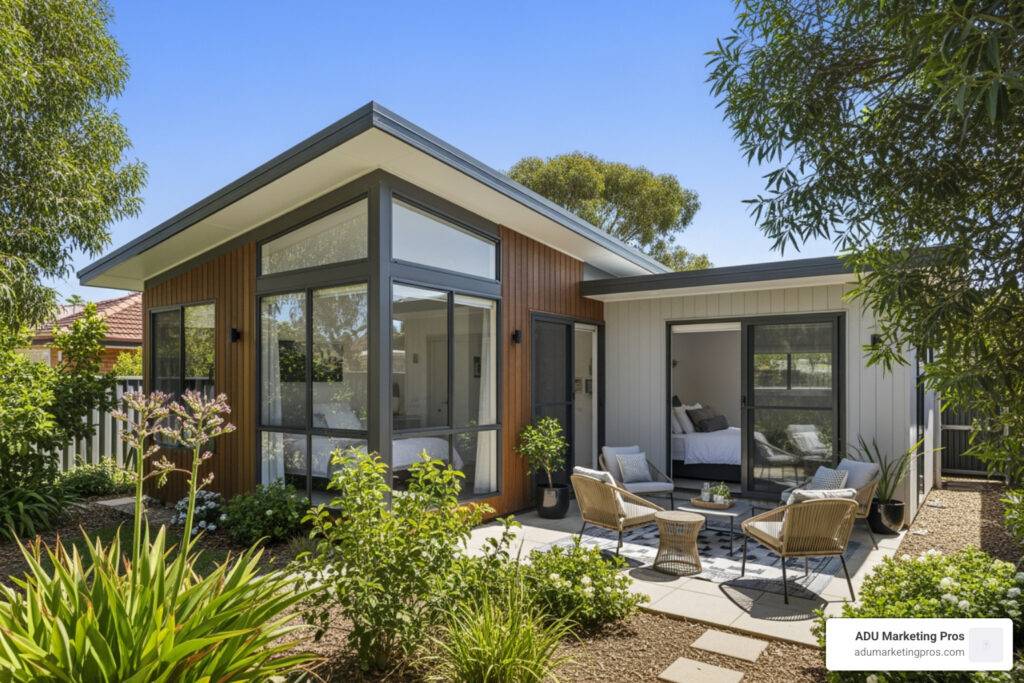
Introduction
At ADU Marketing Pros, headquartered in San Jose, CA, we serve ADU builders and designers across California—from the San Francisco Bay Area to Los Angeles and San Diego. A core part of our strategy is tracking global regulatory and pricing trends because they consistently foreshadow what happens next in our home markets. Right now, Western Australia (WA) offers one of the most compelling case studies in the world for how zoning reform supercharges ADU demand. The parallels between the Perth metropolitan area and the Silicon Valley housing market are striking, particularly in how homeowners respond to legislative shifts that unlock the potential of their backyards.
WA is currently navigating one of the most significant housing shifts in its history. As the state grapples with a persistent housing shortage and a rental vacancy rate that has plummeted to record lows, homeowners from Perth to Margaret River are turning to their own backyards for solutions—whether to house aging parents in a safe and familiar environment, provide a launchpad for adult children struggling with the cost of living, or generate reliable rental income. The demand for secondary dwellings has skyrocketed, and the resulting 1 bedroom granny flats wa price list data provides a fascinating benchmark for anyone in the ADU industry, offering insights into material costs, labor trends, and consumer preferences.
For our California-based ADU clients in San Jose, Sunnyvale, Palo Alto, Mountain View, Menlo Park, Los Angeles, and San Diego, the takeaway is powerful: when regulations loosen and the rental market tightens, homeowners act quickly. Understanding how WA’s market has responded to reform helps our builder and designer clients anticipate demand shifts, refine their pricing strategies, and communicate value to homeowners more effectively. By analyzing the Western Australian model, we can better predict the trajectory of the California market as it continues to mature under its own progressive ADU laws.
In April 2024, the Western Australian government introduced landmark zoning reforms that removed minimum lot size requirements for granny flats, effectively unlocking thousands of suburban backyards that were previously restricted. This mirrors the progressive ADU legislation California has enacted in recent years, such as SB 9 and subsequent updates, and the pricing dynamics that follow are strikingly similar. For readers who want to verify the source policy details directly, see the WA Government’s planning reform updates: https://www.wa.gov.au/government/announcements
To understand the broader housing conditions driving demand in Perth and regional WA, you can also reference the Australian Bureau of Statistics housing and construction data: https://www.abs.gov.au/statistics/industry/building-and-construction. This data highlights the critical need for diverse housing types, a need that is being met by the rapid expansion of the granny flat sector.
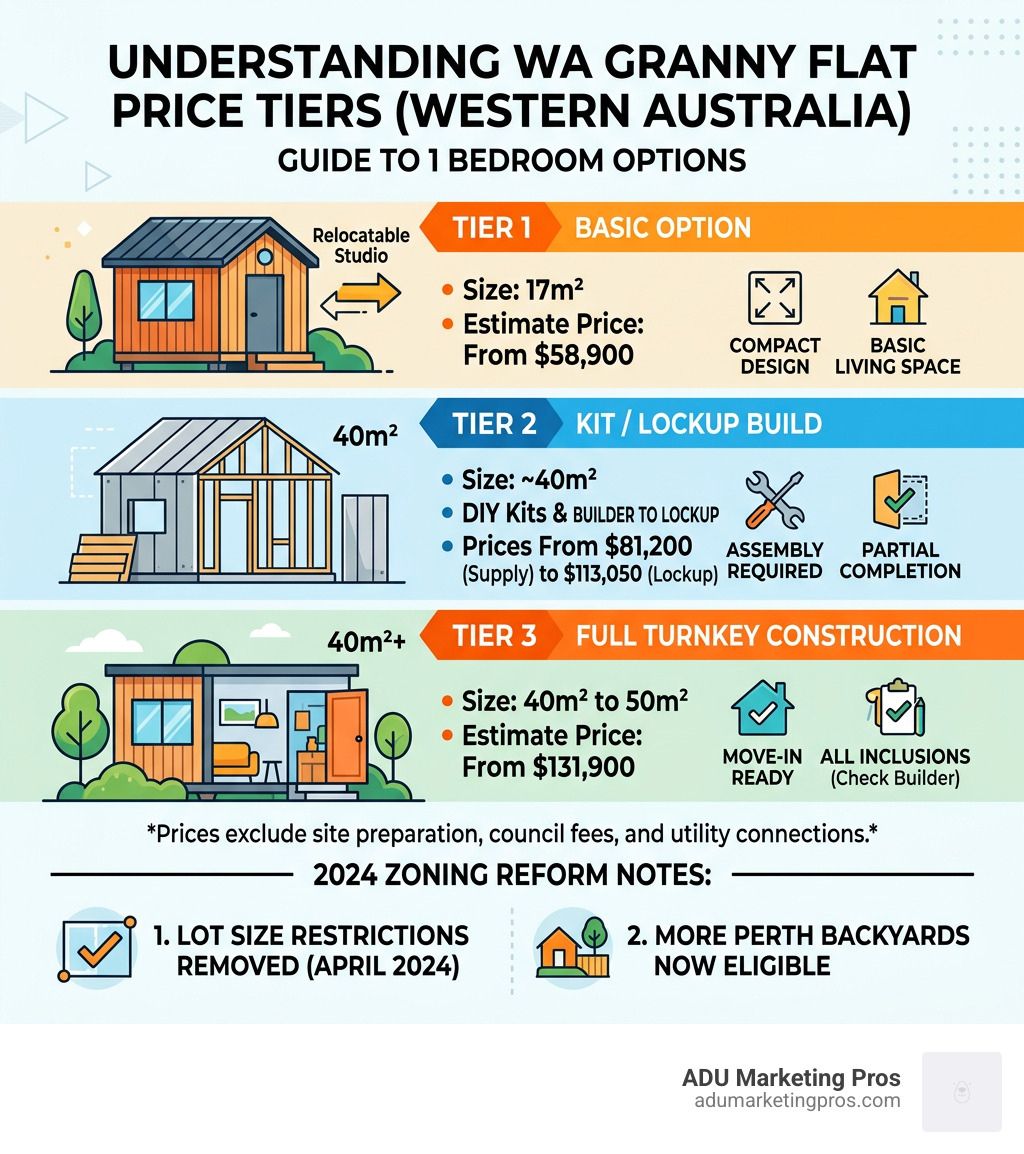
This guide provides a comprehensive breakdown of WA’s current market rates and what they reveal about ADU pricing worldwide. Whether you are a builder looking to benchmark your California pricing or a homeowner researching the global ADU landscape, this analysis will help you move from the research phase to the action phase with confidence. We will explore the nuances of construction methods, the impact of site-specific variables, and the long-term return on investment that these small-scale dwellings provide.
What Does a 1 Bedroom Granny Flat Actually Cost in WA?
The 1 bedroom granny flats wa price list in Western Australia spans a wide range—from under $60,000 AUD for a compact relocatable studio to over $175,000 AUD for a fully turnkey steel-frame build. For California ADU builders and designers, these figures offer a useful international benchmark. While the dollar amounts differ from US pricing due to currency exchange and local labor rates, the cost structure and the factors that drive price variation are remarkably consistent across both markets. In both regions, the “base price” is often just the starting point of a more complex financial journey.
Here’s a quick snapshot of the current WA market rates for 2024/2025, reflecting the diverse options available to homeowners:
| Option | Size | Price Range (AUD) |
|---|---|---|
| Relocatable studio (VanHomes) | 17m² | From $58,900 |
| DIY supply-only kit (Scandi Cabins) | 40m² | From $81,200 |
| Builder to lockup | 40m² | From $113,050 |
| Full turnkey (Scandi Cabins) | 40m² | From $131,900 |
| Steel frame turnkey (Summit Homes) | 50m² | From $161,305 |
| Panel construction (Fox Granny Flats) | 40m²+ | From ~$86,000 |
Note: Prices above are in Australian dollars and exclude site preparation, council fees, and utility connections. These “soft costs” can vary significantly based on the specific local government area (LGA) and the physical characteristics of the lot.
Why is there such a massive discrepancy between the low and high ends? It comes down to the “Three Pillars of Build Cost”: construction method, builder reputation, and inclusions. In Western Australia, the market is split between traditional builders who use steel or timber frames and innovative manufacturers who use insulated panels (EPS). Each has its own price profile and long-term value proposition—a dynamic that California ADU firms in San Jose, Los Angeles, and San Diego will immediately recognize from their own markets. For instance, a steel-frame build offers a sense of permanence and traditional aesthetics, while panel construction prioritizes speed and thermal efficiency.
For homeowners in Perth, the removal of lot size restrictions means that even those on 300m² or 400m² blocks can now consider these options. This has led to a diversification of the market, with more “compact luxury” models entering the price list. Our ADU builder clients in Palo Alto and Mountain View see the same trend: as regulations open up smaller lots, demand shifts toward high-end finishes in smaller footprints. Homeowners are increasingly willing to pay a premium for clever design that maximizes every square inch, incorporating features like high ceilings, large windows, and integrated storage to make a small space feel expansive.
Understanding the 1 Bedroom Granny Flats WA Price List
When we analyze a 1 bedroom granny flats wa price list, we aren’t just looking at a single number. The “price” of a granny flat is highly dependent on the level of service chosen. In Western Australia, most providers offer three distinct tiers of pricing: DIY Supply-Only, Builder-to-Lockup, and Full Turnkey. This tiered structure is nearly identical to what we see in the California ADU market, where firms in San Jose, Sunnyvale, and Los Angeles offer varying levels of involvement for the homeowner, ranging from pure consulting to full design-build services.

The Three Main Pricing Tiers
To help illustrate how pricing works across different delivery methods, we’ve broken down the typical WA costs below. California ADU builders will notice the parallels to their own pricing models, particularly the way labor and project management fees scale with the level of service.
| Service Level | What’s Included? | Price Range (40m² – 50m², AUD) |
|---|---|---|
| DIY Supply-Only Kit | Flat-pack materials, frame, windows, doors, and roofing. You handle the slab and labor. | $80,000 – $105,000 |
| Builder-to-Lockup | Foundation (slab), frame, and external shell completed. Interior is a “blank canvas” for you to finish. | $110,000 – $145,000 |
| Full Turnkey | 100% finished. Plumbing, electrical, kitchen, bathroom, painting, and flooring included. | $145,000 – $200,000+ |
In Perth and greater WA, the ADU Building Costs are influenced by the 2024 regulations which have made it easier to build but haven’t necessarily lowered the cost of materials. A standard 40m² unit often requires a 7525mm x 5500mm footprint with a 100mm reinforced concrete slab foundation. If you are trying to calculate the Cost to Build ADU, the base price on a brochure rarely includes the “dirty work” like connecting the sewer or leveling a sloped backyard—a universal truth whether you’re building in Perth or Palo Alto. Homeowners must account for these site-specific costs early in the planning phase to avoid budget overruns.
Comparing 1 Bedroom Granny Flats WA Price List by Square Meterage
Size is the most obvious price driver. While a 30m² “investor special” might seem like the cheapest option, the cost per square meter often drops as the unit gets larger because fixed costs (like the bathroom and kitchen) are spread over a larger area. This is a principle we frequently discuss with our architecture clients in Palo Alto and Menlo Park when they are designing for maximum efficiency and value.
- 30m² Investor Models (from ~$80,000 AUD): These are often narrow (approx. 7.5m x 4m) and designed specifically for rental yield. They are popular for students or single retirees who prioritize function over form. These units focus on essential amenities and durable finishes.
- 40m² Compact Living (from ~$130,000 AUD turnkey): This is the “sweet spot” for many WA homeowners. It allows for a separate bedroom and a functional L-shaped kitchen without taking up the whole backyard. It provides a balance between affordability and livability.
- 50m² Standard (from ~$160,000 AUD turnkey): These models offer a more residential feel with larger living areas and often include a small porch or veranda. They are ideal for long-term residents who require more space for furniture and personal belongings.
- 60m² Luxury/Large (from ~$185,000 AUD turnkey): At 60m², you can start looking at Z-shaped layouts that create distinct zones for sleeping and living, often including a separate laundry area and higher-end appliances.
For those looking at relocatable options, the Pricing Guide | VanHomes Granny Flats shows that smaller “Studio Suites” (around 17m²) can start as low as $58,900 AUD. When browsing various Granny Flat Designs, always check if the price includes the “wet areas” (kitchen and bathroom), as some “shell” prices can be misleadingly low, leaving the homeowner with significant additional expenses for plumbing and cabinetry.
Price Differences Between Steel Frame and Panel Construction
The method of construction significantly impacts the 1 bedroom granny flats wa price list, and the same debate plays out in California’s ADU market between traditional stick-built and modern prefab methods.
Steel Frame Construction Traditional builders in Perth often favor steel frames. They are termite-proof, straight, and incredibly durable—essential for the harsh WA climate. A 50m² steel-frame 1-bedroom unit typically starts around $161,305 AUD. The benefit is the “house-like” feel and long-term structural integrity, which can be a major selling point for resale value.
Panel (EPS) Construction Companies like Fox Granny Flats use insulated panels (EPS). This method is generally faster and can be more cost-effective, with 1-bedroom models starting around $86,000 AUD for the structure. These are often manufactured off-site and transported to the lot. This “prefab” approach is gaining massive traction in California as well, with Modern Prefab Granny Flats becoming the preferred choice for homeowners in Mountain View and San Jose who want to minimize construction noise and disruption. The thermal efficiency of these panels also leads to lower ongoing energy costs for the occupant.
If you’re researching a Prefab Granny Flat California style build, you’ll find that the speed of assembly is a major selling point globally, often cutting build times down to just a few months compared to the year-long wait times for traditional construction. This speed is particularly valuable in high-demand rental markets where every month of construction represents lost income.
Factors Influencing Your Total Build Investment
The sticker price is just the beginning of the financial commitment. At ADU Marketing Pros, we always advise our California ADU builder clients to help their customers look beyond the brochure. Several “hidden” factors can add $20,000 to $50,000 to the total investment, regardless of whether the project is in Perth or the San Francisco Bay Area. Transparency in these costs is what builds trust between a contractor and a homeowner.
Site Preparation and Council Fees
Perth’s sandy soil is generally good for building, but sloped sites require retaining walls and specialized engineering. Site clearing, leveling, and the removal of existing trees or old sheds can cost between $5,000 and $10,000 AUD. Council planning fees and building permits usually range from $1,000 to $2,000 AUD, though these can vary by shire. In California, these same categories—grading, demolition, and permitting—are consistently the items that catch homeowners off guard, often requiring environmental impact studies or heritage reviews in certain neighborhoods.
Utility Connections
This is where many budgets break. Connecting a new flat to existing sewer, water, and electricity lines can be expensive, especially if the flat is located far from the main house or if the existing infrastructure is aged. If the existing switchboard needs an upgrade to handle the additional load of a second kitchen and air conditioning system, expect to add $2,000 to $4,000 AUD. In some cases, a separate meter may be required by the utility provider, adding further complexity and cost.
Properties with a high Bushfire Attack Level (BAL) rating in WA face additional costs for specialized toughened glass, non-combustible roofing, and specific sealing techniques to prevent ember attack. Much like the fire-prone regions of California, these requirements add meaningful cost but are essential for safety and insurance compliance. For a deeper look at how these variables change based on location, see our ADU Cost Per Square Foot analysis. Even in other US markets, the Cost to Build a DADU in Seattle (2025–2026 Update) highlights that permitting and utility hookups remain the most volatile part of the budget, often requiring significant contingency funds.
Standard Inclusions in Turnkey Pricing
A “Turnkey” price should mean you can turn the key and move in, but the definition of “quality” can vary. Typical inclusions in a quality WA turnkey package include:
- Roofing: Colorbond steel roofing, gutters, and downpipes (essential for WA’s heavy winter rains and high UV exposure).
- Windows/Doors: Aluminium-framed sliding windows with flyscreens and key locks for security.
- Kitchen: Cabinetry, stone or laminate benchtops, and a stainless steel sink. High-quality builders will also include a cooktop and oven.
- Insulation: High-quality batts in the ceiling and walls to meet the 6-star energy rating required in WA, ensuring year-round comfort.
- Floor Coverings: Hybrid flooring or carpets in living areas and tiled bathrooms for durability and moisture resistance.
This all-inclusive approach mirrors the Prefab Granny Flats in California: Granny’s Got a Brand New Pad model that our California builder clients use to deliver a stress-free experience for homeowners. By providing a comprehensive list of inclusions, builders can reduce the “decision fatigue” that often plagues homeowners during a construction project.
Hidden Costs and Contingency Budgeting
We always recommend a 10-20% contingency fund. If builders hit rock while digging the slab or if utility lines aren’t where the diagrams say they are, that buffer becomes essential. Items like landscaping, clotheslines, and letterboxes are rarely included in the base 1 bedroom granny flats wa price list. If you’re comparing this to a Prefab ADU California Cost, you’ll notice that site-specific costs are the universal “budget killer” in the ADU world—a key insight for builders positioning their pricing in any market. Proper planning and a thorough site survey can mitigate some of these risks, but a financial buffer is always the safest strategy.
Maximizing ROI: Rental Income and Property Value in Perth
Building a granny flat isn’t just an expense; for many, it’s a strategic investment designed to build long-term wealth. In Perth suburbs like The Vines, where the median house price is around $1.1 million AUD, adding a high-quality 1-bedroom unit can significantly boost property value. This is a trend we see across our California service areas in Los Angeles, San Diego, and the Bay Area, where homeowners use ADUs to offset high mortgage costs and increase their equity. For ADU builders, understanding these ROI dynamics is essential for effective client communication and sales.
Rental Potential
Perth’s rental market is incredibly tight, with vacancy rates often hovering below 1%. A well-presented 1-bedroom granny flat in a desirable suburb can generate $400 – $500 AUD per week. This rental yield often covers the loan repayments for the build, making the unit “self-funding”—a value proposition that resonates just as strongly with homeowners in San Jose or San Francisco. In many cases, the rental income can even provide a surplus, contributing to the homeowner’s overall financial stability.
Whether you are marketing Modular Granny Flats California or analyzing WA builds, the trend is the same: self-contained living is in high demand. For builders targeting high-density areas, a Granny Flat San Francisco style of compact, high-end finishing can help attract professional tenants and maximize ROI. In Perth, proximity to public transport and major employment hubs dictates rental pricing—just as proximity to tech campuses drives ADU rents in Silicon Valley. Homeowners who invest in quality finishes and modern amenities often see a faster return on their investment through higher rents and lower vacancy periods.
Capital Appreciation
Beyond rental income, a granny flat adds tangible value to the primary residence. Real estate agents in Western Australia report that properties with a legal, well-built secondary dwelling are highly sought after by multi-generational families and investors alike. This “dual-living” capability makes a property more resilient to market fluctuations. For a homeowner, the cost of the build is often immediately reflected in an increased property valuation, sometimes exceeding the initial investment. This capital appreciation is a key component of the long-term financial benefit of adding a granny flat to a Western Australian property.
Navigating the 2024/2025 WA Zoning Reforms
The landscape for granny flats in Western Australia changed dramatically in April 2024, marking a new era for urban infill. The most significant update was the removal of the minimum lot size requirement. Previously, homeowners needed a certain amount of land (often 450m² or more) to be allowed a secondary dwelling; now, if it fits and meets the R-Codes (Residential Design Codes), it can likely be built. For California ADU professionals, this reform is a near-perfect parallel to the state-level ADU legislation that has driven the boom in San Jose, Los Angeles, and across the Bay Area, where local “NIMBY” restrictions were overridden by state mandates.
Key Changes to Remember:
- No more lot size minimums: Small urban lots in suburbs like Subiaco or Victoria Park are now eligible, allowing for increased density in established areas.
- Size limits: While lot size rules are gone, most shires still have a maximum floor area for granny flats (often 70m², though it varies by local government area). This ensures the secondary dwelling remains subordinate to the main house.
- Setbacks: A 1-meter distance from boundaries is generally required, though specific local councils may have more restrictive “visual privacy” requirements, such as screening for windows that overlook a neighbor’s yard.
These reforms are supported by Scientific research on urban density and ADUs, which suggests that increasing “gentle density” through backyard housing is one of the most effective ways to combat housing shortages without destroying neighborhood character. This data-driven approach is exactly what we use at ADU Marketing Pros to help our builder and designer clients in San Jose, Palo Alto, Sunnyvale, and across California communicate the value of their projects to homeowners and planning boards alike. By framing ADUs as a solution to the housing crisis rather than a threat to the neighborhood, builders can navigate the approval process more smoothly and build stronger community support.
Frequently Asked Questions about WA Granny Flats
How long does the average build take in Western Australia?
In the current market, a traditional brick-and-mortar build can take 12 months or more due to labor shortages and supply chain constraints. However, many specialist granny flat builders in WA have streamlined this process. Steel-frame or factory-built panel homes can often be completed in about 6 months from the time the slab is poured. Because much of the work is done off-site in a controlled environment, weather delays are minimized, and quality control is often superior to traditional on-site construction.
Do I need a 1 bedroom granny flats wa price list for a bank loan?
Yes. If you are seeking a construction loan or using equity to fund the build, the bank will require a fixed-price contract. They want to see exactly what the money is being spent on and ensure the project is financially viable. Having a detailed price list from a reputable builder helps the bank’s valuer determine the “as-if-complete” value of your property, which is crucial for securing the loan. This is standard practice from Perth to San Francisco, and having a clear, transparent budget is the first step in securing financing.
What is the difference between a granny flat and a tiny home in WA?
This is a common point of confusion for many homeowners, and the legal distinctions are critical!
- Granny Flats: These are permanent structures fixed to the ground (usually on a concrete slab or stumps). They must comply with the Building Code of Australia (BCA) and require council approval. They are considered permanent additions to the property and add significant value. They are connected to permanent utilities and are designed for long-term habitation.
- Tiny Homes on Wheels: These are technically classified as caravans. While they are cheaper and don’t require a slab, they have strict rules about how long someone can legally live in them permanently. They do not add the same long-term capital growth to your property as a legal granny flat and may face challenges with insurance and financing.
Can I rent out my granny flat to a stranger in WA?
Yes! One of the biggest changes in recent years is that you no longer have to be related to the person living in the granny flat. You can rent it out to anyone, making it a true investment property. This has been a game-changer for ROI in the Perth market, allowing homeowners to tap into the high demand for affordable rental housing. This change has also encouraged more professional investors to enter the granny flat market, further driving innovation and quality in the sector.
Does a granny flat require its own parking space?
Under the new WA R-Codes, the requirement for a dedicated parking space for a granny flat has been relaxed in many areas, particularly those close to high-frequency public transport. However, it is always essential to check with your local council, as some shires still maintain their own specific requirements to manage street parking and traffic flow. Providing off-street parking can often make a rental unit more attractive to potential tenants.
Conclusion
The 1 bedroom granny flats wa price list offers a valuable window into how ADU markets respond to zoning reform and housing pressure. From construction type to the 2024 regulatory changes, the dynamics in Western Australia closely mirror what we see in California—and understanding these global trends gives ADU builders and designers a competitive edge. The shift toward smaller, more efficient, and more affordable housing is a global phenomenon, and those who can deliver high-quality solutions in this space are well-positioned for success.
At ADU Marketing Pros, we don’t build the flats, but we help the people who do. We specialize in marketing solutions for ADU construction and architecture firms, helping them showcase their expertise, attract high-quality leads, and grow revenue. Whether you are a builder looking to capitalize on California’s booming ADU market or a firm seeking to stand out against competitors, we provide the data-driven strategies you need to grow. Our deep understanding of both the local and global ADU landscape allows us to craft messages that resonate with today’s homeowners.
Our team is proud to serve the following locations with specialized ADU marketing expertise:
- San Jose
- San Francisco Bay Area
- Los Angeles
- San Diego
- Sunnyvale
- Palo Alto
- Mountain View
- Menlo Park
If you’re an ADU builder or designer looking to dominate your local market, we’re here to help you grow. For more information on how we help the industry thrive, visit our ADU Marketing Solutions page. Let’s work together to build the future of housing, one backyard at a time.