
LA Garage Conversion vs. Detached ADU Costs at a Glance
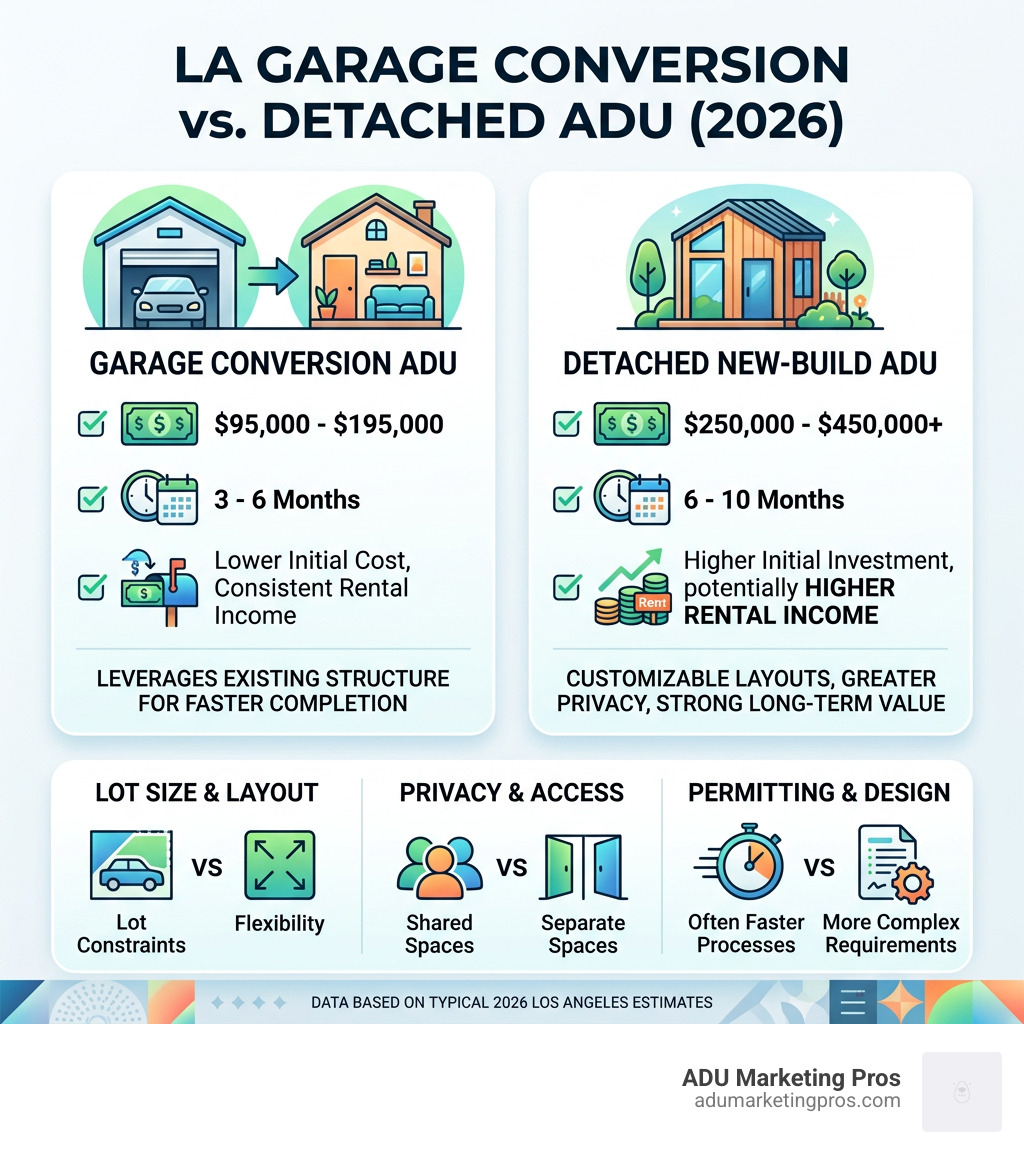
For an ADU vs garage conversion cost comparison in LA, a garage conversion is almost always the lower-cost, faster route to adding legal living area. In 2026, a permitted Los Angeles garage conversion typically runs between $95,000 and $195,000, whereas a ground-up detached accessory dwelling unit (ADU) commonly ranges from $250,000 to $450,000 or more.
| Option | Typical 2026 LA Budget | Typical Cost Per Sq. Ft. | Project Timeline | Primary Advantage |
|---|---|---|---|---|
| Garage Conversion ADU | $95,000 – $195,000 | $250 – $450 | 4 – 8 months | Lower capital entry, faster path to rental income |
| Detached New-Build ADU | $250,000 – $450,000+ | $350 – $600 | 10 – 16 months | Architectural freedom, privacy, higher property resale appraisal |
The substantial price delta exists because an attached or detached conversion leverages an established structural envelope. By utilizing existing concrete footings, perimeter wood framing, exterior cladding, and roof trusses, conversions bypass substantial excavation and framing expenses. Conversely, building a detached ADU from scratch requires comprehensive civil grading, soil testing, poured concrete foundations, engineered shear walls, dedicated exterior finishes, and long utility trenches cut across the yard.
However, converting a garage is rarely as simple as putting up drywall. Structural retrofits, floor moisture mitigation, Title 24 energy envelope mandates, and mandatory electrical service upgrades can quickly impact the bottom line if not evaluated early. Homeowners must balance their available liquid capital, backyard recreation desires, vehicular parking requirements, and long-term investment horizon.
For ADU builders and design professionals, walking property owners through these exact numbers establishes credibility and helps clients pick the build path best suited to their financial targets. Below, we examine the hard numbers, structural variables, permitting timelines, and return-on-investment metrics across Southern California.
Related resources for evaluating accessory dwelling units:
- Calculating overall garage apartment cost
- Budgeting the cost to convert garage into apartment
- Measuring long-term garage conversion value
ADU vs Garage Conversion Cost Comparison LA: 2026 Price Breakdown
When evaluating the adu vs garage conversion cost comparison la market dynamics, the first reality to confront is that square footage economics shift dramatically depending on whether you are working with an existing envelope or building ground-up. In Los Angeles, construction pricing in 2026 reflects elevated labor rates, localized material pricing, and strict energy and seismic standards.
Converting an existing structure allows property owners to skip massive upfront construction phases, yielding a price point that is roughly 30% to 50% lower than building brand-new. However, the scope of work dictates the final invoice. Homeowners and general contractors must account for structural modifications, foundation remediation, plumbing rough-ins, finish materials, and local development impact thresholds.
Baseline Metrics in the ADU vs Garage Conversion Cost Comparison LA
On a pure square-footage basis, a garage conversion in Los Angeles ranges from $250 to $450 per square foot, while a custom detached new-build ADU runs between $350 and $600 per square foot. The wide variance inside these brackets stems from site accessibility, finish levels, and utility connection paths.
To see how these numbers align across standard project sizes, review this side-by-side comparison:
| Metric | Single-Car Garage Conversion (≈240 sq ft) | Two-Car Garage Conversion (≈400–480 sq ft) | Custom Detached ADU (≈600–800 sq ft) |
|---|---|---|---|
| Average Cost Range | $95,000 – $140,000 | $130,000 – $195,000 | $250,000 – $450,000+ |
| Cost Per Square Foot | $350 – $450 | $260 – $390 | $350 – $600 |
| LADBS Plan Check | 6 – 10 weeks | 6 – 10 weeks | 14 – 22 weeks |
| Construction Duration | 2 – 3 months | 3 – 5 months | 6 – 10 months |
| Primary Structural Scope | Framing infill, slab leveling | Structural retrofits, full MEP | Full grading, foundation, framing, roofing |
Reviewing regional Los Angeles ADU cost guidelines helps ensure that property owners set realistic finish allowances before submitting engineering packages to the city. Garage conversions allow you to bypass major earthwork and foundation engineering, but you must still account for high fixed costs such as custom cabinetry, quartz countertops, tiled showers, and architectural space-planning.
Single-Car, Two-Car, and Three-Car Conversion Budgets
The physical footprint of the existing garage establishes the baseline budget:
- Single-Car Garage Conversions (200–280 sq ft): These compact spaces cost between $95,000 and $140,000. Because fixed costs like architectural plans, permits, Title 24 reports, and a dedicated bathroom are compressed into fewer square feet, the cost per square foot tends to sit at the higher end of the conversion range ($350–$450/sq ft). These spaces work best as efficient studio units or dedicated executive home offices with full private baths.
- Two-Car Garage Conversions (360–480 sq ft): The most common project in LA County costs between $130,000 and $195,000. At roughly 400 square feet, this footprint yields an efficient studio or a compact one-bedroom apartment, amortizing fixed soft costs efficiently while delivering strong rental yields.
- Three-Car Garage Conversions (600–750+ sq ft): Ranging from $175,000 to $240,000, a three-car structure allows for a spacious two-bedroom, one-bathroom or two-bathroom layout. Even with custom structural work and extended plumbing distribution, keeping the shell delivers high functional value for thousands less than equivalent ground-up builds.
Homeowners planning interior configurations can refer to our complete garage conversion cost guide for comprehensive material and trade cost schedules.
Detached New Build ADU Cost Drivers
Why does a detached ground-up ADU command a higher initial price? The answer lies in hard construction phases that garage conversions largely sidestep:
- Site Work & Foundation ($18,000–$28,000): Excavation, soil testing, forming, rebar placement, and pouring a continuous perimeter concrete slab create substantial upfront labor and material costs.
- Framing & Structural Envelope ($22,000–$35,000): Sourcing new dimensional lumber, structural shear walls, ceiling joists, and engineered roof trusses adds tens of thousands of dollars before mechanical trades arrive.
- Exterior Weatherproofing & Roofing ($12,000–$20,000): Siding, lath, stucco application, dual-pane energy-efficient windows, exterior doors, underlayment, and roofing shingles must all be built from scratch to comply with California wildfire zone requirements.
- Utility Trenching Runs ($8,000–$25,000): Running new sewer lines, potable water lines, and electrical conduits deep into a rear yard across landscaped zones, concrete patios, or driveways adds substantial site costs.
- Architectural and Engineering Retainers ($9,000–$18,000): Custom ground-up structures demand comprehensive structural calculations, Title 24 energy models, stormwater pollution prevention plans, and civil grading diagrams.
For an in-depth breakdown of line-item trade quotes and soft fees, examine our guide on breaking down the real cost of building an LA ADU.
Structural Realities, Utility Upgrades, and LADBS Permitting
While conversions are generally cheaper, garages were originally engineered to park automobiles, not keep human occupants warm, dry, and seismically secure.
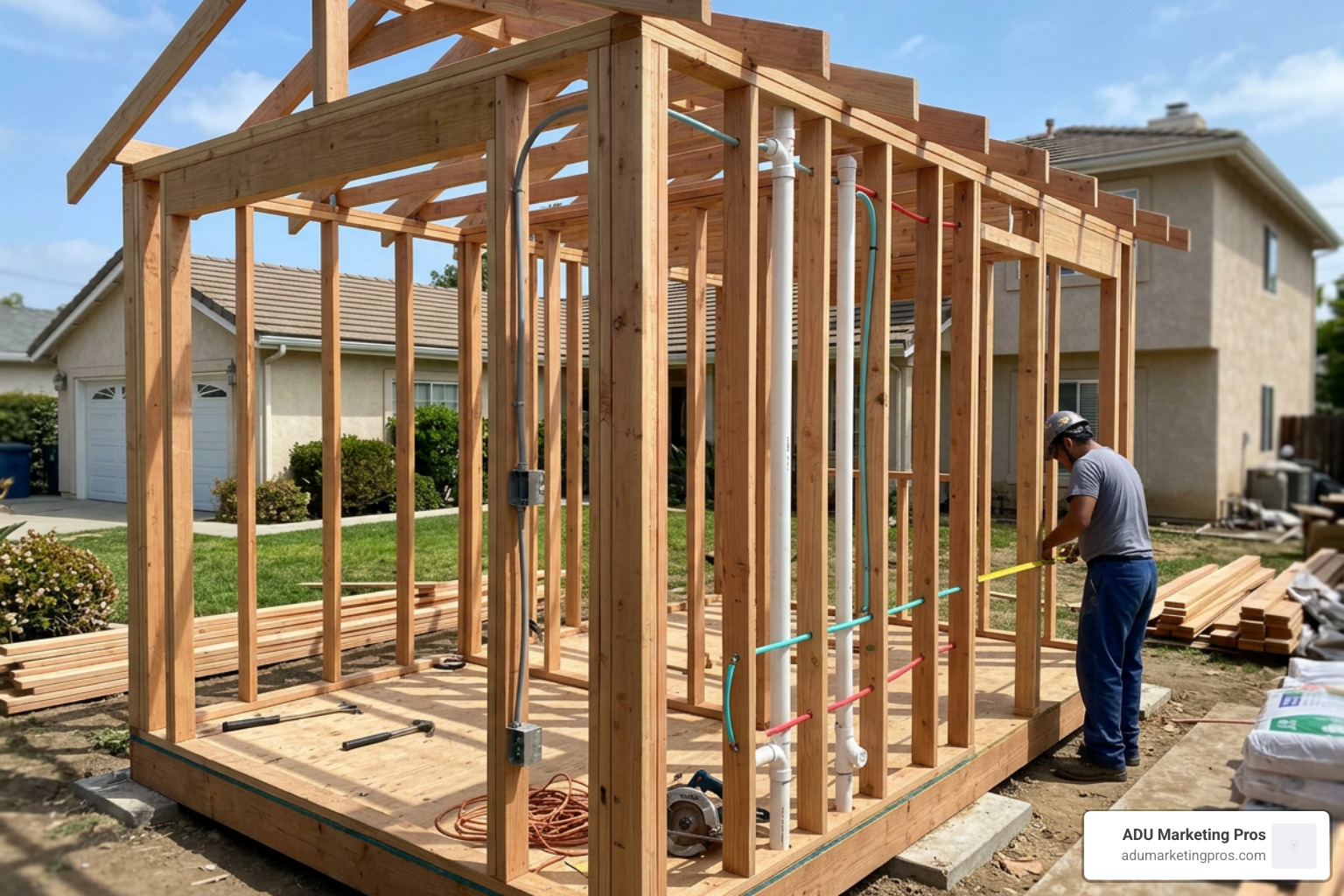
Transforming a utilitarian structure into habitable living space under the Los Angeles Department of Building and Safety (LADBS) requires specific upgrades that homeowners must include in their budget calculations. For a complete look at local municipal codes, refer to the garage conversion Los Angeles resource page.
Foundation Remediation and Seismic Reinforcements
Most existing garage slabs were poured as floating slabs without vapor barriers or interior reinforcement mesh. Over decades, settling and ground moisture create uneven surfaces, cracks, and moisture seepage that violate residential building codes.
- Moisture Sealing and Self-Leveling: Installing an epoxy moisture-mitigation vapor barrier along with a self-leveling cementitious underlayment costs between $2,500 and $5,500, depending on square footage and floor degradation.
- Sill Plate Bolting and Shear Walls: Older structures frequently lack anchor bolts connecting the bottom framing plate to the concrete foundation. LADBS mandates structural hold-downs and retrofit anchor bolts to resist lateral seismic forces, adding $3,000 to $7,000 in carpentry and structural hardware.
- Garage Door Infill Framing: Replacing the rollup door with a 2×6 stud wall, header, waterproofing, insulation, and matching stucco or siding typically runs $2,500 to $4,500.
Utility Trenching and Electrical Capacity
Older Los Angeles homes (especially those built between the 1920s and 1970s) were built with 60-amp or 100-amp main electrical services. A new living unit with an induction cooktop, electric water heater, laundry, and mini-split HVAC system will push the property past capacity.
- Main Electrical Panel Upgrade: Upgrading to a 200-amp main service panel generally costs $3,500 to $6,500, depending on whether the connection is overhead or underground through the Los Angeles Department of Water and Power (LADWP).
- Sewer Lateral Replacements: Tying the ADU drain into the main home’s sewer lateral requires adequate pitch (1/4 inch fall per linear foot). If the existing clay pipe is cracked, root-intruded, or pitched improperly, sewer lateral replacement or relining can add $5,000 to $15,000.
- HVAC Infrastructure: California Title 24 energy standards require energy-efficient heating and cooling. Ductless mini-split heat pumps ($4,000–$7,500 installed) represent the gold standard for small footprint conversions, delivering zoned temperature control with high SEER ratings.
According to the California Department of Housing and Community Development (HCD), local building standards must provide clear paths for conversion projects, yet habitability, waterproofing, and energy calculations remain non-negotiable across every California jurisdiction.
Permitting Timelines and LADBS Plan Check
Permitting paths between conversions and new builds diverge significantly:
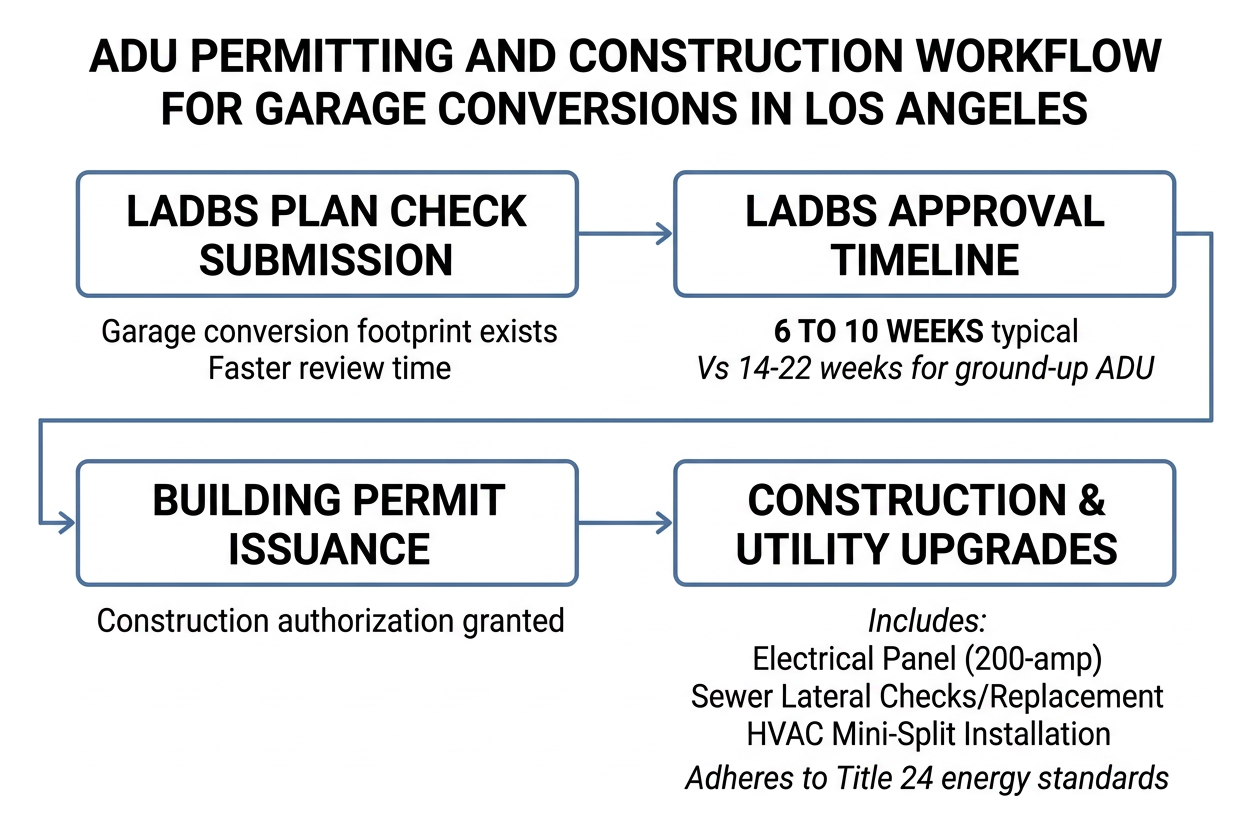
Garage conversions move through plan check faster because the building footprint already exists. For conversions, LADBS plan check approvals often take 6 to 10 weeks. If the garage footprint is entirely preserved, it frequently sidesteps extensive zoning clearance reviews, public works clearances, tree preservation verifications, and geotechnical soil studies.
Conversely, a detached ground-up ADU typically requires 14 to 22 weeks in plan check, as LADBS must review foundation calculations, civil grading, property line setbacks (typically 4 feet for side and rear), and stormwater management plans under Low Impact Development (LID) standards.
For county-wide zoning nuances, see our Accessory Dwelling Unit LA County guide. Additionally, industry analyses from VerifiedADU point out that hillside properties across the city introduce mandatory grading and geotechnical reviews that can add substantial soft and hard costs to any ADU construction budget.
ROI, Neighborhood Rental Yields, and Parking Trade-Offs
Both conversions and new ADUs add equity and generate income, but they yield different financial returns across distinct time horizons. Assessing your immediate capital allocation against your long-term wealth strategy is vital when weighing a conversion against a new detached structure.
Key ROI Takeaways from the ADU vs Garage Conversion Cost Comparison LA
From a pure equity recapture and cash flow standpoint:
- Immediate Value Creation: A garage conversion costing $140,000 typically adds $100,000 to $180,000 in immediate appraised market value (recapturing roughly 40% to 60% of build costs in direct equity above initial investment). A ground-up detached ADU costing $320,000 can add $200,000 to $350,000+ in market value due to larger finished living areas.
- Payback Horizons: Because a garage conversion requires far lower upfront capital, its payback horizon through rental cash flow is remarkably short—frequently between 4 and 6 years. Detached builds, despite generating higher gross rent, carry a break-even payback horizon of 8 to 11 years because of elevated ground-up debt service.
- Appraisal Calculations: Appraisers treat legal living area as gross living area (GLA) if attached, or as an accessory living structure if detached. Converting a garage converts non-habitable storage square footage into high-value residential space at minimal capital expenditure. Review our analysis on the cost to convert garage into apartment to understand how appraisal formulas calculate these returns.
Rental Income Expectations Across LA Neighborhoods
Los Angeles has a competitive rental market where tenants value private outdoor space, modern finishes, and quiet neighborhoods. The rental return between a garage conversion studio and a two-bedroom detached unit varies significantly across sub-markets:
- Westside / Santa Monica / Mar Vista:
- Garage Conversion (Studio/1BA): $2,200 – $2,800/month
- Detached 2-Bedroom ADU: $3,400 – $4,600/month
- Central LA / Silver Lake / Echo Park / Los Feliz:
- Garage Conversion (Studio/1BA): $2,000 – $2,600/month
- Detached 2-Bedroom ADU: $3,000 – $4,000/month
- San Fernando Valley (Studio City, Sherman Oaks, Van Nuys):
- Garage Conversion (Studio/1BA): $1,600 – $2,200/month
- Detached 2-Bedroom ADU: $2,500 – $3,400/month
- South Bay / Torrance / Long Beach:
- Garage Conversion (Studio/1BA): $1,750 – $2,300/month
- Detached 2-Bedroom ADU: $2,800 – $3,700/month
As outlined by ADUscale, simple garage conversions in dense rental sub-markets yield immediate cash yields that can offset mortgage expenses or generate substantial net passive cash flow.
Parking Replacement Laws and Property Livability
One of the most persistent myths in California real estate is that converting your garage requires building a replacement covered carport or dedicated parking space.
Under California state law (including AB 68 and SB 13), no replacement parking is required when an existing garage, carport, or covered parking structure is converted into an ADU.
This statutory protection simplifies conversions. However, homeowners must evaluate the lifestyle impact:
- Driveway Utility: Homeowners retain their driveway space for tandem parking, though covered car storage is eliminated.
- Backyard Preservation: Converting the garage preserves open backyard lawn, garden, or patio space that a new detached build would otherwise occupy, maintaining usable outdoor recreation zones.
- Storage Trade-offs: The loss of dedicated household storage (holiday decor, tools, bicycles) often requires building a compact exterior shed.
- Tenant Separation: Detached new builds can be placed strategically in rear corners to maximize visual separation and sound privacy between the primary residence and rental tenants.
Homeowners planning space utilization can study practical Los Angeles garage ADU floor plan layouts to maximize usable square footage.
Frequently Asked Questions About LA Garage and ADU Costs
Is a garage conversion significantly cheaper than a detached ADU in Los Angeles?
Yes. A garage conversion typically costs 30% to 50% less than a detached new-build ADU of similar quality. Because the foundation slab, exterior wall framing, roof structure, and building envelope already exist, you eliminate major excavation, concrete pouring, framing, and roofing expenses. This saves between $40,000 and $70,000 in raw structural hard costs alone.
How long does an LA garage conversion take from permits to completion in 2026?
A standard garage conversion in Los Angeles takes 5 to 8 months from concept to occupancy:
- Design & Engineering: 3 to 6 weeks
- LADBS Plan Check Approval: 6 to 10 weeks
- Active Construction: 2 to 4 months By comparison, a detached ground-up ADU typically requires 10 to 18 months from design through final inspection.
Do I have to replace my parking spots when converting a garage in LA?
No. California state ADU legislation explicitly eliminates replacement parking mandates when converting an existing legal garage or covered carport into an accessory unit. You do not need to build a new carport, add a garage, or create new covered off-street parking anywhere on the parcel.
What are the main hidden costs when converting a garage?
The most frequent surprise costs during garage conversions involve substandard electrical capacity (requiring a 200A service upgrade), deteriorated sewer laterals that need hydro-jetting or trenchless relining, unreinforced slab foundations requiring moisture sealing and leveling, and the addition of fire-rated drywall if the structure sits within 3 to 4 feet of a property line.
Can I rent out my garage conversion as a short-term rental on Airbnb in Los Angeles?
Under the City of Los Angeles Home-Sharing Ordinance, accessory dwelling units built after January 1, 2017, cannot legally be used for short-term vacation rentals (stays under 30 consecutive days). However, 30-day minimum stays (medium-term corporate or travel nurse rentals) and standard 12-month residential leases are fully permitted and remain in high demand across LA neighborhoods.
Conclusion
Deciding between a garage conversion and a ground-up detached ADU in Los Angeles comes down to balancing capital, speed, space, and long-term value:
- Choose a garage conversion if your priority is lowest upfront cost ($95K–$195K), rapid completion (5–8 months), fast rental payback, and preserving open backyard yard space.
- Choose a detached new-build ADU if you want to retain your covered parking, require larger multi-bedroom footprints (600–1,200 sq ft), desire maximum tenant privacy, and want to maximize long-term equity.
At ADU Marketing Pros, we help builders, architects, and trade specialists present these financial truths to prospective clients every day. By delivering clear, data-backed insights, professionals can cut through market confusion and help property owners build with total confidence.
Homeowners and contractors looking to streamline project delivery can consult our specialized team for expert ADU garage conversions to get started today.