
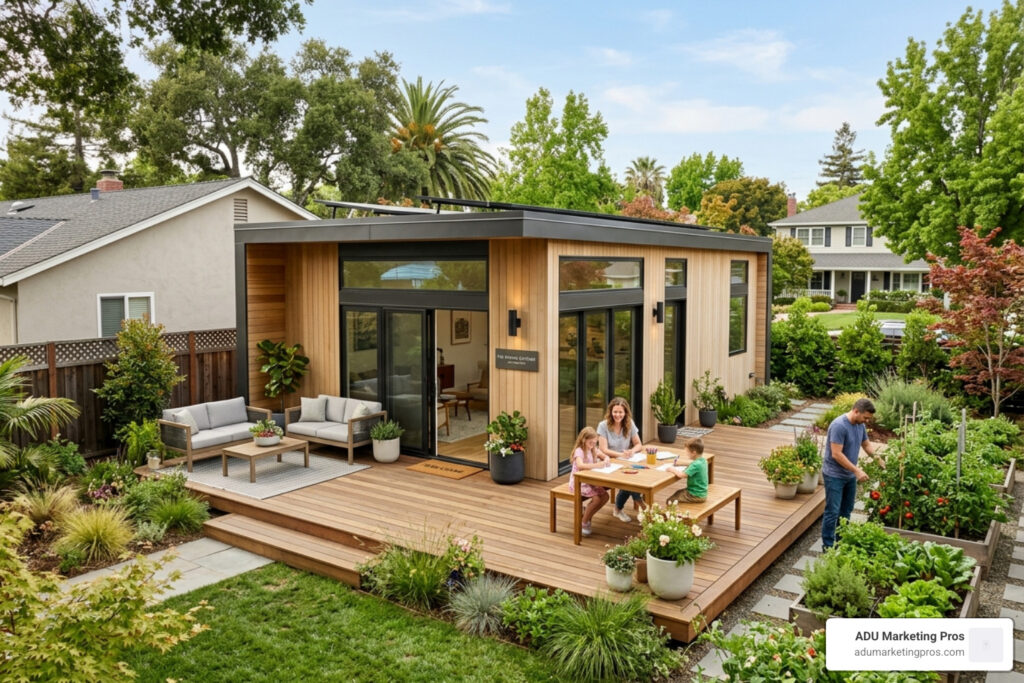
Why the ADU Grant Application Process Matters in 2026
Applying for an ADU grant application is one of the smartest moves a homeowner can make right now — but the process can feel overwhelming without a clear roadmap. As we move through 2026, the housing landscape has shifted significantly. What was once a niche home improvement project has become a cornerstone of state-level housing policy across the United States.
Here’s the fast answer for how to apply for ADU grant funding:
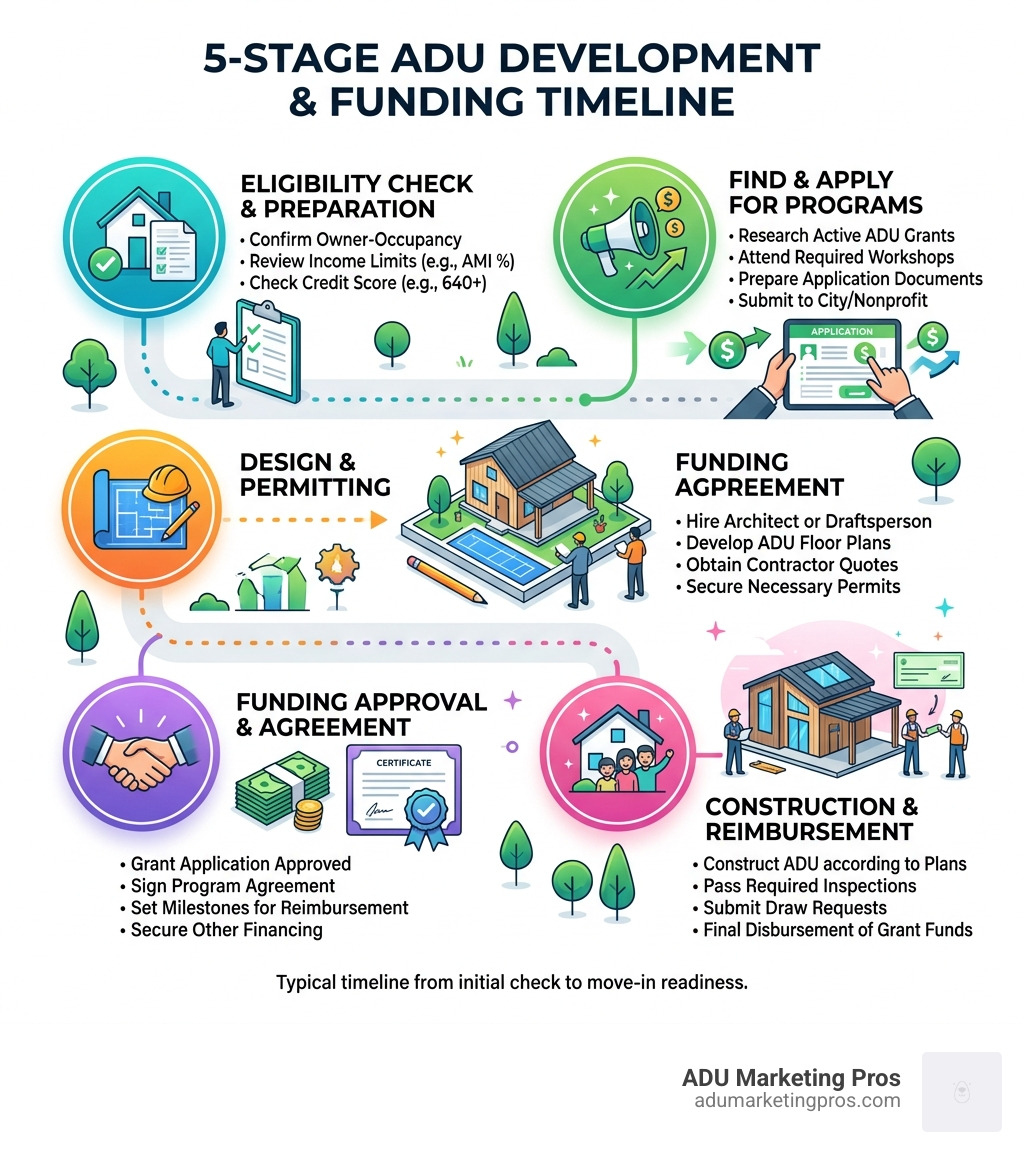
- Check eligibility — confirm you meet income limits (typically up to 150% AMI), credit score minimums (640+ for most programs), and owner-occupancy requirements.
- Find an active program — programs like New York’s Plus One ADU Program (up to $125,000) and Vermont’s VHIP 2.0 (up to $50,000) are currently open; CalHFA’s program is closed as of April 2026, but local municipal grants in cities like San Jose and San Diego often fill the gap.
- Attend required workshops — some programs (like Boston’s) require pre-application workshops before you can submit to ensure you understand the long-term commitments.
- Gather your documents — pay stubs, tax returns, property deed, architectural plans, and contractor quotes are the baseline for any serious application.
- Submit through the right channel — applications go through approved lenders, city portals, or nonprofit partners depending on your program.
- Wait for approval and disbursement — funds are typically released on a reimbursement basis after milestones (like foundation pouring or final inspection) are met.
The Strategic Importance of ADUs in 2026
Housing costs keep rising, and the “missing middle” housing gap has never been wider. Cities and states are under immense pressure to add supply — fast. Accessory dwelling units (ADUs), also called granny flats, in-law suites, or backyard cottages, have emerged as one of the most practical answers to that pressure. They allow for increased density without changing the fundamental character of suburban neighborhoods.
To accelerate ADU construction, dozens of state and local governments now offer grants, forgivable loans, and fee waivers to help homeowners cover the steep upfront costs of building one. The problem? Many of these programs move fast. California’s CalHFA ADU Grant Program, for instance, burned through $25 million in a matter of days during its last funding cycle. Programs open and close on short notice, often dictated by fiscal year budgets and legislative sessions.
That means timing and preparation are everything. You cannot wait until you have a shovel in the ground to look for funding. In fact, doing so often disqualifies you from the very grants you need. This guide walks you through each step of the ADU grant application process — from checking eligibility to submitting documents to understanding what happens after approval. Whether you’re a homeowner planning your first ADU or a builder helping clients access funding, you’ll find a clear, practical path forward here.
Understanding Eligibility for an ADU Grant Application
Before you start picking out floor tiles or hiring a contractor in San Jose or Los Angeles, we need to make sure you actually qualify. Grant money isn’t “free” in the sense that anyone can grab it; these programs are highly regulated to ensure they help those who need it most or contribute to local housing goals. In 2026, eligibility criteria have become more sophisticated, often prioritizing “equity-focused” development.
In California, and specifically across our service areas like the San Francisco Bay Area and San Diego, eligibility usually hinges on three main pillars: your income, your property, and your intent for the unit.
The Role of Area Median Income (AMI)
Most ADU grant application processes require you to prove your household income falls below a certain threshold. This is almost always tied to the Area Median Income (AMI). For the popular CalHFA program, for instance, homeowners historically needed a household income not exceeding 150% of the AMI.
Why does this matter? Because a “low income” in San Francisco looks very different from a “low income” in a smaller municipality. By using a percentage of the AMI, the state ensures that a teacher in Sunnyvale or a nurse in Mountain View can still qualify for help despite the high cost of living. In 2026, many programs have introduced “tiered” funding, where those under 80% AMI receive larger grants than those at the 120% or 150% level.
Credit Score and Financial Health
Additionally, don’t ignore your credit. While these are grants, they are often administered through lenders or tied to construction loans. A minimum credit score of 640 was a standard requirement for past California state grants. This is because the grant usually only covers a portion of the project (the “soft costs”), and the lender needs to know you are creditworthy enough to handle the “hard costs” of actual construction.
If your score is lower, you might need to look into local nonprofit programs, like those offered by Neighborhood Housing Services of Los Angeles County, which sometimes have more flexible criteria for community-based projects. These organizations often provide financial counseling as part of the application process to help you get “loan-ready.”
Property and Residency Restrictions
We often see homeowners get excited about a grant only to realize their property doesn’t fit the bill. Most grant programs require the property to be:
- Owner-occupied: You must live in the primary residence. These grants aren’t designed for developers or “flippers” looking to maximize a portfolio. Some programs require you to sign an affidavit promising to remain in the home for at least 3 to 5 years after the ADU is completed.
- Single-family or small multi-family: Most programs target single-family homes, though some in San Jose and San Mateo allow for units on 1-4 unit properties.
- Zoning Compliance: Your lot must be legally capable of hosting an ADU. While state laws have eased many restrictions, specific local setbacks or utility easements can still pose hurdles.
- Outside high-risk zones: Properties in extreme high fire risk zones or flood plains may face additional scrutiny or disqualification, depending on the specific state funding source and insurance requirements.
| Requirement | Typical Threshold | Why it exists |
|---|---|---|
| Income Limit | 80% – 150% AMI | To target help toward middle and low-income residents. |
| Credit Score | 640+ | To ensure the homeowner can secure the rest of the construction financing. |
| Residency | Primary Home | To prevent institutional investors from taking grant funds. |
| Lot Type | Single-family/Duplex | To focus on residential density in suburban/urban areas. |
If you are looking for more details on specific eligibility nuances, you can check out the Accessory Dwelling Unit Grant Program page for a deeper dive into local California mandates and how they apply to your specific county.
Navigating the ADU Grant Application for Top State Programs
As of April 2026, the landscape for an ADU grant application is a mix of “wait and see” and “act now.” While the massive $100 million CalHFA fund was fully allocated and the subsequent $25 million round was exhausted within days, new local and state-level incentives continue to pop up to address the persistent housing shortage. Understanding the mechanics of these programs is vital for a successful submission.
California’s Evolving Grant Landscape
In California, the “grant” is often less like a check mailed to your house and more like a specialized escrow account. When the CalHFA program is active, you don’t apply directly to the state. Instead, you work with a pre-approved lender who manages the funds on your behalf.
The process typically involves:
- Securing a Construction Loan: You must first prove you have the funds to actually build the unit. The grant acts as “gap” funding or reimbursement for soft costs like permits and designs.
- Lender Certification: Your lender submits a CalHFA Participant Affidavit. They certify that your income is calculated correctly and that the project meets Fannie Mae or FHA requirements.
- The “No Cash Back” Rule: This is a big one. You cannot get cash back from these grants. If you already paid for your permits out of pocket, the grant funds are typically used as a principal reduction on your construction loan, lowering your monthly payments.
For those in our core areas like San Jose and Palo Alto, staying in touch with local housing departments is key. Many cities offer their own version of “soft” incentives, such as the San Jose ADU program which provides pre-approved plans to slash your architectural costs. You can find more about these specific funding structures at Adu Funding Grants.
East Coast Opportunities: New York and Vermont
While California led the charge, other states have caught up with even more aggressive funding models.
- New York’s Plus One ADU Program: This program provides up to $125,000 per household for the construction or improvement of an ADU. The catch? The homeowner must agree to rent the unit to a low-to-moderate income tenant for a set period. This is one of the most generous grants in the country as of 2026.
- Vermont’s VHIP 2.0: The Vermont Housing Incentive Program offers up to $50,000. It is specifically designed to bring vacant or underutilized spaces back into the housing market. It requires a 5-year commitment to affordable rent levels.
Learning from National Models: Colorado and Boston
In Colorado, the ADUG program awards grants to “ADU Supportive Jurisdictions”—local governments that have proven they are making it easy to build. This encourages cities like Grand Junction or Boulder to waive fees, which in turn helps the homeowner. Boston, on the other hand, uses a Technical Assistance Grant of up to $7,500 specifically for design. They require homeowners to attend mandatory workshops before applying—a model we are seeing more California cities adopt to ensure projects don’t stall due to lack of planning.
For official state updates, you can always monitor the ADU Grant Program site or the Accessory Dwelling Unit Grant Program (ADUG) | Division of Local Government for legislative trends that might migrate West.
Essential Documentation for Your ADU Grant Application
If there is one thing that kills an ADU grant application, it’s missing paperwork. Because these programs use taxpayer money, the “paper trail” must be immaculate. We recommend keeping a dedicated digital folder (and a physical one) for your project. In 2026, many portals use automated verification systems, so even a small typo on a tax form can trigger a rejection.
The Financial Paper Trail
You should have the following financial documents ready before the application window even opens. Speed is of the essence when funds are limited:
- Proof of Income: The last two years of federal tax returns (all schedules included), W-2s, and your most recent 60 days of pay stubs. If you are self-employed, you will likely need a year-to-date profit and loss statement signed by a CPA.
- Property Ownership: A copy of your recorded deed. If your home is held in a Trust or an LLC, you may need the full Trust Agreement or Operating Agreement to prove you are the primary occupant and have the legal right to encumber the property.
- Mortgage Standing: Most grants require you to be current on your mortgage and property taxes. Have your latest mortgage statement and most recent property tax bill ready. If you have a second mortgage or HELOC, you’ll need those statements as well.
- Bank Statements: Usually, the last three months of statements for all accounts to prove you have the “liquid assets” required to cover the portion of construction not covered by the grant.
Technical and Architectural Readiness
Beyond your personal finances, the ADU grant application requires technical proof of the project’s viability. You cannot simply say you “want to build”; you must show what you are building.
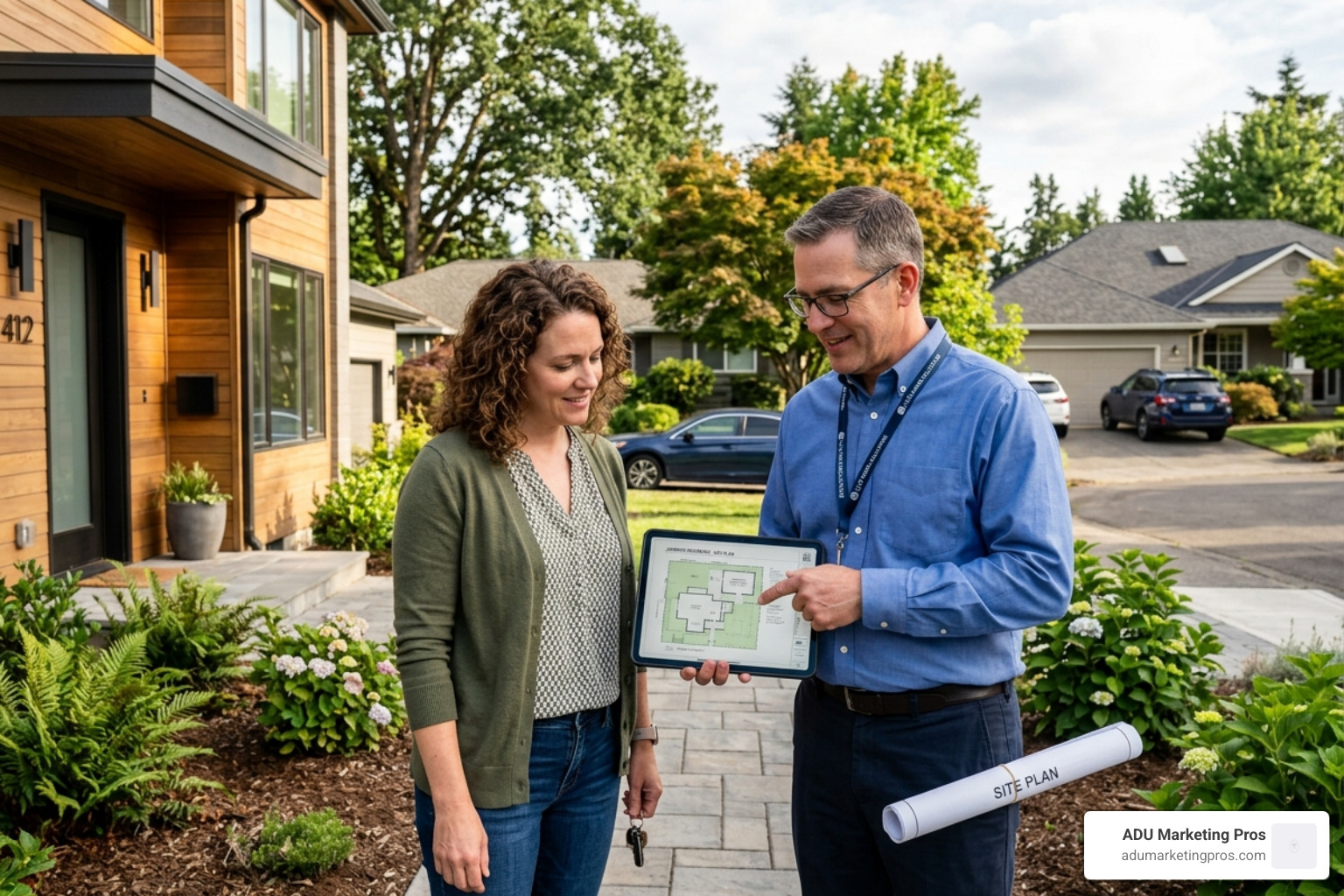
- Architectural Designs: You don’t need a finished interior design with paint colors, but you do need a professional site plan and floor plan that complies with local San Francisco or San Diego building codes. This includes showing setbacks from property lines and the location of utility meters.
- Two Contractor Quotes: Many programs, like the Boston model, require at least two detailed quotes from licensed and bonded contractors. A “rule of thumb” we often see in 2026 is roughly $275-$350 per square foot for preliminary estimates, though this varies wildly by location and finish level.
- Scope of Work: A line-item budget showing exactly where the money goes. This is crucial for “pre-development” grants that only cover things like soil tests, structural engineering, and permits. If the grant is for $40,000, the budget must clearly show $40,000 worth of eligible expenses.
For a great example of a checklist used by a major city, the ADU Financial Assistance Program | Boston.gov provides a very clear breakdown of what “ready to build” looks like. Following this level of detail will make your application stand out to reviewers.
What Costs Does an ADU Grant Application Cover?
One of the biggest misconceptions we hear at ADU Marketing Pros is that a grant will pay for the entire construction of a backyard home. While some programs in New York or Vermont are very generous, most grants—especially the California state versions—are designed to cover “soft costs” or pre-development expenses. Understanding the difference between “hard” and “soft” costs is essential for your budget planning.
Soft Costs: The Invisible Expenses
Think of these as the “invisible” costs of building. Before a single piece of wood is nailed together, you might spend $15,000 to $40,000 just getting permission to build. Reimbursable soft costs often include:
- Architectural and Engineering Fees: Designing a unit that won’t fall down, meets seismic standards, and complies with local zoning. This includes structural engineering and sometimes civil engineering for drainage.
- Permit Fees: The “tax” you pay to the city of Menlo Park or Mountain View to build. These can be surprisingly high, sometimes reaching $10,000 or more for larger units.
- Impact Fees: Fees paid to the city to offset the “impact” of a new unit on local parks, schools, or traffic. In California, state law has waived many of these for units under 750 square feet, but for larger ADUs, they remain a significant expense.
- Soil and Energy Reports: Title 24 energy compliance reports are mandatory in California and ensure your unit is energy efficient. Soil reports (geotechnical) are often required to ensure the ground can support the new foundation.
- Utility Hookups: Connecting your new “granny flat” to the existing sewer, water, and electrical lines. This often involves trenching across your yard, which is a major pre-development expense.
Hard Costs: When Grants Cover Construction
While less common, some programs do offer direct construction funding (hard costs).
- Vermont VHIP 2.0: Offers up to $50,000 that can be used for actual materials and labor, provided the unit is rented at affordable rates.
- Santa Cruz, CA: Forgivable loans of up to $40,000 are available if you agree to rent to low-income tenants for up to 20 years. In this case, the “grant” is actually a loan that disappears over time as long as you follow the rules.
- Napa County: Has historically offered junior ADU (JADU) grants that focus on internal conversions, which are much cheaper than detached units.
If you’re wondering which costs your specific project can offload, visit our Adu Funding Grants resource for a breakdown of “hard” vs. “soft” cost coverage and how to maximize your reimbursement.
Alternatives to ADU Grants: Financing Your Backyard Home
Let’s be real: grants are competitive and often run out of money before the year is half over. If you don’t make the cut for a state program, or if the funds in San Diego are exhausted before you hit “submit,” you still have options. In fact, many of our clients find that specialized loan products are more flexible than grants because they don’t come with the same residency or rent-control strings attached.
Home Equity Solutions
If you’ve lived in your home in Palo Alto or San Jose for more than a few years, you likely have a goldmine of equity that can be tapped for construction.
- HELOC (Home Equity Line of Credit): This works like a credit card tied to your home. You only pay interest on what you use, making it great for phased construction where you pay the contractor in installments. However, rates are variable, which can be risky in a fluctuating 2026 economy.
- Cash-Out Refinance: You replace your current mortgage with a larger one and take the difference in cash. Warning: In April 2026, check your current interest rate. If you have a 3% or 4% rate from years ago, you probably don’t want to trade it for a 2026 market rate just to get $100,000 in cash.
- Home Equity Investment (HEI): This is a newer model where a company gives you cash today in exchange for a share of your home’s future appreciation. There are no monthly payments, which is great for retirees or those with lower monthly cash flow.
Modern Financing: The RenoFi Revolution
A newer and very popular option is the RenoFi Loan. Standard home equity loans only let you borrow against your home’s current value. This is a problem if you just bought the house and haven’t built equity yet. RenoFi loans allow you to borrow based on the After-Renovation Value (ARV).
Imagine your home is worth $800,000 today, but with a brand-new $200,000 ADU, it will be worth $1.1 million. A RenoFi loan lets you tap into that future $1.1 million value today to fund the build. This can provide significantly more capital—sometimes 11x more—than a traditional equity loan. It combines the best of a construction loan and a home equity loan into one product.
Construction-to-Permanent Loans
These loans cover the cost of building the ADU and then “convert” into a standard mortgage once the project is finished. They are excellent for major detached ADU projects that cost $250,000 or more. They often require a higher credit score and more detailed oversight from the lender, but they offer the security of a fixed interest rate for the long term.
Frequently Asked Questions about ADU Grant Applications
How long does the ADU grant approval process take?
Generally, you should plan for 3 to 6 months from the time you submit your ADU grant application to the time funds are actually committed. The review process involves verifying your income, checking your property’s title, and reviewing your construction plans. However, once approved, the construction itself must often be completed within a specific window—typically 12 to 18 months—to keep the grant or forgivable loan in good standing.
Can I apply for a grant if I have already started construction?
For most California programs, the answer is no. Grants are typically intended to help projects that wouldn’t happen otherwise (the “but for” rule). If you’ve already poured the foundation or pulled your final permits, you’ve likely missed the window for “pre-development” reimbursement. Always apply before you pull your final permits if you want to be safe.
What happens if I sell my home after receiving an ADU grant?
This is the “catch” that many homeowners overlook. Many grants come with an affordability covenant or a residency requirement. For example, if you received a forgivable loan in Santa Cruz or through a local nonprofit, you might have to pay back a pro-rated portion of the grant if you move within 5 or 10 years. Some grants are recorded as a lien against the property, which must be cleared during the sale.
Do I have to pay taxes on the grant money?
In many cases, yes. The IRS often views grant funding as taxable income. However, some state-level grants have been specifically exempted from state taxes. You should always consult with a tax professional to see how a $40,000 or $100,000 grant will impact your tax bracket for the year you receive it.
Can I build a Junior ADU (JADU) with these grants?
Yes, many programs actually prefer JADUs because they are more affordable to build and use existing space (like a garage or a spare bedroom). The CalHFA program and many local initiatives in the Bay Area specifically include JADUs in their eligible project lists.
Will an ADU increase my property taxes?
Yes, but not as much as you might fear. In California, the addition of an ADU triggers a “blended assessment.” Your primary home’s value remains at its Prop 13 protected rate, and only the new value of the ADU is added to your tax bill. The grant itself doesn’t change this, but the value of the construction does.
Conclusion
Navigating the ADU grant application process is a marathon, not a sprint. While the lure of “free money” is strong, the real value of these programs is how they empower homeowners to create long-term wealth, provide housing for aging parents, or generate reliable rental income for their own retirement. In the 2026 housing market, an ADU is no longer just a luxury—it is a strategic asset.
At ADU Marketing Pros, we don’t just track these regulations for fun—we do it to help ADU construction and architecture firms in San Jose, Los Angeles, and across California stay ahead of the curve. By understanding the financial hurdles homeowners face, builders can better position themselves as partners in the process rather than just contractors. Being able to tell a client, “I can help you navigate the grant paperwork,” is a massive competitive advantage.
If you are a builder looking to attract high-quality leads who are “grant-ready,” or if you want to scale your business by focusing on expertise over price, we are here to help. Check out our specialized resources on the Accessory Dwelling Unit Grant Program to see how we can grow your revenue in this booming sector.
Building an ADU is one of the most impactful things you can do for your property and your community. It adds value to your land while providing a home for someone who needs it. With the right funding, a meticulous application, and a solid construction plan, your backyard cottage isn’t just a dream—it’s a smart, funded reality that will pay dividends for decades to come.