
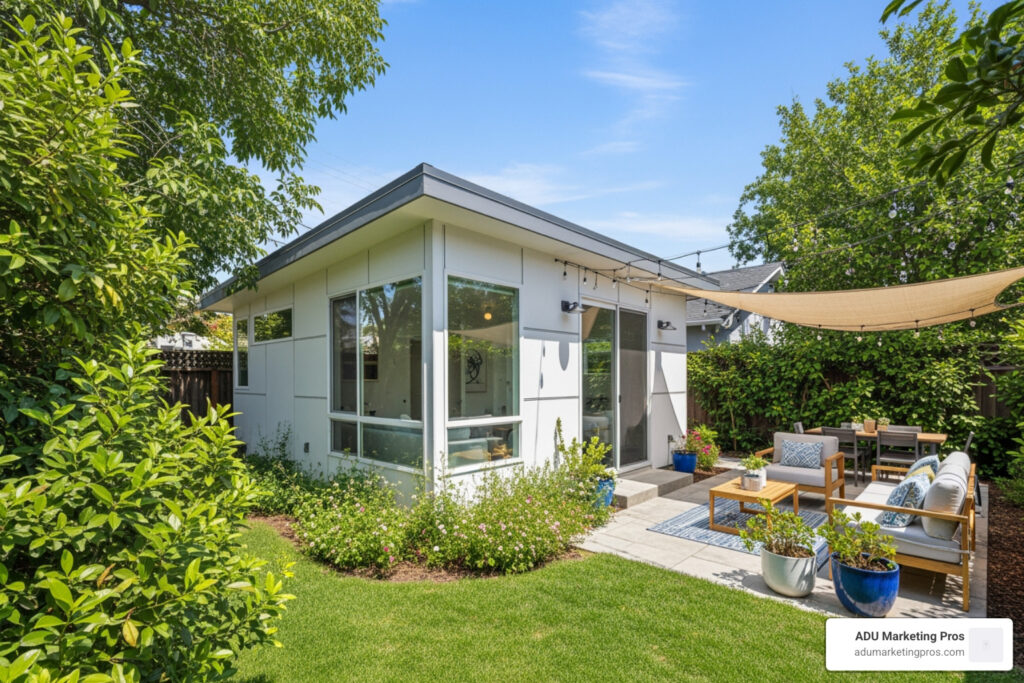
What Is an Alameda County ADU and Why Does It Matter?
Alameda County ADU rules have opened up real opportunities for homeowners across the region — from Oakland to Hayward to unincorporated areas — to add independent living units to their properties. As the San Francisco Bay Area continues to grapple with a historic housing shortage, these small-scale developments have become a cornerstone of local urban planning. By allowing homeowners to build “gentle density,” the county is addressing the “missing middle” — housing that is more affordable than a single-family home but more private than a large apartment complex.
Here’s a quick overview of what you need to know:
| Topic | Key Facts |
|---|---|
| What is an ADU? | A fully independent living unit on the same lot as a primary home |
| Common names | Granny flat, in-law unit, casita, backyard cottage |
| Max size | Up to 1,200 sq ft; 800 sq ft always allowed by state law |
| Min setbacks | 4 feet from side and rear property lines |
| Max height (detached) | 16 feet (up to 18 feet near transit) |
| Short-term rentals | Not allowed — 30-day minimum rental period |
| Key assistance programs | HelloADU, AC Boost (up to $210,000), Renew AC (1% loans) |
| Typical project timeline | 12–18 months from planning to move-in |
The Socio-Economic Impact of ADUs in the East Bay
Alameda County is facing a serious housing crunch that affects everyone from young professionals to retirees. The geography of the county, stretching from the dense urban corridors of Berkeley and Oakland to the suburban expanses of the Tri-Valley, presents unique challenges. Researchers from UC Berkeley have found that ADUs can house teachers, nurses, and other essential workers who would otherwise face brutal commutes from the Central Valley. This isn’t just about adding square footage; it’s about social equity and environmental sustainability. By creating housing near job centers, we reduce the carbon footprint associated with long-distance commuting.
Measure A1, which passed with 73% of the vote, reflects how strongly residents feel about creating more housing — with a goal of building or preserving 3,800 affordable homes countywide. This mandate has pushed local planners to streamline the Alameda County ADU approval process, making it one of the most progressive regions in California for secondary unit development.
Multi-Generational Living and Aging in Place
Furthermore, the rise of the Alameda County ADU has allowed for multi-generational living to return to the forefront of American life. Many families are using these units to keep aging parents close by, providing them with autonomy while ensuring they are just a few steps away from support. This “aging in place” strategy is significantly more cost-effective than assisted living facilities, which can cost upwards of $6,000 to $10,000 per month in the Bay Area.
Conversely, many “empty nesters” are choosing to move into the ADU themselves, renting out the larger primary home to generate retirement income. This flexibility allows residents to stay in their communities even as their lifestyle needs change. Building an ADU isn’t just a smart financial move. It’s also, as many homeowners describe it, a genuine community service. By adding a unit, you are directly contributing to the local housing stock without the need for massive infrastructure changes or the destruction of neighborhood character.
This guide walks you through everything — types of ADUs, local regulations, costs, financing, and the permitting process — so you can move forward with confidence.
Alameda County ADU vocab explained:
Understanding the Alameda County ADU: Types and Definitions
When we talk about an Alameda County ADU, we aren’t just talking about one type of building. These units come in many shapes and sizes, often referred to by charming nicknames like granny flats, backyard cottages, or casitas. Essentially, an ADU is a permanent residential dwelling that provides complete independent living facilities — meaning it has its own kitchen, bathroom, and sleeping area — located on the same lot as a primary home.
The flexibility of these units is what makes them so popular in the San Francisco Bay Area. You might choose to build a tiny house for a minimalist lifestyle or a spacious custom ADU to house aging parents. Understanding the different categories is the first step in your planning journey, as each type is governed by specific California ADU Regulations.
Junior ADUs (JADUs) in Alameda County
A Junior Accessory Dwelling Unit, or JADU, is the “little sibling” of the standard ADU. These are strictly limited to a maximum of 500 square feet and must be contained entirely within the walls of an existing or proposed single-family residence. They are the most cost-effective way to create a rental unit because they require minimal structural changes, often utilizing an existing bedroom or guest suite.
There are a few specific rules for JADUs under California Government Code Section 66134 – 66332:
- Efficiency Kitchen: They must include an efficiency kitchen, which requires a sink, a cooking appliance (like a hot plate or convection oven), and a food preparation counter. It does not require a full-sized stove or oven, which saves on electrical and gas plumbing costs.
- Sanitation: They can share a bathroom with the main house or have their own. If they share, there must be an internal connection to the main house to ensure the unit remains part of the primary structure’s envelope.
- Owner Occupancy: The property owner must reside in either the JADU or the main house. This is a critical distinction from standard ADUs, which currently do not have this requirement in most cases.
- Deed Restriction: A deed restriction must be recorded to ensure these conditions are maintained for future owners, protecting the JADU’s status as a junior unit.
Attached vs. Detached ADU Structures
If you need more space than a JADU provides, you’ll likely look at standard ADUs, which can be either attached or detached. Each has its own set of architectural and logistical considerations.
- Attached ADUs: These share at least one wall with the primary residence. They are often created through additions or by converting a portion of the main house, such as a master suite or a large basement. In Alameda County, an attached ADU can be up to 50% of the primary dwelling’s size, but you are always allowed at least 800 square feet regardless of the main house size. These are popular for those who want to maintain a smaller footprint on their lot and potentially share utility lines more easily.
- Detached ADUs: These are standalone structures, like a detached ADU in San Francisco. They offer the most privacy for both the homeowner and the tenant. In Alameda County, detached units can reach a maximum size of 1,200 square feet, providing ample room for a two-bedroom, two-bathroom layout. These are often built in the backyard and can be designed to match the aesthetic of the main house, increasing the overall curb appeal of the property.
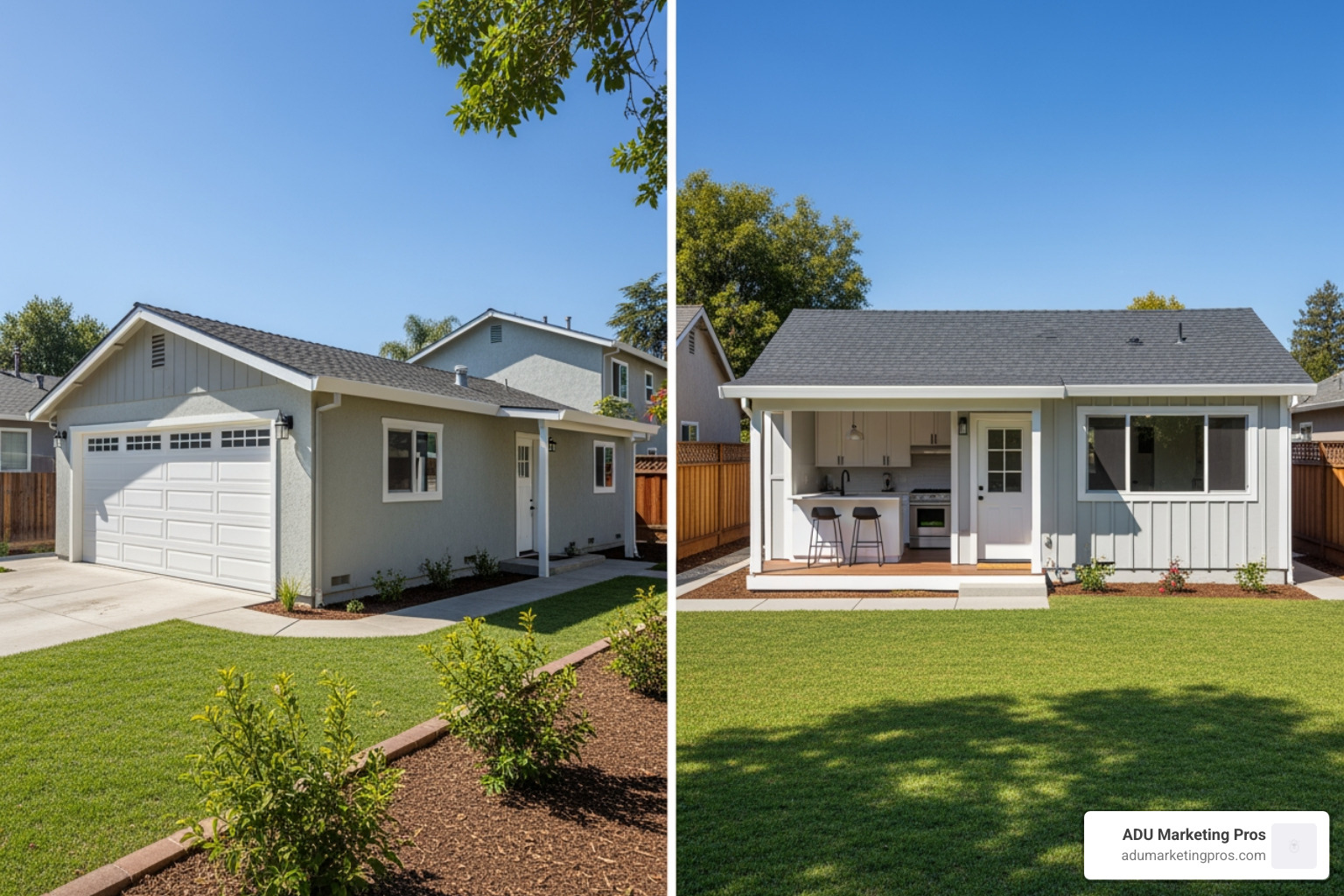
Conversion ADUs: Repurposing Existing Space
A third category is the Conversion ADU. This involves turning an existing non-living space — like a detached garage, a workshop, or a pool house — into a legal residence. The primary benefit here is that you can often build within the existing footprint, even if that footprint violates current setback rules. If your garage is right on the property line, you can usually convert it into an Alameda County ADU without having to move the walls, provided it was legally built in the first place. This is often the fastest path to completion as the primary structure is already standing. For more detailed state-level advice, you can check out the California ADU Guidelines.
Navigating Alameda County ADU Regulations and Zoning
Navigating the local “rule book” can feel like a maze, but recent state laws have made it much easier for us to build. In the past, local cities could block ADUs with strict lot coverage or parking rules. Today, state mandates ensure that if you have a residential lot, you likely have the right to build. However, it is important to distinguish between the rules for unincorporated Alameda County (managed by the County Planning Department) and incorporated cities like Oakland, Fremont, or Berkeley, which have their own local ordinances.
Here is a quick reference for the standard requirements you’ll encounter when planning your Alameda County ADU:
| Requirement | Detached ADU Standard |
|---|---|
| Side/Rear Setbacks | 4 feet minimum |
| Max Height | 16 feet (up to 18 feet near transit) |
| Max Lot Coverage | Generally 60% (but see 800 sq ft rule below) |
| Studio Size | 150 – 400 sq ft |
| 1-Bedroom Size | 300 – 850 sq ft |
| 2-Bedroom Size | 700 – 1,000+ sq ft |
While these are the general California ADU Requirements, specific cities like San Leandro or Berkeley may have slight variations in how they handle design review. For those looking at neighboring areas, the San Jose ADU Guidelines offer a helpful comparison of how different municipalities interpret these rules.
State Law Overrides and the 800 Square Foot Rule
One of the most powerful tools for homeowners is what we call the “State Override.” If your local zoning would normally prevent an ADU because of lot coverage, open space, or floor area ratio (FAR) limits, California law steps in to protect you.
The law guarantees that you can build a detached ADU of at least 800 square feet with 4-foot side and rear setbacks and a 16-foot height limit, regardless of what local lot coverage rules say. This means even if your backyard is small, the Alameda County ADU Resource Center can help you find a way to make it work.
Furthermore, the review process for these units must be “ministerial,” meaning the county cannot require a public hearing or neighborhood notification — if you meet the checklist, they must approve the permit. This removes the “NIMBY” (Not In My Backyard) hurdle that used to kill projects. This is a core part of the New ADU Regulations in California.
Parking Exemptions and Transit Access
In the old days, requiring two new off-street parking spaces for an ADU was the “project killer.” Today, parking requirements are waived for the vast majority of Alameda County ADU projects. This is particularly true in the urbanized parts of the county where public transportation is robust.
You do not need to add parking if your ADU is:
- Within a half-mile walking distance of public transit (which includes most of Alameda County due to BART and AC Transit coverage).
- Located within an architecturally or historically significant district.
- Part of an existing primary residence or an existing accessory structure (like a garage conversion).
- In an area where on-street parking permits are required but not offered to the ADU occupant.
- Within one block of a car-share vehicle.
For property owners in unincorporated areas, you can use the Zoning Viewer Public Access Map to check your proximity to transit and confirm your exemption status. Even if you are required to provide parking, it can often be provided as “tandem” parking on an existing driveway, meaning you don’t have to pave over your entire front yard.
Objective Design Standards
While the county cannot stop you from building, they can require that the ADU follows “objective design standards.” These are rules that are not subject to the whim of a planning official but are clearly defined in the code. This means the unit must look like it belongs on the property. Common standards include:
- Roof Pitch: Matching the slope of the main house’s roof to create a cohesive look.
- Siding Materials: Using similar materials (stucco, wood siding, etc.) as the primary residence.
- Window Placement: Ensuring windows don’t look directly into a neighbor’s yard to maintain privacy for everyone involved.
- Color Palette: Using colors that are complementary to the existing structures on the lot.
These rules are meant to ensure that the Alameda County ADU adds to the neighborhood’s aesthetic value rather than detracting from it, protecting property values for you and your neighbors.
The Financial Side: Costs, Financing, and ROI
Let’s talk numbers. Building in the Bay Area isn’t cheap, but the return on investment (ROI) for an Alameda County ADU is often stellar. On average, we see total project costs ranging from $450 to $550 per square foot. This includes everything from the initial design and permits to the final coat of paint. While this may seem high compared to national averages, the rental market in Alameda County is one of the strongest in the country, with one-bedroom units often fetching $2,500 or more per month.
For a premium 750-square-foot modular unit in a city like Oakland or Piedmont, you might expect to invest around $331,000. While that sounds like a lot, consider the value it adds to your property. Recent studies suggest that an ADU can increase property value by 20% to 35% in high-demand markets. You can find more details on regional pricing in our guide to Bay Area ADU Cost and ADU Cost in the Bay Area.
Hard Costs vs. Soft Costs
When budgeting for your Alameda County ADU, it’s helpful to break down the expenses into two categories:
- Soft Costs: These include architectural design, structural engineering, land surveys, and permit fees. In Alameda County, permit fees can range from $5,000 to $15,000 depending on the size of the unit and the specific city. Don’t forget to budget for Title 24 energy reports and potential school impact fees if your unit is over 500 square feet.
- Hard Costs: This is the actual construction — foundation, framing, plumbing, electrical, and finishes. Site preparation (grading and utility trenching) can be a significant variable here, especially if your backyard is sloped or far from the main sewer line. In the East Bay, rocky soil or steep hillsides can add $20,000 to $50,000 to the foundation costs alone.
Building an Alameda County ADU for Rental Income
Many of our clients build ADUs specifically to generate passive income. However, Alameda County has a strict ban on short-term rentals (like Airbnb) for ADUs. You must have a minimum lease term of 30 days. This is intended to ensure that ADUs contribute to the long-term housing supply rather than becoming de facto hotels.
The good news? Long-term rentals are in high demand. By pricing your unit at a “fair market” rate — which is generally considered affordable if the tenant pays less than one-third of their income on housing — you can attract high-quality, long-term tenants like teachers or local workforce members. This strategy not only provides you with steady cash flow but also helps solve the local housing crisis. For more on managing your new unit, visit the county’s resource on Renting Your ADU.
County Assistance: AC Boost and Renew AC
If the upfront cost is a barrier, Alameda County offers some of the best financial assistance programs in the state. Thanks to the Measure A1 bond, several programs are available to help middle-income families:
- AC Boost: This program provides first-time homeowners with a shared appreciation down payment assistance loan of up to $210,000. This can be a game-changer for those looking to buy a home with the intent of adding an ADU. Learn more at the AC Boost Program.
- Renew AC: This program offers 1% interest loans ranging from $15,000 to $150,000 for qualified homeowners to preserve or improve their homes. The total interest on these loans is capped at 50% of the borrowed amount, and payments are often deferred. Check out Renew AC Loans for eligibility.
These programs are designed to keep people in their homes and make the dream of owning a granny flat a reality. Additionally, some local credit unions offer “ADU Construction Loans” that allow you to borrow against the future value of the home once the ADU is completed, which is often much higher than the current appraised value.
From Planning to Completion: The Permitting Process
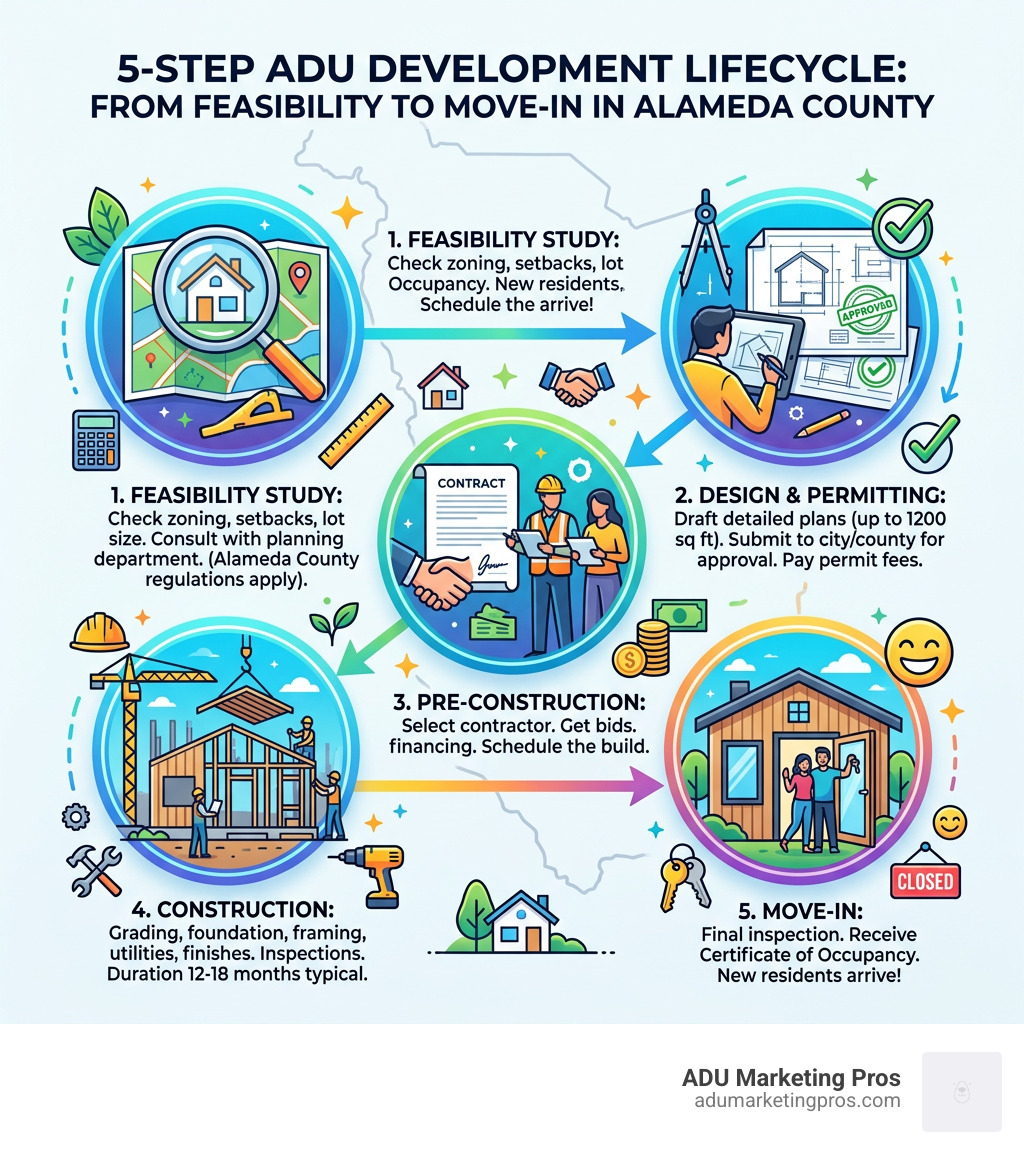
The journey from a “napkin sketch” to a finished home typically takes 12 to 18 months. It’s a marathon, not a sprint, and having the right team is essential. We recommend working with experienced ADU Builders in the Bay Area who understand the local nuances of the Alameda County Planning Department and the specific quirks of East Bay soil and topography.
The process generally follows these steps:
- Feasibility (1-3 months): Research your APN (Assessor’s Parcel Number), check zoning, and meet with local staff. You need to know where your utility lines are and if there are any easements on your property. This is the time to determine if your electrical panel can handle the extra load or if you’ll need a PG&E upgrade.
- Design & Permitting (1-6 months): Hire an architect to create site plans, floor plans, and Title 24 energy calculations. This phase involves back-and-forth with the building department to ensure everything meets code. In Alameda County, you may need separate approvals from the fire department and the local water district (EBMUD).
- Construction (6-12 months): The actual build-out, including inspections for foundation, framing, rough plumbing/electrical, and the final walkthrough. This is where the project truly comes to life.
For those in unincorporated areas, the HelloADU program provides free technical assistance and project management to help you navigate these steps. They can help you review contractor bids and ensure your plans are complete before submission, which can save months of delays.
Technical Requirements: Utilities and Fire Safety
Your Alameda County ADU needs to be safe and functional. This means meeting several technical standards that can impact your budget and design:
- Fire Safety: If the primary residence has fire sprinklers, the ADU must have them too. Even if the main house doesn’t, local fire codes may require them for detached units depending on their distance from the street and the nearest fire hydrant. This is a critical safety measure in California’s fire-prone landscape.
- Solar Panels: Per California’s Title 24 requirements, all newly constructed detached ADUs must include a photovoltaic (solar) system. This adds to the upfront cost but significantly reduces the tenant’s utility bills and helps the county meet its green energy goals.
- Utilities: You will need to coordinate with PG&E and EBMUD (East Bay Municipal Utility District). While JADUs can often share the main house’s meters, larger detached ADUs might require separate connections, which can involve expensive “impact fees” if the unit is over 750 square feet.
You can find more technical support through Hello ADU Technical Assistance.
Timeline: What to Expect in Alameda County
Don’t let the timeline discourage you. While 18 months sounds long, the “active” work on your property (construction) usually only takes 6 to 9 months. The rest is administrative. To help visualize this, we often point homeowners to the Alameda County ADU Process Graphic, which breaks down the review cycles. Each round of permit review typically takes about 30 days. Submitting complete, professional plans from the start is the best way to save time and avoid the dreaded “Request for Information” (RFI) from the county planners, which can reset your 30-day clock.
Frequently Asked Questions about Alameda County ADUs
Can I build an ADU in my garage?
Yes! Garage conversions are one of the most popular ways to create an Alameda County ADU. If you convert a legally built garage, you can often keep the existing setbacks, even if they are less than 4 feet. This is a huge advantage for older homes with garages built right on the property line. However, keep in mind that if you are in an area that does require parking, you may need to replace the parking spaces you lost by converting the garage (though these can often be uncovered spaces on your driveway). Garage conversions are typically the most affordable way to add a unit because the foundation and shell are already in place.
How many ADUs are allowed on my lot?
For a single-family lot, you are generally allowed one full ADU (attached or detached) and one JADU. This means you could potentially have three units on one property! This is a powerful way to maximize the utility of your land and provide housing for multiple generations or rental income streams.
For multifamily lots (like duplexes or apartment buildings), the rules are different. You can generally build attached ADUs up to 25% of the existing unit count, plus a maximum of two detached ADUs. This is a fantastic way for landlords to increase their rental yield without having to buy new land. You can find the full breakdown on the California Department of Housing and Community Development website.
Do I need to live on the property?
For standard ADUs permitted between 2020 and 2025, there is no owner-occupancy requirement under state law. This means you can rent out both the main house and the ADU. This has made ADUs a popular choice for real estate investors looking to maximize their portfolio in the East Bay. However, JADUs always require owner-occupancy, meaning the owner must live in either the JADU or the main house. Be sure to check for any local deed restrictions that might apply to your specific project, as some local jurisdictions may try to re-impose these rules after the current state moratorium expires.
What are “Impact Fees” and will I have to pay them?
Impact fees are charges imposed by local governments on new development to help fund public services like parks, schools, and roads. In California, ADUs that are less than 750 square feet are exempt from impact fees. If your Alameda County ADU is 750 square feet or larger, the fees must be proportional to the size of the primary dwelling. This is why many homeowners choose to build exactly 749 square feet — it can save you $5,000 to $15,000 in fees, making the project much more financially viable.
Can I sell my ADU separately from my house?
Generally, no. An ADU is considered part of the same property and cannot be sold as a separate parcel. However, new legislation (AB 1033) allows local cities to opt-in to a program that lets ADUs be sold as condos. As of now, most cities in Alameda County have not yet adopted this, but it is a space to watch for future investment opportunities. If adopted, this could revolutionize the “starter home” market in the Bay Area.
What is the maximum height for an ADU?
For a detached ADU, the standard height limit is 16 feet. However, if your property is within a half-mile of a major transit stop (like a BART station), you may be allowed to build up to 18 feet. This extra height can be crucial if you want to include vaulted ceilings or a loft space. Attached ADUs are generally allowed to reach the height limit of the primary residence, provided they don’t exceed 25 feet.
Conclusion
Building an Alameda County ADU is one of the most effective ways to increase your property value, provide for your family, and contribute to the community’s housing health. Whether you are looking to create a sanctuary for a family member, a workspace for your growing business, or a reliable stream of rental income, the current regulatory environment in California is more favorable than it has ever been. The shift toward “gentle density” is not just a trend; it is a necessary evolution of our urban landscape.
While the regulations and costs can seem daunting at first glance, the resources available today — from the technical guidance of HelloADU to the significant financial backing of Measure A1 funding — make it more accessible than ever before. The 12-to-18-month journey is a significant commitment, but the long-term rewards of property flexibility and financial security are well worth the effort. You are not just building a structure; you are building a future for yourself and your community.
At ADU Marketing Pros, we are dedicated to helping the firms that build these homes succeed, ensuring that homeowners have access to the best architects and builders in the industry. We believe that every backyard has the potential to help solve the housing crisis, one unit at a time. Whether you are in the heart of Oakland or the quiet hills of Castro Valley, your property holds untapped potential.
Ready to take the next step? Start your Alameda County ADU garage conversion today and transform your backyard into a valuable asset for years to come. With the right planning and the right team, your dream of a backyard cottage is closer than you think.