
Why Bay Area Homeowners Are Turning to Professional ADU Builders
Bay Area ADU builders are seeing unprecedented demand as homeowners seek solutions to the region’s housing crisis. With a median build cost around $177,500 and potential rental income averaging $2,200 monthly, Accessory Dwelling Units (ADUs) have become a strategic investment for thousands of local families.
The Bay Area’s unique regulatory environment, strong rental demand, and high property values make professional expertise essential. Most ADU projects take 6-12 months, with construction itself lasting only 3-4 months. Whether you’re considering a 604-square-foot detached unit (the local average) or a larger 1,200-square-foot design, choosing the right builder determines your project’s success. The best firms offer turnkey services, managing everything from design and permitting to construction and utility connections.
Understanding the ADU Landscape in the Bay Area
In the Bay Area’s soaring housing market, Accessory Dwelling Units (ADUs) have become a practical solution for homeowners seeking financial returns and flexible living space. As state and local laws evolve to encourage ADU development, understanding the benefits, rules, and design options is more crucial than ever.
The Primary Benefits of Building an ADU
Homeowners often build an ADU for one reason but find multiple advantages.
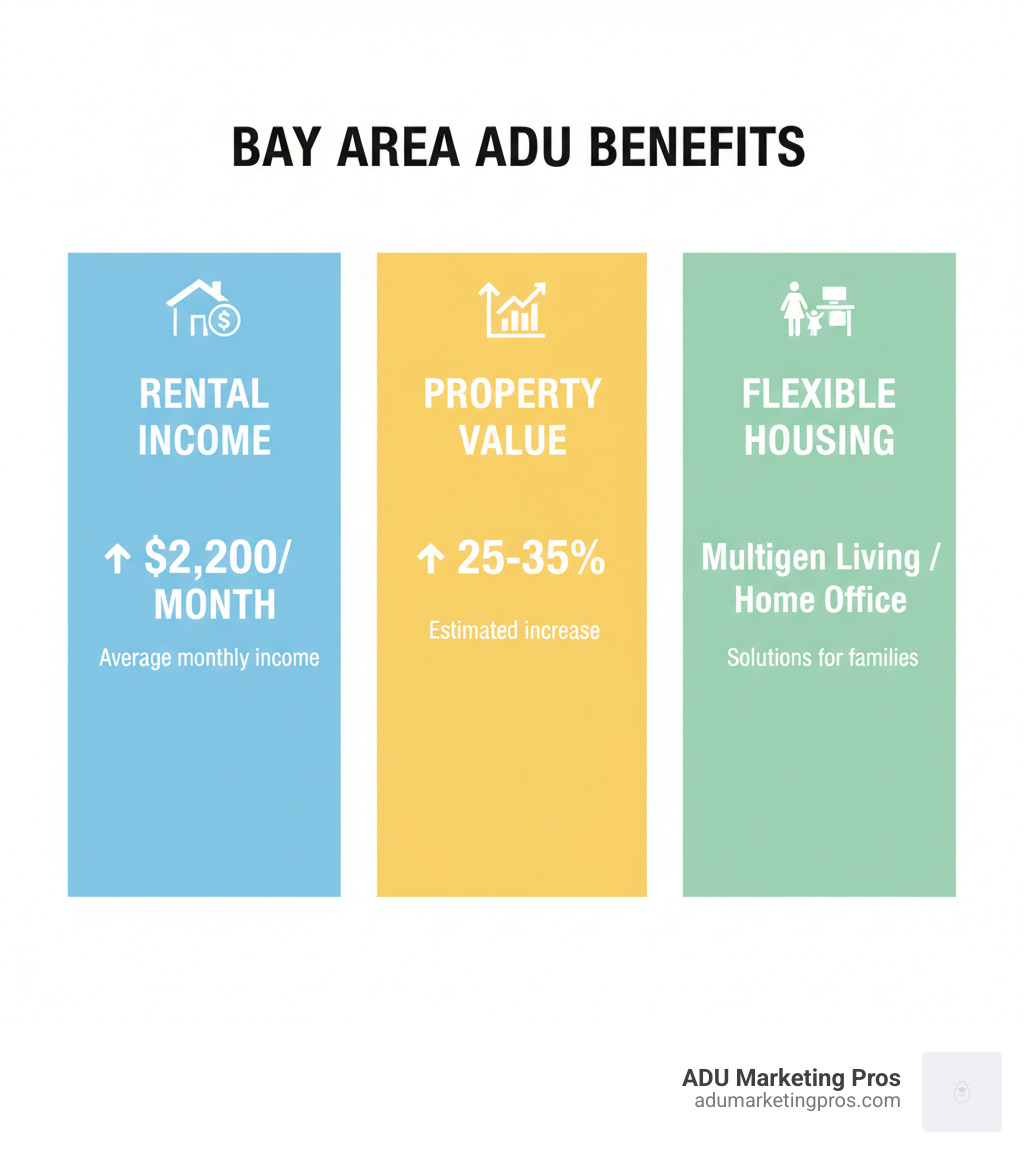
- Rental Income: The most immediate financial gain. According to the UC Berkeley Terner Center, new ADUs in the region generate an average of $2,200 per month. This income can offset mortgage payments and significantly improve a homeowner’s financial picture.
- Property Value Increase: A well-designed ADU can increase property value by 25-35%. It adds functional square footage that is highly valued by future buyers.
- Multigenerational Living: ADUs provide a perfect solution for aging parents or adult children, offering privacy while keeping family close. They allow relatives to live independently without facing the Bay Area’s high rental costs.
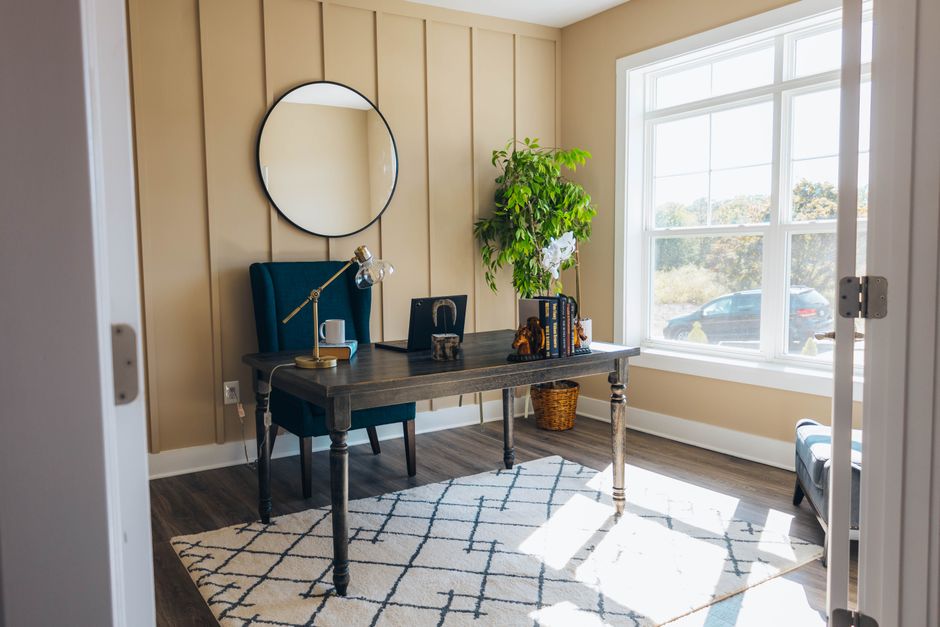
- Flexibility: An ADU can adapt to your changing needs. It can serve as a home office, a guest house, a creative studio, or a rental unit, ensuring your investment remains valuable over time.
Navigating Bay Area ADU Regulations and Restrictions
While state laws have streamlined the process, local rules vary, making it a complex landscape that experienced bay area adu builders steer daily.
- Size Limitations: California allows detached ADUs up to 1,200 square feet, but local rules may differ. The average Bay Area ADU is about 604 square feet. For example, San Francisco ADU guidelines limit studio or one-bedroom units to 850 square feet.
- Setback Requirements: Most jurisdictions now permit 4-foot side and rear setbacks, making it easier to build on smaller lots.
- Parking Waivers: Many cities waive parking requirements for ADUs near public transit, reducing project costs.
- Utility Connections: Separate meters for water, sewer, and electricity are typically required and offer long-term practicality, especially for rentals.
- City-Specific Variations: Each city, from San Jose to Oakland, has unique zoning and permit procedures. For instance, Oakland has specific rules regarding tree protection and creek proximity that can impact site planning. Berkeley has its own Green Building Ordinance that may add requirements to your project. Some cities also have owner-occupancy requirements for either the main house or the ADU, which can affect your long-term rental strategy. This patchwork of regulations makes local expertise from your builder invaluable.
Common ADU Designs and Models
Today’s ADUs go far beyond the “granny flat” concept, with styles to suit any property.
- Detached ADUs: Standalone units offering maximum privacy, ideal for rentals.
- Attached ADUs: Share a wall with the main house, often more cost-effective to build.
- Garage Conversions: A popular option that repurposes an existing structure, saving time and money. This can include converting a portion of the garage while retaining parking space, or a full conversion.
- Above-Garage ADUs: Building a new unit on top of an existing garage can preserve yard space and often provides better views and privacy.
- Basement or Ground-Floor Conversions: Converting an underutilized basement or ground floor of a multi-story home into an ADU is another efficient way to add a unit within the existing structure.
- Junior ADUs (JADUs): The most affordable option, created within the existing home’s footprint and capped at 500 square feet.
- Design Styles: Homeowners can choose from modern designs with clean lines and large windows, traditional styles that match neighborhood character, or fully custom builds for complete personalization.
The ADU Building Process: From Concept to Completion
Building an ADU follows a proven roadmap when guided by experienced bay area adu builders. Understanding the project timeline and the two main construction methods—prefab and stick-built—will help you set clear expectations.
Typical Project Timeline
Most Bay Area ADU projects take 6 to 12 months from start to finish. This timeline is broken into three key phases:
- Design (1-3 months): This initial phase is highly collaborative. You’ll work with designers to create floor plans, 3D renderings, and select materials. Key deliverables from this stage include a comprehensive site plan, architectural drawings, structural engineering calculations, and Title 24 energy compliance reports. Your builder will conduct a thorough site analysis to identify potential challenges like soil conditions, utility access, and property line discrepancies.
- Permitting (3-6 months): This is often the longest and most unpredictable phase. Your builder submits the complete set of construction documents to the local planning and building departments. The plans are reviewed for compliance with zoning, building, fire, and safety codes. Cities may require revisions or additional information, leading to back-and-forth communication. An experienced builder with strong relationships with city officials can navigate this process more efficiently, anticipating common issues and responding to feedback promptly.
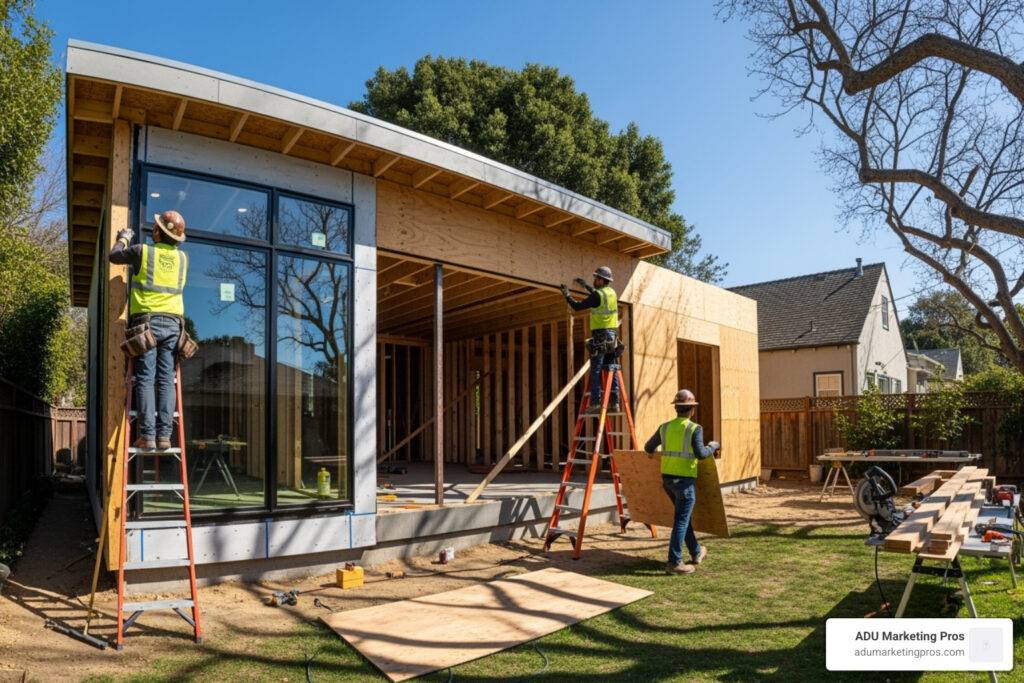
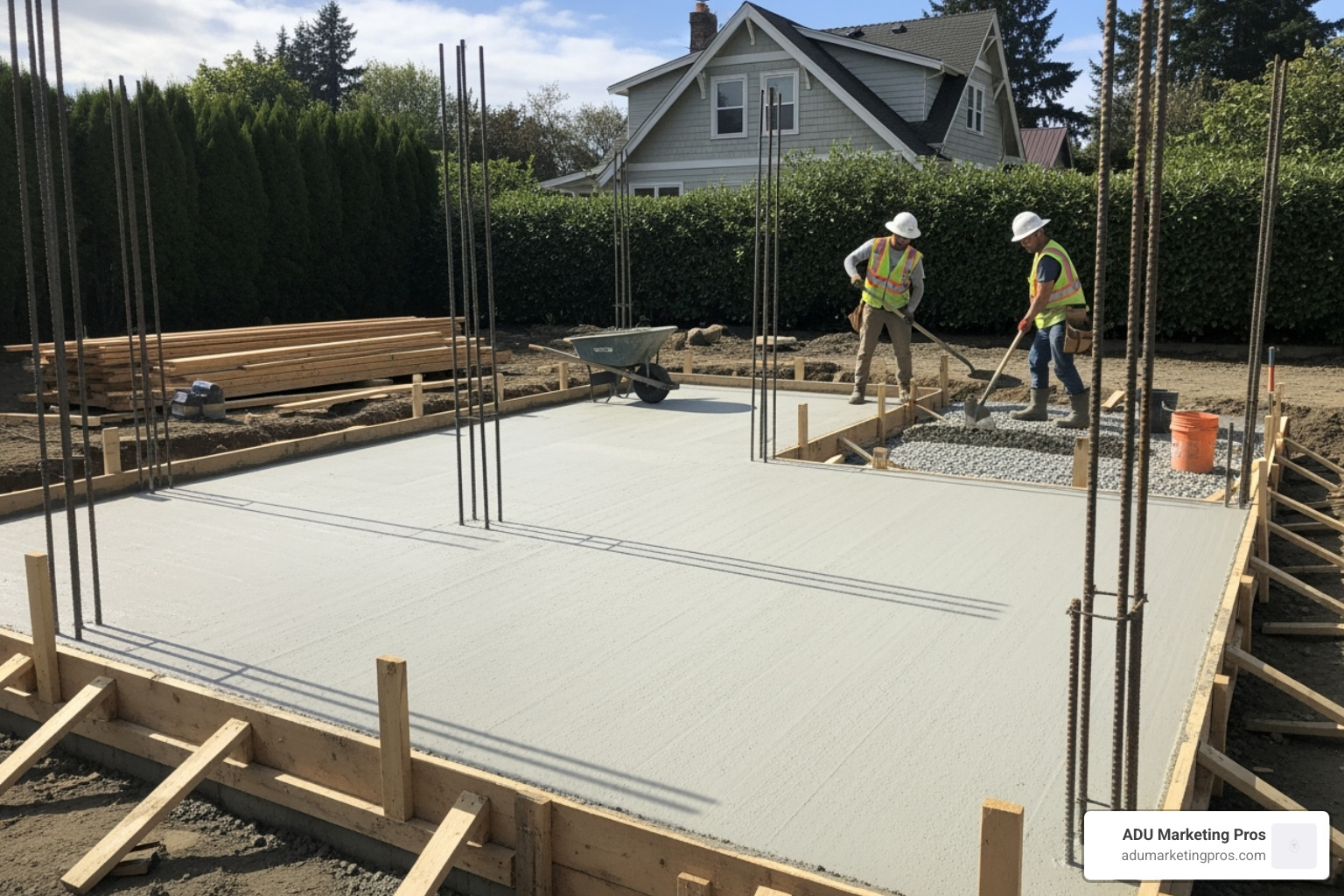
- Construction (3-4 months): Once the permit is issued, the physical build begins. This phase is typically the fastest and includes site preparation and grading, pouring the foundation, framing the structure, installing roofing and windows, running mechanical, electrical, and plumbing (MEP) lines, insulating, hanging drywall, and finally, installing all interior and exterior finishes. An efficient team follows a tight schedule to minimize disruption.
Prefab vs. Stick-Built: Which is Right for You?
One of your biggest decisions is choosing between prefabricated and traditional stick-built construction. The right choice depends on your priorities for speed, budget, and customization.
Prefab ADUs are built in a factory and assembled on-site. This method offers remarkable speed, as factory construction can occur simultaneously with site preparation. It also provides greater cost predictability and minimizes on-site disruption. The main trade-off is less design flexibility, as you’ll work with pre-determined models.
Stick-built ADUs are constructed entirely on your property, offering complete design freedom. This method is ideal for custom architectural details or adapting to challenging sites with slopes or tight access. However, the timeline is longer (9-12+ months), costs can be less predictable, and the on-site disruption is more significant.
| Feature | Prefab ADUs | Stick-Built ADUs |
|---|---|---|
| Average Timeline | 6-9 months (including permits) | 9-12+ months (including permits) |
| Cost Structure | More predictable, often lower per sqft | Can be higher, more prone to overruns |
| Design Flexibility | Limited customization, pre-designed models | High customization, unique architectural designs |
| Site Impact | Minimal, shorter on-site construction | Significant, longer on-site presence |
| Quality Control | Factory controlled, consistent | Site-dependent, variable |
Prefab often suits rental properties, while stick-built is ideal for projects where unique design is a priority.
Decoding the Costs: Budgeting for Your Bay Area ADU
Understanding the financial commitment is a critical step in planning your ADU. While costs vary, a UC Berkeley report places the median cost for a Northern California ADU around $177,500, or $329 per square foot. Your final budget will depend on several key factors.
Key Factors Influencing ADU Costs
- Unit Size: This is the biggest cost driver. While a larger unit costs more overall, the price per square foot often decreases on bigger projects.
- Site Conditions: A flat, accessible lot with nearby utilities is ideal. Sloped properties may require expensive retaining walls and additional foundation work. Difficult site access for machinery and material delivery can increase labor costs. Long utility runs from the main house to the ADU for water, sewer, and power also add significant expense, especially if trenching through concrete or extensive landscaping is required.
- Finish Materials: Your choice of flooring, countertops, fixtures, and appliances gives you great control over the budget. Standard finishes keep costs down, while high-end materials will increase the price.
- Type of Construction: The choice between a stick-built and a prefab ADU can impact the overall cost. While prefab units often have a more predictable and sometimes lower base price, delivery, crane rental, and on-site assembly costs must be factored in. A fully custom stick-built ADU allows for more design flexibility but can have a higher price per square foot and more potential for cost overruns.
- Permit & Hookup Fees: Permit fees vary by city and can range from a few thousand to over $10,000. Utility hookup costs for water, sewer, and electricity can also be substantial. A critical and often overlooked expense is the potential need for a main electrical panel upgrade for the primary residence to support the ADU’s electrical load, which can cost several thousand dollars. Some cities waive impact fees for ADUs under 750 square feet, offering potential savings.
Exploring Your ADU Financing Options
Most homeowners use financing to fund their ADU project. Experienced bay area adu builders can often connect you with lenders who understand ADU construction. Common options include:
- Cash-Out Refinance: This involves replacing your current mortgage with a new, larger one, allowing you to take out the difference in cash. It often provides the lowest interest rates but involves closing costs and resets your mortgage term.
- Home Equity Line of Credit (HELOC): A flexible revolving line of credit based on your home’s equity. You only pay interest on the funds you draw, making it ideal for managing construction payments. However, rates are often variable and can increase over time.
- Construction Loans: These are short-term loans specifically for building projects. Funds are disbursed in stages (draws) as work is completed and verified by an inspector. They typically require conversion to a traditional mortgage upon project completion.
- Renovation Loans: Options like the FHA 203k or Fannie Mae HomeStyle loan allow you to finance the cost of construction based on the home’s after-renovation value. This can be a powerful tool if you have limited existing equity.
- Specialized Lenders: Companies like RenoFi focus on home improvement financing and can be a great resource.
With an average rental income of $2,200 per month, many homeowners find their ADU pays for itself over time while adding significant property value.
How to Choose the Best Bay Area ADU Builders for Your Project
Selecting the right builder is the most critical decision in your ADU journey. You are choosing a partner to guide you through months of complex decisions, permitting, and construction. A great builder ensures a smooth process, while an average one can lead to a stressful experience.
Essential Services to Look for in Top Bay Area ADU Builders
The best bay area adu builders offer comprehensive, integrated services. Look for a firm that acts as a true partner, not just a contractor.
- Turnkey & Design-Build Services: The gold standard is a “one-stop shop” that handles everything from concept to completion. A design-build firm combines architectural design and construction under one roof, which improves communication, accountability, and efficiency.
- Permitting Expertise: Navigating the Bay Area’s complex and varied regulations is a major hurdle. An experienced builder with established relationships at local planning departments can save you time and headaches.
- Dedicated Project Management: A professional project manager is your advocate, coordinating subcontractors, managing the timeline, and providing clear, consistent communication.
- 3D Modeling & Visualization: Modern tools that let you see your ADU before construction begins are invaluable for aligning expectations and making design changes early.
- Post-Construction Warranty: A strong warranty demonstrates a builder’s confidence in their work and gives you peace of mind after the project is complete.
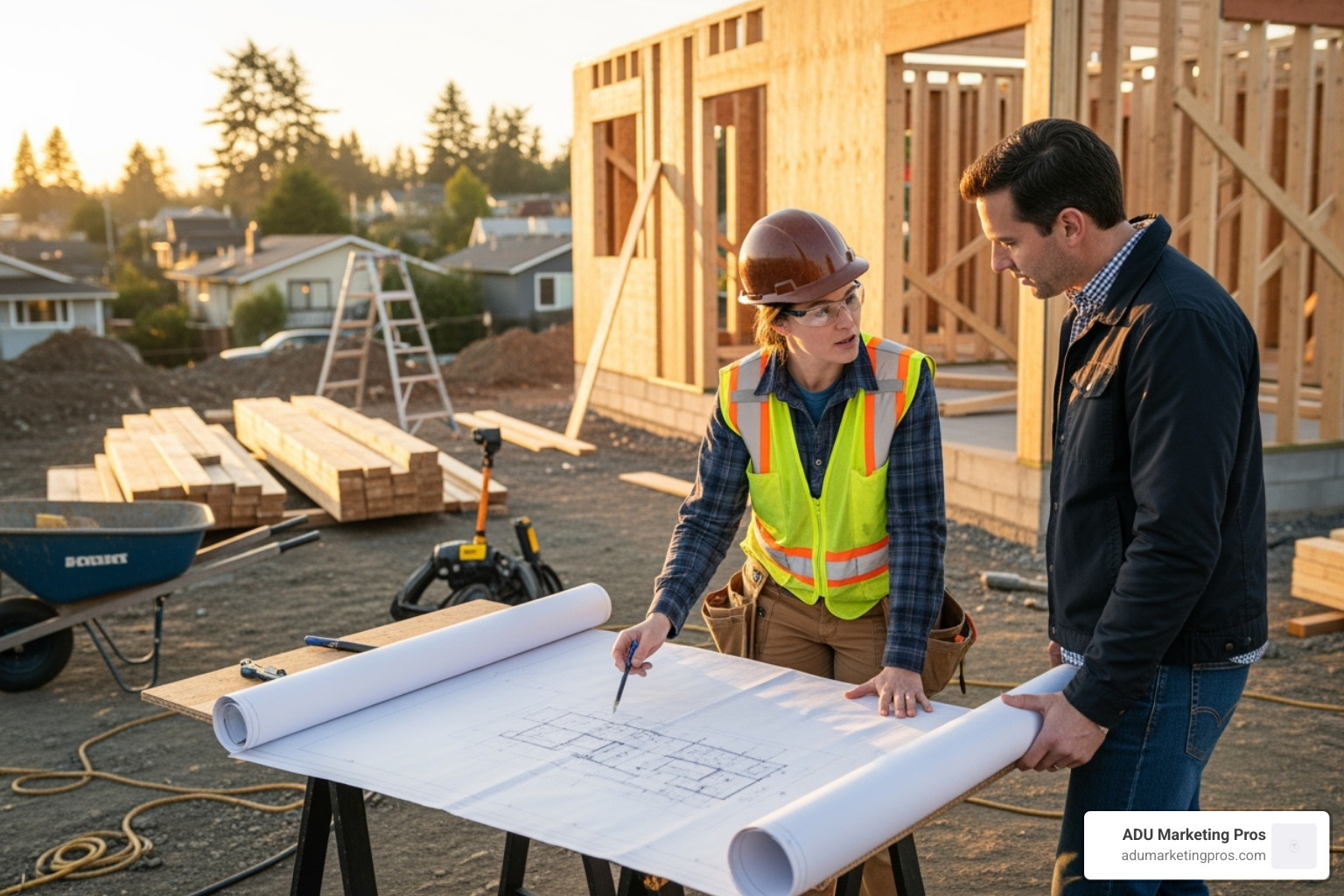
Vetting Potential Bay Area ADU Builders: A Homeowner’s Checklist
Careful due diligence is essential. Use this checklist to evaluate potential builders:
- ADU-Specific Experience: General construction experience is good, but ADU-specific experience is better. Ask how many ADUs they have completed.
- Portfolio Review: Examine their past projects. Do they have a style that matches your vision? Do their ADUs integrate well with the main homes?
- License and Insurance: Verify their CSLB license status on the state website. Ask for current certificates of liability insurance and workers’ compensation. This is non-negotiable protection for you.
- Client Testimonials and References: Read online reviews on platforms like Yelp, Houzz, and Google. But don’t stop there. Ask for a list of recent clients you can speak with directly. Ask them about the builder’s communication, budget management, problem-solving skills, and overall satisfaction with the final product.
- Communication Skills: During your initial consultation, do they listen carefully and explain things clearly? Good communication from the start is a positive sign.
- Understanding of Contracts: Ask for a sample contract and review it carefully. Is it a fixed-price contract, which offers cost certainty, or a cost-plus contract, which can be more flexible but carries a risk of budget overruns? A reputable builder will walk you through their contract and clearly explain all terms, payment schedules, and change order processes.
- Local Expertise: A builder with deep knowledge of your specific city’s rules can be a major advantage. Some cities, like San Jose, even have programs for pre-approved ADU plans that a local expert would know how to leverage.
- Cost Transparency: A reputable builder provides a detailed, itemized estimate that breaks down all anticipated costs, including labor, materials, permits, fees, and a contingency allowance. Be wary of vague, one-page quotes. A transparent bid demonstrates that the builder has thoroughly analyzed your project and is not hiding potential costs.
- Project Management & Technology: Inquire about their project management process. Do they use modern construction management software (like Buildertrend or CoConstruct) to provide you with regular updates, photos, and a clear view of the schedule and budget? This level of organization is a hallmark of a professional firm.
The cheapest bid is rarely the best value. Focus on finding a partner who demonstrates expertise, transparency, and a track record of success.
Frequently Asked Questions about Building an ADU
As you begin your ADU journey, you’ll likely have many questions. Here are answers to some of the most common concerns we hear from homeowners.
How much does an ADU add to property taxes?
Good news: your entire property will not be reassessed. Thanks to Proposition 13, only the value of the new ADU is added to your tax bill. This is called a “blended assessment.” Your main home keeps its existing tax basis, while the ADU is assessed at its current market value. Expect to pay an additional 1-1.5% of the ADU’s value in property taxes annually. For an ADU valued at $200,000, that’s about $2,000-$3,000 per year—an amount often covered by rental income.
Can I build an ADU on a property with an HOA?
Generally, yes. Recent state laws prevent HOAs from unreasonably prohibiting ADUs. However, your HOA can still enforce “reasonable restrictions” regarding design, size, and placement to maintain neighborhood aesthetics. You’ll need to submit your plans for their review, which may add 30-60 days to your timeline. Review your CC&Rs and work with experienced bay area adu builders who are familiar with navigating HOA requirements.
Can I sell my ADU separately from my main house?
In most cases, no. An ADU is legally tied to the main property and cannot be sold separately. However, evolving laws like SB 9 have introduced possibilities for lot splits in some areas, which could potentially allow for a separate sale. This process is complex, varies by city, and is not yet common. For most homeowners, the value of an ADU comes from rental income and the increased value of their entire property, not a separate sale.
Conclusion: Taking the Next Step on Your ADU Journey
Building an ADU in the Bay Area is a powerful investment. It can generate significant rental income, increase your property value, and provide flexible housing for your family. With a median cost of around $177,500 and potential monthly returns of $2,200, the financial case is compelling.
However, success hinges on navigating complex regulations and a multi-stage construction process. This is why choosing the right partner is the most important decision you will make. The expertise of professional Bay Area ADU builders is invaluable for a smooth and successful project.
Find Your Perfect Building Partner
Take the time to vet potential builders thoroughly. Prioritize ADU-specific experience, verify licenses and insurance, review portfolios, and insist on clear communication and cost transparency. The right builder will be a trusted guide, turning your vision into a high-quality, valuable asset.
For ADU construction and architecture firms, connecting with informed homeowners requires standing out in a competitive market. Specialized marketing expertise is key to highlighting your unique value and attracting the right clients.
Learn more about finding the right ADU builder in the San Francisco Bay Area