
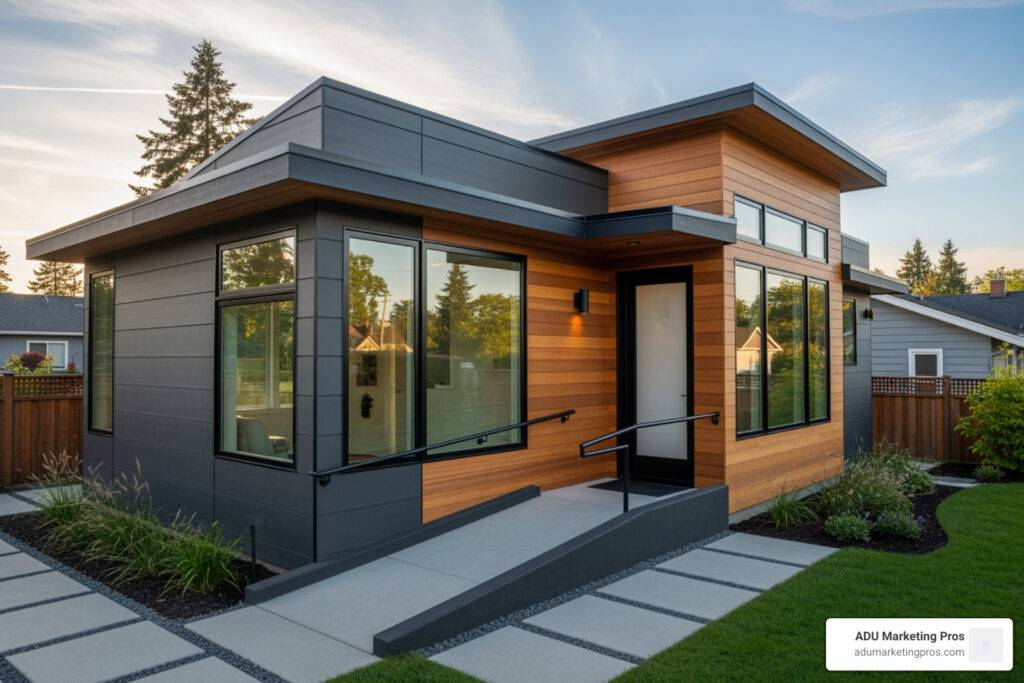
Why an ADA Compliant ADU Is More Than Just a Legal Requirement
An ADA compliant ADU is an accessory dwelling unit designed with accessibility features that meet Americans with Disabilities Act standards, making it safe and usable for people with mobility challenges, seniors, and individuals with disabilities.
Quick Overview: What Makes an ADU ADA Compliant
- No-step entry with ramps or zero-threshold access
- Wide doorways (minimum 32 inches clear width)
- Accessible bathrooms with roll-in showers, grab bars, and adequate turning space
- Wheelchair-friendly kitchens with lower countertops and knee clearance
- Wide hallways (36-42 inches) for easy navigation
- Lever-style handles on doors and faucets
- Non-slip flooring throughout
- Adequate lighting and accessible controls
According to an AARP survey, 67% of adults would consider living in an ADU to be closer to loved ones. As California’s population ages and housing costs continue to climb, more families are finding that building an accessible ADU isn’t just about compliance. It’s about creating a space where aging parents can maintain independence, where family members with disabilities can live comfortably, and where you’re making a smart financial investment that increases your property value by 20-30%.
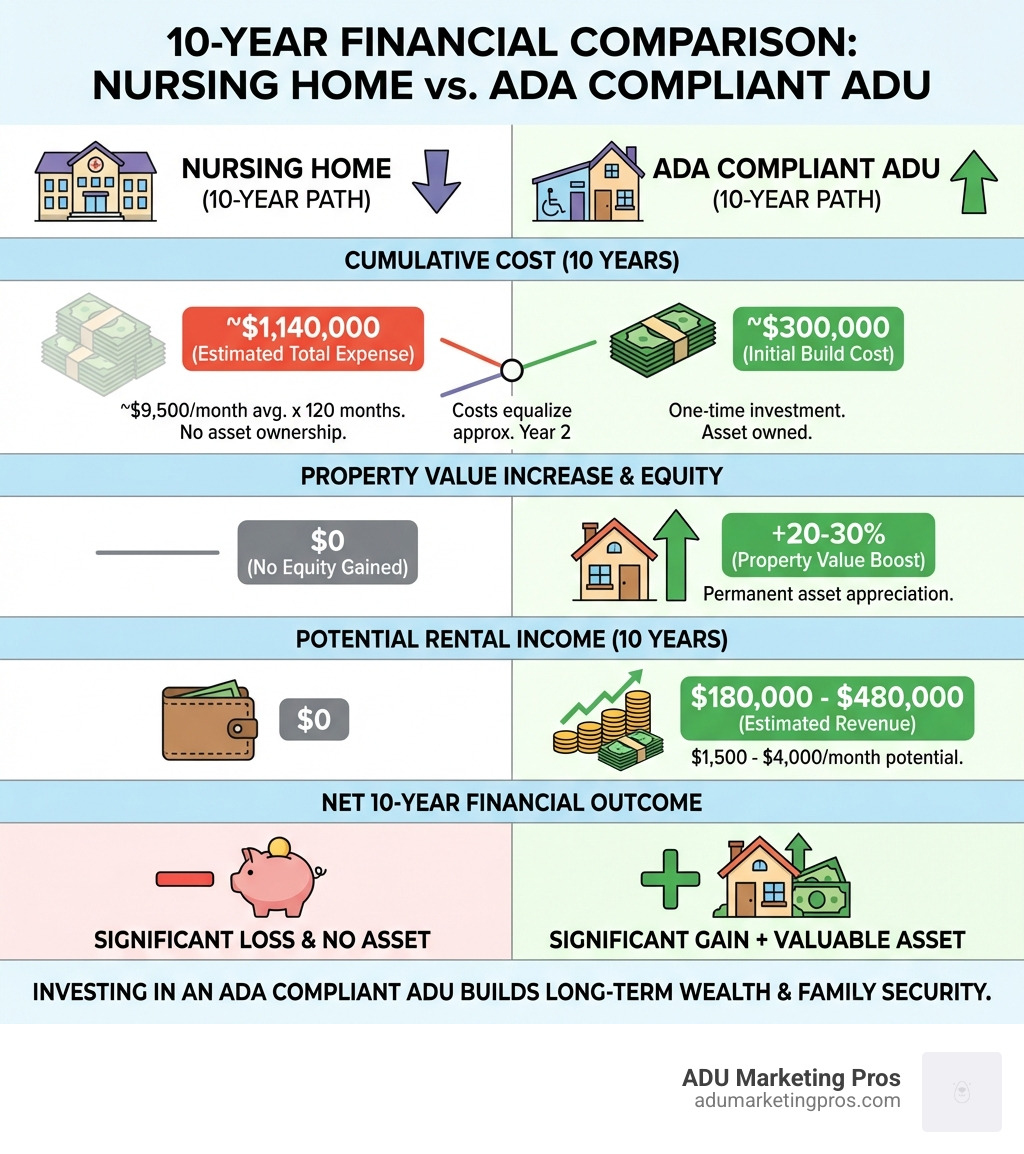
The average nursing home in San Diego costs about $9,500 per month. A typical one-bedroom, one-bathroom ADU costs around $300,000 to build. In under three years, the cost of the ADU can be less than the cumulative cost of a nursing home, but the ADU remains a valuable asset on your property while nursing home payments simply disappear.
Whether you’re planning to house an elderly parent, create a rental unit that serves the growing demand for accessible housing, or simply future-proof your property, understanding accessibility requirements isn’t just about following the rules. It’s about building a space that welcomes everyone and adapts to changing needs over time.
Recent legislative changes in California have made ADU construction easier than ever, with streamlined permitting processes and ministerial approval for most projects. The California ADU Handbook provides comprehensive guidance on state requirements, which often include accessibility standards under Title 24.
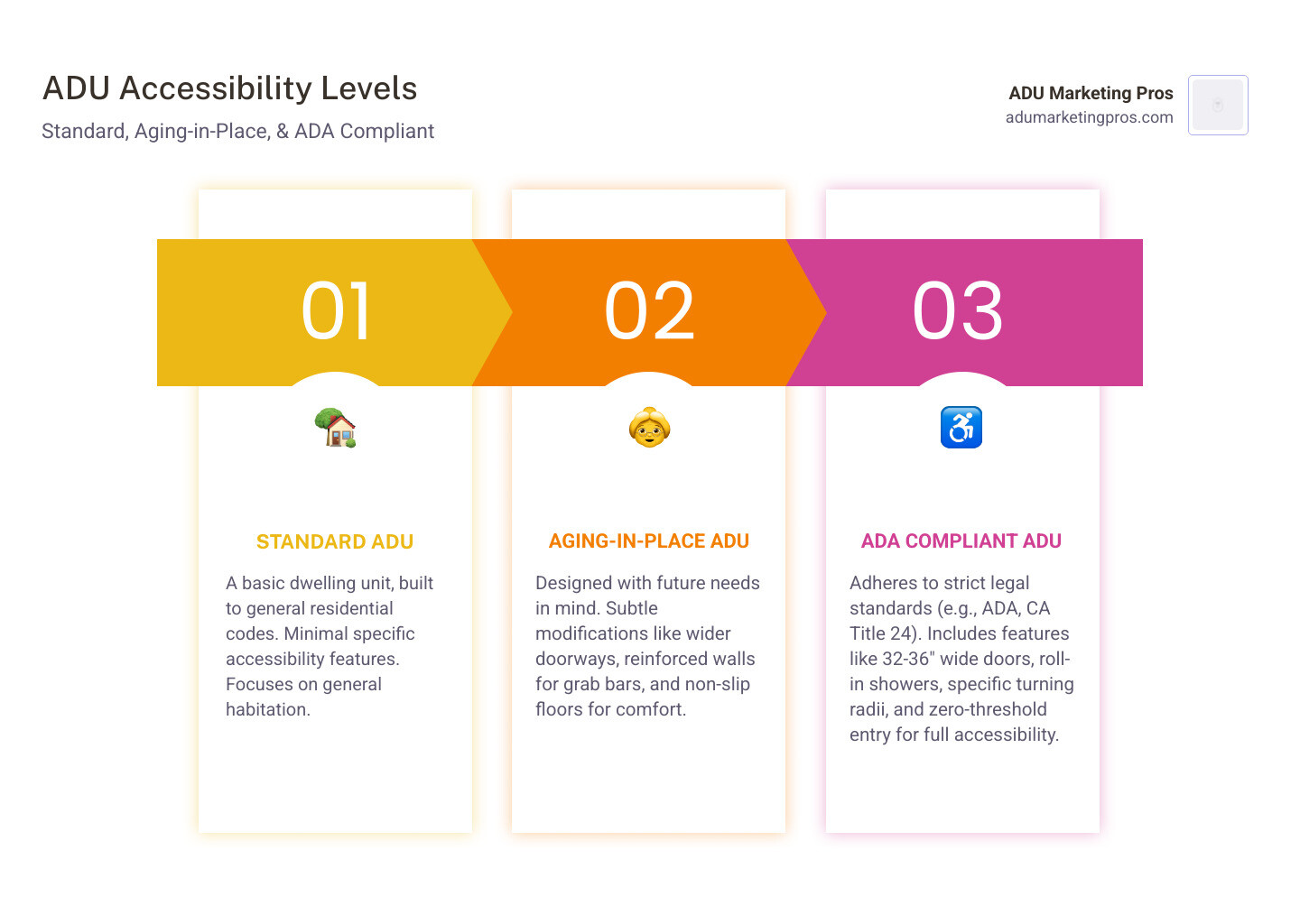
Common ADA compliant ADU vocab:
Why an ADA Compliant ADU is a Smart Investment for Every Homeowner
Building an ADA compliant ADU is more than just a home improvement project; it’s a strategic asset that offers compelling financial, personal, and long-term benefits. We believe it’s one of the smartest investments a homeowner can make in today’s dynamic housing market, especially in competitive areas like San Jose, Los Angeles, and the San Francisco Bay Area.

The Financial Case: Comparing Costs and Long-Term Value
Let’s talk numbers. The decision to build an accessible ADU often comes down to practicality and future planning. Consider the cost of long-term care: the average, middle-of-the-road nursing home in San Diego costs about $9,500 a month. That’s over $114,000 per year, an expense that continues indefinitely without building equity or adding value to your property.
Now, let’s look at an ADU. A typical one-bedroom, one-bathroom ADU generally costs around $300,000 for the entirety of the build, including design, permitting, and construction. While this is a significant upfront investment, the break-even point is surprisingly quick. In just over two and a half years, the cumulative cost of a nursing home ($9,500 x 32 months = $304,000) can exceed the initial investment in an ADU. But here’s the game-changer: after that point, the ADU is a long-term asset that adds significant value to your property, while nursing home payments are a sunk cost.
Adding an ADU can increase your property value by 20% to 30%. Furthermore, if you choose to rent out your accessible ADU, it becomes a powerful income-generating asset. Depending on your location within California, this could bring in $1,500 to $4,000 per month in rental income. For example, in a high-demand area like San Jose or Santa Monica, a well-designed accessible one-bedroom ADU can command rents at the higher end of that range, potentially exceeding $3,500 per month. In other areas like Sacramento or parts of San Diego County, rents might be closer to the $2,000-$2,500 range. This income can be used to pay off the construction loan, cover property taxes, or simply provide a new stream of revenue, offering a far more robust financial return than traditional care options.
Beyond the Bottom Line: The Human Benefits of Accessible Design
While the financial benefits are substantial, the human element of an accessible ADU is truly invaluable. Designing an ADU with accessibility in mind allows elderly family members to age in place with dignity and independence, often just steps away from their loved ones. This multigenerational living setup is increasingly popular; an AARP survey indicates that 67% of adults would consider living in an ADU to be closer to family.
Imagine the peace of mind knowing your parents or family members with disabilities are safe, comfortable, and independent in their own space, yet close enough for daily connection and support. This improved safety and comfort is a cornerstone of accessible design. For example, a successful accessible ADU in Palo Alto was specifically designed to accommodate an elderly parent. It featured wide doorways, a roll-in shower, and a wheelchair-friendly kitchen layout, enabling them to maintain their autonomy. Similarly, in Orange County, cities like Irvine and Santa Ana have seen an increase in accessible ADU construction, with local builders incorporating features like ramps, grab bars, and accessible appliances to meet the growing demand for inclusive living spaces. These real-life examples underscore the profound impact accessible design has on quality of life, fostering stronger family bonds and providing a flexible living solution for evolving needs.
The Blueprint for Accessibility: Essential Features of an ADA Compliant ADU
Creating an ADA compliant ADU requires careful planning and attention to specific design elements that go beyond standard construction. It’s about ensuring every detail contributes to a safe, comfortable, and fully functional space for individuals with varying mobility needs. This section details the essential features, moving from the exterior approach to the interior specifics of key rooms.
From the Outside In: Entryways and Circulation Paths
The journey to an accessible ADU begins before you even step inside. A no-step entry is paramount, whether achieved through a seamless grade transition or properly designed ramps. If ramps are necessary, they must meet specific slope and landing requirements for safe wheelchair access. Once inside, interior circulation paths are critical. We recommend a minimum clear width of 32 inches for doorways, though 36 inches provides even greater ease, especially for power wheelchairs or those assisting others. Hallways should be 36-42 inches wide to allow for comfortable navigation and turning.
For ease of use, lever-style handles on all doors are a must, as they require less grip strength than traditional knobs. Finally, selecting non-slip flooring throughout the ADU helps prevent falls, a simple yet vital safety feature. Adhering to these standards, often guided by California’s Title 24 accessibility requirements, ensures a truly barrier-free environment. For more detailed state-specific guidelines, always consult the California ADU Handbook.
The Heart of the Home: Designing an Accessible Kitchen
The kitchen in an ADA compliant ADU must be designed for functionality and independence. Key considerations include:
- Countertop Height: Incorporate multi-level countertops. While a standard section can remain at 36 inches, a dedicated workspace lowered to 30-34 inches with proper knee clearance is essential for seated users.
- Knee Clearance: Ensure ample knee clearance (at least 27 inches high, 30 inches wide, and 19 inches deep) under sinks and preparation areas, allowing individuals to roll under comfortably.
- Accessible Appliances: Look for appliances with front controls for easy reach. Side-hinged wall ovens, drawer-style dishwashers and microwaves, and induction cooktops with clear touch controls are excellent choices.
- Smart Storage: Maximize storage accessibility with pull-out shelves, pull-down upper cabinet systems, and lazy susans in corner cabinets. This minimizes reaching and straining.
- Turning Radius: A 60-inch diameter clear floor space is often required in kitchens to allow for a full 360-degree turn in a wheelchair.
Safety and Comfort: Creating a Fully Accessible Bathroom
An accessible bathroom is arguably the most critical area in an ADA compliant ADU. Here, safety and ease of use are paramount:
- Roll-in or Curbless Showers: These eliminate barriers, allowing wheelchair users to roll directly in. A sleek trench drain along one wall helps maintain a consistent floor level. Include a built-in or fold-down shower bench and a handheld, adjustable-height showerhead.
- Grab Bar Reinforcement: While grab bars may not be installed immediately, reinforcing walls with solid wood blocking during construction is non-negotiable. This allows for secure installation next to the toilet, in the shower, and along any transfer paths.
- Accessible Toilet Height: Toilets should be comfort-height (17-19 inches from floor to top of seat) for easier transfer. Consider models with integrated bidet functions for enhanced hygiene and independence.
- Roll-Under Sinks: A wall-mounted or console sink with open space underneath allows a wheelchair user to roll under comfortably. Ensure pipes are insulated to prevent burns.
- Lever-Handled Faucets: Single-handle, lever-style or touchless faucets are easier to operate than knobs that require twisting.
- Turning Radius: A 60-inch diameter clear floor space is essential in the bathroom for wheelchair maneuverability, clear of any door swings or fixtures.
Lighting and Electrical Controls
Proper lighting and accessible controls are crucial for safety and usability. Incorporate a layered lighting plan with ambient overhead lights, task lighting over counters and sinks, and low-level nightlights. Use rocker-style light switches, which can be operated with an elbow or closed fist, and place them and electrical outlets at an accessible height (generally between 15 and 48 inches from the floor). Smart, voice-activated lighting can offer an even greater level of convenience and independence.
Navigating the Process: From Zoning Laws to Financial Aid
Starting on an accessible ADU project can seem daunting, but with the right information and team, it’s a smooth journey. We’ll guide you through the practical, logistical steps, from understanding local regulations to securing funding and assembling your dream team.
Understanding Local Laws and Your ADA Compliant ADU
Navigating the legal landscape for ADUs can be complex, especially with varying state and local regulations. In California, recent legislation has significantly streamlined the ADU permitting process. The state generally mandates ministerial approval for ADU applications, meaning if your plans meet objective standards, they must be approved without discretionary action. This is a huge win for homeowners in places like Los Angeles, San Jose, and the broader San Francisco Bay Area.
However, it’s crucial to understand that while state law sets the baseline, local zoning requirements still dictate property-specific details like setbacks and height limits. For instance, the Los Angeles Department of Building and Safety (LADBS) offers a Standard Plan Program designed to expedite permits for pre-approved ADU designs. You can find more information on their LADBS ADU page.
Homeowners Associations (HOAs) can also present challenges, but California law is clear: HOAs cannot prohibit or unreasonably restrict the construction or use of an ADU or JADU. If you encounter such restrictions, contacting your local agency or seeking legal counsel is advisable. Cities like Irvine and Santa Ana in Orange County also provide specific ADU information, and it’s always a good idea to check your specific city’s planning department website for local nuances, such as the City of Irvine ADU information.
Budgeting and Funding Your Accessible ADU Project
The cost of building an accessible ADU can vary widely, often ranging from $200,000 to over $400,000, depending on its size, location, and the specific accessibility features you integrate. This is a significant investment, but various avenues can help manage the costs. Common financing options include a home equity loan or line of credit (HELOC), a cash-out refinance of your primary mortgage, or a dedicated construction loan. Some lenders also offer renovation loans, like the FHA 203(k) loan, which can bundle the cost of construction and the property purchase.
Furthermore, it’s worth researching specific grants and programs. For eligible veterans, the Department of Veterans Affairs offers Specially Adapted Housing (SAH) grants, which can provide significant funds to build or modify a home for accessibility. While other grants vary by location and availability, it’s worth researching your state’s Department of Housing and Community Development (HCD) and local disability services offices. Programs like the CalHome Program or Permanent Local Housing Allocation (PLHA) are designed to support housing development and affordability, and an accessible ADU may align with their goals.
The Dream Team: Assembling Professionals for Your Project
Building an ADA compliant ADU is a specialized endeavor, and having the right team is paramount. We recommend working with professionals who have a proven track record in accessible design.
- Architects: Look for architects with Certified Access Specialist (CASp) credentials or expertise in universal design principles and a deep understanding of California’s accessibility codes (like Title 24). They can seamlessly integrate features without compromising aesthetics.
- Contractors: Choose contractors who have experience building accessible homes. When vetting them, ask to see a portfolio of completed accessible projects and speak with past clients about their experience. Ask how they ensure compliance with details like grab bar reinforcement and proper clearances.
- Accessibility Specialists: Collaborating with an accessibility consultant or an occupational therapist can provide invaluable insights into specific needs, ensuring the ADU is custom for maximum usability and independence. This is especially important if the ADU is being built for a specific family member.
Vetting these professionals means asking for portfolios of accessible projects, checking references, and ensuring they are knowledgeable about local regulations in your area, be it San Francisco, Sunnyvale, or Menlo Park.
Future-Forward Living: Universal Design and Smart Technology
Designing an ADA compliant ADU isn’t just about meeting minimum requirements; it’s about embracing a philosophy that benefits everyone. By incorporating universal design principles and smart technology, we can create spaces that are not only accessible but also incredibly convenient and adaptable for future needs.
Universal Design: Creating a Home for Everyone
Universal design is the concept of creating environments and products that are usable by all people, to the greatest extent possible, without the need for adaptation or specialized design. It’s about designing proactively, ensuring that an ADU is inherently flexible and functional, regardless of age, size, or ability.
Key principles include:
- Equitable Use: Design is useful and marketable to people with diverse abilities.
- Flexibility in Use: Design accommodates a wide range of individual preferences and abilities.
- Simple and Intuitive Use: Use of the design is easy to understand, regardless of the user’s experience, knowledge, language skills, or concentration level.
- Perceptible Information: The design communicates necessary information effectively to the user.
- Tolerance for Error: The design minimizes hazards and the adverse consequences of accidental or unintended actions.
- Low Physical Effort: The design can be used efficiently and comfortably with a minimum of fatigue.
- Size and Space for Approach and Use: Appropriate size and space are provided for approach, reach, manipulation, and use regardless of user’s body size, posture, or mobility.
By integrating universal design from the outset, your ADA compliant ADU becomes a truly future-proof investment, ready to adapt to changing family needs or appeal to a broader market of renters seeking inclusive living spaces.
Integrating Smart Technology for Improved Accessibility
Technology plays an increasingly vital role in enhancing accessibility and convenience within modern homes. For an ADA compliant ADU, integrating smart home features can significantly improve the quality of life for its occupants.
- Voice-Activated Controls: Systems like Amazon Alexa or Google Home can control lighting, thermostats, entertainment, and even open/close blinds, all through simple voice commands.
- Automated Doors: Motion-activated or remote-controlled doors can eliminate physical barriers.
- Smart Appliances: Ovens that can be preheated remotely, refrigerators that alert you when food is low, or washing machines with accessible interfaces.
- Emergency Alert Systems: Wearable devices or strategically placed buttons can instantly connect occupants to caregivers or emergency services.
- Remote Monitoring: For caregivers, smart cameras or sensors can provide peace of mind without intruding on privacy, allowing for discreet check-ins.
These technological integrations not only improve usability but also contribute to a greater sense of independence and security, making the ADU a truly intelligent and accessible living space.
Case Studies: A Look at a Successful ADA Compliant ADU
Real-life examples best illustrate the power of accessible ADU design. As mentioned earlier, a family in Palo Alto successfully designed an ADU for an aging parent, incorporating features like wide doorways, a roll-in shower, and a wheelchair-friendly kitchen. This allowed the parent to live independently while remaining close to family, highlighting the emotional and practical benefits.
In Orange County cities like Santa Ana and Irvine, local builders are actively responding to the demand for inclusive living spaces. They’re incorporating essential features such as ramps, grab bars, and accessible appliances into new ADU constructions. This proactive approach ensures that these ADUs are not just compliant, but truly improve the quality of life for residents with mobility needs. For more details on local initiatives, you can visit the City of Santa Ana’s website. These case studies demonstrate that with thoughtful design and the right professionals, an ADA compliant ADU can be both functional and fabulous.
Frequently Asked Questions about ADA Compliant ADUs
What is the main difference between ‘aging in place’ design and a fully ADA compliant ADU?
Aging in place design focuses on subtle modifications and proactive measures to make a home comfortable and safe as occupants grow older. This might include reinforcing walls for future grab bar installation, installing lever handles, or ensuring a single-level layout. It’s about anticipating future needs. Full ADA compliant ADU design, on the other hand, adheres to strict, legally defined measurements and specifications for dimensions, clearances, and features (like turning radii and specific grab bar placement). It aims to provide immediate, full accessibility for a wide range of disabilities, which is a best practice for maximum usability and independence. While aging in place designs are beneficial, an ADA compliant ADU offers a higher, more rigorously defined standard of accessibility.
How much more does an ADA compliant ADU cost?
The cost of building an ADA compliant ADU can vary significantly based on size, location (e.g., San Diego vs. San Francisco Bay Area), and the extent of specific accessibility features implemented. While total project costs can range from $200,000 to over $400,000, a typical one-bedroom unit often lands around the $300,000 mark. While this might be a higher initial investment than a basic ADU, it often pays off in the long run by eliminating future renovation costs, increasing property value, and opening up rental opportunities to a wider market seeking accessible housing.
Do I need an ADA compliant ADU if it’s just for my family?
While the federal Americans with Disabilities Act (ADA) primarily applies to public accommodations and commercial facilities, not typically private single-family homes, many state and local building codes, like California’s Title 24, do include accessibility requirements for new construction and significant remodels, including ADUs. Even if not legally mandated for your specific private use case, designing an ADA compliant ADU is a best practice for several reasons: it ensures the safety and comfort of all occupants, future-proofs your property for potential changing family needs (e.g., aging parents or a family member acquiring a disability), and significantly increases its market value and rental appeal. It’s about building a space that is truly usable for anyone, at any stage of life, making it a wise and compassionate choice.
Conclusion: Build a Better Future with an Accessible ADU
Building an ADA compliant ADU is more than just a construction project; it’s a profound investment in the future – your family’s, your property’s, and your community’s. It’s a compassionate choice that prioritizes dignity, independence, and comfort for everyone, regardless of their physical abilities.
We’ve explored the compelling financial value, from significant property appreciation and potential rental income to the long-term savings compared to traditional care options. We’ve also highlighted the invaluable human benefits: fostering closer family bonds, enabling loved ones to age in place with grace, and ensuring a safe, inclusive environment for all. By embracing universal design principles and integrating smart technology, you’re not just building a dwelling; you’re creating a flexible, intelligent, and welcoming home that adapts as needs evolve.
For ADU builders and architects looking to market their expertise in accessible design, ADU Marketing Pros can help you connect with homeowners who value quality and inclusivity. We specialize in helping firms like yours stand out in competitive markets across California, from Los Angeles to San Jose, by focusing on your unique strengths.
Ready to explore how an accessible ADU can transform your property and your life?